Sunday, April 13, 2025

ESSAY

2028 Will Be Our Last, Best Hope to Propel a Real Leftist to the Top of the Democratic Ticket

As the mainstream Democrats sink in popularity and their base demands change, It’s critical that the left unites, well ahead of schedule, behind one, single candidate.
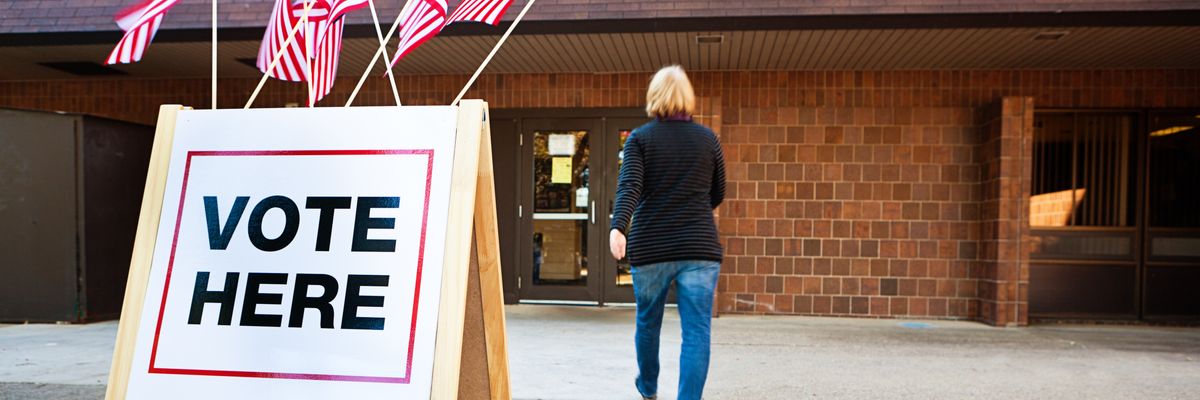

An unidentifiable woman voter enters a voting polling place for a USA government election.
(Photo: Getty Images)


Sam Rosenthal
Apr 11, 2025
Common Dreams


Imagine, if you will, the United States on January 1, 2028. President Donald Trump and his gang of MAGA goons have been drawing from the well of right-wing nativism for the past three years, generating spectacle after spectacle without managing to improve material circumstances for any but the wealthiest Americans. That well has now run dry, and the American public is getting restless. The United States has repeatedly skirted the edge of an economic recession; inflation remains high and unemployment is ticking up. The malaise of stagflation pervades every aspect of American life. Eggs and milk prices remain high, the stock market hasn’t really rallied again since the GOP pushed through its latest cut on taxes for the wealthy, and the big ticket items—homes, vehicles, education—are all more expensive than when Trump first took office, for the second time.

Amidst the chaos, Democrats have kicked their campaigning into high gear, with primary season nearly upon them. This is a primary without an heir apparent, and every Democrat within arm’s reach of a well-funded PAC has thrown their hat into the ring. At the top of the list are familiar names like Gavin Newsom, full of “I feel your pain” empathy for the right and spite for the left. He’s spent the second Trump administration honing his performance of antipathy for progressive social issues and rubbing elbows with the right-wing glitterati. Now he’s ready to convert on his “moderate” bona fides. There’s also Pete Buttigieg, here to remind us that no planes crashed on his watch as Transportation Secretary. Amy Klobuchar is back too although no one, including herself, can articulate exactly why.

Since the resurgence of the New New Left in the last decade, there has never been a wider gulf between the appeal of left-wing politicians and distaste for the Democratic Party establishment.

Despite the typical pomp that attends any party primary season, this campaign looks different than those in recent memory. For the first time in 12 years, more than a decade, Democrats do not have Donald Trump to run against. Whoever the Republican primary process churns out will surely promise to continue whatever erosion of democracy and civil rights Trump has accomplished in his second term. But that nominee is unlikely to carry the same boogeyman-like narrative weight that Trump has wielded to captivate the media for years. Democrats, then, will face a disconcerting prospect: They must run with a positive, projective vision for the country.


What Do the Democrats Believe?


Over the last few election cycles, the Democratic Party has struggled to present a cohesive vision of what it stands for in the 21st century. This is partly due to Donald Trump; the party has, in some sense, overdeveloped its anti-Trump messaging while neglecting the rest of its platform, like a tennis player with an oversized racket arm. Democrats have been saved from having to more carefully cultivate policy messaging because, for the last three cycles, they have simply run as the opposition to Donald Trump. This strategy has a 33% success rate.

The platform problems go much deeper than this, though. The party’s multi-decade pivot away from working class voters toward suburban, college-educated ones has failed to grow a winning coalition for the Democrats. It has, though, paralyzed the party on policy questions relating to income inequality and redistribution of wealth, arguably the most pressing of our present moment. The party cannot serve the interests of wealthy and upper-middle income suburbanites and the working class, simultaneously. Instead of striving to resolve this tension, the party has grasped at social issues in an attempt to trail the prevailing popular opinion of the moment. Where the party was “woke” and all in on ameliorating issues of racial injustice in 2020, just a few years later, some of the most prominent Democrats have joined right-wing Republicans in attacking trans people and migrants.

All this vacillation has run the party aground. Recent polling reveals that the party has reached its lowest point in popularity in at least the last three decades. Constituents do not trust congressional Democrats to stand up to Donald Trump and the GOP. We are only a few months into Donald Trump’s second term, and the Democratic Party already appears to be out of ideas. Leadership is at pains to point out how hamstrung they are by their minority positions in the House and Senate, but they have so far shrunk from any opportunity to use leverage they have against the Trump administration.

The last few months have made two things about the Democratic Party and its supporters abundantly clear: First, there is a real appetite among the party’s constituents to take a radically new tack in combatting Trumpism and, second, there is no inclination among party leadership to do so.

2028 Will Be the Left’s Best Opportunity

Against this backdrop, left electeds and candidates are once again garnering attention and enthusiasm. Sen. Bernie Sanders (I-Vt.) and Rep. Alexandria Ocasio-Cortez (D-N.Y.) have drawn crowds of tens of thousands for their “Fighting Oligarchy” tour, an astounding turnout in an off-election year for two politicians already firmly entrenched in their respective seats. Elsewhere, Zohran Mamdani, the democratic socialist running for mayor of New York City, has surged to take second place in recent polling, trailing only the disgraced, but universally known, Andrew Cuomo. Mamdani’s fundraising has been so robust that he recently implored would-be donors to canvass for him instead, becoming likely the only U.S. candidate for office ever to ask people to stop sending money.

Sanders and Ocasio-Cortez are the most well-known representatives of the left within the sphere of electoral politics. That they are driving massive turnout to their rallies amidst Democrats’ cratering popularity is a testament not just to the durability of their individual fandoms but to the appeal of left policy as well. (It’s also worth recalling that Sanders has long enjoyed some of the highest favorability ratings of any living U.S. politician.) Since the resurgence of the New New Left in the last decade, there has never been a wider gulf between the appeal of left-wing politicians and distaste for the Democratic Party establishment. This is why it’s critical for the left to seize on this imbalance well ahead of 2028.

A Path to Winning the Nomination in 2028


Since its resurgence in 2016, the left has now had the opportunity to observe the primary process (or lack thereof) in three presidential cycles. We should no longer harbor any illusions about how stridently the corporatist wing of the party will oppose a left candidate who appears poised to grab the Democratic nomination. Therefore, it’s critical that the left unites, well ahead of schedule, behind one, single candidate.

Established practice recommends that candidates wait until at least after the dust from the midterm elections has settled. However, the risks to a left candidate declaring before this point are minimal—if Republicans further cement their hold on Congress, it’s proof of the ineptitude of the current party leadership; if Democrats make advances, that’s evidence that the electorate (still) desires change. It’s true that a declaration of intent so far out from the primary contest would be a radical departure from the established modus operandi. But what would a left candidate actually lose in making their intentions known so early? For an established name it would give that person runway to flesh out their platform and expand on their existing base of supporters; for an up-and-comer, it would allow enough time for that person to introduce themselves to the American public and drive up their name recognition. In the era of total digital saturation, media could be had easily—and cheaply—via an infinite number of social media platforms, podcasts, YouTube channels, and so on.

Despite the fierce headwinds a left candidate is sure to face from the party leaders, the left does have one significant advantage: we already have an established political program. Whereas the Kamala Harris campaign was characterized by its almost total lack of prescriptive policy, a left candidate has a tested-and-true platform to run on. The basic tenets of this platform were established by the Sanders presidential campaigns in 2016 and 2020 and have been elaborated on through a series of federal, state, and local campaigns over the ensuing years. They have also been informed by the social movement struggles of the last decade, beginning especially with the Black Lives Matter uprisings after George Floyd’s murder and continuing through the ongoing Cease-Fire Now protests over U.S. complicity in the genocide in Gaza.

While individual candidates may riff on this platform a bit, there are some established, bedrock policies that should form the basis of any left campaign. These include support for single-payer, universal healthcare; acknowledgment that climate change is a real, existential threat; and efforts to massively expand union membership, including installing a radically pro-worker National Labor Relations Board. Also critical will be an immigration approach that ends mass deportations, a policy that is quickly coming to define the second Trump administration. In the realm of foreign policy, a left candidate for president would commit to ending arms sales to Israel and putting the U.S.’ diplomatic weight behind an immediate end to any military action against the Palestinian people. The left flank of the party should be prepared to line up behind the candidate who best represents this platform in 2028.


The Prospects


So, where will we find a perfect tribune of the left? Well, we won’t. The key is simply to find a candidate with enough mass appeal to corral the various left constituencies who will need to back the primary campaign. There are a few places to look for such a person:
The Traditional Route

The most obvious place to go looking for this candidate is among already-established career politicians. The advantages to this approach are obvious: These are people who already know how to run campaigns, have large pools of current and former staffers from whom they could build a campaign team, and have long-running connections with members of the political fundraising ecosystem. The startup costs for a member of this group would be substantially less significant than for an outsider.

The names in contention here are well-known among left politicos. Above the title is, of course, Ocasio-Cortez, who has dominated the progressive Democrat sphere since her shock win over Joe Crowley in 2018. AOC, if she entered the race, would be a formidable frontrunner. Recent surveys have shown that a plurality of Americans already believe her to be the de facto leader of the party, ahead of even Kamala Harris. She has also transformed into one of the party’s strongest fundraisers, a critical component of any successful campaign for president. And, she would be just 38 as the primary season kicked off in 2028, and 39 if she were elected, making her easily the youngest person ever elected to the presidency. Comparatively young candidates have easily capitalized on their youth to brand themselves as change candidates in the past, which is likely to be an especially compelling narrative as the then-81 year old Trump presides over his waning days in office.

The left best serves corporatist Democrats when we descend into internecine squabbles and leave the door open for multiple entrants to claim the “progressive” mantle.

AOC has her detractors as well, of course. Her occasionally uneasy relationship with parts of the left has sometimes destabilized her relationship with what would otherwise be her core constituency. As with Sanders in 2016 and 2020, though, it’s likely that a real attempt by Ocasio-Cortez to seize the Democratic nomination would rally many on the left as the prospect of installing a veteran of left-progressivism in the White House would prove too enticing to pass up.

Less well-known nationally in this group, but perhaps more serious about running in 2028, is Ro Khanna, representative from California. Khanna has built many of his progressive bona fides on being the Big Tech-whisperer of the left, someone who can harness the energy of Silicon Valley for good, not evil. (Khanna represents the district that includes much of Silicon Valley; it is the nation’s wealthiest Congressional district.) As such, he has been a strong advocate for digital privacy rights, an issue that is sure to have increasing salience amidst the destruction of personal privacy which the so-called “Department” of Government Efficiency (DOGE) is currently instituting.

But, Khanna has also taken stances that are more controversial among leftists. In the weeks before Trump’s inauguration, Khanna wrote favorably about DOGE, giving fuel to the idea that he is too close to Silicon Valley and its technocrats. He also raised leftists’ ire over his ties to Hindu nationalists and for lobbying for Indian Prime Minister Narendra Modi, who is a member with the far-right BJP, to address Congress in 2023.

A problem for both Ocasio-Cortez and Khanna is that, if they were to move directly from the House of Representatives to the presidency, they would be the first to do so since James Garfield, in 1880. This isn’t to say that it’s impossible for any candidate to make this jump, just that, over the last century and a half, more presidents have come straight from the ranks of television show hosts than they have from the U.S. House of Representatives.

Labor and Its Allies


A middle ground between recruiting a candidate through the political establishment and a more radical departure from the norm could be to turn to organized labor. Democrats have long counted union members among their most reliable constituencies (although there is some evidence that that association is weakening). Approval for labor unions is also at a high point since the mid-1960s, and labor leaders are becoming more prominent members of the political commentariat, if not quite yet household names.

Most visible among this group is probably Shawn Fain, the president of the United Auto Workers (UAW) since 2023. Fain was one of Trump’s most vocal critics during the presidential campaign, but has substantially moderated his approach toward Trump in the months since the election and has even spoken approvingly of Trump’s tariff policy.

While his occasionally conciliatory attitude toward the Trump administration may rankle some on the left, Fain’s unorthodox approach to the administration may work in his favor. He could use his unique politics to avoid being cleanly labeled as either a Republican or Democrat, and lead with his “pro-worker” brand instead.

Sara Nelson would be another strong contender from the world of labor. Nelson, who has been president of the Association of Flight Attendants since 2014, has been among the most visible and militant labor leaders of the last 10 years. She rose to prominence while advocating for members of her union during the 2019 government shutdown in Trump’s first term, and none other than Bernie Sanders lobbied Joe Biden to name Nelson labor secretary in his administration.

Nelson’s path to achieving widespread name recognition would be much steeper than Fain’s. While Fain is head of one of the most well-known U.S. labor unions with hundreds of thousands of members spread across multiple industries, Nelson heads a much smaller association. And, despite her status as a darling of left organizers, she is still broadly unknown to the wider electorate and, of all the aforementioned candidates, would have to spend the most time driving up her name recognition.

Any candidate who came from organized labor would need to also reckon with whatever labor activity is spinning up as 2028 approaches. Fain and the UAW are gearing up for a potentially massive labor action on May 1, 2028. While the left is sure to support a labor action of this size and scope, presiding over a large-scale strike and the possible months of subsequent negotiations could significantly complicate a labor-aligned candidate’s ability to simultaneously run a presidential campaign.

The Trumpian Tack

Finally, of course, a candidate could come from entirely outside of the political sphere. Since Donald Trump rode his golden escalator into infamy, many entertainers, commentators, and public personalities have toyed with the idea of running for the land’s highest office. The field here, at least for leftists, is a bit thin.

The comedian and host of The Daily Show, Jon Stewart, may be the likeliest pick in an unlikely scenario. Stewart has been propositioned as recently as the last presidential cycle. Although he quickly put that possibility to rest, 2028 will be a different game entirely. In 2024, Stewart was seen as a hail Mary option as Democrats anguished over their unease with keeping former President Joe Biden at the top of the ticket. In 2028, he may be a frontrunner in a wide open primary. Stewart would bring sky-high name recognition and a preexisting base of loyal fans with whom he’s nurtured a connection since the George W. Bush administration. He would also bring the media savvy and knack for comedic timing that Trump himself leveraged to paint his competitors in the 2016 Republican primary as hopeless dullards.

Drafting Stewart into this role is unlikely, and probably best viewed as a fallback, unless he expressed enthusiasm for the job. Assuming he’s not interested, the picture quickly becomes bleak. While the left has a vibrant and expansive ecosystem of podcasters, streamers, content creators, and commentators, growing any individual micro-fandom into a base of supporters large enough to win the Democratic nomination would be a Herculean task, to put it mildly.

A Coalition of the Willing


Finding the right candidate will only be half the battle. Critical, too, will be assembling a coalition of left leaders, organizations, and activists who will form the base of support for that candidate. Conversations among potential members of this group should begin quickly, and aim toward developing a consensus list of preferred candidates. Gaining broad buy-in for this strategy will be essential to getting any effort like this off the ground.

So, who would be part of this group? To be vague and a bit cowardly, I’d say that any person or group who supports the above-described platform should be part of this coalition. More specifically though, this coalition would have to draw together grassroots activists; significant parts of organized labor; and left-leaning, party-adjacent groups who lobby the party on matters of strategy and policy. These different groups would have to set aside interpersonal differences and agree to support whomever the coalition is eventually able to recruit to run, regardless of their personal affinity for, or proximity to, this person. This is a tall order, but members wanting to be part of this network should keep in mind lessons from the past: The left best serves corporatist Democrats when we descend into internecine squabbles and leave the door open for multiple entrants to claim the “progressive” mantle. If we want this effort to be successful, we must be resolute and unambiguous in our promotion of a single person.

We Are Coming to Save Us

The last few months have made it crystal clear that neither our institutions nor the grandees of the old Democratic establishment will save us from encroaching authoritarianism. Neither will appeals to restoring an old, vanished order or promises that nothing, fundamentally, would change with the Democrats in charge.

However, the Democratic Party cannot afford to drift, rudderless, through this Trump administration. It must present a strong counterpoint to the policies of this White House, and soon. One of the surest ways of doing that would be to appoint a new class of leaders who are more prepared to take on the rising fascist tide—a class of leaders who understand how grave, and late, the hour is for our democracy. If the corporatist class of the party will not make this pivot, leftists must do it for them. And, for our part, nothing could be a more concrete statement of the left’s intent for the next four years than to appoint a progressive champion well ahead of schedule.

Our work is licensed under Creative Commons (CC BY-NC-ND 3.0). Feel free to republish and share widely.


Sam Rosenthal
Sam Rosenthal is the political director for RootsAction.
Full Bio >


'Very Dark Stuff': Judge Rules Palestine Activist Mahmoud Khalil Can Be Deported

"If Mahmoud can be targeted in this way, simply for speaking out for Palestinians and exercising his constitutionally protected right to free speech, this can happen to anyone," one of his lawyers warned.


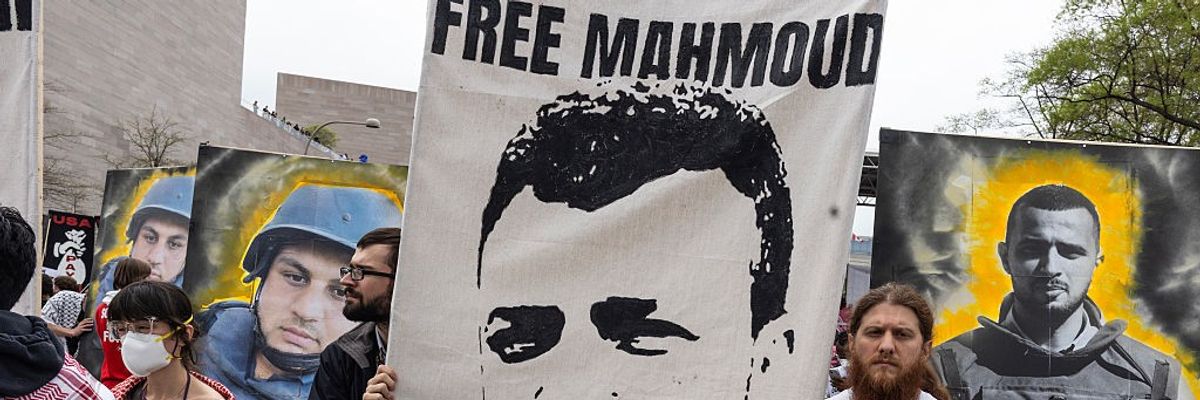
Protesters demand the release of former Columbia University student activist Mahmoud Khalil during a March 10, 2025 demonstration in New York City.
(Photo: Michael Nigro/Pacific Press/LightRocket via Getty Images)


Brett Wilkins
Apr 11, 2025
COMMON DREAMS

A U.S. immigration judge in Louisiana on Friday ruled that Mahmoud Khalil, a permanent U.S. resident and former Columbia University graduate student arrested last month after protesting Israel's genocidal assault on Gaza, can be deported, a decision that came despite the Trump administration admitting the imminently expecting father committed no crime and was being targeted solely for constitutionally protected speech.

Assistant Chief Immigration Judge Jamee Comans said that she lacked the legal authority to question the determination by Secretary of State Marco Rubio that Khalil was deportable. Earlier this week, Comans gave the Department of Homeland Security (DHS) until Friday to produce evidence that Khalil is eligible for deportation.

No such evidence was provided other than Rubio's assertion that he reserves the right to order Khalil's expulsion under the Immigration and Nationality Act of 1952, which empowers the secretary of state to expel noncitizens whose presence in the United States is deemed detrimental to U.S. foreign policy interests.

Rubio admitted that Khalil's "past, current, or expected beliefs, statements, or associations... are otherwise lawful," prompting Marc van der Hout, one of Khalil's attorneys, to assert "that this is merely about targeting Mahmoud's free speech rights about Palestine."

Khalil—who calls himself and is widely considered a political prisoner—now has until April 23 to apply for relief, or face deportation to Syria, where he was born in 1995 in a refugee camp for Palestinians, or Algeria, where he has citizenship.

"I would like to quote what you said last time that there's nothing that's more important to this court than due process rights and fundamental fairness," Khalil told Comans after she announced her decision. "Clearly what we witnessed today, neither of these principles were present today or in this whole process."

"This is exactly why the Trump administration has sent me to this court, 1,000 miles away from my family," Khalil added. "I just hope that the urgency that you deemed fit for me are afforded to the hundreds of others who have been here without hearing for months."


Van der Hout said that "today, we saw our worst fears play out: Mahmoud was subject to a charade of due process, a flagrant violation of his right to a fair hearing, and a weaponization of immigration law to suppress dissent."

Khalil—who last year finished his graduate studies at Columbia University, where he helped lead campus protests against Israel's annihilation of Gaza—was arrested at his New York home by plainclothes DHS officers on March 8 before being transferred to New Jersey and then Louisiana.

The 30-year-old's American wife, Noor Abdallah—who is nine months pregnant—has said Khalil's arrest "felt like a kidnapping because it was."


Khalil was targeted following U.S. President Donald Trump's issuance of an executive order authorizing the deportation of noncitizen students and others who take part in pro-Palestine demonstrations.

Last month, Judge Jesse Furman of the U.S. District Court for the Southern District of New York ruled that since Khalil was detained by DHS in New Jersey when he lodged a legal challenge to his detention, his case should be transferred to the Garden State.

That federal habeas corpus case will continue despite Friday's ruling. Following Comans' decision, the judge in the New Jersey case, Michael E. Farbiarz of the U.S. District Court for the District of New Jersey, ordered both the Trump administration and Khalil's lawyers to immediately report to his court.

Numerous right-wing Israel supporters—including the White House—celebrated Comans' ruling.


Civil liberties defenders, meanwhile, decried Friday's decision.

"Today, reading from a pre-written decision, an immigration judge rubber-stamped a shameful determination by Secretary of State Rubio stating that one's beliefs can lead to deportation. We should all be deeply concerned," Diala Shamas, senior staff attorney at the Center for Constitutional Rights, said in a statement.

"We will continue to stand alongside Mahmoud in his fight to come home to Noor, and in his determination to keep speaking out for Palestinian freedom," Shamas added. "This is just the beginning."

U.S. Rep. Rashida Tlaib (D-Mich.), the only Palestinian American member of Congress, said on social media: "We cannot allow the Trump administration to end our constitutional rights. The right to free speech obviously includes the right to protest the Israeli government's genocide of Palestinians."

"This fascism won't end with Mahmoud Khalil," she added. "It's a threat to all of us."


Leah Greenberg, co-executive director of Indivisible, said on the social media site X that "this is an unbelievably dark day and a direct attack on our fundamental civil liberties."

Nihad Awad, national executive director of the Council on American-Islamic Relgations, said in a statement that "this Louisiana immigration judge's dangerous, unconstitutional ruling allowing the deportation of a legal permanent resident because the current administration wants to punish him for exercising his First Amendment right to criticize the Israeli government's genocide of Palestinians in Gaza must not stand."

"Although today's ruling is just the first step in a long legal process, it should be alarming to all Americans who cherish the Bill of Rights and basic freedoms like free speech," Awad added. "We are confident that federal courts will see through the Trump administration's lawless attack on free speech and that the movement against the Israeli government's genocide will continue to grow in our nation, despite these Orwellian attempts to suppress free speech."

Former U.S. Labor Secretary Robert Reich noted that "Mahmoud Khalil expressed his political point of view peacefully."

"That's supposed to be permitted in a democracy," he added. "If this egregious assault on civil liberties stands, what's to stop Trump from arresting American citizens who support any cause his regime doesn't like?"


Khalil's persecution is part of a wider campaign targeting noncitizens who protest Israel's annihilation of Gaza and advocate for Palestinian rights.

Last month, the U.S. State Department announced the launch of an artificial intelligence-powered "catch and revoke" program to cancel the visas of international students deemed supportive of Hamas. Rubio said that nearly 300 students have had their visas revoked and could be deported.

"Every time I find one of these lunatics, I take away their visas," he said of the student activists opposing one of the great slaughters of the 21st century.

On Wednesday, DHS announced the launch of a task force to surveil immigrants' social media posts, including those of around 1.5 million foreign students, for alleged antisemitism. While DHS did not say how antisemitism would be defined, critics note that the Trump administration has adopted the International Holocaust Remembrance Alliance working definition, which conflates opposition to Zionism—the settler-colonial movement for a Jewish homeland in Palestine—with hatred of Jews.

Khalil's advocates vowed to keep fighting.

"This is not over, and our fight continues," van der Hout said. "If Mahmoud can be targeted in this way, simply for speaking out for Palestinians and exercising his constitutionally protected right to free speech, this can happen to anyone over any issue the Trump administration dislikes."

"We will continue working tirelessly until Mahmoud is free and rightfully returned home to his family and community," he added.

Noor Zafar, senior staff attorney with the ACLU's Immigrants' Rights Project, said, "The fight to bring Mahmoud home is far from over."

"We will continue undeterred to press for his release after this startling escalation of the Trump administration's war on dissent," Zafar added. "We will fiercely defend his and others' right to speak freely about Palestine or any other issue without fear of detention and deportation."


Memo Shows Trump Admin Targeted Mahmoud Khalil 'Solely Because It Disagrees With His Speech'

"Controversial speech is not illegal, and political speech that criticizes the Israeli government or U.S. foreign policy is constitutionally protected," said the NYCLU's interim legal director.


Demonstrators march to the Immigration and Customs Enforcement headquarters in Washington, D.C. to protest the arrest of pro-Palestinian activists on April 5, 2025.
(Photo: Andrew Lichtenstein/Corbis via Getty Images)


Jessica Corbett
Apr 10, 2025
COMMON DREAMS

An attorney for former Columbia University student organizer Mahmoud Khalil said Thursday that a memo submitted to an immigration judge shows that the U.S. government "is clearly going after Mahmoud and persecuting him for exercising his First Amendment rights."

"After a month of hiding the ball since Mahmoud's late-night unjust arrest in New York and taking him away to a remote detention center in Louisiana, immigration authorities have finally admitted that they have no case whatsoever against him," the lawyer, Marc Van Der Hout, said in a statement about a two-page memo from the U.S. Deparment of State that was published by The Associated Press.

Plainclothes federal agents accosted Khalil, a green-card holder who finished his graduate studies at Columbia last year, and his pregnant wife—Noor Abdalla, a U.S. citizen—at their building in New York City on March 8 and took him into custody. Abdalla has said that "this felt like a kidnapping because it was," and Khalil calls himself a "political prisoner."

As Van Der Hout explained Thursday: "The government has charged Mahmoud with a rarely used provision of the immigration laws targeting the deportation of even lawful permanent residents like Mahmoud—but Secretary of State Marco Rubio has provided no proof or evidence that these charges bear any viability against Mahmoud. Further, Secretary Rubio has shown that this is merely about targeting Mahmoud's free speech rights about Palestine."

"If anything, this document only underscores the startling escalation of Trump's war on dissent and efforts to remove people who disagree with him or U.S. policy."

The AP noted that "a Department of Homeland Security spokesperson, Tricia McLaughlin, did not respond to questions about whether it had additional evidence against Khalil, writing in an emailed statement, 'DHS did file evidence, but immigration court dockets are not available to the public.'"

Rubio's memo was submitted to Judge Jamee Comans ahead of an immigration court hearing scheduled for Friday in Jena, Louisiana—and after the judge said earlier this week that the federal government "either can provide sufficient evidence or not," and "if he's not removable, I'm going to terminate this case."

The memo suggests campus protests against the U.S.-backed Israeli assault on Palestinians in the Gaza Strip were inherently discriminatory against Jewish people, stating that Rubio determined the activities and presence of Khalil and another lawful permanent resident whose name is redacted "would have potentially serious adverse foreign policy consequences and would compromise a compelling U.S. foreign policy interest."

"These determinations are based on information... regarding the participation and roles of [redacted] and Khalil in antisemitic protests and disruptive activities, which fosters a hostile environment for Jewish students in the United States," the memo continues. "The public actions and continued presence of [redacted] and Khalil in the United States undermine U.S. policy to combat antisemitism around the world and in the United States, in addition to efforts to protect Jewish students from harassment and violence in the United States."

Van Der Hout said that "an immigration judge would have to find that the secretary of state has 'reasonable ground' to believe that the immigrant's presence or activities in the U.S. 'would have potentially serious adverse foreign policy consequences,' and that his presence—though he has only engaged in lawful conduct that is protected by the First Amendment—'compromise[s] a compelling United States foreign policy interest,' which purportedly justifies the government's ability to override the U.S. Constitution's free speech clause. But Rubio cites no real foreign policy issues or evidence whatsoever, and it is critically important to note that the U.S. government is always constrained by the Constitution, regardless of what its officials might think."


In addition to Van Der Hout's firm, Khalil is represented by Dratel & Lewis, the Center for Constitutional Rights (CCR), the Creating Law Enforcement Accountability & Responsibility (CLEAR) project, New York University Immigrants' Rights Clinic, and the national, New Jersey, and New York arms of the ACLU.

Molly Biklen, interim legal director at the NYCLU, said that Rubio's memo "underscores that the government has ripped Mahmoud Khalil from his home and nine-months pregnant wife, Dr. Noor Abdalla, solely because it disagrees with his speech. Controversial speech is not illegal, and political speech that criticizes the Israeli government or U.S. foreign policy is constitutionally protected."

The New York Timesreported earlier this week that under President Donald Trump, nearly 300 students have had visas revoked and could face deportation. Biklen said that "if anything, this document only underscores the startling escalation of Trump's war on dissent and efforts to remove people who disagree with him or U.S. policy. It's nothing more than a naked attack on all of our free speech rights."

Khalil's immigration case is occurring alongside a federal court battle in New Jersey, where his lawyers are arguing that he has been unlawfully detained. Referencing the latter proceedings, CCR staff attorney Samah Sisay said that the Rubio memo "shows that the secretary of state's determination that Mr. Khalil is deportable is based solely on his free speech activities as he has alleged in his habeas litigation."

"The government has not stated any legitimate foreign policy interest that is negatively impacted by Mr. Khalil but instead erroneously attributes prejudiced views to him for participating in the student encampment at Columbia University and speaking out against the United States' support of Israel's genocide in Gaza," Sisay added. "The government has not met its burden, and Mr. Khalil should be released."

130+ Jewish Georgetown Community Members Oppose Attempted Deportation of Scholar Badar Khan Suri

"Making Jews the face of this autocratic initiative feeds antisemitic conspiracy theories and is dangerous for Jews, on campuses and beyond," says the public statement.


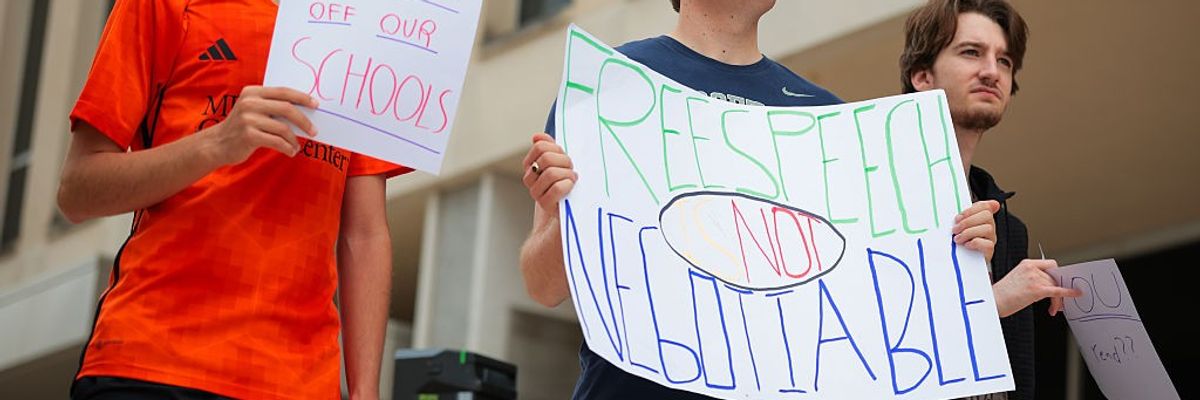
Student protestors from American, George Mason, George Washington, Georgetown, Howard, and Temple universities participate in a "Hands Off Our Schools" rally in front of the U.S. Department of Education on April 4, 2025 in Washington, D.C.
(Photo: Kayla Bartkowski/Getty Images)

Jessica Corbett
Apr 11, 2025
COMMON DREAMS

Over 130 Jewish Georgetown University alumni, students, faculty, and staff on Friday collectively spoke out against the Trump administration's attempt to deport postdoctoral fellow Badar Khan Suri and declared that "the growing wave of politically motivated campus deportation efforts is an authoritarian move that harms the entire campus community."

Khan Suri, an Indian national, was abducted by masked Department of Homeland Security (DHS) agents outside his home in Virginia last month—a scene similar to the arrests of other foreign students who have supported Palestinian rights or criticized the U.S.-backed Israeli assault on the Gaza Strip, which experts across the globe condemn as genocide.

"Despite having a valid visa, the agents detained Dr. Khan Suri and rapidly transferred him to a detention center in Louisiana and then Texas," explains Friday's joint statement. "Dr. Khan Suri is a valued member of the Georgetown community. In addition to the impact this has had on him, these events have terrified his students and colleagues, his wife, three young children, and parents, and his broader family and friends."

The statement says that "the political arrest, detention, and attempted deportation of Dr. Khan Suri and others across the U.S., including Columbia University student Mahmoud Khalil and Tufts University Ph.D. candidate Rumeysa Ozturk, as well as the revocation of hundreds of student and work visas, are transgressions of civil liberties by the Trump administration and DHS that are commonly seen under authoritarian governments. This should alarm us all."

"The Trump administration is waging attacks on our spaces of learning, including by politically targeting, harassing, detaining and attempting to deport Palestinian, Arab, Muslim, international, and immigrant community members, all while claiming to do so in the name of Jewish safety," the statement continues, citing a White House social media post.

President Donald Trump "is weaponizing Jewish identity, faith, and fears of antisemitism as a smokescreen for his authoritarian agenda, further damaging the campus climate for everyone," the statement asserts. "Making Jews the face of this autocratic initiative feeds antisemitic conspiracy theories and is dangerous for Jews, on campuses and beyond. For multiple reasons, it is crucial that we as Jewish community members at Georgetown speak out and act against this, and we encourage Jews on and off campuses everywhere to do the same."

The statement calls for the immediate release of all who have been "unjustly detained" and an end to "all authoritarian actions" against campuses. It also urges elected officials as well as Jewish community leaders and institutions, including Hillel and the Anti-Defamation League, "to clearly and officially condemn and oppose these acts" by the federal government.

The statement—set to be published by the campus newspaper, The Hoya—also endorses the Georgetown administration's Jesuit commitment to "build an environment where all members of our community are free to express their thoughts" and that recognizes "the human dignity of all," and urges the university's leaders "to continue and strengthen these efforts."

Asked about the statement by NPR, DHS spokesperson Tricia McLaughlin responded, "Pretty absurd mental gymnastics to believe that revoking visas of individuals who glorify and support terrorists, harass Jews, and do the bidding of organizations that relish the killing of Americans and Jews, is in fact, making Jewish students less safe."


The school is maintaining an official webpage for U.S. immigration policy and regulatory updates. The latest post, from Wednesday, states: "We are aware of approximately six community members who have had their immigration status terminated. The reasons given for such terminations are limited, and Georgetown University was not informed of them by the government."

For The Hoya's Thursday reporting on that update, the newspaper spoke with Nader Hashemi, director of the School of Foreign Service's Alwaleed Center for Muslim-Christian Understanding, where Khan Suri was a postdoctoral researcher.

"Six lives have effectively been destroyed," Hashemi said. "I hope the university will live up to its pledges to support students in this difficult moment, particularly international students who've been affected."

"I think the university's statements and the communication has been very good so far," Hashemi added. "I think most faculty and students are basically happy with what the university has been doing, and I hope the university will continue to support students who have been unjustly and illegally targeted by this authoritarian regime that's empowered now in Washington."

The newspaper reported Friday that students with a new protest group, the GU Student Coalition Against Repression, "planned to stage a sit-in in Healy Hall but moved outside the gates after Georgetown University Police Department (GUPD) officers forcibly removed them from Healy." The action was timed to coincide with the weekend during which potential students, admitted for the following academic year, visit campus.

The Shift: Hillel’s empty words

The US Jewish campus group Hillel has expressed concerns about Trump's student repression, but it's impossible to take the organization's sentiments seriously given its history of attacking free speech on Palestine.

 April 10, 2025
 MONDOWEISS

Hillel building at the University of Wisconsin in Madison.

In recent years, we have seen Palestine activists protest Hillel groups on campus.

Pro-Israel organizations and pundits often insist that protesting the largest Jewish student organization somehow makes the Palestine movement antisemitic, but Hillel is not exactly apolitical.

In the mid-2000s, they embraced the slogan “Wherever we stand, we stand with Israel,” they sponsor the Birthright program, and they forbid campus Hillels from partnering with anti-Zionist groups.

Earlier this year, Yale Hillel hosted former Israeli solider and Prime Minister Naftali Bennett, which inevitably led to protest. At an event at Harvard Business School later he joked that he would give exploding pagers to protestors, alluding to the Israeli attack on Lebanon that killed dozens of people and injured thousands.

Here’s Andrew Getraer, executive director of Hillel at Rutgers, explaining the group’s mission at a Zionist conference in 2019:

We came up with this idea, we are driven by a core belief, that a positive relationship to Israel is essential for a healthy Jewish identity. It’s not about where you are on the political spectrum. It’s not about what party you would vote for or how much you hate Bibi. Which by the way, college students hate Bibi. My sons are in college too, and I’m going to tell you 80 percent of students think that Bibi is a terrible human being. I happen to be the only Likudnik in New Brunswick. So I’m not here to criticize Bibi…

We want to see past that aspect of political Zionism. We want students to have a positive relationship to the state of Israel, because if they don’t they’re not going to be healthy as Jews. People can’t be healthy if they don’t have a good relationship with their family. You can go through life hating your parents or your brother or your sister, but it’s going to be pain for you for the rest of your life. If you’re a Jew and you can’t find that positive relationship to your brothers and sisters in Israel, and the state of Israel, there’s going to be a part of you that’s in pain, even if you ‘re not aware of it, or you’ve rationalized it away, you’re not fully healthy.

In 2013, Swarthmore College’s campus Hillel became the first one to adopt an open policy” toward partnering with other groups. “All are welcome to walk through our doors and speak with our name and under our roof, be they Zionist, anti-Zionist, post-Zionist, or non-Zionist,” they declared.

This kind of tension was well-established before October 7, but the ensuing protests obviously added additional dimensions to the friction. Last month the New York Times ran a piece saying that the organization is “thriving,” but also “torn by conflict.”

The article cites a very important statistic that I’ve referenced in this newsletter before:


The current ideological split feels sharper, as campus protests for and against Israel have led to arrests, suspensions and lawsuits. When it comes to the campus Hillel, “a lot of students don’t feel comfortable going in for political reasons,” said Danya Dubrow-Compaine, a senior and a co-founder of Yale Jews for Ceasefire.

There is also a growing generation gap. In a Pew survey conducted in February 2024, 38 percent of adults under 30 years old said Israel’s reasons for fighting Hamas were valid, down from 41 percent two years earlier. That compares with 78 percent of people 65 and older who said the same, up several points from the earlier survey.

Elijah Bacal, a sophomore who is an organizer for Yale Jews for Ceasefire, said the institutional leadership of the Slifka Center, as Yale’s Hillel is known, has been slow to adapt.

“I think there is a real, honestly, just like an out-of-touchness,” Mr. Bacal said.

You might assume that a group like Hillel is cheering on Trump’s recent wave of student deportations, as it has been advocating for pro-Palestine speech to be repressed for years. Here’s part of a list compiled by Palestine Legal:Hillel International threw in its weight to condemn a course on Palestinian history at the University of California, Berkeley, joining complaints from other Israel advocacy organizations and Israeli government ministers, which resulted in the mid-semester suspension of the course, in flagrant violation of academic freedom. The university suspended the student-led course, called “Palestine: a Settler Colonial Analysis” and then reinstated it after an outcry from faculty, students and civil rights organizations who protested the First Amendment and academic freedom violations. The Palestinian-American student facilitator was subjected to a severe international smear campaign.

In 2014, a representative of Hillel accused students at Barnard College who hung a banner showing the map of historic Palestine of making Jewish students unsafe. The banner was removed.

In 2014, Hillel at Loyola University in Chicago accused Palestinian students of bias-motivated misconduct, harassment and bullying because they lined up at a Birthright Israel table and requested to register for the program, which excludes Palestinians. The Palestinian students were investigated and punished for their protest.

The group has also called for student activists to be criminally investigated. From the same list:In May 2016, after a multi-racial group of student protesters at University of California Irvine, held signs and chanted outside a Hillel-supported film screening, Hillel falsely accused the protesters of physically threatening Jewish students. The case was referred to the Orange County DA for criminal investigation, but no charges were filed when it became clear that there was no evidence. UC Irvine investigated and determined that while the protest was too loud, it did not target Jewish students, and was peaceful.

In 2014 at Northeastern University, Hillel boasted that it worked closely with police to investigate students who distributed “mock eviction” notices in dorms to raise awareness about Israeli home demolition policies. Accusations that the flyers targeted Jewish students resulted in the suspension of Students for Justice in Palestine. The suspension was lifted after an outcry.

In 2010 at University of California Irvine, after the “Irvine 11” verbally protested a talk by the Israeli Ambassador, the director of Hillel at UC Riverside met with the Orange County District Attorney (DA) before the DA filed criminal charges against the student protesters. The purpose of the meeting was presumably to encourage filing criminal charges, even though the protesters had already been punished by the school. This is the same DA who faced charges of prosecutorial misconduct during the trial. The case was widely viewed as a shocking attempt to criminalize peaceful political protest against Israel.

In 2010, Hillel accused students at Rutgers of material support for terrorism when they fundraised for humanitarian aid to people in Gaza. As a result, the money could not be sent to the students’ selected humanitarian organization.

Despite all this, Hillel International CEO Adam Lehman put out a statement expressing some concerns about Trump’s crackdown.

Lehman begins his remarks by asserting that “Jewish students have been assaulted, harassed, intimidated, and demonized,” but he doesn’t necessarily believe Palestine protesters deserve to be snatched off the street and deported.

“For the benefit of Jewish students and all students, we believe it is essential that students, faculty, and staff violating laws and campus codes of conduct be held accountable for those destructive actions,” writes Lehman. “At the same time, we also believe that due process for those accused of wrongdoing is essential — whether through mandated protections in legal settings or consistent, fair, and responsive disciplinary procedures at the university level.”

Additionally, he’s worried that the Trump moves could actually increase antisemitism.

“We also share concerns over ways in which actions to combat campus antisemitism can inadvertently fuel further antisemitism, by feeding into longstanding tropes about outsized Jewish influence, and leading some people to unfairly hold Jewish students and faculty responsible for actions such as the withholding of significant research grants,” he writes.

For obvious reasons, it’s difficult to take Lehman’s tepid concerns seriously. For a more honest appraisal, let’s turn to Rabbi Jason Rubenstein, Executive Director of Harvard Hillel.

Rubenstein recently sent out an email praising Harvard President Alan Garber for seemingly deferring to Trump and moving to implement policies clearly designed to suppress pro-Palestine sentiment.

Rubenstein praises Garber for a number of recent anti-Palestine moves: severing ties with a West Bank university, enacting more restrictions for campus organizers, suspending the Palestine Solidarity Committee, suspending the Harvard Divinity School’s Religion, Conflict, and Peace Initiative, and dismissing the faculty leaders of the school’s Center for Middle Eastern Studies.

Rubenstein argues that all this great stuff should earn Garber the benefit of the doubt from the pro-Israel crowd.

“What stance carries weight, and with it risk? In this moment of turmoil, the answer is saying, to this entire community, something I tell individual alumni each week,” writes Rubenstein. “I am constantly asked, ‘Is Alan Garber the right person to lead Harvard right now?’ And the answer I always give is, “Yes.” Through hours of conversations, and exchanges the contents of which I cannot disclose, I have come to the same conclusion as many others throughout Harvard: that Alan carries love of Harvard and hatred for anti-Semitism in his heart; that he is a man of both calmness and conviction; and that his skill and courage should give us hope as he leads this deeply divided and irreplaceable university through this long crisis.”

“These are the relationships, and this is the type of community – one where we act together, not allowing our fears to isolate us and turn us against one another and defeat our collective search for truth and joy – that we are building with students at Hillel each Shabbat; and as we mend the rifts of this great, dispersed, community, that spans the world and contains within it infinite possibility,” he continues.

Last week Three Harvard students and two recent graduates had their student visas revoked by the Trump administration.
AIPAC targets Senators

Last week the Senate voted on a pair of resolutions that would have blocked an $8.56 billion sale of weapons and munitions to Israel.

That effort was led by Senator Bernie Sanders (I-VT), who introduced a similar set of resolutions last fall. Just 15 Senators backed the resolutions, less than the last time around.

Now the pro-Israel lobbying group AIPAC is targeting those Senators with a six-figure social media and television ad buy across 11 states.

“Bernie Sanders is jeopardizing the safety and security of the Jewish state as it fights a seven-front war against Iran and Iranian-backed terrorists,” says AIPAC spokesperson Marshall Wittman. “These ads will educate constituents of the senators who voted with Bernie Sanders to undermine America’s partnership with our democratic ally.”

This is a great example of how AIPAC exerts influence over U.S. politicians.

During the autumn vote, Sanders found support from Senator Jon Ossoff (D-GA). He gave an impassioned speech on the Senate floor, defending his decision.

He began by reminding his colleagues that Ronald Reagan had blocked cluster munitions to Israel over its brutal attacks on Lebanon in 1982.

“I tell this story to remind my colleagues that in the pursuit of America’s national interests, to use the leverage that comes with the provision of arms is not just sometimes necessary — it is expected and appropriate,” said Ossoff. “No foreign government, no matter how close an ally, gets everything it wants, whenever it wants, to use however it wants.”

“No one in this body or the American government has suggested that Israel lay down its arms and be overrun, or that Israel does not have a right, and indeed an obligation, to defeat its enemies and defend its people,” he continued. “Rather, the United States has insisted that Israel’s conduct of the war respect our interests and our values — the interests and values of Israel’s closest ally. And yet, for the most part, that insistence has been ignored.”

Ossoff was attacked by local pro-Israel groups for these sentiments. He’s a vulnerable lawmaker with an election next year, so he dutifully fell in line this time and rejected the new round of resolutions.

Maybe one foreign government can get everything it wants.

It’s important to remember that AIPAC is compelled to spend more and more money on behalf of Israel because the country’s brand is slowly eroding.

We saw more proof this week when Pew released a new poll on the issue. According to the survey, 53% of Americans now hold an unfavorable view of Israel, up from 42% in 2022.

When broken down by party, 69% of Democrats and 37% of Republicans hold a negative view of Israel. Those numbers were 53% and 27% in 2022.
'Welcome to the Oligarchy Era': Social Security Administration Switches Communications to Musk's X

"This flagrant conflict of interest stands to serve the interests of Elon Musk while the American people are robbed of fair access to THEIR Social Security Administration," said one former agency leader.


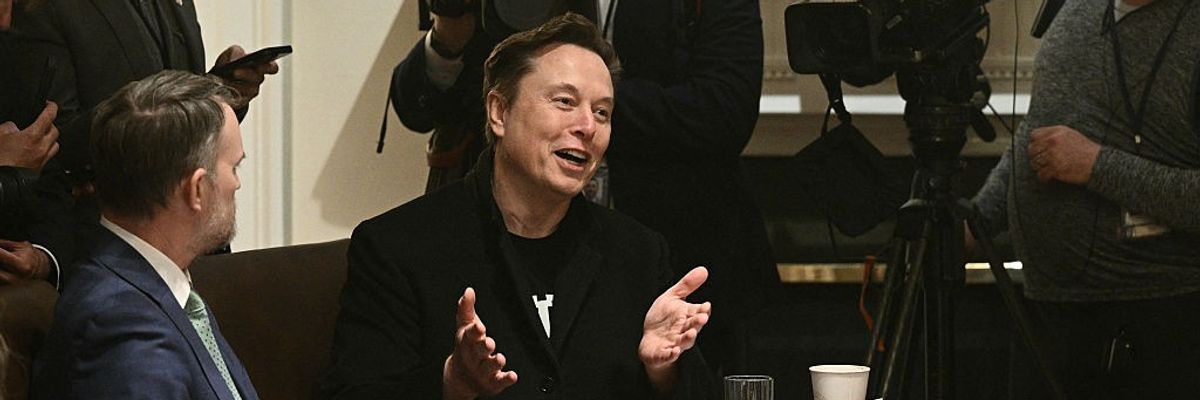
Elon Musk speaks during a Cabinet meeting at the White House on April 10, 2025 in Washington, D.C.
(Photo: Brendan Smialowski/AFP via Getty Images)


Jessica Corbett
Apr 11, 2025
COMMON DREAMS


The Trump administration faced a fresh wave of criticism on Friday in response to reporting that the Social Security Administration is cutting its communications staff and will shift from using press releases to billionaire Elon Musk's social media platform X.

Musk, the richest person on Earth, is notably also the de facto leader of President Donald Trump's Department of Government Efficiency (DOGE), which is leading the administration's effort to gut the federal bureaucracy—though the billionaire faces a rapidly approaching 130-day limit for how long he can serve as a "special government employee" under federal law.

"Elon Musk is forcing seniors onto X to learn about and get news about Social Security," Melanie D'Arrigo, executive director of the Campaign for New York Health, which advocates for universal healthcare, wrote on the platform Friday. "The only person this benefits is Elon Musk. Welcome to the oligarchy era."


Martin O'Malley, who led the agency during the Biden administration, also responded to the reporting on X, saying, "This flagrant conflict of interest stands to serve the interests of Elon Musk while the American people are robbed of fair access to THEIR Social Security Administration and the benefits they worked so hard to earn."

During a Thursday call with employees, SSA Midwest-West (MWW) Regional Commissioner Linda Kerr-Davis said that instead of making announcements via press releases or "Dear Colleague" letters, "the agency will be using X to communicate to the press and the public—formerly known as Twitter," according toFederal News Network. "This will become our communication mechanism."

"If you're used to getting press releases and Dear Colleague letters, you might want to subscribe to the official SSA X account, so you can stay up to date with agency news," Kerr-Davis told agency workers. "I know this probably sounds very foreign to you—it did to me as well—and not what we are used to, but we are in different times now."

Federal News Network also detailed her comments on reassigning workers to minimize the need for layoffs at the agency:
The reassignments will lead to major staffing cuts to regional offices. Kerr-Davis said the MWW regional office has about 550 employees now, but will only have about 70 employees under the new "skinny regional office" model.

"Won't losing subject-matter experts lead directly to fraud, waste, and abuse? Yes," Kerr-Davis told employees. "Things are going to break, and they're going to break fast. We know that, but hopefully we'll be able to get some support."

Kerr-Davis added that the reassignments will be a "welcome addition" for understaffed field offices. But in many cases, reassigned employees will work in less senior positions.

"I can only imagine how this shift might make them feel, after years of dedicated service in their prior roles. They are used to being experts in their field, and we're asking them to take on new responsibilities," she said. "For some, it's going back to work they used to do a long time ago, which may look very different."

Kerr-Davis' comments were also reported Friday by Wired, which noted that she did not respond to a request for comment. However, Liz Huston, a White House spokesperson, said: "This reporting is misleading. The Social Security Administration is actively communicating with beneficiaries and stakeholders."

"There has not been a reduction in workforce," Huston told Wired. "Rather, to improve the delivery of services, staff are being reassigned from regional offices to front-line help—allocating finite resources where they are most needed. President Trump will continue to always protect Social Security."

HuffPostpointed out Friday that "in recent weeks, queries to the SSA press line have produced responses from White House spokespeople instead of Social Security spokespeople."

The SSA has not published a press release on its website since March 27, but has been sharing updates on its X account, @SocialSecurity, in recent weeks—the latest post, from Wednesday, addresses the rollback of a planned identity verification policy and related phone service cuts.


American Federation of State, County, and Municipal Employees president Lee Saunders said in a Friday statement that "retirees, disabled individuals, and the millions of beneficiaries who rely on Social Security should not need an X account to receive updates on the program."

"Moving all Social Security communications to Elon Musk's personal social media platform is a blatant effort to gain more users and pad X's profits," the union leader charged. "This move should ring alarm bells everywhere. Social Security belongs to the hardworking taxpayers who have paid into the program, not an unelected billionaire like Musk."

"This administration has made their desire to gut and then privatize Social Security clear. Shuttering the program's regional offices and moving all communications to a single, unaccountable, insecure, for-profit social media company is just the next step in their scheme to enrich billionaires with our tax dollars," he added. "This is exactly why we need to keep Musk and his DOGE cronies out of the Social Security Administration, and we're not going to give up this fight."

AFSCME, the American Federation of Teachers, and the Alliance for Retired Americans are fighting DOGE's access to sensitive personal data at the SSA in federal court.


'Outrageous Abuse of Power': Trump Weaponizes Social Security for Deportation Spree

"Though Trump claimed he wouldn't cut benefits, he essentially is by diverting dedicated monies from their intended purpose of paying Social Security benefits to the immoral purpose of maliciously ruining lives."


A documented Cuban immigrant holds his son's legal paperwork in Denver, Colorado on February 18, 2025 after the latter was arrested by immigration officers.
(Photo: Jason Connolly/AFP via Getty Images)


Jake Johnson
Apr 11, 2025
COMMON DREAMS


The Trump administration this week reportedly classified thousands of immigrants living in the United States as dead in a Social Security database in an effort to force them out of the country, a scheme that was met with furious uproar from advocates and lawmakers.

By entering the names and Social Security numbers of roughly 6,000 immigrants into Social Security's "death master file," the administration has revoked their ability to legally work in the U.S. and receive benefits in a bid to get them to "self-deport," several news outlets reported Thursday.

"This is an outrageous abuse of power," Nancy Altman, president of the advocacy group Social Security Works, said in a statement. "It will not only create extreme hardship, but kill people. Imagine, in one Trump administration keystroke, losing your income, your health insurance, access to your bank account, your credit cards, your home, and more."

"If they get away with this, it would be no surprise if they then move on to marking their perceived enemies as dead—citizens and non-citizens alike," Altman added. "This is a total misuse of the dedicated revenue that workers contribute to Social Security, with every paycheck. Though Trump claimed he wouldn't cut benefits, he essentially is by diverting dedicated monies from their intended purpose of paying Social Security benefits to the immoral purpose of maliciously ruining lives."

"The Trump administration's weaponization of Social Security is shocking and unconscionable, and we expect House Republicans will remain silent."

The Washington Postreported that the classification of thousands of immigrants as "dead" came at the request of Homeland Security Secretary Kristi Noem, who—in tandem with other administration officials—is trampling basic rights as she moves to carry out Trump's mass deportation agenda.

Aaron Reichlin-Melnick, a senior fellow at the American Immigration Council, called the Trump administration's scheme "utterly unprecedented" and warned that it "has the potential to cause immense problems for people."

"And it's also one with a HUGE potential for error," he wrote on social media. "If the data isn't perfect, people here legally might be effectively declared dead."

According to the Post, "among the people being targeted are immigrants who have bona fide Social Security numbers but have lost their legal status in the U.S., such as those who entered under one of the Biden administration's temporary work programs that have since ended."

"The immigrants' names were placed in the database following two memorandums of agreement signed Monday by Noem and Leland Dudek, the acting Social Security commissioner," the Post reported. "The memos authorize Social Security to place the immigrants in the death file for national security reasons and under the Social Security Act."

The New York Timesreported that the "initial names" added to Social Security's death file "are convicted criminals and 'suspected terrorists,'" according to internal administration documents, "but officials said the effort could broaden to include others in the country without authorization."

The Institute on Taxation and Economic Policy estimates that undocumented immigrants paid roughly $26 billion in Social Security taxes in 2022.

Dudek, who has presided over a large-scale assault on the Social Security Administration (SSA) since Trump installed him to lead the agency in February, wrote in an email to staff that the "financial lives" of the immigrants added to the death file would be "terminated," according to the Times. SSA is also reportedly sharing sensitive personal information with Immigration and Customs Enforcement (ICE).

Dudek recently faced calls to resign after internal emails revealed that SSA terminated contracts with the state of Maine in what one Democratic lawmaker called "direct retaliation for statements made by Maine Governor Janet Mills that upset President Donald Trump."

The acting SSA leader's plans for the agency, including mass staffing cuts and field office closures that advocates say amount to benefit cuts, have drawn widespread outrage. The Timesreported earlier this week that "thousands of worried and frustrated recipients have thronged local field offices, asking why the phone lines are jammed, whether their local offices will be closed by Elon Musk's team of software engineers and technology executives, and whether they will lose their benefits."

"Waves of buyouts and early retirements have hobbled the staff at many local offices," the newspaper added, "and recipients say it has become harder to use the agency's website and phone systems, or even be seen in person."

Reps. John Larson (D-Conn.) and Richard Neal (D-Mass.) issued a joint statement Thursday condemning the Trump administration's latest weaponization of SSA as "digital murder" that "will make life exponentially harder for these victims, who could be effectively forced out of this country if their Social Security numbers are terminated."

"If they cancel the Social Security number of one person, where do they stop?" the lawmakers asked. "The Trump administration's weaponization of Social Security is shocking and unconscionable, and we expect House Republicans will remain silent. If you care about Social Security, you need to raise your voice because, despite what he says, Donald Trump and Elon Musk are the biggest threat to people and their earned benefits."