Friday, December 05, 2025

‘MAGA Power Grab’: US Supreme Court OKs 2026 Map That Texas GOP Rigged for Trump

One journalist who covers voting rights called the decision upholding the new districts “yet another example” of how the high court “has greenlit the many undemocratic schemes of Trump and his party.”



People join a “Stop the Trump Takeover” demonstration outside the Texas State Capitol in Austin on August 16, 2025.
(Photo by Brandon Bell/Getty Images)

Jessica Corbett
Dec 04, 2025
COMMON DREAMS


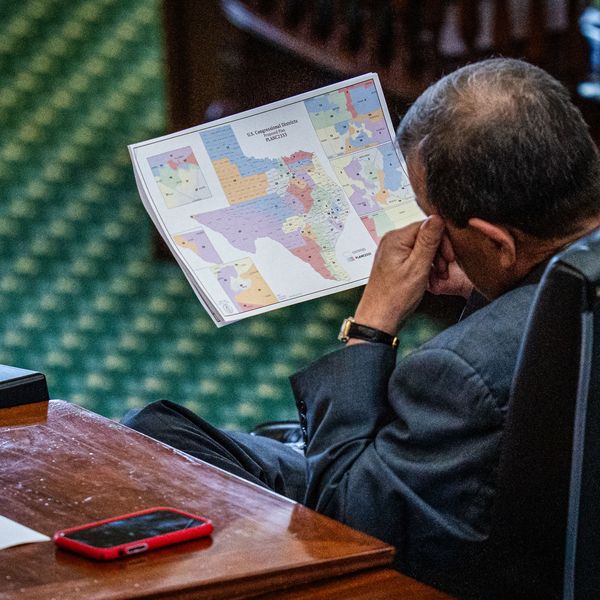
The US Supreme Court’s right-wing supermajority on Thursday gave Texas Republicans a green light to use a political map redrawn at the request of President Donald Trump to help the GOP retain control of Congress in the 2026 midterm elections.

Since Texas lawmakers passed and GOP Gov. Greg Abbott signed the gerrymandering bill in August, Democratic California Gov. Gavin Newsom and his constituents have responded with updated congressional districts to benefit Democrats, while Republican legislators in Indiana, Missouri, and North Carolina—under pressure from the president—have pursued new maps for their states.
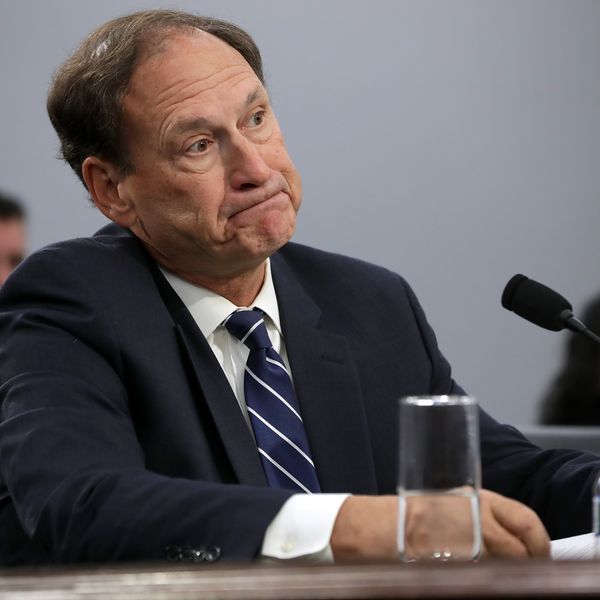


Alito Temporarily Reinstates Texas’ Trump-Requested Redrawn Maps


Trump Rebuked by Federal Ruling Against Unlawful Racial Gerrymandering in Texas

With Texas’ candidate filing period set to close next week, a majority of justices on Thursday blocked a previous decision from two of three US district court judges who had ruled against the state map. The decision means that, at least for now, the state can move ahead with the new map, which could ultimately net Republicans five more seats, for its March primary elections.

“Texas is likely to succeed on the merits of its claim that the district court committed at least two serious errors,” the Supreme Court’s majority wrote. “First, the district court failed to honor the presumption of legislative good faith by construing ambiguous direct and circumstantial evidence against the Legislature.”

“Second, the district court failed to draw a dispositive or near-dispositive adverse inference against respondents even though they did not produce a viable alternative map that met the state’s avowedly partisan goals,” the majority continued. “The district court improperly inserted itself into an active primary campaign, causing much confusion and upsetting the delicate federal-state balance in elections.”


The court’s three liberals—Justices Ketanji Brown Jackson, Elena Kagan, and Sonia Sotomayor—dissented. Contrasting the three-month process that led to the map initially being struck down and the majority’s move to reverse “that judgment based on its perusal, over a holiday weekend, of a cold paper record,” Kagan wrote for the trio that “we are a higher court than the district court, but we are not a better one when it comes to making such a fact-based decision.”

“Today’s order disrespects the work of a district court that did everything one could ask to carry out its charge—that put aside every consideration except getting the issue before it right,” Kagan asserted. “And today’s order disserves the millions of Texans whom the district court found were assigned to their new districts based on their race.”

“This court’s stay guarantees that Texas’ new map, with all its enhanced partisan advantage, will govern next year’s elections for the House of Representatives. And this court’s stay ensures that many Texas citizens, for no good reason, will be placed in electoral districts because of their race,” she warned. “And that result, as this court has pronounced year in and year out, is a violation of the Constitution.”


Top Democrats in the state and country swiftly condemned the court’s majority. Democratic National Committee Chair Ken Martin called it “wrong—both morally and legally,” and argued that “once again, the Supreme Court gave Trump exactly what he wanted: a rigged map to help Republicans avoid accountability in the midterms for turning their backs on the American people.”

“But it will backfire,” Martin predicted. “Texas Democrats fought every step of the way against these unlawful, rigged congressional maps and sparked a national movement. Democrats are fighting back, responding in kind to even the playing field across the country. Republicans are about to be taught one valuable lesson: Don’t mess with Texas voters.”

Texas House Minority Leader Gene Wu (D-137) declared that “the Supreme Court failed Texas voters today, and they failed American democracy. This is what the end of the Voting Rights Act looks like: courts that won’t protect minority communities even when the evidence is staring them in the face.”

“I’m angry about this ruling. Every Texan who testified against these maps should be angry. Every community that fought for generations to build political power and watched Republicans try to gerrymander it away should be angry. But anger without action is just noise, and Democrats are taking action to fight back,” he continued, pointing to California’s passage of Proposition 50 and organizing in other states, including Illinois, New York, and Virginia. “A nationwide movement is being built that says if Republicans want to play this game, Democrats will play it better.”


Christina Harvey, executive director of the progressive advocacy group Stand Up America, said in a statement that “the right-wing majority on the Supreme Court just handed Republicans five new seats in Congress, rubber-stamping Texas Republicans’ MAGA power grab. Make no mistake: This isn’t about fair representation for Texans. It is about sidelining voters of color and helping Trump and Republican politicians dodge accountability for their unpopular agenda.”

“In America, voters get to choose their representatives, not the other way around,” she stressed. “But this captured court undermines this basic democratic principle at every turn. We deserve a Supreme Court that protects the freedom to vote and strengthens democracy instead of enabling partisan politics. It’s time for Democrats in Congress to get serious about plans for Supreme Court reform once Trump leaves office, including term limits, an enforceable code of ethics, and expanding the court.”

Various journalists and political observers also suggested that, despite Thursday’s decision in favor of politically motivated mid-decade redistricting, the high court’s right-wing majority may ultimately rule against the California map—which, if allowed to stand, could cancel out the impact of Texas gerrymandering by likely erasing five Republican districts.
FBI's Bongino Stuns Critics With Frank Admission on Fox News: ‘Says He Lied For Money And Will Likely Do It Again’

Alex Griffing
Fri, December 5, 2025 
MEDIAITE


Dan Bongino

FBI Deputy Director Dan Bongino offered a surprisingly frank admission on Thursday night’s episode of Hannity when pressed on his past suggestion that the January 6 pipe bombs placed at the DNC and RNC were likely an “inside job.”

Bongino, a former Fox News host, has made several earnest remarks in recent months on his former network, including in May, complaining about the difficulties of his new job and flat-out saying he does not like it.

Sean Hannity and Bongino spoke about the FBI’s recent arrest of a suspect responsible for placing the pipe bombs back in 2021, an act that has long fed the right’s conspiracy mongers.

“I don’t know if you remember this,” Hannity told Bongino at one point, adding:

This was before you became the deputy FBI director. You put a post on X right after this happened and said there’s a massive cover-up because the person that planted those pipe bombs, they don’t want you to know who it is because it’s either a connected anti-Trump insider are an inside job. You said that long before you even were thought of as deputy FBI director.

“Yeah, that’s why I said to you this investigation’s just begun,” Bongino replied. “We are pretty comfortable we have our guy.”

Bongino then offered an explanation for his past comments, which stunned many observers in the media: “Listen, I was paid in the past, Sean, for my opinions. That’s clear. And one day I will be back in that space, but that’s not what I’m paid for now. I’m paid to be your deputy director, and we base investigations on facts.”

The clip quickly went viral and led to a wave of reactions, with many observers arguing that Bongino said the quiet part out loud about today’s MAGA influencer culture.

Media reporter Joe Perticone shared the clip and commented, “Deputy FBI director says he lied for money and will likely do it again in the future.”

“Holy crap, what an admission,” added the Atlantic’s Tom Nichols.

Below are some additional reactions:


Bondi orders law enforcement to investigate LEFT WING U.S. groups over accusations of domestic terrorism

ANTI-FA, ANTI CAPITALI$TS, 
& ANTI-CHRISTIANS 
(SATANISTS &  ATHEISTS)

Reuters
Thu, December 4, 2025


U.S. Attorney General Pam Bondi speaks at a press conference following the arrest in the D.C. pipe bomber investigation, at the Justice Department in Washington, D.C., U.S., December 4, 2025. REUTERS/Jessica Koscielniak

WASHINGTON, Dec 4 (Reuters) - U.S. Attorney General Pam Bondi on Thursday ordered federal law ​enforcement to step up investigations into ‌the anti-fascist antifa movement and other similar "extremist groups," and asked ‌the FBI to compile a list of entities that might be engaged in acts of domestic terrorism, according to an internal memo seen ⁠by Reuters.

The memo, ‌which was sent to prosecutors and federal law enforcement agencies, calls on ‍the Justice Department to prioritize investigating and prosecuting acts of domestic terrorism, including any potential "tax crimes" involving "extremist ​groups" who defrauded the Internal Revenue Service.

"These ‌domestic terrorists use violence or the threat of violence to advance political and social agendas, including opposition to law and immigration enforcement; extreme views in favor of mass migration and open ⁠borders; adherence to radical ​gender ideology, anti-Americanism, anti-capitalism, or ​anti-Christianity," Bondi wrote.


She added that the FBI's Joint Terrorism Task Forces "shall prioritize the ‍investigation of ⁠such conduct." She also ordered federal law enforcement agencies to scour their files for ⁠any intelligence they may have on Antifa groups and ‌provide it to investigators.

(Reporting by Sarah Lynch, ‌editing by Michelle Nichols)


Wind Farm to Power Amazon and Google Sends First Power to German Grid

German offshore wind farm
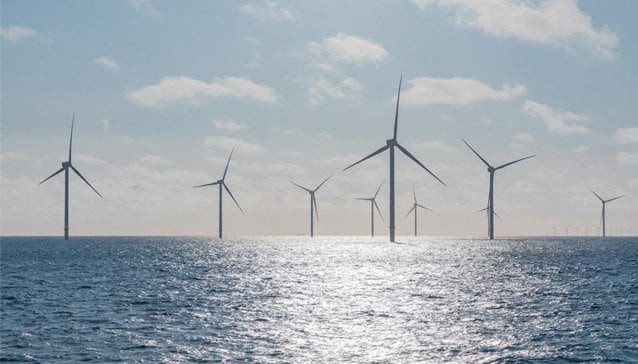
Germany's Borkum Riffgrund 3 started feeding power and when completed it will send power to major corporations including Amazon and Google (Orsted)

Published Dec 4, 2025 9:47 PM by The Maritime Executive


The Borkum Riffgrund 3 offshore wind farm started feeding its first power to the German grid on December 3. The wind farm marks another milestone both for Germany and the EU, becoming the largest offshore wind farm in Ørsted’s German portfolio and one that has contracted more than four-fifths of its power with long-term corporate power purchase agreements.

Located about 45 miles off the German coast in the North Sea, the project is being developed in a partnership between Ørsted and Nuveen Infrastructure.  When it is fully commissioned in the first quarter of 2026, it will have a total capacity of 913 MW, making it just slightly smaller than EnBW’s He Dreith (currently Germany’s largest) and among a crop of new large offshore wind farms that are planned to reinvigorate the EU’s drive to renewable energy.

“The generation of the first power at Borkum Riffgrund 3 is both a significant landmark for German offshore wind and our commitment to accelerating the EU energy transition,” said Jordi Francesch, Managing Director, Renewable Energy Investments at Nuveen Infrastructure.

The companies note that the project illustrates the depth of the EU supply chain for renewable energy. The wind turbines and foundations came from Germany and Denmark, cables from Germany and France, and installation vessels from the Netherlands and Belgium. Operation and maintenance for all Ørsted’s German offshore wind farms is carried out from Norden-Norddeich and Emden in East Frisia.

The project will consist of a total of 83 wind turbines, each with a rated capacity of 11 MW. The companies note that when it is fully operational, it will produce the same amount of electricity that a large city uses every year.

Borkum Riffgrund 3 is supported by several long-term corporate power purchase agreements (CPPA), which they highlight create long-term price security for the project developer and for the customers. Offtake agreements ranging between 10 to 25 years and totalling 786 MW have been entered into with Amazon (350 MW), BASF (186 MW), Covestro (100 MW), Energie-Handels-Gesellschaft/REWE Group (100 MW), and Google (50 MW). 

The project is also the first offshore wind farm to be built by Ørsted in Germany without an offshore substation (OSS). The new connection concept provides a direct connection between the wind turbines via a 66 kV connection to the DolWin epsilon offshore converter platform, installed and operated by the German transmission system operator, TenneT.

As it completes commissioning, Borkum Riffgrund 3 joins a growing portfolio of German offshore projects. Earlier this year, Ørsted and Nuveen Infrastructure’s other jointly owned offshore wind farm, Gode Wind 3, was fully commissioned. The project is located close to Ørsted’s existing wind farms: Borkum Riffgrund 1 and 2 and Gode Wind 1 and 2. With these recent additions, Ørsted's installed offshore wind power capacity in Germany increases to around 2.5 GW in early 2026, making the company the market leader in Germany, operating over 20 percent of the country’s total offshore wind capacity.

Germany’s largest offshore wind farm to date, EnBW’s He Dreith, generated and delivered its first kilowatt-hour of electricity on November 25 as it started the commissioning process for its turbines. It is expected to be completed during the summer of 2026, making another major addition to Germany’s renewable energy supply.

Germany's current offshore wind power capacity is just over nine gigawatts. The country has set ambitious targets to reach 30 GW by 2030, 40 GW by 2035, and 70 GW by 2045. It has not been immune to the pressures on the industry, and in August, for the first time, reported it had received no bids in its latest leasing round. The commissioning of the two large wind farms in 2026 will be a boost as the government explores future policies to encourage the next phase of development.


U.S. Data Center Demand Could Hit 106 GW by 2035

  • BNEF estimates U.S. data center demand could reach 106 GW by 2035, far above other recent forecasts.

  • Many analysts warn that speculative projects, chip constraints, and overlapping permits may deflate current projections.

  • Major U.S. grid operators face rising reliability risks as data center proposals cluster across PJM, MISO, and ERCOT.

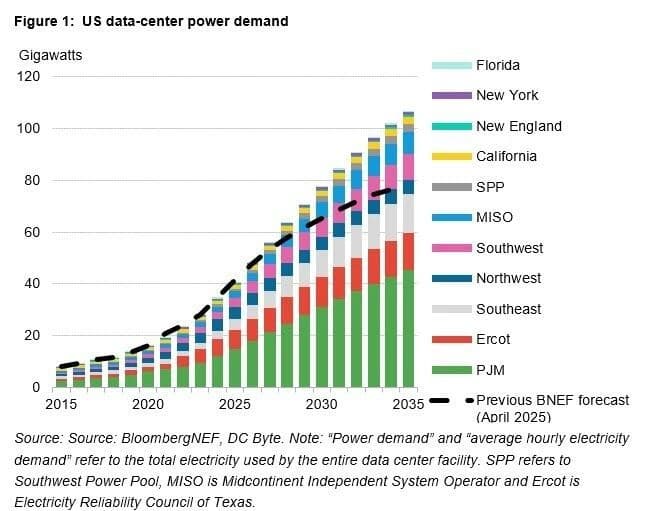
U.S. data center power demand could reach 106 GW in 2035, BloombergNEF said Monday in one of the more aggressive load growth estimates to date. The report comes as some energy industry analysts and executives warn that an artificial intelligence bubble or speculative data center proposals could be fueling excessive load growth projections. 

Grid

A report from Grid Strategies released last month said utility forecasts of 90 GW additional data center load by 2030 were likely overstated; market analysis indicates load growth in that time frame is likely closer to 65 GW, it said. 

July report from the Department of Energy estimated an additional 100 GW of new peak capacity is needed by 2030, of which 50 GW is attributable to data centers. Those facilities could account for as much as 12% of peak demand by 2028, according to Lawrence Berkeley National Laboratory.

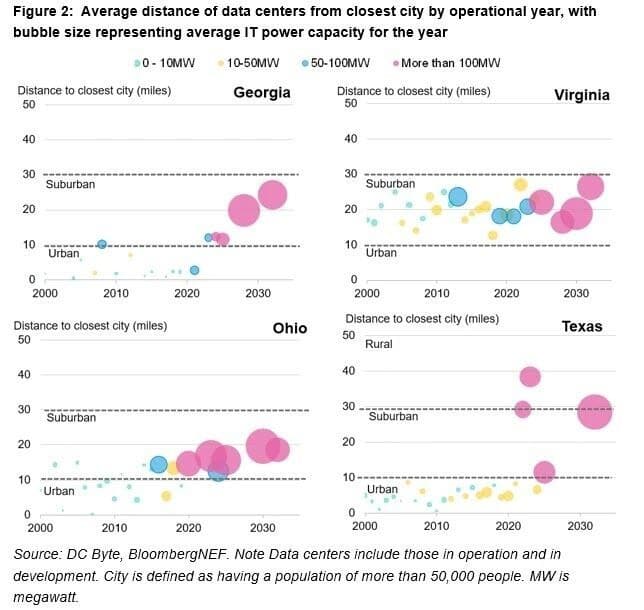
BNEF’s data center project tracker shows the industry diversifying beyond traditional data center hubs like Northern Virginia, metro Atlanta and central Ohio into exurban and rural regions served by existing fiber-optic trunk lines for data traffic.

A map of under-construction, committed and early-stage projects shows gigawatts of planned data center capacity spreading south through Virginia and the Carolinas, up through eastern Pennsylvania and outward from Chicago along the Lake Michigan shore. More data centers are also planned for Texas and the Gulf Coast states.

Fig 2

Much of the capacity is poised to materialize on grids overseen by the PJM Interconnection, the Midcontinent Independent System Operator and the Electric Reliability Council of Texas. BNEF predicts PJM alone could add 31 GW of data center load over the next five years, about 3 GW more than expected capacity additions from new generation. 

With the expected surge, the North American Electric Reliability Corp. warned late last year of “elevated risk” of summer electricity shortfalls this year, in 2026 and onward in all three regions. 

Some experts disputed NERC’s methodology, however. MISO’s independent market monitor said in June that the group’s analysis was flawed and that MISO was in a better position than grid regions not expected to see exponential data center growth, like ISO New England and the New York Independent System Operator. 

Other technology and energy system analysts expect a significant amount of proposed data center capacity to dissipate in the coming years due to chip shortages, duplicative permit requests and other factors. 

In July, London Economics International said in a report prepared for the Southern Environmental Law Center that meeting projections for U.S. data center load in 2030 would require 90% of global chip supply — a scenario it called “unrealistic.” 

Patricia Taylor, director of policy and research at the American Public Power Association, told Utility Dive earlier this year that it’s common for data center developers to “shop around” the same project across neighboring jurisdictions. 

Still, U.S. grid operators face an “inflection moment” as they balance the desire to accommodate large-scale data centers with the obligation to ensure reliable service for all customers, BNEF said.

By Brian Martucci of Utility Drive via Zerohedge


U.S. Eyes Warehouse Generators for Massive Grid Capacity Boost

  • Energy Secretary Chris Wright has proposed an innovative plan to quickly expand US grid capacity by leveraging idled industrial diesel generators at commercial sites like data centers and big-box retailers.

  • The plan aims to unleash approximately 35 gigawatts of electricity capacity, which is described as the equivalent of about 35 nuclear power plants, to serve as a short-term bridge until new natural-gas and nuclear generation is available.

  • The proposal is a direct response to the explosive power demand from the data-center boom, offering a short-term solution for the missing power needed to support the massive buildout and mitigate the strain on regional power grids.

Energy Secretary Chris Wright has floated an unusual but very creative plan to quickly expand U.S. grid capacity: tapping the industrial diesel generators already sitting at data centers, big-box retailers, and other commercial sites. The proposal comes as multiple regional grids strain under the explosive power demand driven by the data-center boom. Leveraging these idled generators could serve as a short-term bridge until new generation comes online.

Bloomberg quoted Wright on Tuesday morning at the North American Gas Forum in Washington, where he said that tapping the nation's idled fleet of industrial diesel generators could add the equivalent of about 35 nuclear power plants' worth of electricity and help bridge the country until new natural-gas and nuclear generation comes online in the coming years.

Wright emphasized the scale of the opportunity, saying, "We're going to unleash that 35 gigawatts of capacity that sits there today," though he noted that pollution rules have historically limited generator use.

He argued that the massive data-center buildout over the next few years could be primarily supported by these existing generators, avoiding the need for dozens of new power plants.

These generators, he said, are already deployed at data centers and commercial sites nationwide. "They're all around the country. It's going to start with communicating to everyone that these assets exist."

Wright and the Trump administration understand that power grids are stretched thin in the era of data centers. The push for dispatchable backup generation is a short-term solution for all the missing power needed for the AI boom...

Perhaps by the time the 2030s arrive, new natural-gas generators and other reliable sources will finally add enough capacity to meet booming demand. Nuclear remains more of a next-decade story. And now, Wright may truly be onto something.

By Zerohedge