Friday, December 26, 2025

Opinion: Trump, Greenland, battleships, and surrounding Canada on 3 sides — Won’t work

ByPaul Wallis
EDITOR AT LARGE
DIGITAL JOURNAL
December 25, 2025


Trump has repeatedly threatened to take over Greenland - Copyright AFP/File Juliette PAVY

On the subject of defense, Trump excels himself – At being Trump. All the proposals are melodramatic, grandiose, obsolete, and incredibly expensive. If you think what he did to the East Wing with a totally unnecessary ballroom was bad, this is far worse although equally obscene.

Let’s start with Greenland. The idea that the US needs Greenland for “national security” is absurd. In the 1950s, the US had a forward presence in Greenland until they decided that they didn’t need it even back then. Modern combat systems aren’t geo-dependent. Nor are strike capabilities. The US Navy doesn’t need to freeze its tail off to manage its role in the North Atlantic, either.

Administering a hot dog stand in Greenland, let alone a full-scale defense presence, would be astronomically expensive and administratively impossibly cumbersome. A US base in Greenland would become an automatic target with massive demands for core-level security for the base. Exactly how useful a Greenland base right next to a totally antagonized Canada and Europe can be is also highly debatable.

Battleships, you say? No. The general consensus is that major units are “drone bait” and instant high priority targets and will definitely be attacked. The Black Sea fleet would be safer. These things would need a fleet of chaperones to get out of New York harbor.
The battleship USS ARIZONA sinking after being hit by Japanese air attack on Dec. 7,1941.
Source – US National Archives, Public Domain

This rosy view also overlooks the fact that the US Navy is having a hard time managing its current construction and modernization. Creating a massive new unit with untold numbers of new systems, components, and maintenance requirements is suicidal. Add nuclear systems, and it’s much worse.

The US Navy now has any number of good, irrefutable reasons and excuses to “go lean”, reduce the logistics burden, and modernize for survivable modern combat needs. This idea is the exact opposite. Big money for contractors, absolutely no use for anyone else, is the verdict.

It’s a costly glass jaw you can bring with you when getting into the ring with Muhammad Ali.

There’s no depth of strategic thinking or any semblance of understanding of tactical realities. The science, materials, and tech are there to deliver real strategic and tactical advantages without committing to idiotic platforms. An unmanned go-cart with a few Harpoon missiles makes more sense than these anything but viable monstrosities.

It’s fairly easy to argue that these proposals are the diametric opposite of any practical US military policy. The entire US military could be diverted from anything remotely practical by these “digressions into futility,” and so could the defense budget for decades to come.

Now we get to Canada. A US-owned Greenland puts US sovereign territory on three sides of Canada. The Canadians won’t like it, and the Danes and Greenlanders definitely already don’t.

Former central bank chief Mark Carney led Canada’s Liberals to victory in April 2025 elections after longtime prime minister Justin Trudeau resigned – Copyright AFP/File ANDREJ IVANOV

Canada couldn’t possibly have made it clearer that after the “51st state” debacle, that all bets are off. Trump has managed to thoroughly antagonize America’s longstanding ally in two words. Not two centuries. If the past was Manifest Destiny, this is Manifest Dumbness.

America’s allies have been patronized and insulted to the point of total refusal to cooperate. America’s credibility is tanking. The Five Eyes intelligence operation works better when one of them isn’t hallucinating non-existent threats all the time. NATO has basically written off US involvement in anything, at least for now.

Deploying major fleet units to Venezuela hardly helps. A non-threat that could easily be managed by the Coast Guard suddenly needs the Navy? Nobody believes that for a second. Wasting expensive ammo on barely credible threats while probably violating maritime law is simply ludicrous.

Forget it. All of it.

______________________________________________________________

Disclaimer
The opinions expressed in this Op-Ed are those of the author. They do not purport to reflect the opinions or views of the Digital Journal or its members.


Conservative Denmark lawmaker mocks Trump's push to take over Greenland


Carl Gibson
December 25, 2025 
ALTERNET

President Donald Trump's ongoing efforts to make Greenland a part of the United States are being met with ridicule — even from a high-ranking conservative member of Denmark's parliament.

In a Thursday post to his official X account, Rasmus Jarlov (a member of Denmark's Conservative Party representing Greater Copenhagen) celebrated the news that third quarter GDP growth in Denmark was more than twice that of the United States, with the Danes experiencing 9.5 percent growth compared to 4.3 percent in the U.S.

"Not that we are satisfied, but the current growth rate in Denmark is decent," Jarlov tweeted. "We will start buying USA states shortly."

Jarlov's post poking fun at Trump comes just days after the president appointed Louisiana Gov. Jeff Landry (R) as his administration's newest special envoy to Greenland. Landry accepted the role, but made a point of telling his constituents in a social media post that he was not abandoning his duties as the Bayou State's governor.

IPaper columnist Simon Marks observed that the president's announcement set off alarm bells in Denmark, which has dominion over Greenland (though Greenland has its own parliament). In a joint statement, Danish Prime Minister Mette Frederiksen and Greenland Parilament chairman Frederik Nielsen both reminded the Trump administration that "land borders and the sovereignty of states are rooted in international law."

"You cannot annex other countries. Not even with an argument about international security. Greenland belongs to the Greenlanders … We expect respect for our territorial integrity."

Danish Foreign Minister Lars Løkke Rasmussen also piled on, with Marks observing that he was "deeply angered" about Landry's appointment, calling it "unacceptable." Denmark has reportedly summoned U.S. Ambassador to Denmark Ken Howery to Copenhagen to discuss Trump's plans for Greenland.

While Greenland's population is sparse, with just under 57,000 residents, the territory itself is rich in mineral deposits. Reuters reported earlier this year that Greenland was rich with 25 of 34 minerals classified as "critical raw minerals" by the European Commission,


A FAVOURITE XMAS SONG

MERRY CHRISTMAS MR. LAWRENCE 


Listen to Queen’s previously-unreleased Christmas song 'Not For Sale (Polar Bear)'


Copyright AP Photo
By David Mouriquand
Published on 25/12/2025 - EURONEWS

The song was recorded during the sessions for 1974's 'Queen II' and has now been played for the first time. It will feature on the 2026 reissue of the band’s second album.

Just in time for Christmas...

Queen have released a never-before-heard Christmas song, titled ‘Not For Sale (Polar Bear)’.

It was recorded in 1974 during the sessions for the band’s second album, ‘Queen II’.

The song, featuring Queen guitarist Brian May and the late Freddy Mercury on lead vocals, never made the final cut and remained unreleased for five decades. Until now.

May played the song for the first time during a special broadcast on Planet Rock radio station earlier this week, and shared that it goes back a very long way, but to my knowledge, no one has ever heard this version.”


Check it out below:


May said: "People might possibly have heard a bootleg version of Not for Sale (Polar Bear) by Smile (his previous band), it’s a song that goes back a very long way, but to my knowledge no one has ever heard this version. It’s a work in progress and will appear on the forthcoming rebuild of the Queen II album - coming next year – but I’m sneaking this into my Planet Rock special because I’m fascinated to know what people think about it. I hope people have a wonderful Christmas and a great New Year!"

‘Not For Sale (Polar Bear)’ will feature in the upcoming 2026 reissue of 'Queen II'.

Earlier this year, music licensing company Phonographic Performance Limited (PPL) announced that Queen was the most-played rock act on UK radio and TV in the 21st century.
The Story of Christmas Is About the Poor Overcoming the Powerful

In Jesus’ own words, Christianity is a faith where the first shall be last and the last shall be first. It is meant not for the rich, the satisfied, and the powerful. Rather it is first intended for the poor, the hungry, the downtrodden, and the rejected.


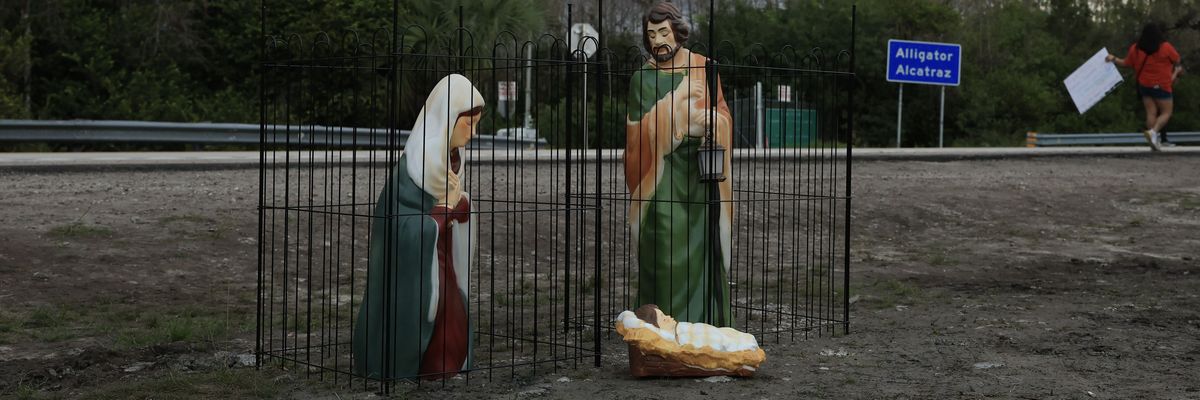
A Nativity scene depicting the birth of Jesus Christ, featuring Mary and Joseph in cages as they are held in custody, sits near the entrance to “Alligator Alcatraz” on December 21, 2025, in Ochopee, Florida. The depiction, activists said, represents a family separated from their baby as they demand that the detention camp be shut down, that the people being detained be freed, and that ICE sweeps end.

(Photo by Joe Raedle/Getty Images)

James Zogby
Dec 25, 2025
Common Dreams

Catholic churches have traditionally erected Nativity scenes outside at Christmas time. To represent the birth of Jesus, the scenes include the baby, his mother and father, Mary and Joseph, together with the shepherds, their animals, and the “wise men from the East” who came to witness the birth.

Despite the fact that the story is rich in meaning and symbolism, these Nativity scenes have been stripped of their deeper meaning and have become quite two-dimensional and shallow. Like the anodyne carols that have come to define the season, the portrait of the birth that emerges is “peaceful,” “calm,” and “bright.” There is no hint of the oppressive Roman occupation that forced this couple to travel across the country to register in a new census mandated by the empire. Nor is there a recognition of the many ironies underlying the story: that this Jewish baby, who is to be a savior, is born in a cave surrounded by animals, or that the first to come to pay homage are lowly sheep herders and non-Jewish travelers from afar.

In fact, it is these various ironies and others like them that truly define the biblical Christian narrative. It is, in reality, an upside-down faith. In Jesus’ own words, it is a faith where the first shall be last and the last shall be first. It is meant not for the rich, the satisfied, and the powerful. Rather it is first intended for the poor, the hungry, the downtrodden, and the rejected. And it is for those who recognize this and who therefore commit themselves to serving “the least of these.”

With this in mind, it is fascinating to see how in recent years some Christians have taken to reclaiming the challenge inherent in their faith.

Just two years ago a Palestinian clergyman in Bethlehem replaced the stable in the Nativity scene with rubble in order to portray what was unfolding in Gaza. His setting of “Jesus in the rubble” eloquently told the story of the Palestinian people: vulnerable, stripped of their humanity, and subjected to indignities. As if to more deeply develop this identification, last year, Pope Francis was shown in quiet prayer before a manger scene in which the baby Jesus was wrapped in a Palestinian keffiyeh.

In somewhat the same vein, this year, a Catholic community in Massachusetts, given the threats faced by migrants and refugees in the United States, found their own deeper meaning in the Christmas story. In the Nativity scene they erected outside their church, there is no Jesus, Mary, or Joseph. Instead, there is a sign noting that because of concern that ICE (the immigration enforcement police) would be conducting one of their raids, the family had gone into hiding and was seeking sanctuary inside the church.

There are reports of other similar efforts by churches to capture the challenge of the Christmas narrative—with references to ICE, the detention of immigrants, and the mistreatment of immigrant children figuring prominently in many of these portrayals.

In the case of the Massachusetts church, Catholic leaders in the state rebuked the church in question accusing them of playing politics. The Nativity scene, they said, was to provide opportunities for quiet prayerful reflection, not divisive politics. What these church leaders miss, of course, is that if they strip the birth story (and, one might add, the rest of the biblical narrative and for that matter the rest of the New Testament and the many radical injunctions Jesus gives to his followers) of its essential content, then it is they who are playing divisive politics. By not grounding the Nativity in its real-world context, there is the danger that the “contemplative prayer” the leaders are advocating can become shallow and contentless.

After all, the writers of the biblical stories had a point to convey. They weren’t just painting a pretty picture to some day appear in pastel tones on a holiday card. There are reasons why the child was born in a cave and first welcomed not by the high priests but by the lowest and foreigners. Why, in the face of repression, his parents had to take him and flee into Egypt. And why, as he grew, he made every effort to challenge the stale and corrupt religious hierarchy of his day, providing his followers with a challenging message of service to the rejected, the vulnerable, and those in need.

Every year around this time, our mailboxes are filled with mostly brightly decorated holiday greeting cards. About a decade ago, I was shocked to open one from a friend in Lebanon. It featured the anguished and dirtied face of a young boy in a tattered t-shirt staring out from behind a wire fence. Inside it read “Holiday Greetings.” At first, I was confused. “Why this card, with this incongruous message? And why now?”

After reflection, I realized that the plight of this young Syrian refugee, forced to flee his homeland, and now trapped in a camp living in squalor, hungry and dirty, is the perfect image to convey the meaning and challenge of the Christmas story. That story wasn’t written to give comfort to the rich, powerful, and clean. It was to give hope to the destitute and the powerless. And to challenge the rest of us to recognize that.


Petition Signers Want Elon Musk to Be ‘The Richest Man in Town’ This Christmas

Our work is licensed under Creative Commons (CC BY-NC-ND 3.0). Feel free to republish and share widely.


James Zogby
Dr. James J. Zogby is the author of Arab Voices (2010) and the founder and president of the Arab American Institute (AAI), a Washington, D.C.-based organization which serves as the political and policy research arm of the Arab American community. Since 1985, Dr. Zogby and AAI have led Arab American efforts to secure political empowerment in the U.S. Through voter registration, education and mobilization, AAI has moved Arab Americans into the political mainstream. Dr. Zogby has also been personally active in U.S. politics for many years; in 1984 and 1988 he served as Deputy Campaign manager and Senior Advisor to the Jesse Jackson Presidential campaign. In 1988, he led the first ever debate on Palestinian statehood at that year's Democratic convention in Atlanta, GA. In 2000, 2008, and 2016 he served as an advisor to the Gore, Obama, and Sanders presidential campaigns.
Full Bio >


What Holiday Magic Teaches Us About Resisting Authoritarianism

This holiday season, let us embrace the art of ambiguity as a form of resistance.


Dutch refugees celebrating St. Nicholas Day in New York City in 1941.
(Photo: Getty Images)

Emese Ilyés
Dec 25, 2025
Common Dreams

As Donald Trump declares in his recent address that he has achieved “more than anyone could have imagined” with “zero illegal aliens” allowed into the country and “100 percent of all jobs” going to American-born citizens, I’m thinking about what my Hungarian mother, my édi, taught me about surviving authoritarianism: the radical necessity of making room for what we cannot fully explain or control.

I’m an academic. I derive great comfort from empirical evidence and investigating every question with a critical, researcher’s eye. I teach my students to do the same. I want them to confidently read the world with care and curiosity. This is more important than ever. As a group of students in my research methods class discovered this semester, 54% of adults in the U.S. read below a sixth-grade level. Authoritarians depend on this. They depend on a population that cannot parse complexity, that craves simple answers to complicated questions, that mistakes certainty for strength. In this recent ostensibly economic address, Trump declared he has “settled eight wars in 10 months” and brought “for the first time in 3,000 years peace to the Middle East.” No nuance. No acknowledgment of ongoing negotiations or fragile ceasefires. Just absolute, unquestionable victory. This is the language of someone who cannot tolerate ambiguity, everything must be either ‘worst ever’ or ‘best ever,’ with no room for the messy reality in between.

I teach at CUNY, the largest urban university in the United States, which makes me one of the luckiest people alive. My students are remarkable worldbuilders, often the first in their families to earn degrees. Much like I experienced as an immigrant navigating college, they have no one opening doors for them, no family footsteps to guide their decision-making. They are celebrations of all their ancestors, all their family members and their legacies. When we get to be together, it is sacred.

While I’m deeply invested in helping refine their critical thinking brilliance and their literacy of complex information, these are essential democratic tools after all, I also focus on something autocrats fear even more: our tolerance for ambiguity. This isn’t new wisdom. Simone de Beauvoir argued seventy years ago that embracing uncertainty is an ethical necessity, that rigid certainty is a form of bad faith. But knowing this intellectually isn’t enough. We must practice it, build the muscle of sitting with what we cannot control. We aren’t necessarily born with a tolerance for ambiguity, no, we have to develop it.

This is what ordinary people do when they refuse authoritarian thinking: they risk themselves for something beyond certainty, for the magic of collective care, for keeping possibility alive in impossible circumstances.

Authoritarianism offers the seductive comfort of certainty. It promises that complex problems have simple solutions, that there are clear enemies and obvious heroes, that strength means never wavering or admitting uncertainty. It means launching missiles at boats in international waters and, when survivors cling to debris, firing again and then claiming moral clarity where there is only extrajudicial killing. But meaningful civic engagement requires the opposite. Meaningful civic engagement requires the capacity to sit with complex questions, to accept unknowns, to trust processes we cannot fully control.

In my research methods course, I ask students to create “visual citations” to introduce themselves. For this assignment they are invited to use any medium their imaginations can conjure. When these are due, we create a gallery around the classroom and marvel at our luck to build community with each person. Students have brought in playlists, five items of clothing representing their life journeys, stunning collages, paintings, sculptures. One created an entire puzzle of her family’s migration story. As we complete our visual analysis, we ask: What gifts does our community bring? That is where we root ourselves, in the joys uncovered through a deceptively ambiguous and uncertain process.

But to reach this revelation, we first have to get past the discomfort of the unfamiliar. Students sometimes want to resist. Who can blame them? Why can’t I just give them an exam to cram for, definitions to memorize? But then, most of the time, the classroom comes to trust me. I always explain my pedagogical reasons. And these risks pay off tremendously. We come to see each other as complex, dynamic, wonderful human beings. We come to see ourselves as capable of things we could not have imagined.

I developed a high tolerance for ambiguity early, as a child in Ceaușescu’s Romania. My father escaped before I could hold onto memories of him. My childhood was my single mother and my two siblings. But Christmas—wow, my mom made Christmas magical!

In our region, it’s not Santa who comes on Christmas. On St. Nicholas Day early in the month, he leaves goodies (and handwritten notes giving tips about how we can behave in the coming year—Santa is such a critic) in our boots. On Christmas, angels arrive and bring surprises and the Christmas tree. We lived on the fifth floor of a communist tenement, and somehow my mom arranged for angels to arrive once while we were home. We had no other explanation. The angels must have flown in through the balcony door and left the same way. We knew that the angels were, in fact, real. Peering through the crack at the bottom of the door, we could see black boots moving in the living room.

Meaningful civic engagement requires the capacity to sit with complex questions, to accept unknowns, to trust processes we cannot fully control.

Decades later, on a rare visit to my village, I learned that our neighbor had been in cahoots with my mom that year and literally risked his life climbing over from his balcony to ours, to make sure we would not give up on the magic of Christmas. Angels do wear black boots, but some climb instead of fly.

This is what ordinary people do when they refuse authoritarian thinking: they risk themselves for something beyond certainty, for the magic of collective care, for keeping possibility alive in impossible circumstances.

We live in a complex world. How lucky we are to share it with people who hold different perspectives, different experiences, different skills from us. To fully appreciate the gift of diversity, we have to tolerate ambiguity.

As the Trump administration moves to consolidate power through the false comfort of absolute certainty—declaring “our border is secure, inflation has stopped, wages are up, prices are down,” a world with no room for the millions of Americans whose lived reality tells a different story—we must practice the opposite. We must hold space for what we cannot fully explain: for the neighbor who climbs across balconies in the dark, for the angels who somehow bring trees to the fifth floor, for the students whose brilliance catches us by surprise, for neighbors organizing to protect community members from ICE raids, for the ways collective care outsmarts surveillance states.

This holiday season, let us embrace the art of ambiguity as a resistance to authoritarianism. Let us choose the discomfort of complexity over the seductive ease of autocratic certainty. Let us trust in processes we cannot fully control—like democratic deliberation, like community care, like the slow work of building understanding across difference.

That’s how my mom taught me to survive authoritarianism with my soul intact. We did not match the rigid certainty of Ceaușescu’s policies. Instead we kept alive our capacity for wonder, for trust in what we cannot see, for believing that angels wear black boots and fly through balcony doors.


Our work is licensed under Creative Commons (CC BY-NC-ND 3.0). Feel free to republish and share widely.


Emese Ilyés
Emese Ilyés is a critical social psychologist and participatory action researcher whose work examines community resistance and collective survival in the face of authoritarianism. Her research focuses on grassroots movements and mutual aid networks.
Full Bio >
New Anglican leader says immigration debate dividing UK


By AFP
December 25, 2025


'Many feel the weight of economic pressure. Some feel pushed to the margins,' said incoming Archbishop of Canterbury, Sarah Mullally - Copyright House of Commons/AFP -

Sarah Mullally, who becomes head of the Church of England next month, warned during a Christmas sermon on Thursday that national conversations over immigration were dividing British society.

Currently the Bishop of London, Mullally, 63, will on January 28 become the first woman to lead the centuries-old mother church of the world’s 85-million strong Anglican community.

In her Christmas sermon at St Paul’s Cathedral in London, the incoming Archbishop of Canterbury raised concerns about the hot-button issue of immigration.

“Our national conversations about immigration continue to divide us, when our common humanity should unite us,” she said.

She continued: “We who are Christians then hold fast to joy as an act of resistance.”

This, she said, was “the kind of joy that does not minimise suffering but meets it with courage”.

Immigration has become a central political issue in the United Kingdom.

In response to undocumented asylum seekers making the perilous journey across the Channel to Britain in small boats, Labour Prime Minister Keir Starmer has vowed to “smash the gangs” of people smugglers behind them.

So far he has struggled to reduce the number of migrants arriving in the country — the vast majority of them legally — but the issue is being exploited by the anti-immigration Reform party.

The rise in support for hard-right Reform mirrors advances by far-right parties across Europe.

Mullally is to succeed Justin Welby, who stepped down from the top post earlier this year over findings that the Church of England had covered up a 1970s case of serial sexual abuse against young boys and men.

The Church of England has been struggling to shake accusation of years of sex abuse cover-ups and safeguarding failures.

It is currently looking into a complaint from 2020 against Mullally’s handling of the allegations made by an individual known as ‘N’.
While Bethlehem Holds First Full Christmas Since Genocide Began, Little to Celebrate in Gaza

“This year’s celebrations carry a message of hope and resilience for our people and a message to the world that the Palestinian people love peace and life.”


Children participate in a Christmas Mass at the Holy Family Parish in Gaza City, Gaza on December 21, 2025.
(Photo by Majdi Fathi/NurPhoto via Getty Images)

Julia Conley
Dec 24, 2025
COMMON DREAMS


With Gaza’s Christian population decimated by Israeli attacks and forced displacement over the past two years, those who remain are taking part in muted Christmas celebrations this week as the West Bank city of Bethlehem displays its tree and holds festivities for the first time since Israel began attacking both Palestinian territories in October 2023.

Middle East Eye reported that while Cardinal Pierbattista Pizzaballa, the Latin patriarch of Jerusalem, led a Christmas Mass at Holy Family Church in Gaza City on Sunday and baptized the newest young member of the exclave’s Christian community, churches in Gaza have been forced this year to keep their celebrations indoors as the Israel Defense Forces (IDF) have continued its attacks despite a “ceasefire” that Israel and Hamas agreed to in October.

“Churches have suspended all celebrations outside their walls because of the conditions Gaza is going through,” Youssef Tarazi, a 31-year-old Palestinian Christian, told MEE. “We are marking the birth of Jesus Christ through prayer inside the church only, but our joy remains incomplete.”

“This year, we cannot celebrate while we are still grieving for those killed, including during attacks on churches,” Tarazi said. “Nothing feels the same anymore. Many members of our community will not be with us this Christmas.”

The IDF, Israeli officials, and leaders in the US and other countries that have backed Israel’s assault on Gaza have insisted the military has targeted Hamas and its infrastructure, but Christian churches are among the places—along with schools, refugee camps, hospitals, and other civilian buildings—that have been attacked since 2023.

Our people-powered journalism cannot survive without you

Your support allows Common Dreams to continue covering the stories and amplifying the voices that the corporate media never will. Make a tax-deductible year-end gift to ensure we can sustain the reporting needed to meet the challenges of 2026.


At least 16 people were killed just days into the war when the IDF struck the Church of Saint Porphyrius, one of the oldest churches in the world. In July, Israel attacked the only Catholic church in Gaza, killing two women and injuring several other people.

Palestinian officials say at least 44 Christians are among more than 71,000 Palestinians who have been killed since Israel began its assault in retaliation for a Hamas-led attack. Some have been killed in airstrikes and sniper attacks while others are among those who have died of illnesses and malnutrition as Israel has enforced a blockade that continues to limit food and medical supplies that are allowed into Gaza.

United Nations experts, international and Israeli human rights groups, and Holocaust experts are among those who have called Israel’s assault a genocide, and the International Criminal Court issued a warrant last year for the arrest of Israeli officials including Prime Minister Benjamin Netanyahu for war crimes and crimes against humanity in Gaza.

George Anton, the director of operations for the Latin patriarchate in Gaza, estimated that the number of Christians killed so far is at least 53, with many dying “because we could not reach hospitals or provide medicine, especially elderly people with chronic illnesses.”

In the past, Muslims in Gaza have joined Christian neighbors for the annual lighting of Gaza City’s Christmas tree and other festivities, and churches have displayed elaborate lights and decorations in their courtyards for the Christmas season.

“We decorated our homes,” Anton told MEE. “Now, many homes are gone. We decorated the streets. Even the streets are gone... There is nothing to celebrate.”

“We cannot celebrate while Christians and Muslims alike are mourning devastating losses caused by the war,” he added. “For us, the war has not ended.”

Hilda Ayad, a volunteer who helped decorate Holy Family Church earlier this month, told Al Jazeera that “we don’t have the opportunity to do all the things here in the church, but something better than last year because last year, we didn’t celebrate.”

About 1,000 Christians, who were mainly Greek Orthodox or Catholic, lived in Gaza before Israel’s latest escalation in the exclave began in 2023.

Greek Orthodox Church member Elias al-Jilda and Archbishop Atallah Hanna, head of the church’s Sebastia diocese in Jerusalem, told the Washington Post that the population has been reduced by almost half. More than 400 Christians have fled Gaza in the last two years. Those who remain have often sheltered in churches, including the ones that have sustained attacks.

Al-Jilda told the Post that this year’s celebrations “will not be full of joy, but it is an attempt to renew life.”

In Bethlehem in the West Bank, officials have sought to send a message to the world this Christmas that “peace is the only path in the land of Palestine,” Mayor Hanna Hanania told Anadolu Agency.

“This year’s celebrations carry a message of hope and resilience for our people and a message to the world that the Palestinian people love peace and life,” he said.

At Al Jazeera, Palestinian pastor Rev. Dr. Munther Isaac wrote that “celebrating this season does not mean the war, the genocide, or the structures of apartheid have ended.”

“People are still being killed. We are still besieged,” he wrote. “Instead, our celebration is an act of resilience—a declaration that we are still here, that Bethlehem remains the capital of Christmas, and that the story this town tells must continue.”

“This Christmas, our invitation to the global church—and to Western Christians in particular—is to remember where the story began. To remember that Bethlehem is not a myth but a place where people still live,” Isaac continued. “If the Christian world is to honor the meaning of Christmas, it must turn its gaze to Bethlehem—not the imagined one, but the real one, a town whose people today still cry out for justice, dignity, and peace.”

Festive lights, security tight for Christmas in Damascus

By AFP
December 24, 2025


Syria's Christian community is believed to have shrunk from one million in 2011, when the war began, to around 300,000 today, with many seeking refuge abroad
 - Copyright TURKISH DEFENCE MINISTRY/AFP HANDOUT

Maher al-Mounes

Christmas lights illuminate Damascus’s Old City while government forces patrol its shadows as security fears haunt Syria’s Christian community.

They recall the shooting and suicide attack in June at the Saint Elias church in the Syrian capital that killed 25 people and wounded dozens more.

“People are going home early, and are afraid,” said Tala Shamoun, 26, a university student who was visiting a Christmas market with family and friends.

Damascus has seen crime including robberies and kidnappings, she said, but the attack on the church “was the biggest tragedy”, she told AFP.

Syria’s authorities blamed the Islamic State jihadist group, while a little-known Sunni Muslim extremist group claimed responsibility.

The Islamists that ousted ruler Bashar al-Assad last year have reaffirmed their commitment to coexistence among all of Syria’s religious groups, vowing to involve everyone in the transition.

But earlier this year, the country’s Alawite heartland saw sectarian massacres, while Druze-majority areas in the south were hit by major clashes.


– ‘Security plan’ –


Interior ministry forces searched some pedestrians or stopped people on motorbikes in the Old City.

At one of the district’s main entrances, an armed member of the government security forces was holding a walkie-talkie and a map of where his personnel were deployed.

“We’ve put a security plan in place that includes several districts and areas in the capital, in order to ensure the safety of all citizens,” he said on condition of anonymity.

“It is the state’s duty to protect all its people, Christian and Muslim, and today we are doing our duty to protect the churches and secure people’s celebrations,” he added.

Ousted ruler Assad, himself an Alawite, had long presented himself as a protector of minorities, who were the target of attacks during Syria’s war, some of which were claimed by jihadists.

Syria’s Christian community is believed to have shrunk from one million in 2011, when the war began, to around 300,000 today, with many seeking refuge abroad.

In the Old City, home to a small but vibrant Christian community and several important churches, red baubles hang from some trees, shopkeepers have put up Christmas decorations and street vendors peddle warm chestnuts.

So-called neighbourhood committees are also providing additional security, with dozens of local Christians protecting churches in coordination with government forces.


– ‘Syria deserves joy’ –


Fuad Farhat, 55, from the area’s Bab Touma district, was supervising the deployment of several unarmed, black-clad Christian men with walkie-talkies in front of the churches.

Many people fear that Christmas crowds could heighten security risks, but with the additional measures “they feel safer and are more comfortable going out”, he said.

“We have been taking steps to protect those celebrating in the Christian neighbourhoods” to avoid any problems, in coordination with the security forces, he said.

University student Loris Aasaf, 20, was soaking up the Christmas atmosphere with her friends.

“Syria deserves joy and for us to be happy, and to hope for a new future,” she said.

“All sects used to celebrate with us, and we hope to see this in the coming years, in order to rebuild Syria,” she added.

Near the Saint Elias church which saw June’s deadly attack, government security forces cordoned off entry and exit areas with metal barriers, while heavily armed personnel were searching anyone entering.

Church-goers lit up a tree decorated with stars bearing the image of those killed in June.

“Christmas this year is exceptional because of the pain and sorrow we went through,” said housewife Abeer Hanna, 44.

“The security measures are necessary because we are still afraid,” she said.

Nearby, Hanaa Masoud lit a candle for her husband Boutros Bashara and other relatives who were among those killed in the attack.

“If we go to church and get blown up, where can we find safety?” she said, choking back tears.
'We're being blindsided': Federal charity drive suffers historic losses under Trump


Alex Henderson
December 25, 2025
ALTERNET

A federal charity drive is reportedly facing hardship due to Trump's actions.

In 1961, President John F. Kennedy issued Executive Order 10927, which authorized the U.S. Civil Service Commission to authorize nonprofit solicitations from employees of the federal government. Then, in 1982, 10927 was replaced when President Ronald Reagan signed Executive Order 12353 and established the Combined Federal Campaign (CFC) — which would be overseen by the U.S. Office of Personnel Management (OPM).

The federal charity drive, according to Washington Post reporter Meryl Kornfield, has "raised more than $9 billion from federal government employees" over the years. But Kornfield, in an article published on Christmas Day 2025, reports that the program is "facing a steep decline in donations and other challenges just months after the Trump administration weighed canceling it altogether."

This year, according to Kornfield, the annual CFC "started later than expected because the Office of Personnel Management had paused planning in late August and for a time considered ending the initiative."

"OPM announced last week that it would extend the campaign through January," Kornfield explains, "but charities are worried that the drive won't be as effective — especially because the agency told its contracted organizers this week that their agreements would not be extended, according to two people familiar with the decision, who spoke on the condition of anonymity to share private discussions."


"The campaign is faring far worse than in previous years, buffeted not only by the loss of nearly 300,000 federal employees — part of the (Trump) Administration's government downsizing — but also, by this year's 43-day government shutdown," Kornfield added.

The Post reporter adds, "As of Saturday, [December 20], workers had contributed only $23 million. In each of the past three years, fundraising had topped $40.5 million by the same time, according to data obtained by The Washington Post."

Ann Hollingsworth, vice president of government affairs at the Nonprofit Alliance, is worried about what will happen with CFC in January.

Hollingsworth told the Post: "If the contractors in the final four weeks in January are not allowed to do their work, it's a question of how successful can we make the CFC campaign after we've already been hit with a delay because of the shutdown and are dealing with other constraints in the nonprofit community."

Retired federal worker and U.S. Air Force veteran Jennifer Ward, an organizer for the program, is also worried about CFC's well-being.

Ward told the Post: "The main concern that I have is that, come January, we can start off and have this great campaign for the next 31 days, but there's no outreach coordinator to ramp us up again. There’s no charity events that we can have. The resources are extremely limited, and if there’s no contracts, it's like we’re being blindsided.… and the charities can't do anything about it."

Read Meryl Kornfield's full Washington Post article at this link (subscription required).
ICYMI

'Impossible to take at face value': CBS's boss shredded for blocking '60 Minutes' story

Matthew Chapman
December 24, 2025 
RAW STORY


Bari Weiss (Photo via Michael Blake for Reuters)

The Atlantic's Jonathan Chait raked newly-installed CBS boss Bari Weiss over the coals for her controversial move to block the release of a "60 Minutes" report on horrific conditions at the foreign megaprison where President Donald Trump is shipping hundreds of migrants with no due process — and warned that her justifications for it are not credible in the slightest, given the context in which she was installed into the network in the first place.

"The year is 2029," wrote Chait. "President Alexandria Ocasio-Cortez, having spent years raging against Fox News as a propaganda organ whose very operation is illegal, has found a pressure point to control it. She enables its sale to owners who are friends of hers, and whose business depends on regulatory favors she has made a practice of doling out to allies. As the new editor in chief of Fox News, the owners installed Tim Miller, a skeptic of conservatism who has never previously worked in television news."

"But then AOC complains that her friends at Fox News aren’t moving fast enough, and the network is still running critical coverage of her. Days later, Miller kills a long-scheduled report showing how AOC may have flouted the Constitution in order to have people tortured," he continued. This, he argued, is exactly what happened here: the Trump administration fast-tracked a merger for CBS's parent company to put it in the hands of right-wing executives who are now interfering in their journalists' coverage.

And yet, he noted, even many Trump skeptics are giving Weiss the benefit of the doubt she does not deserve. For example, conservative commentator Noah Rothman defended the editorial decision in a lengthy write-up, without mentioning anywhere "the abuses of power — Trump’s insistence on favorable coverage from media-owning friends — that led to Weiss running the network. It focuses instead on the merits of her critique of the CECOT story."

"Weiss is following a long-standing instinct to turn every Trump abuse into a debate, a generosity she does not afford targets on the left," wrote Chait. "She herself has sometimes been a fierce and effective critic of Trump. Still, The Free Press, which she continues to edit while running CBS News, publishes obsessively and unremittingly negative coverage of New York Mayor-Elect Zohran Mamdani, but holds symposia on Donald Trump. In defending the administration’s actions as debatable, she has misrepresented just how heedless it has been with the Constitution."

"Even if Weiss’s objections were completely merited and followed procedure, it is impossible to take them at face value given the context in which she is operating," wrote Chait. "Weiss claims that the CECOT story fails to 'advance the ball' because many of its central facts have already been reported. This mania for insisting that every new story introduce breaking news was nowhere to be found when she was airing a town hall with Erika Kirk, Charlie Kirk’s widow, whose talking points have not exactly suffered from underexposure."

At the end of the day, Chait concluded, conservatives "may delight in the new editorial direction of CBS News, but they cannot defend the process that led to it. So they pretend it didn’t happen; offer narrow, pointillistic defenses of Weiss’s editorial pretext; and deftly dodge the authoritarianism that enabled it."


Italy fines Ryanair $300 mn for abuse of dominant position


By AFP
December 23, 2025


Ryanair said it would appeal the Italian fine, calling it 'bizarre' 
- Copyright AFP/File Jaime REINA

Italy’s competition authority said on Tuesday it had fined low-cost airline Ryanair more than 255 million euros ($300 million) for allegedly abusing its dominant position to block travel agencies’ access to its services.

Ryanair said in a statement that it would appeal the decision, calling it “bizarre” and “unsound”.

The move comes a day after the antitrust body fined US tech giant Apple 98 million euros, accusing it of abusing its dominant position in the mobile app market.

The AGCM said Irish carrier Ryanair used “an abusive strategy” that made it difficult for travel agencies to combine Ryanair flights with other services between 2023 and at least April 2025.

The strategy “aimed to block, hinder, complicate or make it more expensive (economically or technically) for travel agencies to purchase Ryanair flights on the ryanair.com website… whether in combination with flights offered by other airlines or other travel and insurance services,” the AGCM said.

“These practices compromised the ability of agencies to purchase Ryanair flights and combine them with flights from other airlines and/or additional travel services, thereby reducing direct and indirect competition between agencies.”

Ryanair is by far the biggest air carrier in Italy, with a market share of 31.7 percent according to Italy’s civil aviation agency — far ahead of Italian carrier ITA on 9.9 percent.

The company’s chief executive Michael O’Leary was quoted as saying that when Ryanair first started in 1985, 20 percent of ticket revenues went to travel agencies and distributors.

He said Ryanair “has passed on these 20 percent cost savings in the form of the lowest air fares in Italy and Europe”.

Italy fined Ryanair three million euros in 2019 for its policy of charging passengers for cabin baggage. The fine was eventually overturned by an administrative court.
World is ‘ready’ for a woman at helm of UN: Chile’s Bachelet tells AFP

By AFP
December 23, 2025


Chile's former president Michelle Bachelet believes it's time for a woman at the helm of the UN - Copyright AFP Raul BRAVO

Michelle Bachelet, a trailblazer for Latin America as its first woman to serve as defense minister and the first elected as Chilean president, now aims to become the UN’s first female secretary general, and says the world is “ready.”

The 74-year-old, who served two terms as Chile’s president, was nominated for the UN’s top job in September by her country’s outgoing leftist leader Gabriel Boric.

She is now seeking the backing of his elected successor, right-winger Jose Antonio Kast, who she met on Monday.

After that meeting, Bachelet told AFP “the world is ready” for a woman to take over and make “a different contribution through a different kind of leadership.”

If chosen, she said she would help the United Nations “modernize and become more efficient, more effective, and more transparent.”

The UN, 80 years old this year, has never had a woman at the helm and only one Latin American — Peruvian diplomat Javier Perez de Cuellar who served as secretary general from 1982 to 1991.

The post traditionally rotates between world regions, with Latin America next in line as Portuguese Antonio Guterres’s term comes to an end.

After serving her first term as Chilean president from 2006 to 2010, Bachelet became the first head of the then-newly created UN Women agency.

She served as Chile’s president again from 2014 to 2018, then as UN High Commissioner for Human Rights.

On the topic of growing tensions between Venezuela and the United States, which has deployed a massive naval force in the Caribbean, bombed alleged drug-smuggling boats and seized oil tankers, Bachelet said non-UN mediation may be the best option.

The presidents of Brazil and Mexico, Luiz Inacio Lula da Silva and Claudia Sheinbaum, have both offered to step in.

“It doesn’t always have to be the full General Assembly, the full Security Council. Probably when one of the countries involved in a conflict is a member of the Security Council and has veto power, that is often not the best place to seek a solution,” she said.

The United States is one of five permanent members of the council, with veto power.

“I think having such powerful mediators from the region… could be a solution, it could be a good response,” added Bachelet.

Three other Latin American women are in the running for the UN top job: Costa Rican Rebeca Grynspan, secretary-general of the UN Conference on Trade and Development; Mexican Environment Minister Alicia Barcena; and Barbados Prime Minister Mia Mottley.

The other candidate is International Atomic Energy Agency chief Rafael Grossi from Argentina.