Tuesday, December 30, 2025

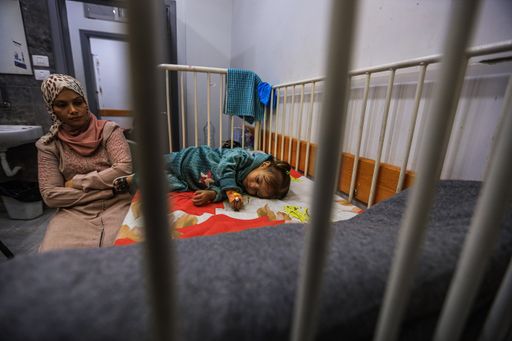
Many in Gaza to ‘Lose Access to Critical Medical Care’ as Israel Suspends Doctors Without Borders

ZIONISM IS CRUEL AND INHUMANE

“The humanitarian response in Gaza is already highly restricted, and cannot afford further dismantlement,” the renowned organization warned.
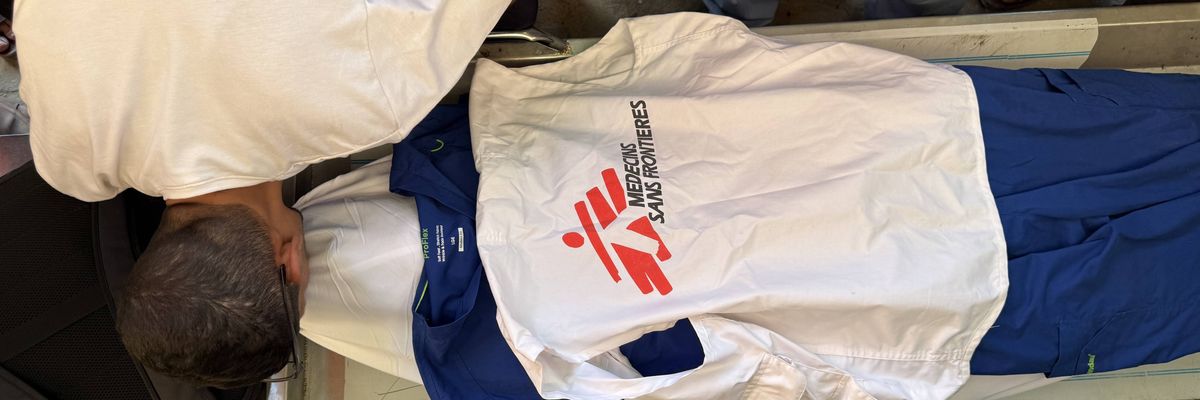


People attend the funeral of Dr. Hussein Najjar, a member of the Doctors Without Borders team who was killed by shrapnel from an Israeli airstrike, in Deir al Balah, Gaza on September 16, 2025
(Photo by Alaa Y. M. Abumohsen/Anadolu via Getty Images)

Jake Johnson
Dec 30, 2025
COMMON DREAMS

The Israeli government said Tuesday that Doctors Without Borders, one of the largest medical organizations currently operating in Gaza, is among the 25 humanitarian groups that will be suspended at the start of the new year for their alleged failure to comply with Israel’s widely criticized new registration rules for international NGOs.

According to the Associated Press, Israel’s Ministry of Diaspora Affairs “said the organizations that will be banned on January 1 did not meet new requirements for sharing staff, funding, and operations information.” The Israeli government specifically accused Doctors Without Borders, known internationally as Médecins Sans Frontières (MSF), of “failing to clarify the roles of some staff that Israel accused of cooperation with Hamas and other militant groups,” AP reported.
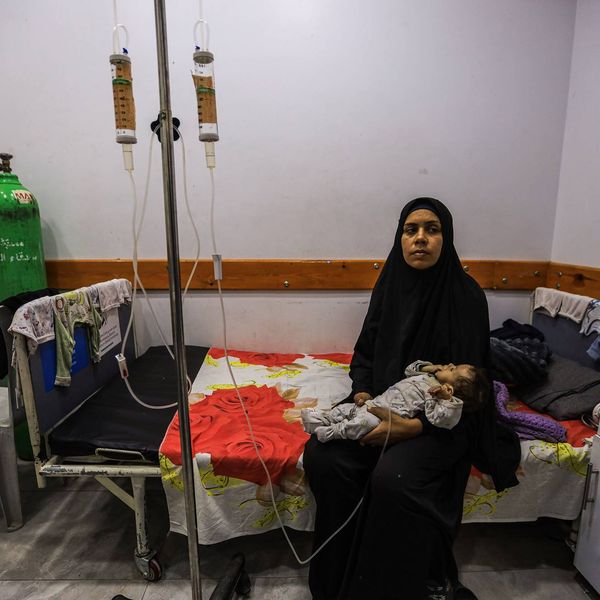

Israel’s Continued Blockade on Medical Supplies Worsening ‘Destruction’ of Gaza’s Health System


In addition to providing medical assistance to desperate Palestinians, MSF has been an outspoken critic of what has it described as Israel’s “campaign of total destruction” in Gaza. The group said in a report released last December that its teams’ experiences on the ground in Gaza were “consistent with the descriptions provided by an increasing number of legal experts and organizations concluding that genocide is taking place.”

Ahead of Tuesday’s announcement, Doctors Without Borders warned that the looming withdrawal of registration from international NGOs “would prevent organizations, including MSF, from providing essential services to people in Gaza and the West Bank.”

“With Gaza’s health system already destroyed, the loss of independent and experienced humanitarian organizations’ access to respond would be a disaster for Palestinians,” the group said in a statement last week. “The humanitarian response in Gaza is already highly restricted, and cannot afford further dismantlement.”

“If Israeli authorities revoke MSF’s access to Gaza in 2026, a large portion of people in Gaza will lose access to critical medical care, water, and lifesaving support,” the group added. “MSF’s activities serve nearly half a million people in Gaza through our vital support to the destroyed health system. MSF continues to seek constructive engagement with Israeli authorities to continue its activities.”

Pascale Coissard, MSF’s emergency coordinator for Gaza, noted that “in the last year, MSF teams have treated hundreds of thousands of patients and delivered hundreds of millions of liters of water.”

“MSF teams are trying to expand activities and support Gaza’s shattered health system,” said Coissard. “In 2025 alone, we carried out almost 800,000 outpatient consultations and handled more than 100,000 trauma cases.”

Israel’s announcement came shortly after Prime Minister Benjamin Netanyahu met with US President Donald Trump in Florida, where both dodged questions about their supposed “peace plan” for Gaza after more than two years of relentless bombing. The Israeli military has been accused of violating an existing ceasefire agreement hundreds of times since it took effect in October.

Al Jazeera reported Tuesday that “Israeli forces have carried out strikes across the Gaza Strip as they continue with their near-daily violations of the ceasefire agreement, with Israel’s genocidal war on the besieged enclave continuing apace and displaced Palestinians enduring the destruction of their few remaining possessions in flooding brought about by heavy winter rains.”
All UN Security Council Members Except US Join Somalia in Condemning Israel’s Recognition of Somaliland

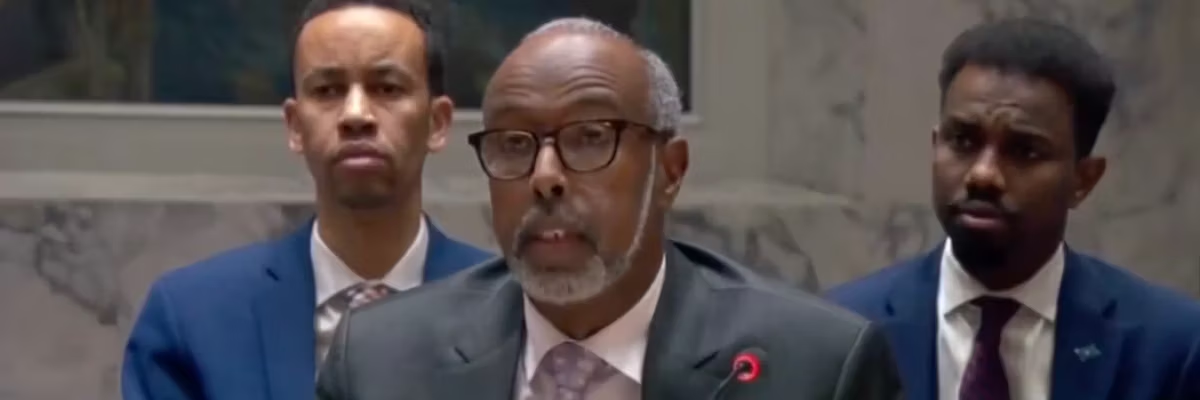
Somalia’s UN ambassador said Israel plans to “relocate the Palestinian population from Gaza to the northwestern region of Somalia,” and warned that “this utter disdain for law and morality must be stopped now.”


Abukar Osman, Somalia’s permanent representative to the United Nations, spoke at an emergency meeting of the UN Security Council on December 29, 2025.
(Photo: screenshot)

Julia Conley
Dec 30, 2025
COMMON DREAMS

At an emergency meeting of the United Nations Security Council on Monday regarding Israel’s recognition of the breakaway region of Somaliland, 14 of 15 member states joined Somalia’s permanent representative to the UN in condemning what the ambassador called an “act of aggression”—and at least one denounced the Trump administration’s defense of Israel’s move.

The emergency summit was called days after Israel announced its formal recognition of the region, which declared independence in 1991 after a civil war, but which has not been acknowledged by any other country. Somalia continues to claim Somaliland as part of the country while the region’s leaders say the state is the successor to the former British protectorate.

Israel announced its decision months after Prime Minister Benjamin Netanyahu spoke with leaders in Somaliland about a potential deal to trade formal recognition of the region for help with illegally deporting Palestinians from Gaza, and as Israeli policy advisers have argued that Somaliland could be used as a base for military operations against the Houthis in Yemen.

Despite evidence that Israel formally acknowledged Somaliland to further its own military and territorial interests, Israeli Deputy Permanent Representative Jonathan Miller arrived at the meeting Monday with the aim of explaining the “historical context” for the country’s decision.

“Entire cities were destroyed,” said Miller. “Civilians were deliberately targeted. These crimes are now widely recognized as a genocide... Israel’s then-acting permanent representative, Yohanan Bein, submitted this letter to this very council warning of grave human rights violations in Somalia... That history provides essential context for the discussion surrounding Israel’s recognition of Somaliland today.”

Abukar Dahir Osman, Somalia’s permanent representative to the UN, suggested Miller’s comments only added insult to injury, considering Israel has been assaulting Gaza for more than two years—with attacks continuing despite a “ceasefire”—and has killed more than 71,000 Palestinians in what numerous human rights groups and experts have called a genocide.

“If we want to talk about genocide, it’s Israel that’s committed this to our own eyes every day,” said Osman. “[Miller] represents a government that killed more than 70,000 people. Civilians, including children, women, elderly, doctors and other health workers, and patients in hospitals. Destroying infrastructures, deliberately starving people of Gaza.”

“To come to this place, and lecture us [on] humanity and genocide and human rights and independence and democracy. And we know what you’re doing on a daily basis,” said Osman. “It’s just an insult.”


Warning that the recognition of the breakaway region could destabilize Somalia as well as the broader Horn of Africa, the ambassador also expressed concern that Israel plans to “relocate the Palestinian population from Gaza to the northwestern region of Somalia.”

“This utter disdain for law and morality must be stopped now,” said Osman.

Other representatives expressed similar outrage, with the UN envoy for the 22-member Arab League, Maged Abdelfattah Abdelaziz, saying the group would reject “any measures arising from this illegitimate recognition aimed at facilitating forced displacement of the Palestinian people, or exploiting northern Somali ports to establish military bases.”

Muhammad Usman Iqbal Jadoon, deputy UN ambassador for Pakistan, said Israel’s move following its previous comments on potentially deporting Palestinians to Somaliland was “deeply troubling.”

Tammy Bruce, who was sworn in Monday as deputy US representative to the United Nations, was alone in backing Israel’s recognition of Somaliland, though she noted that US policy on the region has not changed.

“Israel has the same right to conduct diplomatic relations as any other sovereign state,” said Bruce. “Earlier this year, several countries, including members of this council, made the unilateral decision to recognize a nonexistent Palestinian state. And yet, no emergency meeting was called to express this council’s outrage.”

More than 150 countries, including a number of major US allies, have recognized Palestinian statehood, with nearly two dozen governments announcing their recognition since Israel began its assault on Gaza in 2023.

Samuel Zbogar, Slovenia’s UN ambassador, pushed back against Bruce’s comparison.

“Slovenia recognized Palestine as an independent state,” he said. “We did so in response to undeniable right of Palestinian people to self-determination. Palestine is not part of any state. It is an illegally occupied territory as declared by the [International Court of Justice], among others. Palestine is also an observer state in this organization.”

“Somaliland, on the other hand, is part of a UN member state and recognizing it goes against Article 2, paragraph 4 of the UN Charter,” he said.

On Tuesday, protests erupted in cities across Somalia, including the capital of Mogadishu, with demonstrators calling for national unity.


Somalis rally against Israel’s world-first recognition of Somaliland

Demonstrations sweep Somalia as the government seeks global diplomatic support.


Protesters gather at Mogadishu Stadium to denounce Israel's recognition of Somaliland, December 28, 2025 [Hassan Ali Elmi/AFP]


By Faisal Ali
On 30 Dec 2025
AL JAZEERA

Protests have erupted across Somalia following Israel’s formal world-first recognition of the breakaway region of Somaliland, with demonstrators taking to the streets in multiple cities, including the capital, Mogadishu.

On Tuesday morning, large crowds gathered at locations including Mogadishu’s main football stadium and around the city’s airport, where protesters waved Somali flags and chanted slogans calling for national unity.

The demonstrations, which also took place in Baidoa, Dhusamareb, Las Anod, Hobyo and Somalia’s northeastern regions, came as President Hassan Sheikh Mohamud travelled to Istanbul for talks with his Turkish counterpart Recep Tayyip Erdogan following a stop in neighbouring Djibouti.

Somalia and Turkiye have close political and security ties, with Ankara emerging as a regional rival to Israel in recent months.

Small gatherings also took place in Borama, a city in western Somaliland, where the population has appeared more ambivalent about separation from Somalia, to express opposition.

Somaliland unilaterally declared independence in 1991 following a civil war, but has failed to gain international recognition despite maintaining its own currency, passport and army.

Somaliland’s leaders say the state is the successor to the former British protectorate, which voluntarily merged with Italian Somaliland and has now reclaimed its independence. Somalia continues to claim Somaliland as part of its territory and does not recognise its independence.


Israel became the first and only country to formally recognise it as a sovereign state last Friday, describing the move as being in the spirit of the Abraham Accords that normalised ties between Israel and several Arab nations.

President Mohamud urged Somaliland’s leadership over the weekend to reverse the decision, warning that its territory, overlooking the strategic gateway to the Red Sea, must not be used as a base for targeting other nations.

Yemen’s Houthi rebels have said any Israeli presence in Somaliland would be considered “a military target for our armed forces”.

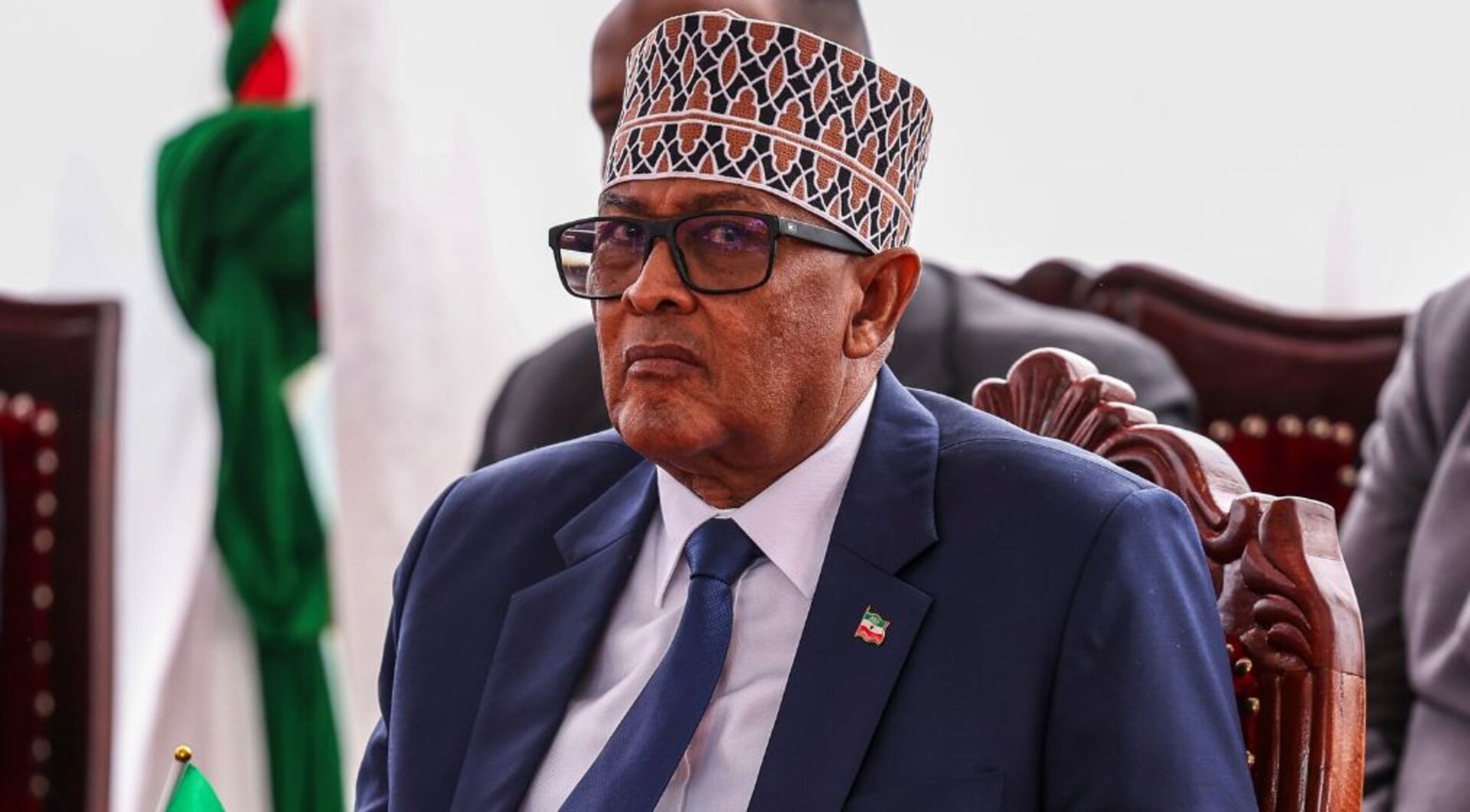
Shortly after Somaliland announced mutual recognition with Israel on Friday, President Abdirahman Mohamed Abdullahi said the move “is not a threat, not an act of hostility” towards any state, and warned that Somalia’s insistence on unified institutions risks “prolonging divisions rather than healing” them.

The widespread public anger in Somalia reflects a rare show of political unity, where leaders across the spectrum have condemned Israel’s decision.

On Monday, the National Consultative Council — chaired by Mohamud and including the prime minister, federal state presidents and regional governors — rejected the recognition as an “illegal step” that threatens regional security stretching from the Red Sea to the Gulf of Aden.

Four federal member states issued coordinated statements over the weekend denouncing the move. However, Puntland and Jubbaland — both of which recently announced their withdrawal from Somalia’s federal system over electoral and constitutional disputes — have remained silent.


Most United Nations Security Council (UNSC) members slammed Israel’s recognition of Somaliland at a meeting convened on Monday in response to the move, which several countries said may also have serious implications for Palestinians in Gaza.

The United States was the only member of the 15-member body not to condemn Israel’s formal recognition at the emergency meeting in New York on Monday, although it said its own position on Somaliland had not changed.

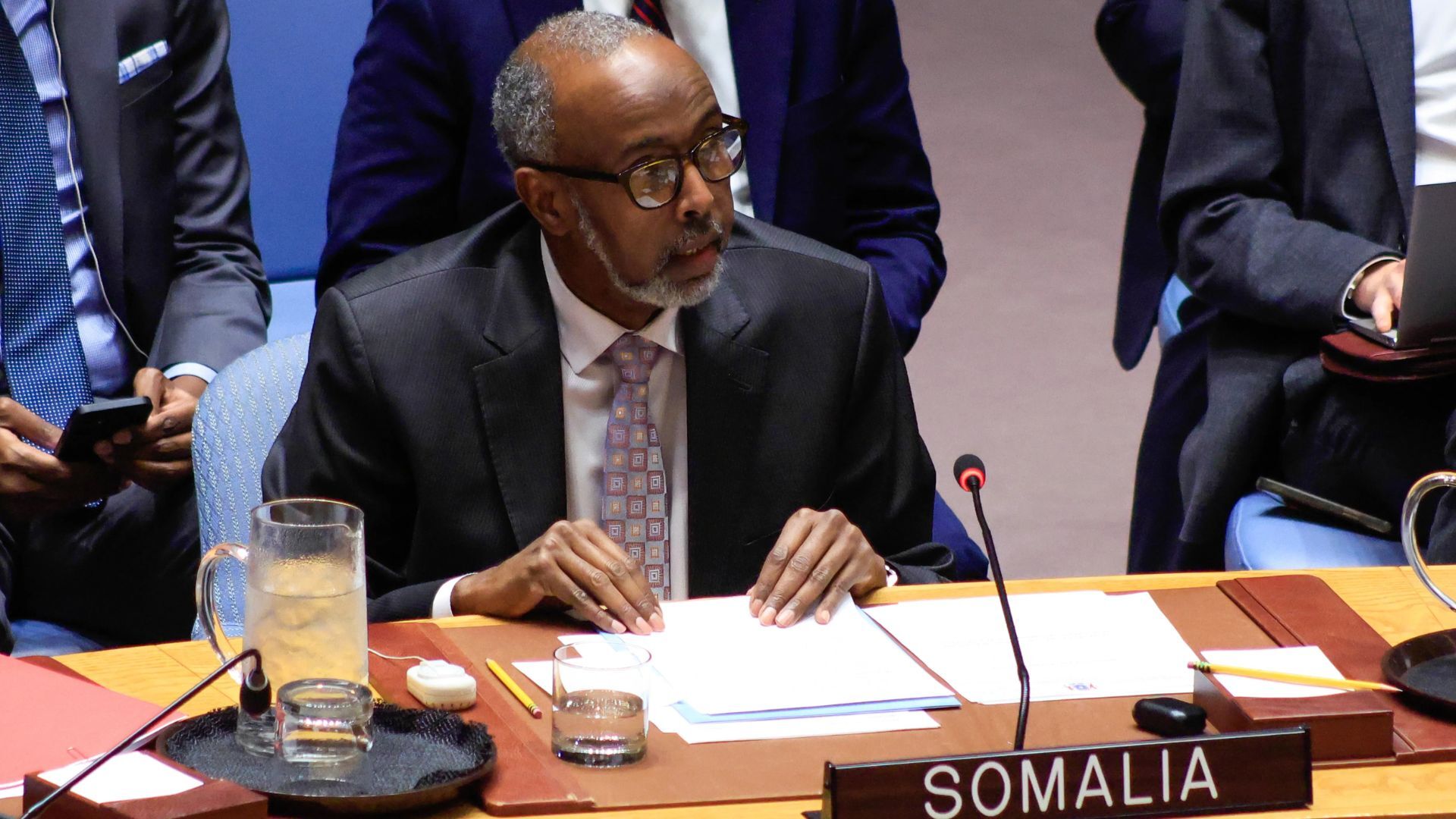
Somalia’s UN ambassador, Abu Bakr Dahir Osman, warned that the recognition “aims to promote the fragmentation of Somalia” and raised concerns it could facilitate the forced relocation of Palestinians from Gaza to northwestern Somalia, a fear echoed by several other nations.

“This utter disdain for law and morality must be stopped now,” he said.

US deputy representative Tammy Bruce told the council that “Israel has the same right to establish diplomatic relations as any other sovereign state”, though she added Washington had made “no announcement” regarding its own recognition of Somaliland.

Israel’s deputy UN ambassador, Jonathan Miller, defended the decision as “not a hostile step toward Somalia” and made the case to the UNSC for other countries to follow its lead.

Somalia’s state minister for foreign affairs, Ali Omar, thanked UNSC members for their “clear and principled” stance on the issue in a post on X.


Why Israel’s ‘recognition’ of Somaliland is fuelling fears of Palestinian resettlement

Any policy advocating the forced relocation of Palestinians from Gaza will constitute a clear violation of the commitments made under the Gaza peace plan, analysts say.


TRT WORLD
Kazim Alam
2 hours ago


Israel's decision on December 26 to become the first country to formally recognise the separatist entity of Somaliland as an “independent and sovereign state” has triggered widespread international outrage, deepening fears that it is part of a strategy to forcibly displace Palestinians from Gaza.

Even though it seceded from Somalia in 1991, Somaliland is recognised by neither the African Union nor the UN as an independent state.

Israeli Prime Minister Benjamin Netanyahu's announcement, made during a phone call with Somaliland's self-proclaimed president Abdirahman Mohamed Abdullahi, was framed as expanding cooperation in agriculture, health and technology.

Yet the move has been widely condemned as a blatant violation of Somalia's sovereignty and territorial integrity, with many linking it directly to Israel's ongoing aggression in Gaza.

The Arab League, African Union, Egypt, Türkiye, Saudi Arabia and numerous other states have rejected the recognition, explicitly warning that it could facilitate the forced relocation of Palestinians, a policy critics describe as ethnic cleansing.

At a UN Security Council briefing on Israel’s recognition of Somaliland, Pakistan called Tel Aviv’s act “deeply troubling”, given that Israeli officials have previously referred to the territory as a “destination for the deportation of Palestinian people, especially from Gaza”. 
RelatedTRT World - MSF accuses Israel of 'weaponising' aid as Gaza medical crisis persists despite truce


Yunus Turhan, a post-doctoral researcher at Harvard University’s African Studies Center, frames Israel's action as driven by dangerous strategic motives tied to Gaza.

“Israel’s decision to recognise Somaliland, despite receiving criticism from across the African continent and beyond, can be assessed within the framework of strategic calculations,” Turhan tells TRT World.

“In the short term, this move may be linked to ongoing discussions concerning forced population transfer scenarios in the context of Gaza, with Somaliland potentially being considered as one such option,” he says.

He points out that the Netanyahu government has been exploring Somaliland as an alternative destination for Palestinians.

Sudan, Somalia, Ethiopia, Libya and Indonesia are some of the other countries that Israel has reportedly approached for the resettlement of about two million Palestinians uprooted by the war in Gaza.

Israel’s plans have faced global criticism, and even Donald Trump’s 20-point Gaza peace plan explicitly states that no one will be forced to leave Gaza, and those who wish to leave will be free to do so and free to return.

Turhan says that any policy advocating the forced relocation of Palestinians will constitute a clear violation of the commitments endorsed during the first phase of the peace plan.

But the fact remains that Israel has shown little regard for peace agreements.

Since the announcement of a ceasefire on October 10, Tel Aviv has repeatedly violated the truce, killing more than 400 Palestinians.

“Israel has repeatedly deviated from such commitments in the past, and the Somaliland issue should therefore be interpreted as presenting Gazans, already exhausted by prolonged warfare, with an almost impossible choice,” he says.

Any relocation of Palestinians from Gaza will only exacerbate an already catastrophic humanitarian situation, likely resulting in additional casualties, he adds.


RelatedTRT World - Israel launches renewed air strikes across Gaza, violating ceasefire


According to Kaan Devecioglu, the coordinator for North and East African Studies at the Ankara-based think tank ORSAM, Israel’s recent discourse on “permanent security control” in Gaza cannot be reduced to a single official document establishing a direct intent-policy link with allegations of forced displacement or ethnic cleansing.

“Nevertheless, developments on the ground, including the confinement of the population to specific areas, the large-scale destruction of civilian infrastructure, and debates over plans to ‘concentrate’ the population, significantly reinforce these concerns,” he tells TRT World.

Devecioglu says the ongoing discourse threatens the Palestinians’ right to self-determination in two fundamental ways.

First, the possibility of forced displacement that weakens the people’s de facto link to their land would render any future political settlement “demographically and spatially” meaningless, he says.

Second, determining Gaza’s political future through the military and political decisions of external powers, rather than through local will, runs counter to the very essence of self-determination, he adds.

A threat to regional stability

The recognition of Somaliland’s sovereignty also advances Israel's military ambitions in the Red Sea, according to analysts.

Turhan says Israel’s engagement with Somaliland will provide it with strategic access to the Bab al-Mandeb Strait, a 32-kilometre-wide body of water between the Arabian Peninsula and Africa, connecting the Red Sea with the Gulf of Aden, a key maritime route.

“This access would enable Tel Aviv to conduct discreet intelligence, surveillance, and security operations along a critical global maritime corridor without the need for large-scale military deployment,” he says.

Devecioglu says Israel’s attempt to complement its military objectives against the Houthis in Yemen by expanding access in the Red Sea-Gulf of Aden corridor puts regional stability at risk.

He says that Israel’s recognition of a separatist entity risks encouraging the redrawing of borders in Africa through unilateral secession.

“If the African Union’s long-standing principle of preserving existing borders were to erode, pressures for chain-reaction secessionism could emerge... This would increase the risk of internal conflict across fragile states,” he says.

Turhan echoes this view, noting that Israel’s unilateral act of recognition threatens Africa’s political integrity: The move can spur more than 30 active separatist movements in 27 African countries, he says.

In early 2023, violent clashes between two major clans and the Somaliland administration resulted in the de facto separation of significant portions of three eastern provinces, he says.

These clans subsequently established a new regional administration integrated into the Federal Republic of Somalia, known as the Northeastern State of Somalia, which now exercises de facto control over nearly half of the territory commonly referred to as Somaliland, Turhan adds.

“Israel’s recognition largely overlooks these on-the-ground realities.”

SOURCE:TRT World


Russian losses in Ukraine rising faster than ever, finds new analysis

Analysis reveals a significant rise in the number of obituaries of soldiers published in Russia in the past five months


Maira Butt
Tuesday 30 December 2025
THE INDEPENDENT


Putin warns Russia will accomplish goals by force if Ukraine doesn’t want to resolve conflict peacefully

From reproductive rights to climate change to Big Tech, The Independent is on the ground when the story is developing. Whether it's investigating the financials of Elon Musk's pro-Trump PAC or producing our latest documentary, 'The A Word', which shines a light on the American women fighting for reproductive rights, we know how important it is to parse out the facts from the messaging.

At such a critical moment in US history, we need reporters on the ground. Your donation allows us to keep sending journalists to speak to both sides of the story.

The Independent is trusted by Americans across the entire political spectrum. And unlike many other quality news outlets, we choose not to lock Americans out of our reporting and analysis with paywalls. We believe quality journalism should be available to everyone, paid for by those who can afford it.Your support makes all the difference.Read more

Russian losses in the war in Ukraine have been growing at a faster rate than at any point so far since the invasion began in February 2022, new analysis suggests.

Analysis by the BBC found that 40 per cent more obituaries of soldiers were published in Russia this year compared with 2024.

The broadcaster, along with independent outlet Mediazona, compiled a list of named individuals using official reports, newspapers and social media as well as new memorials and graves. In total, they were able to confirm the names of around 160,000 people who have been killed.

Experts told the broadcaster that the figure is likely to be far higher, with the BBC's toll only likely to represent between 45 and 65 per cent of the overall total. This would mean that Moscow has suffered between 243,000 and 352,000 casualties since the war began.


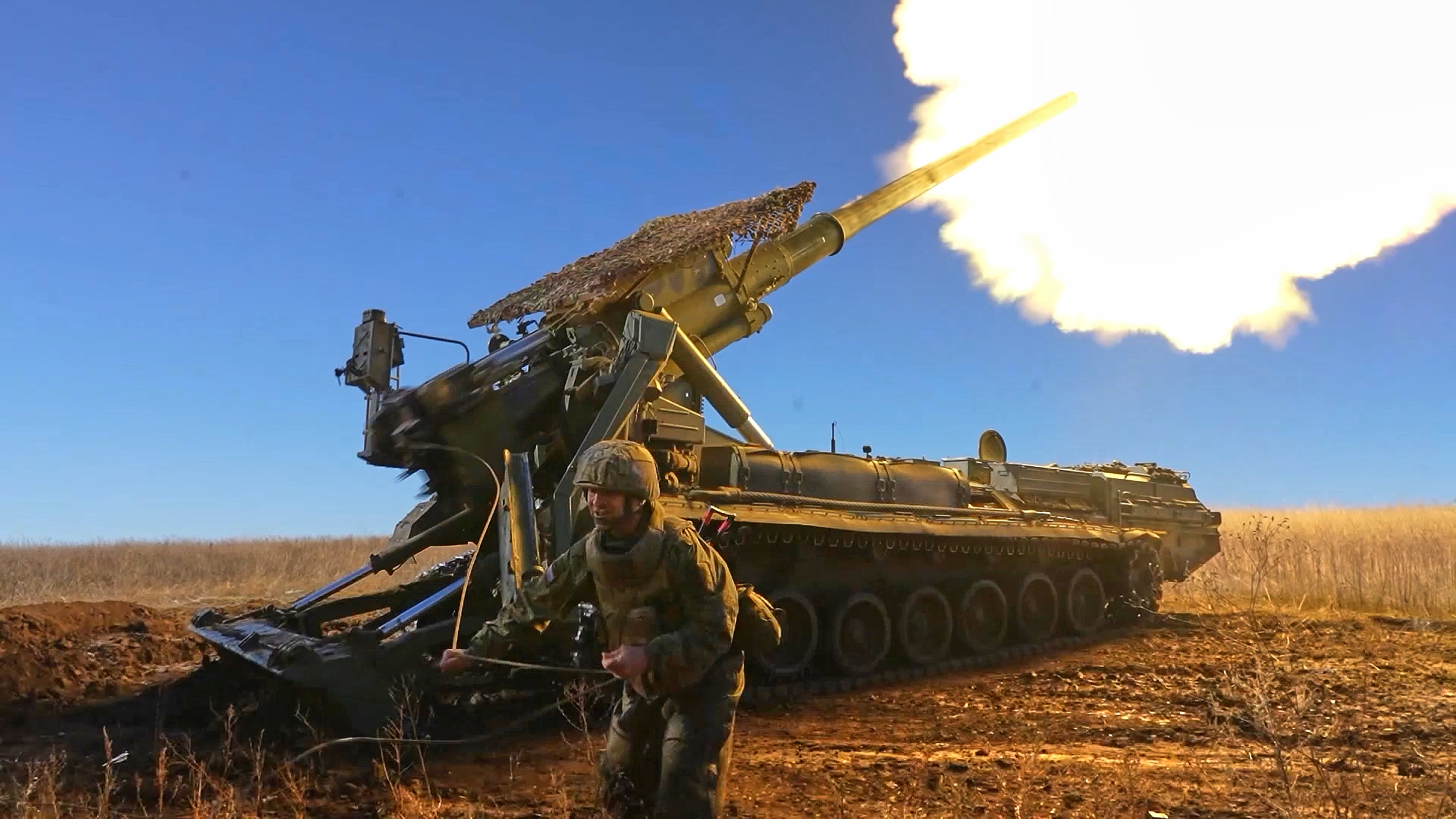
A Russian soldier fires a Malka self-propelled gun towards Ukrainian positions (Russian Defense Ministry Press Service)

The BBC's data shows that the number of obituaries being published in Russia this year saw a considerable spike in August - the same month that Vladimir Putin met with Donald Trump in Alaska for the first US-Russia summit since the war began. It peaked at 12,035 in August.

Between July 2024 and July 2025, the number of obituaries being published did not exceed 7,155.

The BBC's overall death toll appears to reflect assessments by international governments. In October, a Nato official said that more than 250,000 Russian troops had been killed in Ukraine, as part of a total of up to 1.1 million battlefield casualties.

Ukraine has seen more than 140,000 of its soldiers killed in the war, according to the BBC.


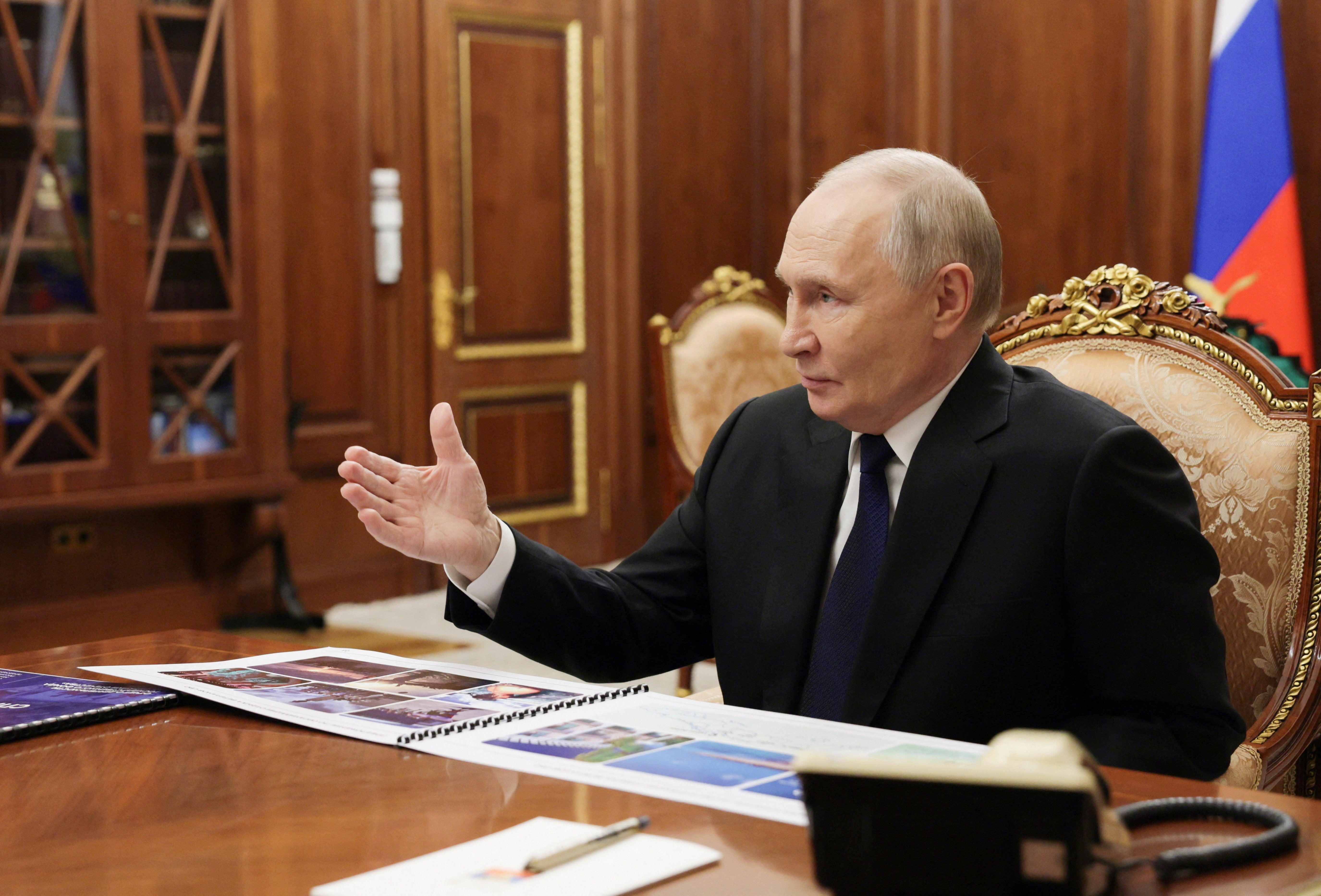
Vladimir Putin attends a meeting in the Kremlin (Sputnik)

Meanwhile, Washington's hopes of brokering a peace agreement in the near future were dashed on Tuesday after Russia accused Ukraine of launching a drone attack at one of Putin's residences - a claim emphatically denied by Kyiv.

Zelensky said the claim was a "complete fabrication" aimed at derailing the peace process, after Moscow signalled that it would harden its negotiating position in response.

Ukrainian Foreign Minister Andrii Sybiha said on Tuesday that Russia had not provided any plausible evidence of its accusations.

"Russia has a long record of false claims it's their signature tactic," Sybiha said.

Asked by reporters whether Russia had physical evidence of the drone attack, Kremlin spokesman Dmitry Peskov said air defences shot the drones down but that the question of wreckage was for the defence ministry.
Kyiv says no evidence for Putin residence attack


By AFP
December 30, 2025


Russia's invasion of Ukraine has dragged on for nearly four years - Copyright AFP ATTA KENARE


Stanislav DOSHCHITSYN

Kyiv said Tuesday there was no “plausible” evidence it launched a drone attack on one of Vladimir Putin’s residences, accusing Moscow of peddling false claims to try to manipulate talks on ending its invasion.

President Volodymyr Zelensky warned a day earlier Russia was preparing the ground for an attack on Kyiv, calling on residents of the capital to be on alert.

Moscow on Monday said Ukraine had launched drones at Putin’s secluded home in the Novgorod region, between Moscow and Saint Petersburg.

The Kremlin said Tuesday it considered it a “terrorist act” and a “personal attack against Putin” — but added it could not provide evidence for its claim as the drones were “all shot down”.

It also said the Russian army had chosen “how, when and where” to retaliate against Ukraine.

Russia has hit Ukraine with an almost daily barrage of drones and missiles for almost four years, killing thousands.

The Kremlin also said it would now “toughen” its negotiating position in talks to end Europe’s worst conflict since WWII.

Kyiv stressed Moscow had provided no evidence, despite almost 24 hours transpiring since Russia made the claim.

“Almost a day passed and Russia still hasn’t provided any plausible evidence,” its foreign minister Andriy Sybiga said on social media.

“And they won’t. Because there’s none. No such attack happened.”

European leaders rallied around Zelensky following Moscow’s allegation and — according to Poland — were set to discuss the war later on Tuesday.

“We are moving the peace process forward. Transparency and honesty are now required from everyone – including Russia,” German Chancellor Friedrich Merz said on social media.

US President Donald Trump — who spoke to Putin on Monday — directed criticism at Kyiv on Monday, despite Ukraine calling the incident a Russian fabrication.

“You know who told me about it? President Putin, early in the morning, he said he was attacked. It’s no good,” Trump said.

“It’s one thing to be offensive because they’re offensive. It’s another thing to attack his house,” the US leader said.

Russia has not said where Putin was at the time.

The longtime Russian leader’s residences are shrouded in secrecy in Russia — as is much of his private life.


– Secretive residence –


The late Russian opposition leader Alexei Navalny, who died in an Arctic prison last year, had published investigations into Putin’s luxury lake-side residence in the Novgorod region.

Putin had increasingly used the residency since the Ukraine war began, as it was more secluded and better protected by air defence installations, according to an investigation by RFE/RL.

Russia’s claim came after Zelensky held talks with Trump in Florida, with the Ukrainian leader saying it was a “fabrication” intended to sabotage diplomatic progress made by the US and Kyiv.

Moscow’s allegation comes at a pivotal moment for diplomacy to end the war.

Ukraine has said it has agreed to 90 percent of a US-drafted peace plan, but Russia has been hesitant to accept a deal that does not meet its maximalist demands.

Putin has repeatedly said that Russia intends to seize the rest of Ukrainian land he has proclaimed as Russian if diplomacy fails.

Russia’s advance in eastern Ukraine picked up pace in autumn, with Moscow’s troops seizing more villages with every week since.

Ukraine on Tuesday also ordered the mandatory evacuation of several villages in the northern Chernigiv region, which borders Moscow-allied Belarus, due to intense Russian shelling.
Putin is not preparing for peace

While Washington and Kyiv trade optimism about a possible deal, Russia’s president is signalling to his own people that the war will grind on – and that they should brace for it


Konstantin Eggert
Euractiv

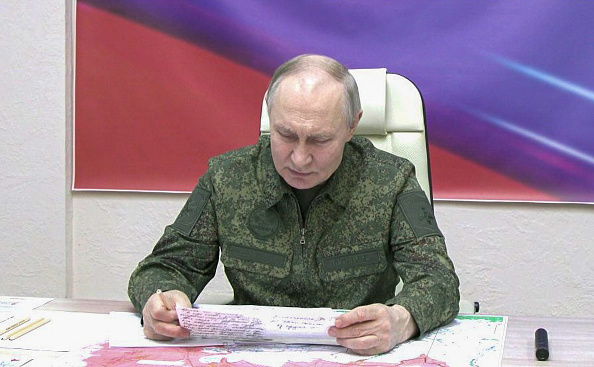
Russian President Vladimir Putin, dressed in military uniform, visited a command post in Kursk, Russia on 12 March 2025 [Photo by Kremlin Press Office / Handout/Anadolu via Getty Images]

The latest round of shuttle diplomacy between Kyiv and Mar-a-Lago has rekindled hopes of a Russia-Ukraine peace deal.

Given that the ultimate decider on peace – Vladimir Putin – wasn’t there, it’s worth taking any declarations of a breakthrough with a healthy pinch of salt. Even as Putin humours Donald Trump and his efforts to broker peace, the Russian has shown little desire to step away from the battlefield.

To understand what really has been on Putin’s mind of late, it’s worth rewinding to his annual staged press conference, which he held just before Christmas.

It was the usual marathon of rehearsed sycophantic questions, approved requests for help from Russia’s far-flung regions (“Vladimir Vladimirovich, the main road in our city of Syktyvkar wasn’t repaired for 15 years!”) and – also quite traditional – unabashed lies by Russia’s dictator.

“It was the West that started the war, we just responded”, he claimed without blinking an eye.

What was missing since the days I attended these events as the BBC Russian Service bureau editor were questions from independent Russian media (none are left inside the country). Veteran BBC correspondent Steve Rosenberg (the real one, not the imposter) asked whether Russia will launch new “special military operations” in the future.

“There won’t be, if you treat us with respect, and respect our interests, just as we’ve always tried to do with you,” Putin replied. “Unless you cheat us, like you did with NATO’s eastward expansion.”

That Russians must be ready for the indefinite continuation of the war was his only recurring message through the whole four hours that the event lasted. There was hardly any mention of peace, even though Kremlin emissary Kirill Dmitriyev was preparing to fly to Miami for the latest peace negotiations as Putin spoke.

What the Russian dictator did was address the Russians’ worries about the state of the economy. For example, he explained in some detail how low economic growth (1%, even officially) was a result of his government’s decision to avoid excessive inflation. Runaway inflation is the perennial nightmare of Russians over 50, who remember the economic turbulence of the 1990s. This group also comprises the majority of his TV audience.

Putin continues to count on their loyalty: after all, ‘saving the country from the Yeltsin-era chaos’ is what they are still supposed to be grateful to him for.

Will he be able to sustain not only the war but the public’s support for it – or at least its benign indifference? The pessimist in me says, yes. Others beg to differ. Researcher Lyubov Tsybulska of Ukraine’s Centre for Strategic Communication and Information Security recently published a convincing analysis of Russia’s depleting manpower resources and gradually decreasing sign-up bonuses for war “volunteers”, i.e. mercenaries.

The report could be dismissed as Ukrainian “infowar” operation – which to some extent it is. But to this former Muskovite, a lot of it sounds rather convincing: the regime’s desire to avoid general mobilisation as a potential factor for political instability; its pronounced unwillingness to conscript people from the well-off and better educated metropolises for the same reason; its attempts to keep recruitment alive without unleashing inflation.

There were two moments during Putin’s press-conference which served as proof of these concealed but gradually growing worries. One was when a specially invited officer, Naran Ochir-Goryayev, recently decorated with the country’s highest award (“Hero of Russia”), told Putin and the audience that “Ukrainians greeted Russians as liberators”, and extolled the virtues of quick-career making in wartime. Ochir-Goryayev (allegedly) climbed from lowly private to first lieutenant in four years of full-scale invasion. If true, I, as former officer myself, have only one explanation: the casualty rate in the Russian army is close to that of the Second World War.

Another episode was truly bizarre. A previously selected and approved caller from the North Caucasus invited Putin to his wedding. Putin responded: “I see you both are 23 and you mentioned you have been together for 8 years. This means you started at 15. It’s good!”

Putin went on to praise the – mostly Muslim – peoples of the North Caucasus for their tradition of very early marriage. Not only does taking child brides contradict the Russian penal code, the practice also violates the convictions of the majority of the population. The Kremlin, however, needs more soldiers.

Recruitment interests dictate the policy. Putin’s strategy: flatter those who can be convinced to sign up (North Caucasus is generally poor and has a strong macho culture) and set an example for others.

Anyone with Russian ears couldn’t help but understand Putin’s real message for “his” people – nothing but war awaits them in the New Year.

Konstantin Eggert is a Russian-born journalist with DW, Germany’s international broadcaster. He is based in Vilnius and was previously editor of the BBC Russian Service Moscow bureau.


Dec 30, 2025 - 12:36Last updated: Dec 30, 2025 - 12:36


Putin amends law to let Russia ignore foreign criminal courts

Russian President Vladimir Putin chairs a meeting on arms production in Moscow, Russia, on Dec 26, 2025.
PHOTO: Reuters

December 29, 2025 

MOSCOW - President Vladimir Putin on Monday (Dec 29) signed into law changes that give Russia the right to ignore judgements in criminal cases issued by foreign and international courts amid Ukrainian and European attempts to punish Moscow for its actions in Ukraine.

The move, which comes as US President Donald Trump is trying to broker a peace deal in Ukraine, appears to be a response to several initiatives to go after Russian officials and military officers for alleged war crimes in Ukraine, something Moscow denies its forces are guilty of.

Ukraine and the Council of Europe human rights body signed an agreement in June forming the basis for a special tribunal, and Europe this month launched an International Claims Commission for Ukraine in an effort to ensure Kyiv is compensated for hundreds of billions of dollars in damage from Russian attacks and alleged war crimes.

The International Criminal Court (ICC) in The Hague has also issued arrest warrants for Putin and five other Russians, accusing them of illegally deporting hundreds of children from Ukraine.

The Kremlin, which called the ICC move outrageous, says the allegation is false and that Moscow has only acted to remove children from a conflict zone for their own safety.

Under the changes to Russian law backed by Putin on Monday, Moscow will formally have the right under its own domestic legislation to disregard rulings in criminal cases taken by foreign courts on behalf of foreign governments without Russia's participation.

Rulings issued by international legal bodies whose authority is not based on an international agreement with Russia or a UN Security Council resolution can also be ignored under the changes.


New Law Specifies that Moscow will No Longer Obey Any International Courts Not Set Up by UN Security Council where Moscow has a Veto

Paul Goble

            Staunton, Dec. 29 – According to the terms of a new law just approved by the Duma and signed into law by Vladimir Putin, Moscow no longer feels itself obliged to obey any decision of an international court not established with the approval of the United Nations Security Council where the Russian Federation as a permanent member has a veto.

            The new law (publication.pravo.gov.ru/document/0001202512290002) gives legal format to what had become Russian practice and means that Moscow will no longer obey the orders of the International Criminal Court or the findings of any tribunal set up to examine Russian war crimes in Ukraine.

            That Moscow should do so is no surprise – it was highly offended when the ICC ordered Putin’s detention and trial earlier – but it represents yet another step by Moscow to remove itself from the international legal order that had been coming into being in the last several decades and provides cover for other governments that don’t like such international supervision.

            Thus, what may appear to be a small step, in fact is a giant leap toward undermining the international legal order that had emerged and throws the world back to one where the reconstitution of this order anytime soon will be difficult if not impossible, something that will further untie the hands of dictators and other authoritarians. 

Jailed Turkish Kurd leader Ocalan calls on govt to broker deal for Syrian Kurds

Jailed Turkish Kurd leader Abdullah Ocalan on Tuesday implored the Turkish government to broker a "crucial" peace deal between the Kurdish-led Syrian Democratic Forces and the Damascus government


Issued on: 30/12/2025 
By: FRANCE 24

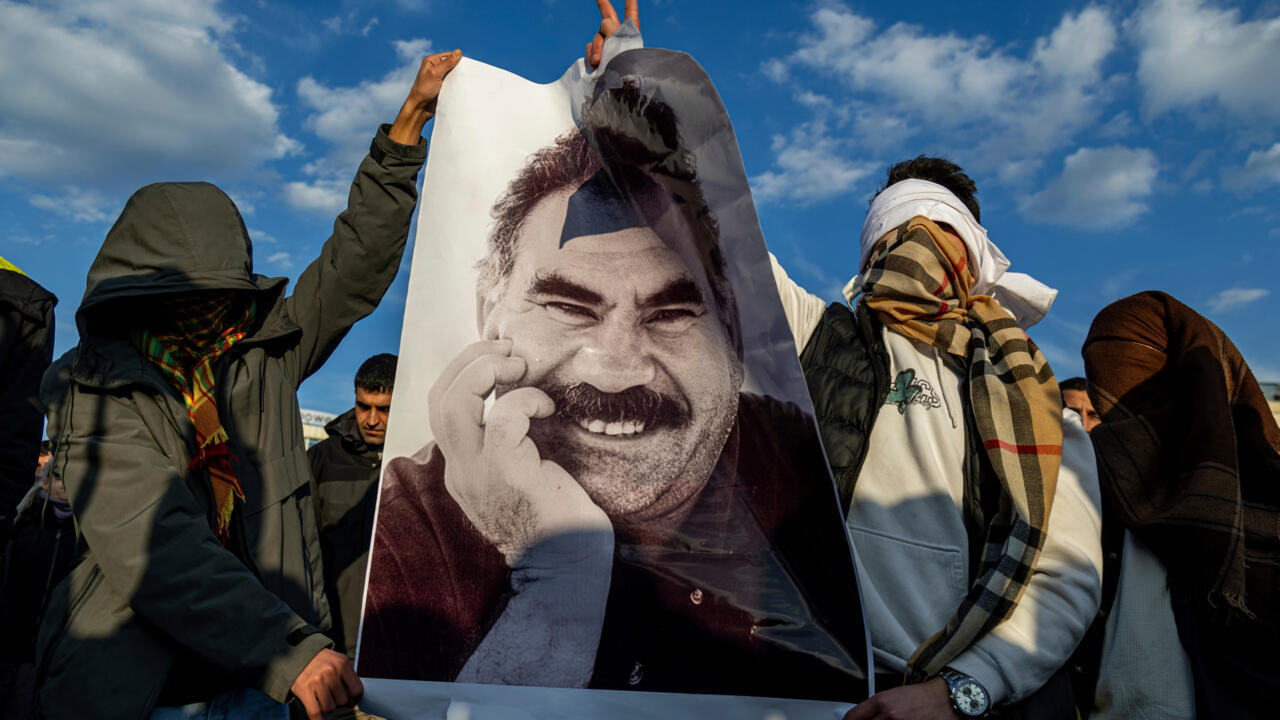
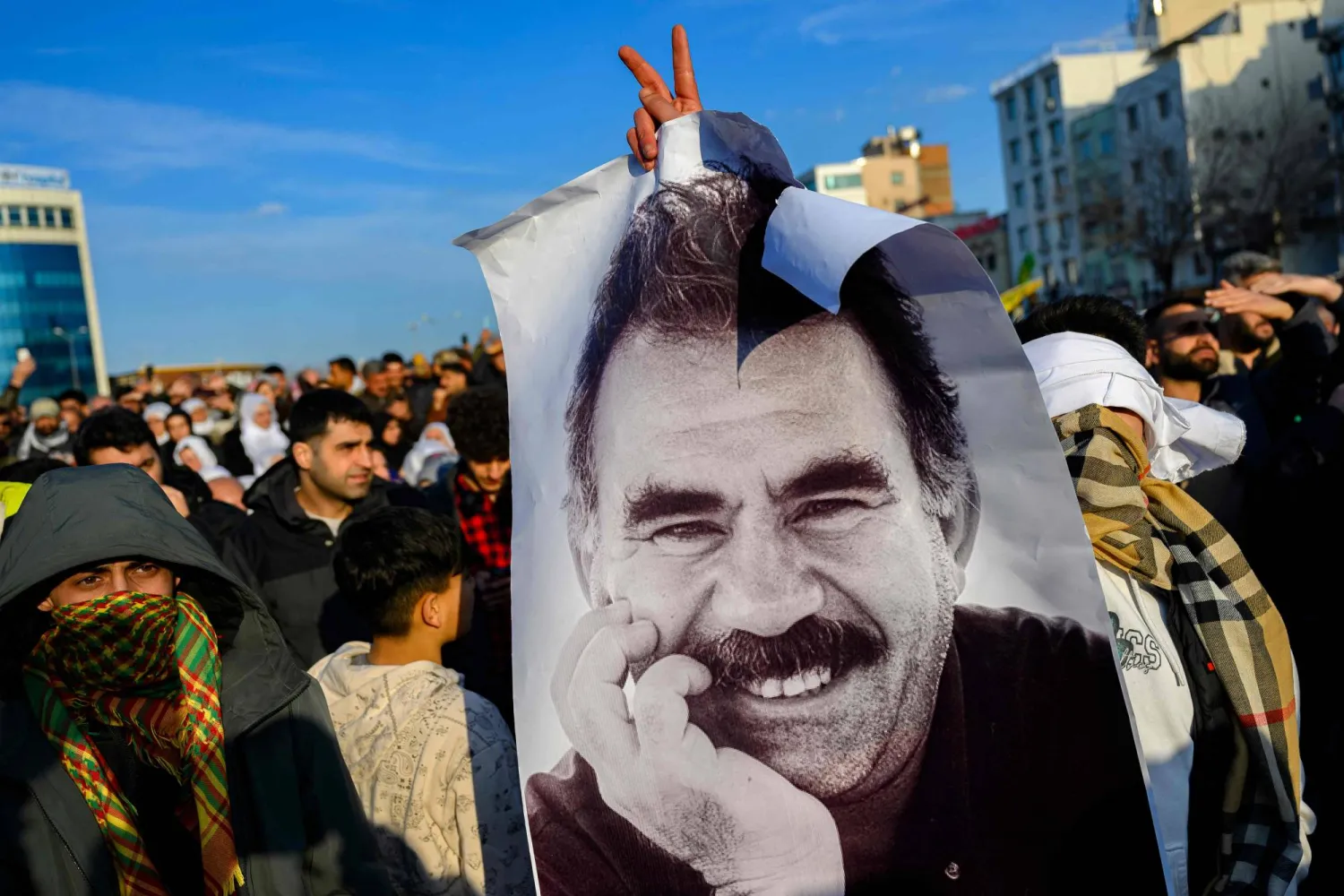
Youngsters hold a photograph of Abdullah Ocalan, the jailed leader of the militant Kurdish group PKK, in Diyarbakir, Turkey on February 27, 2025. © Metin Yoksu, AP

Jailed Turkish Kurd leader Abdullah Ocalan said in a message published Tuesday that it was "crucial" for the Turkish government to broker a peace deal between the Kurdish-led Syrian Democratic Forces (SDF) and the Damascus government.

"It is essential for Turkey to play a role of facilitator, constructively and aimed at dialogue ... This is crucial for both regional peace and to strengthen its own internal peace," Ocalan, founder of the Kurdistan Workers' Party (PKK) militant group, said in a message relayed by Turkey's pro-Kurdish DEM party.

Earlier this year, the Kurdistan Workers' Party (PKK) ended its four-decade armed struggle against Turkey at the urging of its jailed founder Abdullah Ocalan, shifting its focus to a democratic political struggle for the rights of Turkey's Kurdish minority.

The ongoing process has raised hopes among Kurds across the region, notably in Syria where the Kurds control swathes of territory in the north and northeast.

Turkey has long been hostile to the Kurdish SDF force that controls swathes of northeastern Syria, seeing it as an extension of PKK, and pushing for the US-backed force to integrate into the Syrian military and security apparatus.

(FRANCE 24 with AFP)


Jailed Turkish Kurd Leader Calls on Government to Broker Deal for Syrian Kurds


(FILES) Supporters display a poster depicting jailed leader of the Kurdistan Workers' Party (PKK) Abdullah Ocalan, after he called on the Kurdistan Workers' Party (PKK) to disarm and dissolve itself in Diyarbakir, southeastern Türkiye, on February 27, 2025. (Photo by Yasin AKGUL / AFP)


Asharq Al Awsat
30 December 2025
 AD ـ 10 Rajab 1447 AH

Jailed Turkish Kurd leader Abdullah Ocalan said Tuesday that it was "crucial" for Türkiye’s government to broker a peace deal between the Kurdish-led Syrian Democratic Forces (SDF) and the Damascus government.

Clashes between Syrian forces and the SDF have cast doubt over a deal to integrate the group's fighters into the army, which was due to take effect by the end of the year, reported AFP.

Ocalan, founder of the Kurdistan Workers' Party (PKK) group, called on Türkiye to help ensure implementation of the deal announced in March between the SDF and the Syrian government.

"It is essential for Türkiye to play a role of facilitator, constructively and aimed at dialogue," he said in a message released by Türkiye's pro-Kurdish DEM party.

"This is crucial for both regional peace and to strengthen its own internal peace," Ocalan, who has been jailed for 26 years, added.

"The fundamental demand made in the agreement signed on March 10 between the SDF and the government in Damascus is for a democratic political model permitting (Syria's) peoples to govern together," he added.

"This approach also includes the principle of democratic integration, negotiable with the central authorities. The implementation of the March 10 agreement will facilitate and accelerate that process."

The backbone of the US-backed SDF is the YPG, a Kurdish group seen by Türkiye as an extension of the PKK.

Türkiye and Syria both face long-running unrest in their Kurdish-majority regions, which span their shared border.

In Türkiye, the PKK agreed this year at Ocalan's urging to end its four-decade armed struggle.

In Syria, Sharaa has agreed to merge the Kurds' semi-autonomous administration into the central government, but deadly clashes and a series of differences have held up implementation of the deal.

The SDF is calling for a decentralized government, which Sharaa rejects.

Turkish Foreign Minister Hakan Fidan, whose country sees Kurdish fighters across the border as a threat, urged the SDF last week not to be an "obstacle" to stability.

Syrian Kurdish leader Mazloum Abdi said Thursday that "all efforts" were being made to prevent the collapse of talks.

Öcalan urges SDF to abide by integration deal with Damascus


Imprisoned PKK leader Abdullah Öcalan on Dec. 30 called on the Syrian Democratic Forces (SDF) to honor an integration agreement with the country's new administration.


Haberin Devamı
ANKARA
www.hurriyetdailynews.com/

"The fundamental demand made in the agreement signed on March 10 between the SDF and the government in Damascus is for a democratic political model permitting [Syria's] peoples to govern together," Öcalan said in a message released by the Peoples’ Equality and Democracy Party (DEM Party).

Disputes over local autonomy and recent military skirmishes have cast doubt on whether the deal will take effect by its year-end deadline.

The jailed PKK leader called on Türkiye to help ensure the implementation of the deal.

"It is essential for Türkiye to play a role of facilitator, constructively and aimed at dialogue," he said. "This is crucial for both regional peace and to strengthen its own internal peace."

The appeal come amid an ongoing anti-terrorism campaign in Türkiye, where PKK agreed earlier this year to end its 40-year armed struggle at Öcalan’s urging. A Turkish parliamentary commission is currently working on the "terror-free Türkiye" initiative to codify the peace process.

The backbone of the U.S.-backed SDF is YPG, which Ankara views as a direct extension of PKK. "The implementation of the March 10 agreement will facilitate and accelerate the process," Öcalan said.

Last week, Turkish Foreign Minister Hakan Fidan warned the SDF not to become an "obstacle" to Syria's stability. For his part, SDF leader Mazloum Abdi said "all efforts" were being made to prevent the collapse of talks.

PKK

Historical Blockages of the Left and the Radical Rupture of Öcalan

Source: Originally published by Z. Feel free to share widely.

​To understand the historical blockage of the Left, one must first expose its internal contradictions. The Left claims to criticize the state but fails to interrogate the state’s ontology. It asserts a rejection of power, yet fails to realize that its own visions of authority reproduce the same hierarchical patterns.

​While the Left emphasizes its opposition to exploitation, it remains reluctant to grasp that exploitation operates not only through economic means but through cultural, gender-based, ethnic, spatial, and even affective dimensions. In this respect, the crisis of the Left is not merely a crisis of strategy; it is a crisis of ontology, a crisis of being, of the subject, of knowledge, and most crucially, a crisis of meaning.

​At this juncture, the thought of Kurdish People’s Leader Abdullah Öcalan is either ignored or categorically rejected by modern leftist theories. The reason for this is not merely a matter of political positioning. The true reason is that this body of thought has shattered the conceptual ground upon which the Left feels comfortable.

​The Left has become a movement that produces thousands of pages of theoretical texts but remains incapable of producing its own self-criticism. Öcalan’s approach carries an inherent power of critique against the Left’s historical dogmas; it touches the Left at its weakest point: the loss of its capacity for self-explanation.

​The Left’s current inability to explain the world does not stem from the disintegration of capitalism, but rather from the fact that capitalism has reconstructed the entire social fabric in its own image. Capitalism is no longer a system to be criticized from the outside; it is an ontological framework lived from within.

​It is a fundamental regime of existence that shapes human imagination, desires, fears, modes of relation, memories, perceptions of time, and ties to space. The Left continues to attempt to analyze this regime using categories from the era in which Marx wrote; however, capitalism has long since expanded beyond Marx’s conceptual universe.

​Consequently, the narratives the Left develops about itself no longer possess definitive or explanatory power. As the Left attempts to grasp social reality, it finds itself facing a world that slips through its fingers like water. 

This is because today’s social struggle is not merely about the control of the means of production; it is about the reconstruction of the network of relationships that produce life itself. And the factor that most blinds this field is the Left’s historical and subconscious attachment to the idea of the state.

​The state is the structure that the Left overtly criticizes but subconsciously sanctifies. Throughout history, nearly all revolutionary movements have claimed to view the state merely as a tool, yet as they approached power, they could not avoid internalizing the state’s ontological logic.

​This is because the state is not a neutral organization of power; it is an apparatus that captures social energy, institutionalizes hierarchy, and subordinates the subjectivity of society to its own existence. Here lies the deepest impasse of the Left: the belief that one can transform power without first deciphering its ontology.

​The most incisive impact of Öcalan’s thought within the Left stems from his treatment of the state not merely as an apparatus of oppression, but as the foundational axis of the historical system of civilization. In his definition, the state is not an accidental institution of the modern age; it is the crystallized form of the historical evolution of male-dominated civilization, hierarchical societies, and property relations.

​This radically breaks the Left’s understanding of the state. For the Left, the state is often viewed as a “mismanaged tool,” a “power that is dangerous in the wrong hands,” or a “temporary apparatus of coercion.” Conversely, Öcalan’s perspective posits that the state is the primary cause of the failure to achieve liberation, rather than its instrument. This is a theoretical upheaval that the Left finds difficult to accept.

​Precisely for this reason, the idea of “stateless democracy” emerges within the Left as a proposition that is both radical and unsettling. The Left’s century-old strategic vision has ultimately been anchored to the seizure of the state.

​To suggest that the passion for seizing the state is futile or that it even paralyzes the struggle for freedom is to target the foundational narrative of the Left. The Left’s defensive reflex against this proposition points to a fear it has failed to resolve within itself: the inability to conceive of a revolution without power.

​However, freedom cannot be established by reproducing the mechanics of power. Every form of centralism, even when emerging with the most revolutionary intentions, eventually turns into a machine that extinguishes social creativity and subjectivity. Therefore, criticizing the state is insufficient. 

The state must be removed as a category of “solution.” The Left’s inability to accept this idea is not just a theoretical resistance but a psychological one. The Left has built its historical legitimacy through a struggle aimed at the state.

​The reason Öcalan’s thought creates such friction within the Left is his assertion that a politics beyond the state is possible. 

This politics centers not on seizing power, but on its dispersal. Not on centralization, but on social self-governance. Not on representation, but on direct social participation. Not on hierarchy, but on horizontal organization. When moving outside the paradigm familiar to the Left, politics ceases to be a struggle for power and becomes the process of society creating itself.

​In this context, the centralization of women’s liberation is not just a promise of social transformation; it is a shift in the ontological ground of political theory. 

Women’s liberation signifies the destruction of the historical continuity of patriarchy, and without dismantling patriarchy, the dismantling of the state and capitalism is impossible. This is the rupture that reveals the male-dominant structure hidden within leftist theory. The discomfort the Left feels in the face of this critique demonstrates that patriarchy remains the deepest subconscious of the Left.

​Placing women’s liberation at the heart of the revolution means redefining revolution itself. This implies a change in the subject of the revolution, its objective, its method, and its epistemology.

​The reason the Left cannot internalize this transformation is that it has always viewed revolution as a power dynamic, a struggle for dominance, and a moment of violence. Yet, when freedom is situated outside of violence, moved beyond power, and transcends the state, revolution attains its true meaning.

​This perspective mandates that the Left transcend the boundaries of its own historical universe. The Left can no longer exist solely by criticizing capitalism. Capitalism has become a system that feeds on critique; it absorbs every criticism directed at it and reproduces itself through them. Therefore, critique alone is not revolutionary. What is radical is to move beyond critique and construct an alternative ontology.

​Öcalan’s thought is a radical rupture for this very reason: it does not settle for critique; it proposes a new social ontology, a new sociology of freedom, a new vision of democracy, a new understanding of the subject, and a new political practice. The conventional conceptual universe of the Left is insufficient to meet any of these proposals. The Left will either accept this paradigm shift and reconstruct itself, or it will continue to exist as a nostalgic movement on the margins of history.


The books he wrote are technically submissions to various courts, in Turkish called savunmalar, 'the defences', but are also a discussion of the Kurdish issue.

The future is democratic confederalism. Page 45. 45. Writings by Abdullah ocalan ... the Kurdish Question (Summary), Cologne, 2011, PDF http://www.freedom ...

“Freedom for Abdullah Öcalan – Peace in Kurdistan”. P.O. Box 100511. 50445 Cologne. Germany www.freedom-for-ocalan.com www.freeocalan.org www.ocalan-books.com ...

chures on specific themes that are important in his writings. ... www.ocalan-books.com www.democraticmodernity.com. Page 40. “Ecology stands for ...

... books sent to Abdullah. Öcalan during his captivity. A complete list of books available to Öcalan can be found at www.ocalan-books.com. 4. Page 7. Manifesto ...

In his prison writings, the liberation of women is touched on numerous times as part of Öcalan's discussions of history, contemporary society and political ...

PDF Icon. download. Download Free PDF. Download Free PDF. PRISON WRITINGS THE ROOTS OF CIVILISATION ABDULLAH OCALAN. Profile image of serhat masis serhat masis.