Tuesday, January 27, 2026

In times of systematic intimidation, complicit silences and institutional cowardice, the joint decision by the Vrije Universiteit Brussel, the University of Antwerp and Ghent University to award an honorary doctorate to Francesca Albanese is not a routine academic gesture. It is a stand. It is an ethical affirmation. And above all, it is a declaration of intellectual independence in a global climate in which telling the truth has become an act of risk.

For the first time in their history, in a solemn ceremony to be held on April 2 in Antwerp, these three Flemish universities — all of them benchmark institutions in Europe in research, international law, social sciences and the humanities — have decided to jointly confer the highest academic distinction on a jurist whose professional trajectory embodies with rare coherence the values the university claims to defend: rigor, honesty, courage and service to the public good. This is neither a coincidence nor a symbolic concession. It is a community of the highest intellectual level choosing to speak with a single voice.

Francesca Albanese is an international lawyer with a solid, extensive and deeply respected career in the field of human rights. Before assuming in 2022 the position of United Nations Special Rapporteur on the situation of human rights in the occupied Palestinian territories, she worked for more than a decade as a legal adviser and expert within various UN mechanisms, specializing in international humanitarian law, civilian protection, forced displacement and state responsibility. Her mandate was renewed in 2025, an explicit recognition of her technical quality and the independence with which she has exercised a function particularly exposed to political pressure.

The official statements issued by the universities are clear and deliberate. In their joint declaration, the institutions underline the “exceptional commitment of Francesca Albanese to the protection of human rights and the strengthening of international law”, as well as her ability to exercise her mandate “with professional independence and legal rigor in contexts of extreme polarization”. This is not empty praise: it is an accurate description of a career built on evidence, law and responsibility.

From the Vrije Universiteit Brussel, its rector has insisted that the university is not a neutral space in the face of injustice, but a place where critical thought must remain free from external pressure. The University of Antwerp has stressed that this joint recognition expresses a shared conviction: that academia has an inescapable social responsibility when international law is systematically violated. Ghent University, for its part, has emphasized that honoring Albanese is honoring the principle that research and legal analysis cannot be subordinated to campaigns of intimidation or to contingent political interests.

That last point is not minor. Because the announcement of the doctorate has been followed, as was predictable, by a smear offensive driven by Zionist organizations that operate as political lobbies, not as academic actors. We are not speaking of religious communities or cultural identities. We are speaking of organized political structures that, for years, have sought to discredit, silence or expel from the public sphere any voice that documents the crimes of the State of Israel and the colonial and violent nature of the Zionist project in its current expression.

The pattern is familiar and crude: distortion of statements, unfounded accusations, media pressure, veiled threats to institutions, moral blackmail through the instrumental use of antisemitism. None of this withstands serious analysis. And none of it has been enough to make three elite universities retreat. On the contrary: they have reaffirmed their decision with clarity, laying bare the abysmal distance between rigorous intellectual work and the dirty game of those who confuse intimidation with argument.

The background to this dispute is not abstract. It is material. It is human. It is bloody. The reports presented by Francesca Albanese to the United Nations constitute one of the most severe and meticulously substantiated documentations of the destruction of Gaza. In them, the rapporteur explains that, when considering not only direct deaths caused by bombings and military attacks, but also indirect deaths caused by induced hunger, the collapse of the health system, the deliberate destruction of civilian infrastructure, dehydration, preventable diseases and massive forced displacement, the real number of Palestinians killed reaches, at a minimum, 680,000 people, a civilian population composed overwhelmingly of children, women and the elderly.

This figure is not rhetorical. It is not propaganda. It is the result of applying legal and epidemiological standards historically used to assess mortality in contexts of mass destruction. And it is, moreover, a conservative figure. Albanese herself has been explicit in stating that the impossibility of counting the dead with precision — bodies under the rubble, destroyed records, razed hospitals — is part of the crime itself. Genocide does not only kill: it erases.

Faced with that reality, the reaction of the Zionist organizations that today attempt to sabotage this academic recognition is not a defense of ethics or historical memory. It is the reaction of a political apparatus that knows itself exposed, challenged and increasingly isolated in the face of evidence. It is the symbolic violence of those who cannot refute the facts and instead choose to attack the one who names them.

The response of the Belgian universities is therefore profoundly significant. They are not rewarding an opinion. They are recognizing a professional life dedicated to law, rigorous research and the defense of the most basic principles of international legality. They are saying, without ambiguity, that the university does not bow to political bullying or moral blackmail. They are reminding us that knowledge does not submit to power when power commits crimes.

Francesca Albanese is not a fleeting figure nor an occasional provocateur. She is a solid jurist, a serious researcher and an international public servant who has assumed the cost of saying what many prefer to silence. And that is why she is attacked today. And that is precisely why she is honored.

Neither all the money, nor all the influence, nor all the disinformation machinery of the criminals who today ravage Gaza will be able to silence an honest voice. Much less extinguish her brilliance. Because when intelligence is exercised with ethics, and the university remembers its reason for being, the truth always finds where to stand.

And this time, it is sustained by a community of the highest academic level that has decided not to look the other way.Email

Claudia Aranda is a journalist in Pressenza's Chile team.

Resisting the Empire Next Door, Protests in Mexico Grow

Source: Truthout

An anti-imperialist movement is building in Mexico, where the U.S. invasion of Venezuela has been seen as an act of intimidation for all of Latin America. Protests are swelling in response to this latest blow after decades of political and economic subjugation by its neighbor to the north.

Across the country, larger-than-usual marches on January 3 and 10 condemned the U.S. attacks on Venezuela. The marches included some pro-Morena groups (the governing party) as well as students, workers, farmers, and Indigenous groups that are critical of Morena.

Over a hundred organizations met in university union offices in Mexico City and collectively

condemned the U.S. intervention in Venezuela, calling for anti-imperialist action around the continent, as “Latin American sovereignty is at stake.” The Zapatistas also released a statement, supported by around 170 organizations in Mexico, in solidarity with the Venezuelan people and denouncing “big capital’s wars of conquest.”

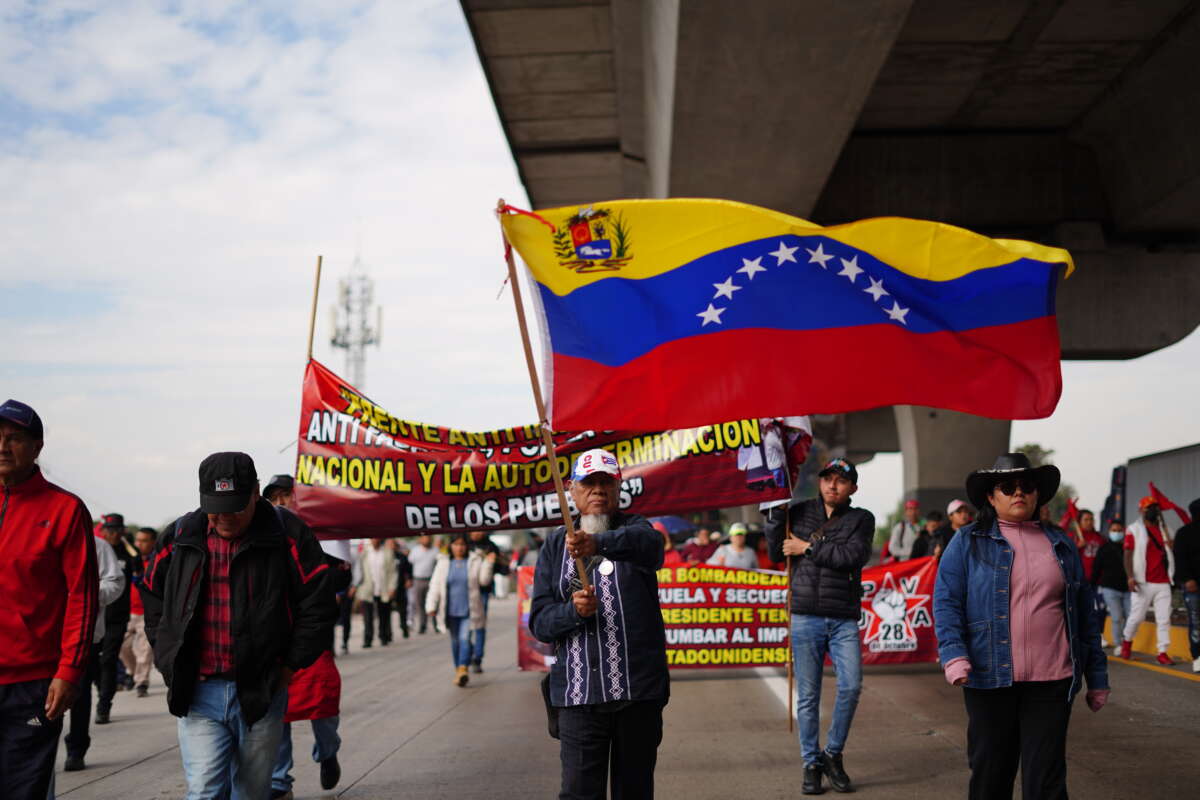
In Mexico City, unions, environmentalists, feminists, sexual diversity activists, students, movements for housing rights, and anti-racists chanted “Yankees out of Latin America” and held banners that read “Down with the Monroe Doctrine.”

Here in Puebla, thousands of street vendors, small farmers, university workers, students, solidarity groups, and revolutionary organizations chanted, “We don’t want to be a colony.” The local anti-imperialist front was created on January 12.

“The day the U.S. bombed Venezuela, we mobilized in Puebla … and we condemned the aggression and denounced that this would be the start of something bigger,” Rubén Sarabia Sánchez, known as Simitrio, tells Truthout. The founder and general advisor of the UPVA 28 de Octubre, which organizes thousands of market and street vendors in Puebla, he has been a political prisoner twice and his daughter was murdered in 2017 as part of the repression of the group.

The front also called for another protest on January 21. That day, some 10,000 people shut down a major highway and marched along it for six kilometers (3.7 miles). “We’re not heard unless the circulation of goods are affected,” Simitrio said.

Other fronts have been formed around the country, including in Guanajuato, where civil society groups are calling for the withdrawal of all U.S. troops from Latin America. In Sinaloa, the new front has held protests in Culiacán, rejecting the U.S. attacks on Venezuela and defending self-determination throughout the continent.

“The sentiment in the marches has been ‘if it happens to them, it could happen to us.’ It seems like the U.S. president has no limits now,” Axel Hernández tells Truthout. He is part of the Journalism Cooperative in Mexico City, which has been documenting police abuse at protests and observing movements against gentrification, for water rights, and against the upcoming World Cup to be held in Mexico City, among other venues.

“With the supposed ceasefire in Gaza, the mobilizations for Palestine became smaller, but now we are seeing huge numbers of people coming into the street, for some of the biggest mobilizations in the past year … including unions, housing organizations, and even some members of Morena, and some of its leaders like the writer Paco Ignacio Taibo,” Hernández said. Formal political parties like Morena, PRI, PAN, etc. aren’t typically welcome in most mobilizations, such as demonstrations for women’s rights or for the forcibly disappeared.

Mexico’s National Education Workers Union (CNTE), with an estimated 350,000 members, condemned the attack on Venezuela, saying it confirmed Trump’s “monopolizing ambitions towards Latin America” and his “determination to use his military power for the capitalist interests of his empire.” Rural Indigenous organizations also released statements of solidarity, noting “Trump thinks the whole world is his village … but we understand that it is the people’s time … to wake and unite more.”

At the same time, a few right-wing figures in the country celebrated the attacks on Venezuela, with billionaire and media mogul Ricardo Salinas Pliego calling it a “victory” and source of “hope” for Mexico.

President Donald Trump’s direct threats and attacks against Mexico and Latin America have continued since the U.S. kidnapping of Venezuelan President Nicolas Maduro, with the U.S. selling stolen Venezuelan oil on January 14. The next day, The New York Times reported that the U.S. was intensifying pressure on Mexico to allow U.S. military forces into its territory, allegedly to dismantle fentanyl labs. Trump has also said the U.S. could strike land targets to combat cartels in Mexico. Then, on January 16, the Federal Aviation Administration issued a 60-day-long warning urging airlines to “exercise caution” over Mexico, Central America, Ecuador, and Colombia due to “military activities.”

“January 3 was a bigger blow in a war that has been going on for many years,” Miguel Guerra Castillo, an organizer of a new anti-imperialist front in Puebla and national leader of the Popular Socialist Party of Mexico, told Truthout. “But it was a warning and Mexicans are realizing this threat affects us.”

U.S. Pressures Mexico With Calls for Boots on the Ground

While Trump paved the way for military intervention in Venezuela by first bombing boats in the Caribbean under the pretext that they were supposedly trafficking drugs, his threats against cartels may also be laying the groundwork for actions in Mexico. Many U.S. companies depend on Mexico for nearshoring, low-paid labor, and access to land, water, and energy that is cheaper than in the U.S. Trump “wants to take control of” Mexico’s petroleum, water, and lithium, said Simitrio.

Trump designated six Mexican cartels as foreign terrorist organizations in February 2025. Nearly a year later, on January 7, 2026, he called for a US$1.5 trillion military budget for 2027, up from $901 billion for this year. The next day, he suggested that the U.S. military could launch land strikes on drug cartels in Mexico. “We’ve knocked out 97 percent of the drugs coming in by water. And we are going to start now hitting land, with regard to the cartels,” Trump said, adding, “The cartels are running Mexico, it’s very sad to watch and see what’s happened to that country.”

Anti-imperialist organizers in Mexico see Trump’s statements as a cover for U.S. imperialism.

“Drug trafficking is the pretext, the reality is that they want to impose their policies of domination on Mexico,” said Guerra.

Simitrio agreed. “Yes, it’s a pretext, a construct created by the United States to justify aggression whenever they want something.”

Mexico has already lived through a U.S.-led so-called “War on Drugs,” with disastrous consequences for the country. In 2006, then-president Felipe Calderón launched a military offensive against cartels, heavily supported by U.S. funding and strategy through the Merida Initiative. Conflict and violence between security forces and armed groups led to more violence, and organized crime groups bloomed, growing from just a handful in 2006 to reportedly over 400 by 2021, “many of them with ties to the U.S,” Business Insider noted. Further, the vast majority of cartels’ guns come from the U.S. now. From 2006 to 2020, there were over 250,000 narco-related deaths in Mexico — with homicides in Mexico tripling in the first six years of the “War on Drugs.”

On January 14, three U.S. congresspeople introduced the No Unauthorized War in Mexico Act to prohibit taxpayer funds being used for military invasion of Mexico. However, its passage is unlikely, as a resolution to limit the future use of U.S. military force in Venezuela has already failed.

Bilateral “Collaboration” Amid Fear and Intimidation

The attack on Venezuela demonstrated that the U.S. under Trump is ready for escalation. The attack “was also to plant fear, to demobilize us,” said Guerra, “It’s an intolerable pressure, that we can’t ignore or assume nothing will happen. Nor should we see it as a done deal. The United States has global military supremacy. It is the international police, and with the latest policies, they have declared themselves the owners of the Americas.”

Nearby, Cubans are also anxious, as Trump has said Venezuelan oil supplies — a lifeline to the country — will be cut. The U.S. is saying Cuba has to make a deal before it’s “too late,” but Cuba is refusing.

“The threats regarding supplies have people worried, but at the same time, they’re used to it … from friends, I’m getting angry resignation. More worrying, is the idea of military intervention, though many don’t think that is likely, since Cuba doesn’t have oil or key resources. But with Trump, anything is possible,” Catriona Goss told Truthout from Havana.

Mexican President Claudia Sheinbaum has offered to mediate dialogue between the U.S. and Cuba, and this month she has consistently responded to Trump’s pressure on Mexico with rhetoric about “coordination” and “cooperation.” She has also stressed the Mexican government’s “positive results” in capturing key criminal leaders and destroying drug laboratories. However, if drugs are just a pretext, as was the case in Venezuela (Trump has only talked about and sold oil since the intervention), then such “collaboration” by Mexico will have its limits.

Just over the past year, the U.S. has canceled CBP One appointments and left thousands of migrants and refugees stranded in Mexico. Mexico has sent troops to its north and south borders to appease U.S. anti-migrant policies, and the U.S. has forced Mexico to continue to “cooperate” via tariffs as threats or punishments.

Mexican officials have reported that in every call between Trump and Sheinbaum, the U.S. president has raised the specter of troop deployment. As a result, the government is reassessing its assumptions that obedient economic and security policies are sufficient to protect Mexico from unilateral U.S. action.

“The U.S. has never stopped attacking our continent — with weapons or economically, it’s always there, protecting its economic and geopolitical interests,” said Hernández.

Transnationals Are Prioritized as Trade Talks Approach

Sheinbaum and Trump also disagree on the United States–Mexico–Canada Agreement (USMCA) — the new version of NAFTA that went into effect in 2020 — which is due for review in July. Trump said on January 14 that the USMCA is “irrelevant” without any “real benefits,” while Sheinbaum believes it is important, given the highly integrated economies between the three participating countries. But while major automakers have said they depend on it, Mexican people and the environment do not benefit in the long term. The USMCA promotes extractivism and mining and protects transnational miners over Indigenous communities’ rights and the Mexican environment. It also permits extreme wage inequality between U.S. and Mexican workers who are doing exactly the same work for the same company.

Trump is only against the USMCA because he wants to be able to use tariffs to extort, Simitrio explained. The agreement includes a no-tariffs policy for products that meet certain requirements and are largely made in North America.

“I don’t think there is real sovereignty here, because economic interests take precedence. The law, or the Mexican state, always come down in favor of transnational companies,” Hernández said, agreeing with Estrada that, “Everything changed with NAFTA, now the USMCA. I was born after NAFTA, but all the uncles and parents always talk about how things were different before it.”

NAFTA opened Mexico up much more to imports and exports, and U.S. multinationals quickly set up hundreds of factories to exploit Mexican labor and resources. NAFTA provisions forced Mexico to tolerate most pollution and environmental consequences of these factories, as the government could be sued if environmental regulations negatively impacted transnationals’ profits. NAFTA reorganized Mexico’s economy, replacing local products and food traditions with U.S. products, and millions lost their jobs and land.

As a continuation of this approach, under USMCA, U.S. corn exports to Mexico (where Indigenous people created modern corn) are protected, Mexico can’t ban genetically modified crops from the U.S., and private pharmaceutical corporations are prioritized over public health.

“United States imperialism is in our veins — it’s not just this external thing where they crush and pressure you from the outside, it’s also within the economy,” said Simitrio. He believes the Mexican government uses sovereignty as a “disguise for subordination to the United States,” and describes how transnationals are often the main beneficiaries of fuel, energy, and other resources, even when petroleum is extracted and managed by a state company.

Coca-Cola for example, uses 419.7 million cubic meters of water a year, leaving many Chiapas residents without water, and private car manufacturing has increased its energy consumption (provided by the publicly-owned CFE) by 75 percent over the past decade.

The three countries in USMCA will also host the World Cup in June and July this year. The event is bringing other issues to the forefront, Hernández said, as the Mexican government is spending a lot of money and time on tourism, while urgent social issues are sidelined.

“Processes of colonization that have been denounced and protested for a while are more visible now,” he said, referring to displacement of Indigenous and other local communities and the diversion of resources for gentrification, multinational construction, and transnationals like FIFA and Airbnb. Protesters argue that the proliferation of Airbnb and other types of gentrification are increasing the rent of locals and leading to mass evictions by landlords, while legislation fails to protect renters and Mexico City has an agreement with Airbnb to promote tourism.

Protesters outside the U.S. embassy on January 18 called for a boycott of U.S. chains like Walmart and McDonald’s because they “finance wars” and for a boycott of the World Cup because the government is prioritizing it and the needs of tourists over the needs and demands of movements.

“Younger people in Mexico haven’t known any life other than being under the thumb of an empire,” Juan Francisco Estrada García tells Truthout. He is a university professor and general secretary of SUNTUAP, the University of Puebla Workers’ Union that was a key convener of the recent anti-imperialist marches in Puebla.

“What happened (in Venezuela) is a continuation of history, of the U.S. tradition of ruling over the governors — imposing its will through local leaders,” said Estrada. “It’s a system that was established a very long time ago. The U.S. is present everywhere in Mexico, it owns half the country, it is meddling in everything.”Email
avatar

Tamara Pearson is an Australian-Mexican journalist, editor, activist, and literary fiction author. Her latest novel is The Eyes of the Earth, and she writes the Global South newsletter, Excluded Headlines.

‘The Jungle is Back’


International politics has always been violent, selective, and unequal. What is different today is the disappearance of restraint as a governing norm.


Anti-ICE signs during protest in San Diego. Photo: Micah Fong

For much of the 20th century, international relations lived on a powerful hope, that the raw struggle for power could be disciplined, fenced in, and gradually civilised. Late US President Woodrow Wilson gave this hope its most enduring metaphor. The world, he believed, need not remain a jungle governed by brute force; through law, institutions, and collective security, it could be transformed into something closer to a zoo, although still dangerous, still hierarchical, but regulated, predictable, and constrained by rules. That vision never fully described reality, but it shaped behaviour by shaping expectations. Today, that hope has quietly expired.

What we are witnessing is not simply a rise in conflict or a breakdown of diplomacy. International politics has always been violent, selective, and unequal. What is different today is the disappearance of restraint as a governing norm. Power no longer feels obliged to justify itself convincingly. Institutions still speak, but they no longer command. Law remains present, but increasingly as language rather than limit. The jungle is back, not as rhetoric, but as structure.

This return did not begin with any single event. Yet recent developments make the shift difficult to ignore. Israel’s sustained and widening military actions, from the prolonged devastation of Gaza, to repeated strikes in southern Lebanon, to covert and overt operations linked to Iran, and even escalatory signalling toward Gulf actors, such as Qatar, illustrate how geographical restraint has collapsed alongside political caution.

The United States’ direct military strikes against alleged Iranian nuclear sites, its earlier interventionist posture toward Venezuela, and its unusually open endorsement of civilian protests against the Iranian government further blur the line between diplomacy, coercion, and regime pressure. These actions are no longer framed as exceptional; these are justified as routine instruments of “security management.” Security is once again understood primarily in terms of capability, not commitment; deterrence, not diplomacy.

This moment vindicates an old but uncomfortable insight. As German-American political scientist Hans Morgenthau once warned, international politics, like all politics, is a struggle for power. For decades, liberal internationalism sought to soften this struggle through institutions and norms. It did not eliminate power politics, but it placed a moral and procedural tax on its use. That tax is now being steadily dismantled.

 The contemporary revival of explicitly nationalist rhetoric, captured vividly in the MAGA refrain that “the jungle is back” does not merely describe this shift; it celebrates it.

 Consider the condition of global institutions. The United Nations was never meant to abolish great-power rivalry; it was designed to manage it. Its effectiveness rested on a fragile assumption: that major powers, despite competition, shared an interest in preserving minimum restraints. That assumption is increasingly untenable.

In 2025 and 2026, repeated emergency UN sessions on Gaza, Lebanon, Iran, and Ukraine produced familiar outcomes, such as statements, condemnations, draft resolutions, followed by paralysis. The spectacle remains, but the authority has thinned.This is not institutional failure in the dramatic sense; it is institutional hollowing. The UN today functions less as a site of decision and more as a platform for narrative positioning. Law is invoked selectively, sovereignty defended conditionally. When enforcement depends on power alignment rather than principle, legality becomes rhetorical.

The United States’ withdrawal or distancing from several international commitments and forums reinforces this pattern: institutions are treated as optional instruments, not binding constraints. Institutions survive procedurally, but their constraining capacity erodes substantively.

 The consequences are visible across regions. In West Asia, the expansion of strike zones and pre-emptive doctrines has blurred the line between deterrence and habitual escalation. Military action is no longer exceptional; it is normalised as routine security governance. In South Asia, balancing behaviour has become more explicit, with threats and counter-threats treated as legitimate instruments of stability rather than failures of diplomacy. In Eastern Europe, the war in Ukraine continues to demonstrate how assurances collapse when confronted by force, reinforcing a harsh lesson about vulnerability in an anarchic system.

These developments differ in context and legality, but they converge in effect. Together, they confirm what American political scientist Kenneth Waltz argued decades ago: in anarchy, there is no automatic harmony. Order emerges not from goodwill, but from power configurations. When those configurations shift, norms adjust, or collapse.

Domestic political incentives accelerate this trend. Leaders operate within media and electoral ecosystems that reward visible resolve and punish hesitation. Strength must be performed. Restraint struggles to compete with spectacle. In such conditions, legality becomes an obstacle to be managed rather than a framework to be respected.

Precision warfare, remote technologies, cyber tools, and surveillance dominance further reduce the perceived cost of using force. Violence appears controllable, escalation manageable. History suggests otherwise, but political temptation often outweighs historical caution.

 For middle powers and states of the Global South, this transformation is particularly destabilising. They are urged to uphold a “rules-based order” whose rules appear elastic and whose enforcement is asymmetrical. Strategic autonomy becomes harder to sustain when sovereignty itself seems negotiable, respected for some, suspended for others. Hedging, diversification, and quiet deterrence replace normative alignment. As historian E.H. Carr famously observed, the utopia of one is the ideology of the other. Today’s order increasingly reflects the ideology of the powerful, thinly disguised as universality.

Perhaps, the most corrosive consequence lies in the lesson being learned across capitals. States without credible deterrents watch how guarantees fail, how institutional assurances evaporate, and how violations are absorbed without decisive cost. States with hard power, by contrast, enjoy insulation, even when norms are openly breached. The implication is uncomfortable but unmistakable: survival flows from capability. This does not automatically translate into proliferation, but it reshapes strategic imagination. When law cannot be relied upon, self-help regains legitimacy.

 The danger, however, is cumulative rather than immediate. No single act destroys international order. What weakens it is repetition without consequence. Each violation that passes lowers the threshold for the next. Over time, exception becomes routine, and routine becomes common sense. Once that happens, reversal becomes extraordinarily difficult. Norms do not collapse dramatically; they erode quietly, through practice.

This is why framing the present moment as mere disorder misses the point. What we are witnessing is a reordering, that is less constrained by institutions, more openly hierarchical, and increasingly comfortable with coercion. The jungle was never fully eliminated, but it was partially fenced. Those fences are now being dismantled, not always violently, but decisively.

Woodrow Wilson’s ‘zoo’ mattered not because it described reality accurately, but because it disciplined ambition. It imposed limits on imagination as much as on behaviour. Today, that imaginative restraint has weakened. Power is no longer something to be apologised for; it is something to be displayed. Institutions remain, but they follow power rather than guide it.

 The task ahead is not to romanticise a liberal order that never fully existed, nor to celebrate realism as moral clarity. It is to recognise, soberly, that international politics has entered a phase where restraint must be rebuilt under far harsher conditions. Ignoring the jungle does not civilise it; pretending the zoo still functions does not make it so. The jungle is back, not because the world has changed its nature, but because it has stopped pretending otherwise.

Dr. Zahoor Ahmad Mir is an Assistant Professor in the Social Science Department, Akal University, Bhatinda, Punjab. He writes on geopolitics, security, International Relations. mirzahoor81.m@gmail.com

Dr. Firdoos Ahmad Reshi is an Assistant Professor of Political Science in Cluster University, Srinagar. J&K. reshidous88@gmail.com. The views are personal.