Japan Launches Its First Dedicated Ice-Class Arctic Research Vessel
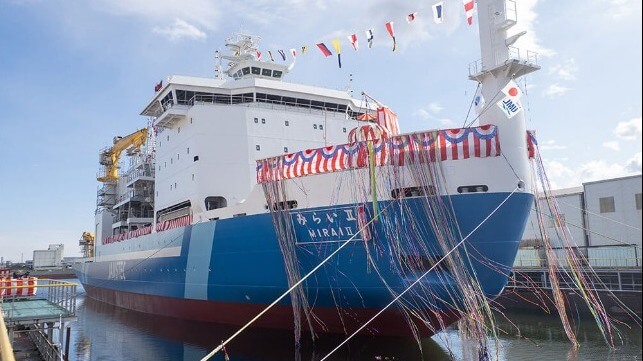
Japan celebrated the naming and launch of its first purpose-built ice-class Arctic research vessel, Mirai II. Construction on the vessel began in 2021 and it represents a significant step forward for the Japan Agency for Marine-Earth Science and Technology (JAMSTEC), which will be responsible for the vessel’s operations.
Japanese officials said as a country adjacent to and affected by the Arctic region, and as one of the world's leaders, Japan has a mission to contribute to resolving the various issues based on scientific evidence that impact the Arctic region. They noted that the Arctic is experiencing rapid environmental changes, such as a decrease in sea ice, which is resulting in increased economic activity in the region. They said that since the issues facing the Arctic are impacting the climate and weather on the entire planet they need to be viewed from a global perspective.
JAMSTEC highlights the vessel will be equipped with equipment and facilities to enable a wide range of observations related to the atmosphere, weather, ocean, sea ice, and more. The design incorporates the maximum extent of Japan’s icebreaking construction technology. The new vessel will be Polar Class 4 capable of continuously breaking 1.2 meter (nearly 4 foot) of flat one-year ice at a speed of 3 knots.
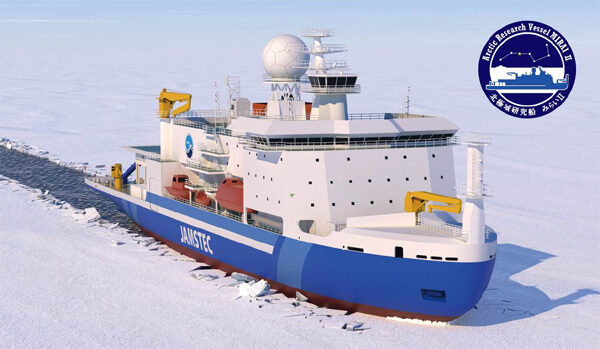
Rendering of the completed research ship
Mirai II will be 13,000 tons with a length of 128 meters (420 feet). It will accommodate a total of 97 people, including 34 crewmembers and 63 researchers.
Considering the aging of the vessel, JAMSTEC reports it has decided to cease the operations of its current marine research vessel Mirai at the end of fiscal year 2025. The current vessel was launched in 1969 designed to become a nuclear-powered cargo ship. She was fueled in 1972, but two years later a controversy emerged due to questions over the vessel’s shielding for the nuclear reactor. It was used as a demonstration vessel and never entered commercial service before being retired in 1992. She was rebuilt as a diesel-powered ship and began operation as an oceanographic research ship in 1997.
The launching of the new vessel took place on March 19 at the Isogo Plant of Japan Marine United Corporation. Delivery is scheduled for November 2026.
To raise awareness of JAMSTEC’s activities and the new Arctic research vessel, the public was invited to submit names for the vessel. Using the public suggestions, the vessel’s workboat will be named Shirokuma, a common word used to describe polar bears, an animal that is being affected by environmental changes in the Arctic.
Japanese officials said they expect once the vessel is in service it will make a significant contribution to advancing research into the global environment, including the Arctic region.
US Awards $951M in Contract Modifications for Polar Cutter Program
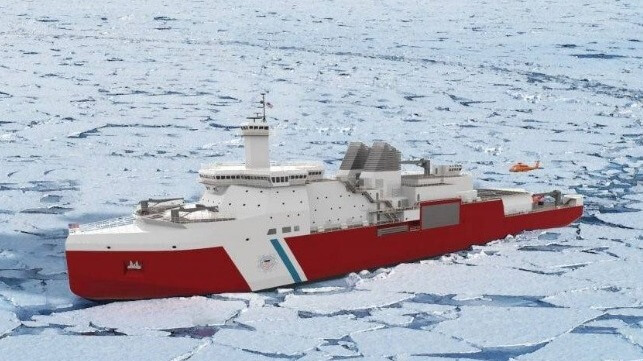
The troubled U.S. effort to build a new generation of Polar Security Cutters received an important boost with the U.S. Coast Guard awarding a $951.6 million contract modification to Bollinger Shipyards. The program has struggled to move forward with years of design delays and cost overruns with the builders now asserting that the project is on a solid path forward.
The shipyard reports it received the modification which advances the Detail Design and Construction phase of the first of the three vessels. They report it was structured as a Fixed-Price-Incentive-Firm Target (FPIF) contract modification reflecting the efforts to get the project on track. Congressional members and the independent Congressional Budget Office have been very critical of the project and poor management and organization. The failures of the project were cited among the reasons that the Trump administration dismissed Admiral Linda Fagan as Commandant of the U.S. Coast Guard on the president’s first day in office in January.
“Securing this contract modification has truly been a Herculean effort and underscores the incredible trust the U.S. Government has placed in Bollinger to build and deliver the first heavy polar icebreaker in half a century,” said Ben Bordelon, President and CEO of Bollinger Shipyards. He recognized the issues in the project saying, “hard work and dedication have successfully put the PSC program on a strong path forward after a rocky start under the previous, foreign-owned builder. We now look forward to receiving the green light to begin full production.”
Bollinger took over the project in 2022 when it acquired the VT Halter shipyard. A Congressional report found that the project which had begun in 2014 was deeply flawed with significant design issues with the vessel which it said Bollinger was working to address.
Since acquiring the shipyard, Bollinger highlights that it has increased its Mississippi workforce by over 61 percent. Further, it says that production rolls at the Mississippi shipyard group have increased by more than 178 percent. It expects to continue to increase these roles as the project moves forward. The current contract modification primarily supports operations at Bollinger Mississippi Shipbuilding, with additional project contributions from facilities located in Massachusetts, Illinois, Virginia, Georgia, Louisiana, and other regions.
Bollinger now reports that completion of the first Polar Security Cutter is anticipated by May 2030. That places the project six years behind the originally anticipated schedule. The Congressional report on the project acknowledged the complexity of the project and the difficulties associated with building a heavy icebreaker and recognized that it was 50 years since the U.S. had built such a vessel.
Poor organization and design issues were cited as key contributors to the cost overruns. Earlier estimates set the projected cost at $1.3 billion for the first vessel but the latest Congressional estimate targeted $1.9 billion, a nearly 40 percent increase over the Coast Guard’s projections. They however expected the project would realize cost synergies for the second and third vessels which CBO set at $1.6 billion each. The total cost for the project was last estimated at over $5 billion.
The U.S. Coast Guard has been forced to scramble with life extension programs to keep its only large icebreakers in operation. It currently depends on the Polar Star which was commissioned in 1976, and recently marked its 49th mission to Antarctica. Healy, commissioned in 1999, had one of its engines replaced due to a failure and this year was temporarily sidelined by an engine room fire. Stretched to maintain the mission, the USCG acquired from Edison Chouest Offshore a polar class 3 icebreaker built in 2012 as an icebreaking anchor-handler. She will enter service by 2026 as the USCGC Storis.
The USCG and the Navy Integrated Program Office received approval in December 2024 to begin building the first of the new icebreakers, which will be called Polar Sentinel. Bollinger in 2023 cut steel for a series of up to eight prototype modules as it sought to demonstrate the capabilities and advance the project. The contract modifications are an important step while Congressional members said it was also a sign of the urgency placed on the project.

No comments:
Post a Comment