OUTLAW SEABED MINING
Miner’s bid to tap seabed pits UN-backed regulators against TrumpBloomberg News | March 29, 2025 |
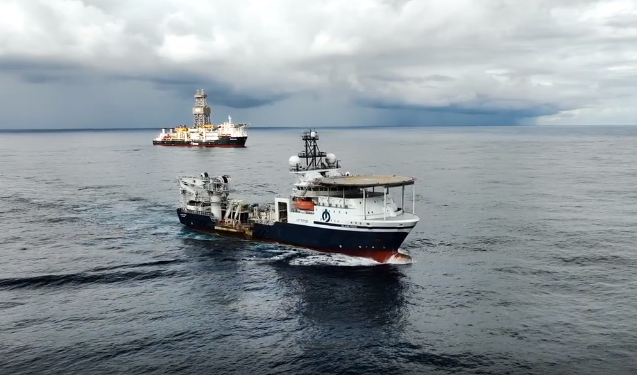
TMC is determined to mine polymetallic nodules from the seafloor despite widespread opposition to their plans. Credit: The Metals Company
International regulators on Friday condemned a seabed mining company’s move to circumvent their authority by seeking the Trump administration’s approval to extract critical minerals from untouched ocean ecosystems.

The Metals Company (TMC) on Thursday said it had initiated a process to obtain a US government license to mine metals used in green technologies from a region of the Pacific Ocean controlled by the International Seabed Authority (ISA), the United Nations-affiliated organization that regulates the exploitation of the deep sea. The announcement came as ISA delegates were meeting in Kingston, Jamaica, to draft rules for how companies should go about mining a vast swath of the ocean outside the jurisdiction of any one nation.
ISA Secretary-General Leticia Carvalho and members of the organization’s 36-nation Council policymaking body denounced TMC’s action, saying it defied the organization’s authority over 54% of the global seabed and its mandate to manage it for the benefit of humanity.
“Any unilateral action would constitute a violation of international law and directly undermine the fundamental principles of multilateralism,” Carvalho, a Brazilian oceanographer who took office in January, told the delegates.
A decision by the Trump administration to issue a seabed mining license for an ISA-controlled area could upend an international treaty that governs deep-sea mining and other commercial uses of the world’s oceans.
TMC holds an ISA license sponsored by member state Nauru to explore for minerals but has grown frustrated by decade-long negotiations to draft regulations governing mining biodiverse deep-sea ecosystems. TMC and other ISA-licensed companies can’t begin mining until regulations are enacted. The two-week Council meeting ended on Friday with contentious issues unresolved, including how to protect marine life in areas targeted for mining.
The company is now seeking permission from the Trump administration to mine its ISA license area under US law, which would go against the UN Convention on the Law of the Sea (UNCLOS). The US never ratified the treaty and is not an ISA member. But that treaty reserved some mining areas for the US in case it eventually acceded to the convention. The US in turn passed a 1980 law that laid out procedures for American companies to gain access to deep-sea minerals there.
TMC chief executive officer Gerard Barron said in a statement to Bloomberg Green that the company had complied with the terms of its ISA contract but the organization has failed to fulfill its duty under UNCLOS to enact regulations.
“I’m not sure why ISA member states act surprised that TMC is now looking at an alternative, long-standing regulatory regime,” he said. “Member states cannot have it both ways—expressing shock while repeatedly breaching UNCLOS and failing to deliver the regulatory clarity they committed to years ago.”
International legal experts said it’s unclear what action the 169-member nation ISA could undertake if TMC obtains a US mining license. “If the US takes steps in this unilateral direction,” it’s possible the ISA could pursue some form of international legal action, said Pradeep Singh, an expert on the Law of the Sea at the Oceano Azul Foundation.
Representatives of China, Russia, France, Germany, South Africa and Chile were among the delegates who asserted that only the ISA has the authority to issue mining licenses under UNCLOS. Uganda delegate Duncan Muhumuza Laki, who serves as president of the ISA Council, characterized TMC’s actions as “a breach of their good faith obligation.”
Despite its move to obtain a US mining license, TMC has said it will still file an application for an ISA mining contract in June even if regulations, including environmental protections, are not in place. But many ISA delegates on Friday reiterated that they would not approve any contracts until strong environmental rules are in place.
Thirty-two ISA member nations, including Costa Rica, Germany and France, have called for a moratorium on mining until its environmental impacts are better understood.
“No country, no person and no company may claim property rights nor exercise sovereignty over the common resources of this heritage,” Gina Guillén Grillo, Costa Rica’s representative to the ISA, said Friday.
The ISA Council will likely have to decide how to handle TMC’s application for a mining contract at its next meeting in July.
“We call on ISA members to not be bullied,” Louisa Casson, a Greenpeace deep sea mining campaigner, told delegates.
(By Todd Woody)
Reuters | March 27, 2025 |
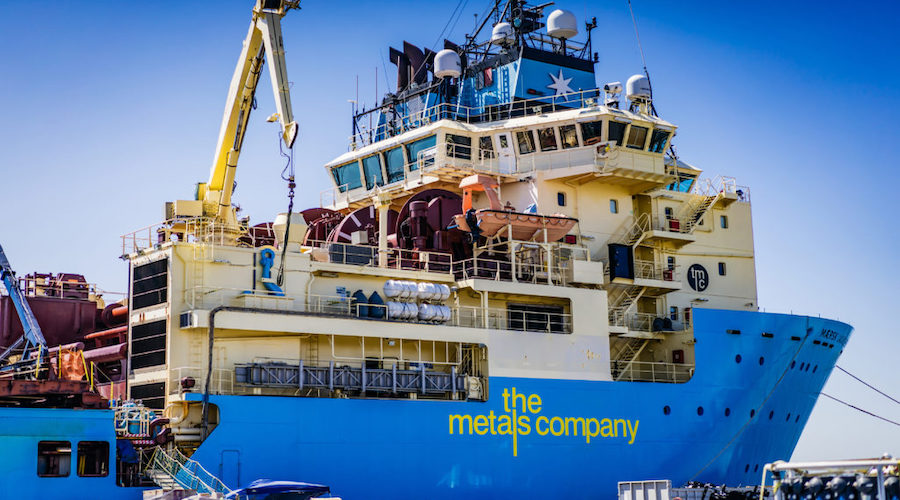
TMC hopes to begin seafloor mining by late 2025.
Credit: The Metals Company
Canadian miner The Metals Company said on Thursday it had formally initiated a process under the US Department of Commerce to apply for exploration licenses and permits to extract minerals from the ocean floor.
The company plans to apply under the Deep Seabed Hard Mineral Resources Act of 1980 (DSHMRA) instead of the International Seabed Authority (ISA), stating the latter had not yet adopted regulations around deep seabed exploitation.
It also added that it has requested a pre-application consultation with National Oceanic and Atmospheric Administration (NOAA).
TMC’s bid to become the first company to gain approval to develop deep sea minerals has been controversial. Environmental groups are calling for all activities to be banned, warning that industrial operations on the ocean floor could cause irreversible biodiversity loss.
This move comes at a time when delegations from 36 countries are attending a council meeting of the UN’s ISA in Kingston, Jamaica this week to decide if mining companies should be allowed to extract metals such as copper or cobalt from the ocean floor.
Few expect a final text for the mining code to be completed by the end of the latest round of talks on March 28, with delegates also planning to discuss potential actions if a mining application is submitted before the regulations are completed.
“We believe we have sufficient knowledge to get started and prove we can manage environmental risks. What we need is a regulator with a robust regulatory regime, and who is willing to give our application a fair hearing,” said Gerard Barron, CEO of The Metals Company.
Advocacy group Greenpeace said the move was “desperate”, accusing the company of “encouraging a breach of customary international law”, by attempting to mine the international seabed under US legislation.
(By Seher Dareen and Ernest Scheyder; Editing by Vijay Kishore)
See Also: Trump is the best news for deep sea mining – The Metals Company CEO
Canadian miner The Metals Company said on Thursday it had formally initiated a process under the US Department of Commerce to apply for exploration licenses and permits to extract minerals from the ocean floor.
The company plans to apply under the Deep Seabed Hard Mineral Resources Act of 1980 (DSHMRA) instead of the International Seabed Authority (ISA), stating the latter had not yet adopted regulations around deep seabed exploitation.
It also added that it has requested a pre-application consultation with National Oceanic and Atmospheric Administration (NOAA).
TMC’s bid to become the first company to gain approval to develop deep sea minerals has been controversial. Environmental groups are calling for all activities to be banned, warning that industrial operations on the ocean floor could cause irreversible biodiversity loss.
This move comes at a time when delegations from 36 countries are attending a council meeting of the UN’s ISA in Kingston, Jamaica this week to decide if mining companies should be allowed to extract metals such as copper or cobalt from the ocean floor.
Few expect a final text for the mining code to be completed by the end of the latest round of talks on March 28, with delegates also planning to discuss potential actions if a mining application is submitted before the regulations are completed.
“We believe we have sufficient knowledge to get started and prove we can manage environmental risks. What we need is a regulator with a robust regulatory regime, and who is willing to give our application a fair hearing,” said Gerard Barron, CEO of The Metals Company.
Advocacy group Greenpeace said the move was “desperate”, accusing the company of “encouraging a breach of customary international law”, by attempting to mine the international seabed under US legislation.
(By Seher Dareen and Ernest Scheyder; Editing by Vijay Kishore)
See Also: Trump is the best news for deep sea mining – The Metals Company CEO

No comments:
Post a Comment