
Strange sell-off in the U.S. dollar raises the specter of investors losing trust in the U.S. under Trump
By Bernard Condon
April 18, 2025

U.S. one hundred dollar bills are shown in this picture illustration in Buenos Aires, Argentina, on March 10, 2025. (NurPhoto/Photographer: NurPhoto/NurPhoto)
NEW YORK — Among the threats tariffs pose to the U.S. economy, none may be as strange as the sell-off in the dollar.
Currencies rise and fall all the time because of inflation fears, central bank moves and other factors. But economists worry that the recent drop in the dollar is so dramatic that it reflects something more ominous as President Donald Trump tries to reshape global trade: a loss of confidence in the U.S.
The dollar’s dominance in cross-border trade and as a safe haven has been nurtured by administrations of both parties for decades because it helps keep U.S. borrowing costs down and allows Washington to project power abroad — enormous advantages that could possibly disappear if faith in the U.S. was damaged.
“Global trust and reliance on the dollar was built up over a half century or more,” says University of California, Berkeley, economist Barry Eichengreen. “But it can be lost in the blink of an eye.”
Since mid-January, the dollar has fallen 9% against a basket of currencies, a rare and steep decline, to its lowest level in three years.
Many investors spooked by Trump don’t think the dollar will be pushed quickly from its position as the world’s reserve currency, instead expecting more of a slow decline. But even that is scary enough, given the benefits that would be lost.
With much of world’s goods exchanged in dollars, demand for the currency has stayed strong even as the U.S. has doubled federal debt in a dozen years and does other things that would normally send investors fleeing. That has allowed the U.S. government, consumers and businesses to borrow at unnaturally low rates, which has helped speed economic growth and lift standards of living.
Dollar dominance also allows the U.S. to push around other countries like Venezuela, Iran and Russia by locking them out of a currency they need to buy and sell with others.
Now that “exorbitant privilege,” as economists call it, is suddenly at risk.
“The safe haven properties of the dollar are being eroded,” said Deutsch Bank in a note to clients earlier this month warning of a “confidence crisis.” Added a more circumspect report by Capital Economics, “It is no longer hyperbole to say that the dollar’s reserve status and broader dominant role is at least somewhat in question.”
Traditionally, the dollar would strengthen as tariffs sink demand for foreign products.
But the dollar not only failed to strengthen this time, it fell, puzzling economists and hurting consumers. The dollar lost more than 5% against the euro and pound, and 6% against the yen since early April.
As any American traveler abroad knows, you can buy more with a stronger dollar and less with a weaker one. Now the price of French wine and South Korean electronics and a host of other imports could cost more not only due to tariffs but a weaker currency, too.
And any loss of safe-haven status could hit U.S. consumers in another way: Higher rates for mortgages and car financing deals as lenders demand more interest for the added risk.
More worrisome is possible higher interest rates on the ballooning U.S. federal debt, which is already at a risky 120% of U.S. annual economic output.
“Most countries with that debt to GDP would cause a major crisis and the only reason we get away with it is that the world needs dollars to trade with,” says Benn Steil, an economist at the Council on Foreign Relations. ”At some point people are going to look seriously at alternatives to the dollar. ”
They already have, with a little help from a U.S. economic rival.
China has been striking yuan-only trading deals with Brazil for agricultural products, Russia for oil and South Korea for other goods for years. It has also been making loans in yuan to central banks desperate for cash in Argentina, Pakistan and other countries, replacing the dollar as the emergency funder of last resort.
Another possible U.S. alternative in future years if their market grows: cryptocurrencies.
Said BlackRock Chairman Larry Fink in his annual shareholder letter about dollar dominance, ”If deficits keep ballooning, America risks losing that position to digital assets like Bitcoin.”
Not everyone is convinced that a big reason the dollar is falling is because of lost faith in the U.S.
Steve Ricchiuto, an economist at Mizuho Financial, says dollar weakness reflects anticipation of higher inflation due to tariffs. But even if investors aren’t as comfortable holding dollars, he says, they really don’t have much of a choice. No other currency or other asset, like yuan or bitcoin or gold, is vast enough to handle all the demand.
“The U.S. will lose the reserve currency when there is someone out there to take it away,” Ricchiuto says. “Right now there isn’t an alternative.”
Maybe so, but Trump is testing the limits.
It’s not just the tariffs, but the erratic way he’s rolled them out. The unpredictability makes the U.S. seem less stable, less reliable, and a less safe place for their money.
There are also questions about his logic justifying the policy. Trump says the U.S. needs tariffs to drive down its trade deficits with other countries. But most economists believe those deficits, which measure trade in goods, not services, are a bad measure of whether a country is “ripping off” America, as Trump puts it.
Trump has also repeatedly threatened to chip away at the independence of the Federal Reserve, raising fears that he will force interest rates lower to boost the economy even if doing so risks stoking runaway inflation. That is a sure fire way to get people to flee the dollar. After Fed Chair Jerome Powell said Wednesday that he would wait to make any rate moves, Trump blasted him, saying “Powell’s termination cannot come fast enough!”
Economists critical of Trump’s April 2 tariff announcement recall another event, the Suez Crisis of 1956, that broke the back of the British pound. The military attack on Egypt was poorly planned and badly executed and exposed British political incompetence that sank trust in the country. The pound fell sharply, and its centuries-long position as the dominant trading and reserve currency crumbled.
Berkeley’s Eichengreen says Liberation Day, as Trump called it, could be remembered as a similar turning point if the president isn’t careful.
“This is the first step down a slippery slope where international confidence in the U.S. dollar is lost.”
NEW YORK — Among the threats tariffs pose to the U.S. economy, none may be as strange as the sell-off in the dollar.
Currencies rise and fall all the time because of inflation fears, central bank moves and other factors. But economists worry that the recent drop in the dollar is so dramatic that it reflects something more ominous as President Donald Trump tries to reshape global trade: a loss of confidence in the U.S.
The dollar’s dominance in cross-border trade and as a safe haven has been nurtured by administrations of both parties for decades because it helps keep U.S. borrowing costs down and allows Washington to project power abroad — enormous advantages that could possibly disappear if faith in the U.S. was damaged.
“Global trust and reliance on the dollar was built up over a half century or more,” says University of California, Berkeley, economist Barry Eichengreen. “But it can be lost in the blink of an eye.”
Since mid-January, the dollar has fallen 9% against a basket of currencies, a rare and steep decline, to its lowest level in three years.
Many investors spooked by Trump don’t think the dollar will be pushed quickly from its position as the world’s reserve currency, instead expecting more of a slow decline. But even that is scary enough, given the benefits that would be lost.
With much of world’s goods exchanged in dollars, demand for the currency has stayed strong even as the U.S. has doubled federal debt in a dozen years and does other things that would normally send investors fleeing. That has allowed the U.S. government, consumers and businesses to borrow at unnaturally low rates, which has helped speed economic growth and lift standards of living.
Dollar dominance also allows the U.S. to push around other countries like Venezuela, Iran and Russia by locking them out of a currency they need to buy and sell with others.
Now that “exorbitant privilege,” as economists call it, is suddenly at risk.
“The safe haven properties of the dollar are being eroded,” said Deutsch Bank in a note to clients earlier this month warning of a “confidence crisis.” Added a more circumspect report by Capital Economics, “It is no longer hyperbole to say that the dollar’s reserve status and broader dominant role is at least somewhat in question.”
Traditionally, the dollar would strengthen as tariffs sink demand for foreign products.
But the dollar not only failed to strengthen this time, it fell, puzzling economists and hurting consumers. The dollar lost more than 5% against the euro and pound, and 6% against the yen since early April.
As any American traveler abroad knows, you can buy more with a stronger dollar and less with a weaker one. Now the price of French wine and South Korean electronics and a host of other imports could cost more not only due to tariffs but a weaker currency, too.
And any loss of safe-haven status could hit U.S. consumers in another way: Higher rates for mortgages and car financing deals as lenders demand more interest for the added risk.
More worrisome is possible higher interest rates on the ballooning U.S. federal debt, which is already at a risky 120% of U.S. annual economic output.
“Most countries with that debt to GDP would cause a major crisis and the only reason we get away with it is that the world needs dollars to trade with,” says Benn Steil, an economist at the Council on Foreign Relations. ”At some point people are going to look seriously at alternatives to the dollar. ”
They already have, with a little help from a U.S. economic rival.
China has been striking yuan-only trading deals with Brazil for agricultural products, Russia for oil and South Korea for other goods for years. It has also been making loans in yuan to central banks desperate for cash in Argentina, Pakistan and other countries, replacing the dollar as the emergency funder of last resort.
Another possible U.S. alternative in future years if their market grows: cryptocurrencies.
Said BlackRock Chairman Larry Fink in his annual shareholder letter about dollar dominance, ”If deficits keep ballooning, America risks losing that position to digital assets like Bitcoin.”
Not everyone is convinced that a big reason the dollar is falling is because of lost faith in the U.S.
Steve Ricchiuto, an economist at Mizuho Financial, says dollar weakness reflects anticipation of higher inflation due to tariffs. But even if investors aren’t as comfortable holding dollars, he says, they really don’t have much of a choice. No other currency or other asset, like yuan or bitcoin or gold, is vast enough to handle all the demand.
“The U.S. will lose the reserve currency when there is someone out there to take it away,” Ricchiuto says. “Right now there isn’t an alternative.”
Maybe so, but Trump is testing the limits.
It’s not just the tariffs, but the erratic way he’s rolled them out. The unpredictability makes the U.S. seem less stable, less reliable, and a less safe place for their money.
There are also questions about his logic justifying the policy. Trump says the U.S. needs tariffs to drive down its trade deficits with other countries. But most economists believe those deficits, which measure trade in goods, not services, are a bad measure of whether a country is “ripping off” America, as Trump puts it.
Trump has also repeatedly threatened to chip away at the independence of the Federal Reserve, raising fears that he will force interest rates lower to boost the economy even if doing so risks stoking runaway inflation. That is a sure fire way to get people to flee the dollar. After Fed Chair Jerome Powell said Wednesday that he would wait to make any rate moves, Trump blasted him, saying “Powell’s termination cannot come fast enough!”
Economists critical of Trump’s April 2 tariff announcement recall another event, the Suez Crisis of 1956, that broke the back of the British pound. The military attack on Egypt was poorly planned and badly executed and exposed British political incompetence that sank trust in the country. The pound fell sharply, and its centuries-long position as the dominant trading and reserve currency crumbled.
Berkeley’s Eichengreen says Liberation Day, as Trump called it, could be remembered as a similar turning point if the president isn’t careful.
“This is the first step down a slippery slope where international confidence in the U.S. dollar is lost.”
Frank Holmes - U.S. Global Investors | April 18, 2025 |
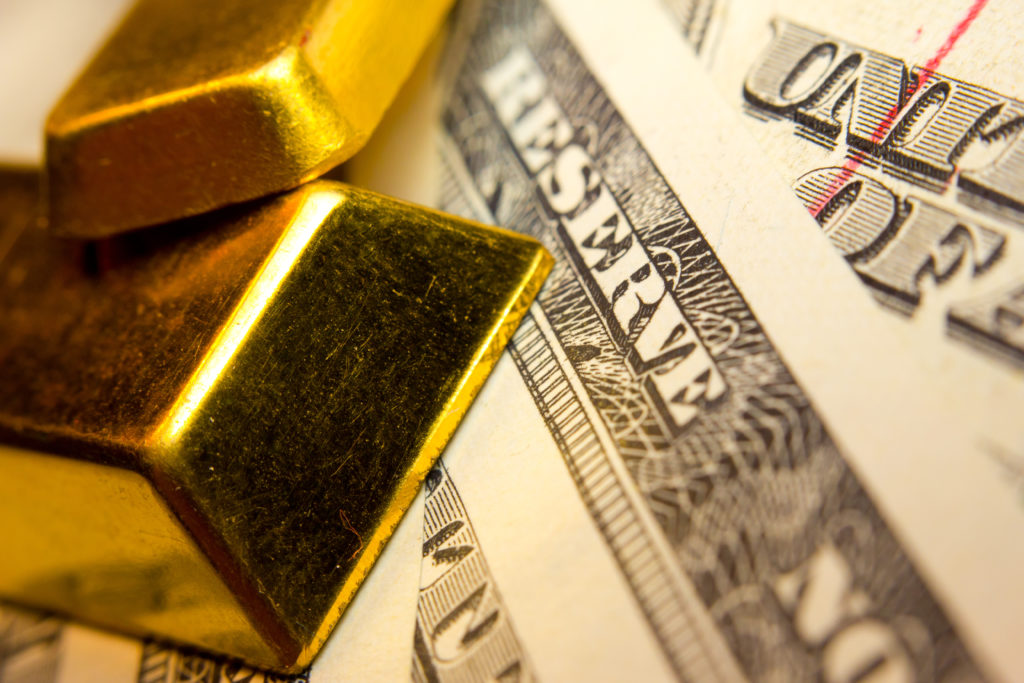
Gold is hitting records in more ways than one.

In nominal terms, the yellow metal set multiple new all-time highs this week, exceeding $3,300 an ounce for the first time ever on Wednesday. And on an inflation-adjusted basis, gold also notched a new record price, surpassing the longstanding record set in 1980.

There could be further gains in the coming months, if analyst expectations come to fruition. Goldman Sachs sees gold topping out at $3,700 by the end of this year and $4,000 an ounce by mid-2026.
Top performing gold stocks now featured in the IBD 50
Gold miners, I’m happy to report, also appear to be back in favor. The IBD 50, Investor’s Business Daily’s flagship screen of growth stocks, now includes about a dozen gold mining names. Companies that were just added to the list include DRDGold, Eldorado Gold, Gold Fields, Randgold Resources, Osisko Gold Royalties, Royal Gold, Triple Flag Precious Metals and Wheaton Precious Metals.
We’re proud to hold shares in 11 of these companies across one or more of our gold equity or resource funds, as of March 31. Below is a comprehensive list.

Worst start on record for the dollar index spurs gold buying
This gold rally is classic Fear Trade. It comes as investor sentiment has collapsed to its lowest level in three decades, according to April’s BofA Global Fund Manager Survey. Eighty-two percent of participants said they believe the global economy will shrink, marking the most pessimistic reading in the survey’s history.
The value of the US dollar, when measured against a basket of world currencies, has sunk to a three-year low as traders await more details on the fallout from President Donald Trump’s trade policies. The ICE US Dollar Index is down 8% so far in 2025, making this the worst start to a year in the index’s four-decade history, according to the Wall Street Journal.
Granted, a weaker greenback has its advantages: It makes the price of goods being exported out of the US more affordable to foreign buyers, helping exporters.
My concern is the reason why the dollar is on the decline. Foreign central banks have been dumping US debt for a while, but the selling pressure of longer-dated bonds has increased in recent months. In the four months through February, overseas institutions sold a combined net of approximately $90 billion.
Retail investors still missing out on the gold rally
Despite the rally, retail investors are still sorely underexposed. Gold-backed ETF assets currently represent less than 2% of all ETF assets, down from approximately 8% in 2011. Investment in gold ETFs has significantly picked up since February, but holdings are still off by about 19% from their highs in October 2020.

The market share for gold mining ETFs is even lower, representing less than 0.5% of total equity ETFs.
That’s a shame because gold stocks have been among the best bets of the year so far. The NYSE Arca Gold Miners Index, or GDM, has advanced more than 53% through Thursday’s close, far outperforming the S&P 500, which has lost close to 10% over the same period.
Believe it or not, the second-best-performing S&P 500 stock so far this year is Newmont, the world’s largest gold mining company. Newmont is up a little over 50% through April 16, following CVS Health, up nearly 53%.
Analysts have rosy expectations for Newmont’s year ahead. Those polled by FactSet say they project profits to rise 13% to $3.92 per share this year, followed by an 8% rise to $4.23 per share next year.
South African gold stocks break records in 2025
This rally isn’t limited to US-based gold stocks. South African producers, as measured by the rand-priced FTSE/JSE Precious Metals and Mining Index, hit a new record high as the price of gold has exploded to the upside, crossing above R60,000 per ounce this month for the first time ever.

Many American depository receipts (ADRs) of South African producers have done exceptionally well so far in 2025, with Sibanye Stillwater up about 50%, AngloGold Ashanti and DRDGold both up 93% to 94%, and Harmony Gold up a remarkable 113%.
Gold stocks remain deeply undervalued relative to the market
Just as investors’ portfolios are underexposed to the yellow metal, gold mining stocks look incredibly undervalued compared to the market.
The chart below shows the ratio between the GDM and the S&P 500. You can see that, relative to the S&P, gold stocks have traded in a range-bound pattern going back about 10 years.

So how do mining stocks break out of this pattern? Either gold equities continue to trade up, or the S&P 500 continues to fall (or a combination of the two).
In any case, this could be a good buying opportunity. As always, I recommend a 10% weighting, with 5% in physical gold (bars, coins, jewelry) and the other 5% in high-quality gold stocks.
* Frank Holmes is the CEO of U.S. Global Investors

No comments:
Post a Comment