Rain complicates recovery in quake-hit Myanmar as death toll rises
By AFP
April 6, 2025
The 7.7-magnitude quake struck Myanmar on March 28, razing buildings, cutting off power and destroying bridges and roads across the country - Copyright AFP Zaw Htun
Rain is compounding misery and presenting new hurdles for relief efforts on Sunday in Myanmar, where state media reported the death toll from a devastating earthquake has risen to nearly 3,500 people.
The 7.7-magnitude quake struck on March 28, razing buildings, cutting off power and destroying bridges and roads across the country.
Damage has been particularly severe in the city of Sagaing near the epicentre, as well as in Mandalay, Myanmar’s second city and home to more than 1.7 million people.
State media in the military junta-led country now say that the earthquake has caused 3,471 confirmed deaths and injured 4,671 people, while 214 remain missing.
With people either having lost their homes entirely or reluctant to spend time in cracked and unstable structures, many Mandalay residents have been sleeping outside in tents.
When wind and rain began battering the rudimentary shelters on Saturday evening, victims were forced to choose between passing the night in dry but risky buildings or outdoors in the elements.
“People are trying to rebuild their lives now,” said United Nations aid chief Tom Fletcher in a video filmed in Mandalay, posted to X on Sunday.
“They need food. They need water. They need the power back on,” he said.
Many people in the area are still without shelter, he said, describing the scale of damage in the area as “epic”.
“We need to get tents and hope to survivors as they rebuild their shattered lives,” Fletcher wrote in another post.
Aid experts warn that rainy conditions and scorching heat increase the risk of disease outbreaks at outdoor camps where victims were in temporary shelter.
– Ongoing attacks, aftershocks –
Myanmar has been ruled by junta leader Min Aung Hlaing since 2021, when his military seized power in a coup that overthrew the civilian government of Aung San Suu Kyi.
International efforts to provide quake relief in the Southeast Asian country of more than 50 million people have been complicated by unreliable communication networks and infrastructure heavily damaged by four years of civil war.
Even before the recent quake, the humanitarian crisis in the country was severe, with the persistent, multi-sided conflict displacing 3.5 million people, according to the UN.
The UN said Friday that since the earthquake, the junta continued to conduct dozens of attacks against rebel groups, including at least 16 since Wednesday when the military government announced a temporary ceasefire.
Fletcher held discussions with the foreign ministers of Thailand and Malaysia on Saturday for what he called a “practical meeting” centred on “strong, coordinated, collective action” to save lives in Myanmar.
Aftershocks have also continued as long as a week after the initial tremors, with a 4.7-magnitude quake striking just south of Mandalay late Friday evening, according to the United States Geological Survey.
Myanmar Earthquake and Tariffs Shake Rare Earths Industry
- The 7.7-magnitude earthquake in Myanmar, coupled with existing political unrest, has raised concerns about the reliability of rare earth supplies from the region.
- New U.S. tariffs, particularly on Chinese goods, are expected to further strain the global rare earth supply chain, given China's dominant position in the market.
- Companies and governments are actively seeking alternative sources and investing in domestic production to mitigate risks and ensure supply chain security for rare earth materials.
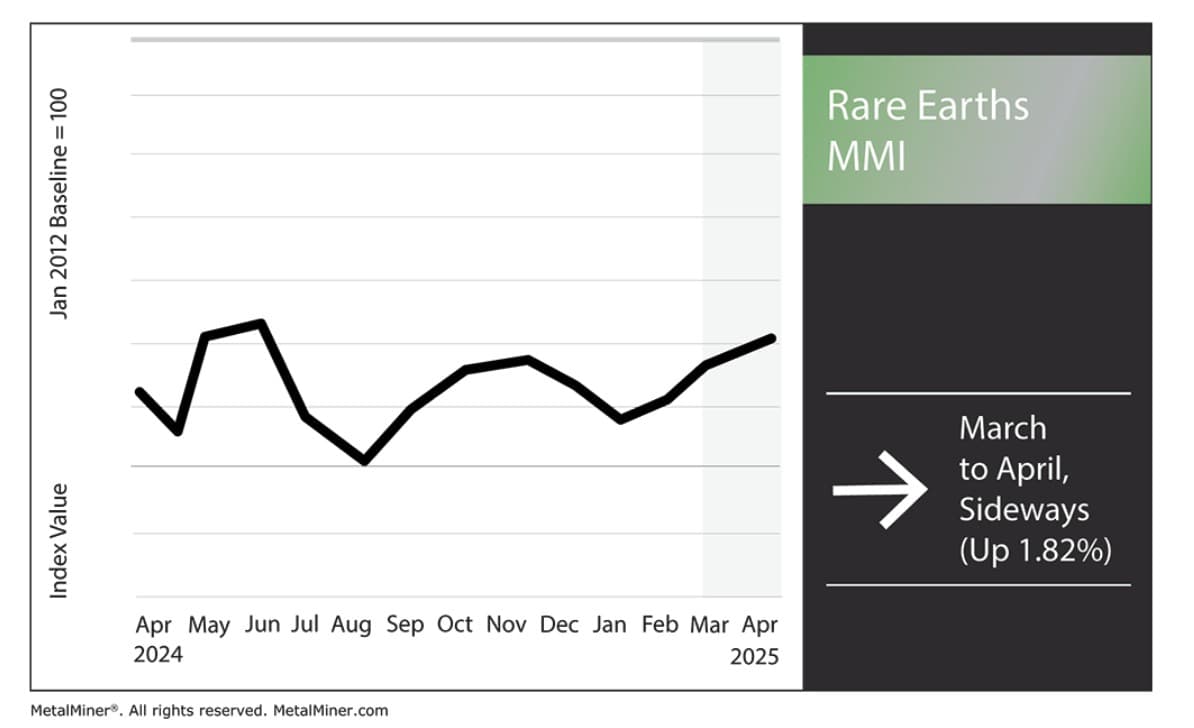
The Rare Earths MMI (Monthly Metals Index) moved sideways, edging up by a slight 1.82%. The global rare earth market has taken a significant hit lately, thanks to a combination of natural disasters and big geopolitical moves. A strong earthquake in Myanmar and the recent wave of U.S. tariffs have thrown this somewhat delicate industry into even more uncertainty.
Myanmar’s Quake: A Jolt to the Supply Chain?
On March 28, a powerful 7.7-magnitude earthquake rocked the country of Myanmar. While the tremors didn’t directly damage rare earth mining operations, the global market still took notice. The quake struck near Mandalay, about 425 kilometers from Kachin State, the location of many of Myanmar’s rare earth mines.
Despite a tragic and still-growing death toll, early reports show those key mining regions were mostly untouched. Mine operators in the Longchuan area confirmed with Metal.com that roads remain open and ore deliveries are continuing without issue.
Why buy price points for every metal type when you only need a few? Only purchase the metal price points you need with MetalMiner Select. Learn more.
Political Turmoil Was Already Causing Problems
Even before the earthquake, Myanmar’s rare earth sector was struggling. Back in October 2024, the Kachin Independence Army (KIA) took over major mining hubs like Kanpaiti, a town near the Chinese border.
That single event disrupted operations in areas responsible for around half of the world’s output of heavy rare earths. Mining ground to a halt, and by February 2025, Chinese imports of rare earth oxides and compounds from Myanmar had dropped by a staggering 89%.
Why Myanmar’s Rare Earth Supplies Matter
Myanmar isn’t just another name on the rare earth map. The Southeast Asian country is a major supplier, which means it plays a key role in everything from smartphones to electric vehicles to rechargeable batteries. The combination of the ongoing conflict and the recent natural disaster highlights just how risky it is to rely on politically unstable nations for such critical materials.
Enter the Tariffs
Back in the United States, President Donald Trump announced sweeping new tariffs on April 2, 2025. All U.S. trading partners now face at least a 10% tariff, while some countries, particularly China, were hit even harder.
Given prior tariffs, Chinese goods entering the U.S. will now face a total tariff rate of 54%. Considering China dominates the global rare earth supply chain, analysts expect these new tariffs will intensify existing supply problems.
What Comes Next?
Given the news, many American companies are already taking action. Most are working to secure alternative domestic and international sources for rare earths, while the U.S. government ramps up investment in local production to strengthen supply chain security.
In the meantime, experts anticipate that rare earth prices will stay volatile, driving up manufacturing costs, potentially raising consumer prices and weakening the global competitiveness of U.S. products.
By Jennifer Kary

No comments:
Post a Comment