SPACE/COSMOS
Not One, But Two Massive Black Holes Are Eating Away At This Galaxy
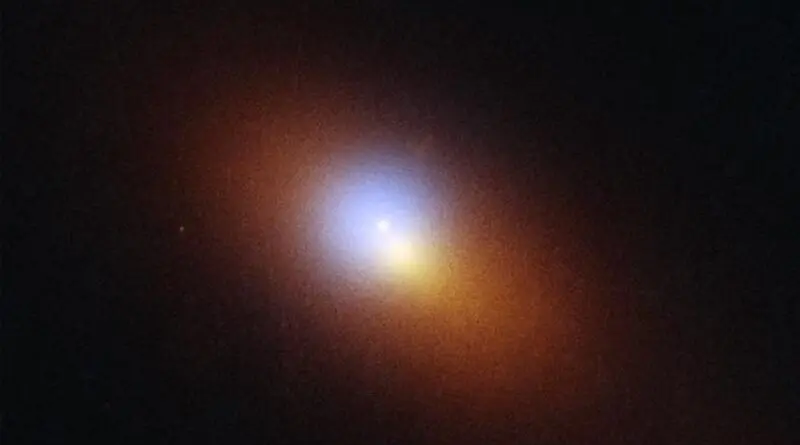
Long ago, in a galaxy 600 million light years from Earth, a star got too close to a massive black hole and was torn apart. This image combines observations of the tidal disruption event obtained in August 2024 by the Hubble Space Telescope and the Chandra X-Ray Observatory. The location, pinpointed by Hubble, is the bright blue-white dot of ultraviolet light in the middle of the blue X-ray haze detected by Chandra. The TDE is offset from the center of the galaxy, which appears as a bright orange-white blob at the center of the visible stars, colored orange. CREDIT NASA, ESA, STScI, Yuhan Yao (UC Berkeley); Image Processing by Joseph DePasquale (STScI)
Astronomers have discovered nearly 100 examples of massive black holes shredding and devouring stars, almost all of them where you’d expect to find massive black holes: in the star-dense cores of massive galaxies.
University of California, Berkeley, astronomers have now discovered the first instance of a massive black hole tearing apart a star thousands of light years from the galaxy’s core, which itself contains a massive black hole.
The off-center black hole, which has a mass about 1 million times that of the sun, was hiding in the outer regions of the galaxy’s central bulge, but revealed itself through bursts of light generated by the spaghettification of the star — a so-called tidal disruption event, or TDE. In a TDE, the immense gravity of a black hole tugs on a star — similar to the way the moon raises ocean tides on Earth, but a lot more violently.
“The classic location where you expect massive black holes to be in a galaxy is in the center, like our Sag A* at the center of the Milky Way,” said Yuhan Yao, a Miller Postdoctoral Fellow at UC Berkeley who is lead author of a paper about the discovery recently accepted for publication in The Astrophysical Journal Letters (ApJL). “That’s where people normally search for tidal disruption events. But this one, it’s not at the center. It’s actually about 2,600 light years away. That’s the first optically discovered off-nuclear TDE discovered.”
The galaxy’s central massive black hole, about 100 million times the mass of our sun, is also gorging itself, but on gas that has gotten too close to escape.
Studies of massive black holes at galactic centers tell astronomers about the evolution of galaxies like our own, which has one central black hole — called SagA* because of its location within the constellation Sagittarius — weighing in at a puny 4 million solar masses. Some of the largest galaxies have central black holes weighing several 100 billion solar masses, presumably the result of the merger of many smaller black holes.
Finding two massive black holes in the center of a galaxy is not surprising. Most large galaxies are thought to have massive black holes in their cores, and since galaxies often collide and merge as they move through space, large galaxies should occasionally harbor more than one supermassive black hole — at least until they collide and merge into an even bigger black hole. They typically hide in stealth mode until they reveal their presence by grabbing nearby stars or gas clouds, creating a short-lived burst of light. These are rare events, however. Astronomers calculate that a massive black hole would encounter a star once every 30,000 years, on average.
The new TDE, dubbed AT2024tvd, was detected by the Zwicky Transient Facility, an optical camera mounted on a telescope at Palomar Observatory near San Diego, and confirmed by observations with radio, X-ray and other optical telescopes, including NASA’s Hubble Space Telescope.
“Massive black holes are always at the centers of galaxies, but we know that galaxies merge — that is how galaxies grow. And when you have two galaxies that come together and become one, you have multiple black holes,” said co-author Ryan Chornock, a UC Berkeley associate adjunct professor of astronomy. “Now, what happens? We expect they eventually come together, but theorists have predicted that there should be a population of black holes that are roaming around inside galaxies.”
The discovery of one such roaming black hole shows that systematic searches for the signature of a TDE could turn up more rogue black holes. The find also validates plans for a space mission called LISA — the Laser Interferometer Space Antenna — that will look for gravitational waves from mergers of massive black holes like these.
“This is the first time that we actually see massive black holes being so close using TDEs,” said co-author Raffaella Margutti, a UC Berkeley associate professor of astronomy and of physics. “If these are a couple of supermassive black holes that are getting closer together — which is not necessarily true — but if they are, they might merge and emit gravitational waves that we’ll see in the future with LISA.”
LISA will complement ground-based gravitational wave detectors, such as LIGO and Virgo, which are sensitive to the merger of black holes or neutron stars weighing less than a few hundred times the mass of our sun, and telescopic studies of pulsar flashes, such as the Nanograv pulsar timing array experiment, which are sensitive to gravitational waves from the mergers of supermassive black holes weighing billions of solar masses. LISA’s sweet spot is black holes of several million solar masses. LISA is slated to be launched in the next decade.
Transient outbursts
Because black holes are invisible, scientists can only find them by detecting the light produced when they shred stars or gas clouds and create a bright, hot, rotating disk of material that gradually falls inward. TDEs are powerful probes of black hole accretion physics, Chornock said, revealing how close material can get to the black hole before being captured and the conditions necessary for black holes to launch powerful jets and winds.
The most productive search for TDEs has used data from the Zwicky Transient Facility, originally built to detect supernova explosions, but also sensitive to other flashes in the sky.
The ZTF has discovered nearly 100 TDEs since 2018, all within the cores of galaxies. X-ray satellites have also detected a few TDEs, including two in the outskirts of a galaxy that also has a central black hole. In those galaxies, however, the black holes are too far apart to ever merge. The newly discovered black hole is close enough to the core’s massive black hole to potentially fall toward it and merge, though not for billions of years.
Yao noted that two alternative scenarios could explain the presence of the wandering black hole in AT2024tvd. It could be from the core of a small galaxy that merged with the larger galaxy long ago and is either moving through the larger galaxy on its way out or has become bound to the galaxy in an orbit that may, eventually, bring it close enough to merge with the black hole at the core.
Erica Hammerstein, another UC Berkeley postdoctoral researcher, scrutinized the Hubble images as part of the study, but was unable to find evidence of a past galaxy merger.
AT2024tvd could also be a former member of a triplet of black holes that used to be at the galactic core. Because of the chaotic nature of three-body orbits, one would have been kicked out of the core to wander around the galaxy.
Searching galaxies for off-center black holes
Because the ZTF detects hundreds of flashes of light around the northern sky each year, TDE searches to date have focused on flashes discovered near the cores of galaxies, Yao said. She and Chornock created an algorithm to distinguish between the light produced by a supernova and a TDE, and employed it to search through the 10,000 or so detections by ZTF to date to find bursts of light in the galactic center that fit the characteristics of a TDE.
“Supernovae cool down after they peak, and their color becomes redder,” Yao said. “TDEs remain hot for months or years and have consistently blue colors throughout their evolution.”
TDEs also exhibit broad emission lines of hydrogen, helium, carbon, nitrogen and silicon.
Last August, the Berkeley team discovered a burp of light that looked like a TDE, but its location seemed off-center, though within the resolution limits of the ZTF. The researchers suspected the black hole was indeed off center, and immediately requested time on several telescopes to pinpoint its location. These included NASA’s Chandra X-ray Observatory, the Very Large Array and the Hubble Space Telescope. They all confirmed its off-nucleus location, with HST providing a distance of about 2,600 light years — about one-tenth the distance between our sun and Sag A*.
Though close to the central black hole, the off-nuclear black hole is not gravitationally bound to it. Because the black hole at the core spews out energy as it accretes infalling gas, it is categorized as an active galactic nucleus.
Yao and her team hope to find other roaming TDEs, which will give astronomers an idea of how often galaxies and their core black holes merge, and thus how long it takes to form some of the extreme, supermassive black holes.
“AT2024tvd is the first offset TDE captured by optical sky surveys, and it opens up the entire possibility of uncovering this elusive population of wandering black holes with future sky surveys,” Yao said. “Right now, theorists haven’t given much attention to offset TDEs. They primarily predict rates for TDEs occurring at the centers of galaxies. I think this discovery really motivates them to compute rates for offset TDEs, as well.”
Eurasia Review
Eurasia Review is an independent Journal that provides a venue for analysts and experts to disseminate content on a wide-range of subjects that are often overlooked or under-represented by Western dominated media.
SwRI scientist discovers how solar events affect the velocity of helium pickup ions
New methods track particle evolution across the heliosphere
image:
A new study led by Southwest Research Institute’s Dr. Keiichi Ogasawara indicates that helium pickup ions are a wellspring of solar energetic particles. These high-energy accelerated particles travel at speeds twice as fast as during times of quiet solar activity. But when they are boosted by solar shocks, such as coronal mass ejections, they can penetrate spacecraft and spacesuits, posing a radiation hazard to astronauts.
view moreCredit: NASA Scientific Visualization Studio/ANIL RAO/Univ. of Colorado/MAVENNA/NASA GSFC
SAN ANTONIO — May 20, 2022 — Southwest Research Institute scientists have discovered how solar activity affects the velocity distribution and evolution of helium pickup ions.
Pickup ions are charged particles created when neutral particles originating outside of our solar system are ionized. They are ionized by solar ultraviolet radiation and captured by the interplanetary magnetic field.
A new study led by SwRI’s Dr. Keiichi Ogasawara indicates that these pickup ions are a wellspring of solar energetic particles (SEPs). These high-energy accelerated particles include protons, electrons and heavy ions produced by solar events like flares and coronal mass ejections (CMEs). Using data from NASA’s Solar TErrestrial RElations Observatory, SwRI detected the initial characteristics of the helium pickup ion acceleration through several CME events.
“We carefully identified the specific properties of the ions and used them to trace the physical energy transfer processes,” Ogasawara said. “We also considered the roles played by different types of interplanetary shocks, when fast-moving solar wind disturbances collide with slower-moving solar wind plasmas.”
Understanding how and when SEPs occur is critical because, when they are accelerated to higher energies, they can penetrate spacecraft and spacesuits, posing a radiation hazard to astronauts.
SwRI also studied the velocities of individual helium pickup ions in relation to their local magnetic field orientations and identified their characteristic behaviors when interacting with different types of shocks associated with CMEs.
“The velocity distribution of pickup ions is quite different from that of the solar wind,” Ogasawara said. “In fact, they can be twice as fast as the solar wind even during relatively quiet times. Because of this difference, pickup ions are more effectively accelerated to even higher energies than normal solar wind particles.
In comparison to SEPs, the solar wind is a continuous lower-energy flow of plasma emitted by the corona, the Sun’s outer atmosphere.
SwRI developed a new method for tracking particle evolution as pickup ions travel through shock passages, turbulence and large-scale magnetic structures. This allows researchers to separate processes that increase or decrease energy from those that maintain energy levels.
“This study examined particle behavior across a broad range of structures in the heliosphere including magnetic structures, interplanetary shocks and the sheath region that forms in advance of a CME,” Ogasawara said.
To access the “Helium Pickup Ion Velocity Distributions Observed in Interplanetary Coronal Mass Ejection Structures” paper, see DOI: 10.3847/1538-4357/adb1b4.
For more information, visit https://www.swri.org/markets/earth-space/space-research-technology/space-science/heliophysics.
Journal
The Astrophysical Journal
Method of Research
Observational study
Subject of Research
Not applicable
Article Title
Helium Pickup Ion Velocity Distributions Observed in Interplanetary Coronal Mass Ejection Structures
'Cosmic joust': astronomers observe pair of galaxies in deep-space battle
ESO
image:
This image, taken with the Atacama Large Millimeter/submillimeter Array (ALMA), shows the molecular gas content of two galaxies involved in a cosmic collision. The one on the right hosts a quasar –– a supermassive black hole that is accreting material from its surroundings and releasing intense radiation directly into the other galaxy.
Astronomers used the X-shooter instrument at ESO’s Very Large Telescope (VLT) to detect the quasar’s light as it passes through an invisible halo of gas surrounding the galaxy on the left. In doing so, they could observe the damage that this radiation causes to the victim, disrupting its clouds of gas and hampering its ability to form new stars.
view moreCredit: ALMA (ESO/NAOJ/NRAO)/S. Balashev and P. Noterdaeme et al.
Astronomers have witnessed for the first time a violent cosmic collision in which one galaxy pierces another with intense radiation. Their results, published today in Nature, show that this radiation dampens the wounded galaxy’s ability to form new stars. This new study combined observations from both the European Southern Observatory’s Very Large Telescope (ESO’s VLT) and the Atacama Large Millimeter/submillimeter Array (ALMA), revealing all the gory details of this galactic battle.
In the distant depths of the Universe, two galaxies are locked in a thrilling war. Over and over, they charge towards each other at speeds of 500 km/s on a violent collision course, only to land a glancing blow before retreating and winding up for another round. “We hence call this system the ‘cosmic joust’,” says study co-lead Pasquier Noterdaeme, a researcher at the Institut d'Astrophysique de Paris, France, and the French-Chilean Laboratory for Astronomy in Chile, drawing a comparison to the medieval sport. But these galactic knights aren’t exactly chivalrous, and one has a very unfair advantage: it uses a quasar to pierce its opponent with a spear of radiation.
Quasars are the bright cores of some distant galaxies that are powered by supermassive black holes, releasing huge amounts of radiation. Both quasars and galaxy mergers used to be far more common, appearing more frequently in the Universe’s first few billion years, so to observe them astronomers peer into the distant past with powerful telescopes. The light from this ‘cosmic joust’ has taken over 11 billion years to reach us, so we see it as it was when the Universe was only 18% of its current age.
“Here we see for the first time the effect of a quasar’s radiation directly on the internal structure of the gas in an otherwise regular galaxy,” explains study co-lead Sergei Balashev, who is a researcher at the Ioffe Institute in St Petersburg, Russia. The new observations indicate that radiation released by the quasar disrupts the clouds of gas and dust in the regular galaxy, leaving only the smallest, densest regions behind. These regions are likely too small to be capable of star formation, leaving the wounded galaxy with fewer stellar nurseries in a dramatic transformation.
But this galactic victim isn’t all that is being transformed. Balashev explains: “These mergers are thought to bring huge amounts of gas to supermassive black holes residing in galaxy centres.” In the cosmic joust, new reserves of fuel are brought within reach of the black hole powering the quasar. As the black hole feeds, the quasar can continue its damaging attack.
This study was conducted using ALMA and the X-shooter instrument on ESO’s VLT, both located in Chile’s Atacama Desert. ALMA’s high resolution helped the astronomers clearly distinguish the two merging galaxies, which are so close together they looked like a single object in previous observations. With X-shooter, researchers analysed the quasar’s light as it passed through the regular galaxy. This allowed the team to study how this galaxy suffered from the quasar’s radiation in this cosmic fight.
Observations with larger, more powerful telescopes could reveal more about collisions like this. As Noterdaeme says, a telescope like ESO’s Extremely Large Telescope “will certainly allow us to push forward a deeper study of this, and other systems, to better understand the evolution of quasars and their effect on host and nearby galaxies.”
More information
This research was presented in a paper to appear in Nature titled “Quasar radiation transforms the gas in a merging companion galaxy.” (doi: 10.1038/s41586-025-08966-4)
The team is composed of S. Balashev (Ioffe Institute, St Petersburg, Russia), P. Noterdaeme (Institut d’Astrophysique de Paris, Paris, France [IAP] & French-Chilean Laboratory for Astronomy [FCLA], Chile), N. Gupta (Inter-University Centre for Astronomy, Pune, India [IUCAA]), J.K. Krogager (Université Lyon I, Lyon, France & FCLA), F. Combes (Collège de France, Paris, France), S. López (Universidad de Chile [UChile]), P. Petitjean (IAP), A. Omont (IAP), R. Srianand (IUCAA), and R. Cuellar (UChile).
The Atacama Large Millimeter/submillimeter Array (ALMA), an international astronomy facility, is a partnership of ESO, the U.S. National Science Foundation (NSF) and the National Institutes of Natural Sciences (NINS) of Japan in cooperation with the Republic of Chile. ALMA is funded by ESO on behalf of its Member States, by NSF in cooperation with the National Research Council of Canada (NRC) and the National Science and Technology Council (NSTC) in Taiwan and by NINS in cooperation with the Academia Sinica (AS) in Taiwan and the Korea Astronomy and Space Science Institute (KASI). ALMA construction and operations are led by ESO on behalf of its Member States; by the National Radio Astronomy Observatory (NRAO), managed by Associated Universities, Inc. (AUI), on behalf of North America; and by the National Astronomical Observatory of Japan (NAOJ) on behalf of East Asia. The Joint ALMA Observatory (JAO) provides the unified leadership and management of the construction, commissioning and operation of ALMA.
The European Southern Observatory (ESO) enables scientists worldwide to discover the secrets of the Universe for the benefit of all. We design, build and operate world-class observatories on the ground — which astronomers use to tackle exciting questions and spread the fascination of astronomy — and promote international collaboration for astronomy. Established as an intergovernmental organisation in 1962, today ESO is supported by 16 Member States (Austria, Belgium, Czechia, Denmark, France, Finland, Germany, Ireland, Italy, the Netherlands, Poland, Portugal, Spain, Sweden, Switzerland and the United Kingdom), along with the host state of Chile and with Australia as a Strategic Partner. ESO’s headquarters and its visitor centre and planetarium, the ESO Supernova, are located close to Munich in Germany, while the Chilean Atacama Desert, a marvellous place with unique conditions to observe the sky, hosts our telescopes. ESO operates three observing sites: La Silla, Paranal and Chajnantor. At Paranal, ESO operates the Very Large Telescope and its Very Large Telescope Interferometer, as well as survey telescopes such as VISTA. Also at Paranal ESO will host and operate the Cherenkov Telescope Array South, the world’s largest and most sensitive gamma-ray observatory. Together with international partners, ESO operates ALMA on Chajnantor, a facility that observes the skies in the millimetre and submillimetre range. At Cerro Armazones, near Paranal, we are building “the world’s biggest eye on the sky” — ESO’s Extremely Large Telescope. From our offices in Santiago, Chile we support our operations in the country and engage with Chilean partners and society.
Links
- Research paper
- Photos of the VLT
- Photos of ALMA
- Find out more about ESO's Extremely Large Telescope on our dedicated website and press kit
- For journalists: subscribe to receive our releases under embargo in your language and apply to take part in ESO's (partly funded) 2025 strategic media visit (NEW)
- For scientists: got a story? Pitch your research
- New ESO analysis confirms severe damage from industrial complex planned near Paranal
Journal
Nature
Streaked slopes on Mars probably not signs of water flow, study finds
Brown University
image:
CaSSIS camera aboard ESA’s ExoMars Trace Gas Orbiter captures dark finger-like slope streaks extending
across Mars' dusty surface in Arabia Terra. New research by Bickel and Valantinas reveals these features
form through dry avalanches triggered by wind and impacts rather than liquid water. These active
geological phenomena may transport millions of tons of dust annually, potentially playing a significant
role in Mars' climate system.
Credit: NASA
PROVIDENCE, R.I. [Brown University] — A new study by planetary scientists at Brown University and the University of Bern in Switzerland casts doubt on one of the most tantalizing clues that water might be flowing on present-day Mars.
For years, scientists have spied strange streaks running down Martian cliffsides and crater walls. Some have interpreted those streaks as liquid flows, suggesting the possibility of currently habitable environments on the Red Planet. But this new study, which used machine learning to create and analyze a massive dataset of slope streak features, points to a different explanation: dry process related to wind and dust activity.
“A big focus of Mars research is understanding modern-day processes on Mars — including the possibility of liquid water on the surface,” said Adomas Valantinas, a postdoctoral researcher at Brown who coauthored the research with Valentin Bickel, a researcher at Bern. “Our study reviewed these features but found no evidence of water. Our model favors dry formation processes.”
The research was published in Nature Communications on Monday, May 19.
Scientists first saw the odd streaks in images returned from NASA’s Viking mission in the 1970s. The sinewy features are generally darker in hue than the surrounding terrain and extend for hundreds of meters down sloped terrain. Some last for years or decades, while others come and go more quickly. The shorter-lived features — dubbed recurring slope lineae (RSL) — seem to show up in the same locations during the warmest periods of the Martian year.
The origin of the streaks has been a hot topic among planetary scientists. Modern Mars is remarkably dry, and temperatures rarely peak above freezing. Still, it’s possible that small amounts of water — perhaps sourced from buried ice, subsurface aquifers or abnormally humid air — could mix with enough salt to create a flow even on the frozen Martian surface. If true, RSLs and slope streaks could mark rare, habitable niches on a desert world.
Other researchers haven’t been convinced. They contend the streaks are triggered by dry processes like rock falls or wind gusts, and only appear liquid-like in orbital images.
Hoping for new insights, Bickel and Valantinas turned to a machine learning algorithm to catalog as many slope streaks as they could. After training their algorithm on confirmed slope streak sightings, they used it to scan more than 86,000 high-resolution satellite images. The result was a first-of-its-kind global Martian map of slope streaks containing more than 500,000 streak features.
“Once we had this global map, we could compare it to databases and catalogs of other things like temperature, wind speed, hydration, rock slide activity and other factors.” Bickel said. “Then we could look for correlations over hundreds of thousands of cases to better understand the conditions under which these features form.”
This geostatistical analysis showed that slope streaks and RSLs are not generally associated with factors that suggest a liquid or frost origin, such as a specific slope orientation, high surface temperature fluctuations or high humidity. Instead, the study found that both features are more likely to form in places with above average wind speed and dust deposition — factors that point to a dry origin.
The researchers conclude that the streaks most likely form when layers of fine dust suddenly slide off steep slopes. The specific triggers may vary. Slope streaks appear more common near recent impact craters, where shockwaves might shake loose surface dust. RSLs, meanwhile, are more often found in places where dust devils or rockfalls are frequent.
Taken together, the results cast new doubt on slope streaks and RSLs as habitable environments.
That has significant implications for future Mars exploration. While habitable environments might sound like good exploration targets, NASA would rather keep its distance. Any Earthly microbes that may have hitched a ride on a spacecraft could contaminate habitable Martian environments, complicating the search for Mars-based life. This study suggests that the contamination risk at slope streak sites isn’t much of a concern.
“That’s the advantage of this big data approach,” Valantinas said. “It helps us to rule out some hypotheses from orbit before we send spacecraft to explore.”
UT Austin grad students find missing link in early Martian water cycle
University of Texas at Austin
image:
Early Mars, as it may have been, billions of years ago. Graduate students at The University of Texas at Austin have published research that suggests much of the planet’s water was locked underground.
view moreCredit: Ittiz/Wikimedia Commons
Billions of years ago, water flowed on the surface of Mars. But scientists have an incomplete picture of how the Red Planet’s water cycle worked.
That could soon change after two graduate students at The University of Texas at Austin filled a large gap in knowledge about Mars’ water cycle — specifically, the part between surface water and groundwater.
Students Mohammad Afzal Shadab and Eric Hiatt developed a computer model that calculates how long it took for water on early Mars to percolate from the surface down to the aquifer, which is thought to have been about a mile underground. They found that it took anywhere from 50 to 200 years. On Earth, where the water table in most places is much closer to the surface, the same process typically takes just a few days.
The results were published in the journal Geophysical Research Letters.
The researchers also determined that the amount of water trickling between surface and aquifer could have been enough to cover Mars with at least 300 feet of water. This was potentially a significant portion of the planet’s total available water.
The research helps complete scientists’ understanding of the water cycle on early Mars, said Shadab, who earned his doctoral degree from UT Austin and is now a postdoctoral researcher at Princeton University. This new understanding will be useful in determining how much water was available to evaporate and fill lakes and oceans with rain, and ultimately, where the water ended up.
“We want to implement this into [an integrated model] of how the water and land evolved together over millions of years to the present state,” said Shadab, who was the study’s lead author. “That will bring us very close to answering what happened to the water on Mars.”
Today, Mars is largely dry, at least at the surface. But 3 to 4 billion years ago — at around the time that life was getting started on Earth — oceans, lakes and rivers carved valleys through Mars’ mountains and craters and imprinted shorelines in the rocky surface.
Ultimately, Mars’ water took a different path than Earth’s. Most of it is now either locked in the crust or was lost to space along with Mars’ atmosphere. Understanding how much water was available near the surface could help scientists determine whether it was in the right places long enough to create the chemical ingredients needed for life.
The new findings add to an alternative picture of early Mars in which there was little water going back into the atmosphere through evaporation and raining down to refill oceans, lakes and rivers — as it would have on Earth — said coauthor Hiatt, who recently graduated with a doctoral degree from UT Jackson School of Geosciences.
“The way I think about early Mars is that any surface water you had — any oceans or large standing lakes — were very ephemeral,” he said. “Once water got into the ground on Mars, it was as good as gone. That water was never coming back out.”
The researchers said that the findings are not all bad news for potential life on Mars. If nothing else, the water seeping into the crust wasn’t being lost to space, Hiatt said. That knowledge could one day be important for future explorers looking for buried water resources to sustain a settlement on the Red Planet.
Shadab and Hiatt’s research was supported by a Blue Sky grant from the University of Texas Institute for Geophysics, a research unit of the Jackson School, and grants from UT Austin’s Center for Planetary Systems Habitability and NASA.
The work was conducted while Shadab was earning a doctoral degree from the Oden Institute for Computational Engineering and Sciences at UT Austin. Other coauthors include Rickbir Bahia and Eleni Bohacek from the European Space Agency (now at UK Space Agency), Vilmos Steinmann from the Eotvos Lorand University in Hungary, and Professor Marc Hesse from the Jackson School’s Department of Earth and Planetary Sciences at UT Austin.
Journal
Geophysical Research Letters
Method of Research
Computational simulation/modeling
Subject of Research
Not applicable
Article Title
Infiltration Dynamics on Early Mars: Geomorphic, Climatic, and Water Storage Implications
Astronomers observe largest ever sample of galaxies up to over 12 billion light years away
New observations from the James Webb Telescope give researchers unique insight into how galaxies have evolved since the universe was under a billion years old
image:
A galaxy cluster over 6 billion light years away. Peering back in time to when the universe was younger than the Earth is now, the images span the period from around twelve billion years ago until one billion years ago.
view moreCredit: ESA/Webb, NASA & CSA, G. Gozaliasl, A. Koekemoer, M. Franco, and the COSMOS-Web team
The largest sample of galaxy groups ever detected has been presented by a team of international astronomers using data from the James Webb Space telescope (JWST) in an area of the sky called COSMOS Web. The study marks a major milestone in extragalactic astronomy, providing unprecedented insights into the formation and evolution of galaxies and the large-scale structure of the universe.
Peering back in time to when the universe was younger than the Earth is now, the images span the period from around twelve billion years ago until one billion years ago. The new catalogue of images, soon to be published in the journal Astronomy and Astrophysics (A&A), includes nearly 1,700 galaxy groups. The research group’s impressive image of a galaxy cluster over 6 billion light years away is currently showcased as the European Space Agency’s (ESA) picture of the month.
‘We're able to actually observe some of the first galaxies formed in the universe,’ says Ghassem Gozaliasl of Aalto University, and head of the galaxy groups detection team who led the study. ‘We detected 1,678 galaxy groups or proto-clusters – the largest and deepest sample of galaxy groups ever detected – with the James Webb Space telescope. With this sample, we can study the evolution of galaxies in groups over the past 12 billion years of cosmic time.’
The James Webb Space Telescope began operating in 2022. The largest telescope in space, its higher resolution and greater sensitivity have enabled astronomers to see farther and better than ever before. Because light travels at a finite speed, the further away an object is, the further back in time our image of it. By observing very faint, very distant galaxies – the faintest galaxies in this dataset are one billion times dimmer than the human eye can see – the team got a glimpse of what galaxies looked like in the early universe.
Galaxy groups and clusters are rich environments filled with dark matter, hot gas, and massive central galaxies that often host supermassive black holes, explains Gozaliasl. ‘The complex interactions between these components play a crucial role in shaping the life cycles of galaxies and driving the evolution of the groups and clusters themselves. By uncovering a more complete history of these cosmic structures, we can better understand how these processes have influenced the formation and growth of both massive galaxies and the largest structures in the universe.’
Cosmic family history
Galaxies aren’t scattered evenly throughout the universe. Instead, they cluster in dense regions connected by filaments and walls, forming a vast structure known as the cosmic web. Truly isolated galaxies are rare — most reside in galaxy groups, which typically contain anywhere from three to a few dozen galaxies, or in larger galaxy clusters, which can include hundreds or even thousands of galaxies bound together by gravity. Our own Milky Way is part of a small galaxy group known as the Local Group, which includes the Andromeda Galaxy and dozens of smaller galaxies.
‘Like humans, galaxies come together and make families,’ explains Gozaliasl. ‘Groups and clusters are really important, because within them galaxies can interact and merge together, resulting in the transformation of galaxy structure and morphology. Studying these environments also helps us understand the role of dark matter, feedback from supermassive black holes, and the thermal history of the hot gas that fills the space between galaxies.’
Because the new catalog includes observations that span from one billion to twelve billion years ago, scientists can compare some of the earliest structures in the universe with relatively modern ones to learn more about galaxy groups and how they evolve. Studying the history of galaxy groups can also help astronomers understand how the giant, brightest group galaxies (BGGs) at their centres form through repeated mergers — an area explored in depth across several of Gozaliasl’s recent publications.
‘When we look very deep into the universe, the galaxies have more irregular shapes and are forming many stars. Closer to our time, star formation is what we refer to as ‘quenched’ –– the galaxies have more symmetric structures, like elliptical or spiral galaxies. It’s really exciting to see the shapes changing over cosmic time. We can start to address so many questions about what happened in the universe and how galaxies evolved,’ says Gozaliasl.
...
Media gallery: Images available for media use in connection with the research HERE
Credits: ESA/Webb, NASA & CSA, G. Gozaliasl, A. Koekemoer, M. Franco, K. Virolainen.
Image captions:
gigapixel-bgg_z022.pdf: A Brightest Group Galaxy (BGG) seen as it was 3 billion years ago, located about 2.7 billion light-years away.
jwst_hst_rgb_Xray_group_1.png: Image of a galaxy group, selected as the ESA Image of the Month for April, appears from 6.6 billion years ago, at a distance of 7.3 billion light-years, and represents the core of the large group sample discovered in this project.
jwst_hst_rgb_Xray_group_15.jpg: Group 15, a nearby group viewed 1.5 billion light-years away, shows the mature form of galaxy associations in the present-day universe — observed as they were 12.3 billion years into cosmic time.
Each image combines the sharp infrared vision of the James Webb Space Telescope (JWST) and Hubble Space telescope (group 1 and 15) with soft, glowing overlays of X-ray emissions, revealing the hot gas trapped within massive cosmic structures.
A Brightest Group Galaxy (BGG) seen as it was 3 billion years ago, located about 2.7 billion light-years away.
Credit
ESA/Webb, NASA & CSA, G. Gozaliasl, A. Koekemoer, M. Franco, and the COSMOS-Web team
Journal
Astronomy and Astrophysics
Article Title
Astronomers observe largest ever sample of galaxies up to over 12 billion light years away
Article Publication Date
19-May-2025
Low-cost antennas power high-precision space-based positioning
image:
Positioning scenario and signal acquisition of Iridium NEXT satellites’ signal in the long baseline positioning scenario.
view moreCredit: Satellite Navigation
A novel method using signals of opportunity from Low Earth Orbit (LEO) satellites is redefining what’s possible in satellite-based navigation. Researchers have developed a joint pseudo-range and Doppler positioning technique that taps into signals from constellations like Starlink and Iridium NEXT—without relying on traditional navigation signal structures. By employing low-cost, wide-beam antennas and a specially designed time–frequency inversion algorithm, the team achieved remarkable accuracy: 3.6 meters in 2D and 6.2 meters in 3D, surpassing Starlink positioning approaches based on parabolic antennas by 35%.
Global Navigation Satellite Systems (GNSS), such as Global Positioning System (GPS), often struggle in dense urban settings or under heavy foliage, where signal blockage and reflection compromise accuracy. In response, researchers are turning to Signals of Opportunity (SOP)—ambient radio emissions not originally intended for navigation, including those from Low Earth Orbit (LEO) satellites. Among these, Starlink stands out for its dense coverage and global reach. Yet, technical barriers remain: unknown signal transmission times, low signal power, and imprecise orbital data all hinder accurate positioning. Addressing these challenges demands a new approach to extracting usable navigation data from LEO constellations.
In 2025, a study (DOI: 10.1186/s43020-025-00163-y) published in Satellite Navigation. Researchers from the Aerospace Information Research Institute introduced a joint pseudo-range and Doppler positioning method using wide-beam antennas to receive LEO satellite SOPs. The approach centers on a signal time–frequency inversion algorithm that reconstructs key signal parameters, alongside a novel accuracy metric called Equivalent Position Dilution of Precision (EPDOP). Real-world experiments combining Starlink Doppler data and Iridium NEXT pseudo-range signals confirmed strong performance, especially in long-baseline conditions—reinforcing the method’s global applicability.
To overcome the cost and complexity of existing satellite tracking equipment, the team employed Low-Noise Block (LNB) wide-beam antennas capable of simultaneously receiving signals from multiple Starlink satellites. The core innovation lies in a signal processing algorithm that estimates transmission time and frequency from the received code phase and Doppler shifts—enabling both pseudo-range and Doppler observations without needing exact satellite clock data or real-time ephemeris. To quantify system performance under real-world errors, the researchers developed the EPDOP metric, adapted to mixed measurement inputs. Tests demonstrated the method’s robustness: 3.6 m 2D and 6.2 m 3D positioning using Starlink Doppler signals, and up to 24 m (2D) and 41 m (3D) accuracy using Iridium NEXT SOPs over a 40 km baseline. Compared to Doppler positioning techniques, the algorithm reduced positioning errors by over one-third and successfully suppressed the impact of orbital inaccuracies inherent in public Two-Line Element set (TLE) datasets.
“This work marks a key step toward accessible, accurate navigation using commercial satellite constellations,” said lead author Dr. Ying Xu. “By integrating Doppler and pseudo-range measurements and introducing a flexible precision metric, we can now harness Starlink and Iridium NEXT signals for high-precision positioning, even without access to proprietary signal structures. The proposed low-cost architecture opens new possibilities for resilient navigation in GPS-denied environments.”
Because of its ability to operate with low-cost antennas and weak, unstructured signals, the technique is poised to support a wide range of applications: from autonomous driving and Unmanned Aerial Vehicle (UAV) navigation in remote regions to emergency response and IoT asset tracking. Its resilience to satellite orbital prediction errors and adaptability across different LEO constellations make it a strong contender for next-generation positioning systems. As LEO deployments continue to expand globally, this approach offers a scalable and practical solution for real-time, high-accuracy navigation—promising enhanced capabilities for both civilian infrastructure and defense operations.
###
References
DOI
Original Source URL
https://doi.org/10.1186/s43020-025-00163-y
Funding Information
Partial financial support is received from the Strategic Priority Research Program of the Chinese Academy of Sciences (XDA0350101) and the Project (E2M4140306).
About Satellite Navigation
Satellite Navigation (E-ISSN: 2662-1363; ISSN: 2662-9291) is the official journal of Aerospace Information Research Institute, Chinese Academy of Sciences. The journal aims to report innovative ideas, new results or progress on the theoretical techniques and applications of satellite navigation. The journal welcomes original articles, reviews and commentaries.
Journal
Satellite Navigation
Subject of Research
Not applicable
Article Title
Joint pseudo-range and Doppler positioning method with LEO Satellites‘ signals of opportunity
Article Publication Date
18-May-2025

No comments:
Post a Comment