"Humanitarian assistance must not be politicized or militarized," said one humanitarian worker.
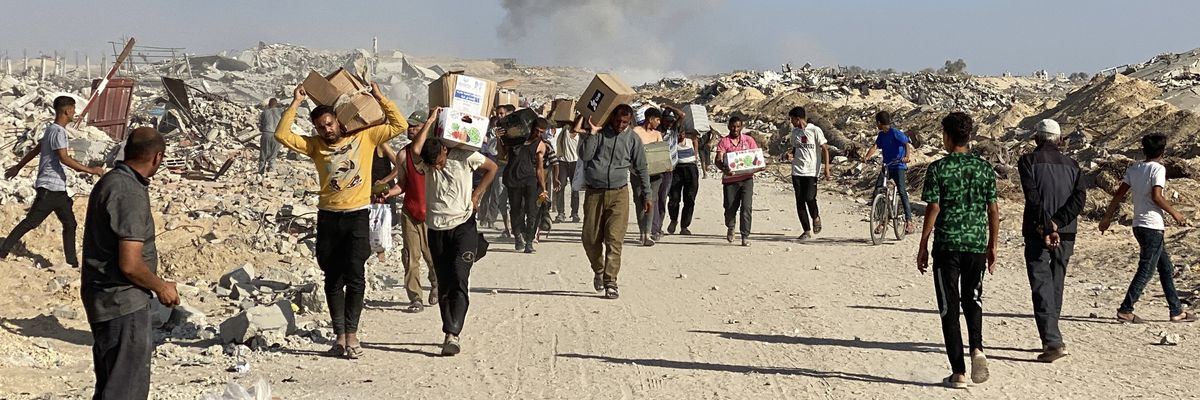
Displaced Palestinians receive food packages from a U.S.-backed foundation pledging to distribute humanitarian aid in western Rafah in the southern Gaza Strip on May 27, 2025.
(Photo: AFP via Getty Images)
Julia Conley
May 27, 2025
COMMON DREAMS
On the first day of operations for the U.S.- and Israel-backed foundation set up to provide aid to Palestinians in Gaza, reports Tuesday indicated that distribution sites descended into "chaos," with desperate people who have suffered increasingly from malnutrition in recent months "corralled" into metal enclosures for hours, U.S. and Israeli forces firing live ammunition, and at least one person reportedly being "kidnapped" by Israeli intelligence officers.
The Gaza Humanitarian Foundation (GHF), which is based in Geneva and staffed by private U.S. security contractors, said it had distributed 8,000 food boxes containing more than 460,000 meals on Tuesday, but some Palestinians said they were hesitant to approach the group's distribution points for fear of being targeted after going through the GHF's facial recognition technology screening process.
Israeli officials have said recipients of the aid will be screened so Hamas members don't obtain food packages, but Jeremy Scahill of Drop Site News said there was already a report Tuesday morning of a Palestinian man "being kidnapped when he went to get one of the small boxes of food" at the Muraj Crossing distribution point.
"To our shock, he called us under threat from Israeli intelligence officers, demanding information about one of our relatives with whom we've had no contact since the beginning of the war," said the man's family. "When we were unable to provide the information the army requested, communication was cut off, and we were later informed that he was transferred to a detention center. He is now considered missing."
A humanitarian coordinator in central Gaza toldDrop Site the distribution points are "being used to detain civilians."
The United Nations and aid groups that have long operated in Gaza have boycotted the GHF and warned against its plan to set up distribution points only in the southern part of the enclave, forcibly displacing Palestinians—90% of whom have already been forced from their homes since Israel began its bombardment of the enclave in retaliation for a Hamas-led attack in October 2023.
"Humanitarian assistance must not be politicized or militarized," Christian Cardon, chief spokesperson of the International Committee of the Red Cross, toldReuters.
Drop Site and Reuters reported that at a distribution point in Tel al-Sultan, west of Rafah, order quickly collapsed as Palestinians rushed toward the site to retrieve aid after "waiting for hours in the sun"—and following 86 days of Israel's total blockade on humanitarian aid, which has caused the risk of famine to rise across Gaza and has caused dozens of children to die of starvation, as Israel has also intensified its bombardment.
"This situation constitutes humiliation and degradation of the Palestinian citizen," said Eyad Amawi of the Gaza Relief Committees. "We are talking about tens of thousands across the Gaza Strip who will not be able to access these aid points. A single distribution location in Rafah, in the heart of the military incursion zone, poses significant danger and threat. It will not be effective unless aid distribution is returned to a system managed by U.N.-affiliated institutions—ensuring neutrality, fairness, and inclusivity in the process."
Images posted online showed Palestinians crowded into metal enclosures at the site.
The Israeli news outlet Ynet published conflicting accounts, with an Israeli security source saying U.S. forces fired warning shots into the air after a "Gazan mob" entered a "sterile area." Another source said that American security forces "fled the scene" after Palestinians raced toward the distribution point. Channel 12 in Israel reported that an Israeli combat helicopter reportedly fired into the air to disperse the crowd—even though Israel has said its forces would not be involved in GHF's operations.
"No entity can manage the humanitarian scene in Gaza except for U.N. agencies, foremost among them the U.N. Relief and Works Agency for Palestine Refugees in the Near East," said Ramy Abdul, chairman of the Euro-Mediterranean Human Rights Monitor. "Any other parties are engaging in political blackmail and criminal acts, led by the U.S. and Israel."
Drop Site posted a video online showing a large crowd of Palestinian people rushing toward a distribution site without any humanitarian workers appearing to ensure order or provide aid.
"The Gaza Humanitarian Foundation has left Palestinians without food," said José Andrés, the chef who founded World Central Kitchen, which has provided aid in Gaza, even as Israel has killed some of its workers. "The people that created it are selfish. And now because people are really hungry [they] just stormed the distribution place damaging the fence. It seems a helicopter began shooting."
"The World Central Kitchen system of kitchens is the way," said Andrés. "Palestinians feeding Palestinians."
The GHF and Israel claimed without evidence that Hamas tried to block Palestinians from reaching the distribution centers.
Ismail Al-Thawabta, director of Gaza's Government Media Office, which is run by Hamas, told Reuters that "the real cause of the delay and collapse in the aid distribution process is the tragic chaos caused by the mismanagement of the same company operating under the Israeli occupation's administration in those buffer zones."
"This has led to thousands of starving people, under the pressure of siege and hunger, storming distribution centres and seizing food, during which Israeli forces opened fire," said Al-Thawabta.
The chaotic first day of operations for GHF came two days after its executive director, Jake Wood, resigned, saying the foundation's plan for aid distribution violated basic "humanitarian principles."
Jewish Voice for Peace (JVP) said that starving Palestinians were forced to walk an average of 9.3 miles to a distribution point near Al-Mawasi.
"This is the grim reality for Palestinians trapped under siege by the Israeli military: insufficient aid, poorly organized, delivered at gunpoint by military contractors in coordination with the Israeli military," said JVP. "Instead of GHF, established international organizations operating under the U.N. should be granted full, safe, and unlimited access to deliver aid effectively, impartially, and with dignity."
"There is no time to waste," said the group. "Stop funding the Israeli military. End the siege. Let in U.N.-coordinated aid. Demand an immediate cease-fire. End the occupation. Free Palestine."
Intensifying Israeli Onslaught Has Displaced 180,000 Palestinians in Just 10 Days
"They call places safe, then attack them," said one Palestinian aid worker. "I'd rather stay home with my family and face whatever comes, at least we all die together, rather than be separated."
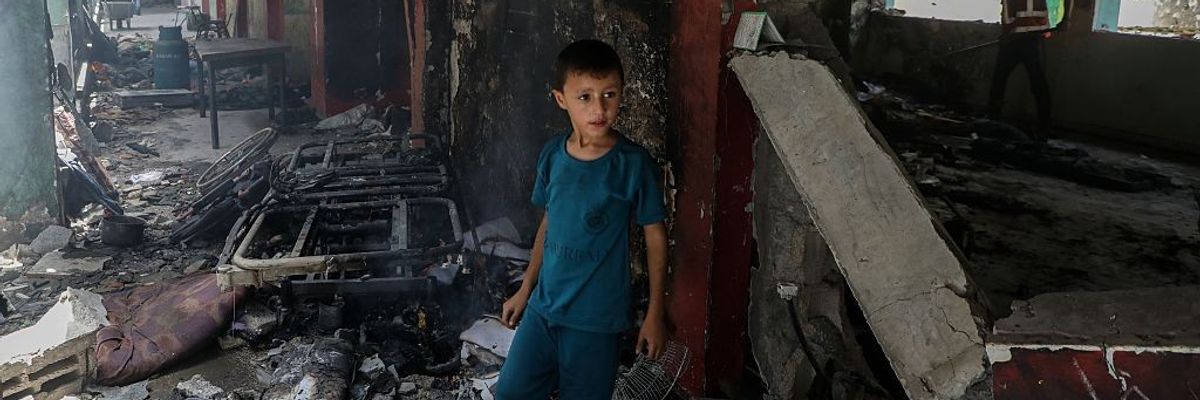
A Palestinian boy is seen at the Fahmi Al-Jarjawi school after an Israeli airstrike in Gaza City on May 26, 2025.
(Photo: Rizek Abdeljawad/Xinhua via Getty Images)
Jake Johnson
May 27, 2025
COMMON DREAMS
A United Nations group said Tuesday that Israel's renewed ground offensive and continued airstrikes in the Gaza Strip displaced roughly 180,000 Palestinians in just 10 days this month, leaving desperate, starving families with nowhere to turn as Israeli forces target shelters and other civilian infrastructure.
The estimate from the International Organization for Migration's Global Camp Coordination and Camp Management (CCCM) Cluster came a day after the Israeli military bombed a school-turned-shelter in Gaza City, killing dozens.
CCCM said Tuesday that direct attacks on shelters for displaced people "have become common" in recent weeks as Israeli forces have moved ahead with Operation Gideon's Chariots, an expansion of Israel's devastating assault on the besieged Palestinian enclave. The official death toll from Israel's assault, which began in the wake of a Hamas-led attack in October 2023, surpassed 54,000 on Tuesday.
"Since the collapse of the cease-fire on 18 March, nearly 616,000 people have been displaced—multiple times, some as many as 10," said the U.N. group. "During the cease-fire, over half a million people went back to their homes, mostly in the north, to try to rebuild their lives. That fragile progress has now been reversed, as intensified military operations are once again displacing families away from the areas they had only recently returned to."
Citing humanitarian partners on the ground, CCCM noted that roughly 80% of the Gaza Strip is either under a displacement order or marked as a "no-go" zone, making most of the enclave's population vulnerable to Israel's ground and aerial onslaught.
"My sibling died in a 'safe' zone after they bombed it," one Palestinian aid worker told CCCM. "They call places safe, then attack them. I'd rather stay home with my family and face whatever comes, at least we all die together, rather than be separated."
CCCM also raised alarm over a newly launched aid scheme led by the Gaza Humanitarian Foundation (GHF), a private organization with ties to the U.S. and Israeli governments.
"These arrangements risk circumventing established humanitarian coordination mechanisms, undermining humanitarian principles, and putting civilians at further risk by promoting displacement without essential protection or adequate access to lifesaving services," the U.N. organization said.
The Euro-Mediterranean Human Rights Monitor echoed that warning, saying in a statement that "all available information about the new Israeli mechanism clearly indicates that it is designed as a tool of coercive control over the Gaza Strip's civilian population."
"It limits families to just one aid parcel per week under highly restrictive security conditions, thus violating the principles of non-discrimination, adequacy, and continuity in humanitarian aid," the group said. "Such limited distribution is not a genuine humanitarian response, but a deliberate policy aimed at barely managing hunger, rather than actually alleviating it."
"They call places safe, then attack them," said one Palestinian aid worker. "I'd rather stay home with my family and face whatever comes, at least we all die together, rather than be separated."
A Palestinian boy is seen at the Fahmi Al-Jarjawi school after an Israeli airstrike in Gaza City on May 26, 2025.
(Photo: Rizek Abdeljawad/Xinhua via Getty Images)
Jake Johnson
May 27, 2025
COMMON DREAMS
A United Nations group said Tuesday that Israel's renewed ground offensive and continued airstrikes in the Gaza Strip displaced roughly 180,000 Palestinians in just 10 days this month, leaving desperate, starving families with nowhere to turn as Israeli forces target shelters and other civilian infrastructure.
The estimate from the International Organization for Migration's Global Camp Coordination and Camp Management (CCCM) Cluster came a day after the Israeli military bombed a school-turned-shelter in Gaza City, killing dozens.
CCCM said Tuesday that direct attacks on shelters for displaced people "have become common" in recent weeks as Israeli forces have moved ahead with Operation Gideon's Chariots, an expansion of Israel's devastating assault on the besieged Palestinian enclave. The official death toll from Israel's assault, which began in the wake of a Hamas-led attack in October 2023, surpassed 54,000 on Tuesday.
"Since the collapse of the cease-fire on 18 March, nearly 616,000 people have been displaced—multiple times, some as many as 10," said the U.N. group. "During the cease-fire, over half a million people went back to their homes, mostly in the north, to try to rebuild their lives. That fragile progress has now been reversed, as intensified military operations are once again displacing families away from the areas they had only recently returned to."
Citing humanitarian partners on the ground, CCCM noted that roughly 80% of the Gaza Strip is either under a displacement order or marked as a "no-go" zone, making most of the enclave's population vulnerable to Israel's ground and aerial onslaught.
"My sibling died in a 'safe' zone after they bombed it," one Palestinian aid worker told CCCM. "They call places safe, then attack them. I'd rather stay home with my family and face whatever comes, at least we all die together, rather than be separated."
CCCM also raised alarm over a newly launched aid scheme led by the Gaza Humanitarian Foundation (GHF), a private organization with ties to the U.S. and Israeli governments.
"These arrangements risk circumventing established humanitarian coordination mechanisms, undermining humanitarian principles, and putting civilians at further risk by promoting displacement without essential protection or adequate access to lifesaving services," the U.N. organization said.
The Euro-Mediterranean Human Rights Monitor echoed that warning, saying in a statement that "all available information about the new Israeli mechanism clearly indicates that it is designed as a tool of coercive control over the Gaza Strip's civilian population."
"It limits families to just one aid parcel per week under highly restrictive security conditions, thus violating the principles of non-discrimination, adequacy, and continuity in humanitarian aid," the group said. "Such limited distribution is not a genuine humanitarian response, but a deliberate policy aimed at barely managing hunger, rather than actually alleviating it."

No comments:
Post a Comment