Chernobyl looking to develop tourism post-war
The Chernobyl nuclear power plant and the Slavutych City authorities have signed a memorandum of cooperation with the goal of developing local tourism as part of the post-war revival of the region.
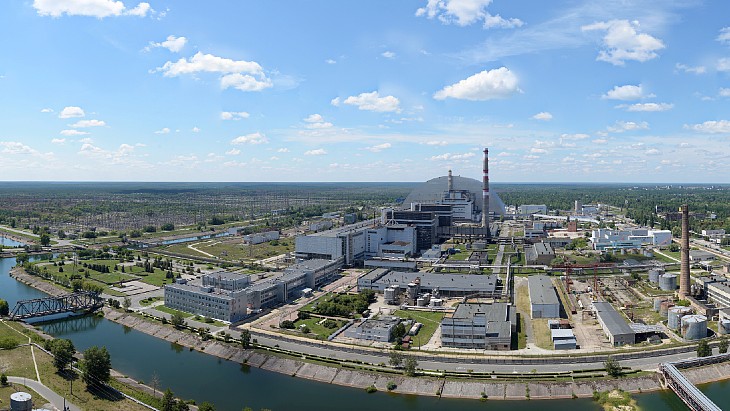
According to the Chernobyl Nuclear Power Plant (ChNPP) state enterprise, "this will contribute to the development of the tourist attractiveness of the Slavutych community and the region as a whole, the preservation of historical memory, and the formation of a positive image both at the national and international levels".
Slavutych was the city built 45 kilometres east of Chernobyl to house its workers evacuated from Pripyat which was three kilometres from the plant, after the 1986 accident.
The framework of the memorandum includes support for the city museum of Slavutych, the tourist information centre and expanding exhibitions related to the history of the Chernobyl nuclear power plant and "the construction of the cities of Pripyat and Slavutych, as well as the elimination of the consequences of the accident, which will contribute to a deeper understanding of the events of 1986".
There are also proposals for "thematic excursions" and "joint tourist, cultural, educational and educational events - conferences, festivals, excursions, study tours for students, thematic events dedicated to the topics of Chernobyl, ecology and sustainable development with the involvement of specialists of the ChNPP State Enterprise and institutions and organisations of the city, scientists and tourists".
Education of future generations of people in Slavutych is also seen as a key goal of the cooperation and "provides for joint participation in training courses, seminars for guides and researchers specialising in the topics of Chernobyl, nuclear energy, and ecology".
The background
Following the Chernobyl accident in April 1986 (you can read more about it in the World Nuclear Association's Chernobyl Accident information paper) a 4200-square kilometre Chernobyl Exclusion Zone was established, which has been largely uninhabited since. A containment shelter was built at speed over the ruins of unit 4 after the accident and there has since been a giant new shelter - the New Safe Confinement built over it. The last operating unit at Chernobyl, unit 3 operated until 2000.
There was a developing tourist/visitor industry before the war with Russia began in 2022.
In 2019 a decree by Ukraine's President Volodymyr Zelensky titled "On the development of areas affected by radioactive contamination due to the Chernobyl disaster" aimed to begin turning the exclusion zone into one of the growth points of the new Ukraine.
It aimed to remove a ban on filming in the area and to "popularise" tourism in Chernobyl at international events. "We must give this territory of Ukraine a new lease of life. Until now, Chernobyl has been a negative component of the Ukrainian brand. It's time to change that. We must showcase this place to the world: to scientists, ecologists, historians, tourists," he said at the time.
As well as the historical and educational potential of the area, the exclusion zone has become what the United Nations' environment programme describes as "a haven for wildlife, with lynx, bison, deer and other animals roaming through thick forests" in "the third-largest nature reserve in mainland Europe and an iconic – if accidental – experiment in rewilding".
However tourism to the area halted after the Russian invasion in February 2022, which saw its forces taking control of the Chernobyl plant and area for two months before they withdrew. The war continues and in February the New Safe Confinement shelter was damaged by a drone strike.

Zaporizhzhia security, restart and US fuel discussed in IAEA-Russian talks
In the latest meeting between International Atomic Energy Agency Director General Rafael Mariano Grossi and Rosatom Director General Alexei Likhachev the two sides discussed the on-going security situation and issues relating to any future restart of the plant's units.
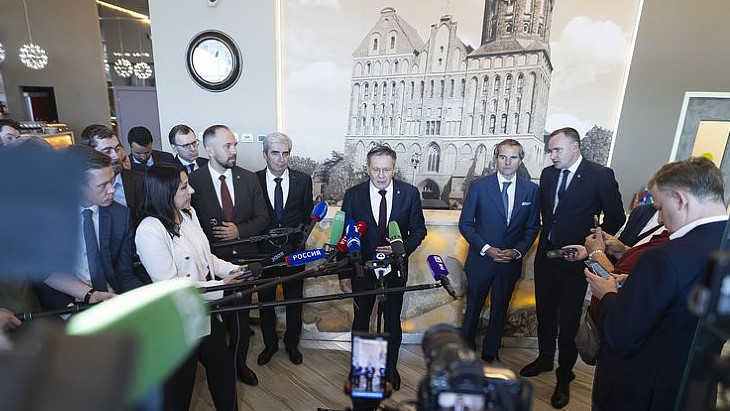
Grossi, who visited Russia following talks in Ukraine, described the talks on social media platform X as a "comprehensive and necessary" exchange "on the current safety, security and safeguards situation" at the Zaporizhzhia nuclear power plant "and the essential role" played by the International Atomic Energy Agency (IAEA) experts stationed at the plant "to prevent a nuclear accident".
At a press conference in Vienna on Monday as the IAEA board of governors met, Grossi said there was a "common view" between the Russian side and the IAEA that it would be inadvisable to restart the plant in the current military situation. He added: "There are other more technical aspects like, for example, the availability of enough water to cool down the reactors or also the availability of sufficient, stable, external power so you can rest assured that if it's started there will be no blackout and the plant will be able to operate."
"Apart from that we know that they have the intention to restart it at some point - some plans were shown to us - but that is a matter which has other interconnections with wider negotiations that are taking place."
The Russian Tass news agency's report of Likhachev's comments said the plant could only be restarted once there was no military threat, and quoted him as saying "we have already started construction of a floating modular pumping station with a capacity of up to 80,000 cubic metres per hour, which will address all problems related to water supply in the event that the units are brought to their design capacity".
Rosatom has already produced a plan for restarting the units in the future which is currently being considered by the Russian government.
One of the other topics covered was the issue of the rotation of the IAEA teams, which have been subject to delays because of security concerns. There was also a general discussion on how to ensure nuclear safety and security, and the general security situation at the plant, which has been under Russian military control since March 2022 and which is on the frontline of Ukrainian and Russian forces.
There has also been an issue with the US nuclear fuel at the plant, with Tass saying that Likhachev had asked Grossi to mediate discussions on the use of the US-manufactured fuel which are currently loaded into four of the six units with more in the fresh fuel storage facility and in the used fuel pools.
At his media conference on Monday, Grossi said the general situation at Zaporizhzhia nuclear power plant - which continues to rely on one external power line - "continues to be very fragile ... the level of military activity is increasing, not decreasing". He also noted that the erosion of infrastructure in Ukraine "continues to have an impact on nuclear safety".
Emergency core cooling system tank shipped for Xudabao 4
The 80-tonne tank, which has a capacity of 60 cubic metres, was produced at the Petrozavodskmash plant of Rosatom's machine-building division with the ceremonial shipment marking the plant's 65th anniversary.
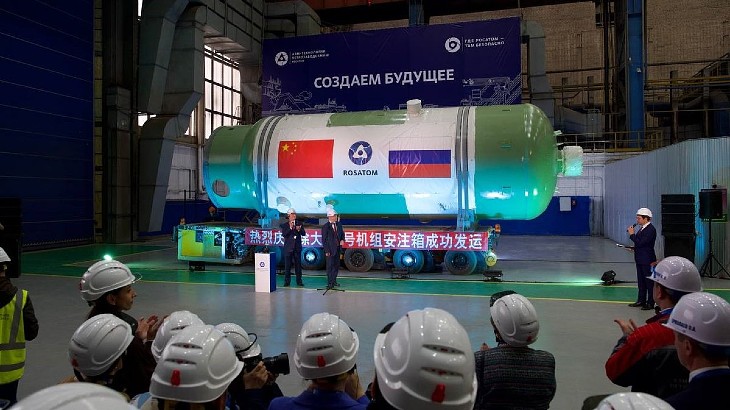
The emergency core cooling system tank is a thick-walled high-pressure vessel about three metres in diameter and will be filled with an aqueous solution of boric acid which would be automatically fed into the reactor to cool the active zone in the event of a pressure drop in the primary circuit.
Each unit's emergency core cooling safety system includes four of the tanks, with the fourth and final one for unit 4 to be shipped during June.
The background
In June 2018, Russia and China signed four agreements, including for the construction of two VVER-1200 reactors at the new Xudabao (also known as Xudapu) site in China's Liaoning province. Agreements signed in June 2019 included a general contract for the construction of Xudabao units 3 and 4, as well as a contract for the supply of nuclear fuel.
Construction of Xudabao unit 3 began in July 2021, with that of unit 4 starting in May 2022. Commissioning of the units is scheduled for 2027 and 2028, respectively.
When completed, the two units are expected to generate more than 18 billion kWh of electricity per year, equivalent to saving about 6.4 million tonnes of coal and reducing carbon dioxide emissions by about 18.9 million tonnes per year.
The Xudabao plant is owned by Liaoning Nuclear Power Company Limited, a joint venture between China National Nuclear Corporation (70%), Datang International Power Generation Company (20%) and State Development and Investment Corporation (10%).
What they said
The head of the Rosatom Machine-Building Division, Igor Kotov, said: "Rosatom's machine builders have now manufactured 95% of the contracted equipment for the four new power units being built at the Tianwan and Xudapu nuclear power plants. In particular, main circulation pipelines, main circulation pump housings, equipment for safety systems and much, much more have been shipped from Petrozvodskmash. By the end of 2025, the manufacture of all products involved in the operation of the nuclear island will be completed."
Deputy Director General of the Rosatom State Corporation for Mechanical Engineering and Industrial Solutions, Andrey Nikipelov, said: "Petrozavodskmash produces equipment that is unique for the industry and participates in all Rosatom projects for the construction of nuclear power plants. In the coming years, the company will have a lot more work."
Artur Parfenchikov, the head of the Republic of Karelia in northwest Russia where the plant is located, said: "Petrozavodskmash makes a great contribution to the economy and industrial development of Karelia ... and in this anniversary year, we honour the veterans of the plant, talk about achievements ... it creates new jobs, increases the tax base of our budget ... [and] is an interesting and promising place to work for our Karelian youth."

No comments:
Post a Comment