‘We're getting close to finding countries’ – Netanyahu and Trump on ‘relocation’ of Palestinians
Human rights groups condemned the plan as ethnic cleansing.

Israel's prime minister Benjamin Netanyahu. Photo: Reuters
U.S. President Donald Trump, hosting Israeli Prime Minister Benjamin Netanyahu at the White House on Monday, said the United States had scheduled talks with Iran and indicated progress on a controversial effort to relocate Palestinians out of Gaza.
Speaking to reporters at the beginning of a dinner between U.S. and Israeli officials, Netanyahu said the United States and Israel were working with other countries who would give Palestinians a "better future," suggesting that the residents of Gaza could move to neighbouring nations.
"If people want to stay, they can stay, but if they want to leave, they should be able to leave," Netanyahu said.
"We're working with the United States very closely about finding countries that will seek to realise what they always say, that they wanted to give the Palestinians a better future. I think we're getting close to finding several countries."
Trump, who initially demurred to Netanyahu when asked about the relocating of Palestinians, said the countries around Israel were helping out. "We've had great cooperation from... surrounding countries, great cooperation from every single one of them. So something good will happen," Trump said.
The president earlier this year floated relocating Palestinians and taking over the Gaza Strip to turn it into the "Riviera of the Middle East." Gazans criticised the proposal and vowed never to leave their homes in the coastal enclave. Human rights groups condemned the plan as ethnic cleansing.
Trump and Netanyahu met for several hours in Washington while Israeli officials continued indirect negotiations with Hamas aimed at securing a U.S.-brokered Gaza ceasefire and hostage-release deal. Netanyahu returned to the Blair House guest house late on Monday, where he is due to meet Vice President JD Vance at 9:30 EDT on Tuesday.

An image depicting U.S. President Donald Trump and Israeli Prime Minister Benjamin Netanyahu is displayed as people attend the Napoli Pride parade in Naples, Italy, July 5, 2025, REUTERS/Matteo Ciambelli
Netanyahu's visit follows Trump's prediction, on the eve of their meeting, that such a deal could be reached this week. Before heading to Washington, the right-wing Israeli leader said his discussions with Trump could help advance negotiations under way in Qatar between Israel and the Palestinian militant group.
It was Trump's third face-to-face encounter with Netanyahu since returning to office in January, and came just over two weeks after the president ordered the bombing of Iranian nuclear sites in support of Israeli air strikes. Trump then helped arrange a ceasefire in the 12-day Israel-Iran war.
Trump said his administration would be meeting with Iran. "We have scheduled Iran talks, and they... want to talk. They took a big drubbing," he said.
Trump's Middle East envoy Steve Witkoff said the meeting would take place in the next week or so.
Trump said he would like to lift sanctions on Iran at some point. "I would love to be able to, at the right time, take those sanctions off," he said.
Iranian President Masoud Pezeshkian said in an interview released on Monday that he believed Iran could resolve its differences with the United States through dialogue.
Trump and his aides appeared to be trying to seize on any momentum created by the weakening of Iran, which backs Hamas, to push both sides for a breakthrough in the 21-month Gaza war.
The two leaders, with their top advisers, held a private dinner in the White House Blue Room, instead of more traditional talks in the Oval Office, where the president usually greets visiting dignitaries.

Demonstrators hold a banner featuring images of Israeli Prime Minister Benjamin Netanyahu, Finance Minister Bezalel Smotrich and National Security Minister Itamar Ben-Gvir, during a protest to demand the immediate release of hostages held in Gaza since the October 7, 2023 attack on Israel by Hamas, in Tel Aviv, Israel, July 5, 2025. REUTERS/Ronen Zvulun
Outside, hundreds of protesters, many wearing Palestinian keffiyeh scarves and waving Palestinian flags, gathered near the White House, waving banners that read "Stop Arming Israel" and "Say No to Genocide". They also called for Netanyahu's arrest, referring to the International Criminal Court's arrest warrant against the Israeli leader over alleged war crimes in Gaza.
Netanyahu met earlier on Monday with Witkoff and Secretary of State Marco Rubio. He planned to visit the U.S. Capitol on Tuesday to see congressional leaders.
During their meeting, Netanyahu gave Trump a letter that he said he had used to nominate the U.S. president for the Nobel Peace Prize. Trump, appearing pleased by the gesture, thanked him.
Ahead of their visit, Netanyahu told reporters Israeli negotiators were driving for a deal on Gaza in Doha, Qatar's capital.
Israeli officials also hope the outcome of the conflict with Iran will pave the way for normalization of relations with more of its neighbours such as Lebanon, Syria and Saudi Arabia.
Human rights groups condemned the plan as ethnic cleansing.
Israel's prime minister Benjamin Netanyahu. Photo: Reuters
U.S. President Donald Trump, hosting Israeli Prime Minister Benjamin Netanyahu at the White House on Monday, said the United States had scheduled talks with Iran and indicated progress on a controversial effort to relocate Palestinians out of Gaza.
Speaking to reporters at the beginning of a dinner between U.S. and Israeli officials, Netanyahu said the United States and Israel were working with other countries who would give Palestinians a "better future," suggesting that the residents of Gaza could move to neighbouring nations.
"If people want to stay, they can stay, but if they want to leave, they should be able to leave," Netanyahu said.
"We're working with the United States very closely about finding countries that will seek to realise what they always say, that they wanted to give the Palestinians a better future. I think we're getting close to finding several countries."
Trump, who initially demurred to Netanyahu when asked about the relocating of Palestinians, said the countries around Israel were helping out. "We've had great cooperation from... surrounding countries, great cooperation from every single one of them. So something good will happen," Trump said.
The president earlier this year floated relocating Palestinians and taking over the Gaza Strip to turn it into the "Riviera of the Middle East." Gazans criticised the proposal and vowed never to leave their homes in the coastal enclave. Human rights groups condemned the plan as ethnic cleansing.
Trump and Netanyahu met for several hours in Washington while Israeli officials continued indirect negotiations with Hamas aimed at securing a U.S.-brokered Gaza ceasefire and hostage-release deal. Netanyahu returned to the Blair House guest house late on Monday, where he is due to meet Vice President JD Vance at 9:30 EDT on Tuesday.
An image depicting U.S. President Donald Trump and Israeli Prime Minister Benjamin Netanyahu is displayed as people attend the Napoli Pride parade in Naples, Italy, July 5, 2025, REUTERS/Matteo Ciambelli
Netanyahu's visit follows Trump's prediction, on the eve of their meeting, that such a deal could be reached this week. Before heading to Washington, the right-wing Israeli leader said his discussions with Trump could help advance negotiations under way in Qatar between Israel and the Palestinian militant group.
It was Trump's third face-to-face encounter with Netanyahu since returning to office in January, and came just over two weeks after the president ordered the bombing of Iranian nuclear sites in support of Israeli air strikes. Trump then helped arrange a ceasefire in the 12-day Israel-Iran war.
Trump said his administration would be meeting with Iran. "We have scheduled Iran talks, and they... want to talk. They took a big drubbing," he said.
Trump's Middle East envoy Steve Witkoff said the meeting would take place in the next week or so.
Trump said he would like to lift sanctions on Iran at some point. "I would love to be able to, at the right time, take those sanctions off," he said.
Iranian President Masoud Pezeshkian said in an interview released on Monday that he believed Iran could resolve its differences with the United States through dialogue.
Trump and his aides appeared to be trying to seize on any momentum created by the weakening of Iran, which backs Hamas, to push both sides for a breakthrough in the 21-month Gaza war.
The two leaders, with their top advisers, held a private dinner in the White House Blue Room, instead of more traditional talks in the Oval Office, where the president usually greets visiting dignitaries.
Demonstrators hold a banner featuring images of Israeli Prime Minister Benjamin Netanyahu, Finance Minister Bezalel Smotrich and National Security Minister Itamar Ben-Gvir, during a protest to demand the immediate release of hostages held in Gaza since the October 7, 2023 attack on Israel by Hamas, in Tel Aviv, Israel, July 5, 2025. REUTERS/Ronen Zvulun
Outside, hundreds of protesters, many wearing Palestinian keffiyeh scarves and waving Palestinian flags, gathered near the White House, waving banners that read "Stop Arming Israel" and "Say No to Genocide". They also called for Netanyahu's arrest, referring to the International Criminal Court's arrest warrant against the Israeli leader over alleged war crimes in Gaza.
Netanyahu met earlier on Monday with Witkoff and Secretary of State Marco Rubio. He planned to visit the U.S. Capitol on Tuesday to see congressional leaders.
During their meeting, Netanyahu gave Trump a letter that he said he had used to nominate the U.S. president for the Nobel Peace Prize. Trump, appearing pleased by the gesture, thanked him.
Ahead of their visit, Netanyahu told reporters Israeli negotiators were driving for a deal on Gaza in Doha, Qatar's capital.
Israeli officials also hope the outcome of the conflict with Iran will pave the way for normalization of relations with more of its neighbours such as Lebanon, Syria and Saudi Arabia.
Second day of Qatar talks
Witkoff, who played a major role in crafting the 60-day ceasefire proposal at the centre of the Qatar negotiations, will travel to Doha this week to join discussions there, White House press secretary Karoline Leavitt told reporters earlier on Monday.
In a sign of continued gaps between the two sides, Palestinian sources said Israel's refusal to allow the free and safe entry of humanitarian aid into Gaza remains the main obstacle to progress in the indirect talks. Israel insists it is taking steps to get food into Gaza but seeks to prevent militants from diverting supplies.
On the second day of negotiations, mediators hosted one round and talks were expected to resume in the evening, the Palestinian sources told Reuters.
The U.S.-backed proposal envisages a phased release of hostages, Israeli troop withdrawals from parts of Gaza and discussions on ending the war entirely.
Hamas has long demanded a final end to the war before it would free remaining hostages; Israel has insisted it would not agree to halt fighting until all hostages are released and Hamas dismantled.
Trump told reporters last week that he would be “very firm” with Netanyahu on the need for a speedy Gaza deal and that the Israeli leader also wanted to end the war.
Some of Netanyahu's hard-line coalition partners oppose halting military operations but, with Israelis having become increasingly weary of the Gaza war, his government is expected to back a ceasefire if he can secure acceptable terms.
A ceasefire at the start of this year collapsed in March, and talks to revive it have so far been fruitless. Meanwhile, Israel has intensified its military campaign in Gaza and sharply restricted food distribution.
Gazans were watching closely for any sign of a breakthrough. “I ask God almighty that the negotiating delegation or the mediators pressure with all their strength to solve this issue, because it has totally became unbearable,” said Abu Suleiman Qadoum, a displaced resident of Gaza city.
The Gaza war erupted when Hamas attacked southern Israel in October 2023, killing around 1,200 people and taking 251 hostages. Some 50 hostages remain in Gaza, with 20 believed to be alive.
Israel's retaliatory war in Gaza has killed over 57,000 Palestinians, according to the enclave's health ministry. Most of Gaza's population has been displaced by the war and nearly half a million people are facing famine within months, according to United Nations estimates.
Trump has been strongly supportive of Netanyahu, even wading into domestic Israeli politics last month by criticising prosecutors over a corruption trial against the Israeli leader on bribery, fraud and breach-of-trust charges that Netanyahu denies.
Palestinians have no rights in Trump-Netanyahu Gaza deal
July 8, 2025
By John Wojcik
People’s World
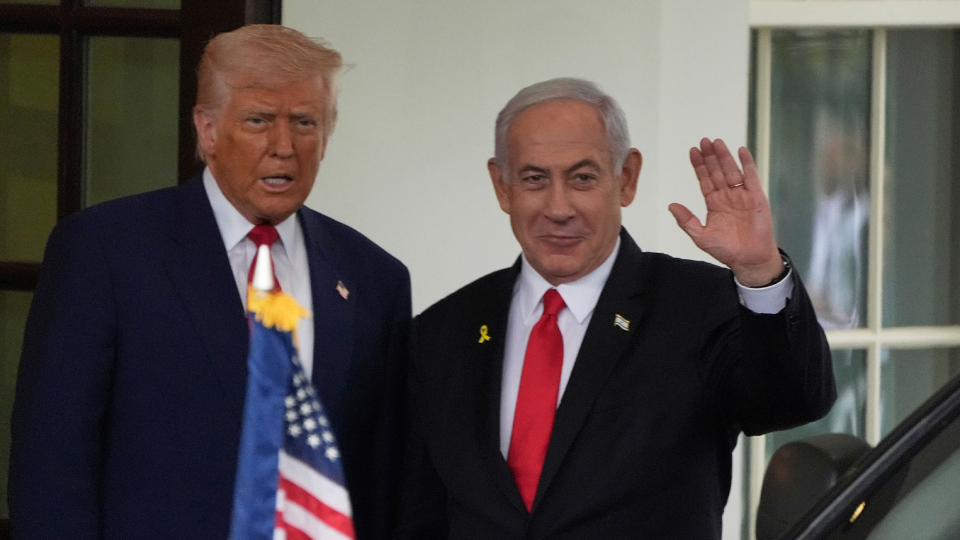
President Trump and Israeli Prime Minister Netanyahu at a White House meeting during which Netanyahu nominated Trump for the Nobel Peace Prize and the two discussed, among many other things, the option of moving the people of Gaza out to surrounding countries rather than backing the idea of an independent Palestinian state.| AP
Israeli Prime Minister Benjamin Netanyahu and President Donald Trump were closer together on key issues more than ever at their White House meeting on Gaza this week, as the Israeli warmaker nominated the American warmaker for the Nobel Peace Prize.
After the meeting, they discussed how, among other things, there were talks going on that could result in the removal of Palestinians from Gaza to surrounding countries. “The Palestinian people should have a choice,” Netanyahu declared, “about whether to stay or to move out.” Not included in the choice he or Trump is offering them, of course, was the right to form an independent Palestinian state and remain in what has been their homeland for thousands of years.
No credible journalists or lawmakers anywhere in the world report even a scintilla of evidence that other countries in the region are even willing to take in Palestinians. The choice Trump and Netanyahu, his accomplice in war crimes in the region, are offering Palestinians is to either stay in a devastated country facing starvation and death at the hands of military occupiers or a massive transfer of an entire people out to surrounding countries that have no interest in taking them in.
In explaining his call for Trump to be nominated for the Nobel Peace Prize, Netanyahu cited the “unmitigated success” of the recent joint U.S.-Israeli strikes on Iran’s nuclear facilities.
The two leaders sat down with their top aides for a dinner in the White House Blue Room to mark the Iran operation and allegedly to discuss efforts to push forward with a 60-day ceasefire proposal to pause the 21-month conflict in Gaza.
“He’s forging peace as we speak, one country and one region after the other,” Netanyahu said as he presented Trump with a nominating letter he said he sent to the Nobel committee.
In a move that, instead, endangered peace in the region and the world, Trump ordered U.S. forces to drop “bunker-buster” bombs and fire a barrage of Tomahawk missiles on three key Iranian nuclear sites.
“Coming from you in particular, this is very meaningful,” Trump told Netanyahu as the prime minister handed him the nomination letter for the peace prize.
Other than being a meeting enabling Netanyahu and Trump to celebrate a supposed “victory” this week, the session at the White House yielded nothing when it comes to concrete plans for Israel to end its genocidal war against Palestinians. It also left the widespread perception around the world that Trump is not at all seriously pushing for an end to the conflict but instead orchestrating, from behind the scenes, its continuation.
Nothing was done to change the fact, for example, that continued pumping in of armaments to Israel by Washington enables the war against the Palestinians to continue.
Trump is also claiming that Iranian officials have reached out to the U.S. to schedule talks about Iran’s nuclear program. Negotiations had started in April but were scuttled after Israel and then the U.S. began bombings last month.
Contrary to Trump’s assurances, Tehran has yet to confirm that it has agreed to restart talks with the U.S.
But Iran’s President Masoud Pezeshkian, in an interview published Monday, said the U.S. airstrikes so badly damaged his country’s nuclear facilities that Iranian authorities still have not been able to access them to survey the destruction.
Pezeshkian added in the interview with right-wing journalist Tucker Carlson that Iran would be willing to resume cooperation with the U.N. nuclear watchdog but cannot yet commit to allowing its inspectors unfettered access to monitor the sites.
The Associated Press contributed to this article.
As with all news-analysis and op-ed articles published by People’s World, the views reflected here are those of the author.
We hope you appreciated this article. At People’s World, we believe news and information should be free and accessible to all, but we need your help. Our journalism is free of corporate influence and paywalls because we are totally reader-supported. Only you, our readers and supporters, make this possible. If you enjoy reading People’s World and the stories we bring you, please support our work by donating or becoming a monthly sustainer today. Thank you!
President Trump and Israeli Prime Minister Netanyahu at a White House meeting during which Netanyahu nominated Trump for the Nobel Peace Prize and the two discussed, among many other things, the option of moving the people of Gaza out to surrounding countries rather than backing the idea of an independent Palestinian state.| AP
Israeli Prime Minister Benjamin Netanyahu and President Donald Trump were closer together on key issues more than ever at their White House meeting on Gaza this week, as the Israeli warmaker nominated the American warmaker for the Nobel Peace Prize.
After the meeting, they discussed how, among other things, there were talks going on that could result in the removal of Palestinians from Gaza to surrounding countries. “The Palestinian people should have a choice,” Netanyahu declared, “about whether to stay or to move out.” Not included in the choice he or Trump is offering them, of course, was the right to form an independent Palestinian state and remain in what has been their homeland for thousands of years.
No credible journalists or lawmakers anywhere in the world report even a scintilla of evidence that other countries in the region are even willing to take in Palestinians. The choice Trump and Netanyahu, his accomplice in war crimes in the region, are offering Palestinians is to either stay in a devastated country facing starvation and death at the hands of military occupiers or a massive transfer of an entire people out to surrounding countries that have no interest in taking them in.
In explaining his call for Trump to be nominated for the Nobel Peace Prize, Netanyahu cited the “unmitigated success” of the recent joint U.S.-Israeli strikes on Iran’s nuclear facilities.
The two leaders sat down with their top aides for a dinner in the White House Blue Room to mark the Iran operation and allegedly to discuss efforts to push forward with a 60-day ceasefire proposal to pause the 21-month conflict in Gaza.
“He’s forging peace as we speak, one country and one region after the other,” Netanyahu said as he presented Trump with a nominating letter he said he sent to the Nobel committee.
In a move that, instead, endangered peace in the region and the world, Trump ordered U.S. forces to drop “bunker-buster” bombs and fire a barrage of Tomahawk missiles on three key Iranian nuclear sites.
“Coming from you in particular, this is very meaningful,” Trump told Netanyahu as the prime minister handed him the nomination letter for the peace prize.
Other than being a meeting enabling Netanyahu and Trump to celebrate a supposed “victory” this week, the session at the White House yielded nothing when it comes to concrete plans for Israel to end its genocidal war against Palestinians. It also left the widespread perception around the world that Trump is not at all seriously pushing for an end to the conflict but instead orchestrating, from behind the scenes, its continuation.
Nothing was done to change the fact, for example, that continued pumping in of armaments to Israel by Washington enables the war against the Palestinians to continue.
Trump is also claiming that Iranian officials have reached out to the U.S. to schedule talks about Iran’s nuclear program. Negotiations had started in April but were scuttled after Israel and then the U.S. began bombings last month.
Contrary to Trump’s assurances, Tehran has yet to confirm that it has agreed to restart talks with the U.S.
But Iran’s President Masoud Pezeshkian, in an interview published Monday, said the U.S. airstrikes so badly damaged his country’s nuclear facilities that Iranian authorities still have not been able to access them to survey the destruction.
Pezeshkian added in the interview with right-wing journalist Tucker Carlson that Iran would be willing to resume cooperation with the U.N. nuclear watchdog but cannot yet commit to allowing its inspectors unfettered access to monitor the sites.
The Associated Press contributed to this article.
As with all news-analysis and op-ed articles published by People’s World, the views reflected here are those of the author.
We hope you appreciated this article. At People’s World, we believe news and information should be free and accessible to all, but we need your help. Our journalism is free of corporate influence and paywalls because we are totally reader-supported. Only you, our readers and supporters, make this possible. If you enjoy reading People’s World and the stories we bring you, please support our work by donating or becoming a monthly sustainer today. Thank you!

No comments:
Post a Comment