“There are no red lines anymore … It is scary,” said Albanese.
Saturday 12/07/2025

Special Rapporteur on the situation of human rights in the occupied Palestinian territory, Francesca Albanese, speaks during a press conference at the European headquarters of the UN in Geneva, Switzerland. REUTERS
BRUSSELS
Despite its traditional reluctance to openly voice disagreement with the US, the European Union has gingerly moved to criticise Washington’s action against Francesca Albanese, the UN Special Rapporteur on human rights in the occupied Palestinian territories and an Italian human rights lawyer.
The European Union “deeply regrets” the US decision to impose sanctions on Albanese, an EU spokesperson said on Friday.
“We deeply regret the decision to impose sanctions on Francesca Albanese”, spokesperson Anouar El Anouni told reporters during a daily EU briefing, adding that the European Union “strongly supports the United Nations human rights system.”
Belgium has separately expressed “deep regrets” over the sanctions.
The top UN expert on Palestinian rights said on Friday that the US decision to place her under sanctions could have a “chilling effect” on people who engage with her and restrict her movements, but that she planned to continue her work.
On Wednesday, US Secretary of State Marco Rubio announced that Francesca Albanese would be added to the US sanctions list for her actions, which he described as prompting illegitimate prosecutions of Israelis at the International Criminal Court.
Albanese said she now faces asset freezes and potential travel restrictions, warning that the US decision could set a “dangerous” precedent for human rights defenders worldwide.
“There are no red lines anymore … It is scary,” she told Reuters via video link from Bosnia, where she was attending events for the 30th anniversary of the Srebrenica genocide.
“It might block me from moving around. It will have a chilling effect on people normally engaging with me because for American citizens or for green card holders, this is going to be extremely problematic.”
“My plans are to continue what I’ve been doing,” she added.
The UN Special Rapporteur on human rights in the occupied Palestinian territories is one of dozens of experts appointed by the 47-member UN Human Rights Council to report on specific global issues.
Albanese, an Italian lawyer and academic, has been a vocal critic of Israel’s treatment of Palestinians. She recently published a report calling on states at the UN Council to impose an arms embargo and cut off trade and financial ties with Israel, while accusing the US ally of waging a “genocidal campaign” in Gaza.
Israel’s mission in Geneva said the report was “legally groundless, defamatory and a flagrant abuse of her office.”
The sanctions on Albanese set a dangerous precedent, said the spokesperson for UN Secretary-General Antonio Guterres, adding that the special rapporteurs do not report to Guterres and he has no authority over them.
“The use of unilateral sanctions against special rapporteurs, or any other UN official or expert, is unacceptable,” said UN spokesperson Stephane Dujarric.
Juerg Lauber, the Swiss permanent representative to the UN who now holds the rotating presidency of the Human Rights Council, said he regretted the sanctions, and called on states to “refrain from any acts of intimidation or reprisal” against the body’s experts.
Washington has already imposed sanctions against officials at the International Criminal Court, after it issued arrest warrants against Israeli Prime Minister Binyamin Netanyahu and his former defence minister for suspected war crimes in Gaza. Another court, the International Court of Justice, is hearing a case brought by South Africa that accuses Israel of genocide.
“The United States is working to dismantle the norms and institutions on which survivors of grave abuses rely,” said Liz Evenson, international justice director at Human Rights Watch.
The United States, once one of the most active members of the Human Rights Council, has disengaged from it under President Donald Trump, alleging an anti-Israel bias.
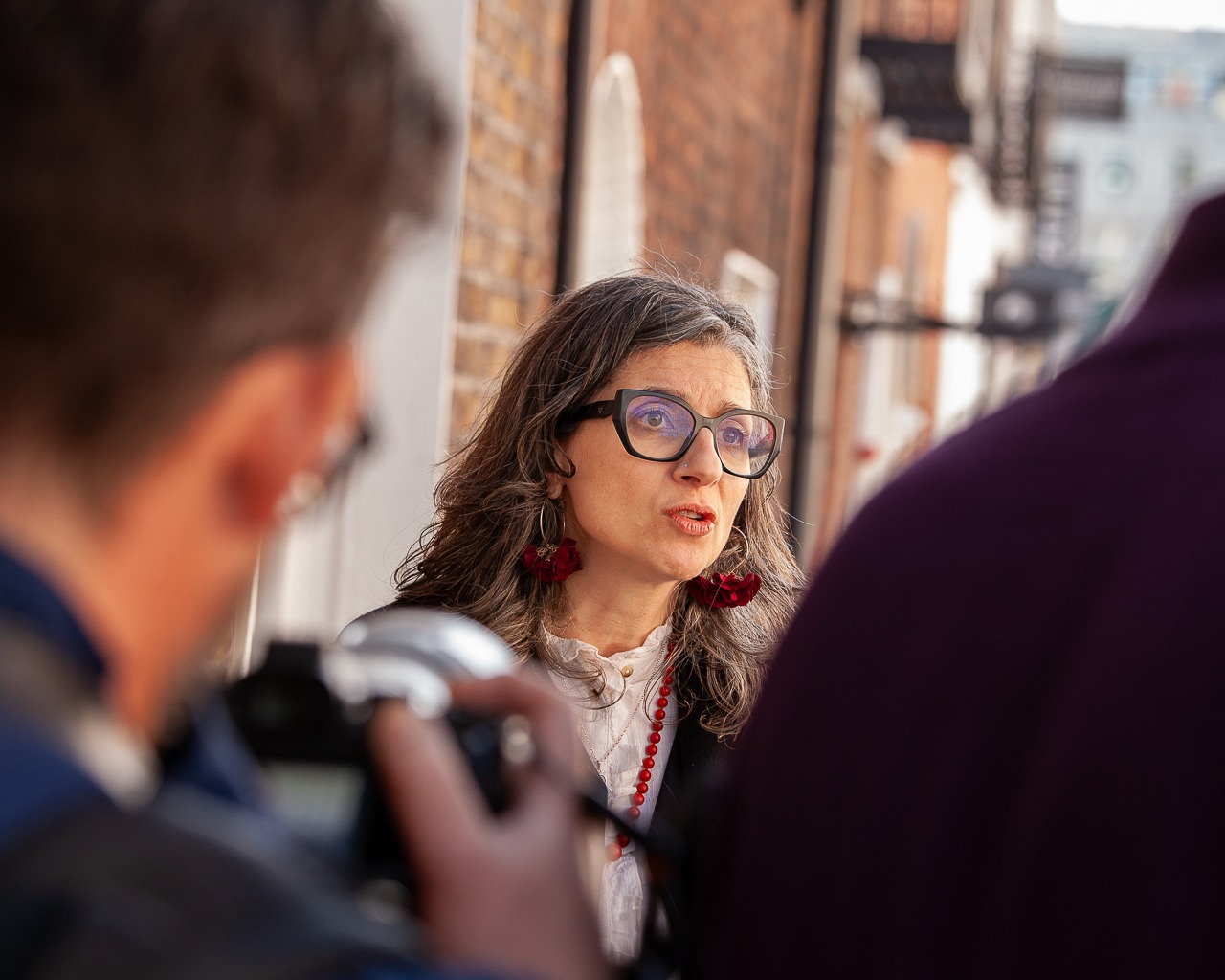
The US imposed sanctions on Wednesday on the United Nations special rapporteur for Palestine, Francesca Albanese.
The sanctions follow Albanese’s scathing report on 30 June in which she named over 60 companies, including major US technology firms like Google, Amazon and Microsoft, which she said were involved in “the transformation of Israel’s economy of occupation to an economy of genocide”.
The report called for the International Criminal Court and national judicial systems to pursue investigations and prosecutions of corporate executives and companies. It also called on United Nations member states to pursue sanctions and asset freezes.
“Today I am imposing sanctions on UN Human Rights Council Special Rapporteur Francesca Albanese for her illegitimate and shameful efforts to prompt @IntlCrimCourt action against US and Israeli officials, companies, and executives,” US Secretary of State Marco Rubio said in a statement on X on Wednesday.
“Albanese’s campaign of political and economic warfare against the United States and Israel will no longer be tolerated. We will always stand by our partners in their right to self-defense,” Rubio added.
The sanctions will freeze any assets Albanese has in the US and would likely restrict her ability to travel to the US.
Albanese is an Italian citizen. If the sanctions are fully enforced, they could also prohibit her from engaging in financial transactions within the European Union. US sanctions carry weight because the US can impose secondary sanctions on entities, such as banks or financial institutions, which conduct transactions with the sanctioned individual. Unlike Iran or North Korea, the EU is deeply wired into the US economy.
In a subsequent statement, Rubio said Albanese was engaging in “economic warfare” against the US.
Rubio said Albanese had written “threatening letters to dozens of entities worldwide, including major American companies across finance, technology, defense, energy, and hospitality, making extreme and unfounded accusations and recommending the ICC pursue investigations and prosecutions of these companies and their executives”.
‘Getting rich out of genocide’
In a forthcoming exclusive interview with Middle East Eye, Albanese slammed US and European companies that she said were profiting off of Israel’s war on Gaza.
“It’s not the Israelis [who] are getting rich out of the genocide, it is that there are corporations, and there is an oligarchy connected to the defence industry, including in Europe and in the US, getting rich out of the genocide,” she told MEE.
The report did not focus solely on US-domiciled companies but included Caterpillar, Airbnb, and Lockheed Martin. South Korea’s HD Hyundai, Sweden’s Volvo Group, France’s BNP Paribas and the UK’s Barclays were also listed.
The sanctions announcement coincides with Israeli Prime Minister Benjamin Netanyahu’s visit to Washington, DC this week. Rubio and Netanyahu met on Wednesday.
One US official who spoke with MEE after the sanctions were announced called the move “in keeping with the administration’s policies”, saying it had been expected.
Albanese has emerged as one of the most prominent UN officials to criticise Israel’s war on Gaza, which she has labelled a genocide against Palestinians. She has also levelled broadsides against the policies of US President Donald Trump, particularly his plan announced in early February to take over the Gaza Strip and forcibly displace Palestinians.
The US, earlier this month, requested that the UN remove Albanese from her post.

Francesca Albanese, Special Rapporteur on the situation of human rights in the Palestinian territories occupied since 1967, talks to the media during a press conference at the European headquarters of the United Nations in Geneva, Switzerland, July 11, 2023. (Salvatore Di Nolfi/Keystone via AP, File)
A UN special rapporteur was sanctioned by the United States over her work as an independent investigator scrutinizing human rights abuses in the Palestinian territories, a high-profile role in a network of experts appointed by the United Nations Human Rights Council.
Francesca Albanese is among the experts chosen by the 47-member council in Geneva. They report to the body as a means of monitoring human rights records in various countries and the global observance of specific rights.
Special rapporteurs don't represent the UN and have no formal authority. Still, their reports can step up pressure on countries, while their findings inform prosecutors at the International Criminal Court and other venues working on transnational justice cases.
US Secretary of State Marco Rubio said in a statement announcing sanctions against Albanese on Wednesday that she “has spewed unabashed antisemitism, expressed support for terrorism, and open contempt for the United States, Israel and the West.”
Albanese said Thursday that she believed the sanctions were “calculated to weaken my mission.” She said at a news conference in Slovenia that “I’ll continue to do what I have to do.”
She questioned why she had been sanctioned — “for having exposed a genocide? For having denounced the system? They never challenged me on the facts.”
The UN high commissioner for human rights, Volker Türk, called for a “prompt reversal” of the US sanctions. He added that “even in face of fierce disagreement, UN member states should engage substantively and constructively, rather than resort to punitive measures.”
Prominent expert
Albanese, an Italian human rights lawyer, has developed an unusually high profile as the special rapporteur for the West Bank and Gaza, a post she has held since May 2022.
Last week, she named several large US companies among those aiding Israel as it fights a war with Hamas in Gaza, saying her report “shows why Israel’s genocide continues: because it is lucrative for many.”
Israel has long had a rocky relationship with the Human Rights Council, Albanese and previous rapporteurs, accusing them of bias. It has refused to cooperate with a special “Commission of Inquiry” established following a 2021 conflict with Hamas.
Albanese has been vocal about what she describes as a genocide by Israel against Palestinians in Gaza. Israel and the US, which provides military support to its close ally, have strongly denied the accusation.
‘Nothing justifies what Israel is doing’
In recent weeks, Albanese issued a series of letters urging other countries to pressure Israel, including through sanctions, to end its deadly bombardment of the Gaza Strip. She also has been a strong supporter of arrest warrants issued by the International Criminal Court against Israeli officials, including Prime Minister Benjamin Netanyahu for allegations of war crimes.
Albanese said at a news conference last year that she has “always been attacked since the very beginning of my mandate,” adding that criticism wouldn't force her to step down.
“It just infuriates me, it pisses me off, of course it does, but then it creates even more pressure not to step back,” she said. “Human rights work is first and foremost amplifying the voice of people who are not heard.”
She added that “of course, one condemned Hamas — how not to condemn Hamas? But at the same time, nothing justifies what Israel is doing.”
Albanese became an affiliate scholar at the Institute for the Study of International Migration at Georgetown University in 2015, and has taught and lectured in recent years at various universities in Europe and the Middle East. She also has written publications and opinions on Palestinian issues.
Albanese worked between 2003 and 2013 with arms of the UN, including the legal affairs department of the UN Palestinian aid agency, UNRWA, and the UN human rights office, according to her biography on the Georgetown website.
She was in Washington between 2013 and 2015 and worked for an American nongovernmental organization, Project Concern International, as an adviser on protection issues during an Ebola outbreak in West Africa.
Member of a small group
Albanese is one of 14 current council-appointed experts on specific countries and territories.
Special rapporteurs, who document rights violations and abuses, usually have renewable mandates of one year and generally work without the support of the country under investigation. There are rapporteurs for Afghanistan, Belarus, Burundi, Cambodia, North Korea, Eritrea, Iran, Myanmar, Russia and Syria.
There also are three country-specific “independent experts,” a role more focused on technical assistance, for the Central African Republic, Mali and Somalia.
Additionally, there are several dozen “thematic mandates,” which task experts or working groups to analyze phenomena related to particular human rights. Those include special rapporteurs on “torture and other cruel, inhuman or degrading treatment or punishment,” the human rights of migrants, the elimination of discrimination against people affected by leprosy and the sale, sexual exploitation and sexual abuse of children.

No comments:
Post a Comment