Greece passes North Africa asylum ban amid rights groups' opposition
Greek lawmakers voted on Friday to temporarily stop processing asylum requests from migrants arriving from North Africa by sea in a bid to reduce arrivals into Europe's southernmost tip, a move rights groups and opposition parties have called illegal.
Issued on: 12/07/2025 - RFI

"Illegal and inhumane"
Since then, flows have dropped off dramatically. While there has been a rise in arrivals to the outlying islands of Crete and Gavdos - those numbers have quadrupled to over 7,000 so far this year - sea arrivals to Greece as a whole dropped by 5.5 percent to 17,000 in the first half of this year, U.N. data show.
Rights groups and opposition parties said the ban approved by parliament violates human rights.
"Seeking refuge is a human right; preventing people from doing so is both illegal and inhumane," said Martha Roussou, a senior advocacy adviser for aid group International Rescue Committee (IRC.)

Thousands of irregular migrants have been rescued by the Greek coastguard off Crete in recent days, the Athens government said. Hundreds of them, including children, were temporarily housed at an exhibition centre in Agyia, near the city of Chania in western Crete, amid sweltering summer temperatures.
Footage by the Reuters news agency on Friday showed a migrant who had fainted being taken out of the shelter on a stretcher.
Crete lacks an organised reception facility. The government said it would build a migrant camp there but the local tourist industry is worried the plan could harm the island's image.
“The weight is too great, the load is too big, and solutions now have to be found ... at a central level,” said George Tsapakos, a deputy governor for Crete.
(With newswires)
Greek lawmakers voted on Friday to temporarily stop processing asylum requests from migrants arriving from North Africa by sea in a bid to reduce arrivals into Europe's southernmost tip, a move rights groups and opposition parties have called illegal.
Issued on: 12/07/2025 - RFI
Migrants inside a refugee camp in the port of Vathy on the eastern Aegean island of Samos, Greece. June 7, 2021. AP - Michael Svarnias
The ban comes amid a surge in migrants reaching the island of Crete and after talks with Libya's Benghazi-based government to stem the flow were this week.
It marks a further hardening of Greece's stance towards migrants under Prime Minister Kyriakos Mitsotakis' centre-right government, which has built a fence at its northern land borders and boosted sea patrols since it came to power in 2019.
Human rights groups accuse Greece of forcefully turning back asylum-seekers on its sea and land borders. This year, the European Union border agency said it was reviewing 12 cases of potential human rights violations by Greece.
The government denies wrongdoing.
The law, which received 177 votes in favour and 74 against, halts asylum processing for at least three months and allows authorities to quickly repatriate migrants without any prior identification process.
UN demands urgent action after Greece migrant boat tragedy
"Faced with the sharp increase in irregular arrivals by sea from North Africa, particularly from Libya to Crete, we have taken the difficult but absolutely necessary decision to temporarily suspend the examination of asylum applications," Mitsotakis was quoted by his office as telling the German newspaper Bild on Friday.
"Greece is not a gateway to Europe open to everyone."
The ban comes amid a surge in migrants reaching the island of Crete and after talks with Libya's Benghazi-based government to stem the flow were this week.
It marks a further hardening of Greece's stance towards migrants under Prime Minister Kyriakos Mitsotakis' centre-right government, which has built a fence at its northern land borders and boosted sea patrols since it came to power in 2019.
Human rights groups accuse Greece of forcefully turning back asylum-seekers on its sea and land borders. This year, the European Union border agency said it was reviewing 12 cases of potential human rights violations by Greece.
The government denies wrongdoing.
The law, which received 177 votes in favour and 74 against, halts asylum processing for at least three months and allows authorities to quickly repatriate migrants without any prior identification process.
UN demands urgent action after Greece migrant boat tragedy

"Faced with the sharp increase in irregular arrivals by sea from North Africa, particularly from Libya to Crete, we have taken the difficult but absolutely necessary decision to temporarily suspend the examination of asylum applications," Mitsotakis was quoted by his office as telling the German newspaper Bild on Friday.
"Greece is not a gateway to Europe open to everyone."
Greece was on the front line of a migration crisis in 2015-16 when hundreds of thousands of migrants from the Middle East, Asia and Africa passed through its islands and mainland.
"Illegal and inhumane"
Since then, flows have dropped off dramatically. While there has been a rise in arrivals to the outlying islands of Crete and Gavdos - those numbers have quadrupled to over 7,000 so far this year - sea arrivals to Greece as a whole dropped by 5.5 percent to 17,000 in the first half of this year, U.N. data show.
Rights groups and opposition parties said the ban approved by parliament violates human rights.
"Seeking refuge is a human right; preventing people from doing so is both illegal and inhumane," said Martha Roussou, a senior advocacy adviser for aid group International Rescue Committee (IRC.)
Asylum seekers in Greece live in overcrowded and unhygienic camps AFP
Thousands of irregular migrants have been rescued by the Greek coastguard off Crete in recent days, the Athens government said. Hundreds of them, including children, were temporarily housed at an exhibition centre in Agyia, near the city of Chania in western Crete, amid sweltering summer temperatures.
Footage by the Reuters news agency on Friday showed a migrant who had fainted being taken out of the shelter on a stretcher.
Crete lacks an organised reception facility. The government said it would build a migrant camp there but the local tourist industry is worried the plan could harm the island's image.
“The weight is too great, the load is too big, and solutions now have to be found ... at a central level,” said George Tsapakos, a deputy governor for Crete.
(With newswires)
Greek parliament approves controversial amendment to curb migrant influx from Libya
UN refugee agency expresses concern about decision to suspend asylum applications
Ahmet Gencturk |12.07.2025 - TRT/AA
ATHENS
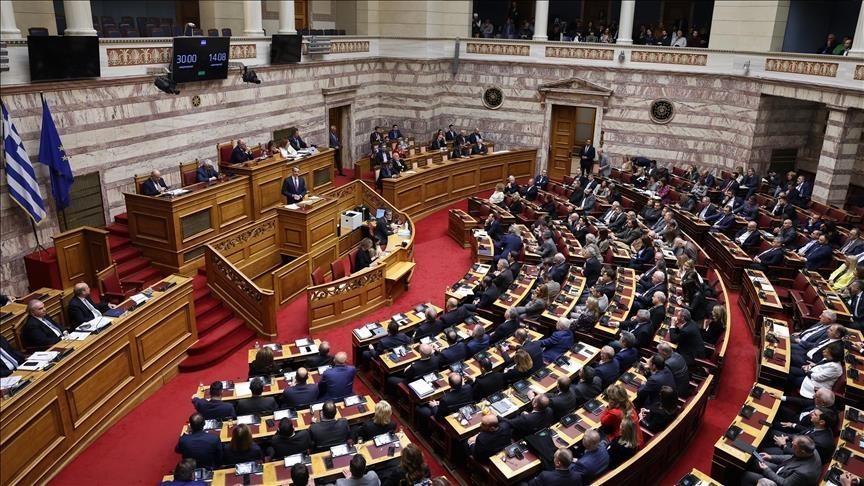
Greek parliament approved a controversial amendment Friday to curb migrant influx from Libya.
The amendment, proposed by the migration ministry, passed with the support of 177 lawmakers from the ruling central-right New Democracy party, the right-wing Greek Solution, as well as some independent lawmakers.
Of the 293 lawmakers who were present during the vote in parliament, social-democratic PASOK and far-right NIKI parties abstained, while left-wing opposition parties of SYRIZA, the Greek Communist Party (KKE), the Course of Freedom, and the New Left voted against the amendment.
The amendment mandates that, for three months, those arriving by sea from North African countries without official permission will be barred from submitting asylum requests. The individuals may be sent back to their countries of origin or departure without formal registration.
The government justifies the move as an exercise of sovereign authority and constitutional obligation to protect national integrity.
But the amendment sparked serious domestic and international concerns.
The UN refugee agency (UNCHR) said it recognizes the pressure created by migrant influx arriving from Libya to Crete and states’ right to control their borders, but measures in this direction of the amendment should be in line with EU and international law.
Underlining that to seek asylum is a fundamental human right, even at times of migratory pressure, it said, “States must ensure that people seeking asylum have access to asylum procedures. Returning people to a place where they would face threats to their life or freedom would breach the principle of non-refoulement. “
Likewise, on Wednesday, former Foreign Minister Evangelos Venizelos drew attention to the potential unconstitutionality of the amendment, criticizing the government administration for invoking Article 15 of the European Convention on Human Rights (ECHR) to pass the extraordinary measure.
Should the government insist on invoking the ECHR, it could entail applying Article 48 of the Greek Constitution, he warned. Article 48 outlines when the president can declare a state of seize and related emergency powers.
Today, during the debate of the amendment, KKE denounced the “shameful amendment.”
Moreover, the leader of the Course of Freedom party, Zoi Konstantopoulou, likened it to the authoritarian approaches of Hungarian Premier Viktor Orban and US President Donald Trump.
US Transforms Greek Bay into Strategic Military StrongholdUN refugee agency expresses concern about decision to suspend asylum applications
Ahmet Gencturk |12.07.2025 - TRT/AA
ATHENS
Greek parliament approved a controversial amendment Friday to curb migrant influx from Libya.
The amendment, proposed by the migration ministry, passed with the support of 177 lawmakers from the ruling central-right New Democracy party, the right-wing Greek Solution, as well as some independent lawmakers.
Of the 293 lawmakers who were present during the vote in parliament, social-democratic PASOK and far-right NIKI parties abstained, while left-wing opposition parties of SYRIZA, the Greek Communist Party (KKE), the Course of Freedom, and the New Left voted against the amendment.
The amendment mandates that, for three months, those arriving by sea from North African countries without official permission will be barred from submitting asylum requests. The individuals may be sent back to their countries of origin or departure without formal registration.
The government justifies the move as an exercise of sovereign authority and constitutional obligation to protect national integrity.
But the amendment sparked serious domestic and international concerns.
The UN refugee agency (UNCHR) said it recognizes the pressure created by migrant influx arriving from Libya to Crete and states’ right to control their borders, but measures in this direction of the amendment should be in line with EU and international law.
Underlining that to seek asylum is a fundamental human right, even at times of migratory pressure, it said, “States must ensure that people seeking asylum have access to asylum procedures. Returning people to a place where they would face threats to their life or freedom would breach the principle of non-refoulement. “
Likewise, on Wednesday, former Foreign Minister Evangelos Venizelos drew attention to the potential unconstitutionality of the amendment, criticizing the government administration for invoking Article 15 of the European Convention on Human Rights (ECHR) to pass the extraordinary measure.
Should the government insist on invoking the ECHR, it could entail applying Article 48 of the Greek Constitution, he warned. Article 48 outlines when the president can declare a state of seize and related emergency powers.
Today, during the debate of the amendment, KKE denounced the “shameful amendment.”
Moreover, the leader of the Course of Freedom party, Zoi Konstantopoulou, likened it to the authoritarian approaches of Hungarian Premier Viktor Orban and US President Donald Trump.
| July 6, 2025, Sunday //

The United States is reinforcing its military footprint in the Eastern Mediterranean by heavily fortifying the naval base at Souda Bay, located on the Greek island of Crete. The upgrade involves the deployment of advanced weaponry and defense systems aimed at shielding crucial assets positioned in this geopolitically sensitive area. The move, reported by Greek daily Kathimerini, signals the growing importance of the base not only to NATO but to broader US strategic operations in the region.
The base already serves as a key hub for both the Greek Navy and NATO forces. In recent months, however, it has seen a rapid transformation into a more robust defensive node. Alongside Greek-operated Patriot missile systems, the United States has positioned M-LIDS (Mobile-Low, Slow, Small Unmanned Aircraft System Integrated Defeat System) units designed to counter drone threats. These are paired with short-range air defense systems intended to intercept a range of aerial targets.
Souda Bay now hosts a mix of highly sensitive military assets, including Arleigh Burke-class destroyers that have been used in missile interception missions - most notably in response to Iranian attacks on Israeli territory. Smaller naval vessels, submarines, and large transport aircraft such as the C-17 and C-130 are also based there, used to facilitate the rapid movement of personnel and supplies.
Despite the assessment that a regional escalation remains unlikely for now, US military planners consider it essential to take precautionary steps. The risk - though low - of a wider confrontation extending from the Eastern Mediterranean to the Persian Gulf has led to the placement of additional layers of protection around assets stationed at Souda Bay.
The defense infrastructure being installed includes not only systems brought in directly from the United States, but also units repositioned from existing bases in Europe. Among them, the M-LIDS system stands out for its hybrid approach - it combines electronic jamming to disable enemy drone communications with a 30mm cannon for direct kinetic engagement.
Another key addition is the AN/TWQ-1 Avenger, a mobile short-range air defense system known for its versatility. Mounted on a Humvee platform, the Avenger is capable of engaging drones, low-flying aircraft, helicopters, and even cruise missiles. These platforms belong to the US Army’s 4th Air Defense Artillery Regiment and are frequently deployed in support of American forces across different global theaters.
While current reports indicate these systems are based in Souda Bay, the US retains the logistical flexibility to redeploy them to other locations within 48 to 72 hours, should the situation demand it. This capacity for rapid movement underscores the base’s utility in responding to evolving threats.
The growing strategic relevance of Souda Bay was further underscored when Air Force General Dan Caine - Chairman of the US Joint Chiefs of Staff - paid a visit to the Maratha military facilities within the bay. Accompanied by senior commanders from the Sixth Fleet and US Naval Forces Europe and Africa, General Caine’s inspection coincided with the docking of the USS Thomas Hudner. The Arleigh Burke-class destroyer was among five US naval vessels deployed near Israel during recent tensions, where they played a direct role in assisting the Israeli military in neutralizing missile threats from Iran, Kathimerini noted.

No comments:
Post a Comment