Navigator Joins with Amon to Build Two Ammonia-Fueled Gas Carriers
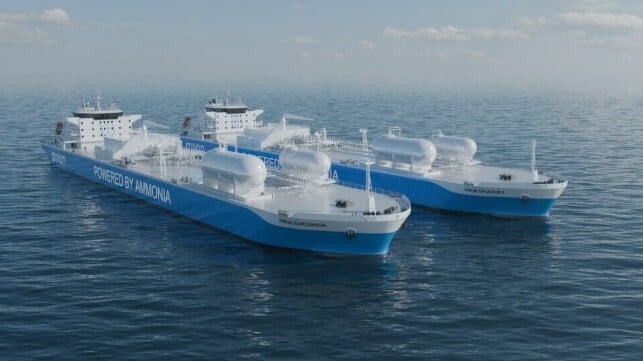
The ammonia-fueled vessel sector took another major step forward with the news that Navigator Holdings and Amon Maritime have formed a new joint venture and ordered two ammonia-fueled liquefied ammonia carriers. The news came a day after WinGD reported the installation of the first ammonia-fueled marine engine into a newbuild, and the new joint venture builds on Amon Maritime’s mission to lead the green shift in shipping.
Navigator will own 80 percent of the new company to be known as Navigator Amon Shipping, with Amon owning 20 percent. The company will place the vessels under long-term charters to blue-chip industry leaders. It anticipates the vessels will be on five-year charters. Navigator is already the owner/operator of the world’s largest fleet of handysize liquified gas carriers.
The construction order was placed with Nantong CIMC Sinopacific Offshore & Engineering in China. Navigator reports an average price for each vessel of $84 million. Deliveries are scheduled for June and October 2028. Operating on ammonia as their primary fuel, the vessels will transport ammonia and be capable of also transporting liquefied petroleum gas with a capacity of 51,530 cubic meters. The project is receiving a NOK 90 million ($9 million) investment grant from Norway’s Enova.
“Expanding our fleet with two modern ammonia carriers capable of using clean ammonia as a fuel, operating in a long-term time charter, is a strategic enabler in meeting the growing demand for a sustainable fuel source in a net-zero economy,” said Mads Peter Zacho, Chief Executive Officer of Navigator. “These modern vessels will be equipped with newly developed technologies that comply with present and future environmental regulations and will thereby deliver great value to both our customers and our shareholders.”
Amon had highlighted the opportunities in ammonia in June when it received its grants from Enova. It said that ammonia is currently primarily transported on a Medium Gas Carrier (MGC). Because the ship is already designed for transporting ammonia, it said that the relative additional cost to convert to ammonia-fueled propulsion in this segment compared to conventional ships will be less than in most other segments.
As it seeks to expand ammonia into more segments of shipping, Amon Maritime also reported it would launch Amon Bulk after securing a NOK 253 million ($24.6 million) grant from Enova to support the construction of two ammonia-powered bulk carriers. The plan for the bulkers calls for one Capesize (180,000 dwt) vessel designed for long-haul transport of heavy bulk commodities. The second vessel will be a Kamsarmax bulk carrier (80,000 to 85,000 dwt). The smaller vessel, it said, would offer greater port flexibility while maintaining high cargo capacity and energy efficiency.
Amon Bulk reported it is entering the next phase of shipyard evaluation and the tendering process for these vessels. The aim is to order these vessels for delivery by 2029.
It said the developments in ammonia are another key step toward decarbonizing deep-sea shipping.
First Two-Stroke Ammonia-Fueled Engine Installed as Newbuild Proceeds
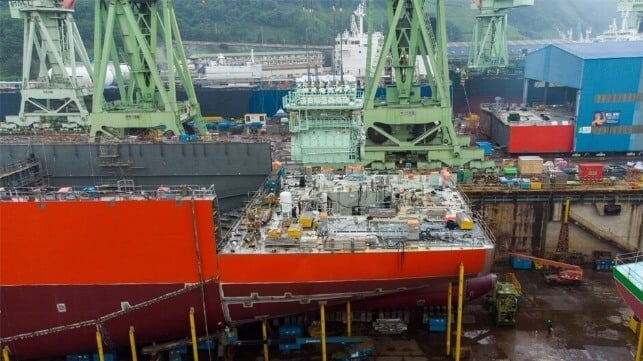
The race to launch the first commercial ammonia-fueled engines marked a key milestone, reports marine engine designer WinGD. The first two-stroke engines built from the company’s designs were tested and recently successfully installed in the first new ammonia carriers being built in South Korea. WindGD is highlighting that it became the first engine designer to bring an ammonia-fueled two-stroke engine to market, and the vessels are due to enter service in 2026.
The 52-bore engine was built by HD Hyundai Heavy Industries’ Engine and Machinery Business Unit. WindGD reports that the results from its laboratory test engine runs were confirmed at the factory in South Korea, and the engine has now been delivered to HD Hyundai Mipo, which installed it on the newbuild vessel.
WinGD reports the X-DF-A engine features high-pressure ammonia injection supplemented by a low, targeted pilot fuel dose of around five percent at full load. The engine delivers load handling, dynamic response, and fuel efficiency on par with WinGD’s equivalent diesel-fueled X Engines in both ammonia and diesel operating modes. It critically delivers low emissions and an efficient performance similar to diesel engines.
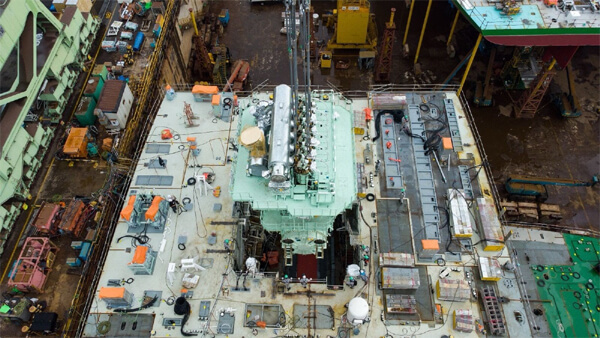
The first engine was installed in South Korea on a vessel due to deliver to EXMAR in 2026 (WinGD)
The company achieved other key firsts in the development of its first ammonia-fueled marine engine. Lloyd’s Register, which is part of the project, noted that the engines were the first to achieve class approval in September 2022 for ammonia two-stroke engines. They were selected for the newbuilds in 2023 and are being combined with a fuel supply system developed by Wärtsilä Gas Solutions.
WinGD says that further optimization will continue for the second engine in the 52-bore series, which will be delivered later this year.
The engines are being incorporated into the ammonia gas carriers ordered by EXMAR in 2020. Each vessel will be approximately 623 feet in length. They will have a capacity of 45,000 cbm and will be able to transport either ammonia or LPG.
Construction on the vessels began in December 2024 with the first steel cutting. Work started on the second vessel of the class in May 2025. EXMAR has called the ships “a bold step toward a decarbonized shipping industry, and a cleaner future.”
Each of the major engine designers is working on different sizes of ammonia-fueled engines, and each has reported strong progress in the designs and now qualification testing. WinGD reports it has built an early orderbook of around 30 X-DF-A engines, which will be going into not only gas carriers, but also bulk carriers and containerships.
DNV calculates that there are currently 37 vessels on order that will be capable of operating on ammonia as their marine fuel. The bulk of the deliveries will start in 2026 and 2027. As the infrastructure becomes more developed and the regulations are defined, it is anticipated that ammonia-powered engines will increase in popularity as one of the solutions to meeting the industry’s decarbonization challenge.

No comments:
Post a Comment