Kyrgyzstan abandons attempt to rescue Russian climber trapped on icy summit of country’s highest mountain
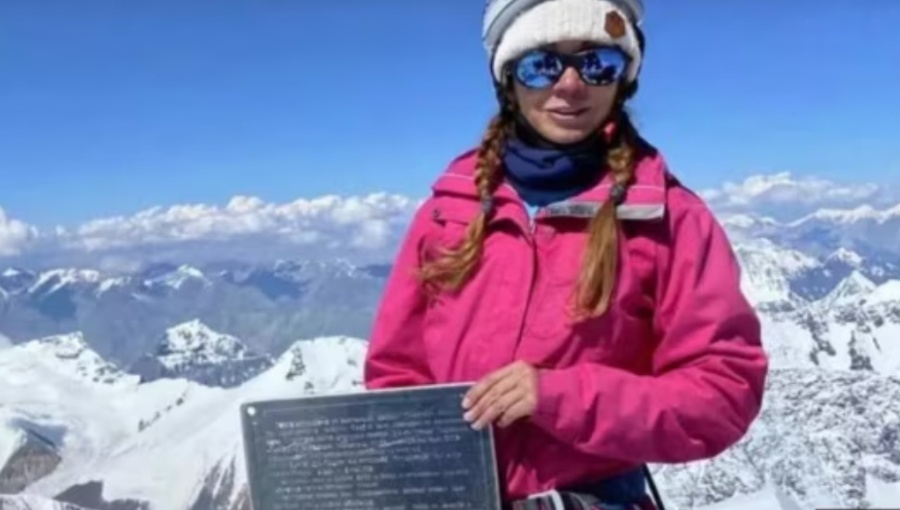
Rescue missions for well-known Russian climber Natalia Nagovitsyna, trapped on the icy summit of Kyrgyzstan’s highest mountain, have been indefinitely abandoned after two weeks. Officials came to the decision to halt operations following the death of a climber who took part in an attempt to reach her, according to the Kyrgyz Ministry of Emergency Situations.
The rescuer who perished was Italian mountaineer Luca Sinigaglia. The Italian Ministry of Foreign Affairs announced his death on August 15. Extremely bad weather conditions have so far made it impractical to recover his body.
Nagovitsyna—who lost her climber husband in a climbing tragedy four years ago—was attempting to descend from Jengish Chokusu, or Victory Peak (height 7,439 metres, or 24,406 feet), on August 12 when she broke her leg.
Dmitry Grekov, head of the Victory Peak base camp, told Russian news agency TASS that rescuers “know where [Nagovitsyna] is”, adding: "It’s impossible to get there."

Peak of Jengish Chokusu seen from the Southern Inylchek Glacier (Credit: Maryliflower, cc-by-sa 4.0).
Radio Azattyk, meanwhile, quoted Grekov as saying that he warned Nagovitsyna and her climbing companion before they set off that the weather was set to deteriorate on the mountain on August 11.
One group of climbers did reach Nagovitsyna to provide her with some supplies, but due to extreme conditions they were not able to help her down from the summit, the highest mountain in the Tian Shan mountain system, and which sits at Kyrgyzstan’s border with China.
Repeated attempts to save Nagovitsyna have included operations involving helicopters. One helicopter suffered a hard landing during one such operation, with several onboard injured.
CNN reported on August 25 that Nagovitsyna was spotted on a surveillance drone not far from the top of the mountain on August 19. A spokesperson for the Kyrgyz Ministry of Emergency Situations said it was believed that she was alive at the time. But on August 23, authorities suspended the search, with heavy snowfall and other difficult weather continuing to worsen sharply. Temperatures were reported to be around -30C (-22F) at night on the summit.
The ministry has also stated that Kyrgyzstan lacks the kind of helicopter that would be needed to mount a rescue attempt with a good chance of success.
If the plight of Nagovitsyna ends in tragedy then it will follow that of her husband, Sergei Nagovitsyn, who in 2021 became paralysed and incapacitated during an expedition to another Tian Shan mountain, Khan-Tengri, located on the Kazakhstan-Kyrgyzstan-China tri-point. Nagovitsyna was with Sergei during the incident. She refused to leave his side until rescuers arrived. Sadly, he died while still on the mountain.
Both Jengish Chokusu and Khan-Tengri are one of the so-called Snow Leopard mountains, the five 7,000-ft-plus peaks of the former Soviet Union. Ascending all five is considered a major achievement. Only around 700 people, including 30 women, have accomplished the feat.
Kathmandu (AFP) – A team of drone operators joined climbers and guides at Everest Base Camp this climbing season, armed with heavy-duty drones to help clear rubbish from the world's highest peak.
Issued on: 26/08/2025 - RFI

Tonnes of trash -- from empty cans and gas canisters, to bottles, plastic and discarded climbing gear -- have earned once-pristine Everest the grim nickname of the "highest dumpster in the world".
Two DJI FC 30 heavy-lifter drones were flown to Camp 1 at 6,065 metres (19,900 feet), where they airlifted 300 kilograms (660 pounds) of trash down during the spring climbing season, which usually lasts from April to early June.
"The only options were helicopters and manpower, with no option in between," said Raj Bikram Maharjan, of Nepal-based Airlift Technology, which developed the project.
"So, as a solution for this problem, we came up with a concept of using our heavy-lift drone to carry garbage."
After a successful pilot on Everest last year, the company tested the system on nearby Mount Ama Dablam, where it removed 641 kilos of waste.
"This is a revolutionary drive in the mountains to make it cleaner and safer," said Tashi Lhamu Sherpa, vice chairman of the Khumbu Pasang Lhamu rural municipality, which oversees the Everest area.
'Game changer'
The drones are proving to be far more efficient, cost-effective and safer than earlier methods, said Tshering Sherpa, chief of the Sagarmatha Pollution Control Committee.
"In just 10 minutes, a drone can carry as much garbage as 10 people would take six hours to carry," Sherpa told AFP.
The powerful drones cost around $20,000 each, but were supplied by the China-headquartered manufacturer to support the cleanup operation and promote its brand.
Other costs were borne partially by the local authorities.
Beyond waste removal, the drones have also been deployed to deliver essential climbing gear such as oxygen cylinders, ladders, and ropes -- reducing the number of dangerous trips across the Khumbu Icefall, one of Everest's deadliest sections.
That can help improve safety for the guides and porters, especially the early "fixing" teams who establish routes at the start of the new season.
"People in the fixing team were very happy," said record-holding climber Nima Rinji Sherpa, the youngest to summit all 14 of the world's highest peaks.
"They can simply just go by themselves and the drone will carry ladders or the oxygen and ropes for them. It saves a lot of time and energy."
Next month, Airlift Technology will take the drones to Mount Manaslu, the world's eighth-highest peak.
"It's not just in war that drones are useful," Maharjan said.
"They can save lives and protect the environment. For climate and humanitarian work, this technology is going to be a game changer."
© 2025 AFP


No comments:
Post a Comment