Antonio Mazzeo filed a complaint against the Israeli government at the Rome Tribunal for kidnapping and mistreatment.
By Andrea Umbrello ,
August 8, 2025
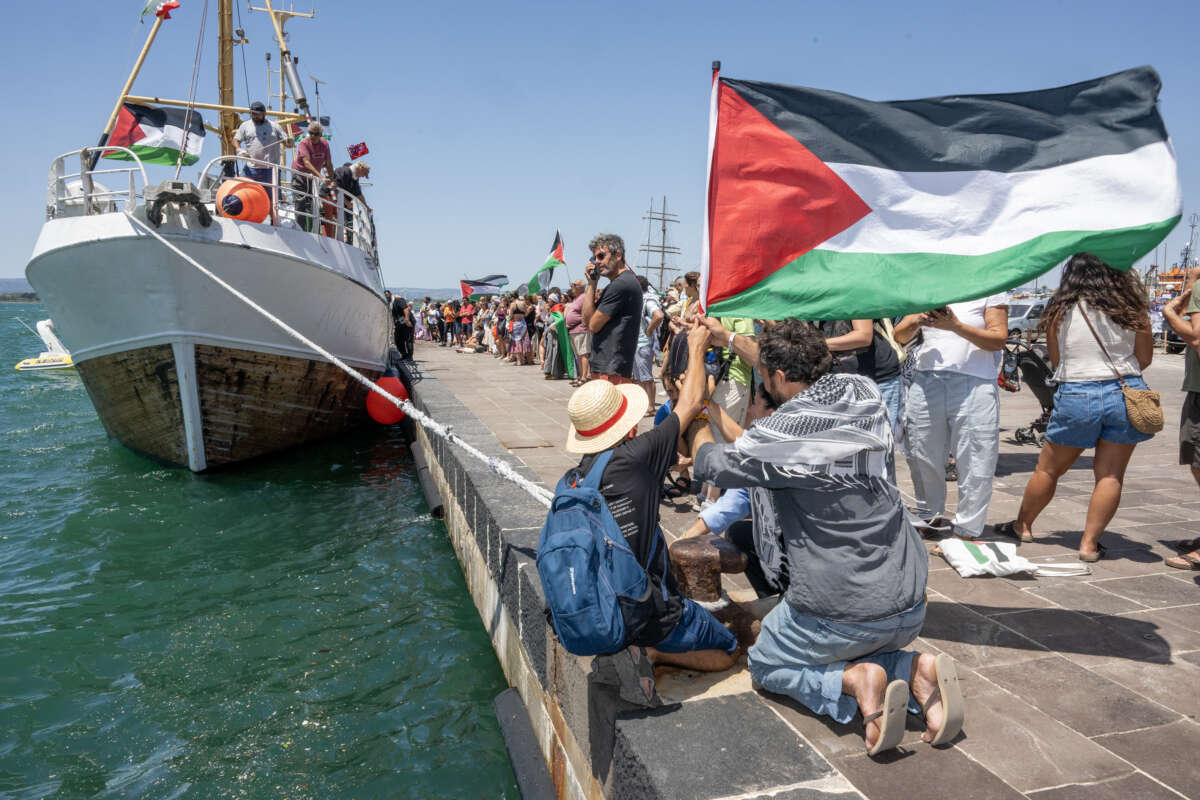
People gather with Palestinian flags around the Freedom Flotilla ship "Handala" ahead of the boat's departure for Gaza at a port in Syracuse, Sicily, southern Italy, on July 13, 2025.GIOVANNI ISOLINO / AFP via Getty Images
The Handala, a Freedom Flotilla Coalition ship, set sail to Gaza from Gallipoli, an Italian city on the coast of Puglia, on July 20. Its aim was to bring humanitarian aid — including food, medicine, and toys — to the Palestinian population under Israeli siege. Twenty-one people from around the world took part in the mission, attempting to break the naval blockade that Tel Aviv has maintained for nearly two decades. Just weeks earlier, Israeli naval forces had boarded and seized another vessel from the same group, the Madleen, with Greta Thunberg on board, in international waters. On the night of July 26 to 27, Israeli forces repeated the action, intercepting the Handala and illegally deporting the entire crew. Antonio Mazzeo, an Italian journalist, was among those on board. In this exclusive interview for Truthout, Mazzeo discusses his experience, the crew’s journey, and what motivated the difficult and dangerous mission. The interview that follows has been edited for clarity and length.
Andrea Umbrello: Can you describe what happened on the Handala’s final day, before and after the Israeli navy arrived?
The Handala, a Freedom Flotilla Coalition ship, set sail to Gaza from Gallipoli, an Italian city on the coast of Puglia, on July 20. Its aim was to bring humanitarian aid — including food, medicine, and toys — to the Palestinian population under Israeli siege. Twenty-one people from around the world took part in the mission, attempting to break the naval blockade that Tel Aviv has maintained for nearly two decades. Just weeks earlier, Israeli naval forces had boarded and seized another vessel from the same group, the Madleen, with Greta Thunberg on board, in international waters. On the night of July 26 to 27, Israeli forces repeated the action, intercepting the Handala and illegally deporting the entire crew. Antonio Mazzeo, an Italian journalist, was among those on board. In this exclusive interview for Truthout, Mazzeo discusses his experience, the crew’s journey, and what motivated the difficult and dangerous mission. The interview that follows has been edited for clarity and length.
Andrea Umbrello: Can you describe what happened on the Handala’s final day, before and after the Israeli navy arrived?
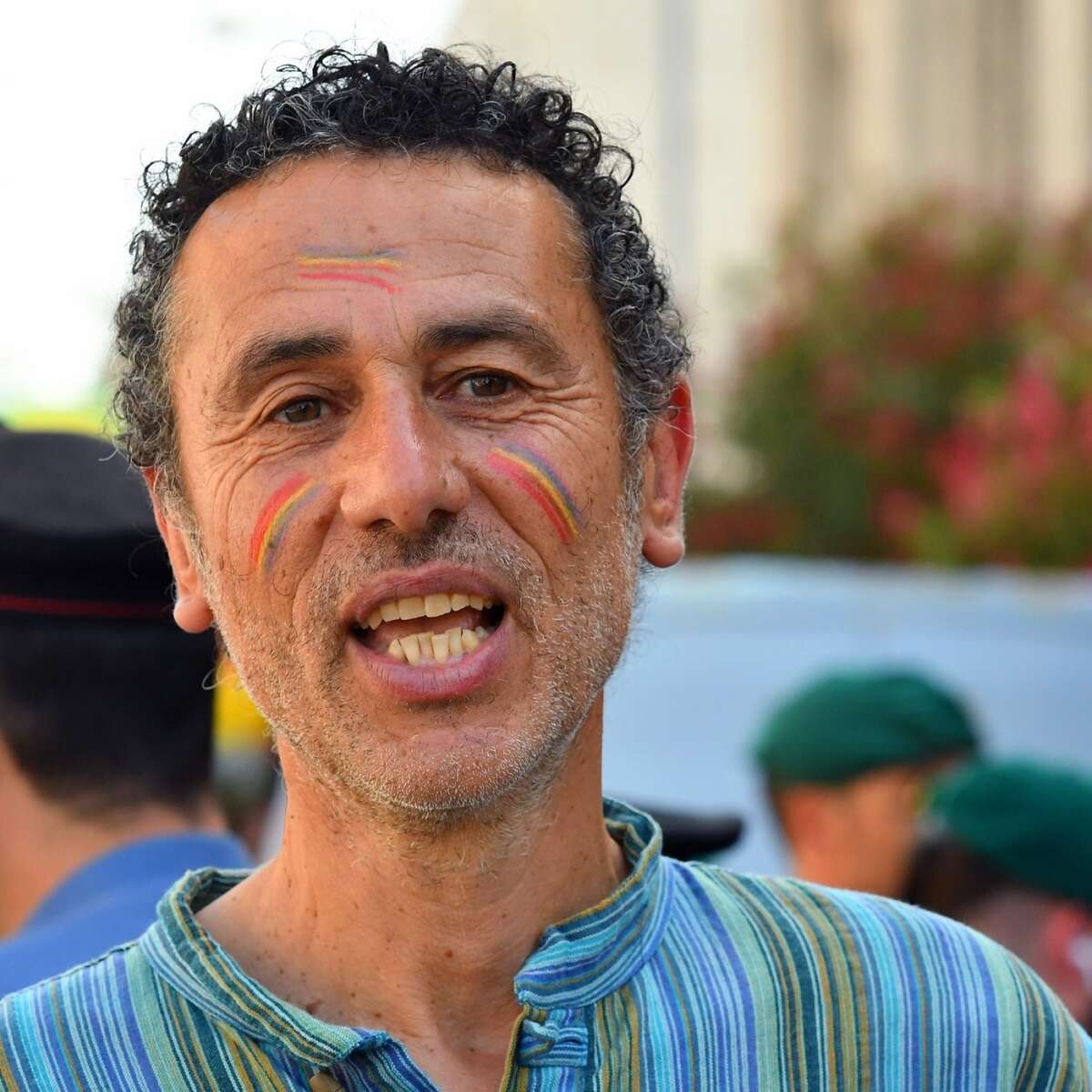
Antonio Mazzeo
Photo: Courtesy of Antonio Mazzeo
Antonio Mazzeo: Saturday, [July] 26 was quiet. We knew it would be a long day, but we stayed calm. In the afternoon, an Israeli Heron drone circled low over the boat for more than an hour. Only then did we realize for certain that Israel was watching us closely. Soon after, we learned two ships carrying special forces had left Haifa. We prepared for anything, even an armed attack. We tried to steer the ship south, asking the Egyptian authorities for permission to enter their territorial waters to reach Gaza. We were given permission to land in Egypt, but that wasn’t our goal. When the Israeli ships became visible on the horizon, we sat on the deck wearing our life jackets, ready to face what was to come. The commandos arrived on fast rubber boats and boarded the Handala. They found us sitting side by side, our hands open as a sign of peace, singing the famous Italian resistance song “Bella Ciao.” There was no violence or abuse; in fact, the soldiers tried to be courteous. The journey aboard the Handala, now occupied by about 30 commandos, lasted nearly 12 hours. We were taken to the port of Ashdod, where the police took us into custody. From that moment on, everything changed, and the ongoing harassment, mistreatment, insults, and violations of our most basic rights began.
What happened after you landed in Israel?
We were taken to a large hall for the first of many body searches, the seizure of our backpacks, and photo identification. Then 18 of us were made to sit in a semi-circular room, watched over by brutal and violent police. It was the last time we were able to share the Handala mission together. One by one, they took us to interrogation booths where the interrogations took place and we were notified of our arrest. Then we were transferred to cramped cells at police stations near Ben Gurion Airport in Tel Aviv, or in a maximum-security detention center that has housed thousands of Palestinian prisoners.
Related Story
Antonio Mazzeo: Saturday, [July] 26 was quiet. We knew it would be a long day, but we stayed calm. In the afternoon, an Israeli Heron drone circled low over the boat for more than an hour. Only then did we realize for certain that Israel was watching us closely. Soon after, we learned two ships carrying special forces had left Haifa. We prepared for anything, even an armed attack. We tried to steer the ship south, asking the Egyptian authorities for permission to enter their territorial waters to reach Gaza. We were given permission to land in Egypt, but that wasn’t our goal. When the Israeli ships became visible on the horizon, we sat on the deck wearing our life jackets, ready to face what was to come. The commandos arrived on fast rubber boats and boarded the Handala. They found us sitting side by side, our hands open as a sign of peace, singing the famous Italian resistance song “Bella Ciao.” There was no violence or abuse; in fact, the soldiers tried to be courteous. The journey aboard the Handala, now occupied by about 30 commandos, lasted nearly 12 hours. We were taken to the port of Ashdod, where the police took us into custody. From that moment on, everything changed, and the ongoing harassment, mistreatment, insults, and violations of our most basic rights began.
What happened after you landed in Israel?
We were taken to a large hall for the first of many body searches, the seizure of our backpacks, and photo identification. Then 18 of us were made to sit in a semi-circular room, watched over by brutal and violent police. It was the last time we were able to share the Handala mission together. One by one, they took us to interrogation booths where the interrogations took place and we were notified of our arrest. Then we were transferred to cramped cells at police stations near Ben Gurion Airport in Tel Aviv, or in a maximum-security detention center that has housed thousands of Palestinian prisoners.
Related Story
Amazon Labor Union Leader Chris Smalls Released From Israeli Prison
Smalls, the only Black person on a crew hoping to break Israel’s blockade on Gaza, was beaten by Israeli officers. By Sharon Zhang , Truthout July 31, 2025
The interrogations were conducted by police with strong ideological prejudices, who did not hold back insults or threats. My interrogator tried to belittle the political and humanitarian value of our mission. “But do you know how many children Hamas has killed?” he yelled at me when I explained that the Handala wanted to deliver aid and stuffed animals to Palestinian children. “Have you ever taken aid to Syria or Africa?” When I replied that I didn’t have to justify to the Israeli state what I had done or planned to do, he screamed incomprehensible phrases for over five minutes. I asked the translator and my lawyer for a summary, but they advised me to let it go. For me, it was important to formally contest the accusation and declare that I would report Israel for kidnapping upon my return to Italy. I left Israel as soon as I could because I had set out to get to Gaza to see the eyes of the children of Gaza, not the hate-filled eyes of Israel’s fascio-Zionist police. I spent another 24 hours in detention, in three different cells in Ashdod, at a police station near Ben Gurion Airport, and in a police center on the outskirts of Tel Aviv. Everywhere I was stripped, searched, and completely deprived of my personal belongings. In 24 hours, I was offered two glasses of water and a sandwich.
What were the conditions of your detention?
The first detention facility where I spent almost three hours, two of which were in total isolation, was a cage inside a two-by-two-meter cell. It was hot and there was a noisy air conditioner that did little good. The second cell was in a police station, a cramped, windowless room with a concrete bed and a filthy toilet. It was myself, Jacob Berger, another U.S. activist, and two journalists from Al Jazeera. There were insects everywhere and the air felt suffocating. After a couple of hours, Jacob and I were transferred to Tel Aviv to a cell we ironically called a “five-star hotel” compared to the previous ones. A reinforced concrete bunk bed was the only furniture. We stayed there until 4:00 in the morning. Then they took us to the airport, to a large room where, under guard, we slept on blankets and sofas with about 10 immigrants without legal status, most of them from Asia. With us was also Emma Fourreau, a French parliamentarian and a member of the Handala crew.
In those hours, my only thought was for my Palestinian brothers, for thousands of minors who have spent entire parts of their lives imprisoned, tortured and often without even an accusation to defend themselves against.
The Freedom Flotilla Coalition confirmed that U.S. human rights defender Christian Smalls was physically attacked by seven uniformed officers immediately upon entering Israeli custody. They choked him and kicked his legs, leaving clear marks of violence. Did you witness similar acts of violence against him or other activists?
I know what the legal team that visited Chris in the detention center reported, and I can attest to the especially violent behavior of the police during the landing in Ashdod. There was a strong sense of racism among the police at the port. The most vulnerable were him, being of African descent, and the other activists of Arab origin. If U.S. citizens received different treatment, it’s perhaps because they lacked adequate consular assistance. A country that declares war against anyone who “offends” its citizens or interests has abandoned the seven American activists. Chris was one of them and we unfortunately know the level of violence he suffered. This indifference finds its reason in the fact that Washington — along with Brussels, Strasbourg, Paris, Berlin, and Rome — have the blood of the Palestinian people on their hands. [These countries] provide the weapons for the genocide, and make key facilities available, like the U.S. base in Sigonella in my Sicily, which offers operational, logistical, and strategic support. [These countries] also support [Israel] politically and diplomatically, legitimizing crimes, abuses, and unheard-of violations.
What’s next for you?
I will continue to do what I have done my whole life: analyze and denounce Israel’s crimes, the military-industrial-financial-academic system that governs it and feeds apartheid and genocide, and especially the very serious responsibilities of partner countries, first and foremost my own: Italy…. I would do a mission like the Handala’s again, with the utmost conviction and the same hope of reaching Gaza.
This article is licensed under Creative Commons (CC BY-NC-ND 4.0), and you are free to share and republish under the terms of the license.
Andrea Umbrello
An Italian multimedia journalist, Andrea Umbrello tells frontline stories through articles published in international outlets, podcasts, and photojournalism. Balancing rigor and empathy, they’ve spent years documenting Palestinian issues, human rights violations, and social injustices worldwide. Their work on human migration and discrimination aims to foster critical reflection on frequently overlooked subjects.

No comments:
Post a Comment