"Whoever said West Virginia was a conservative state?" Sanders asked the crowd in Wheeling. "Somebody got it wrong."
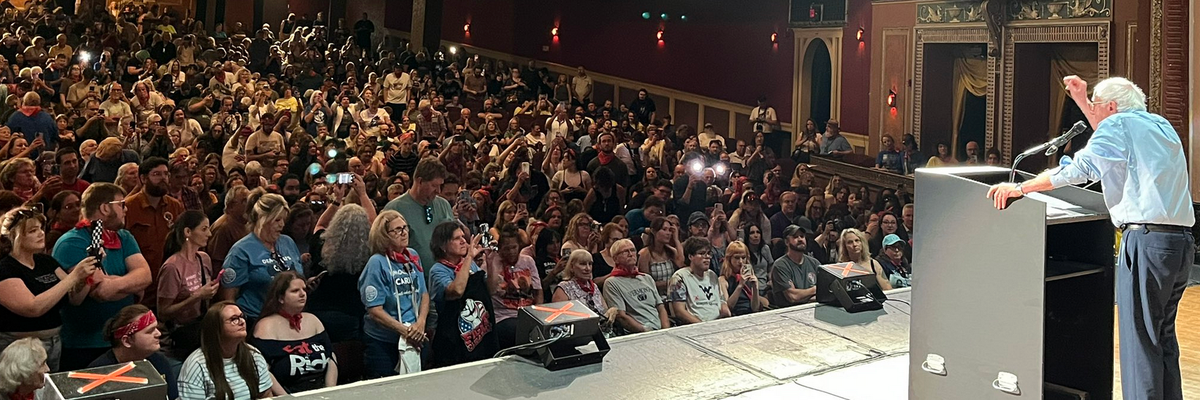
U.S. Sen. Bernie Sanders (I-Vt.) speaks to a crowd in Wheeling, West Virginia on August 9, 2025.
(Photo: Bernie Sanders/X)
Julia Conley
Aug 09, 2025
COMMON DREAMS
On the latest leg of his Fighting Oligarchy Tour, U.S. Sen. Bernie Sanders headed to West Virginia for rallies on Friday and Saturday where he continued to speak out against the billionaire class's control over the political system and the Republican Party's cuts to healthcare, food assistance, and other social programs for millions of Americans—and prove that his message resonates with working people even in solidly red districts.
"Whoever said West Virginia was a conservative state?" Sanders (I-Vt.) asked a roaring, standing-room-only crowd at the Capitol Theater in Wheeling. "Somebody got it wrong."
As the Pittsburgh Post-Gazette reported, some in the crowd sported red bandanas around their necks—a nod to the state's long history of labor organizing and the thousands of coal mine workers who formed a multiracial coalition in 1921 and marched wearing bandanas for the right to join a union with fair pay and safety protections.
Sanders spoke to the crowd about how President Donald Trump's One Big Beautiful Bill Act, which was supported by all five Republican lawmakers who represent the districts Sanders is visiting this weekend, could impact their families and neighbors.
"Fifteen million Americans, including 50,000 right here in West Virginia, are going to lose their healthcare," Sanders said of the Medicaid cuts that are projected to amount to more than $1 trillion over the next decade. "Cuts to nutrition—literally taking food out of the mouths of hungry kids."
Seven hospitals are expected to shut down in the state as a result of the law's Medicaid cuts, and 84,000 West Virginians will lose Supplemental Nutrition Assistance Program benefits, according to estimates.
Sanders continued his West Virginia tour with a stop in the small town of Lenore on Saturday afternoon and was scheduled to address a crowd in Charleston Saturday evening before heading to North Carolina for more rallies on Sunday.
The event in Lenore was a town hall, where the senator heard from residents of the area—which Trump won with 74% of the vote in 2024. Anna Bahr, Sanders' communications director, said more than 400 people came to hear the senator speak—equivalent to about a third of Lenore's population.
Sanders invited one young attendee on stage after she asked how Trump's domestic policy law's cuts to education are likely to affect poverty rates in West Virginia, which are some of the highest in the nation.
The One Big Beautiful Bill Act includes a federal voucher program which education advocates warn will further drain funding from public schools, and the loss of Medicaid funding for states could lead to staff cuts in K-12 schools. The law also impacts higher education, imposing new limits for federal student loans.
"Sometimes I am attacked by my opponents for being far-left, fringe, out of touch with where America is," said Sanders. "Actually, much of what I talk about is exactly where America is... You are living in the wealthiest country in the history of the world, and if we had good policy and the courage to take on the billionaire class, there is no reason that every kid in this country could not get an excellent higher education, regardless of his or her income. That is not a radical idea."
Sanders' events scheduled for Sunday in North Carolina include a rally at 2:00 pm ET at the Steven Tanger Center for the Performing Arts in Greensboro and one at 6:00 pm ET at the Harrah Cherokee Center in Asheville.
On the latest leg of his Fighting Oligarchy Tour, U.S. Sen. Bernie Sanders headed to West Virginia for rallies on Friday and Saturday where he continued to speak out against the billionaire class's control over the political system and the Republican Party's cuts to healthcare, food assistance, and other social programs for millions of Americans—and prove that his message resonates with working people even in solidly red districts.
"Whoever said West Virginia was a conservative state?" Sanders (I-Vt.) asked a roaring, standing-room-only crowd at the Capitol Theater in Wheeling. "Somebody got it wrong."
As the Pittsburgh Post-Gazette reported, some in the crowd sported red bandanas around their necks—a nod to the state's long history of labor organizing and the thousands of coal mine workers who formed a multiracial coalition in 1921 and marched wearing bandanas for the right to join a union with fair pay and safety protections.
Sanders spoke to the crowd about how President Donald Trump's One Big Beautiful Bill Act, which was supported by all five Republican lawmakers who represent the districts Sanders is visiting this weekend, could impact their families and neighbors.
"Fifteen million Americans, including 50,000 right here in West Virginia, are going to lose their healthcare," Sanders said of the Medicaid cuts that are projected to amount to more than $1 trillion over the next decade. "Cuts to nutrition—literally taking food out of the mouths of hungry kids."
Seven hospitals are expected to shut down in the state as a result of the law's Medicaid cuts, and 84,000 West Virginians will lose Supplemental Nutrition Assistance Program benefits, according to estimates.
Sanders continued his West Virginia tour with a stop in the small town of Lenore on Saturday afternoon and was scheduled to address a crowd in Charleston Saturday evening before heading to North Carolina for more rallies on Sunday.
The event in Lenore was a town hall, where the senator heard from residents of the area—which Trump won with 74% of the vote in 2024. Anna Bahr, Sanders' communications director, said more than 400 people came to hear the senator speak—equivalent to about a third of Lenore's population.
Sanders invited one young attendee on stage after she asked how Trump's domestic policy law's cuts to education are likely to affect poverty rates in West Virginia, which are some of the highest in the nation.
The One Big Beautiful Bill Act includes a federal voucher program which education advocates warn will further drain funding from public schools, and the loss of Medicaid funding for states could lead to staff cuts in K-12 schools. The law also impacts higher education, imposing new limits for federal student loans.
"Sometimes I am attacked by my opponents for being far-left, fringe, out of touch with where America is," said Sanders. "Actually, much of what I talk about is exactly where America is... You are living in the wealthiest country in the history of the world, and if we had good policy and the courage to take on the billionaire class, there is no reason that every kid in this country could not get an excellent higher education, regardless of his or her income. That is not a radical idea."
Sanders' events scheduled for Sunday in North Carolina include a rally at 2:00 pm ET at the Steven Tanger Center for the Performing Arts in Greensboro and one at 6:00 pm ET at the Harrah Cherokee Center in Asheville.
COPLAND CONDUCTS COPLAND; APPALCHIAN SPRING
'Are You Worried the Billionaires Are Going to Go Hungry?' Warren Asks Mamdani Critic
"Do you know how many working families are chased out of New York City every day because they can't afford housing, they can't afford groceries?"
"Do you know how many working families are chased out of New York City every day because they can't afford housing, they can't afford groceries?"
said the Democratic senator.

U.S. Sen. Elizabeth Warren (D-Mass.) speaks during a rally on May 21, 2025 in Washington, D.C.
(Photo: Jemal Countess/Getty Images for Families Over Billionaires)
Julia Conley
Aug 04, 2025
U.S. Sen. Elizabeth Warren (D-Mass.) speaks during a rally on May 21, 2025 in Washington, D.C.
(Photo: Jemal Countess/Getty Images for Families Over Billionaires)
Julia Conley
Aug 04, 2025
COMMON DREAMS
Before joining New York City mayoral candidate Zohran Mamdani at an event focusing on childcare in the largest city in the U.S., Sen. Elizabeth Warren appeared on CNBC where she feigned concern for New York's richest residents—those who aren't being centered in Mamdani's campaign focused on making housing, groceries, and other essentials more affordable for the city's working class.
"Oh dear, are you worried that billionaires are going to go hungry?" the Massachusetts Democratic senator asked anchor Dan Faber when he inquired whether raising taxes on the richest residents is how Mamdani's far-reaching economic justice initiatives should be funded.
Faber responded that rich New Yorkers will leave the city if Mamdani becomes mayor and succeeds in establishing city-owned grocery stores and universal childcare by raising the corporate tax rate to 11.5%—the rate that already exists in neighboring New Jersey and that would raise $5 billion—and instituting a 2% tax on households earning above $1 million annually.
"Do you know how many working families are chased out of New York City every day because they can't afford housing, they can't afford groceries, they can't afford groceries?" Warren asked Faber.
She later added that billionaires have repeatedly threatened to leave the city at various times. Real estate brokers have expressed doubt that wealthy New Yorkers like Gristedes magnate John Catsimatidis and hedge fund manager Bill Ackman will follow through on their threats, and state tax data has shown that recent shocks like the coronavirus pandemic and tax code changes have not pushed the rich away.
Data also backs up Mamdani's warnings that more and more families in New York are having an increasingly hard time affording life in the city, with Columbia University and the anti-poverty group Robin Hood reporting earlier this year that 1 in 4 New Yorkers can't afford essentials like housing and food.
"You want to have a workable city?" asked Warren. "You want to have a city that's vibrant, you want to have a city where the streets are full, where there are things for sale 24 hours a day, then you need people who can live here and work here."
Warren's comments preceded her appearance with Mamdani, currently a state assemblymember who represents parts of Queens, at the headquarters of District Council 37, the city's largest public employees union, where they spoke about childcare challenges for families in New York. Parents in the city pay nearly $3,000 per month on average for full-time childcare, and more for an infant.
"We know that it is our responsibility to move beyond the broken politics of the past, of our city and our state, and start to offer an alternative across this country to what it could look like to be a people that fight for the families that raise us," said Mamdani at the event.
The progressive candidate has pledged to make childcare free for all New York City families with children aged 6 weeks to 5 years.
Warren said at the event that following Mamdani's surprise victory against former Gov. Andrew Cuomo in the Democratic primary in June, the city "is the place to start the conversation for Democrats on how affordability is the central issue, the central reason to be a Democrat, and that delivering on it in meaningful, tangible ways that will touch working families is why we're here."
The senator endorsed Mamdani days after his primary victory—a step that powerful establishment Democratic figures in the assemblyman's home state, such as U.S. House Minority Leader Hakeem Jeffries, Senate Minority Leader Chuck Schumer, and Gov. Kathy Hochul—have yet to take.
"The way I see it, Zohran ran a campaign that inspired people, that actually got people on their feet," said Warren on Monday. "And the issue he focused on? Affordability."
Mamdani's primary success, said Warren, raises the question: "Why are billionaires and Wall Street CEOs pouring millions of dollars into a race to stop Zohran?"
In an article in Rolling Stone, the senator noted that Mayor Eric Adams—who is running as an independent and is currently in fourth place in general election polls, with just over 12% of the vote compared to Mamdani's 35%—"raised $1 million in a single night from donors with ties to big law firms, commercial brokerages, and big real estate developers who could lose their iron-fisted grip on New York in a Mamdani administration."
Ackman has also played Cuomo and Adams against each other, she wrote, holding "back-to-back meetings" so the candidates could "tap dance for the 'hundreds of millions of dollars' he has said he will spend" to defeat Mamdani.
"In a democracy, billionaires should not be able to buy our elections and control our politicians," wrote Warren. "Elected officials should work for their constituents, not use their government offices to hand out favors to a well-connected few."
Mamdani, she said in a video posted on social media, is "not afraid to take on the billionaires and the giant corporations to make New York more affordable."
Before joining New York City mayoral candidate Zohran Mamdani at an event focusing on childcare in the largest city in the U.S., Sen. Elizabeth Warren appeared on CNBC where she feigned concern for New York's richest residents—those who aren't being centered in Mamdani's campaign focused on making housing, groceries, and other essentials more affordable for the city's working class.
"Oh dear, are you worried that billionaires are going to go hungry?" the Massachusetts Democratic senator asked anchor Dan Faber when he inquired whether raising taxes on the richest residents is how Mamdani's far-reaching economic justice initiatives should be funded.
Faber responded that rich New Yorkers will leave the city if Mamdani becomes mayor and succeeds in establishing city-owned grocery stores and universal childcare by raising the corporate tax rate to 11.5%—the rate that already exists in neighboring New Jersey and that would raise $5 billion—and instituting a 2% tax on households earning above $1 million annually.
"Do you know how many working families are chased out of New York City every day because they can't afford housing, they can't afford groceries, they can't afford groceries?" Warren asked Faber.
She later added that billionaires have repeatedly threatened to leave the city at various times. Real estate brokers have expressed doubt that wealthy New Yorkers like Gristedes magnate John Catsimatidis and hedge fund manager Bill Ackman will follow through on their threats, and state tax data has shown that recent shocks like the coronavirus pandemic and tax code changes have not pushed the rich away.
Data also backs up Mamdani's warnings that more and more families in New York are having an increasingly hard time affording life in the city, with Columbia University and the anti-poverty group Robin Hood reporting earlier this year that 1 in 4 New Yorkers can't afford essentials like housing and food.
"You want to have a workable city?" asked Warren. "You want to have a city that's vibrant, you want to have a city where the streets are full, where there are things for sale 24 hours a day, then you need people who can live here and work here."
Warren's comments preceded her appearance with Mamdani, currently a state assemblymember who represents parts of Queens, at the headquarters of District Council 37, the city's largest public employees union, where they spoke about childcare challenges for families in New York. Parents in the city pay nearly $3,000 per month on average for full-time childcare, and more for an infant.
"We know that it is our responsibility to move beyond the broken politics of the past, of our city and our state, and start to offer an alternative across this country to what it could look like to be a people that fight for the families that raise us," said Mamdani at the event.
The progressive candidate has pledged to make childcare free for all New York City families with children aged 6 weeks to 5 years.
Warren said at the event that following Mamdani's surprise victory against former Gov. Andrew Cuomo in the Democratic primary in June, the city "is the place to start the conversation for Democrats on how affordability is the central issue, the central reason to be a Democrat, and that delivering on it in meaningful, tangible ways that will touch working families is why we're here."
The senator endorsed Mamdani days after his primary victory—a step that powerful establishment Democratic figures in the assemblyman's home state, such as U.S. House Minority Leader Hakeem Jeffries, Senate Minority Leader Chuck Schumer, and Gov. Kathy Hochul—have yet to take.
"The way I see it, Zohran ran a campaign that inspired people, that actually got people on their feet," said Warren on Monday. "And the issue he focused on? Affordability."
Mamdani's primary success, said Warren, raises the question: "Why are billionaires and Wall Street CEOs pouring millions of dollars into a race to stop Zohran?"
In an article in Rolling Stone, the senator noted that Mayor Eric Adams—who is running as an independent and is currently in fourth place in general election polls, with just over 12% of the vote compared to Mamdani's 35%—"raised $1 million in a single night from donors with ties to big law firms, commercial brokerages, and big real estate developers who could lose their iron-fisted grip on New York in a Mamdani administration."
Ackman has also played Cuomo and Adams against each other, she wrote, holding "back-to-back meetings" so the candidates could "tap dance for the 'hundreds of millions of dollars' he has said he will spend" to defeat Mamdani.
"In a democracy, billionaires should not be able to buy our elections and control our politicians," wrote Warren. "Elected officials should work for their constituents, not use their government offices to hand out favors to a well-connected few."
Mamdani, she said in a video posted on social media, is "not afraid to take on the billionaires and the giant corporations to make New York more affordable."

No comments:
Post a Comment