Reclaiming the Republic: The Case for Breaking America’s Bond with Israel
August 8, 2025
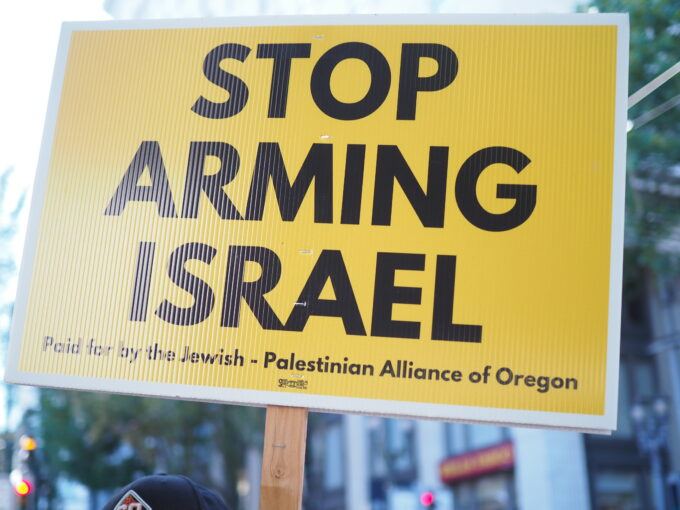
Photograph by Nathaniel St. Clair
It has become abundantly clear that after 250 years, a second American revolution is necessary.
Thomas Jefferson, principal author of the Declaration of Independence (1776), emphasized the importance of periodic uprisings to preserve liberty and protect against government overreach when he presciently wrote in 1787: “I hold it that a little rebellion now and then is a good thing, and as necessary in the political world as storms in the physical.”
In the spirit of Jefferson, I offer the following: it is way past time for the United States to declare independence from Israel; a destructive unhealthy 77-year liaison that has contributed to authoritarian creep, the dismantling of public liberty and increasing domestic instability in both countries.
For Palestinians and for all of mankind, the United States must free itself from its rogue ally. Washington’s continued financial, political and military investment in a violent apartheid regime has been a tragedy, that has ultimately led to Israel’s brazen and transparent genocide of Palestinians in Gaza today.
By cutting ties with Israel, the United States might begin to reclaim the principles on which it was founded and that are enshrined in the Declaration of Independence: resistance to tyranny, self-determination and the right to life, liberty and pursuit of happiness.
The Palestinian struggle for freedom and self-determination is inseparable from the quest for justice and dignity in the United States and worldwide.
Nelson Mandela, who spent most of his adult life struggling against the apartheid regime in South Africa, fully understood the link between freedom and justice for all, declaring that: “We know all too well that our freedom is incomplete without the freedom of the Palestinians.”
For Palestinians, freedom means removal of the punishing and humiliating yoke of Israel’s apartheid occupation and daily hellish violence. For Americans, it means not being subjected to Israel’s relentless hasbara campaign of disinformation, intimidation, exploitation of the Holocaust and distortion of antisemitism in order to crush criticism of its monstrous crimes against the Palestinian people.
To paraphrase the Declaration of Independence: The current course of events and history of repeated injuries require that we declare to mankind in 2025 the causes which impel the dissolution of America’s political bonds from Israel. Let the “facts be submitted to a candid world”:
+ It has, for over 80 years, been engaged in the theft and colonization of Palestinian land; systematically carrying out a campaign of brutalization, dehumanization, displacement and ethnically cleansing of the indigenous Palestinian population.
+ It has, for 58 years, engaged in the unlawful occupation and crime of apartheid in Gaza, the West Bank and East Jerusalem.
+ It has, for 22 months, executed a policy of starvation in Gaza as a weapon of war.
+ It has employed a systematic strategy of humiliation to psychologically punish Palestinians.
+ It has been committing genocide against the Palestinians in Gaza for 22 months.
+ It has, since 7 October 2023, dropped from 85,000 to 100,000 tons of explosives on densely populated Gaza.
+ It has indiscriminately bombed and destroyed infrastructure, farm land, homes, schools, hospitals, health facilities, mosques, churches, parks, cemeteries, libraries, museums, archives and cultural heritage sites.
+ It has killed more than 18,000 children since 7 October 2023, leaving many survivors orphaned, permanently disabled and traumatized.
+ It has imposed a siege of Gaza, blockading supplies of humanitarian aid.
+ It has replaced United Nations providers of aid with a U.S.-Israeli militarized chaotic aid operation run by mercenaries.
+ It has forced Gazans into military concentration camps (zones) with the aim of pressuring them into “voluntary” displacement.
+ It has allowed violent Jewish “settlers,” to wage a campaign of terror against Palestinians and their communities in the West Bank and East Jerusalem.
+ It has seized the sovereign territory of other nations by military force and continues to occupy it in defiance of UN Security Council resolutions.
+ It has waged thousands of unprovoked military attacks on the Occupied Palestinian Territory, Lebanon, Syria, Iraq, Iran and Yemen.
+ It has sent assassins into other countries to kill its political “enemies.”
+ It has refused to prosecute soldiers and “settlers” who have killed Americans.
+ It has imprisoned thousands of Palestinians without charges or trials.
+ It has subjected detainees to physical and mental abuse and inhumane conditions.
+ It has refused to be a party to the Nuclear Non-Proliferation Treaty and has not accepted International Atomic Energy Agency safeguards over its nuclear weapons program.
+ It has flagrantly violated and never abided by international, humanitarian and human rights laws.
Pointedly, since its establishment, Israel has exhibited disdain for international laws and for the body, the United Nations, created to uphold them. There was, however, no hesitation to act on Resolution 181 (29 November 1947), a non-binding General Assembly recommendation to the Security Council that it “take measures to plan for the implementation of the partition of Palestine.”
Zionist leaders, on 14 May 1948, unilaterally declared “independence”—from whom, is uncertain—and proclaimed the State of Israel on Palestinian land. They did so despite the fact the Security Council—the only body whose resolutions are binding on all members—had not (and has never) voted on the recommended partition plan. Thus, UN members have never been obligated to recognize Israel’s legitimacy.
The rights and freedoms outlined in Israel’s 1948 declaration were a smokescreen to hide the real goals of the newly proclaimed Jewish state. With regard to the indigenous Palestinians, Israel has ruthlessly disregarded every freedom and right stated in its declaration; among the most egregious examples: “The State of Israel…will foster the development of the country for the benefit of all its inhabitants; it will be based on freedom, justice and peace…and it will be faithful to the principles of the Charter of the United Nations.”
Additionally, Israel’s Declaration of Independence explicitly stated that a Constitution was to be drawn up no later than the first day of October 1948. None has ever been enacted. Instead of a single codified written constitution, Israel has
enacted over time a collection of Basic Laws (currently 14) which serve as a de facto constitution.
Israel’s Zionist founders understood that to assert dominance over an already inhabited land and to conduct their Eretz Israel (Greater Israel) expansionist ambitions unimpeded, they could not be constrained by a formal unambiguous constitution; one which would set limits on political power and force the designation of territorial borders.
Also, a comprehensive democratic constitution would have required the Jewish state to describe its structure, processes of government and define the basic principles and values of the state, as well as the fundamental rights of the citizens. Hence, Israel would have had to delineate itself as a Jewish supremacist anti-Arab state. The Israeli Knesset in 2018 did just that when it unambiguously enacted the Basic Nation-State Law, which states: “The realization of the right to national self-determination in the State of Israel is exclusive to the Jewish people.” The law, therefore, effectively excludes the over 2 million Arab citizens of Israel.
Liberation from an occupying power, decolonization, will be more difficult today than in the eighteenth century because of the “unbreakable bond” between the U.S. and Israel, a deep tanglement that has reached into every corner of American life.
Israel has thoroughly colonized the political, economic, military, media, academic and cultural fabric of life in the United States. It has become so entrenched, for example, that instead of working to end genocide, they have prioritized punishing those who protest it, militarized university campuses and policed anti-Zionist political speech.
The long-standing relationship with Tel Aviv, rooted in hegemonic interests, has not made the United States stronger. Mired in Israel’s conflicts and wars have made America weaker and contributed to anti-American sentiment in West Asia and the world.
Americans are awakening today to what Jefferson understood in 1787 when he wrote: “And what country can preserve its liberties if their rulers are not warned from time to time that their people preserve the spirit of resistance?”
Liberty cannot be preserved unless U.S. ties with Israel, the perpetrators of war and genocide, are severed. What Americans and the international community have begun to realize, what Nelson Mandela knew decades ago, is that our freedom is not only incomplete, it is also imperiled, while Palestinians continue to be denied self-determination, life, liberty and the pursuit of happiness in Palestine.
Middle East Turmoil and the Tragedy of the
Forgotten King-Crane Commission Report
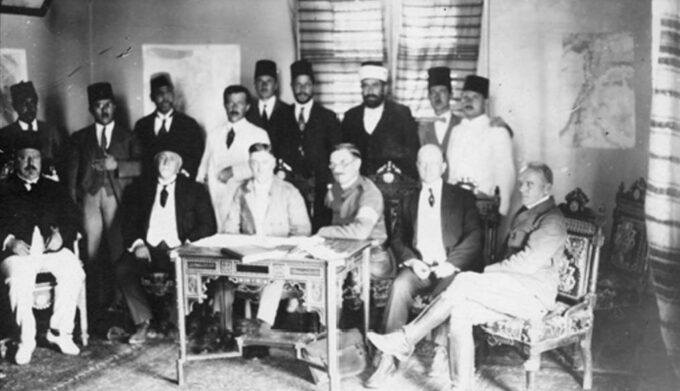
1919 Photo of the King Crane Commission. Photograph Source: Oberlin College Archives – Public Domain
Counterfactuals – what if so and so had happened? – are always dicey. For example; would there have been a full-scale Vietnam War if President John F. Kennedy had not been assassinated? There is no way to prove that hypothesis right or wrong. In the case of today’s Middle East, one could pose the counterfactual question about a forgotten 1919 report about the fate of the Middle East. Would there be turbulence and violence in the region today if President Wilson had not fallen ill and his vision of self-determination and decolonization been acted upon as recommended by certain members of the King-Crane Commission he created?
The governance and history of the region might have been different had alternative decisions been made at the 1919 Paris Peace Conference. Woodrow Wilson had one vision, the major European powers – Great Britain, France and Italy – had another. At the crucial post-World War I moment decisions were being made about the Middle East, the U.S. president fell ill; his vision for the Middle East was overruled by the European powers. The King-Crane Commission’s travels and Report have been tragically forgotten.
What was Wilson’s vision? It is easily understood in his idea to form a commission to visit the region to ask the people their desires about how they were to be governed. Before decolonization and self-determination became fashionable, Wilson sent a group to the Middle East to ask the people in the defeated Ottoman Empire how they wanted to their lives to be organized. As James Zogby noted, the King-Crane Commission did “the first survey of Arab public opinion.”
Wilson stated in a January 1918 address that the end of the War created the possibility for “an absolutely unmolested opportunity of autonomous development” for peoples previously under Turkish rule. That possibility was diametrically opposed to the 1916 Sykes-Picot secret treaty between France and Britain by which European powers would carve up the failing Ottoman Empire to establish their spheres of influence.
Wilson’s commission was headed by Henry King, the President of Oberlin College and Charles R. Crane, a wealthy Chicago industrialist and Wilson financial supporter.
The King-Crane Commission’s Report was truly “America’s Forgotten Middle East Initiative,” the title of Andrew Patrick’s thoroughly researched and exhaustive study. (The official title of the final Report was “Report of the American Section of the International Commission on Mandates in Turkey.”)
The Commission had two mandates:
1) “to separate from the Turkish Empire certain areas comprising, for example, Palestine, Syria, the Arab Countries to the East of Palestine and Syria, Mesopotamia, Armenia and Cilicia…and to put the development of their people under the guidance of Governments which are to act as Mandatories of the League of Nations.”
2) “form a definite opinion…of the divisions of territory and assignment of mandates which will be most likely to promote the order, peace and development of those peoples and countries.”
In order to do that, the Commission members visited 36 cities and towns over 42 days, read numerous petitions and interviewed 1,800 individuals. From Istanbul, the Commission visited several places in Greater Syria, among them Damascus, Jerusalem, and Beirut.
The final Report represented different opinions within the Commission. On the one hand, representatives from the major powers wished to continue some form of colonial domination such as in the Sykes-Picot Agreement. On the other side were Wilsonian idealists like Crane who were trying to see how far some form of quasi-independence could be established.
Patrick summarizes the final Report’s recommendations as follows:
1) Greater Syria was to be under the Mandate of one major power, either the United States or Great Britain, with a constitutional monarchy.
2) Lebanon was to have considerable autonomy within Greater Syria with an eventual French Mandate.
3) Because of regional hostility to the idea, a separate state for Jews was not recommended.
4) The United States would have the Mandate for the new International Constantinopolitan State under the League of Nations.
5) Mesopotamia would be under Great Britain’s Mandate.
While one could question how mandates could be part of decolonization or self-determination, it should be noted that the mandates were to be under the League of Nations, quite different from stark colonialism. As Patrick notes about the commisioners’ Report; “the commissioners emphatically argued that a mandate should not be treated as a colony. The mandatory power’s duty was to ‘educate’ the peoples of these regions in ‘self-government’ and help them create ‘a democratic state’ that protected its minorities. The mandates would help develop an ‘intelligent’ citizenry with a ‘strong national feeling’ whose overarching goal was ‘the progress of the country.’”
What happened to the Report? The Commission reported to the American Peace Commission in Paris. A copy of the Report was delivered to the White House, but most historians believe that Wilson’s illness prevented him from reading the Report. The Report was buried in the Department of State archives until it was discovered in 1922. In early December 1922, the New York Times published the entire Report with a short introduction by a journalist.
The journalist, William Ellis, called the Report “one of the great suppressed documents of the peacemaking period.” Charles Crane wrote in the 1930s; “The interests that were opposed to the report, especially the Jewish and the French, were able to persuade President Wilson that, as Americans were not going to take any future responsibility for Palestine, it was not fair that the report should be published so it was pigeonholed in the archives of the State Department.”
As far as the impact in the region, Patrick notes that “When it appeared that the commission was going to have little impact on decisions made in Paris…more populist nationalism emerged.”
Would the situation be different today if the recommendations had been followed and Wilson’s vision implemented? It is significant to note that the August 5, 2025, New York Times front-paged the secret Sykes-Picot Agreement to show how Britain and France have changed their historical, colonial ambitions in the region to now favor Palestinian statehood. No mention was made of the King-Crane Commission and Wilson’s vision.
Forgetting the King-Crane Commission Report has had dire consequences. As Richard Drake wrote in 2014: “The tragedy of the King-Crane Report lies not in the failure to implement its recommendations…but in taking no notice of the document at all. It remains the best historical source available for understanding Arab concerns about the Middle East in 1919. We live today with the consequences of having ignored the Arabs at that fateful moment.”
While counterfactuals are dicey, what is not dicey is that today we live with the consequences of the 1919 frustrated voices and desires the King-Crane Commission heard that were quickly forgotten. The tragedy of Andrew Patrick’s “America’s Forgotten Middle East Initiative” has been with us for over 100 years.

No comments:
Post a Comment