CMA CGM Boxship Slices Into Pier at Port in Estonia
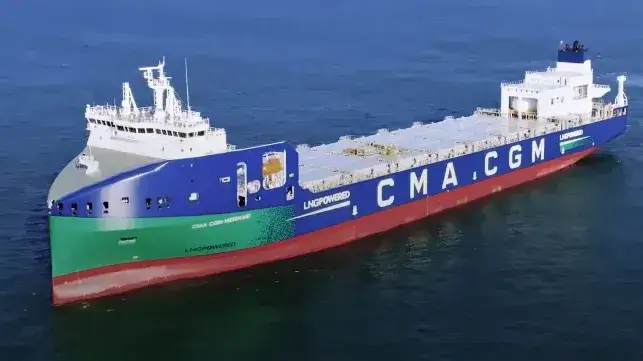
A large boxship has run into a quay at the small port of Muuga, Estonia, causing damage and cutting a chunk out of the wharf.
At about 1150 hours UTC on September 8, during an arrival from Kotka, CMA CGM Mermaid allided with the quay at Muuga's container terminal. Images obtained by local media show significant local damage to the quay, which the ship's plumb bow sliced into by several meters. An adjacent bulker, the Belasitza, was also damaged at the bow. The extent of any damage to the boxship was not immediately disclosed.
As of the morning of September 11, CMA CGM Mermaid was still moored alongside the quay wall at Muuga.
CMA CGM Mermaid is a novel new house-forward container feeder with a capacity of 2,000 TEU, one in a series of 10 sister ships designed by Chantiers de l'Atlantique and HHI. Delivered just last year, the vessel is designed for CO2 savings of up to 20 percent. Like many modern boxships built for lower speed and higher efficiency, she has a sharp, plumb bow, a design feature that tends to ease penetration of waves.
Port of Long Beach Resumes Operations After Container Collapse
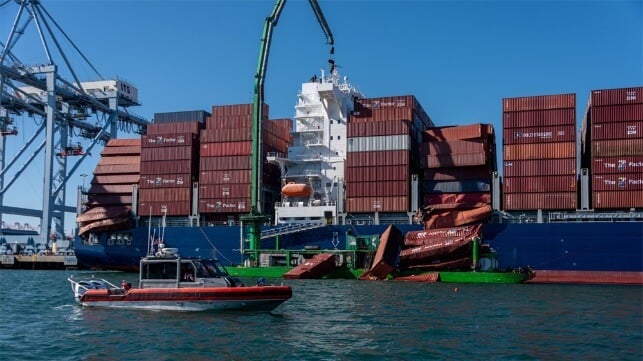
The Port of Long Beach, California, is reporting that all its terminals have resumed operations a day after the dramatic container collapse on a berthed vessel. Pier G, where the vessel Mississippi is berthed, is open and operating except for the immediate area around the vessel.
In a statement issued on Wednesday, a day after the collapse, the Port of Long Beach now reports that there was one minor injury tied to the incident. They avoided a worse situation, especially with the emissions barge that was alongside and attached to the containership when some of the containers collapsed onto the barge. The U.S. Coast Guard reports the barge sustained damage. Other containers collapsed onto the dock alongside the ship.
Additional videos have been released showing the sequence of events. After the first collapse, it appears the area around the vessel had been roped off for safety before the subsequent collapse. The situation continued with additional boxes that had been hanging from the ship also giving way and falling overboard.
The Unified Command for the incident, which consists of federal, state, and local agencies, is working to ensure the recovery of the cargo containers. The Coast Guard raised the estimated number of 75 containers from the 67 it reported yesterday.
Sonar surveys are being conducted to locate approximately 25 to 30 containers submerged in the harbor to ensure the safe navigation of ship traffic. The Coast Guard is maintaining a 500-yard safety zone, and a salvage plan is being developed and will be implemented as soon as possible.
The port has clarified that the manifest shows shoes, apparel, furniture, and electronics as the cargo. The vessel operates one of Zim’s express services, making only four port calls: Vietnam, China, and California. TV reports from the port showed images of a chair floating in the water as well as packages of slippers washing ashore.
The Long Beach Fire Department used one of its fireboats with high-powered nozzles to corral and direct the containers. They were seen pushing them toward a berth area as well as harbor boats that were being used to nudge the boxes toward the dock. The port said in its statement on Wednesday that the fallen containers had been recovered.
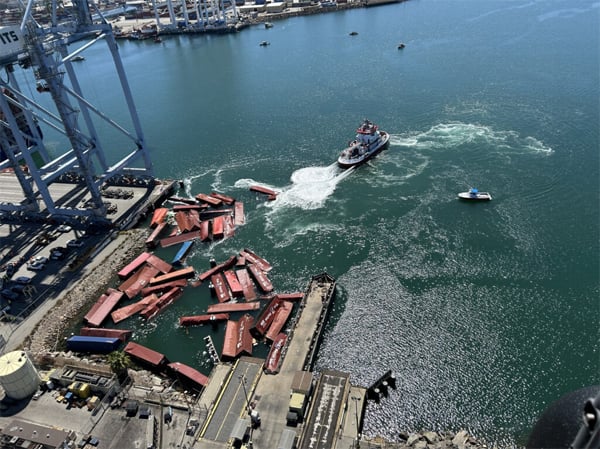
Floating containers were moved into a secure location away from vessel traffic (Port of Long Beach)
Speculation is mounting on the cause of the incident. It is unclear if the ship, which had arrived earlier in the morning, had begun container handling. The published schedule reflected a planned departure later today for the return to Vietnam.
The Mississippi, registered in Portugal, was built in 2024. It had undergone five port state inspections, the last in April 2025 in Shanghai. It was cited for deficiencies, including with its Voyage Data Recorder and the crew’s safety drill, but did not receive a detention.
Operations are continuing at the port to stabilize the containers aboard the vessel, including several that are continuing to be suspended over the side of the ship as well as the collapsed stacks. The U.S. Coast Guard reports it will be leading an investigation into the incident as will the National Transportation Safety Board.
Deal Finalized to Save Oregon’s Only International Container Terminal
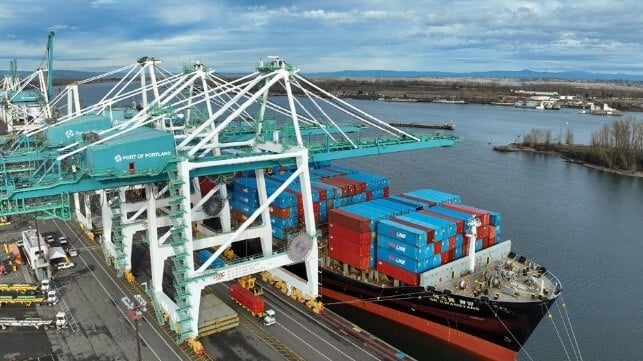
After more than 15 months of effort, the Port of Portland (Oregon) has completed a long-term agreement for the operation of Terminal 6, which is the state’s only active international container terminal. The port had announced in early 2024 that it planned to close the terminal due to mounting financial losses and the collapse of negotiations for a private operator.
"Scores of businesses throughout Oregon rely on Terminal 6 to ship their goods," said Governor Tina Kotek, who played a critical role by providing interim financing and state support to keep the terminal operating. "Oregon communities will be better off because we came together and worked toward this shared goal."
While it is located more than 100 miles from the ocean, the port plays a vital role in the state’s agricultural and seafood sectors. Without the port, they would have had to truck goods through other ports, raising costs. However, in 20214, with high fixed operating costs, loss of a rail service partner, BNSF, that had provided a connection to Seattle and Tacoma, and collapse of negotiations for a potential private operator, the port authority said it had no choice but to begin winding down the operation. It was pointed out that the Columbia River is shallow, limiting the size of vessels that can reach the port. In addition, it is a relatively small consumer market.
“The Port of Portland is the gateway connecting our farms, small businesses, and manufacturers to global markets,” noted Representative Shelly Boshart Davis.
The Port has been rebuilding container service since 2018 and was working to secure a private operating partner, highlighting that Terminal 6 is an important piece of Oregon’s economic infrastructure. California-based Harbor Industrial, which had been providing stevedoring services, reached a tentative agreement last December to become the operator.
The company will lease the 200-acre facility from the port authority for an initial seven-year term. It also has four options to extend the lease for a total of 20 years. Harbor has agreed to purchase seven new cranes for the terminal and will pay the port rent based on the amount of cargo it moves through the port. It will take over both the container and breakbulk operations at Terminal 6 as of December 31.
In June, Oregon legislators also approved $20 million recommended by Governor Tina Kotek for necessary capital improvements at the terminal.
The port and Harbor Industrial report they are committed to maintaining the significant benefits of shipping goods through Oregon ports. The port released a long-term plan that calls for doubling the size of the operation, and together they said they look forward to continued operations and growth of the container terminal.
Croatia Marks Opening of New Rijeka Terminal as a Gateway for the Region
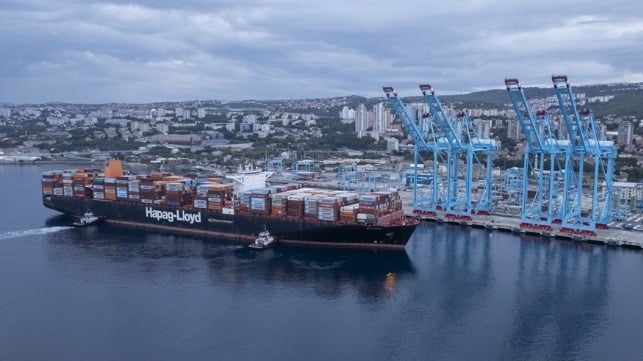
Officials gathered in the Port of Rijeka, Croatia, to mark the arrival of the first commercial container vessel as the port transitioned from trial operations. Rijeka Gateway, they reported, represents the largest private investment in logistics in Croatia, and it becomes the most modern and technologically advanced container terminal in the region.
The concession for the new terminal was awarded in November 2021, creating a joint venture between Maersk’s APM Terminals and ENNA Group. Croatia’s Deputy Prime Minister and Minister of the Sea, Transport and Infrastructure, Oleg Butkovi?, highlights that it was the largest agreement in the history of the Port of Rijeka.
Maersk committed to a €380 million ($445 million) investment for the operations, which have been under construction for the past two years. It includes a 400-meter (1,300-foot) quay, which was in part financed with a World Bank loan, along with construction of access and internal roads, a new intermodal terminal, and rail interface. The terminal will have an initial annual capacity of 650,000 TEU, and they are also making investments in hinterland and terminal equipment.
“This terminal is more than just infrastructure. It is a symbol of Rijeka as a modern, sustainable, and technologically advanced port that creates value and drives both the local and national economy,” said Peter Corfitsen, CEO of Rijeka Gateway.
Emphasizing its role as a regional center, the Rijeka Gateway Terminal is being included in the new Gemini Cooperation between Maersk and Hapag-Lloyd. It becomes part of the route linking ports in East Asia with locations in the Mediterranean and Adriatic Sea.
The first commercial vessel to berth at Rijeka Gateway was Al Jasrah (157,374 dwt). Built in 2016, the vessel is registered in Liberia and operated by Hapag-Lloyd. It has a capacity of approximately 15,000 TEU. It was arriving from Port Said, Egypt.
After a planned expansion, the port will grow to 680 meters (2,230 feet) of quay and a capacity of over one million TEU. The terminal is equipped with four remotely operated ship-to-shore cranes (STS), 15 rubber-tired gantry cranes (RTG), two rail-mounted gantry cranes (RMG), and 28 terminal tractors. All systems are integrated into a single control center, and terminal operations will be managed with cutting-edge technology, full automation, and renewable energy, making Rijeka Gateway the first terminal of its kind in the Adriatic region.

No comments:
Post a Comment