HITRON Catches its 1,000th Smuggling Boat, Using Force Without Fatalities
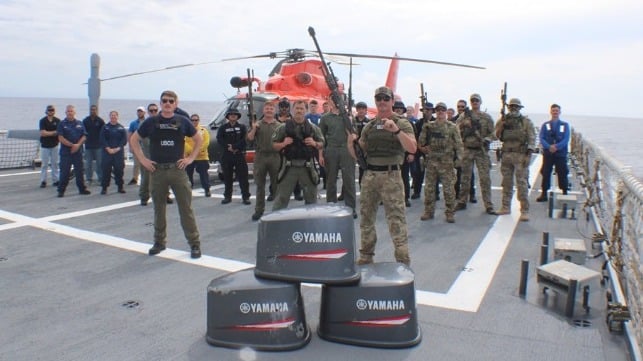
The U.S. Coast Guard's Helicopter Interdiction Tactical Squadron (HITRON) has completed its 1,000th drug-running interdiction, racking up yet another disabled go-fast boat.
On August 25, a HITRON team aboard USCGC Midgett was operating about 375 nautical miles southwest of Acapulco, in the Eastern Pacific transit zone. A trafficking vessel was spotted and refused to heave to for boarding, so the team disabled the boat for law enforcement boarding. Midgett's crew recovered more than 3,600 pounds of cocaine from the vessel.
HITRON was commissioned in 2000 with a mission to stop suspect go-fast vessels and slow the flow of cocaine into the U.S. Its tactics are unique: its sharpshooters operate from helicopters deployed aboard Coast Guard cutters in U.S. Southern Command, and they give pursuit when a smuggling boat is in range. If radio hails and warning shots do not bring the suspect boat to a halt, the HITRON team uses .50-caliber rifles to shoot out the boat's outboards. This compels the smuggling vessel to stop, generally in safety; loss of life is accidental, vanishingly rare, and investigated when it occurs.
An example of a HITRON interdiction earlier this year (USCG file)
HITRON hit its 500th interdiction mark in 2017, having stopped a combined 422,000 kilograms of cocaine with a wholesale value estimated in the range of $17 billion (at the time). Over the past 12 months alone, HITRON squadrons have added another $3.3 billion to the existing tally.
After each vessel is interdicted and the suspects arrested, the suspect boat may be destroyed as a hazard to navigation, often using kinetic means.
The only hard drug interdicted at sea off Latin America is cocaine, much of which is bound for high-priced European markets via ports in the Caribbean and Central America. The remainder makes its way to North America, predominantly overland via Central America, Mexico and the U.S. southern border.
Cocaine accounted for about 30,000 fatal drug overdoses in the U.S. in 2023, the most recent year for data from the National Institutes for Health. Fentanyl, typically manufactured within Mexico and smuggled in by land, accounted for about 74,000 deaths.
U.S. Coast Guard Buys 10 More Fast Response Cutters From Bollinger

The United States Coast Guard announced Tuesday that it will award $507 million to Bollinger to begin construction of 10 more Fast Response Cutters, which are the backbone of its nearshore patrol fleet and a versatile stand-in for overseas missions. The agreement is part of the service's newly-invigorated shipbuilding plan, bolstered by historic new funding from the One Big Beautiful Bill Act.
The Act handed the Coast Guard nearly $25 billion for procurement and repairs, including $1 billion for FRCs. The congressionally-authorized order brings the total Fast Response Cutter fleet under contract from 67 vessels to 77, expanding on one of America's most successful shipbuilding programs. Since the first hull joined the fleet in 2012 to replace the service's aging 110-foot Island-class patrol vessels, FRCs have grown in number and voyaged the seas; they are now homeported around the world, from Florida to Alaska to Guam and Bahrain.
Currently, 59 Sentinel-class Fast Response Cutters are actively deployed alongside larger assets. Though small compared to a medium-endurance cutter (WMEC), the FRCs are much bigger than the predecessor Island-class cutters, and have been tested on much longer oceangoing deployments than typically assigned to vessels of this size. Capable of achieving maximum speeds between 28 and 30 knots, the cutter can also transit up to 2,500 nautical miles at 12 knots.
The vessels' elevated bow and fin stabilizers improve their handling characteristics beyond what might be expected for a 350-ton hull, enabling small boat deployment in waves of up to six feet in height. And with a 22-person roster and a lieutenant in command, they are lean and efficient to crew, a major virtue for a resource-constrained Coast Guard.

No comments:
Post a Comment