It’s possible that I shall make an ass of myself. But in that case one can always get out of it with a little dialectic. I have, of course, so worded my proposition as to be right either way (K.Marx, Letter to F.Engels on the Indian Mutiny)
Thursday, September 11, 2025
SCI-FI-TEK 70YRS IN THE MAKING
Key diagnostic system for ITER reactor nears completion
The Henryk Niewodniczanski Institute of Nuclear Physics Polish Academy of Sciences
Cracow, 10 September 2025 - In the Universe, thermonuclear fusion is a common reaction: it is the source of energy for stars. On Earth producing energy using this process is difficult due to problems with controlling the plasma emitting significant amounts of energy. Of critical importance here is the knowledge of the current state of the plasma and the power released in nuclear reactions. In the ITER reactor this knowledge will be gathered by a sophisticated neutron flux diagnostic system.
The ITER experimental reactor, which has been under construction for over a decade, is a milestone in the development of fusion energy: it is to be the first device using nuclear fusion, capable of generating several times more power than required for its operation. A critically important element of the plasma diagnostics system in this reactor – the High Resolution Neutron Spectrometer (HRNS) – has just been presented in the journal Fusion Engineering and Design. The spectrometer design is a joint effort by physicists and engineers from the Institute of Nuclear Physics of the Polish Academy of Sciences (IFJ PAN) in Cracow, the University of Uppsala and the Istituto per la Scienza e Tecnologia dei Plasmi in Milan, developed in close cooperation with the ITER Organization.
“The spectrometer we have designed allows us to measure both the number and energies of neutrons emitted by plasma across the full range of fusion power expected for the ITER reactor. This provides us with information about the proportions of deuterium and tritium, hydrogen isotopes that combine with each other inside the reaction chamber,” says Dr. Jan Dankowski (IFJ PAN), the first author of the article describing the spectrometer. He further clarifies: “Measuring the fast neutron population from the two dominant reactions in the plasma is a direct indicator of fuel composition, ion temperature, and combustion quality. In ITER and future reactors, this will be a key tool for controlling and optimizing reactor operation. Lack of this information would effectively mean the loss of one of the most important plasma diagnostic tools, significantly hampering both scientific research at ITER and the safe operation of future power reactors”.
Thermonuclear energy can safely be described as ‘green’. Energy is generated here similarly to the manner in which it is generated inside stars, i.e. through nuclear fusion reactions, the most promising of which appears to be the fusion of hydrogen isotopes (deuterium and tritium) into helium. Importantly, deuterium is found in vast quantities in the Earth's oceans, and tritium is not needed in large amounts and may in future be produced in the reactor itself (by bombarding more readily available lithium with neutrons). Furthermore, the fusion reaction is not chain-like, so it cannot lead to an explosion and the dispersion of large amounts of highly harmful radioactive materials. The risk of environmental contamination therefore remains minimal and is mainly limited to the reactor's structural elements themselves. Unfortunately, despite its enormous potential, fusion energy remains in the research and development phase. Practical implementation may take several years to complete – with the construction of the DEMO tokamak, a bridge between experimental reactors and a fusion power plant.
The nuclei of hydrogen isotopes form plasma, which, being electrically charged, can be held in isolation from the walls by a magnetic field inside the toroidal vacuum chamber of the reactor (these sorts of reactors are called tokamaks). Currently, this plasma must be additionally heated to reach a temperature of 150 million Kelvin, which guarantees the proper course of the reaction. The high-energy neutrons produced during fusion, being electrically neutral, escape towards the walls of the tokamak, allowing most of the energy produced to be recovered (and ultimately creating tritium in collisions with lithium).
The formation of helium nuclei would be of fundamental importance for the efficiency of future thermonuclear reactors. Endowed with high energy and electrically charged, they would remain inside the plasma in the tokamak's magnetic field and, in subsequent collisions with deuterium and tritium, would decrease own energy, ultimately increasing the energy of the thermonuclear fuel. This process would reduce the energy costs associated with external heating. The ITER reactor – under construction in Cadarache, France, since 2007, with a budget currently exceeding $20 billion and scheduled to start operating in the middle of the next decade – will not yet use helium nuclei to heat the plasma. Despite this limitation, it is expected to generate up to ten times more energy than it consumes, ultimately reaching a power output of 500 megawatts.
The HRNS spectrometer will be installed behind a thick concrete protective wall surrounding the fusion chamber, near an opening several centimetres in diameter, to be able to detect neutrons produced in the very center of the plasma. Depending on the power of the reactor, their flux will vary dramatically, reaching up to hundreds of millions of particles per square centimetre per second. During the measurement, HRNS will be able to analyze the neutron spectrum from the deuterium-deuterium reaction (neutrons with an energy of 2.5 megaelectronvolts) and from the deuterium-tritium reaction (neutrons with an energy of 14 megaelectronvolts).
In order to ensure the operation of the HRNS spectrometer under the full range of conditions anticipated in the ITER reactor, it had to be divided into four independent sub-assemblies. Each of these is essentially a separate spectrometer, operating on different principles and designed for a different range of neutron flux intensities. Physicists from the IFJ PAN are working on the development of the first subassembly, called TPR (Thin-foil Proton Recoil). Here, neutrons knock protons out of a thin polyethylene foil – and their scattering angles depend on the energies of the neutrons. Nearly 100 silicon detectors are responsible just for the detection of the protons. The second subassembly is the NDD (Neutron Diamond Detector) spectrometer, where neutrons are recorded by an array of over a dozen diamond detectors. The last two subassemblies, FTOF (Forward Time-of-Flight) and BTOF (Backscattering Time-of-Flight), measure the flight times of neutrons and estimate their kinetic energy based on the velocities determined in this way, with FTOF analysing neutrons that maintain a direction of motion similar to the original one, and BTOF analysing those scattered at large angles.
“The HRNS was designed to measure neutrons, but that doesn't mean it won't detect other types of radiation. In practice, many other particles, from gamma-ray photons to particles resulting from neutron interactions with reactor components and even with parts of our spectrometer, will produce a signal in the active part of the detector. All these factors results in the measured spectrum having an exceptionally complex structure. To properly interpret the data and extract reliable information about the amounts of deuterium and tritium, we must thoroughly understand the origin of this rich noise,” emphasises Prof. Marek Scholz (IFJ PAN).
Due to limited access to the measuring system during tokamak operation, scientists need to know how to interpret the incoming data. This is especially important if, during the running phase, some of the detectors of one of the subassemblies or even the entire subassembly are damaged. It was also critically important to design shielding elements so that neither the neutron flux nor the parts of the equipment excited by it would interfere with the operation of electronic subsystems or other measuring devices operating in the vicinity of the entire spectrometer.
“The project required a huge amount of numerical calculations, not only those directly related to neutron measurements. For example, a group from our institute was responsible for, amongst others, Monte Carlo calculations that enabled the optimization of the HRNS spectrometer's radiation shielding by demonstrating the transport of neutrons and gamma radiation in the environment and within individual components of the entire system. Equally important was the calculation of the radioactive activity of individual components of the HRNS spectrometer. This knowledge guarantees both the proper functioning of the device and the safety of the personnel operating it,” notes Dr. Urszula Wiacek, head of the Department of Radiation Transport Physics at the IFJ PAN.
Scientists expect that a prototype of a high-resolution neutron spectrometer for the ITER fusion reactor will be developed within two years. Work on the device was financed by the Ministry of Science and Higher Education and the ITER Organization.
The Henryk Niewodniczański Institute of Nuclear Physics (IFJ PAN) is currently one of the largest research institutes of the Polish Academy of Sciences. A wide range of research carried out at IFJ PAN covers basic and applied studies, from particle physics and astrophysics, through hadron physics, high-, medium-, and low-energy nuclear physics, condensed matter physics (including materials engineering), to various applications of nuclear physics in interdisciplinary research, covering medical physics, dosimetry, radiation and environmental biology, environmental protection, and other related disciplines. The average yearly publication output of IFJ PAN includes over 600 scientific papers in high-impact international journals. Each year the Institute hosts about 20 international and national scientific conferences. One of the most important establishments of the Institute is the Bronowice Cyclotron Centre (CCB), which is an infrastructure unique in Central Europe, serving as a clinical and research centre in the field of medical and nuclear physics. In addition, IFJ PAN runs four accredited research and measurement laboratories. IFJ PAN is a member of the Marian Smoluchowski Kraków Research Consortium: “Matter-Energy-Future”, which in 2012-2017 enjoyed the status of the Leading National Research Centre (KNOW) in physics. In 2017, the European Commission granted the Institute the HR Excellence in Research award. As a result of the categorization of the Ministry of Education and Science, the Institute has been classified into the A+ category (the highest scientific category in Poland) in the field of physical sciences.
SCIENTIFIC PUBLICATIONS:
“Development and performance of the thin-foil proton recoil spectrometer for ITER plasma diagnostics”
J. Dankowski, J. Bielecki, J. Błądek, S. Conroy, B. Coriton, G. Croci, D. Dworaka, G. Ericsson, J. Eriksson, A. Wójcik-Gargula, A. Hjalmarsson, A. Jardin, R. Kantor, A. Kovalev, K. Król, A. Kulińska, A. Kurowski, G. Mariano, R. Mehrara, D. Morawski, M. Rebai, M. Scholz, F. Scioscioli, M. Tardocchi, G. Tracz, M. Turzański, U. Wiącek
Press releases of the Institute of Nuclear Physics, Polish Academy of Sciences.
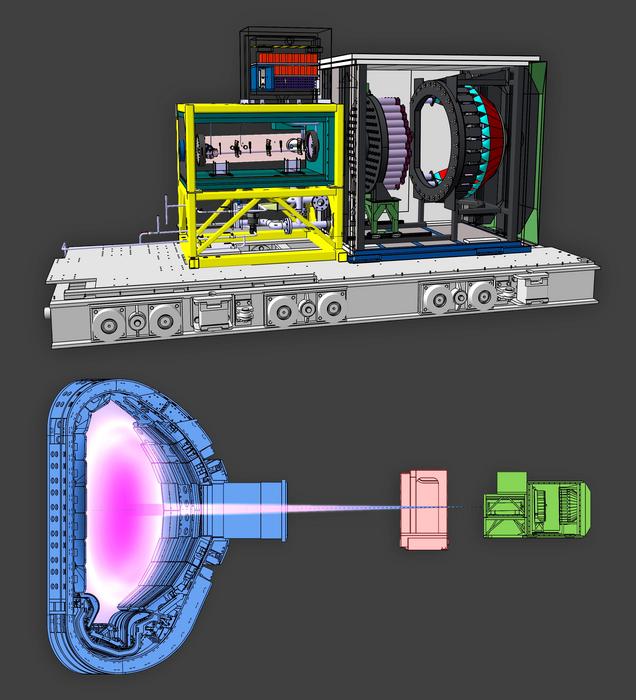
The high-resolution neutron spectrometer HRNS. The yellow structural elements surround the TPR system designed at the Institute of Nuclear Physics of the Polish Academy of Sciences in Cracow. The lower part of the image shows the position of the HRNS spectrometer (green) relative to the tokamak's protective wall (red) and its fusion chamber (blue).
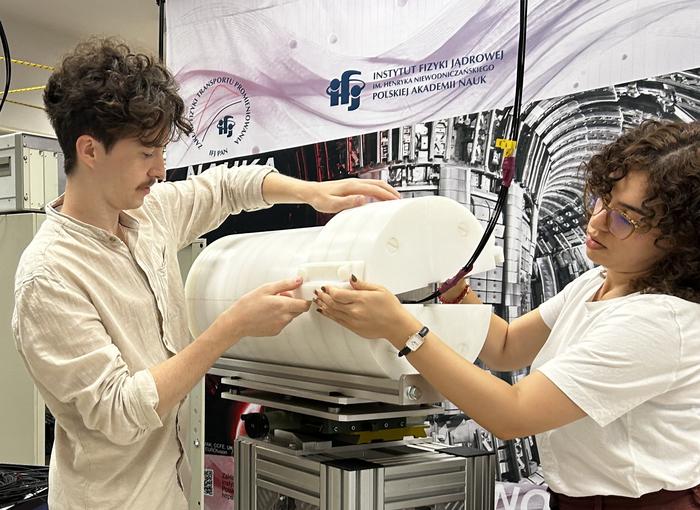
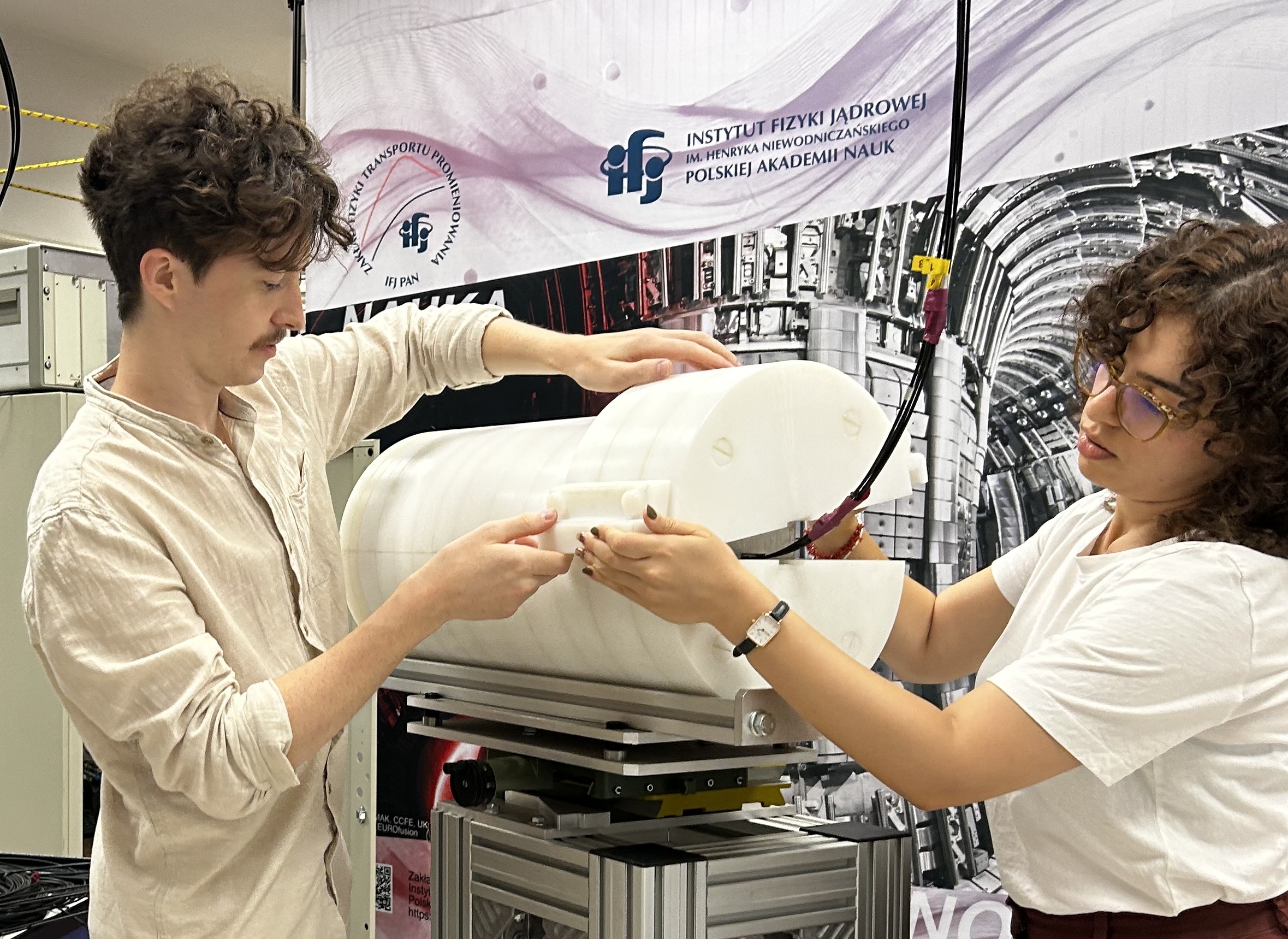
Installation of a neutron diagnostics system in the laboratory of the Institute of Nuclear Physics of the Polish Academy of Sciences in Cracow. (Source: IFJ PAN)
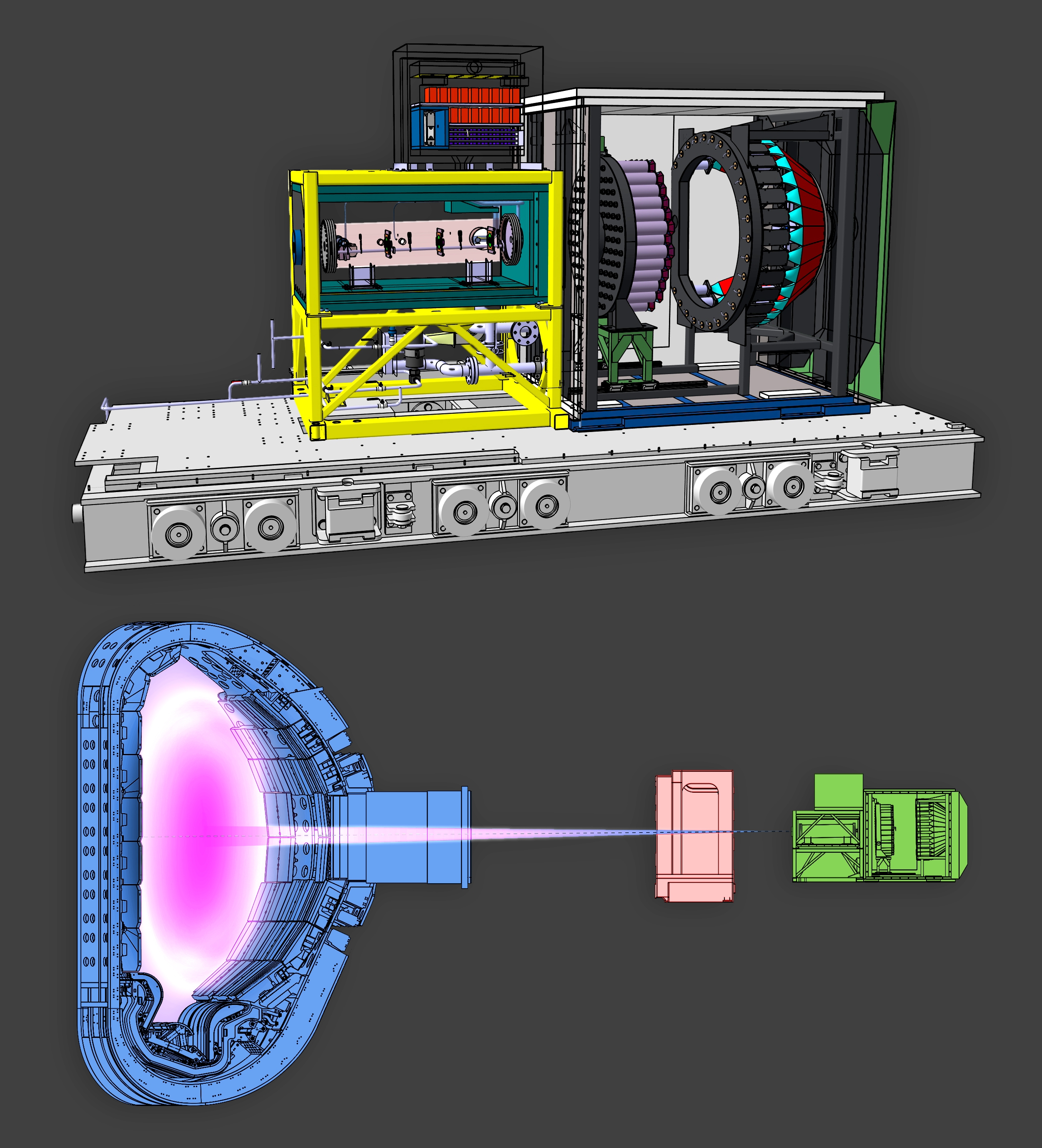
The high-resolution neutron spectrometer HRNS. The yellow structural elements surround the TPR system designed at the Institute of Nuclear Physics of the Polish Academy of Sciences in Cracow. The lower part of the image shows the position of the HRNS spectrometer (green) relative to the tokamak's protective wall (red) and its fusion chamber (blue). (Source: IFJ PAN, ITER Organization)
Durham University scientists have completed one of the largest quality verification programmes ever carried out on superconducting materials, helping to ensure the success of the world’s biggest fusion energy experiment ITER.
Their findings, published in Superconductor Science and Technology, shed light not only on the quality of the wires themselves but also on how to best test them, providing crucial knowledge for scientists to make fusion energy a reality.
Fusion (the process that powers the Sun) has long been described as the holy grail of clean energy. It offers the promise of a virtually limitless power source with no carbon emissions and minimal radioactive waste.
ITER, now under construction in southern France, is designed to demonstrate fusion at an unprecedented scale.
When operational, its giant magnets will confine plasma at temperatures hotter than the Sun’s core, and those magnets depend entirely on the performance of advanced superconducting wires.
The Durham University team, led by Professor Damian Hampshire and Dr Mark Raine, were chosen in 2011 to establish one of Europe’s official reference laboratories for ITER.
Their task was to develop the specialised methods needed to test the superconducting wires made from compounds called Nb₃Sn and Nb–Ti that form the backbone of ITER’s magnet system.
Each piece of wire had to meet extremely high standards to ensure the reliability of the machine.
Over the course of the project, the research team received more than 5,500 wire samples and carried out approximately 13,000 separate measurements.
Every wire had to be processed, prepared, and in the case of Nb₃Sn, heat-treated in furnaces reaching over 650°C before measurement.
What makes this work particularly significant is the statistical analysis carried out on this enormous dataset.
The Durham group showed that when the same strand cannot be measured repeatedly as is the case with Nb₃Sn wires, which are altered by heat-treatment measuring adjacent strands in different laboratories can act as a reliable substitute.
This provides a practical and cost-effective method of cross-checking results, ensuring both laboratory accuracy and manufacturing consistency.
Fusion energy could be transformative, but its success depends on getting the details right,
the researchers say.
The wires inside ITER’s magnets must carry currents hundreds of times greater than in household wiring, under extreme conditions.
Professor Damian Hampshire of Durham University, who led the work said: "The UK leads the world in the manufacture of MRI body scanners using Superconducting magnets.
“The question is can we help lead the world with the commercialisation of Fusion Power generation using Superconducting magnets?”
The findings come at a time of growing momentum in fusion energy. While ITER aims for its first plasma in 2035, private companies are racing to develop commercial reactors sooner.
Microsoft has already signed a deal to buy electricity from Helion’s planned fusion plant in 2028, and Google has pre-ordered 200 megawatts of fusion power from Commonwealth Fusion Systems in the 2030s.
Meanwhile, the UK government has committed £2.5 billion to fusion research and is building its own prototype plant, STEP, on a former coal site in Nottinghamshire.
When ITER begins operating, its magnets will generate some of the strongest steady magnetic fields ever created, enabling fusion reactions that could produce abundant, low-carbon energy without long-lived radioactive waste.
The success of the magnets and of ITER itself depends on the quality of the superconducting strands now verified in Durham.
It also provides an open resource that scientists everywhere can use to refine both the technology and the testing methods.
Durham’s role extends beyond ITER, the University is also a lead partner in the UK’s Centre for Doctoral Training in Fusion Power, helping train the next generation of scientists and engineers.
ENDS
Media Information
Professor Damian Hampshire from Durham University is available for interview and can be contacted on d.p.hampshire@durham.ac.uk.
Alternatively, please contact Durham University Communications Office for interview requests on communications.team@durham.ac.uk or +44 (0)191 334 8623.
Source
‘European Nb3Sn and Nb–Ti strand verification for ITER: processing, measurements and statistical analysis’, (2025), M J Raine, T Boutboul, P Readman and D P Hampshire, Superconductor Science and Technology.
An embargoed copy of the paper is available from Durham University Communications Office. Please email communications.team@durham.ac.uk.
Durham University is a globally outstanding centre of teaching and research based in historic Durham City in the UK.
We are a collegiate university committed to inspiring our people to do outstanding things at Durham and in the world.
We conduct research that improves lives globally and we are ranked as a world top 100 university with an international reputation in research and education (QS World University Rankings 2026).
We are a member of the Russell Group of leading research-intensive UK universities and we are consistently ranked as a top 10 university in national league tables (Times and Sunday Times Good University Guide, Guardian University Guide and The Complete University Guide).


No comments:
Post a Comment