Police came down hard on scattered groups of protesters trying to block critical roads and infrastructure in Paris on Wednesday to protest government austerity measures as France's fifth prime minister in under two years took office. Demonstrators said they were frustrated with successive governments that changed names and faces – but not policy.
Issued on: 10/09/2025 -
By: Paul MILLAR
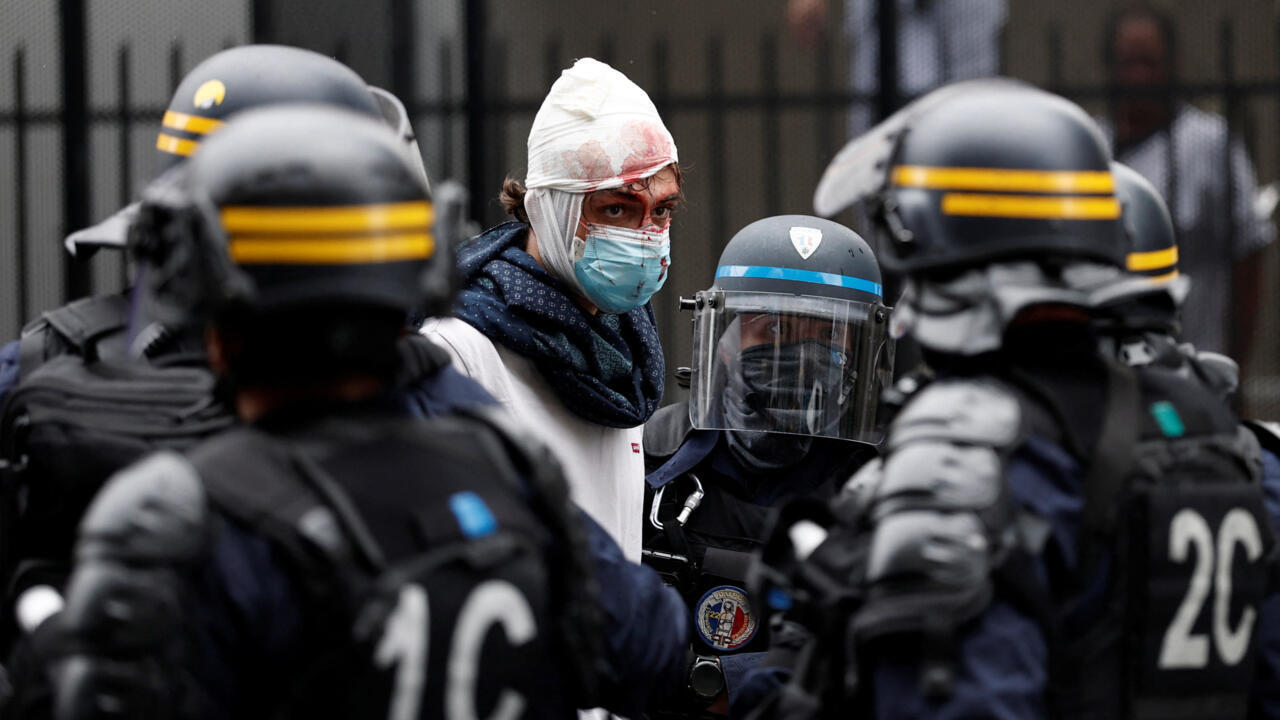 An injured masked protester is surrounded by French CRS riot police during a demonstration near the Gare du Nord train station during a day of protests in Paris. © Benoit Tessier, Reuters
The signal’s red, but the road is still alive with people. At the Porte de Bagnolet, one of several major interchanges between metropolitan Paris and the Boulevard Périphérique ring road that curls around the capital, a few dozen demonstrators are milling back and forth across the road. Traffic is backed up, and the drivers are furious. It’s 7:30am, and if they’re not already late for work, they soon will be. The noise of horns is unrelenting.
Soon, the braying horns give way to a sharper sound. Mounted police pull up on heavyset motorbikes in a wail of sirens, and the pace of the protesters quickens. They drift away from the crossing and begin making their way back into the city.
The armoured police dismount, and all pretence of nonchalance vanishes. A few demonstrators break into a run, and the police give chase. A man stumbles as a police officer lunges at him, hitting the asphalt hard. The protesters seethe. Back off, back off, they yell. Back on his feet, the police officer looks around him and sees that he’s outnumbered. He backs off.
The next action ends less dramatically. At a nearby crossing, a mounted police officer tells a scant dozen protesters that they have ten minutes to clear the road before the police come out in force. The young demonstrators exchange nervous looks, then let out a cheer, and clap, and clear the road.
French protesters 'focus on disrupting key elements of national infrastructure'
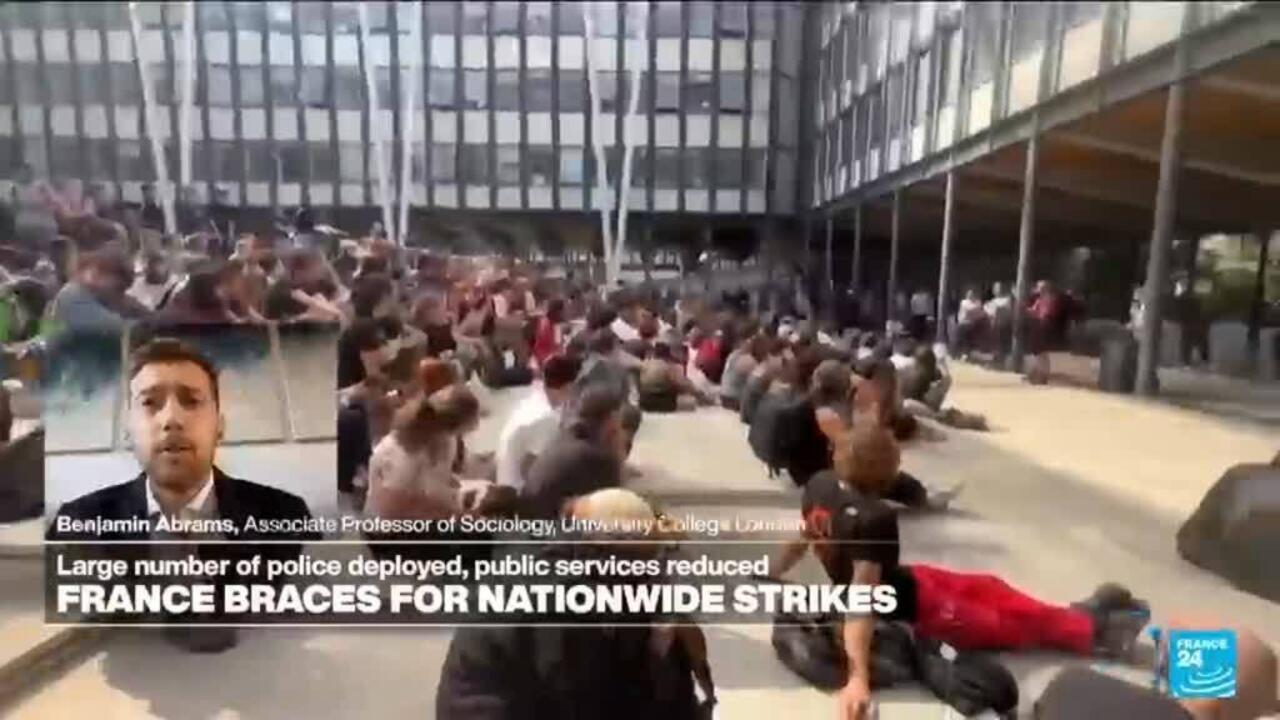
© France 24
06:19
06:19
The day’s rallying cry was “Block Everything”, and they haven’t. All across Paris, all across France, groups of young protesters who found one another through social media gathered at critical points of the nation’s roads and infrastructure, setting up makeshift barriers and putting their bodies in the way of traffic to protest years of austerity measures imposed by French President Emmanuel Macron and his successive prime ministers.
Each time they were met by rank after rank of heavily armed and armoured police who drove them from the streets with clubs, tear gas and flash balls.
Read moreHundreds arrested as police clash with France’s ‘Block Everything’ protesters
Right-wing Interior Minister Bruno Retailleau – now outgoing interior minister after the fall of François Bayrou’s government on Monday – had warned the nation’s prefectures that there were likely to be at least 100,000 protesters across the country. To match their numbers, he assured them, he would be mobilising some 80,000 law enforcement officials across France.
In Paris, the result was a day-long, shifting pursuit spanning swaths of the city. Police would break one blockade by force, scattering protesters into side streets who would then catch their breath, find their comrades and try again.
Macron ‘doesn’t care about the French people’
At Porte de Bagnolet, Marie is mulling her next move. The young professor says she came out with one aim in mind – the fall of the government, before it’s even been put into place.
“It’s important to take action right now,” she says, arguing that Macron’s decision to name long-time loyalist Sébastien Lecornu as France’s new prime minister last night showed that he “didn’t care about the French people”.
“I think it's problematic to appoint someone from his own ranks, even before he has met with party leaders and the opposition, and seen what today's movement will bring,” she says.
While the conservative-turned-centrist ally of Macron has promised a break from the policies of previous governments, critics of the decision say it sends a clear message that the struggling president will continue to push for the same policies that have already seen his last two appointments voted out of office.
Lecornu’s appointment seems only to have strengthened the protesters’ resolve. Throughout the day, messages hurtle back and forth in the Telegram groups that have been crucial to the movement’s momentum: Where’s the next action? Are any blockades still standing?
At Porte de Montreuil on the eastern edge of Paris, someone responds, things are heating up. Garbage bins, broken glass and wooden pallets lie strewn across the street from where the latest blockade has been cleared away. The police are hunting the remaining demonstrators through the streets – one officer catches a woman around the throat and sets her to clearing the remaining palettes from the road. The air is sharp with tear gas.
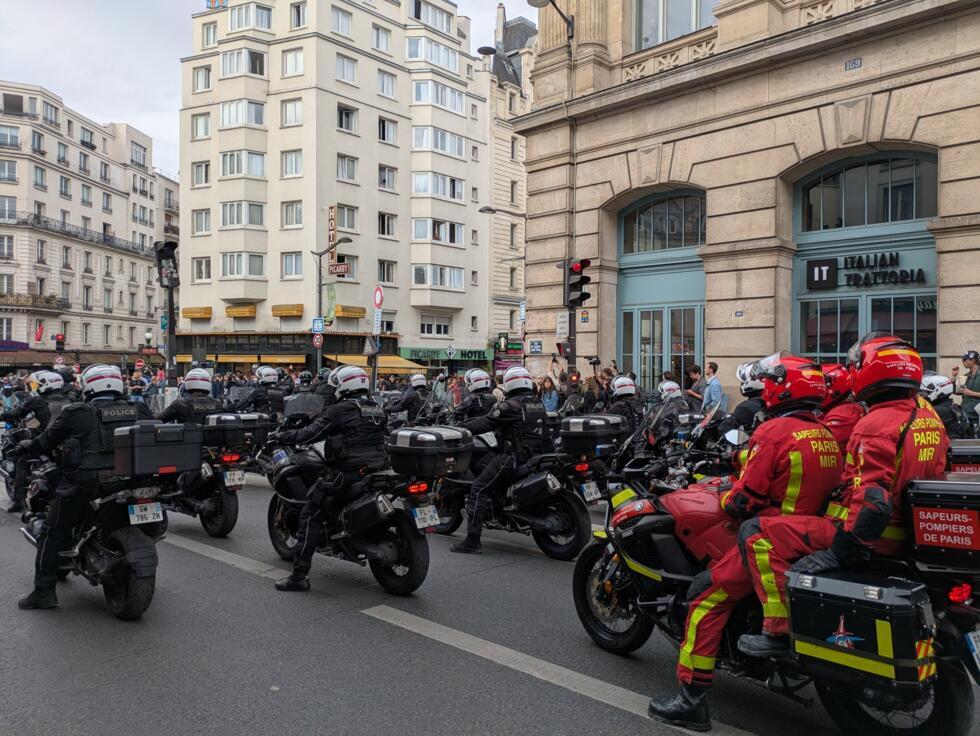
A mobile brigade of riot police disperse a crowd of demonstrators near Gare du Nord station in Paris on September 10, 2025. © Paul Millar, FRANCE 24
As a phalanx of riot shield-bearing police cordon off the block, demonstrators begin to trickle north to Tenon Hospital, where healthcare workers have gone on strike to protest what they describe as chronic under-funding. The atmosphere here is joyous, and calmer; union reps and local left-wing politicians speak to the packed crowd before opening the mic to all comers. A brass band launches into a raucous cover of Rage Against the Machine’s "Killing in the Name Of", to wild applause.
Nicolas, a striking lab technician at the hospital, says that working conditions in public hospitals continue to deteriorate.
“We’re changing prime ministers, but will this new prime minister be able to do any better? I don’t think so,” he says. “We’ve grown too used to budget cuts and bed closures. Today, behind each caregiver there’s a man or a woman at the end of their rope, who can’t take it anymore. Public hospitals have become an enormous psycho-social risk for the people who work there.”
Evelyn, a nursing assistant at the hospital, says that she was glad to attach their struggle to the broader movement.
“We’re fed up with the current French system,” she says. “We never have enough people working in our hospitals – we’re always working with knives drawn.”
“All we want is to be seen and heard,” she adds.
As a phalanx of riot shield-bearing police cordon off the block, demonstrators begin to trickle north to Tenon Hospital, where healthcare workers have gone on strike to protest what they describe as chronic under-funding. The atmosphere here is joyous, and calmer; union reps and local left-wing politicians speak to the packed crowd before opening the mic to all comers. A brass band launches into a raucous cover of Rage Against the Machine’s "Killing in the Name Of", to wild applause.
Nicolas, a striking lab technician at the hospital, says that working conditions in public hospitals continue to deteriorate.
“We’re changing prime ministers, but will this new prime minister be able to do any better? I don’t think so,” he says. “We’ve grown too used to budget cuts and bed closures. Today, behind each caregiver there’s a man or a woman at the end of their rope, who can’t take it anymore. Public hospitals have become an enormous psycho-social risk for the people who work there.”
Evelyn, a nursing assistant at the hospital, says that she was glad to attach their struggle to the broader movement.
“We’re fed up with the current French system,” she says. “We never have enough people working in our hospitals – we’re always working with knives drawn.”
“All we want is to be seen and heard,” she adds.
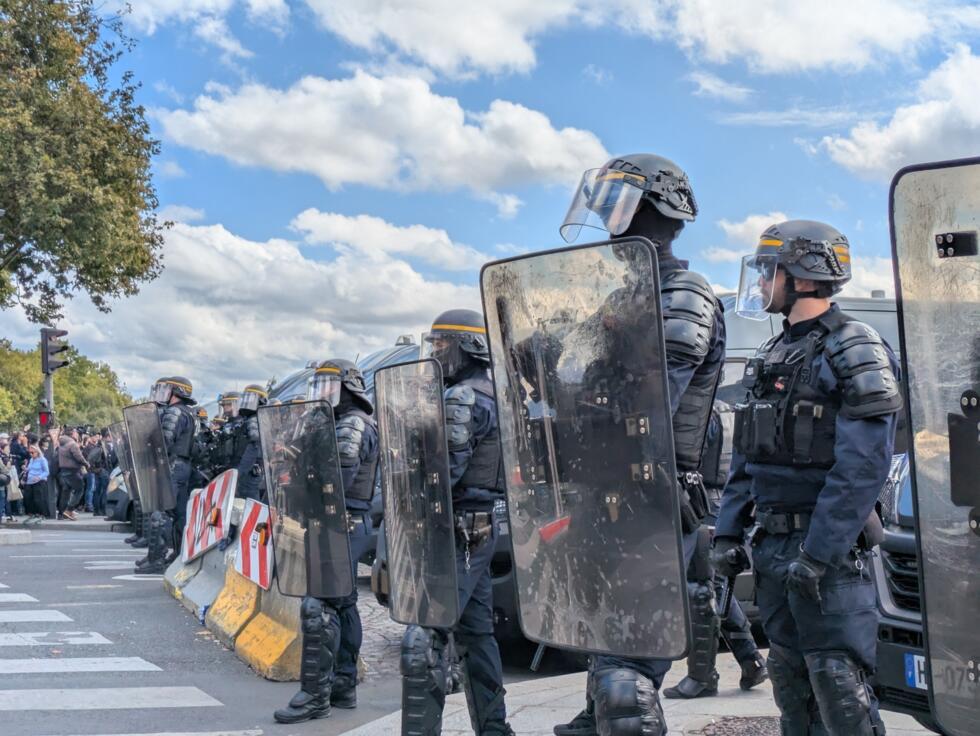
Riot police block off a bridge near Place du Châtelet on September 10, 2025. © Paul Millar, FRANCE 24
The chasm between the desperate blockades launched by hastily assembled groups and the more structured leftist protests reflects an uneasy tension within the “Block Everything” movement. Taking direct inspiration from the massive spontaneous Gilets Jaunes protests that rocked Macron’s first term in office, the grassroots movement has championed a leaderless expression of general protest, keeping its distance from traditional parties and social organisations.
Despite this, and perhaps unsurprisingly for a movement born out of frustration with cuts to social services and proposed austerity measures that fall heaviest on working- and middle-class French people, the movement soon gained support from the country’s left-wing parties. Jean-Luc Mélenchon’s France Unbowed was quick to voice its solidarity with the movement, and the left-wing CGT trade union federation quickly followed – though the country’s unions have also announced their own day of protest on September 18.
While some in the Telegram groups rankle at what they see as the risk that a grassroots movement may be swallowed by the familiar struggles of French politics, Marie said that the parties’ support was all too welcome.
“The interests that we’re defending are the interests of the majority,” she says. “Isn't that what political parties in France are supposed to represent? If some don't support us, that's their problem – but I think it's a bad strategy.”
The chasm between the desperate blockades launched by hastily assembled groups and the more structured leftist protests reflects an uneasy tension within the “Block Everything” movement. Taking direct inspiration from the massive spontaneous Gilets Jaunes protests that rocked Macron’s first term in office, the grassroots movement has championed a leaderless expression of general protest, keeping its distance from traditional parties and social organisations.
Despite this, and perhaps unsurprisingly for a movement born out of frustration with cuts to social services and proposed austerity measures that fall heaviest on working- and middle-class French people, the movement soon gained support from the country’s left-wing parties. Jean-Luc Mélenchon’s France Unbowed was quick to voice its solidarity with the movement, and the left-wing CGT trade union federation quickly followed – though the country’s unions have also announced their own day of protest on September 18.
While some in the Telegram groups rankle at what they see as the risk that a grassroots movement may be swallowed by the familiar struggles of French politics, Marie said that the parties’ support was all too welcome.
“The interests that we’re defending are the interests of the majority,” she says. “Isn't that what political parties in France are supposed to represent? If some don't support us, that's their problem – but I think it's a bad strategy.”

Rendez-vous Gare du Nord
Bolstered by reports of a general assembly launched by striking railway workers at the capital’s Gare du Nord, groups of demonstrators descend into the city metro to make their way to France’s largest train station. The police are waiting for them. Imposing police vans block off the station, and the roar of motorbikes heralds the arrival of a mobile brigade of riot police.
As the protesters jeer, the armoured police form ranks and charge, driving the protesters back. Dozens of two-man teams of mounted police follow on their motorbikes, forming a wall of muscle and metal scattering all in its path. As they turn the corner, one bike skids and goes down, bringing its riders with it.
As the officers scramble to their feet, batons in hand, a scattered shower of gravel bounces off their body armour. Immediately, the police fire a barrage of tear gas grenades, putting the crowd to flight. Defiant to the last, a protester tips a recycling bin onto the street as he sprints past, blocking a lane of traffic. As the gas seethes down the street, a flash ball erupts, and the first fat rain drops begin to fall.
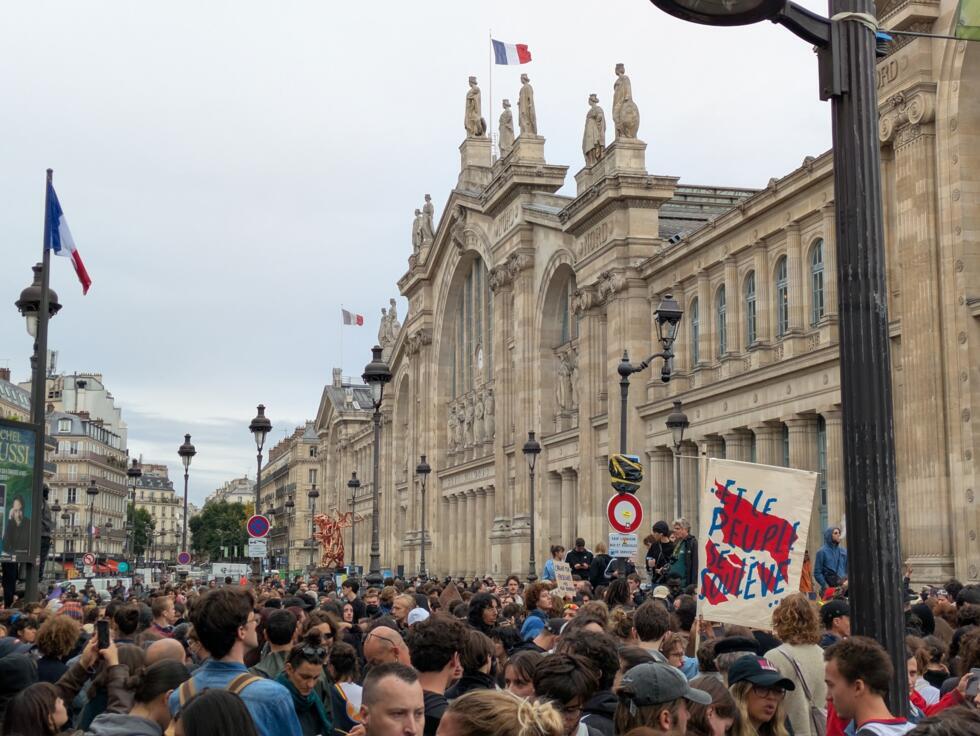
A demonstration takes place outside Paris's Gare du Nord station on September 10, 2025. © Paul Millar, FRANCE 24
In photos: Block Everything demonstrators protest in Marseille
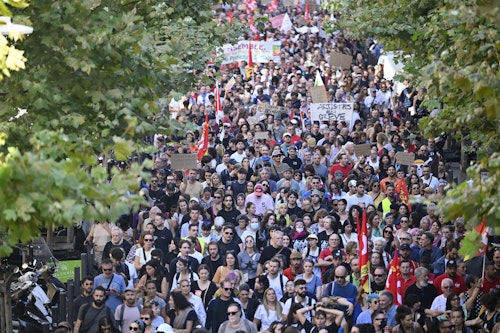
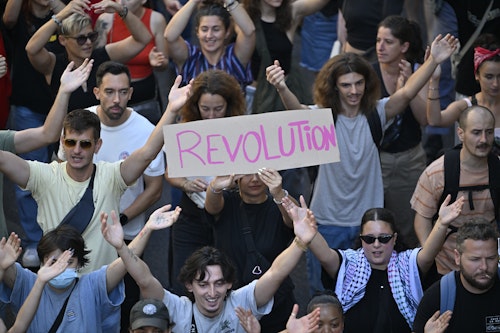
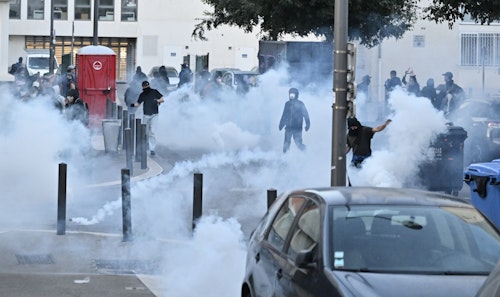
(Philippe Magoni, AP)
Her voice still thick from the gas, Sarah – a civil servant worried about further cuts to France’s public sector – scrubs at her eyes and says she is not surprised by the force of the police’s response.
“It’s not surprising, but we still find it pretty excessive,” she says. “The number of cops – here, we were a bit even, but we were in the south of Paris a little while ago and there were really three cops for every protester. It was a bit absurd. So yeah, we find it violent, excessive and frankly dangerous – it puts everyone in danger, it gets people riled up. I think there’s a lot of violence in these kinds of protests that is really a response to heavy police repression.”
With the sun high in the sky, demonstrators across the city converge on the Place du Châtelet, a tree-lined public square on the banks of the Seine. Here, the mood is festive – the unions are out in force, red flags ripple overhead and chants that have become a fixture of French demonstrations since the Yellow Vest protests thunder out across the river. Lecornu’s name is on everyone’s lips – they’ve wasted little time in working it into the lyrics.
Soon, the crowd stretches out deep into the streets surrounding the square, growing every minute as processions arrive from Gare du Nord, Place de la République and beyond. The Telegram groups minutely track police movements – they’ve blocked off the Les Halles shopping complex to stop spontaneous acts of anti-capitalist sentiment. Closer to the crowd, a wall of police vans blocks the bridge across the Seine. Ranks of police officers stand before it, their batons drawn.
Police clash with protesters in Nantes
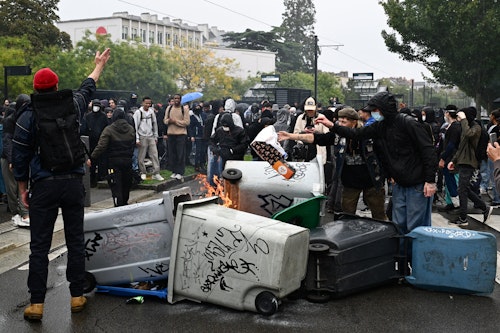
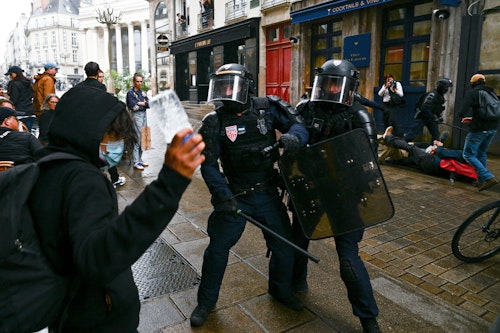
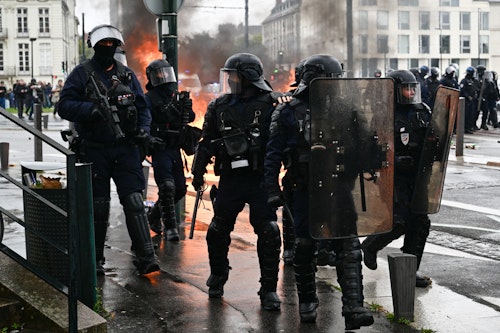
(Sebastien Salom-Gomis, AFP)
(Sebastien Salom-Gomis, AFP)
The police presence has done little to weaken the protesters’ resolve.
Anaïs, a medical student who came to protest what she describes as the underfunded state of French hospitals, says that she would continue to take part in joint actions against Macron’s policies.
“I want this mobilisation and this strength to make the government listen to us,” she says. “Even if that hasn't always been the case in the past. I think it's important for us as well as citizens – we need to mobilise and continue to fight. If we start to give up and say that it's pointless, unfortunately things will never change, and that's why we're here.”
She says attempting to shut down the country for a day was the only effective way to give voice to the widespread frustration with successive governments that changed names and faces but not policies.
“I think it's important for me to protest, to say that we're not happy, and unfortunately ... if we don't stop the system from working just a little bit, our voices just aren’t heard.”

No comments:
Post a Comment