Freighter Hits Explosive Device off Odesa
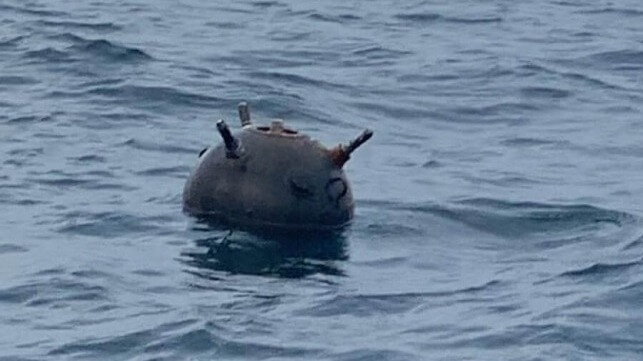
A small freighter encountered an explosive device and suffered a blast in waters off the coast of Odesa, according to Ukrainian media.
Ukraine's Black Sea shipping corridor is known for the risk of drifting explosive devices and occasional Russian attacks. Sea mines linked to the Ukraine conflict have been found as far away as Georgia, on the other side of the Black Sea. The navies of Romania, Bulgaria and Turkey have removed countless mines from the water, but despite countermeasures, chance encounters still happen.
In this case, the Belize-flagged freighter NS Pride was operating off Chornomorsk - just south of Odesa's harbor - when it struck an unidentified floating explosive device. The vessel was in ballast at the time of the casualty, and there were no injuries reported.
"The ship sustained minor damage and is currently being inspected. It is likely to continue its journey under its own power," Ukrainian Navy spokesman Dmitry Pletenchuck told local outlet Dumskaya. "Unfortunately, due to the actions of the Russian invaders, a large number of explosive objects remain at sea. And in a constantly moving maritime environment, it is, of course, impossible to predict such incidents with 100% certainty."
Ukrainian outlet Militarnyi reports that it is possible that the object was the remains of a Russian-Iranian Shahed drone that had been shot down by Ukrainian forces. The other strong possibility is a drifting sea mine.
NS Pride is an Albanian-owned, Belize-flagged coastal freighter of about 3,400 dwt. Built in 1988 and approaching her 40th year in service, the vessel has changed names eight times since 2001 and has a questionable inspection record. Her typical trading pattern alternates between Greece, Sicily and Tunisia; on this voyage, she departed from that pattern and made multiple stops in Turkey before heading further north to Odesa, hugging the coast to stay closer to Bulgaria and Romania, AIS data provided by Pole Star shows.
Ukrainian Drones Hit Harbor Tug and Two Helicopters in Crimea
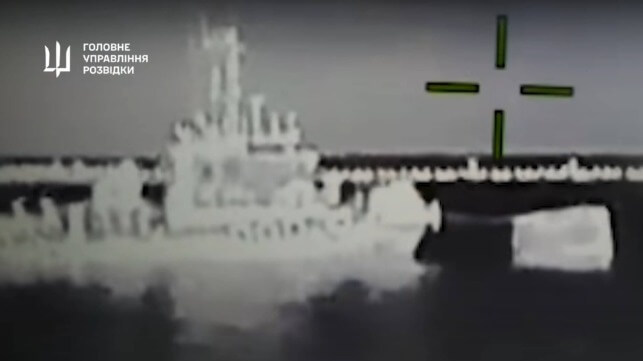
The Defense Intelligence of Ukraine (GUR) has attacked a Russian tug and two helicopters in Crimea, which has been occupied by Russia since 2014 and is a frequent target of Ukrainian strikes.
On August 30, GUR first-person view drones hit the Russian airbase in Gvardiyske, not far from Simferopol, damaging two Mi-8 transport helicopters. Each is valued at about $20-30 million, GUR said.
An FPV drone attack also hit a Russian tug in Sevastopol's bay, illustrating why the Black Sea Fleet has evacuated its more valuable warships to the relative safety of Novorossiysk, far to the east. The tug was likely the assist tug BUK-2190, a RAL RAscal-2000 design licensed and built at Pella Shipyard in Leningrad in 2018.
GUR said that the drone strike on the tug was carried out by military divers, "for whose training significant financial and time resources are spent."
Diver-enabled attacks are widely suspected in a series of attacks on tankers linked to Russia since the start of the year; Ukrainian divers (whether employed by Kyiv or acting on their own) are also suspected of conducting the 2022 attack on the Nord Stream pipeline complex.
Vessel Reports Explosion in the Water off Saudi Red Sea Coast
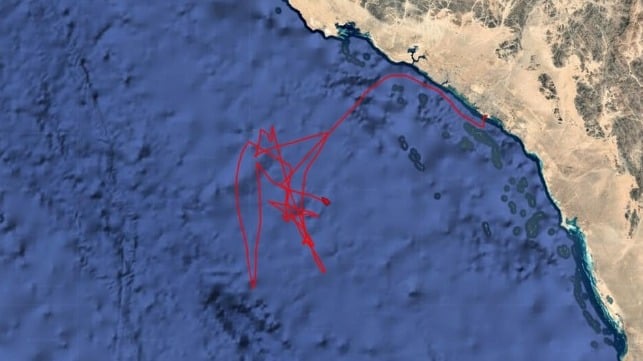
A merchant vessel may have narrowly avoided an attack off the Red Sea coast of Saudi Arabia, an area that has previously had comparatively few security issues for passing traffic. The reported incident follows just days after an Israeli strike eliminated top Houthi leaders.
At about 1730 hours UTC on Sunday, the master of an unnamed vessel informed UKMTO that they had seen a splash in the water near the ship, followed by a loud bang. The crew is safe, and no damage was reported. The vessel remains under way. Investigations are in process and UKMTO has asked for passing traffic to report any suspicious activity.
A Houthi spokesman later identified the vessel in question as the tanker Scarlet Ray, and said that it had been "hit" by a ballistic missile - contrary to the ship's own reports. AIS data suggests that Scarlet Ray had been loitering off Yanbu, and that her GPS signal was disrupted by spoofing in the weeks prior to the incident; the signal has not been received since midday Sunday.
The area of the incident is more than 600 nautical miles north of the highest-risk Red Sea region, the waters just off Houthi-controlled parts of western Yemen. Waters off Yanbu are within the Saudi exclusive economic zone, and rarely see disturbances of the kind that plagued the Strait of Bab el-Mandeb and Gulf of Aden last year.
Observers have been quick to note that the claimed attack followed three days after a major Israeli airstrike on Houthi leaders. The Israeli attack killed the group's prime minister, Ahmed al-Rahawi, and several associates, Houthi official Mohammed al-Bukhaiti told the New York Times. Others believed dead include foreign minister Jamal Amer and information minister Hashem Sharaf el-Din. The Houthis have vowed to take revenge: the group's militia council chief Mahdi al-Mashat said Sunday that "our vengeance does not sleep, and dark days await you."
Multiple analysts have assessed that the strikes on the Houthis' political leadership - including moderates - are likely to drive the group to take more kinetic action, potentially including more actions against shipping. For more than a month, the group has focused its aim on striking Israeli territory rather than disrupting merchant traffic; after Houthi forces hit and then sank the Greek bulker Eternity C, no further reported attacks followed off the coast of Yemen for about six weeks.

No comments:
Post a Comment