Ukrainian Drones Set Russian Oil Tanker Ablaze in Black Sea Port
- Ukrainian drones struck Russia’s Tuapse oil port on November 2, igniting a tanker fire and disabling several loading facilities.
- The attack coincided with intense battles in Pokrovsk, where Ukrainian forces are resisting heavy Russian assaults.
- President Zelenskyy confirmed new German Patriot air defense systems had arrived as Russia escalated missile and drone attacks across Ukraine.
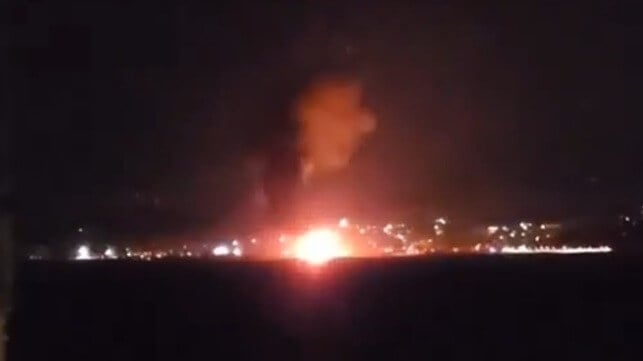
A Ukrainian drone attack hit Russia's Black Sea port of Tuapse on November 2, setting an oil tanker ablaze and damaging port infrastructure, in the latest of a series of strikes on Moscow's crucial oil sector. A source in Ukraine's Security Service (SBU) told RFE/RL's Ukrainian Service it had fired dozens of drones at the facility, which has been targeted in multiple attacks this year.
"Five drone hits were recorded. As a result of the attacks, a tanker caught fire and at least four oil tanker [loaders]...were disabled. Port buildings were also damaged," the source said.
"The security service continues to strike at Russian oil refining infrastructure, which gives the enemy resources for aggression against Ukraine," the source added.
Russian officials said that "fragments of [drones] fell on an oil tanker, damaging the deck superstructure. A fire broke out on the vessel. The crew were evacuated."
The attack came as Ukrainian military authorities insisted their forces were holding out in the front-line eastern town of Pokrovsk, and while Russian forces launched missile and drone attacks at various locations overnight from November 1-2.
Zelenskyy: New Patriots Have Arrived
The Ukrainian general staff reported on November 2 that Russia had launched Iskander-M ballistic missiles and 79 strike drones overnight.
A Russian drone strike on Odesa killed two people. Another person was injured, according to the head of the regional military administration, Oleh Kiper, who said "civilian infrastructure" was damaged.
Ukrainian authorities also reported five people were killed in Russian shelling in the eastern Donetsk region, resulting in power being cut off to tens of thousands of people.
In a social media post on November 2, Ukrainian President Volodymyr Zelenskyy said Germany had provided additional Patriot air defense systems.
He did not specify when this happened or how many systems or missiles were provided. Ukraine has been seeking to upgrade its air defense capabilities as Russia has intensified its aerial assaults in recent months.
Related: Chinese Solid-State Battery Breakthrough Powers 800-Mile Range
"We have strengthened the Patriot component of our Ukrainian air defense. I thank Germany and personally Chancellor Friedrich Merz for this joint step of ours to protect lives from Russian terror," Zelenskyy wrote.
"We have been preparing this strengthening of air defense for some time, and now the agreements reached have been implemented," he added.
On the front lines, Ukrainian military authorities reported ongoing fighting at numerous locations on November 2. But much of the focus remains on Pokrovsk, where Ukrainian forces reportedly face some 170,000 Russian troops.
The Battle For Pokrovsk
Analysts warn that the fall of Pokrovsk, which had a prewar population of around 70,000, could open a route west into Dnipropetrovsk for Russian forces, putting Ukraine’s southern regions at risk.
“We are holding Pokrovsk," Ukraine’s commander-in-chief, General Oleksandr Syrskiy, wrote on Facebook on November 1.
"A comprehensive operation to destroy and dislodge enemy forces from Pokrovsk is ongoing," he added a day after Ukrainian President Volodymyr Zelenskyy called the fight for the mostly destroyed city “our priority.”
As the fighting raged, Kremlin spokesman Dmitry Peskov said a meeting between the Russian and US presidents was "not necessary at the moment."
The comments, released by the TASS news agency on November 2, were the latest indication that Moscow is determined to press ahead with its nearly 4-year-old full-scale invasion -- despite US-led peace efforts.
"What is needed right now is very meticulous work to address the specific details of the problem," Peskov said, without elaborating.
Following Western media reports, Kyiv confirmed that special forces had been deployed to Pokrovsk, as Russian forces claimed to have encircled Ukrainian defenders there.
Russia’s Defense Ministry also claimed that its forces had killed all 11 members of a Ukrainian special forces team that had landed in the city from a helicopter.
The situation on the ground remains unclear and cannot be independently verified.
By RFE/RL
Satellite Imaging Confirms Oil Spill at Port of Tuapse
Satellite imaging of the loading terminal at Tuapse, Russia confirms that oil was spilled after the Ukrainian attack last weekend. The strike was a rare example of a Ukrainian attempt to target foreign-flag merchant tankers; historically it has limited its efforts to Russian-flagged vessels and shoreside infrastructure.
The Telegram channel Dosye Shpiona ("Spy Dossier") - often cited by Russian military analysts - claimed that the prolonged, large-scale attack was carried out with 12 long-range Ukrainian UAVs. Three foreign-flag tankers caught fire: the Greek-owned Aframax Pollux and product tanker Coast Buster; and the Turkish-owned product tanker Chai. The channel also reported damage to a Russian coastal product tanker, the Saturn, and the destruction of a small vessel, the Nord. Equipment at the terminal was damaged, including a transport pipeline. The extent of this damage assessment suggests that at least half of the Ukrainian drones found their targets, despite Russian air defense activity.
Images taken by Planet Labs on Monday and shared by TankerTrackers.com show black oil drifting from the berths where the tankers Chai and Coast Buster were moored at the time of the strike. Containment booms (orange hard booms) were also visible. No oil can be seen on the surface in the inner harbor, where the tanker Pollux is berthed. Notably, all three ships remained in place as of the morning of November 3.
Unverified videos have appeared on Ukrainian and Russian social media that purport to contain VHF audio from the crews of the vessels at the time of the attack. The videos (while unconfirmed) suggest that the crew of the Chai was on its own for firefighting resources in the immediate aftermath to spray foam on the blaze; despite a request for aid, the harbormaster responded that extra firefighters could not be dispatched until after the ongoing drone attack was over.
In an extended-length version of the audio file, there also appears to have been an early discussion of whether to sortie the still-burning vessels out of the port; and, later, whether one of the tanker crews would have to abandon ship onto a tug.
Video: Ukrainian Drones Hit Russian-Occupied Jackup Rig off Crimea
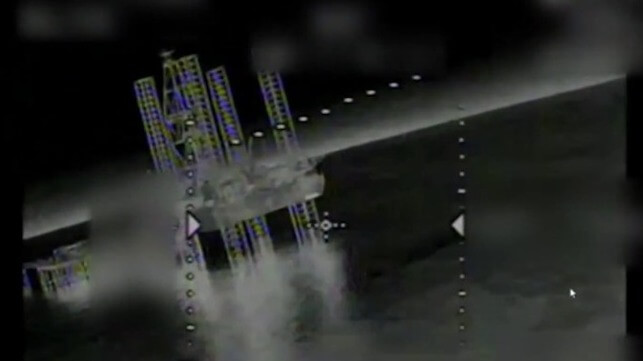
Ukraine's navy has conducted an air and surface drone strike on a Russian oil platform complex in the Black Sea, which has reportedly been in use as a surveillance base by Russian special forces.
Videos provided by the service appear to show at least one and possibly two drone hits on the jackup legs of a platform, along with two boat-launched aerial drone strikes on the platform topsides. The imagery shows that the platform's garrison mounted a vigorous defense with small arms.
The jackup rig, known as the Sivash, is one of two units known in Ukraine as the Boyko Towers - an unflattering reference to former minister of energy Yuriy Boyko, who was in charge at the time they were purchased by Chornomornaftogaz in 2011. The state energy company transferred funds for the rigs through an intermediary and paid out $400 million more than the two units would have cost if ordered directly from rig builder Keppel, raising questions about possible embezzlement.
The two rigs were captured by Russian forces in 2014 during the invasion of Crimea, and they were towed to new locations off the peninsula's coast. Under Russian management, the jackups - and two fixed platforms - were fitted out with radars and staffed by monitoring teams to spot Ukraine's movements, contributing to Russian maritime domain awareness in the opening months of the 2022 full-scale invasion.
Ukrainian special forces units regained control of the platforms in 2023, but they remained under continued threat. Russian forces were able to re-emplace radars and special forces teams on the sites, and last month, Radio Free Europe reported that the platforms were occupied by the Russian maritime security contractor "Espanyola." Ukraine resumed attacking the platforms with airborne drones in May 2025, and announced another complex strike on Monday.
"The Naval Forces of the Armed Forces of Ukraine struck an elite special forces unit of the enemy, which was located on the drilling rig 'Sivash.' In addition to the technical means of reconnaissance and surveillance of the Russian occupiers, the enemy ATGM crew was destroyed," Ukraine's navy said in a statement.
Kyiv Links Ukrainian Attacks on Russia To
Surge in Western Oil Earnings

Ukraine’s defence agencies are claiming that their campaign of strikes on Russian oil infrastructure, combined with Western sanctions, are indirectly benefiting major Western oil companies. According to The Kyiv Independent, Ukraine’s military and energy officials attribute rising refining margins at ExxonMobil, Chevron, Shell, and TotalEnergies to disruptions in Russian oil-product exports and constrained global fuel supply.
According to Ukrainian officials, nearly 160 successful strikes have been carried out this year against refineries, terminals, and storage depots, cutting Russian refining capacity by roughly one-fifth. Kyiv’s estimates, drawn from internal defence briefings and trade-tracking data from Kpler, suggest that Russia’s refined-product exports have fallen by about 500,000 barrels per day since July. The government argues that this shortfall coincides with a 61% surge in refining profits among Western oil majors during the third quarter.
The claim comes as Ukraine expands its drone operations into the Black Sea, where an oil tanker at a Russian export port was recently set ablaze. The incident marked one of the most significant maritime strikes of the year, targeting fuel logistics vital to Russia’s southern export routes.
Western financial filings show that downstream and trading divisions posted strong quarterly results, but the companies have not connected those gains to Ukrainian actions. U.S. and EU sanctions on Russian producers have already constrained flows of crude and refined products to global markets, tightening margins even before the latest attacks.
Kyiv’s framing positions its strike campaign as both a military and economic tool designed to degrade Russia’s energy leverage. No independent verification of the claims has been published, and none of the companies named have commented publicly on the reported link between Ukrainian operations and their financial performance.
By Charles Kennedy for Oilprice.com

No comments:
Post a Comment