In Texas, North Carolina, Alabama, Tennessee, Florida, and beyond, grassroots resistance to ICE is growing.
By Sonali Kolhatkar ,
December 29, 2025
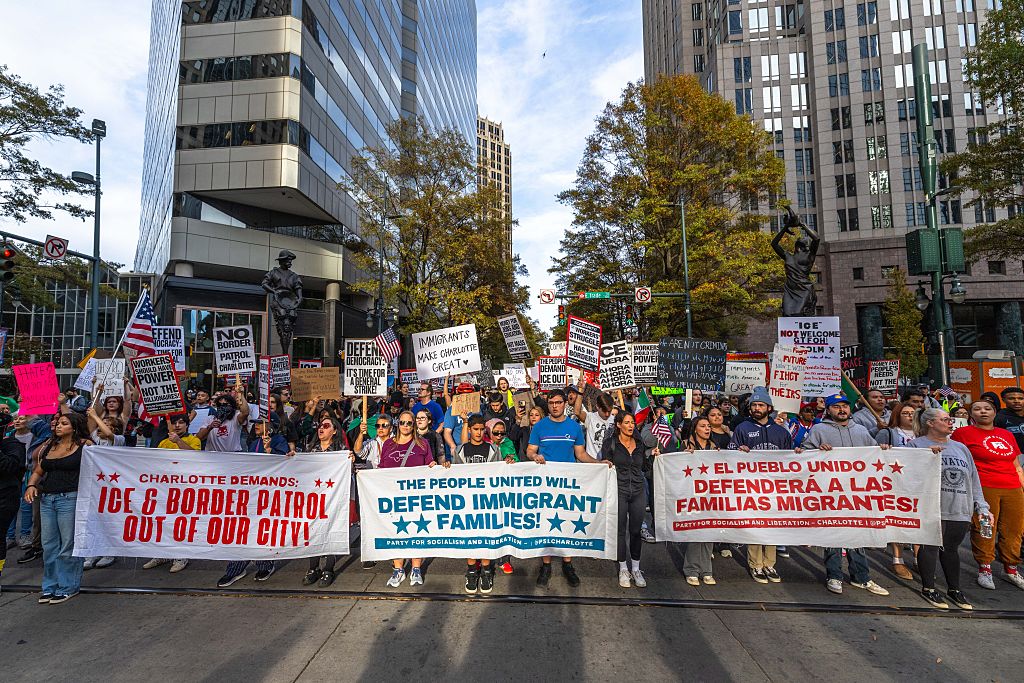
Protesters march through uptown after gathering at First Ward Park for the "No Border Patrol In Charlotte" rally on November 15, 2025, in Charlotte, North Carolina.Grant Baldwin / Getty Images
Grassroots organizations around the United States, with little to no support from local authorities, have spent much of the past year defending themselves against President Donald Trump’s deployments of Immigration and Customs Enforcement (ICE) agents and the National Guard. While community defense efforts in large urban metropolises such as Los Angeles, New York City, Chicago, and Portland have attracted the most media coverage, anti-ICE activity is also thriving in Republican-controlled states like Texas and North Carolina.
Many grassroots groups in conservative-leaning states are documenting their own work on Instagram, using social media accounts as hubs to update local communities on ICE activity, recruit volunteers, and announce trainings. They may face a more challenging terrain than those organizing in Democratic-controlled states, given the active collaboration of law enforcement agencies with ICE.
While red state anti-ICE organizing may be less likely to feature whistles, bullhorns, and other confrontational tactics seen in cities like Chicago and Los Angeles, common themes are emerging, consistent with organizing in liberal cities. The anti-ICE playbook in red states involves creating a hotline for residents to report ICE activity, “Know Your Rights” sessions that give people legal advice on what information they should withhold when confronted by ICE, and ICE-watch trainings for observers documenting arrests. Many groups are also ensuring that the families of those arrested and detained have legal and financial support.
The anti-ICE playbook in red states involves creating a hotline for residents to report ICE activity, “Know Your Rights” sessions, and ICE-watch trainings.
This non-comprehensive roundup of anti-ICE activities is an indication of how widespread resistance to fascism became in 2025.
North Carolina
In North Carolina cities such as Raleigh and Charlotte, a grassroots organization called Siembra NC is leading efforts to protect community members from ICE. Siembra NC was founded in 2017 in direct response to the first Trump administration and offers a hotline for residents reporting ICE arrests, as well as abusive employers and landlords. If ICE agents attempt to enter people’s home or car, Siembra NC advises locking the door and starting a livestream on social media to document the interaction.
In an Instagram post in mid-November, Siembra NC also documented its members showing up outside grocery stores in Charlotte when ICE agents arrested shoppers. Volunteers who were trained as part of Siembra NC’s “Safe to Work, Safe to School” patrols ensured that those being arrested were informed of their right to remain silent and knew not to sign any documents.

Jail Support for Immigrants Held in Missouri Offers Resistance in a Red State
Local communities resist ICE by reaching inside jails and building networks of support.
By Brian Dolinar , Truthout/TheAppeal December 6, 2025
Grassroots organizations around the United States, with little to no support from local authorities, have spent much of the past year defending themselves against President Donald Trump’s deployments of Immigration and Customs Enforcement (ICE) agents and the National Guard. While community defense efforts in large urban metropolises such as Los Angeles, New York City, Chicago, and Portland have attracted the most media coverage, anti-ICE activity is also thriving in Republican-controlled states like Texas and North Carolina.
Many grassroots groups in conservative-leaning states are documenting their own work on Instagram, using social media accounts as hubs to update local communities on ICE activity, recruit volunteers, and announce trainings. They may face a more challenging terrain than those organizing in Democratic-controlled states, given the active collaboration of law enforcement agencies with ICE.
While red state anti-ICE organizing may be less likely to feature whistles, bullhorns, and other confrontational tactics seen in cities like Chicago and Los Angeles, common themes are emerging, consistent with organizing in liberal cities. The anti-ICE playbook in red states involves creating a hotline for residents to report ICE activity, “Know Your Rights” sessions that give people legal advice on what information they should withhold when confronted by ICE, and ICE-watch trainings for observers documenting arrests. Many groups are also ensuring that the families of those arrested and detained have legal and financial support.
The anti-ICE playbook in red states involves creating a hotline for residents to report ICE activity, “Know Your Rights” sessions, and ICE-watch trainings.
This non-comprehensive roundup of anti-ICE activities is an indication of how widespread resistance to fascism became in 2025.
North Carolina
In North Carolina cities such as Raleigh and Charlotte, a grassroots organization called Siembra NC is leading efforts to protect community members from ICE. Siembra NC was founded in 2017 in direct response to the first Trump administration and offers a hotline for residents reporting ICE arrests, as well as abusive employers and landlords. If ICE agents attempt to enter people’s home or car, Siembra NC advises locking the door and starting a livestream on social media to document the interaction.
In an Instagram post in mid-November, Siembra NC also documented its members showing up outside grocery stores in Charlotte when ICE agents arrested shoppers. Volunteers who were trained as part of Siembra NC’s “Safe to Work, Safe to School” patrols ensured that those being arrested were informed of their right to remain silent and knew not to sign any documents.
Jail Support for Immigrants Held in Missouri Offers Resistance in a Red State
Local communities resist ICE by reaching inside jails and building networks of support.
By Brian Dolinar , Truthout/TheAppeal December 6, 2025
In a piece for Teen Vogue, Siembra NC’s co-executive director Nikki Marín Baena explained how her organization began training people in the parking lots of immigrant neighborhoods on how to identify ICE agents. “After a volunteer confirmed an officer’s identity, they would alert neighbors to the agent’s presence, and our dispatch team would send a text message to our contacts in the area,” she wrote. Siembra NC’s efforts are effective. According to Baena, “in every case we worked on, when the agents realized they were being watched, they abandoned their stakeout.”
Having learned how to respond to anti-immigrant attacks in Trump’s first term, Siembra NC has published a downloadable playbook as part of its “Defend and Recruit” campaign, and on July 23, held a virtual event specifically designed for organizers in red states engaged in ICE-watch activities.
Pennsylvania
The People’s Defense Front (PDF) in Northern Appalachia, which is located in central Pennsylvania, offers community defense trainings against “police violence, landlord cruelty, white supremacists and abusive bigots.” Its Instagram account documents the August 19 arrests of 26 workers by ICE agents and state troopers. Labeling the effort as “Know Your Enemy,” PDF published photos of those armed agents and asked community members for help in identifying them.
PDF offers a Centre County Rapid Response Network hotline for community members to report ICE activity, and recruits volunteers to sign up for and get trained in conducting anti-ICE patrols. “We patrol every morning and night,” said the group in an online post, and “maintain close contact with workers and the community.”
PDF is also collaborating with the Student Committee for Defense and Solidarity (SCDS) in State College where Penn State’s campus is located, and where ICE activity was documented in July 2025. SCDS explained in a post that, “In confronting ICE through our patrols, we raise the cost of ICE’s violence with the aim to undercut their power and deter their presence in the area.”
Texas
In Dallas and Fort Worth, Vecinos Unidos DFW is holding “Know Your Rights” and ICE-watch trainings, and organizing people by neighborhoods. “People who know both how to defend their rights and how immigration agents are operating nearby are less likely to be separated from their families,” said the group on Instagram. Like many other organizations, they have a community defense hotline that people can call to report ICE activity.
Vecinos Unidos DFW also began a court watch program after immigrants were arrested when they showed up to their court dates. The grassroots organization is calling on local residents to be present at immigration hearings. “With ICE activity picking up in our area,” said Vecinos Unidos DFW on Instagram, “it’s crucial to stay vigilant and learn our rights to protect ourselves and our neighbors.” The group is also organizing people to prevent Dallas police from cooperating with ICE agents, and raising funds as mutual aid for immigrant families who have been separated by detention and deportation.
Alabama
The Alabama Coalition for Immigrant Justice, along with other organizations local to Birmingham, has set up an ICE-watch program called Bham Migra Watch, alerting local communities of the locations, times, and dates of ICE arrests.
In September 2025, after dozens of people were arrested in Russellville, Franklin County, on their way to work, the group urged people to call their hotline with any information or requests for legal and other help.
Bham Migra Watch also informs residents of their rights if they are approached by ICE agents, and recruits volunteers to sign up for trainings for “all Birmingham friends interested in fighting against ICE aggression,” and for those located in Montgomery and Montevallo to “fight for the community around you.”
Florida
Defensa Gulf Coast is a Florida-centered effort in and around Pensacola, describing itself as a group “formed to defend our immigrant neighbors against the racist deportation machine.” Operating out of the “Pensacola Liberation Center,” Defensa Gulf Coast has participated in efforts to shut down the notorious immigrant jail known as “Alligator Alcatraz,” and, like other groups, established a hotline to report ICE sightings.
Tennessee
An effort centered in Nashville called Music City Migra Watch is encouraging local residents to carefully document ICE activity and send it to them. The group conducts ICE-watch and court-watch trainings “meant to empower our community, build safety, and support those who need it most.” It also supports trainings in surrounding localities including Springfield, Murfreesboro, and Mount Juliet. Beyond local community defense, Music City Migra Watch is leading a boycott of Avelo Airlines, a company known for collaborating with ICE to transport arrested immigrants.
“How many of us would it take to put the focus on the attacks that will touch nearly every American, not simply those terrorizing immigrants?”
Looking Toward Resistance in 2026
Given the increasing number of U.S. citizens caught in ICE’s dragnet, organizers are warning that attacks on immigrants are just the beginning. Siembra NC’s Baena issued a challenge to those who want ICE out of their communities, saying, “How many of us would it take to put the focus on the attacks that will touch nearly every American, not simply those terrorizing immigrants?”
After a year of ICE violence, groups like hers are bracing themselves for increased staffing at the federal agency and a greater armed presence on city streets. The 2025 “Know Your Rights” sessions and trainings on anti-ICE defense offer a strong foundation for local communities to ramp up activism in many forms. “We are more ready than ever if ICE accomplishes its goal of hiring 600 percent more officers,” said Baena.
And readiness means expanding activities from the streets to the halls of power. “In 2026 we are going to switch from ‘defense’ to ‘offense,’ ensuring we don’t simply watch out for ICE agents but create the conditions necessary to hold elected officials accountable for guaranteeing dignity for everyone in our state,” Baena promised.
This article is licensed under Creative Commons (CC BY-NC-ND 4.0), and you are free to share and republish under the terms of the license.

Sonali Kolhatkar
Sonali Kolhatkar is a monthly contributor to Truthout. She is an award winning multimedia journalist and author. She is the host and executive producer of Rising Up With Sonali, a nationally syndicated weekly television and radio program airing on Pacifica stations and Free Speech TV. She was most recently Senior Editor at YES! Media covering race, economy, and democracy, and is currently Senior Correspondent for the Economy for All Project at the Independent Media Institute, and a monthly columnist for OtherWords, a project of the Institute for Policy Studies. Her writings have been published in LA Times, Salon, The Nation, In These Times, Truthdig, and more. Her books include Talking About Abolition: A Police-Free World is Possible (Seven Stories, 2025), Rising Up: The Power of Narrative in Pursuing Racial Justice (City Lights, 2023), and Bleeding Afghanistan: Washington, Warlords, and the Propaganda of Silence (Seven Stories, 2006). Her first novel, Queen of Aarohi will publish in 2027 by Red Hen Press. Her website is www.SonaliKolhatkar.com.

No comments:
Post a Comment