Thursday, February 19, 2026

Sanders to Rally for Billionaire Tax in California as Crypto Industry Joins Newsom in Opposition

“While US billionaires became $1.5 trillion richer last year, the average worker in America has just $955 in retirement savings,” said Sen. Bernie Sanders. “That’s why I’ll be in LA this week fighting for a wealth tax on billionaires.”


US Sen. Bernie Sanders (I-Vt) speaks at a rally in Folsom, California on April 15, 2025.
(Photo by Paul Kuroda for The Washington Post via Getty Images)


Jake Johnson
Feb 18, 2026
COMMON DREAMS


US Sen. Bernie Sanders is set to rally in California on Wednesday with frontline healthcare workers and other supporters of a proposed ballot measure that would impose a one-time 5% tax on the wealth of the roughly 200 billionaires who reside in the Golden State.

Sanders (I-Vt.), a longtime champion of efforts to redress massive income and wealth inequality nationwide, said in a statement ahead of Wednesday’s rally that he “strongly” supports the proposed wealth tax in California, which is home to more billionaires than any other state in the US.


“While US billionaires became $1.5 trillion richer last year, the average worker in America has just $955 in retirement savings and 21% of seniors are trying to survive on less than $15,000 a year,” Sanders wrote in a social media post earlier this week. “That’s why I’ll be in LA this week fighting for a wealth tax on billionaires.”

Sanders’ appearance at Wednesday’s rally in Los Angeles, which is set to begin at 5 pm local time, comes as organizers behind the California wealth tax push are working to collect the roughly 875,000 signatures required to get the proposal on the November ballot.

“Union leaders believe the visit by Mr. Sanders will energize their campaign, which has already trained more than 1,000 volunteers and doubled the amount per signature that it is paying petition circulators,” the New York Times reported on Tuesday.

“We are very grateful for the support of US Sen. Sanders, who for years has been telling the truth about the threat that income inequality poses to our nation—and to working people.”

The Times also reported that “an opposition campaign committee with ties to the crypto industry, called Golden State Promise, officially formed on Friday” and “was expected to report this week $10 million in donations, including $5 million from Chris Larsen, a founder of the cryptocurrency company Ripple.”

The proposal has also drawn opposition from Democratic California Gov. Gavin Newsom, who has close ties to Silicon Valley elites—some of the most vocal opponents of the state wealth tax plan. (Notably, the billionaire CEO of the most valuable company in the world, Nvidia, said earlier this year that he is “perfectly fine” with the proposal as others in his class pumped millions into the effort to defeat it.)

Newsom, widely seen as a possible 2028 presidential candidate, has publicly vowed to defeat the proposed wealth tax, which is aimed at raising funds to prevent a looming healthcare crisis spurred by federal Medicaid cuts that US President Donald Trump and congressional Republicans approved last summer.

“This will be defeated—there’s no question in my mind,” Newsom said in January. “I’ll do what I have to do to protect the state.”

Proponents of the tax estimate that it would raise around $100 billion in revenue—much of which would be placed in a “Billionaire Tax Health Account” designed to help shore up the state’s healthcare system.

Mayra Castaneda, an Ultrasound Technologist at St. Francis Medical Center in Lynwood, said that “we are very grateful for the support of US Sen. Sanders, who for years has been telling the truth about the threat that income inequality poses to our nation—and to working people.”

“If we let these healthcare cuts stand, my patients will suffer. Hospitals and ERs will close, others will be strained by taking on more patients, and people will lose access to life-saving care,” said Castaneda. “This is all avoidable if billionaires just pay their fair share in California, so I’m going to do whatever is in my power to see this proposal pass in November. I’ll be telling my story alongside Sen. Sanders and urging my fellow Californians to take action to save lives.”
Lashing Out at Starmer, Trump Says ‘It May Be Necessary’ to Use UK Bases to Attack Iran

Trump lambasted Britain for an agreement transferring sovereignty of the Chagos archipelago—which includes Diego Garcia, site of a major US-UK military base—to Mauritius.


US President Donald Trump and UK Prime Minister Keir Starmer speak to reporters at Trump Turnberry Golf Courses in Turnberry, Scotland on July 28, 2025.
(Photo by Christopher Furlong/Pool/AFP via Getty Images)

Brett Wilkins
Feb 18, 2026
COMMON DREAMS

President Donald Trump on Wednesday suggested that the United States could launch attacks on Iran from British territory with or without the permission of the UK government.

Trump opened a characteristically rambling post on his Truth Social network by disparaging last year’s deal under which the UK is ceding sovereignty of the Chagos archipelago to Mauritius, with the exception of Diego Garcia, an island from which the Indigenous Chagossian people were forcibly expelled over half a century ago to make way for one of the world’s largest and most important US military bases, which is jointly operated by Britain.


Iran Vows to ‘Respond Like Never Before’ as Trump Ramps Up War Threats


“I have been telling [UK] Prime Minister Keir Starmer, of the United Kingdom, that Leases are no good when it comes to Countries, and that he is making a big mistake by entering a 100 Year Lease with whoever it is that is ‘claiming’ Right, Title, and Interest to Diego Garcia, strategically located in the Indian Ocean,” Trump wrote.


“Our relationship with the United Kingdom is a strong and powerful one, and it has been for many years, but Prime Minister Starmer is losing control of this important Island by claims of entities never known of before,” the president continued. “In our opinion, they are fictitious in nature.”

“Should Iran decide not to make a Deal, it may be necessary for the United States to use Diego Garcia, and the Airfield located in Fairford, in order to eradicate a potential attack by a highly unstable and dangerous Regime—An attack that would potentially be made on the United Kingdom, as well as other friendly Countries,” Trump added, referring to the critical US Air Force forward operating base at RAF Fairford in Gloucestershire.

Trump’s post came as an advisor to the president said there is “a 90% chance” of a US attack on Iran in the coming weeks after nuclear talks end in Switzerland. Administration rhetoric and US movements suggest that Trump may soon resume bombing of Iran following last summer’s bombing and assassination campaign targeting the country’s nuclear scientists and infrastructure.

The president’s Truth Social post concluded: “Prime Minister Starmer should not lose control, for any reason, of Diego Garcia, by entering a tenuous, at best, 100 Year Lease. This land should not be taken away from the UK and, if it is allowed to be, it will be a blight on our Great Ally. We will always be ready, willing, and able to fight for the UK, but they have to remain strong in the face of Wokeism, and other problems put before them. DO NOT GIVE AWAY DIEGO GARCIA!”

Trump’s post stood in stark contrast the State Department, which said Tuesday that the US “supports the decision of the United Kingdom to proceed with its agreement with Mauritius concerning the Chagos archipelago”.


Under the UK-Mauritius deal, Mauritius authorities will facilitate Chagossians’ eventual resettlement of their archipelago, with the apparent glaring exception of Diego Garcia. While some Chagossians welcomed the agreement, others denounced it, largely due to the exclusion of the Chagossian community from the negotiations.

Diego Garcia was once home to around 1,500 Creole-speaking Chagossians and their beloved dogs. However, in the 1960s the US convinced Britain to grant it full control there and subsequently began to “sweep” and “sanitize” the atoll of its Indigenous population, in the words of one American official.

“We must surely be very tough about this,” a British official privately wrote, adding that “there will be no Indigenous population except seagulls.”

Many Chagossians were tricked or terrorized into leaving. US Marines told them they’d be bombed if they didn’t evacuate, and Chagossians’ dogs were gassed to death with fumes from military vehicles. The islanders were permitted to take just one suitcase with them. Most were shipped to Mauritius, where they were treated as second-class citizens and where many ended up living in poverty and heartbreak in the slums of the capital, Port Louis.

Meanwhile, the US and Britain used Diego Garcia as a base for attacks on countries including Afghanistan, Pakistan, and Iraq during the so-called War on Terror, while despoiling the atoll’s water with human sewage.

Britain’s High Court of Justice twice ruled that the Chagossians’ removal was illegal. In 2019, the International Court of Justice in The Hague issued an advisory opinion that the UK was exercising “illegal” sovereignty over Diego Garcia and urged the British government to “decolonize” the atoll by handing sovereignty to Mauritius, whose government long contended it was forced to cede control in order to secure its own independence.

US to discuss base with Mauritius as UK returns islands


By AFP
February 17, 2026


The State Department said it would hold talks in the Mauritian capital Port Louis on the strategic base at Diego Garcia - Copyright DoD/AFP/File Handout

The United States said Tuesday it would hold talks with Mauritius on retaining its military presence on an Indian Ocean archipelago being returned by Britain in a deal earlier denounced by President Donald Trump.

The State Department said it would hold three days of talks next week in the Mauritian capital Port Louis on the strategic base at Diego Garcia.

The talks will discuss “effective implementation of security arrangements for the base to ensure its long-term, secure operation,” the State Department said in a statement.

It said it also was also holding discussions with Britain.

“The United States supports the decision of the United Kingdom to proceed with its agreement with Mauritius concerning the Chagos archipelago,” it said.

Prime Minister Keir Starmer’s Labour government in May reached an agreement to return the Chagos Islands to Britain’s former colony Mauritius and to pay to lease the joint US-UK base for a century.

Britain had kept control of the Chagos Islands after Mauritius gained independence from Britain in the 1960s. Britain evicted thousands of people, who have since mounted legal challenges for compensation.

Secretary of State Marco Rubio initially welcomed the deal as “historic” but Trump later posted on social media that it was an “act of GREAT STUPIDITY” that showed why the United States should conquer Greenland from ally Denmark.

Trump later backtracked and said he accepted the deal after speaking to Starmer.

As Trump Marches US Toward Iran War, Critics Ask: Where’s the ‘Pushback’ From Dems and Media?


“It’s astonishing that we’re building up for a significant military clash, and Congress isn’t involved, no real case is being made to the public, and the average American has no clue.”


US Senate Minority Leader Chuck Schumer (D-NY), and US House Minority Leader Hakeem Jeffries (D-NY) depart a press conference on Capitol Hill in Washington, DC, on January 8, 2026.
(Photo by Saul Loeb/AFP via Getty Images)


Stephen Prager
Feb 18, 2026
COMMON DREAMS

Amid reports that President Donald Trump is pushing the US toward a “massive” war in Iran, critics have found themselves shocked by the lack of “pushback” from top Democrats and mainstream media institutions.

Barak Ravid reported for Axios on Wednesday that, with a deal between the US and Iran appearing increasingly out of sight, “the Trump administration is closer to a major war in the Middle East than most Americans realize” and “It could begin very soon.”

‘The Tankers Just Keep Coming’: US Military Movements Spike Fears of Imminent Attack on Iran

US Military Told Mideast Ally That Trump Attack on Iran is ‘Imminent’: Report

Sources told the outlet that “A US military operation in Iran would likely be a massive, weeks-long campaign that would look more like full-fledged war than last month’s pinpoint operation in Venezuela.”

“Such a war would have a dramatic influence on the entire region and major implications for the remaining three years of the Trump presidency,” Ravid wrote.

However, with Congress on recess and the media largely distracted by a whirlwind of other issues, he noted, “there is little public debate about what could be the most consequential US military intervention in the Middle East in at least a decade.”

As columnist Adam Johnson pointed out on social media, Trump’s sabre-rattling toward Iran was underway well before Congress left town.

Despite this, Johnson said, the “two most powerful Democrats in the country,” Senate Minority Leader Chuck Schumer (D-NY) and House Minority Leader Hakeem Jeffries (D-NY), “have once again not leveled a single word of substantive pushback,” as was the case when Trump conducted strikes against Iran over the summer.

He said the top Democrats have only acknowledged Trump’s threats “when asked by reporters” and have made only “process criticisms” rather than criticizing the merits of the war itself.

Last month, as Trump threatened to carry out massive strikes in retaliation for Iran’s brutalization of protesters, Schumer limited his criticism to the fact that Trump had not consulted Congress.

“It has to be debated by Congress. Something like that, the War Powers Act, the Constitution, requires a discussion in Congress. We’ve had no reach-out from the administration at this point,” he told reporters.

More recently, Jeffries—a member of Congress who is briefed on national security matters—was asked on CBS’s Face the Nation what he knew about the war plans or what he would want to know.

He did not answer that question, but vaguely lamented that Trump “has been slow to provide information... to the Gang of Eight members of Congress” and “hasn’t provided a significant amount of information to Congress in general.”

“When it comes to sanctions, perma-war, and bombings, we do not have an opposition party,” Johnson said. “We have sleepy AIPAC-funded hall monitors paid to get wedgies and vaguely object after the craters are smoking in the ground.”

New York Times columnist David French agreed: “It’s astonishing that we’re building up for a significant military clash, and Congress isn’t involved, no real case is being made to the public, and the average American has no clue. If this gets serious, it will be a shock for lots of people.”


There is little hunger in the American public for a war with Iran. A YouGov survey from early February found that 48% said they strongly or somewhat opposed military action in Iran, compared with just 28% who supported it and 24% who weren’t sure.

Trita Parsi, the executive vice president of the Quincy Institute for Responsible Statecraft, said in an interview with Democracy Now! on Wednesday that, despite the public’s broadly anti-interventionist attitudes, “their voices are more or less not being heard in the mainstream media.”

“We’re seeing exactly what we saw during the Iraq War, in which a large number of pro-intervention Iraqi voices were paraded through mainstream media in order to give the impression that not only is this something that is supported by the overwhelming majority of the Iraqi society, but also that this is the morally right thing to do,” Parsi said.

Drop Site News founder Ryan Grim said that when compared with the invasion of Iraq, which was built up over the course of more than a year through persistent propaganda to get the public on board, the Trump administration’s effort to sell a war with Iran is laughable.

“We don’t even get the respect of being lied into war anymore,” he said. “He’s just going to do it.”

Trump inches close to 'pulling the trigger' on 'full-fledged war': 'Could begin very soon'

Alexander Willis
February 18, 2026
RAW STORY


As a fleet of U.S. warships barrel toward Iran, the Trump administration appears poised to “pull the trigger” on a “full-fledged war” at any moment, and may do so sooner than “most Americans realize,” Axios reported Wednesday.

“Trump's military and rhetorical buildups make it hard for him to back down without major concessions from Iran on its nuclear program,” writes Axios’ Mike Allen in the outlet’s report Wednesday.

“It's not in Trump's nature, and his advisers don't view the deployment of all that hardware as a bluff. With Trump, anything can happen. But all signs point to him pulling the trigger if talks fail.”

The Trump administration met with Iranian officials in Geneva, Switzerland on Tuesday in the hopes of reaching a deal to avoid further escalations, but according to Vice President JD Vance, those talks stalled due to Iranian officials refusing to “acknowledge” some of President Donald Trump’s “red lines.”

Now, according to sources who spoke with Axios on the condition of anonymity, the United States could be engaged in “a major war in the Middle East,” and “very soon,” Axios reported.

Both the USS Gerald Ford and the USS Abraham Lincoln – two massive aircraft carriers that each carry dozens of aircraft and crews of up to 5,690 – are currently near Iran, BBC Verify and AntiWar.com have reported.

With the aircraft carriers are dozens of warships and hundreds of fighter jets. And, according to Axios, more than 150 military cargo flights have “moved weapons systems and ammunition” to the region. Within the past 24 hours as of Wednesday morning, the Trump administration has also moved 50 additional fighter jets to the region.


Trump's conspiratorial 2011 Iran warning resurfaces as war reports swirl

Robert Davis
February 18, 2026
 RAW STORY


U.S. President Donald Trump walks to deliver an address to the nation at the White House in Washington, D.C., U.S. June 21, 2025, following U.S. strikes on Iran's nuclear facilities. REUTERS/Carlos Barria/Pool

One of President Donald Trump's old warnings about Iran resurfaced on Wednesday as reports indicate that he is pondering war with the country

In 2011, Trump claimed that then-President Barack Obama would strike Iran to ensure he was elected for a second term. The post at the time was quite controversial, as the former president was facing a stiff re-election campaign while the country was still recovering from the Great Recession.

That post was retweeted on Wednesday, at a time when Axios reported that Trump had deployed more than 150 cargo flights to move weapons and ammunition into the region. The U.S. military has also sent 50 fighter jets, including F-35s, F-22s, and F-16s, to the area.

Last year, the Trump administration conducted a secret strike against three of Iran's nuclear facilities. Trump claimed afterwards that the facilities were "totally destroyed," although some analysts disagreed with that claim.

People in Trump's orbit, like conservative talk show host Mark Levin, have been pushing the president to strike Iran again.

The president's son-in-law, Jared Kushner, and special envoy Steve Witkoff held negotiations with Iranian representatives on Tuesday, Axios reported. U.S. officials told the outlet that they are unconvinced that the two countries can close the "gaps" that exist between them.


Far-right influencer melts down over Trump's push to war with Iran: 'Completely betrayed!'

Nicole Charky-Chami
February 18, 2026 
RAW STORY

Far-right white nationalist and Nazi sympathizer Nick Fuentes lost it on Wednesday amid growing national concern that America is moving closer to war with Iran.

Fuentes wrote on X about what he expected to happen if a war were to break out between the U.S. and Iran under President Donald Trump.

"If Trump brings us to war in Iran you can forget about 2026 and you can forget about a ticket with Vance or Rubio in 2028. This is literally Iraq 2.0. The GOP has utterly and completely betrayed America First," he wrote.

As military movement heightens in the Arabian Sea and more American air defense are repositioned closer to the Middle East, a Trump administration adviser reportedly told Axios, “I think there is 90% chance we see kinetic action."

MAGA has been divided over the Trump administration's international focus throughout the first year of Trump's second term. Fuentes' most recent comment signifies his growing disdain over the Trump administration's pivot to international security versus the MAGA coalition's central push for "America First" policies.

Laser-etched glass can store data for millennia, Microsoft says


By AFP
February 18, 2026


Cooling vents on data centres in Virginia. Researchers hope that storing data on glass will save energy - Copyright AFP/File ANDREW CABALLERO-REYNOLDS
Frédéric Bourigault and Daniel Lawler

Thousands of years from now, what will remain of our digital era?

The ever-growing vastness of human knowledge is no longer stored in libraries, but on hard drives that struggle to last decades, let alone millennia.

However, information written into glass by lasers could allow data to be preserved for more than 10,000 years, Microsoft announced in a study on Wednesday.

Since 2019, Microsoft’s Silica project has been trying to encode data on glass plates, in a throwback to the early days of photography, when negatives were also stored on glass.

The system uses silica glass, a common material that is resistant to changes in temperature, moisture and electromagnetic interference.

These are all problems for energy-hungry data centres, which use fast-degrading hard drives and magnetic tapes that require backing up every few years.

In the journal Nature, Microsoft’s research arm said Silica was the first glass storage technology that had been demonstrated to be reliable for writing, reading and decoding data.

However, experts not involved in the project warned that this new tech still faces numerous challenges.

– How to write inside glass –

First, bits of data are turned into symbols, which correspond to three-dimensional pixels called voxels.

A high-powered laser pulse then inscribes these minuscule voxels into square glass plates that are roughly the size of a CD.

“The symbols are written layer by layer, from the bottom up, to fill the full thickness of the glass,” the study explained.

To read the data requires a special microscope that can see each layer, then decode the information using an algorithm powered by artificial intelligence.

The Microsoft researchers estimated that the glass could survive for more than 10,000 years at a blistering 290 degrees Celsius, which suggests the data could last even longer at room temperature.

However, the researchers did not look into what happened when the glass was deliberately smashed — or corroded by chemicals.

Unlike data centres, the glass does not require a climate-controlled environment, which would save energy.

Another advantage is that the glass plates cannot be hacked or otherwise altered.

The Microsoft researchers emphasised that future storage is important because the amount of data being produced by humanity is now doubling roughly every three years.

– ‘Carry the torch ‘ –

One of the glass plates holds the equivalent of “about two million printed books or 5,000 ultra-high-definition 4K films”, according to Feng Chen and Bo Wu, researchers at Shandong University in China not involved in the study.

In a separate Nature article, the pair warned there were more challenges ahead, including finding a way to write the data faster, to mass produce the plates and to ensure people can easily access and read the information.

However, they praised Silica for creating a “viable solution for preserving the records of human civilisation”.

“If implemented at scale, it could represent a milestone in the history of knowledge storage, akin to oracle bones, medieval parchment or the modern hard drive,” they said.

“One day, a single piece of glass might carry the torch of human culture and knowledge across millennia.”
LES GRANDE ENNUI
‘Close our eyes’: To escape war, Muscovites flock to high culture

THEY HAVE NOT EXPERIENCED WAR

Russians are increasingly turning to culture and art to detach - Copyright AFP HECTOR RETAMAL

 AFP
February 18, 2026
Béatrice LE BOHEC

In front of Moscow’s ornate Bolshoi Theatre, its soft yellow lights illuminating a snowstorm in the Russian capital, Valentina Ivakina had come to “escape today’s problems”.

It is a knowing reference to the war that has been raging between Russia and Ukraine for the past four years, with Muscovites increasingly turning to culture and art to detach from the reality of the conflict, unleashed by the Kremlin’s February 2022 offensive.

Concert halls are packed, the famed Tretyakov Gallery is teeming even on a midweek afternoon. A Marc Chagall exhibition at the Pushkin Museum: sold out.

Museum attendance in Moscow, which competes with Saint Petersburg as Russia’s cultural capital, jumped 30 percent in 2025, according to deputy mayor Natalya Sergunina.

Ivakina has spent much of the winter bouncing from show to show.

On a stormy evening, the 45-year-old marketing specialist was heading to a Sergei Prokofiev opera at the Bolshoi’s historic stage. The night before, at its New Stage, she was at a ballet based on an Anton Chekhov work. A week ago, the theatre.

“It’s a certain attempt to escape reality,” she said, standing on the glittering square in front of the Bolshoi as she talked about having “fewer opportunities to go somewhere and leave the country.”

Russians have become accustomed to alluding about the war in code, avoiding specific phrases or opinions that could land them years in prison under military censorship laws.

Usually a single phrase — “the context” — is enough to know the underlying topic of conversation.

The conflict, launched when Vladimir Putin ordered troops into Ukraine on February 24, 2022, has become Europe’s deadliest since World War II, killing tens of thousands of civilians and hundreds of thousands of soldiers.

Immediately hit with sanctions, Russia has been pushed off the world stage — athletes banned, artists’ shows cancelled and tourist visas harder to obtain.

At home, the state has pushed the war into daily life — promoting the army, soldiers, and masculine narratives of “patriotic values” as core Russian values.

Those who openly oppose are liable to arrest and prosecution.

– ‘Silent conspiracy’ –

“There seems to be very few things left to cling to,” said Viktor Chelin, a photographer coming out of the Chagall exhibition, titled “The Joy of Earthly Gravity”, with his wife.

Trips to the museum are “a kind of silent conspiracy,” he told AFP.

“You walk around and understand that you’re united with others by the admiration of a certain beauty.”

“Something enormous happened in Russia, which we are all afraid of. We close our eyes to it, but try to live and maintain and certain normality,” said Chelin, 30.

Wearing a cap pulled low, he talked about “the feeling, as they say, of a feast in time of plague,” a reference to the 1830s play by Alexander Pushkin, Russia’s national poet, written during a cholera epidemic.

He and his wife moved to Georgia for two years after Russia launched its offensive, before returning to Saint Petersburg.

They are now regular visitors to the grand Hermitage Museum, housed in the former palace of the Tsars.

“We’re not even going to see specific works of art, we’re grounding ourselves, as if we’re connecting to something familiar,” he said.

Sociologist Denis Volkov of the Levada Centre — designated a “foreign agent” by Russian authorities — said escapism is prevalent across Russia.

“People don’t want to follow events, they don’t want to get information about what’s happening on the battlefield,” he told AFP.

“There’s been a continuous desire to cut down the flow of bad news, to filter it out somehow, not to discuss it with relatives or friends. Perhaps that’s where this surge in interest in culture comes from.”

He added, however, that the mindset also chimes with the line being put out by the authorities — that life in Russia continues as normal, despite the war.

“Festivals, parties, concerns — it reflects the authorities’ policy that life goes on. They fight somewhere over there, and here we live our lives without worry,” Volkov said.

Outside of the Chagall exhibition in Moscow, former piano teacher Irina refutes the idea of trying to escape from the war.

In her short fur coat and bright pink lips, she said she is well aware of “everything that’s happening in the world, and where black and white lie.”

“We live with it, yes, we live with it,” she said. “We often go to all the exhibitions that nourish us and lift our spirits.”


THEY SHOULD HIDE IN THEIR ROOMS AND PUT ON THE PHONOGRAPH

Piano Sonata No. 9 "Black Mass", Op. 68 (1912-13) A late piano sonata in one movement by Russian composer and pianist Alexander Scriabin (1872-1915). A highly chromatic, dissonant work, this sonata exploits the harsh sound of the tritone interval, which has traditionally been associated with the Devil, for mystical effect.


Greece to claim Nazi atrocity photos found on Ebay: minister


By AFP
February 18, 2026


The Nazis executed 200 Greek Communists May 1, 1944 shortly after the killing of a German general and his staff - Copyright AFP Angelos TZORTZINIS

Greece will claim a World War II photo trove posted for sale online believed to show for the first time one of Nazi Germany’s worst atrocities in the country, the culture ministry said Wednesday.

Culture Minister Lina Mendoni said an “entire collection” of photographs apparently taken by a German army lieutenant serving in wartime Greece had been declared a national monument “due to its particular historical value”.

“They allow us to frame the drama of occupied Greece also through the eyes of the occupier,” she said in a statement.

“With today’s declaration of the collection as a monument, the Ministry of Culture acquires the legal basis to claim it and acquire it on behalf of the Greek state,” Mendoni said.

Greek Communist party lawmaker Giorgos Lambroulis on Wednesday said the party had so far identified four men in the photographs.

Twelve of the photographs had originally appeared on the Ebay site Crain’s Militaria on Saturday before being taken down on Monday.

The ministry says the photographs appeared to show “the last moments” of 200 Greek Communists.

They were executed on May 1, 1944 in retaliation for the killing of a German general and his staff by Communist guerrillas a few days earlier.

The execution at the Kaisariani shooting range in Athens was a seminal event of the 1941-1944 Nazi occupation of Greece, which was marked by several atrocities, mostly against Greek villagers.

Greece’s Jewish community was also decimated during this period.

The mayor of Kaisariani, Ilias Stamelos, on Wednesday called the find “astonishing”.

“These are the first documents to come to light (regarding this event),” he told state TV ERT.

Until now, the only testimony of the 200 victims’ final moments were from the handwritten notes they threw out of the trucks taking them to execution.

One of the pictures shows groups of the men marching through a field. Several others show them standing against a wall at the shooting range.

One photo appears to show the men being marched into the shooting range, after discarding their overcoats outside.

Mendoni said that ministry experts on Friday would visit the collector in Evergem, Belgium, to examine the photographs.

PRIVATIZED UTILITIES
UK manufacturers struggle under sky-high energy bills


By AFP
February 17, 2026


The UK has some of the highest energy prices in Europe - Copyright AFP Paul ELLIS
Pol-Malo Le Bris and Olivier Devos

Molten glass drops through chutes before being blown into bottles at manufacturer Encirc’s northwest England plant, where intensive operations are under strain from exorbitant energy prices weighing on Britain’s heavy industry.

“We’re paying a lot more energy costs than our European competitors,” said Oliver Harry, head of corporate affairs at Encirc, which makes over a third of the UK’s glass bottles.

Britain has some of the highest energy prices in Europe, driven by its reliance on natural gas and the costs of transitioning to renewables, which are passed on to bills.

The country’s industrial electricity prices were also the steepest in Europe in 2024, according to the latest annual government data.

Standing in the intense heat of the factory’s two huge furnaces, Harry warned: “We’re already seeing an increase in imports into the UK as customers turn to cheap, more unsustainable glass producers”, notably from China and Turkey.


– More action needed –


Across energy-intensive industries — from steel and chemicals to glass and cement — companies are warning that government support does not go far enough to keep them competitive.

The government said it will increase discounts on electricity network charges to 90 percent from April, which will save around 500 of the UK’s biggest energy users a cumulative £420 million ($570 million) per year in electricity bills.

“Lowering bills is central to every decision we make,” a government spokesperson told AFP.

But the steel sector, already weakened by the closure of traditional coal-fired blast furnaces, argues that more action is needed.

“The industry still faces industrial power prices almost 40 percent higher than in France and Germany,” Gareth Stace, director general of the steel union, UK Steel, told AFP.

The union has called for stronger protections similar to those in France, Italy, Spain and the UAE to shield heavy industry from high wholesale power costs.


– Decarbonisation –


Electricity is so expensive in the UK largely because more than a quarter of its power still comes from gas, which surged in price after Russia’s 2022 invasion of Ukraine.

While wholesale prices have since fallen, they remain elevated.

Under the liberalised electricity market, the last power station switched on to meet demand sets the price for all generators, and in the UK, that station is usually gas-powered.

“In France, nuclear sets the price fairly often and nuclear is cheaper … so it’s not always the same expensive gas that sets the price,” Sam Frankhauser, professor of economics and climate change policy at Oxford University, told AFP.

In other countries “there’s moments in the day where somebody cheaper sets the price and in the UK, those moments don’t exist” as it is almost always a natural gas plant setting the price, he added.

At Encirc’s Elton factory, where bottles clatter along the conveyor belts to be filled and labelled, executives say energy prices are inseparable from the push to decarbonise.

By the end of the decade, “we’re going to be producing glass bottles that are 80 percent reduced carbon,” said Harry.

“The UK managed to decarbonise the grid phenomenally because of the exit of coal,” said Gregor Singer, professor at the London School of Economics.

“It’s really unfortunate that this gas price shock came now, exactly at that point where you sort of exited coal but you don’t quite have enough renewables yet.”

“In the medium to long run… it’s almost guaranteed that prices are coming down,” he said.
Germany’s Merz casts doubt on European fighter jet plan


By AFP
February 18, 2026


A mock-up of the European New Generation Fighter for the Future Combat Air System (FCAS) at the Paris Air Show in 2023 - Copyright AFP/File JULIEN DE ROSA


Bryn Stole with Valerie Leroux in New Delhi

Germany does not need the same new fighter jets as France, Chancellor Friedrich Merz said Wednesday, signalling that Berlin could abandon a flagship joint defence project for Europe.

“The French need, in the next generation of fighter jets, an aircraft capable of carrying nuclear weapons and operating from an aircraft carrier,” Merz told the German podcast Machtwechsel.

“That’s not what we currently need in the German military,” he said.

The Future Combat Aircraft System (FCAS) project was launched in 2017 to replace France’s Rafale jet and the Eurofighters used by Germany and Spain, to come into service around 2040.

But the scheme, jointly developed by the three countries, has stalled in the past year as France’s Dassault Aviation gotten into disputes with Airbus Space and Defence over control of the project.

The office of French President Emmanuel Macron said in response that he “remains committed to the success” of the project.

“The military needs of the three participating states have not changed, and these needs included from the outset French [nuclear] deterrence as well as the other missions of the future aircraft,” the Elysee Palace said in a statement while Macron was travelling in India.

“Given the strategic stakes for Europe, it would be incomprehensible if industrial differences could not be overcome, especially as we must collectively demonstrate unity and performance in all areas concerning its industry, technology, and defence,” it added.

Discord over FCAS has stoked concerns that French-German ties are under strain, following recent disagreements on defence spending and on French efforts to derail an EU trade deal with the Mercosur bloc of South American countries.

Germany’s foreign minister sought Wednesday to shut down talk of worsening relations with France, telling AFP that Paris remains Berlin’s “closest partner and most important friend in Europe”.

Failure to get FCAS off the ground would also be a blow to broader efforts by European NATO allies to demonstrate tight defence cooperation in the face of threats from Russia and doubts about American security commitments.


– ‘At odds’ –


Airbus is Germany’s lead contractor for FCAS, while Spanish defence contractor Indra Sistemas is also involved with the roughly 100 billion euro ($118 billion) FCAS project.

Merz had previously promised a decision on FCAS by the end of last year but postponed making the final call.

Merz said on the podcast that France and Germany were now “at odds over the specifications and profiles” of the kind of aircraft they needed.

“The question now is: do we have the strength and the will to build two aircraft for these two different requirement profiles, or only one?” he asked.

If this issue is not resolved, he said Germany would “not be able to continue the project”, adding that there were “other countries in Europe” ready to work with Berlin.

For Germany and potentially Spain, several other options have been floated by industry sources and in media reports, most prominently a partnership with Swedish aerospace firm Saab.

The FCAS project was launched with fanfare in 2017 by Macron and Germany’s then-chancellor Angela Merkel, with Spain joining two years later.

The plan envisions not only a fighter jet but an interlinked drone swarm and a digital cloud system.

German industrial interests and some politicians have bristled at Dassault’s alleged efforts to revise FCAS agreements and take greater control of the aircraft portion of the project.

The powerful IG Metall industrial trade union, which represents many Airbus workers in Germany, has joined with German aerospace industry leaders to back a split with France.

Juergen Kerner, IG Metall’s vice president, joined German Aerospace Industries Association president Marie-Christine von Hahn last week in urging Berlin to find new partners on the fighter jet.

Building separate jets could make military sense because of France’s very particular requirements, but would almost certainly hike overall costs.

Dassault’s CEO, Eric Trappier, has insisted that his company can develop a fighter jet alone.

But the costs could put the French government’s already strained budget under further pressure.

Germany, on the other hand, has launched a massive military investment programme with vows from Merz to build Europe’s largest conventional armed forces.
After Greenland, Arctic island Svalbard wary of great powers


By AFP
February 18, 2026


People in Svalbard are going about their daily lives despite speculation the Norwegian archipelago could be the next Arctic territory coveted by Washington - Copyright AFP Oriane Laromiguière


Oriane LAROMIGUIERE, with Pierre-Henry DESHAYES in Oslo 
and Jonathan KLEIN in Stockholm

There are no outward signs of jitters, at least not yet: people in Svalbard are going about their daily lives as normal despite speculation that this Norwegian archipelago could be the next Arctic territory coveted by the United States or Russia.

“Today Greenland, tomorrow Svalbard?” — Terje Aunevik, mayor of Svalbard’s main town Longyearbyen, says he has been asked the question many times.

US President Donald Trump’s expansionist ambitions have turned the global spotlight on the Arctic, where geo-strategic and financial stakes are mounting.

“The Arctic is no longer a quiet corner on the map,” the European Union’s top diplomat Kaja Kallas told a conference in Tromso in northern Norway in early February. “It is the front line of the global power competition.”

Longyearbyen is an unusual place. A former mining community turned tourist destination and academic hotspot, it lies in the fastest-warming region on the planet.

One of the northernmost towns in the world, located halfway between continental Norway and the North Pole, Longyearbyen is home to 2,500 people.

It is plunged in darkness with no sun for four months in winter, then bathed in round-the-clock daylight in summer.

Venturing outside the town means carrying a mandatory rifle in case of encounters with polar bears.


– Strategic importance –


Some political observers have suggested that Trump’s desire to control the Arctic may extend beyond Greenland to Svalbard, or that Russia may want to match his appetite and seize the archipelago.

In addition to the riches believed to lie under its seabed, Svalbard — twice the size of Belgium — is strategically located, controlling the northern part of the so-called “Bear Gap”.

The military term refers to the maritime zone where the Barents Sea meets the Norwegian Sea. It is this zone Russia’s Northern Fleet missile-launching submarines based on the Kola Peninsula must cross to disappear into the deep waters of the Atlantic.

Svalbard’s “strategic relevance does not necessarily lie in the island itself, but in the waters around it,” Barbara Kunz, director of the European Security Programme at Stockholm peace research institute SIPRI, told AFP.

“Russia wants to protect its nuclear deterrence, and so it wants to make sure that nobody can approach its northern coast”, while the United States “would like to prevent” Russian submarines from having access to the Atlantic, she said.

Longyearbyen’s residents, who hail from around 50 countries, are staying cool-headed amid the speculation.

“Maybe we talk a bit more about what’s happening in Greenland and with Trump and everything, but at the same time I feel like we’re not more anxious than we usually are,” shop employee Charlotte Bakke-Mathiesen told AFP.

“We’re just in our own bubble.”


– Svalbard treaty –


In his office, where his mayor’s chain is displayed alongside a polar bear femur, Terje Aunevik echoed that sentiment.

“The situation is as it is, but I don’t feel it as a threat,” he said.

“I strongly believe that both our allies and our neighbours are living very well with Norway having sovereignty over this island.”

By “neighbours”, he means the 350 or so Russians and Russian-speaking Ukrainians who live in the Svalbard town of Barentsburg, around 40 kilometres (25 miles) away as the crow flies.

It is hard to believe that Barentsburg, a small mining community under Russian control for almost a century, is located on NATO territory: a Lenin bust takes centre stage in the town, where all of the signs are written in Cyrillic lettering.

A treaty signed in 1920 recognises Norway’s “full and absolute” sovereignty over Svalbard, but it also gives citizens of the almost 50 signatory powers — which include China, Russia and the US — equal rights to exploit its resources.

Since Russia’s 2014 annexation of Crimea, Norway has tried to tighten its control of Svalbard, for example by blocking the sale of land to foreigners and drastically reducing voting rights.

Moscow has argued that Oslo is not respecting the Svalbard treaty and has increased its provocations in recent years.

It held a quasi-military parade in Barentsburg celebrating Russia’s victory over Nazi Germany and erected a giant unauthorised Orthodox cross in Pyramiden, another small Russian community.


– ‘Anything can happen’ –


“The Russians have other more strategic priorities right now and have no interest in an escalation beyond the hybrid actions they’ve been conducting for a long time,” polar geopolitics researcher Mikaa Blugeon-Mered said when asked about a possible Russian takeover attempt.

“For Norway, the United States is a much bigger concern today when it comes to Svalbard, because it is more likely to carry out an operation that could destabilise the territory’s precarious balance,” he said.

“With the current Trump administration, anything can happen.”

For a long time, experts spoke of “Arctic exceptionalism”: the concept that the region had its own set of unwritten rules of cooperation, a zone of peace immune to geopolitical rivalries.

But now, said Barbara Kunz, “the era of High North, low tension is over”.
Deadly Indonesia floods force a deforestation reckoning

By AFP
February 18, 2026


Flooding and landslides made worse by deforestation killed over 1,000 people in Sumatra last year - Copyright AFP Ebrahim Hamid


Sara HUSSEIN

Permits revoked, lawsuits filed, the threat of state takeovers. Deadly flooding in Indonesia has prompted unprecedented government action against companies accused of environmental destruction that worsened the disaster.

But environmentalists who have long warned about the risks of rampant deforestation fear the current response will not solve the problem, and could even make it worse.

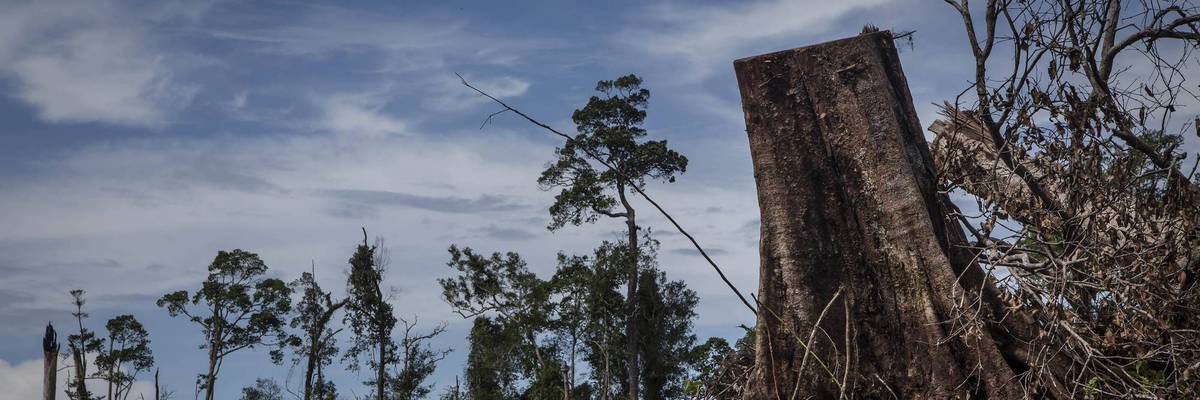
Officials from President Prabowo Subianto down have acknowledged the role of deforestation and overdevelopment in last year’s flooding and landslides, which killed over 1,000 people in Sumatra.

Mining, plantations, and fires have caused the clearance of large tracts of lush Indonesian rainforest, removing trees that absorbed rain and helped stabilise soil.

Now, Indonesia is prioritising “protecting the environment, protecting nature”, Prabowo told attendees at this year’s World Economic Forum.

Several dozen companies have had their permits revoked, and the government will reportedly hand management of around a million hectares of land to a state enterprise.

Initially, the government said that would include the Martabe gold mine, which conservationists have regularly accused of environmental damage.

More recently, officials said they were still reviewing potential violations by the site.

But there has been no suggestion of halting development in the worst-affected and most ecologically sensitive areas, like Batang Toru, where Martabe is located.


– World’s rarest great ape –


The area is home to the world’s rarest great ape, the tapanuli orangutan, just 800 of which were believed to exist in the wild before the disaster.

“Revoking permits is not immediately a win,” said Panut Hadisiswoyo, a conservationist and orangutan specialist.

“The idea of revoking should be to stop the devastation, but by continuing these operations, this means industry will continue in this vulnerable area.”

Conservationists have lobbied for a moratorium on development in Batang Toru, where tapanuli orangutans suffered first habitat loss and then the flood disaster.

Using satellite data and information on the pre-existing tapanuli orangutan population, experts have calculated nearly 60 animals may have been killed in what they called an “extinction-level event” for the species.

Between 2001 and 2024, Sumatra lost 4.4 million hectares of forest, an area larger than Switzerland, “making the hilly forest landscapes more vulnerable to landslides and flooding”, said Amanda Hurowitz, senior director at conservation group Mighty Earth.

Much of that deforestation happened in areas with government permits, and it is not clear that transferring operations to the state will improve matters.

“It’s a concern that the state-backed takeover may not guarantee better environmental practices, and that production may be prioritised over conservation,” Hurowitz told AFP.

“We have yet to see any plans.”


– ‘Blessing in disguise’ –


Indonesia’s environment and forestry ministries did not respond to AFP’s request for comment.

Other experts have warned that revoking permits and seizing operations has disrupted plans to audit and investigate companies and determine their precise responsibility for the disaster.

And so far, the government has not outlined plans for forest recovery and environmental remediation, said Timer Manurung, executive director of Indonesian environmental group Auriga Nusantara.

“It’s not only revocation but it also has to include remediation, taking responsibility for the destruction,” he told AFP.

The government’s lawsuits are seeking close to $300 million from six companies, some of which will be set aside for environmental recovery.

But much more money would be needed for real remediation, and other companies are likely to be culpable too, experts said.

And there is no sign yet that other projects linked to large-scale deforestation, including a food and energy plantation plan in South Papua, will be halted in this drive.

The one saving grace, said Timer, has been the public’s “very significant rising awareness” of deforestation in Indonesia since the disaster.

That has been “a blessing in disguise”.
OpenAI’s Altman says world ‘urgently’ needs AI regulation


By AFP
February 19, 2026


OpenAI CEO Sam Altman at the AI Impact Summit in New Delhi - Copyright AFP Ludovic MARIN

Sam Altman, head of ChatGPT maker OpenAI, told a global artificial intelligence conference on Thursday that the world “urgently” needs to regulate the fast-evolving technology.

An organisation could be set up to coordinate these efforts, similar to the International Atomic Energy Agency (IAEA), he said.

Altman is one of a host of top tech CEOs in New Delhi for the AI Impact Summit, the fourth annual global meeting on how to handle advanced computing power.

“Democratisation of AI is the best way to ensure humanity flourishes,” he said on stage, adding that “centralisation of this technology in one company or country could lead to ruin”.

“This is not to suggest that we won’t need any regulation or safeguards,” Altman said.

“We obviously do, urgently, like we have for other powerful technologies.”

Many researchers and campaigners believe stronger action is needed to combat emerging issues, ranging from job disruption to sexualised deepfakes and AI-enabled online scams.

“We expect the world may need something like the IAEA for international coordination of AI”, with the ability to “rapidly respond to changing circumstances”, Altman said.

“The next few years will test global society as this technology continues to improve at a rapid pace. We can choose to either empower people or concentrate power,” he added.

“Technology always disrupts jobs; we always find new and better things to do.”

Generative AI chatbot ChatGPT has 100 million weekly users in India, more than a third of whom are students, he said.

Earlier on Thursday, OpenAI announced with Indian IT giant Tata Consultancy Services (TCS) a plan to build data centre infrastructure in the South Asian country.


Tech chiefs address India AI summit as Gates cancels


By AFP
February 19, 2026


Frenzied demand for generative AI has fuelled anxiety over the risks to society - Copyright AFP Arun SANKAR


Katie Forster

Indian leader Narendra Modi and tech chiefs including OpenAI’s Sam Altman will speak Thursday on artificial intelligence’s opportunities and threats at a summit in New Delhi, but Microsoft founder Bill Gates cancelled just hours before his speech.

Gates, facing questions over his ties to late sex offender Jeffrey Epstein, withdrew just hours before his speech to “ensure the focus remains on the AI Summit’s key priorities,” the Gates Foundation said.

The AI Impact Summit is the fourth annual international gathering focused on the rapidly advancing field, following previous summits in Paris, Seoul and Britain’s wartime code-breaking hub Bletchley.

Frenzied demand for generative AI has turbocharged profits for many companies, while fuelling anxiety about the risks to society and the planet.

Modi will speak on stage with French President Emmanuel Macron Thursday at the huge event that has drawn tens of thousands of attendees including dozens of world leaders and ministers.

Google DeepMind head Demis Hassabis, UN Secretary General Antonio Guterres and Meta’s Alexandr Wang also on the bill.

Another Gates Foundation official will take the place of Gates, who said this month he regrets “every minute” he spent with Epstein.

The mere mention of someone’s name in the Epstein files does not in itself imply any wrongdoing by that person.

– New investments –

As the first global AI meeting held in a developing country, the five-day summit, which wraps up Friday, has also been a chance for India to boost its position in the booming sector.

The nation expects more than $200 billion in investments over the next two years, and US tech titans have unveiled new deals, investments and infrastructure for the South Asian country this week.

On Thursday, ChatGPT maker OpenAI and Indian IT giant Tata Consultancy Services (TCS) announced a plan to build hyperscale AI data centre capacity in the South Asian country.

The previous day Google said it planned to build subsea cables as part of an existing $15 billion AI infrastructure investment.

“Since my childhood growing up in Chennai, India has undergone an incredible transformation,” Google CEO Sundar Pichai said.

“India is going to have an extraordinary trajectory with AI and we want to be a partner,” he added.

US chip behemoth Nvidia — the world’s most valuable company — also said it was teaming up with Indian cloud computing providers to provide advanced processors for data centres that can train and run AI systems.

AI data centres are under construction worldwide on a massive scale, as companies race to develop super-intelligent systems.

The huge amounts of electricity needed to power them and water to cool hot servers has sparked alarm at a time when countries have pledged to decarbonise their grids to try and slow climate change.

– Gridlock –

Last year India leapt to third place in an annual global ranking of AI competitiveness calculated by Stanford researchers, although experts say it has a long way to go before it can rival the United States and China.

Brazil’s President Luiz Inacio Lula da Silva is in town to attend the AI summit and hold talks with Modi, including on rare earths.

Leaders are expected to deliver a statement at the end of the week about how they plan to handle AI technology.

One fear is disruption to the job market, especially in India where millions of people are employed in call centres and tech support services.

“We are creating human imitators. And so of course, the natural application for that type of system is replacing humans,” leading computer science researcher Stuart Russell told AFP.

Some say the broad focus of the event and vague promises made at previous global AI summits mean that concrete commitments are unlikely.

Many researchers and AI safety campaigners believe stronger action is needed to combat issues ranging from sexualised deepfakes to AI-enabled online scams and intrusive surveillance.

Siddharth Soni, the 23-year-old founder of an Indian AI-designed jewellery startup, said he could see both sides.

“We’re losing artisans. We’re losing the value of art, using AI, actually. That is one of the sad parts,” he told AFP.

'Who are they for?' Ex-Trump lawyer appalled at buildup of MAGA prison network

Matthew Chapman
February 18, 2026
 RAW STORY

U.S. Immigration and Customs Enforcement (ICE) agents stand guard outside the Whipple Building near a U.S. flag, during a protest against the fatal shooting of Renee Nicole Good by a U.S. Immigration and Customs Enforcement (ICE) agent, and a rally against increased immigration enforcement across the city, in Minneapolis, Minnesota, U.S., January 9, 2026. REUTERS/Tyrone Siu

Former Trump administration White House lawyer Ty Cobb delivered a dire warning Wednesday on MS NOW about the growing network of Immigration and Customs Enforcement detention facilities that are planned and funded — and suggested that Trump having that much detention power and resources at his disposal is horrifying.

Cobb's warning came in the middle of a discussion with anchor Ari Melber, about the possibility ICE might try to engage in election interference by stationing agents at polling places.

"What is your legal view of the limits on ICE under current law?" asked Melber, himself an attorney. "To be out in a way that might be voter intimidation in any voting period when we get to the midterms?"

"So that's an excellent question," said Cobb. "I think we're going to see the courts gradually parse through that. You know, ICE actually has no local law enforcement authority in any of the states. They're only supposed to manage the limited number of federal crimes entrusted to them, and they shouldn't be there. But it's going to take a series of court battles, I think, to prevent them from being there. And it may come down to a conflict between, you know, state National Guards and ICE absent, absent an invocation of the Insurrection Act, which I think we will see in advance of, of the election. So I think — I think people should be very, very concerned and very, very animated about what's coming."

To understand the reason for fear, Cobb continued, consider Garry Kasparov, the Russian world chess champion turned dissident of the Putin regime.

Kasparov, he said, "has been very outspoken about, you know, the gulags that are being built around the country and the fact that they're intended not only to house, you know, illegally detained immigrants, of which we have thousands now, but also likely dissidents and people of color on a going forward basis. You know, what is happening in this country."

"You don't think that's just an international parallel gone too far?" Melber pressed him. "You believe that's something that Trump would, would try to do and get away with?

"So I'll put it this way," said Cobb. "You know, Trump is deporting people on a trajectory and at a pace that's not very different from the number of deportations that happened under Obama. However, the number of illegally detained people is extraordinarily high. And he's building, you know, dozens of prisons to house up to 8,000 people. We've never needed that before. That's — that's, you know, well over 150,000 beds. Who are they for and who are they going to be for when, when detainees are gone?"

"This is, this is — this is, as Garry Kasparov says, this is not a drill," he added.

Trump's ICE routinely lies that observers are breaking federal law: report

Daniel Hampton
February 18, 2026 
RAW STORY


DHS agents operate as people take part in a protest against U.S. Immigration and Customs Enforcement (ICE) and U.S. President Donald Trump's immigration policies outside the Metropolitan Detention Center (MDC) in Los Angeles, California, U.S., January 30, 2026. REUTERS/Jill Connelly

Federal immigration officers are routinely lying to people watching and tracking them, alleging they're violating federal law, with legal experts clapping back that the vast majority of community observers are simply exercising their constitutional rights.

A Minneapolis-area woman named Jess learned this the hard way when agents smashed her car window with a baton and detained her for eight hours for legally tracking U.S. Immigration and Customs Enforcement activity.

"We followed at a distance. We never got in front of them. We never honked our horns. We never made any sort of noise. We were just keeping an eye on them," Jess told NPR, explaining that she fears federal retaliation.

When the vehicles she was following suddenly turned around and rushed toward her with guns drawn, officers shattered her window and dragged her from the car in handcuffs. She's now waiting to learn if the feds will charge her with a crime for doing something legal.

And she's not alone.

Dozens of people told the outlet that immigration officers falsely claimed they were impeding federal investigations while engaging in perfectly lawful behavior.

Legal experts say observing officers, recording them, following at a safe distance, and even shouting at them are all constitutionally protected activities.

"A lot of the activities that the government is claiming are interfering or obstructing, in the vast majority of those examples, they're engaged in perfectly lawful conduct," Scarlet Kim, a senior staff attorney with the Speech, Privacy, and Technology Project at the ACLU, told the outlet.

The ACLU is suing the Trump administration over these First Amendment violations.

Courts across the country have thrown out charges against observers.

Civil rights attorney Will Stancil called the tactics "gross intimidation," which he experienced firsthand: three ICE vehicles once surrounded and escorted him home.
THE EPSTEIN CLASS

This ugly truth about America's rulers was unmasked in Epstein's emails


Robert Reich
February 17, 2026 
RAW STORY


Jeffrey Epstein is seen in this image released by the Department of Justice. Handout via REUTERS


Here’s how Kentucky Republican Congressman Thomas Massie responded on ABC last weekend, to a question about the Trump regime’s handling of the Epstein files:

“This is about the Epstein class …. They’re billionaires who were friends with these people, and that’s what I’m up against in Washington, D.C. Donald Trump told us that even though he had dinner with these kinds of people, in New York City and West Palm Beach, that he would be transparent. But he’s not. He's still in with the Epstein class. This is the Epstein administration. And they’re attacking me for trying to get these files released.”

The Epstein Class. Not just the people who cavorted with Jeffrey Epstein or the subset who abused young girls. It’s an interconnected world of hugely rich, prominent, entitled, smug, powerful, self-important (mostly) men. Donald Trump is honorary chairman.

Trump is still sitting on two and a half million files that he and Pam Bondi won’t release. Why? Because they implicate Trump and even more of the Epstein class. The files that have been released so far don’t paint a pretty picture.

Trump appears 1,433 times in the Epstein files so far. His billionaire backers are also members. Elon Musk appears 1,122 times. Howard Lutnick is there. So is Trump-backer Peter Thiel (2,710 times), and Leslie Wexner (565 times). As is Steven Witkoff, now Trump’s envoy to the Middle East, and Steve Bannon, Trump’s consigliere (1,855 times).

The Epstein Class isn’t limited to Trump donors. Bill Clinton is a member (1,192 times), as is Larry Summers (5,621 times). So are LinkedIn founder Reid Hoffman (3,769 times), Prince Andrew (1,821 times), Bill Gates (6,385 times), and Steve Tisch, co-owner of the New York Giants (429 times).

If not politics, then what connects the members of the Epstein Class? It’s not just riches. Some members are not particularly wealthy, but they’re richly connected. They trade on their prominence, on whom they know and who will return their phone calls.

They exchange inside tips on stocks, on the movements of currencies, on IPOs, on new tax-avoidance mechanisms. On getting into exclusive clubs, reservations at chic restaurants, lush hotels, exotic travel.

Most members of the Epstein Class have seceded into their own small, self-contained world, disconnected from the rest of society. They fly in one other’s private jets. They entertain at one other’s guest houses and villas. Some exchange tips on how to procure certain drugs or kinky sex or valuable works of art. And, of course, how to accumulate more wealth.

Many don’t particularly believe in democracy; Peter Thiel (recall, he appears 2,710 times in the Epstein files) has said he “no longer believes that freedom and democracy are compatible.” Many are putting their fortunes into electing people who will do their bidding. Hence, they are politically dangerous.

The Epstein Class is the by-product of an economy that emerged over the last two decades, from which this new elite has siphoned off vast amounts of wealth.

It’s an economy that bears almost no resemblance to that of mid-20th-century America. The most valuable companies in this new economy have few workers because they don’t make stuff. They design it. They create ideas. They sell concepts. They move money.

The value of businesses in this new economy isn’t in factories, buildings, or machines. It’s in algorithms, operating systems, standards, brands, and vast, self-reinforcing user networks.


I remember when IBM was the nation’s most valuable company and among its largest employers, with a payroll in the 1980s of nearly 400,000. Today, Nvidia is nearly 20 times as valuable as IBM was then and five times as profitable (adjusted for inflation), but it employs just over 40,000. Nvidia, unlike the old IBM, designs but doesn’t make its products.

Over the past three years, Google parent Alphabet’s revenue has grown 43 percent while its payroll has remained flat. Amazon’s revenue has soared, but it’s eliminating jobs.

Members of the Epstein Class are compensated in shares of stock. As corporate profits have soared, the stock market has roared. As the stock market has roared, the compensation of the Epstein Class has reached the stratosphere.

Meanwhile, most Americans are trapped in an old economy where they depend on paychecks that aren’t growing and jobs in short supply. They’re one or two paychecks away from poverty. The Federal Reserve Bank of New York just reported that mortgage delinquency rates for lower-income households are surging.

Affordable housing isn’t a problem that occurs to the Epstein Class. Nor is income inequality. Nor the loss of our democracy. Nor the deleterious effects of social media on young people and children.

When Silicon Valley’s biggest tech proponent in Congress — Rep. Ro Khanna (D-CA) — recently announced his support for a tax on California billionaires, to help fill the void created by Trump’s cuts in Medicare and Medicaid (which, in turn, made way for Trump’s second huge tax cut for the rich), the Epstein Class blew a gasket.

Vinod Khosla, one of Silicon Valley’s most prominent venture capitalists, with a net worth estimated at more than $13 billion (and who’s mentioned 182 times in the Epstein files but is no friend of Trump), called Khanna a “commie comrade.”

Khosla, by the way, is best known by the public for purchasing 89 acres of California beachfront property in in 2008 for $32.5 million, then trying to block public access to the ocean with a locked gate and signs. Despite losing multiple court rulings, including a 2018 Supreme Court appeal, he carries on with the dispute.

Not classy, but, shall we say, a typical Epstein Class move.


Robert Reich is an emeritus professor of public policy at Berkeley and former secretary of labor. His writings can be found at https://robertreich.substack.com/. His new memoir, Coming Up Short, can be found wherever you buy books. You can also support local bookstores nationally by ordering the book at bookshop.org