Ocean Infinity Launches New Search for Lost Flight MH370
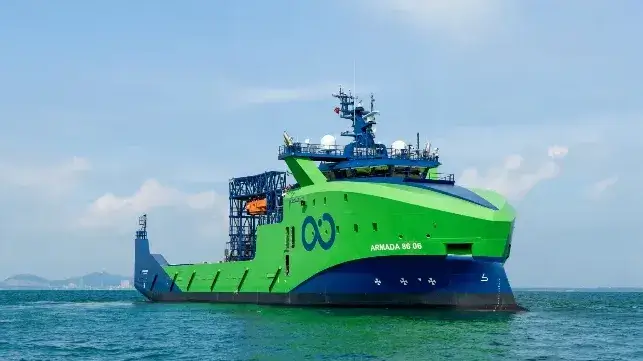
Ocean Infinity has launched its search for the lost Flight MH370, the aircraft that disappeared over the Indian Ocean in 2014. MH370's fate remains unknown, and the company believes that its advanced search technology could find the wreckage at last and perhaps yield new clues into the aircraft's loss.
AIS tracking provided by Pole Star Global shows that the Ocean Infinity ship Armada 86 05 is on station and searching at a position about 1,100 nautical miles west of Perth. As of Wednesday, the ship was driving a tight search pattern of about 15-20 nm per north-to-south leg. Water depth in the area is about 1,100-4,000 meters; high-resolution charting shows rough terrain in the area, with a mix of abyssal plain, valleys and seamounts.
The search will last up to 55 days and could cover up to 25,000 square kilometers, investigator Richard Godfrey told The Guardian. It was arranged through a service agreement with the Malaysian government, using a deal structure that displays confidence. If Ocean Infinity does not find the wreck, it will receive no compensation. If it does find the wreck, it will be paid $70 million, plus the advertising rights that would go with solving a high profile, needle-in-a-haystack search. The company is already well-known for finding the wreck of Sir Ernest Shackleton's famed ship Endurance, the wrecked ore carrier Stellar Daisy and the lost Argentinian submarine ARA San Juan, among other discoveries in the deep ocean.
Multiple previous searches for MH370 have come up empty-handed, including Ocean Infinity's own previous effort in 2018, which covered an 80,000 square kilometer swath of ocean. The current search area has been examined before, but technology has changed in the intervening years, and the company's fleet of acoustic-mapping AUVs from Kongsberg can provide detailed imaging of the bottom - as well as magnetometer detection for metal debris and laser scanning for detailed imaging at closer range.
The task is daunting. The missing plane was flying out of sight of radar coverage for hours, and the only electronic positioning data available is a series of hourly pings received by an Inmarsat satellite. These pings ended about seven hours after it took off, somewhere over the southern Indian Ocean, on about the timeframe when the aircraft would have run out of fuel. The long hourly interval between pings and the one-dimensional data yielded by the satellite ping means that the priority search zone is vast - a large arc of about 120,000 square kilometers in total, in a region exposed to powerful Southern Ocean weather systems. It is clear that the plane went down, as multiple pieces of floating debris have been recovered on far-flung foreign shores, but the main wreck site remains hidden.
The operational concept and technology for the search are wholly new. Ocean Infinity's Armada 86 class vessels are lean-crewed, autonomy-capable survey ships built with high levels of automation in mind. They are much smaller than conventional survey vessels, consume less fuel and require fewer people at sea. The ships are built with two moonpools and over-the-stern launch and recovery capability for AUVs and ROVs, augmented with remote-control systems for piloting the submersible equipment from shore.

No comments:
Post a Comment