A political economy of corporations and the wealthy lobbying for and receiving increased government help to snag higher profits and market share has ruled the roost of US society.
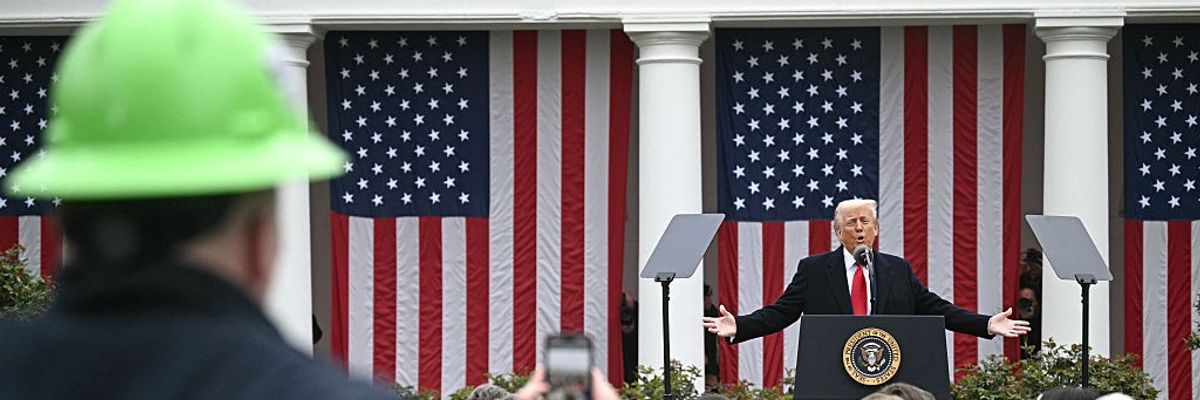
US President Donald Trump delivers remarks on reciprocal tariffs during an event in the Rose Garden entitled “Make America Wealthy Again” at the White House in Washington, DC, on April 2, 2025. (Photo by Brendan Smialowski/ AFP via Getty Images)
Seth Sandronsky
Jan 01, 2026
Common Dreams
As 2025 ended, one thing was as plain as day. American small businesses and their customers are paying a price for global trade tariffs, an import tax, courtesy of President Donald J Trump. How this economic fact plays out legally and politically is an open question, connected with long-running trends.
On the legal front, small businesses, over 700 of them at last count, have joined together as part of an amicus curiae (“friend of the court”) to the US Supreme Court with their testimonies against President Trump’s tariffs on foreign imports (Trump v. V.O.S. Selections, Inc. and Learning Resources, Inc. v. Trump).
Recall that the president promised to use tariff revenue on foreign imports to increase American manufacturing. Why the need for tariff revenue to grow private-sector manufacturing across the US?
Corporate America has been disinvesting in industrial production stateside for decades. Shifting manufacturing abroad and eliminating unionized employment for reasons of higher profits has been one of the hallmarks of the US economy under Democratic and GOP administrations. That’s a bipartisan consensus.
Centering kitchen table issues of labor and living conditions can garner working class support in rural and urban America in 2026. The Democratic and Republican parties have billions of reasons to fight such a working-class agenda.
Looking at this trend with a class and politics lens, it’s a kitchen table issue. Material reality, such as wage income and prices for groceries and rent, shapes ideology and systemic thinking about the political economy of living and working. The current moment of social tumult has been gathering steam since the end of the Vietnam War, which heralded the sunset of a postwar US economy of broad-based prosperity, with blue collar, family-wage employment for male workers.
Dubbed neoliberalism under successive Democratic and Republican presidents, a political economy of corporations and the wealthy lobbying for and receiving increased government help to snag higher profits and market share has ruled the roost of US society.
That government intervention, from copyrights and patents to misnamed free-trade pacts, favors big business and investors to the detriment of the working class. This trend ushered in the growth of the “working poor.” To be fair, President Trump didn’t begin this class war of a few against the many.
Meanwhile, the Supreme Court with a conservative majority is expected to issue a decision on a “demand for restitution” from businesses paying the Trump tariffs soon. The case challenges the president’s authority to impose tariffs due to a “large and persistent annual US goods trade deficits,” creating a national emergency.
Persistent implies a long-standing trend. This economic emergency of an imbalance in American exports and imports is a symptom of the corporate agenda. It’s driving both political parties support to deindustrialize America.
Political resistance to this agenda exists, but it’s weak. Think of the rise and fall of the anti-corporate globalization movement decades ago.
On that note, Public Citizen does magnificent work to advance the kitchen table issues of the working majority. However, the other side has unlimited cash to buy politicians, a major reason the corporate agenda barrels ahead.
Centering kitchen table issues of labor and living conditions can garner working class support in rural and urban America in 2026. The Democratic and Republican parties have billions of reasons to fight such a working-class agenda. The parties rely in part upon division to bolster their power and privilege.
Countering such a strategy of the ruling class is a tall order, but a necessary step. There will be many opportunities to build unity against the bipartisan consensus of war and Wall Street and for peace and social justice in the new year.
Our work is licensed under Creative Commons (CC BY-NC-ND 3.0). Feel free to republish and share widely.
Seth Sandronsky
Seth Sandronsky is a Sacramento journalist and member of the freelancers unit of the Pacific Media Workers Guild.
Full Bio >
As 2025 ended, one thing was as plain as day. American small businesses and their customers are paying a price for global trade tariffs, an import tax, courtesy of President Donald J Trump. How this economic fact plays out legally and politically is an open question, connected with long-running trends.
On the legal front, small businesses, over 700 of them at last count, have joined together as part of an amicus curiae (“friend of the court”) to the US Supreme Court with their testimonies against President Trump’s tariffs on foreign imports (Trump v. V.O.S. Selections, Inc. and Learning Resources, Inc. v. Trump).
Recall that the president promised to use tariff revenue on foreign imports to increase American manufacturing. Why the need for tariff revenue to grow private-sector manufacturing across the US?
Corporate America has been disinvesting in industrial production stateside for decades. Shifting manufacturing abroad and eliminating unionized employment for reasons of higher profits has been one of the hallmarks of the US economy under Democratic and GOP administrations. That’s a bipartisan consensus.
Centering kitchen table issues of labor and living conditions can garner working class support in rural and urban America in 2026. The Democratic and Republican parties have billions of reasons to fight such a working-class agenda.
Looking at this trend with a class and politics lens, it’s a kitchen table issue. Material reality, such as wage income and prices for groceries and rent, shapes ideology and systemic thinking about the political economy of living and working. The current moment of social tumult has been gathering steam since the end of the Vietnam War, which heralded the sunset of a postwar US economy of broad-based prosperity, with blue collar, family-wage employment for male workers.
Dubbed neoliberalism under successive Democratic and Republican presidents, a political economy of corporations and the wealthy lobbying for and receiving increased government help to snag higher profits and market share has ruled the roost of US society.
That government intervention, from copyrights and patents to misnamed free-trade pacts, favors big business and investors to the detriment of the working class. This trend ushered in the growth of the “working poor.” To be fair, President Trump didn’t begin this class war of a few against the many.
Meanwhile, the Supreme Court with a conservative majority is expected to issue a decision on a “demand for restitution” from businesses paying the Trump tariffs soon. The case challenges the president’s authority to impose tariffs due to a “large and persistent annual US goods trade deficits,” creating a national emergency.
Persistent implies a long-standing trend. This economic emergency of an imbalance in American exports and imports is a symptom of the corporate agenda. It’s driving both political parties support to deindustrialize America.
Political resistance to this agenda exists, but it’s weak. Think of the rise and fall of the anti-corporate globalization movement decades ago.
On that note, Public Citizen does magnificent work to advance the kitchen table issues of the working majority. However, the other side has unlimited cash to buy politicians, a major reason the corporate agenda barrels ahead.
Centering kitchen table issues of labor and living conditions can garner working class support in rural and urban America in 2026. The Democratic and Republican parties have billions of reasons to fight such a working-class agenda. The parties rely in part upon division to bolster their power and privilege.
Countering such a strategy of the ruling class is a tall order, but a necessary step. There will be many opportunities to build unity against the bipartisan consensus of war and Wall Street and for peace and social justice in the new year.
Our work is licensed under Creative Commons (CC BY-NC-ND 3.0). Feel free to republish and share widely.
Seth Sandronsky
Seth Sandronsky is a Sacramento journalist and member of the freelancers unit of the Pacific Media Workers Guild.
Full Bio >

No comments:
Post a Comment