Trump actively dismantling the international rules-base order
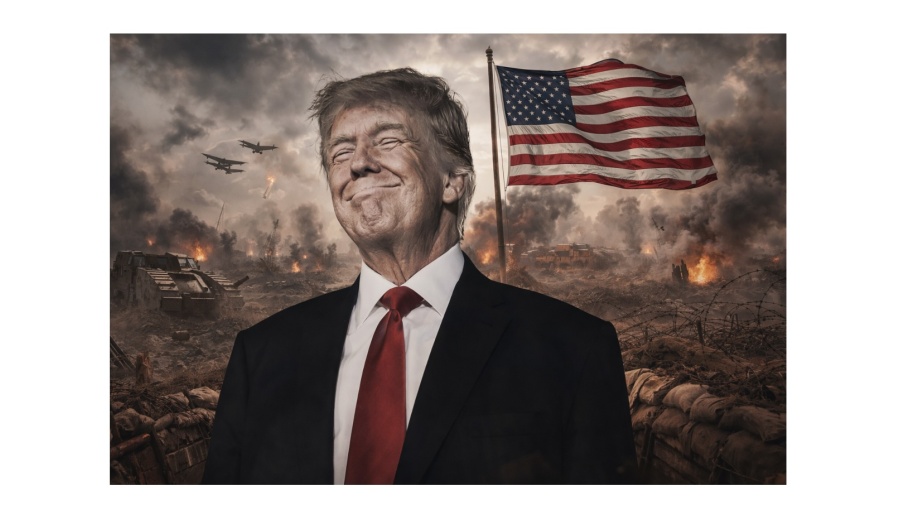
Trump is actively dismantling the international rules-based order, dismantling or sidelining the multinational institutions that have been built up since the end of WWII, and put himself personally in charge of running the world.
This process has been unfolding for a year already. It started in Ukraine when he conflated the principled support for Ukraine’s stand against Russian aggression with business deals.
As part of his 28-point peace plan (28PPP) was a proposal to seize the Central Bank of Russia (CBR)’s frozen $300bn in reserves and create a $100bn Ukraine restoration funds and another $200bn US-Russia investment fund for commercial joint venture projects – a major sop for Russian President Vladimir Putin and a de facto rehabilitation of Russia into the international community. In addition, Trump tied any support for Ukraine to the minerals deal that was signed on April 30 and gave significant concessions to US companies, but offered no critical security guarantees in return whatsoever.
That episode could still be sold as a “pragmatic” solution to winning over US support for Ukraine’s fight to regain control over its sovereign territory, but with the decapitation of Venezuelan President Nicolás Maduro’s regime on January 3 all pretence at following the rules was dropped.
America’s early morning bombing and helicopter assault on Caracas. The kidnapping of a sitting president. The cold-blooded execution of 100 Venezuelan presidential guards and their Cuban colleagues. And Trump’s open admission that the entire operation was all about grabbing control of Venezuela’s oil. This was all totally illegal under international law and flies in the face of the UN Charter that is supposed to be the bedrock of the international order.
To add insult to injury, Trump’s decision to hand over the concession to dispose of 50mn barrels of oil seized as part of the raid to his mega-donor Vitol, the world’s largest independent oil trader, to dispose of was a corrupt insider deal worthy of the Kremlin and Putin’s sweetheart deals for his inner circle of stoligarchs.
Trump is becoming bolder and bolder as he asserts his transactional approach to geopolitics. The emerging new economic paradigm is a return to nineteenth century imperialism where might-makes-right is the new rule book. This was codified in the recently released National Security Strategy (NSS) where the trans-Atlantic shared values “special relationship” that has driven US-EU relations since the end of WWII is over. Europe has been downgraded to simply being a US market and the White House has openly said it will interfere with European domestic politics, favouring the parties of the far-right. The upgraded Monroe Doctrine that is spelled out in the NSS is a reassertion of “America First, and everyone else last”.
The latest escalation is even more extreme. All coming one on top of the other, Trump is now proposing to send in 100,000 troops to Greenland, which has a population of 57,000 people, to take control of the country for the sake of US “national security” needs. It will be the easiest invasion ever, as US soldiers will outnumber the unarmed Greenlanders five-to-one and can simply walk into the parliament building without firing a shot.
Trump has justified this plan by claiming that Russia and China “may” annex the island, which is complete nonsense. China’s foreign ministry issued a statement this week, calling on Trump to drop the “fake China-threat” argument, used to justify his own “selfish” ambitions.
Russia has never expressed any interest in Greenland either, but has bitterly objected to Trump’s proposed annexation of Greenland. The idea of US troops establishing bases on the island, which lies on Russia’s northern border creates a security issue for the Kremlin where there was none before – very similar to the Kremlin’s objection of Nato moving into Ukraine on Russia’s western borders, just across from European Russia where 80% of the population lives.
Just the possibility of the US moving missiles into a new “51st state” that could strike Russian missile and military bases deep inside the country, that were previously out of range of European-based Nato munitions, would create a new security crisis where none existed before. Russia would inevitably respond. It invaded Ukraine simply because the US refused to contemplate any exclusion from Nato for Ukraine despite the fact the White House and Brussels have adamantly repeated there was never any plans to allow Ukraine into Nato. Turning Greenland into a US militarised proxy, even if no more bases are built and no troops are stationed there, is a giant step on from any possible Nato-proxy threat Ukraine poses to Russia.
The implications of a US annexation of Greenland are too grim to contemplate. One Nato country attacking and annexing another Nato country spells the end of Nato. It flies in the face of the UN charter. It makes the US the enemy of Europe, more aggressive and threatening than Russia or China. Putin has invaded Ukraine which is neither a member of the EU nor Nato. Trump would have invaded Greenland, which is a member of both.
A US annexation of Greenland means there are no rules at all anymore. But that was already clear after Trump ordered the kidnap of Maduro purely so he could seize Venezuela’s oil.
Peace Council
Trump’s efforts to dismantle the international order are no longer haphazard or piecemeal. As the process goes on, it is becoming systematic and it is escalating.
2025 was characterised by a series of ad hoc measures, but as his confidence grows he is now attempting to institutionalise the process. The latest initiative is to set up a “Board of Peace” that is an attempt to sideline the UN and silence the voices of all the other countries in the world in the process.
This could trigger a new and extreme crisis. Europe, in particular, has been put in a desperate position where it now has to choose to either stand up to Trump and stick to its principles or trigger a debilitating trade war.
Europe’s collective economy is already flat on its back due to the boomerang effect of the Russian sanctions. France is facing a major budget deficit crisis it has lost control of. Germany’s economic model has been wrecked by the end of cheap Russian gas and has been in recession for three years now. And the UK is being strangled by its mounting and increasingly unsustainable debt burden.
The game is in play in Davos where European leaders are due to meet Trump in the next few days and have an almost impossible choice to make.
Trump is proposing to set up a conflict resolution body, the Board of Peace, with himself as chairman and retaining veto powers over any decision the council reaches.
We don’t need a Peace Council. We already have one. It’s called the UN. And everyone is already a member of that. Trump is actively trying to usurp the UN and put himself personally in charge of running the world. If Russian President Vladimir Putin had done this, he would be called a fascist and compared to Hitler.
So far invitations to join the Peace Council have been extended to 60 countries. (The UN has 193 members.) Countries that have already said yes include UAE, Kosovo and Israel. Belarus President Alexander Lukashenko gleefully signed off on accepting his invitation yesterday. Russia has also been invited but the Kremlin is still thinking about it. (The Kremlin has always said the UN is the appropriate body to run a multipolar world.)
Other countries that have reacted positively to the idea include Hungary, Vietnam, Kazakhstan, Argentina, Morocco and Canada. Those that have already definitely rejected the invite include France, Norway and Sweden. Notably, Brussels has yet to comment. Trump says he only needs three countries to say yes to set the Council up.
The foundation of the rules based international order was established by the UN Charter signed in 1945 that was designed to prevent another world war. It commits members to sovereign equality, non-use of force, territorial integrity, and peaceful settlement of disputes. The economic and financial governance was covered by the Bretton Woods deal in 1944 and trade by General Agreement on Tariffs and Trade (GATT) in 1947.
Trump has already withdrawn from multiple UN institutions, most notably the Paris Climate Agreement. But that process is now accelerating, after he recently cancelled the US membership in 66 international institutions, 31 of them UN bodies including the UN Human Rights council and WHO. On economics he has threatened to punish any country that tries to drop the dollar and on trade he is using the US status as a major trade partner to weaponize tariffs with his poignantly named Liberation Day tariff regime.
The construction of an international order has been going on since the end of WWII. A major plank in this effort were Helsinki Accords signed in 1975 by 35 states, specifically including the US and the Soviet Union that codified the rules and stabilised tensions during the Cold War.
The Accords emerged from the Conference on Security and Co-operation in Europe (CSCE) that set post-war borders in Europe, and created rules for coexistence between East and West. Crucially, they linked security, economic cooperation, and human rights into a single framework in three “baskets”: the inviolability of existing borders in Europe; trade and economic cooperation; and guarantees for human rights and fundamental freedoms
Trump is proposing to throw all this work out of the window and Europe, as the leader of the values-based system, is now facing an existential choice.
French President Emmanuel Macron summed up the issues in his speech delivered in Davos on January 20. Wearing sunglasses to conceal his eye condition, the president warned that the world is entering a phase of “increasing instability”.
“International law is trampled underfoot and the only law that seems to matter is that of the strongest,” he told the assembled captains of the global economy.
“We are approaching a world without rules,” he cautioned, in a speech marked by explicit references to the return of “imperial ambitions” and the “normalization of conflict as a political tool.”
Former Nato Secretary General Anders Fogh Rasmussen put it even more bluntly: "The time for flattery of Trump is over."
Should I stay or should I go?
Following the raid on Caracas, the threats of bombing Iran (which still might happen next week) and now the potential invasion of Greenland, the EU’s policy of appeasing Trump is facing a litmus test. Trump has largely ignored all European demands and entreats so far. Europe is coming up to a red line where it may be forced to take retaliatory trade action itself. Putin and Chinese President Xi Jinping must be looking on in amazement.
But European leaders are split on Trump's offer to join the Peace Council and the issue will only deepen the already increasingly divided EU. It is clear that France will fight back, but for countries like Britain, which is not an EU member, London may choose to fold and attempt to revive its own “special relation” with the US, forged in the days of the Margret Thatcher, Ronald Reagen double act. Hungarian Prime Minister Viktor Orban and Slovak Prime Minister Robert Fico will go with Trump. The Nordic states will oppose him.
The Peace Council has already undermined Western unity in the Ukraine conflict. Lukashenko was delighted by the offer and leapt on the possibility to reagitate Belarus’ return to the, albeit Trumpian, international order. (Although he also made it clear he was not going to pay the $1bn membership fees Trump is demanding.)
Trump is clearly narked by Macron’s criticism and leaked private messages from Macron in which the French president proposed organizing a G7 summit in Paris, even with the possibility of inviting Russia on the sidelines of the meeting, which would have marked the first high-level rapprochement since the start of the war in Ukraine. In Davos, Macron denied any such meeting was planned and avoided elaborating on the episode.
Polish Prime Minister Donald Tusk is another one that is calling for a showdown. He urged European countries to resolutely defend their interests amid “blackmail” by Trump. Tusk, without directly mentioning either the US or Trump, called on European partners to stop "appeasement" and to defend their interests more firmly.
"Appeasement is always a manifestation of weakness. Europe cannot afford weakness - neither towards enemies nor towards an ally. Appeasement ends with a lack of results - except humiliation. At this time, European perseverance and confidence are very much needed," the Polish Prime Minister noted.
The choice is between economic wellbeing and points of principles. The US-Europe trade pair is the biggest in the world with over $1 trillion of annual turnover. At the same time, they have also the heaviest mutual foreign direct investment (FDI) of some $5 trillion investment stock in each other’s country – the fruits of 80 years of that special relationship.
A major trade war would wreck this relationship permanently with major economic consequences.
Now we are waiting to see what will happen next. Trump is firing his first salvos, threatening to put 10% on European countries that do not join the Peace Council, and singled out France for a 200% tariff on champagne.
The EU has already prepared its own retaliatory package of tariffs that target things like US-made motorbikes and bourbon whiskey in case Trump rolls out his threatened 10% additional tariffs on top of the 15% already conceded by European Commission President Ursula von der Leyen last year. However, if things escalate, Brussels has its "trade bazooka" in reserve: a set of regulations that could freeze US companies out of the European market entirely.

No comments:
Post a Comment