Top Putin Aide Threatens EU Ships in Response to Shadow Fleet Boardings
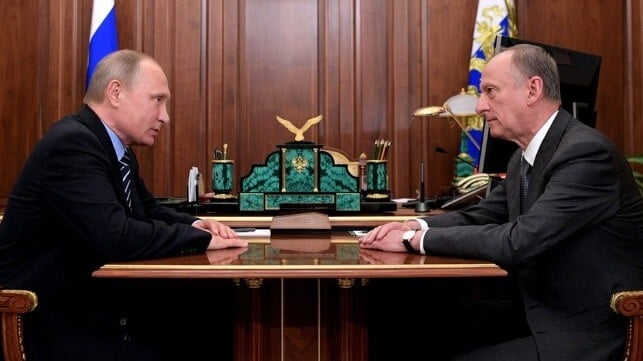
As Europe contemplates stiffer measures against the lightly-regulated, underinsured "shadow fleet" of tankers that carry most of Russia's oil, Russia is threatening to counterpunch. In an interview with outlet Argumenty i Fakty, Kremlin insider Nikolai Patrushev called Western tanker boardings "pirate attacks," and predicted a future in which Europe takes an active, regular role in interdicting Russia-linked tanker traffic. He intimated that Russia's navy is working on ways to "cool the ardor of Western corsairs" who "want to paralyze" the Russian oil economy.
"The Europeans are deliberately pursuing a scenario of military escalation, testing the limits of our patience and provoking active retaliatory measures. If a peaceful resolution to this situation fails, the blockade will be broken and eliminated by the [Russian] Navy," Patrushev said. "Let's not forget that many ships sail the seas under European flags. We, too, may be interested in what they are transporting and where they are going."
To date, the shadow fleet has been able to operate with relative freedom in and out of Russia's Baltic loading terminals. Often lacking valid insurance, or even a legitimate flag state, the tankers pass through the Kattegat and the North Sea en route to China or India - frequently under the watch of what may be Russian paramilitary forces. On rare occasions involving suspicious activity, these tankers are boarded and searched by EU security forces, but the vast majority - about 240 last year - enter and exit the Baltic without incident. That could change under evolving engagement protocols.
"According to available information . . . attacks on our ships and cargo will become more frequent," Patrushev warned. "If we don't respond firmly, the British, French, and even the Baltic states will soon become so brazen that they will attempt to completely block our country's access to the seas, at least in the Atlantic basin."
Patrushev - a former Soviet intelligence officer who once served alongside Russian President Vladimir Putin in the KGB - said that the Russian Navy would be the best tool for response. "Significant forces must be permanently stationed in key maritime routes, including in regions remote from Russia," he said. "Any attempt at a naval blockade of our country is completely illegal from the standpoint of international law, and the concept of a 'shadow fleet,' which EU representatives brandish at every turn, is a legal fiction."
The proposed European crackdown on the shadow fleet would affect the largest share of Russia-facing tanker tonnage. It would also be an important complement to a proposed EU shutdown of all "legitimate" European maritime services for Russian oil cargoes (currently allowed for consignments priced under $45 per barrel). If every Russian barrel becomes noncompliant for EU shipowners, as is expected soon, the "clean" vessels that currently carry compliant Russian shipments will be forced out of the Russian trade lanes, and the demand for unregulated shadow fleet services will increase. This would drive up shadow fleet traffic to and from Russia - which Europe is now preparing to counter with the possibility of tanker interdictions at sea.
Escort mission limitations
Russian warships are already providing escorts for key tanker and logistics ship movements in the English Channel and the Baltic, but there is a limit to how much more the Russian Navy can do.
Patrushev acknowledged that the service is already "under considerable strain." Russia's military actions in Ukraine and Syria have had effects on its navy - including the attrition of the Black Sea Fleet, the closure of the Bosporus to warships, the loss of the Russian base at Tartus, Western sanctions impeding Russian shipbuilding and component imports, and the loss of access to Ukrainian gas turbine engines.
For recruitment, the navy's manpower availability is limited by the constant need to refill combat roles for fighting in Eastern Ukraine, which is consuming about 1,100 Russian soldiers per day (killed or injured). At least one vessel, the now-defunct carrier Adm. Kuznetsov, has transferred part of its crew to the front lines for ground combat roles.
Patrushev partially addressed this challenge by highlighting the potential of technology to change naval affairs - a "high-tech navy" filled with unmanned vessels of corvette size or larger.

No comments:
Post a Comment