Showing posts sorted by date for query PROTESTANT REVOLUTION. Sort by relevance Show all posts

Saturday, January 10, 2026

REVOLUTIONARY HUMANIST & INTERNATIONALIST
National organizations unite to celebrate Thomas Paine’s Revolutionary War service at annual birthdate event: A Tribute to Thomas Paine’s Legacy
Thomas Paine Memorial Association


The Times That Tried Men’s Souls: Thomas Paine’s Service During The Revolutionary War

January 29, 2026 — Online Event | 4:00 PM PST / 7:00 PM EST
Registration Required:  us02web.zoom.us/meeting/register

The Thomas Paine Memorial Association (TPMA) and a coalition of leading secular, historical, and humanist organizations invite the public to the annual celebration of the birth of one of America’s most influential Founders — Thomas Paine. This year’s online commemorative program, The Times That Tried Men’s Souls: Thomas Paine’s Service During The Revolutionary War,” will take place on Thursday, January 29, 2026.

TPMA, which educates about Paine’s legacy, has been authorized by Congress to erect a memorial to Paine in Washington, D.C. The group has since received preliminary approval to pursue a memorial in Area 1 (close to the United States Capitol Building). The approval bill is awaiting congressional action.

Thomas Paine, author of Common Sense and The American Crisis, played an indispensable role in igniting the call for independence and sustaining morale through the darkest moments of the Revolution. His writing, service, and vision for a democratic society continue to inspire generations. Paine’s contributions recently have been highlighted in Ken Burns’ documentary “The American Revolution.”

Event Highlights

Distinguished Opening Remarks
The program will commence with words from Members of Congress Jamie Raskin and Victoria Spartz, with a special appearance from Benjamin Franklin (portrayed by actor Brian Patrick Mulligan).

Keynote Presentation
Acclaimed historian and author Jack Kelly — whose book Tom Paine’s War explores Paine’s firsthand experiences during the Revolution — will deliver a keynote address examining Paine’s military service and enduring relevance. Kelly will cover:

  • Paine’s background and rise to prominence
  • His Common Sense pamphlet and his influence on the Declaration of Independence
  • His service with the Pennsylvania militia and involvement with the Continental Army
  • The fall of Fort Washington and Fort Lee
  • The march across New Jersey
  • The writing of The American Crisisand its impact on the battles of Trenton and Princeton
  • Paine’s legacy in modern times

Readings from Paine’s Writings
Award-winning actor Ian Ruskin, known for his one-man show portraying Paine, will perform a dramatic reading from The American Crisis synchronized with a photo slide show of various images of the Paine memorial sculpted by Georg Lober, dedicated in 1950 in Morristown, New Jersey. The statue portrays Paine in the midst of writing The American Crisis during the Revolutionary War — capturing both his intellectual and patriotic courage.

A Veteran’s Perspective
Gene Jones of Florida Veterans for Common Sense will speak about Paine’s heroism, the challenges he faced after the war, and why Paine remains a powerful symbol of principled military service today.

Showcase: The Thomas Paine Cottage
A video created by Suzanne Tanswell and Gary Bush, trustees of the Huguenot New Rochelle Historical Association which owns the Thomas Paine Cottage in New Rochelle, New York, will highlight one of the most important historical sites connected to Paine’s life.

Additional Program Features

  • Musical selection from the celebrated play ‘The Crossing’
  • Live Q&A with Jack Kelly, Gary Berton, Christopher Cameron, Ian Ruskin, Margaret Downey, Gene Jones, Frances Chiu, Joy Masoff, Suzanne Tanswell, and Gary Bush
  • Cosponsor messages from national organizations
  • Credits slideshow
  • A post-event Social Hour and Toasts, including a special opening toast by renowned sculptor Zenos Frudakis, who will show his progress in creating a statue of Thomas Paine that will be placed in a prestigious pre-approved location in Washington, D.C.

Event Hosts and Sponsors

The event will be co-hosted by TPMA President Margaret Downey and TPMA Board Member Christopher Cameron.

Sponsors include:

  • Thomas Paine Memorial Association
  • Black Nonbelievers
  • Thomas Paine Historical Association
  • Freethought Society
  • Freedom From Religion Foundation
  • Thomas Paine Society
  • Military Association of Atheists and Freethinkers
  • American Atheists
  • Secular Coalition for America
  • American Humanist Association
  • Center for Inquiry/Richard Dawkins Foundation

Join Us

This event offers an extraordinary opportunity to rediscover Thomas Paine’s contributions through scholarship, performance, and reflection.

Attendance is free, but pre-registration is required.

Register here: https://us02web.zoom.us/meeting/register/ga-dvEPuR0iLzT5LA45BOw

###

Contact:
Margaret Downey, President
Thomas Paine Memorial Association
info@thomaspainememorial.org


THOMAS PAINE. COMMON SENSE (1776). Perhaps the sentiments contained in the following pages, are not yet sufficiently fashionable to procure them general ...


"Common Sense" by Thomas Paine is a pamphlet published in January 1776 advocating independence from Great Britain for the Thirteen Colonies. Written in clear, persuasive prose, Paine presents moral and political arguments to encourage common people to fight for egalitarian government. Published anonymously at the American Revolution's beginning, it became an immediate sensation—the best-selling American title of all time. Paine connected independence with Protestant beliefs and structured his work like a sermon, making the first serious case for full independence when reconciliation still dominated colonial thinking. (This is an automatically generated summary.) 


The Writings of Thomas Paine,
Complete by Thomas Paine

"The Writings of Thomas Paine, Complete" by Thomas Paine is a historical collection of political writings compiled in the late 18th century. The volume includes influential pamphlets that played a pivotal role in shaping American revolutionary sentiment, particularly focusing on issues of independence and the fight against tyranny. The collected works provide profound insights into the social and political climate of the time, highlighting the struggle for freedom and democratic ideals. The opening of this work lays the groundwork for Paine's monumental series, "The American Crisis," which begins with a stirring call to action amidst the Revolutionary War. He reflects on the challenges facing American patriots, emphasizing the importance of perseverance and unity against oppression. The famous opening lines address the trials of these tumultuous times and encourage individuals to stand firm in their commitment to liberty, while also critiquing those who waver in their loyalty. Through vivid imagery and passionate prose, the initial segments set a tone of urgency and resolve, making it clear that the fight for independence is both a personal and collective responsibility. (This is an automatically generated summary.) 


Liberal Christian denominations condemn US actions in Venezuela, call for peace

(RNS) — Four days after the raid that extracted the Venezuelan leader and his wife and brought them to face federal charges in New York, nearly every mainline Protestant group has condemned the US actions.


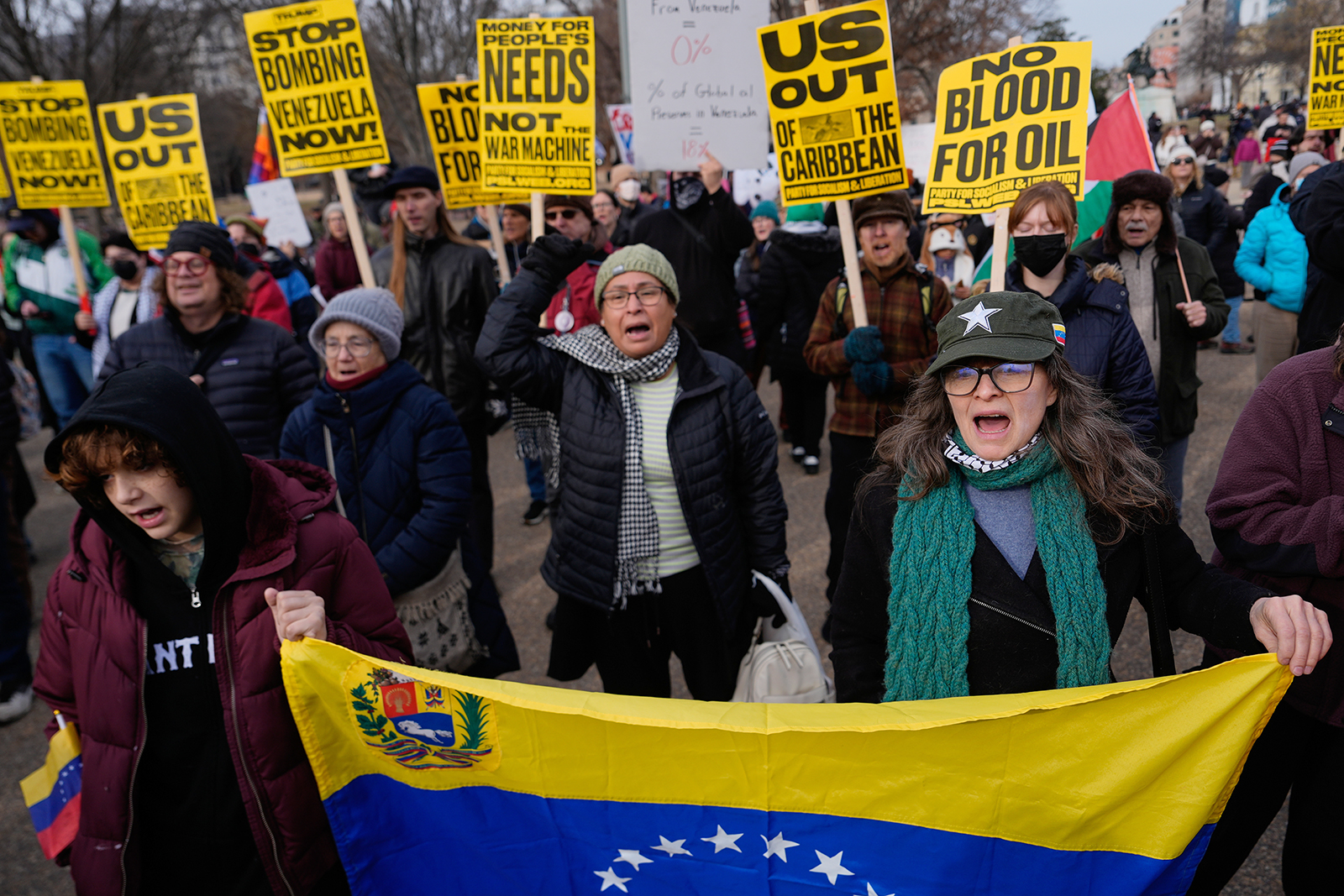
Protesters demonstrate outside the White House, Jan. 3, 2026, in Washington, after the U.S. captured Venezuelan President Nicolás Maduro and his wife in a military operation. (AP Photo/Julia Demaree Nikhinson)

Yonat Shimron
January 7, 2026
RNS

(RNS) — Four days after the U.S. military seized Venezuelan President Nicolás Maduro and his wife in a strike on Caracas that took nearly everyone by surprise, liberal Christian denominations have begun to criticize the raid.

The bishops of the United Methodist Church on Wednesday (Jan. 7) issued a statement “condemning all acts of violence, military aggression, and violations of national sovereignty” and urging its members to pray for the Venezuelan people.

The United Methodist Church does not have churches in Venezuela, a mostly Catholic country with growing numbers of Protestants and other faiths, but it does have autonomous Methodist churches.

In the letter, the United Methodist bishops pointed to their social principles that oppose war and violence. It did not mention the deposed Venezuelan leader by name. Neither did it mention President Donald Trump, who ordered the raid that extracted Maduro from the country and brought him to a New York City jail. On Tuesday, he pleaded not guilty to federal drug and weapons charges.

The Episcopal Church was quicker to respond. An Action Alert released Saturday — the same day as the raid — by its Office of Government Relations condemned the use of military force “aimed at disrupting a non-imminent, uncertain military threat.” It also called on Congress to investigate the operation, which it said “marks a striking and unprecedented escalation of conflict.”

RELATED: Vatican faces ‘complicated’ balancing act in responding to US arrest of Maduro

The Episcopal Church has more skin in the game. The denomination has a diocese in Venezuela with 17 congregations and several more missions. The diocese’s provisional bishop, Cristóbal Olmedo León Lozano, is stationed in Ecuador.

“The Episcopal Church called for an investigation and accountability, first because of our 2009 resolution condemning ‘the first use of armed force in the form of a preventive or preemptive strike that is aimed at disrupting a non-imminent, uncertain military threat.,” said Rebecca Linder Blachly, chief of public policy and witness for the Episcopal Church. “Also, we are firm supporters of the United Nations, and this operation lacked legal authorization under international law, per the UN charter. Additionally, there was no congressional authorization for the use of military force nor advance notice to all required members of Congress.”

The Rev. Canon David Ulloa Chavez, the Episcopal Church’s partnership officer for Latin America and the Caribbean, said he has spoken via phone with the provisional bishop and has been assured that no church members have been injured so far.

“From what I understand, everyone is safe,” Chavez told RNS. “There is this sort of ambiguity around what is actually taking place. There’s sort of a nervous calm at this stage.”

Secretary of State Marco Rubio told members of Congress on Wednesday that the Trump administration has plans for a prolonged mission in the country that included taking control of its vast oil reserves.

Many Venezuelan migrants to the U.S. celebrated Maduro’s capture. Political and economic insecurity under Maduro’s authoritarian rule has led to an exodus of some 7.9 million Venezuelans as of December 2024, according to the Migration Policy Institute. As of 2023, some 770,000 Venezuelan immigrants had entered the U.S. In 2021, the Biden administration designated Venezuela for Temporary Protected Status, which grants legal immigration status to people fleeing countries facing armed conflict or humanitarian crises. Trump ended the program last year.


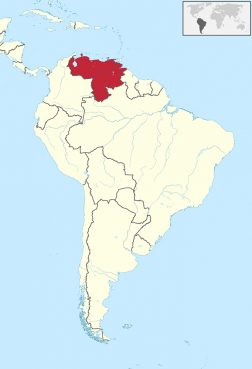
Venezuela, red, is located on the northern coast of South America. (Map courtesy of Wikimedia/Creative Commons)

But inside the country, some have described an uneasy quiet and deep fears about what might come next.

Chavez said he and leaders in the Episcopal Church’s province that covers Venezuela, Colombia, Ecuador, the Dominican Republic and Honduras, are talking about how to better support Venezuelans who are leaving via its long western border with Colombia. “How do we partner for the sake of our migrating neighbors that are coming into not only our province, but throughout the region?” Chavez said.

Other liberal Protestant denominations have also condemned the U.S. action. The United Church of Christ and the Christian Church (Disciples of Christ) released a joint statement condemning the attack, saying it posed a “troubling pattern of unlawful U.S. military activity, including the December 25, 2025, airstrikes in Nigeria.”

The World Council of Churches also condemned the raid and Maduro’s capture, saying the U.S. actions constituted “stunningly flagrant violations of international law.”

And Pope Leo XIV voiced “deep concern” over the situation. “The good of the beloved Venezuelan people must prevail over every other consideration,” he said in a Sunday address, with an appeal to end the violence and guarantee the country’s sovereignty.

Caracas Residents Describe Terror of US Invasion as They Worry for What’s Next


“It was a massacre against defenseless people,” a mother of three said of the US operation to abduct Maduro.
January 9, 2026

A woman attends a march to demand the release of kidnapped Venezuelan President Nicolás Maduro and his wife Cilia Flores, in Caracas, Venezuela, on January 8, 2026.Federico PARRA / AFP via Getty Images

“Several helicopters were dropping bombs, and the windows shattered from the shockwaves,” Caracas resident Paola Rosal told Truthout, describing her experience of the U.S. attack on Venezuela on January 3.

Rosal, a mother of three who lives in Ciudad Tiuna, a massive government-built housing project located in the Fuerte Tiuna military complex in Caracas, said she was alone getting ready to take a shower when “the power went out, and the first bomb fell near my building.” Feeling a sense of terror and panic, Rosal describes how she fled and, for a while, was alone in a carpark. Her mother, who was in her own apartment with her daughters, witnessed a bomb drop in front of her apartment which shattered all of the windows.

“When we went outside to take cover, the next bomb fell,” Rosal told Truthout. “People didn’t know where to go for shelter. It was so awful that my daughter doesn’t want to go back, and like her, many other people feel the same way.” Rosal, a married 40-year-old owner of a bodega, has long voted for the leaders of the Bolivarian revolution: first President Hugo Chávez (1999-2013), and then President Nicolás Maduro, who won his first election by a narrow margin in early 2013.

Rosal said she has concrete criticisms of Maduro’s government: For example, she is concerned that the government’s decision to distribute weapons to citizens in preparation for a full-scale U.S. invasion could result in pro-government civilian armed groups (colectivos) gaining more power, and that worries her.

But Rosal was vehement in her outrage and fury in response to the U.S. attack.


Experts Say Even Average Venezuelans Critical of Maduro Won’t Back Regime Change
A US military attack “would bring more chaos, more poverty,” one Caracas resident said.
By Rodrigo Acuña , Truthout  December 16, 2025


“It was a massacre against defenseless people,” Rosal told Truthout, expressing that she is still frightened, angry and uncertain about the future and adding that the U.S. military attack “damaged the infrastructure, the buildings where we live, and killed civilians,” including “the elderly.” Full data has yet to come out on the ages of all the people killed in the strike, but The New York Times confirms that 80-year-old Rosa González was among the dead.

“The way the helicopters attacked indiscriminately is unacceptable,” Rosal added, calling Trump a “violator of all rights,” and decrying how Trump “enters our country as if nothing is wrong, and no one says a word to him.”
The Trump Administration’s Attack on Caracas

At around 2 am on January 3, the bombs ordered by U.S. President Donald Trump commenced falling on Venezuela. The bombs hit the country’s largest military complex, Fuerte Tiuna, whose perimeter contains the civilian Ciudad Tiuna housing project, which is far larger than the military facilities and which is home to tens of thousands of people. The capital’s electricity was also cut off for several hours in sectors of the south, center, and west of Caracas.

Near the capital, the Generalissimo Francisco de Miranda Air Base (La Carlota) was hit, as was the Port of La Guaira — the primary maritime gateway for the Caracas. According to the Venezuelan News Agency, in La Guaira, warehouses of the Venezuelan Institute of Social Security, which holds supplies for dialysis and nephrology programs, were also bombed. Outside of the capital, the Barquisimeto F-16 Base was reportedly hit, as was the Charallave Private Airport and the Higuerote Military Helicopter Base in the state of Miranda.

On January 7, DW News (the international news branch of Germany’s public media outlet) said 24 members of Venezuela’s Bolivarian National Armed Forces were killed, as were 32 members of the Revolutionary Armed Forces of Cuba and the Ministry of the Interior who were serving an international security mission in a sister Latin American nation. (Due to several agreements between Caracas and Havana, since 1999 thousands of Cuban doctors, nurses, teachers, and sports trainers have been working in Venezuela. By 2009, the number stood at 42,000 Cubans, several of whom have been on military missions.)

Officially, on January 8, the Venezuelan government said 100 people were killed with a similar number injured. On January 3, The New York Times reported that, on the U.S. side, “about half a dozen soldiers were injured” in the operation.

Roughly two-and-a-half hours after the bombing commenced, Trump publicly declared that the United States had “successfully carried out a large-scale strike against Venezuela and its leader, President Nicolás Maduro, who has been, along with his wife, captured and flown out of the country.” The first image to be released of 63-year-old Maduro showed him in a Nike tracksuit, handcuffed and wearing blackout goggles, with his ears covered. On January 5 it was noted that Maduro’s 69-year-old-wife, Cilia Flores, in a New York court, had a bandage on her head, bruises on her face, and was suffering “significant injuries,” according to her lawyer.

Venezuela Residents and Political Analysts Express Fears for the Future

Jessica Falcon, a Caracas state employee in her late thirties, is deeply worried about the future of Venezuela and the actions of the Trump administration. Asked by Truthout what she thought about the act of war by the United States toward her homeland, Falcon said:


Once again, the U.S. is doing whatever it pleases with the complicit gaze of the rest of the world and multilateral organizations. Venezuela is experiencing a period of great tension, and this violation of our sovereignty seems outrageous. Archaic colonialism in the 21st century — a true step backward.

Corporate media outlets in the United States, Britain, and Australia have focused on the military details of Washington’s illegal actions in Venezuela, using words like “capture” or “arrest” rather than “kidnapping” to describe what the U.S. did to Maduro and Flores.

In contrast, within Venezuela state media have focused on interviewing injured soldiers and civilians. Venezuelan media have also covered Delcy Rodríguez, formally the vice president, being sworn in as the acting president of Venezuela, saying, “I come with pain for the suffering that has been caused to the Venezuelan people after an illegitimate military aggression against our homeland.”

On the streets and online, two key questions are repeatedly asked: How was the U.S. military able to completely disable Venezuela’s air defense systems? And were there people inside Maduro’s inner security circle that betrayed him?

Speaking to Truthout, Clinton Fernandes, a professor at the University of New South Wales in Australia who assess the threats, risks and opportunities that military forces face in the future, said: “Over the past 10 years, there has been a revolution in sensing and precision technologies, eroding the survivability of air defenses and the targets they seek to protect.” Fernandes claims that “new sensors in all domains, including air, space, and cyberspace, have increased enemy transparency.” This development, he said, shaped the course of events last year when Iran’s nuclear facilities were bombed in June 2025, and also shaped the outcome of the U.S. attack on Venezuela.

Fernandes added:


The U.S. has been at the cutting edge of technological advances in stealth, sensing, and precision. Stealth allows it to approach targets undetected. It has guidance systems with advanced inertial sensors relying on stellar updates, sensors, data processing, communication, artificial intelligence, and a host of other products of the computer revolution. Its advantages allow it to create openings for disarming strikes against enemy positions and forces.

Caracas-based Ricardo Vaz, who is a writer and editor at Venezuelanalysis.com, told Truthout that the outcome of the U.S. strike is forcing analysts to reassess previous “expectations concerning Venezuela’s military capabilities and readiness.” Vaz added:


There was an assortment of Russian-supplied short-, medium- and long-range surface-to-air weapons which failed to offer much deterrence to the invading U.S. forces. It is possible that U.S. air power, including bombers and electronic warfare planes, managed to completely neutralize air defences.

Meanwhile, speaking recently to journalist Jeremy Scahill, Venezuela’s ex-Deputy Minister of Foreign Affairs for North America Carlos Ron said that while he did not want to speculate that someone inside Maduro’s security detail betrayed him, “you can’t rule out that something to that effect happened.”
What Comes Next for Venezuela?

Back in Washington, during his first press conference after Maduro and Flores’s kidnapping, a gloating Trump declared: “We are going to run the country,” in reference to Venezuela. He added: “We’ll have the greatest oil companies in the world going in, invest billions and billions of dollars. … And the biggest beneficiary are going to be the people of Venezuela.” When asked about installing opposition leader María Corina Machado, who claimed the 2024 presidential election was stolen from Edmundo González, who ran on her behalf, Trump replied: “She doesn’t have the support within or the respect within the country.” On January 9, Trump claimed he would meet with Machado in the next week.

Asked to comment on the ramification of Washington’s actions in Venezuela, Luis F. Angosto-Ferrández — a scholar at Sydney University and the author of the book Venezuela Reframed — predicted that the Trump administration “will use the kidnapping of President Maduro (and the forthcoming theatralisation of his trial) as another mechanism of destabilisation and pressure on the Venezuelan government.” Still, Angosto-Ferrández argued, “it is evident that they continue to fail in their attempts at making the government collapse.”

While a clearer picture will develop as future events unfold under the pressure of the current U.S. economic blockade on Venezuela, Angosto-Ferrández says:


What is clear is that the U.S. government’s expectations of an immediate collapse of Venezuelan governance and institutionality are not going to happen even with the kidnapping of Maduro. Other than that, the U.S. may decide to continue with its illegal attacks, and perhaps even invade the country with the goal of controlling it in part — basically, enclaves that give access to oil and perhaps minerals.

Constantly paraded in front of the global media in a humiliating manner as he is being transported (it is illegal to publicly degrade prisoners of war under the Third Geneva Convention), Maduro has shown himself to be cordial with his captors while making a two-handed symbol — one hand forming a “V,” the other pointing toward it — meaning “Nosotros venceremos,” or “Together we will win”.

In front of a judge in New York on January 5, President Maduro in Spanish declared: “I am innocent. I am not guilty. I am a decent man.” He described himself a “prisoner of war” and said he was illegally captured.

The four charges that the U.S. has made against Maduro are narcoterrorism conspiracy, cocaine importation conspiracy, possession of machine guns and destructive devices, and conspiracy to possess machineguns and destructive devices.

Maduro has hired Barry Pollack — the distinguished U.S. trial lawyer who spent years representing Australian WikiLeaks editor Julian Assange — to join his legal team.

Meanwhile, with Maduro’s next court appearance set for March 17, the U.S. armada continues to sit off the coast of Venezuela while crushing economic sanctions are imposed on the Latin American country.


This article is licensed under Creative Commons (CC BY-NC-ND 4.0), and you are free to share and republish under the terms of the license.

Rodrigo Acuña
Rodrigo Acuña holds a PhD on Venezuelan foreign policy from Macquarie University. Together with journalist Nicolas Ford, last year he released his first documentary Venezuela: The Cost of Challenging an Empire. Rodrigo has been writing on Latin American politics for close to 20 years and publishes a newsletter on Latin America. He works the NSW Department of Education and can be followed on X (Twitter) @rodrigoac7.


Thursday, January 01, 2026

Oligarchy XIV: Thoughts on the Anarchism of Dorothy Day


 January 1, 2026

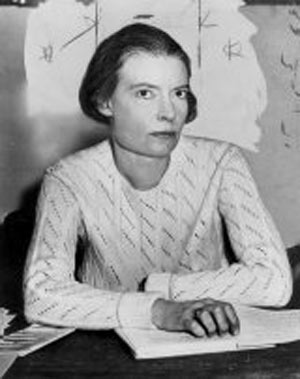
Dorothy Day in 1934. New York World-Telegram & Sun Collection. Public Domain.

I have a few thoughts in response to what seems like an uptick in interest in Dorothy Day (1897-1980) in recent years. When I first read Dorothy Day, the first thing that stood out to me was her continuity with a long tradition of Christian anarchism in America. Yet as a Catholic, she seemed to represent a split from the main line of Christian anarchism in America, which is distinctly Protestant (though not exclusively so, and who knows how to classify Tolstoy’s religion). In any case, I kept running into her name after years of studying and steeping in the Christian anarchism and non-resistance of folks like Adin Ballou, William Lloyd Garrison, and Henry Clarke Wright, among others. Many of the individualist anarchists received theological instruction and were ordained ministers (for example, Joshua K. Ingalls, William B. Greene). Day resembled these Protestants of the American libertarian tradition in her deep personal commitment and her total rejection of political action, which, as we will discuss, entails explicit renunciation of core features of our political life, for example, voting, paying taxes, and obeying unjust laws. The historian Anne Klejment helps us understand Day’s ideas within this context:

The seedbed of her pacifism extended back into her Protestant young adulthood. Her familiarity with the Bible remained a significant part of her spirituality and informed her pacifism. Back then, the Catholic laity was discouraged from Bible reading. It would take a convert like Dorothy to advance biblical nonviolence as an essential Catholic teaching. She placed enormous emphasis on the commandment to love God and love neighbor. She understood it as the core teaching of Jesus and pondered over it from adolescence until her death.

Many of the American Christian anarchists/non-resistants follow in a long tradition of antinomians, arguably going back to the Antinomian Controversy in New England and before. These episodes left an established tradition of challenging authority and hierarchical power. Day’s Christian anarchism stands out in its delicate location within the Catholic tradition. Indeed, hers was a stance that angered many in both the Church hierarchy and in her old left-wing circles. She recalled at the end of her life that many of her radical friends had felt betrayed by her conversion:

One who had yearned to walk in the footsteps of a Mother Jones and an Emma Goldman seemingly had turned her back on the entire radical movement and sought shelter in that great, corrupt Holy Roman Catholic Church, right hand of the Oppressor, the State, rich and heartless, a traitor to her beginnings, her Founder, etc.

Just as she was a poor fit with the narrow-minded college socialists (more on that below), she was also an awkward fit in a movement defined by people like Proudhon, whom she frequently discussed, and Bakunin. Day’s personalism is another distinctive feature of her approach to anarchism. This is the idea, grounded in a basic belief in the dignity of every human being, that each person must take personal responsibility on every level: that there is a duty to one’s neighbors and coworkers, and we cannot look to others, including large institutions, which are themselves the key offenders and impediments to change. Day often talked about how she was changed after the experience of seeing neighbors come to each other’s aid in the wake of the 1906 San Francisco earthquake. In an article in 1936, Day explained:

We are Personalists because we believe that man, a person, a creature of body and soul, is greater than the State, of which as an individual he is a part. We are Personalists because we oppose the vesting of all authority in the hands of the state instead of in the hands of Christ the King. We are Personalists because we believe in free will, and not in the economic determinism of the Communist philosophy.

Remarking on the 1927 murder of Italian immigrants and anarchists Nicola Sacco and Bartolomeo Vanzetti, Day noted that anarchism “is the word, or label, which confuses many of our readers (especially the bishops?)” Day saw anarchism, as a philosophy of mutual respect and voluntary cooperation, as a natural extension of Christian spiritual practice and fellowship. She argued that there is no human law applicable to those who love and follow Jesus, and that “anarchism means ‘Love God, and do as you will.’” From the moment it became aware of the Catholic Worker movement, the U.S. government has treated it with suspicion, targeting and spying on Day and the movement as supposedly subversive elements. Day’s activism drew the attention of the FBI, and she is said to have enjoyed reading her FBI files.

Day had joined the Socialist Party in Urbana, Illinois, as a teenage college student, but its “petty bourgeois” attitudes and lack of “the religious enthusiasm for the poor” left her cold. She was not one for posturing; her Christian anarchism was based on the idea that every person is “known and named,” and that the real movement for human freedom takes place where there is a human need to be satisfied. Day roundly rejected the value system and approach of rigid bureaucracies and hierarchies, either corporate or governmental, which treat people as case numbers within cold, detached systems of power. As Michael Kazin put it: “Like any good anarchist, Christian or not, Day had no faith whatsoever in the desire or ability of governing authorities to create a moral, egalitarian society.” Her political outlook was grounded in and expressed through the sharing of everyday acts of kindness, through up-close relationships rather than philosophical abstractions. Yet she was extremely well-read and capable of the most insightful and skillfully articulated engagements with advanced ideas. Day has a very particular way with words. There is a rare candor, which reflects her lack of pretenses and her vulnerability in sharing her full life in the most open and sincere way. Her columns go back and forth between the tragedy and the comedy of being human with real thought and skill. Some of the vignettes in her autobiography are as powerful and moving as anything written by any American, for my money. “In 2012, the U.S. Conference of Catholic Bishops unanimously voiced its support for her sainthood,” and this cause is, as I understand it, pending. An anarchist Catholic saint would be something to see.
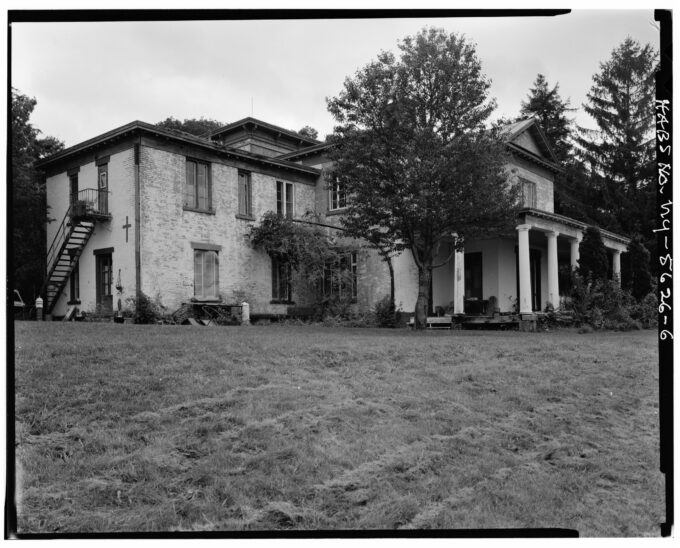
Rose Hill Catholic Worker farm, Tivoli, New York. Photo: National Park Service.

Day believed that we have the social and political question backwards, starting with abstractions, ideological camps, and grand plans, when what we should focus on what is personal and tangible, what can be done directly, immediately, and without “professional” intermediaries. I was drawn to Day’s writings first because her way of thinking about political and social questions is so categorically different from the one we get from both halves of the poisonous main currents of our discourse today. She rejected both versions of bloodthirsty twentieth century authoritarianism, capitalism and socialism, instead articulating a radical politics of the corporeal and close by. Nothing more complicated in policy terms than housing and feeding our neighbors, the most important work (we prefer conceptual complexity and institutional paralysis while oligarchs bleed the country). Her belief in the transformative power of community and hospitality at the most basic but most intimate scale led her to reject the way almost everyone of our age thinks about politics. Day’s politics were about love for and service to other people; her way of looking at the world, according to her granddaughter, focused on the idea that “what we can do is so little, but that is what we are given to do. That’s only what we can do, so let’s move forward and do what we each think that we can do.” She emphasized “the necessity of smallness,” encouraging a direct and hands-on approach to serving those in need. She could not accept any approach to activism or ministry that separated the theorizing from the doing. Contrast our culture of aloof contempt for the poor, workers, prisoners, migrants and refugees, etc. There is nothing lower than not having money in our anti-human culture and political system. It is thoroughly bipartisan and it will outlast every politician and political party. Rest assured that the state’s indifference toward the suffering of the poor will be there still when there is no more U.S. government.

In Day’s view, we are depriving ourselves of another political dimension in the notion that love is the only response to political moments like this one. Regardless of anyone’s opinions, if love and community are not reliable for us in the social and community context, then what are we talking about? If they aren’t starting with the people at the bottom, what are they building? Everyone seems to feel that the country is lost today. My suggestion is: do not try to find it. Dorothy Day’s example suggests that we find each other, face-to-face, and begin to relearn the lessons of solidarity and mutual aid. We do that and we don’t have to fuss with any of today’s counterfeit B.S. In the social reality that capital and the state are hawking, there is nothing for workers or the poor, nothing but getting shorted. Day saw the crises unfolding around her in terms of human suffering. She did not put herself in the position of judging or condemning; she did not hold out false solutions or panaceas. She asked people to follow her lead in taking personal responsibility and initiative. Among the goals of the House of Hospitality, she stated, was to “emphasize personal action, personal responsibility as opposed to political action and state responsibility.” As a social model, the House of Hospitality explicitly resists impersonal, bureaucratized forms of charity and deliberately puts givers and recipients on the same footing, creating genuine relationships and community life. Day lived a life of voluntary poverty and thought that one should try to “be close enough to people so that you are indifferent to the material.” Central to her thought was leading by example and in accordance with love for all people. Her life, her work, her politics, all inseparable, were based on the radical notion that Jesus meant what he said about loving each other, turning the other cheek, etc.

Day offers another way of thinking about what it means to be politically active within a broader network of movements for freedom, equality, and justice. We don’t need to play to the strengths of the ruling class by focusing our energies and resources back into the sources of hierarchy and domination. Day thought that we had things backwards when it came to political and social change: that is, she believed we are already where the action is, in that everything grows from the bottom up. The movement is where you are, and it exists within your power to take care of people in need. So this is obviously a way of thinking poles apart from the performative nonsense that is encouraged today. Her worldview was a wholesale rejection of today’s faux meritocracy and its ugly pretense that some people are worth more than others. She believed that there is a “a spirit of non-violence and brotherhood” in the Gospels that counsels anarchism in practice. She favored radical decentralization and recognized the principle of subsidiarity, or the idea that decision-making should take place at the most local possible level. In the United States, we have departed from this principle to our own peril, yet neither of our teams seem to understand the problem. Day did not mince words in providing a classically anarchist condemnation of government:

Eventually, there will be this withering away of the State. Why put it off in some far distant utopia? Why not begin right now and say that the state is the enemy. The state is the armed forces. The state is bound to be a tyrant, a dictatorship. A Dictatorship of the Proletariat becomes yet another dictatorship. (emphasis in original)

Day did not believe that we can effectively resist this system of poverty and social alienation by supporting politicians or by mimicking the coercive, bureaucratic style of elites. For her, it could not be a matter of voting, giving alms, or being a good member of some party. Day’s approach represents the opposite of the institutional distance and stuck-up elitism that characterize most of our systems. Day insisted on being there on the ground, sharing daily life in real human connections, resisting the state and consumerism through friendship and love rather than through government. This mode of politics can only be understood and practiced by one who is not interested in being there for others, not in her own opinions or in electing certain politicians, etc. This is the real revolution everyone has been talking about and waiting for, but Day’s isn’t a path most people are capable of walking. One of the mottos of the Catholic Worker movement is, “Conscience is supreme.” Day could not reconcile any politics of division or violence with her own conscience. Institutions that rely on violence – the state, for instance – could not help except by receding into the background; they are not there to help, but rather to create the conditions for widespread deprivation and poverty.

There may be no starker contrast to the hollow identitarian blather of our moment than the life and work of Dorothy Day. Today’s hideous and embarrassing elite-worship, its obsessions with maximums of speed and scale regardless of the social dangers or consequences, its institutional detachment and opacity, and its counterproductive GDPism all represent pervasive social decay and alienation within Day’s philosophy. They are not the visible signs of “progress.” By comparison, today’s PMC liberals appear to be deliberately authoritarian and parochial defenders of plutocracy. And our conservatives, particularly the churchgoing ones, seem to genuinely hate the people Day said we’re commanded to love. I think Professor Larry Chapp put it well, discussing the importance of Day’s politics of resistance to our current moment (now retired, Professor Chapp runs the Dorothy Day Catholic Worker Farm in Pennsylvania):

This is all modern Liberalism has to offer: blunt force and wealth. And what moral and spiritual weapons do we have that are not undermined by our own supreme hypocrisy? We all, rightly, recoil in horror at the sufferings inflicted by Putin’s insane military gambit to restore empire. But empire building is what Liberals do, and have done now for centuries, and so the moral condemnations of our political class rings hollow.

Day didn’t think it was all that difficult to see why our political culture and discourse continue to fail us, particularly those at the margins of our society. Political ideology totally abstracted from the real relations of ministering to the needs of the poor, from the real struggles of workers striving around the clock yet no further from the edges of social and economic oblivion. That is American liberalism today. The American right meanwhile offers an incoherent, unwholesome slop of racial and ethnic scapegoating, open thuggery and corruption, and in MAGA the treatment of the country as a cheap and trashy brand name for enriching the political mercenaries and shady billionaires around Donald Trump. But, fundamentally, the teams share a value system, and the poor are despised by that system. If they’re not blaming them for crime and social discord, politicians are trying desperately to ignore the poor and pretend they don’t exist. This is one of the bedrock values of our system, at least as it exists materially rather than in the purely imaginary fantasies of a PMC that proudly embeds itself in the military-industrial complex even as it scolds everyone.

Statists and imperialists of all kinds, including liberals, who try to appropriate Day should understand that she was not joking about anarchism and would not willingly cooperate with the government; her identity as an anarchist was inseparable from the rest of her life and work, which meant ignoring the law and living according to the law of conscience. Like many anarchists before and since, Day had run-ins with the law throughout her life. She was jailed several times, beginning in 1917, when she was arrested while picketing as part of the Silent Sentinels campaign. She was a fixture of the anti-war and anti-nuclear movements and was jailed several times in the 1950s for her refusal to take shelter during civil defense drills during that period (this protest seems to have been the brainchild of Ammon Hennacy, whom I discussed for the Cato Institute’s Libertarianism.org several years back). Responding to the nuclear mass murders in Hiroshima and Nagasaki in 1945, Day wrote with rare moral clarity against the death cult that still has our ruling class in its grip:

Jubilate Deo. We have killed 318,000 Japanese.

That is, we hope we have killed them, the Associated Press, on page one, column one of the Herald Tribune, says. The effect is hoped for, not known. It is to be hoped they are vaporized, our Japanese brothers – scattered, men, women and babies, to the four winds, over the seven seas. Perhaps we will breathe their dust into our nostrils, feel them in the fog of New York on our faces, feel them in the rain on the hills of Easton.

Jubilate Deo. President Truman was jubilant.

Day felt the truth in her bones. She understood that those dead families in Japan were our family – they were not evil foreigners. She protested through two world wars and saw firsthand every trick used by the state to stir up hatred and enthusiasm for war. Consider the attitudes of our putatively liberal elite on questions of war and empire today, and contrast them to those of Dorothy Day. Our corporate uniparty has two openly war-mongering and imperialistic wings, with differences only in emphases and vibes, and even there the degree of difference is smaller than is generally thought (respectable opinion in the District wants war, but with Russia and China, not Venezuela). Today, people who have made their entire careers pitching and overseeing disastrous wars of choice get in line for fancy fellowships and interviews on the supposedly progressive shows. Because the U.S. government manages a powerful empire, our political class is compelled by the agglomeration of interests around them to chaperone a politics of imperialism, with disagreement confined to the margins. Higher defense spending is popular with politicians of both parties, because war is the business the state is in. Violence is its key offering in economic terms, much as any lesser mafia. Virtually all members of Congress make their peace with it in one way or another, because this is what the overall system requires of them, and the system is very good at getting what it needs; whatever their reasons, both parties want and actively search for and recruit candidates that they know will be reliably pro-war, often those with connections to the Pentagon or the intelligence community, the major “defense” contractors of the federal government, or financial interests aligned with warfare and empire. Recall that the deepest and strongest connections between the two ways our ruling class shows itself, the state and capital, take place within the world of war. In our system, both always want war because they see it as a source of growth, but they were fused together even before the growth logic took over completely. That is the perversity of our system, which Day saw. She didn’t think one could escape complicity merely because they were positioned within bourgeois polite society; she called the scientists who worked on the bomb murderers, and she demanded accountability from the places of higher learning that allied themselves with “this colossal slaughter of the innocents.” To understand the perversity and degeneration of our politics and discourse, we just have to look at how quickly our simulacra of political participation set up a new enemy of the week, reincorporating the old enemies (e.g., the rehabilitation of George W. Bush) and using the energy and appearance of conflict to reaffirm the imperial system itself. Day understood that the state was a den of thieves and criminals regardless of who is in charge, and the source of positive social change has to be us, working together.

Dorothy Day was an amazing person and a true rarity. She relentlessly downplayed her own importance and contributions to the Catholic Worker movement. During an interview in 1971, a week before her 74th birthday, Day discussed the movement’s humble beginnings and reiterated the centrality of small, personal scale and the face-to-face community to the mission:

You start in with a table full of people and pretty soon you have a line and pretty soon you’re living with some of them in a house. You do what you can. God forbid we should have great institutions. The thing is to have many small centers. The ideal is community.

Not long after, reminiscing at the age of 75, she referred to herself as “the housekeeper of the Catholic Worker movement.” It wasn’t the fake humility of today’s political tabloid show. To her, that work is as worthwhile and honorable as any honest service to other people. She passed away in 1980 at the Catholic Worker’s Maryhouse on the Lower East Side. She was 83. If radicals today are looking for a normative model or a plan of action, the life of Dorothy Day, the first hippie, in Abbie Hoffman’s words, will at least provide inspiration. Growing interest in Dorothy Day must not obscure the central facts of her anarchist politics, that the work to which she dedicated her life can’t ever be carried out by the authoritarian, bureaucratic state or by the professional-managerial class administering it. Her commitments were not those of our political class, and she was explicit about that. They point to forms of personal responsibility and solidarity that are structurally incompatible with the state and capitalism. To take her political ethic seriously is to move in a direction directly opposed to the logic and practices of both mainstream and elite politics today.

David S. D’Amato is an attorney, businessman, and independent researcher. He is a Policy Advisor to the Future of Freedom Foundation and a regular opinion contributor to The Hill. His writing has appeared in Forbes, Newsweek, Investor’s Business Daily, RealClearPolitics, The Washington Examiner, and many other publications, both popular and scholarly. His work has been cited by the ACLU and Human Rights Watch, among others.