Monday, March 16, 2020


In Indian capital, riots deepen a Hindu-Muslim divide

Rupam Jain, Aftab Ahmed

NEW DELHI (Reuters) - For years, Hindus and Muslims lived and worked peacefully together in Yamuna Vihar, a densely populated Delhi district.

Security force personnel stand guard in a street following Hindu-Muslim clashes triggered by a new citizenship law, in Mustafabad in the riot-affected northeast of New Delhi, India, March 4, 2020. REUTERS/Anushree Fadnavis

But the riots that raged through the district last month appear to have cleaved lasting divisions in the community, reflecting a nationwide trend as tensions over the Hindu nationalist agenda of Prime Minister Narendra Modi boil over.

Many Hindus in Yamuna Vihar, a sprawl of residential blocks and shops dotted with mosques and Hindu temples, and in other riot-hit districts of northeast Delhi, say they are boycotting merchants and refusing to hire workers from the Muslim community. Muslims say they are scrambling to find jobs at a time when the coronavirus pandemic has heightened pressure on India’s economy.

“I have decided to never work with Muslims,” said Yash Dhingra, who has a shop selling paint and bathroom fittings in Yamuna Vihar. “I have identified new workers, they are Hindus,” he said, standing in a narrow lane that was the scene of violent clashes in the riots that erupted on Feb. 23.

The trigger for the riots, the worst sectarian violence in the Indian capital in decades, was a citizenship law introduced last year that critics say marginalizes India’s Muslim minority. Police records show at least 53 people, mostly Muslims, were killed and more than 200 were injured.

Dhingra said the unrest had forever changed Yamuna Vihar. Gutted homes with broken doors can be seen across the neighborhood; electricity cables melted in the fires dangle dangerously above alleys strewn with stones and bricks used as makeshift weapons in the riots.

Most Hindu residents in the district are now boycotting Muslim workers, affecting everyone from cooks and cleaners to mechanics and fruit sellers, he said.


“We have proof to show that Muslims started the violence, and now they are blaming it on us,” Dhingra said. “This is their pattern as they are criminal-minded people.”

Those views were widely echoed in interviews with 25 Hindus in eight localities in northeast Delhi, many of whom suffered large-scale financial damages or were injured in the riots. Reuters also spoke with about 30 Muslims, most of whom said that Hindus had decided to stop working with them.

Suman Goel, a 45-year-old housewife who has lived among Muslim neighbors for 23 years, said the violence had left her in a state of shock.

“It’s strange to lose a sense of belonging, to step out of your home and avoid smiling at Muslim women,” she said. “They must be feeling the same too but it’s best to maintain a distance.”

Mohammed Taslim, a Muslim who operated a business selling shoes from a shop owned by a Hindu in Bhajanpura, one of the neighborhoods affected by the riots, said his inventory was destroyed by a Hindu mob.

He was then evicted and his space was leased out to a Hindu businessman, he said.

“This is being done just because I am a Muslim,” said Taslim.


Many Muslims said the attack had been instigated by hardline Hindus to counter protests involving tens of thousands of people across India against the new citizenship law.

“This is the new normal for us,” said Adil, a Muslim research assistant with an economic think tank in central Delhi. “Careers, jobs and business are no more a priority for us. Our priority now is to be safe and to protect our lives.”

He declined to disclose his full name for fear of reprisals.

Emboldened by Modi’s landslide electoral victory in 2014, hardline groups began pursuing a Hindu-first agenda that has come at the expense of the country’s Muslim minority.

Vigilantes have attacked and killed a number of Muslims involved in transporting cows, which are seen as holy animals by Hindus, to slaughterhouses in recent years. The government has also adopted a tough stance with regard to Pakistan, and in August withdrew semi-autonomous privileges for Jammu and Kashmir, India’s only Muslim-majority state.

In November, the Supreme Court ruled that a Hindu temple could be built at Ayodhya, where a right-wing mob tore down a 16th-century mosque in 1992, a decision that was welcomed by the Modi government.

The citizenship law, which eases the path for non-Muslims from neighboring Muslim-majority nations to gain citizenship in India, was the final straw for many Muslims, as well as secular Indians, sparking nationwide protests.

Modi’s office did not respond to questions from Reuters about the latest violence.


NIGHT VIGILANTES

During the day, Hindus and Muslims shun each other in the alleys of the Delhi districts that were hardest hit by the unrest in February. At night, when the threat of violence is greater, they are physically divided by barricades that are removed in the morning.

And in some areas, permanent barriers are being erected.

On a recent evening, Tarannum Sheikh, a schoolteacher, sat watching two welders install a high gate at the entrance of a narrow lane to the Muslim enclave of Khajuri Khas, where she lives. The aim was to keep Hindus out, she said.

“We keep wooden batons with us to protect the entrance as at any time, someone can enter this alley to create trouble,” she said. “We do not trust the police anymore.”

In the adjacent Hindu neighborhood of Bhajanpura, residents expressed a similar mistrust and sense of insecurity.

“In a way these riots were needed to unite Hindus, we did not realize that we were surrounded by such evil minds for decades,” said Santosh Rani, a 52-year-old grandmother.

She said she had been forced to lower her two grandchildren from the first floor of her house to the street below after the building was torched in the violence, allegedly by a Muslim.


“This time the Muslims have tested our patience and now we will never give them jobs,” said Rani who owns several factories and retail shops. “I will never forgive them.”

Hasan Sheikh, a tailor who has stitched clothing for Hindu and Muslim women for over 40 years, said Hindu customers came to collect their unstitched clothes after the riots.

“It was strange to see how our relationship ended,” said Sheikh, who is Muslim. “I was not at fault, nor were my women clients, but the social climate of this area is very tense. Hatred on both sides is justified.”


China allows detained Canadian ex-diplomat to call sick father


Former Canadian diplomat Michael Kovrig has been languishing in China's opaque legal system since December 2018 for allegedly gathering state secrets (AFP Photo/Julie DAVID DE LOSSY)Mo

China has allowed a former Canadian diplomat detained for allegedly gathering state secrets to speak on the phone to his ill father, the foreign ministry said Monday.

Michael Kovrig has been languishing in China's opaque legal system since he was apprehended in December 2018, along with Canadian businessman Michael Spavor, who faces similar accusations.

Their detention has been widely seen as retribution by Beijing for Canada's arrest days earlier of Huawei chief financial officer Meng Wanzhou on a US extradition request.

Beijing said it had allowed the phone call "after understanding the serious illness of Kovrig's father".

"The Chinese departments handling the case made special arrangements within the scope allowed by Chinese law, and agreed to allow Kovrig to speak on the phone with his father," foreign ministry spokesman Geng Shuang said at a regular press briefing.

Geng added that during the coronavirus outbreak which emerged in China late last year, authorities have taken "relevant measures to realistically protect the health and safety of people in custody including Kovrig and Spavor".

Former Canadian ambassador to Beijing Guy Saint-Jacques told AFP that it was "not in the habit of Chinese authorities" to allow these kinds of calls, and said the news was "a little encouraging".

"I don't think that his chances of getting out have increased because of this, but it shows a little bit of goodwill on the part of Chinese authorities," he said.

However, he warned that if Meng's extradition is to go ahead then he expects the Chinese authorities to formally charge the two Canadians, which would complicate efforts to secure their release.

Canada's foreign minister Francois-Philippe Champagne expressed his country's "deep concern" over the condition of the two men's detention in talks with his Chinese counterpart late last year.

Beijing has insisted the men are being held in "good" conditions, but people familiar with the matter have told AFP the two have endured hours of interrogation and in the first six months of detention were forced to sleep with the lights on.
IMPERIALIST COLONIZERS
First Russian-Turkish patrol on Syrian highway cut short by protests

Reuters•March 15, 2020


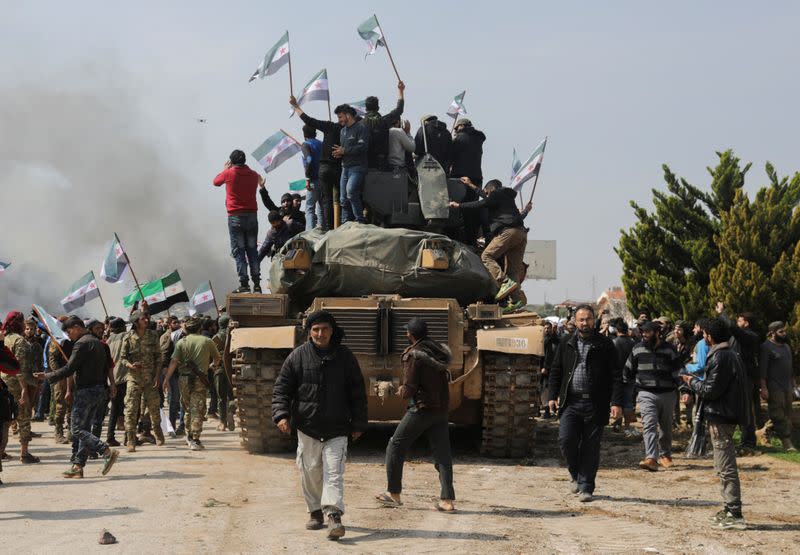
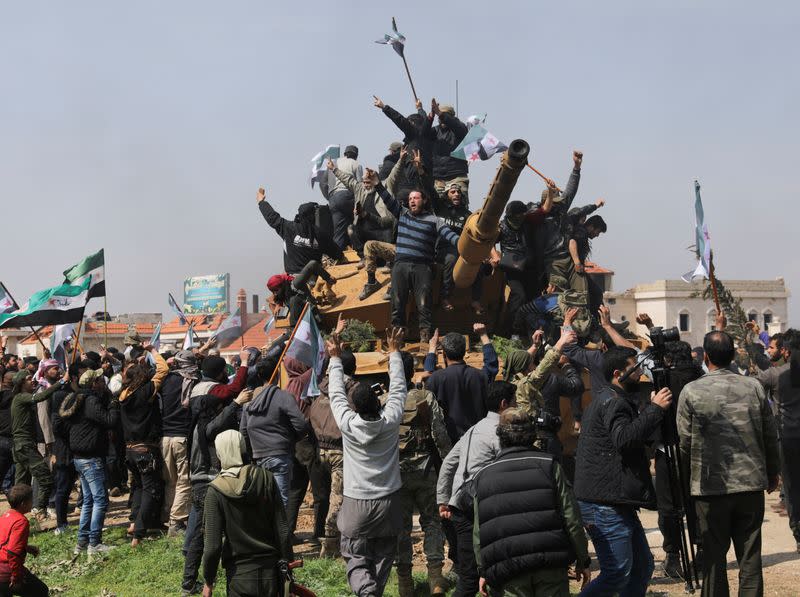
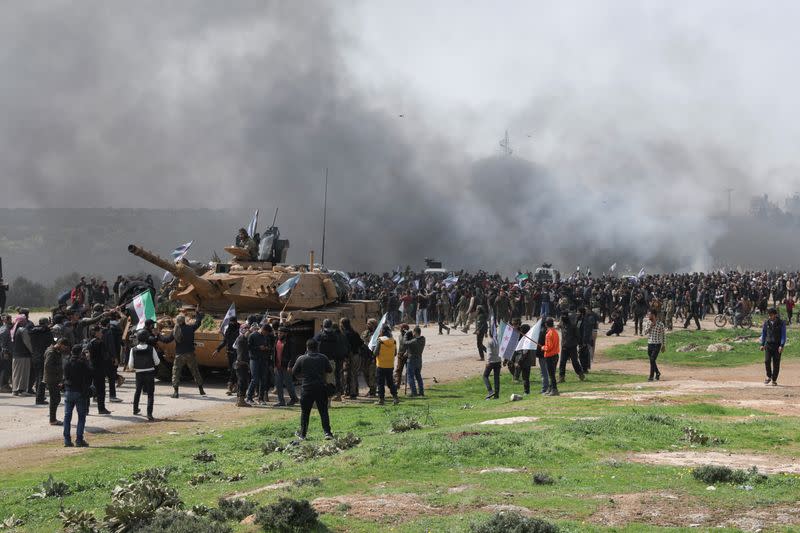
People hold Syrian opposition flags during a protest against an agreement on joint Russian and Turkish patrols, at M4 highway in Idlib province
First Russian-Turkish patrol on Syrian highway cut short by protests
People stand on a Turkish military vehicle during a protest against an agreement on joint Russian and Turkish patrols, at M4 highway in Idlib province

IDLIB,SYRIA/MOSCOW (Reuters) - Russia and Turkey cut short their first joint patrol in Syria's Idlib on Sunday after rebels and civilians opposed to a ceasefire agreement cut off a main roadway to block its path, according to witnesses and Russian news agencies.

The patrol on the M4 highway in Idlib province was the result of a March 5 ceasefire accord between Moscow and Ankara, which back opposing sides in Syria's nine-year war. The ceasefire has largely held since then.

Under the deal, which halted hostilities after an escalation of violence that displaced nearly a million people, Turkish and Russian forces are to establish a security corridor on either side of the M4, as well as carry out joint patrols along it.

But on Sunday hundreds of civilians and rebels cut off the roadway, rejecting the presence of Russian forces and what they said was an agreement that did not guarantee their re-settlement after being pushed out by violence.

"If the patrols happen without people being able to return to their lands, we oppose them," said Osama Rahal, a military commander with the Syrian National Army, a Turkey backed rebel group.

Protesters, some waving Syrian National Army flags, climbed atop Turkish tanks or stood in their path, according to witnesses. Photos posted by the Syrian Observatory, a Britain-based war monitor, showed people lighting fires in the street and forming human chains.

"We are at odds with Russians who have been killing us for six years and have bombed us by air. So we oppose their entry into our towns," said Ahmed Shehad, 22.

The Russian Defense Ministry said the joint patrols were cut short because of rebel "provocations" and civilians being used as a human shield, forcing them to take a shorter route, according to Russian news agency RIA.

Ankara has been given more time to rein in rebels undermining the patrols, the Russian defense ministry said.

The Turkish Defense Ministry said the first patrol had been completed with air and land assets. It released photos showing Russian and Turkish military vehicles traveling along a highway and officers in discussion as they looked at a map.

It subsequently said the two sides in coordination "took necessary measures, with the aim of preventing potential provocations and harm to the civilian population in the region". It did not give further details.


(Reporting by Khalil Ashawi, Andrey Ostroukh and Daren Butler; Editing by Alexandra Hudson)

The Sanders-Biden debate was all about competence, and recent coronavirus poll shows us why
Business Insider•March 15, 2020
Former Vice President Joe Biden, left, and Sen. Bernie Sanders, I-Vt., right, participate in a Democratic presidential primary debate at CNN Studios in Washington, Sunday, March 15, 2020.

AP Photo/Evan Vucci


Senator Bernie Sanders and former Vice President Joe Biden debated each other one-on-one for the first time Sunday night.


This was also the first debate to take place after the coronavirus pandemic exploded in the United States.


Insider has been polling Americans on how they view the preparedness of the government in light of the pandemic.


The results show that people, especially Democrats, don't think the government is prepared.

The first debate to have just two contenders took place Sunday, with the immediate focus of Sen. Bernie Sanders and Vice President Joe Biden being the coronavirus pandemic response from the United States government.

Sanders highlighted the work he and colleagues on the Hill had done to get a initial relief bill through, and emphasized other efforts he wanted to pursue to help workers. Biden laid out his proposal as released late last week for a governmental response, and also spoke about his role in the Obama administration's performance during the previous H1N1 and Ebola epidemics.

The remainder of the debate after the coronavirus portion was much of the same theme: two men with decades of government service arguing that they were the more competent one at various points in their assorted legislative and executive experiences, and saying that they would be the most prepared.

There's a key reason why: Americans, especially Democrats, think the government is not prepared for coronavirus.

From March 13-14, 2020 Insider conducted a poll of 1,081 American adults, asking them "Do you feel the US government is sufficiently prepared to handle coronavirus cases?"


8% said the government was "extremely prepared"


12% said the government was "very prepared"


26% said the government was "somewhat prepared,"


25% said the government was "not so prepared"


25% said the government was "not at all prepared," up 9 percentage points from the previous week.


4% didn't know.

Former Vice President Joe Biden, left, and Sen. Bernie Sanders,
 I-Vt., right, participate in a Democratic presidential primary
 debate at CNN Studios in Washington, Sunday, March 15, 2020. 
(AP Photo/Evan Vucci)

AP Photo/Evan Vucci

The percentage who said "somewhat prepared" or more was down 6 points from two weeks prior, and the percentage who said "not so" or "not at all" prepared is up 10 percentage points.

There's a fairly striking partisan element to this as well.

Among those who identified as slightly liberal or more, 73% say the government is not so or not at all prepared compared to 25% who say they are somewhat, very, or extremely prepared.

Among those who identified as slightly conservative or more, 25% say the government is not so or not at all prepared compared to 72% who say they are somewhat, very, or extremely prepared.

Overall, the U.S. is split on the topic, with a 5 percentage point edge in favor of those who think the federal government is not prepared. But left-leaning voters don't trust the federal government, and as the remaining Democratic primary voters go to the polls, the global pandemic may have put a few people who thought they had made their choice between the candidates in a position to change their mind.

The one thing that Democrats mostly agree on is that the federal government has botched the preparation for coronavirus, and may be looking for a candidate who is more prepared on the issue. That's why tonight's debate left most of the issues that split the primary to the side, and instead focused on one of the core issues for Democrats now: Who was ahead of the curve when it counted, because in their view the government is not ahead of the curve right now.


Read more:


We hired 2 comic creators from the world of DC and Marvel to tell the full story of why Trump was impeached, and what he got away with


Here's how Democrats will elect their presidential nominee over the next several months


DELEGATE COUNT: Here's who's winning the race for the 2020 Democratic nomination

SurveyMonkey Audience polls from a national sample balanced by census data of age and gender. Respondents are incentivized to complete surveys through charitable contributions. Generally speaking, digital polling tends to skew toward people with access to the internet. SurveyMonkey Audience doesn't try to weigh its sample based on race or income. A total of 1,081 respondents were collected March 13-14 2020, a margin of error plus or minus 3.08 percentage points with a 95% confidence level. Previous poll conducted February 27, 2020: 1,051 US Adults were collected via SurveyMonkey Audience , a margin of error plus or minus 3.09 percentage points with a 95% confidence level.

Read the original article on Business Insider
HEY DON'T FORGET ABOUT THE UBIQUITOUS BIRD FLU

Germany confirms case of H5N8 bird flu in poultry farm

Reuters•March 16, 2020

HAMBURG (Reuters) - A case of H5N8 bird flu has been confirmed in a poultry farm in the eastern German state of Saxony, German authorities said on Monday.

The social affairs and protection ministry in the state of Saxony said the case involved bird flu of type H5N8 found on a farm in Bad Lausick near Leipzig. All poultry on the farm has been slaughtered and a quarantine area set up around it.

A series of outbreaks of the disease, which in the past has led to major disruptions and slaughtering programs in Europe's poultry industry, have been reported in Europe in past months.

Bird flu cases have appeared in the four central European countries of Slovakia, Poland, Hungary and the Czech Republic since the end of last year. A previous case was found in a wild bird in Germany in January.

Philippines detects bird flu outbreak in quail farm

Reuters•March 16, 2020
File Photo: A Filipino worker feeds hundreds of chickens at 
a poultry farm in Santa Maria town of Pampanga. 
REUTERS/Romeo Ranoco

MANILA, March 16 (Reuters) - The Philippines has detected an outbreak of avian flu in a northern province after tests showed presence of the highly infectious H5N6 subtype of the influenza A virus in a quail farm, the country's farm minister said on Monday.

Agriculture Secretary William Dar said the bird flu virus, the same strain that hit some local poultry farms in 2017, was detected in Jaen municipality in Nueva Ecija province, where about 1,500 quails had died on one farm alone.

A total of 12,000 quails have been destroyed and buried to prevent further infections, Dar said, citing field reports.

"We are on top of the situation," he said. "Surveillance around the 1-km and 7-km radius will be carried out immediately to ensure that the disease has not progressed around the said perimeter."

Animal quarantine checkpoints have also been set up to restrict the movement of all live domestic birds to and from the quarantine area, he said.

"We would like to emphasise that this is a single case affecting one quail farm only," Dar said.

Dr. Arlene Vytiaco, technical spokeswoman for avian flu at the agriculture department, said that while there is a possibility of transmission to humans through excretion and secretion, "the chances are very slim".

"There is also zero mortality rate," she said.

Dar said his department and the local government were jointly conducting an investigation and contact-tracing to determine the source of infection.

To ensure steady domestic supply of poultry, he said the transport of day-old chicks, hatching eggs and chicken meat will be allowed provided the source farms have tested negative for bird flu.

(Reporting by Enrico dela Cruz; Editing by Stephen Coates)

Mnuchin Shills for Trump’s Botched Oval Office Address


Justin Baragona,The Daily Beast•March 15, 2020


On Sunday, Treasury Secretary Steve Mnuchin waved off the numerous misstatements made by President Donald Trump in his much-criticized Oval Office address last week. Mnuchin insisted that the president didn’t get “things wrong at all” despite the Trump administration having to clarify and correct multiple inaccuracies.

Appearing on ABC’s This Week, Mnuchin boasted that the stock market reacted positively to the announcement of a bipartisan bill to address the coronavirus crisis and Trump’s Rose Garden speech in which private sector companies committed resources to the government.

But host Jonathan Karl retorted that the market had acted “severely negative” to Trump’s address.

“The president said several things. He said that cargo would be banned coming in from Europe,” Karl continued. “He failed to mention that the American citizens would not be subjected to the ban. These were all false statements. How, in an Oval Office address, do statements about the president’s own proposals end up being wrong?”
- ADVERTISEMENT -


Trump’s Coronavirus Speech Sparks ‘Total Chaos’ in His Own Administration

Mnuchin, meanwhile, said that Trump wanted to be “very clear” that he was making a “move to shut down travel so that we shut down more cases coming” into the country.

“He wanted to reassure the American public,” Mnuchin added. “I don’t think in an Oval Office address you can address every single issue as you’re discussing it.”

Shortly after Trump’s Wednesday night address, however, the Department of Homeland Security had to scramble and clarify that the proclamation would not impact Americans and legal permanent residents abroad. Despite the clarification, the 30-day European travel ban has resulted in massive overcrowding at airports due to Americans rushing home, causing lengthy customs waits and heightening the risk of infection through community spreading.

“How does he get things wrong about his own proposal?” Karl shot back, prompting Mnuchin to answer: “I don’t think he got things wrong at all.”

The ABC host would go on to note that Trump also incorrectly said that cargo would be banned, causing Mnuchin to place the blame on the public.

“We were very clear that people misinterpreted the comment on cargo and we immediately put out a statement to clarify that,” Mnuchin insisted. “So the president said this is similar to China and China cargo is not banned.”

Later in the interview, Karl would also press the Treasury secretary on another botched announcement by the president: his claim Google was working on a coronavirus testing website that would be “very quickly done.”

Karl pointed out that Google has since contradicted the president, noting that they are only in the early stages of development of a pilot program in the Bay Area that they had the “hope of expanding more broadly over time.”

When asked when he thought the website would be up and running, Mnuchin admitted that he really doesn't know. But then he optimistically added that he believes it would be made "as quickly as possible."
I DUNNO I SAW THIS PIC AND I THOUGHT OF THIS 
WHEN MAKING THIS MEME


WHILE THIS REMINDS ME OF BERNIE


The US government clarifies when workers must get paid amid coronavirus shutdowns


Alexis Keenan
Reporter,
Yahoo Finance•March 13, 2020


SEATTLE, WA - MARCH 08: The Steelhead Diner, owned by Kevin and Terresa Davis, is closed on March 8, 2020 in Seattle, Washington. According to the owners, the restaurant will be closed :due to the social and economic impacts" over the coronavirus, COVID-19. (Photo by Karen Ducey/Getty Images)More

The U.S. Department of Labor (DOL) posted new guidance this week clarifying compensation requirements for employees who have worked only partial work weeks due to coronavirus-related business closures.

Salaried workers exempt from being paid overtime, if mandated by their employers to stay home, must be paid in full even if they complete only a partial week’s work. Non-exempt workers are not similarly protected. Under the Fair Labor Standards Act (FLSA), employers need only pay non-exempt employees for hours worked, regardless of whether they had been scheduled to work additional time.

“The general rule is that you don't have to pay [exempt workers] for a week in which they perform no work, but if they work a portion of the week then you owe an exempt employee their full salary,” Zach Hutton, an employment lawyer with the Paul Hastings law firm, told Yahoo Finance.

Hutton said he’s been fielding questions from employer clients uncertain of their responsibilities to compensate employees when the quantity of an employee’s work is compromised as a result of working outside the usual place of business. Until the DOL issued its new guidance it was unclear whether a viral outbreak would justify reducing employee compensation.
“The new guidance reinforces that if an employer has a shutdown and instructs employees to stay at home and not work, an exempt employee doesn't have to be paid for a week in which they perform no work, but they generally do have to be paid for a week in which they perform some work,” he said.

Do employers have to pay for work-at-home expenses?

Additional unforeseen expenses that may arise for employers are tied to local rules that can require reimbursement of employee expenses incurred during a work-from-home mandate. In certain states the scenario triggers non-negotiable costs for employers.

In California, for example, employers must reimburse reasonable and necessary employee business expenses, Hutton said. “So if [employers] suggest, or strongly suggest, or require that an employee telecommute,” he said, “then you can unwittingly end up with an obligation to pay for a portion of the employees’ expenses.”

Expenses could include home office equipment, supplies and internet connectivity, just to name a few.

“In the aggregate, that cost can be substantial,” Hutton said.

Though expense reimbursement may be somewhat offset by savings realized due to less trafficked offices, the extent of savings will largely depend on the size and scope of an employer's workforce. Employers that save on maintenance, cleaning services and utilities can’t avoid major fixed costs such as rent, mortgage and insurance premiums.

Ira Klein, also a Paul Hastings attorney, said a decision to instruct employees to work from home during the outbreak should be based on an assessment of an employee’s exposure risk. Exposure risk, he said, can be difficult to assess because they allow for interpretation. Risk levels — low, medium and high — are based on the likelihood of transmission at work, where employees may either contract COVID-19 or spread it to others.

“There's so many different ways to look at risk,” Klein said, explaining that guidance comes from separate agencies and laws that must be read together, including the Centers for Disease Control and Prevention (CDC), the Occupational Safety and Health Administration (OSHA), and state and local authorities.

Under OSHA, he said, healthcare workers who engage in close person-to-person contact are considered high risk. Other layers of risk analysis under OSHA are based on whether the work is performed in an area of widespread transmission, and whether a worker’s job places her in contact with people returning from areas of widespread transmission. Whether a job places a worker in contact with the general public is also considered. CDC guidance differs, Klein said, in that it is more focused on individual employee actions such as travel and sanitary practices.

As COVID-19 spreads, challenges for employers to make the right call are becoming increasingly difficult.

“Guidance from agencies, including the CDC and OSHA, and state level agencies and local health departments, are being updated in nearly real time,” Klein said. “If an employer is doing everything that’s reasonable, given agency guidance from the CDC and OSHA, and an employee still says, ‘I don't want to come to work,’ I think that those are where the hard questions will come up.”

Alexis Keenan is a reporter for Yahoo Finance. Follow her on Twitter @alexiskweed.
Italy's health workers on edge of exhaustion in virus fightFranck IOVENE, AFP•March 14, 2020


On Thursday Italian media reported that in the northern town of Bergamo alone around 50 doctors had tested positive for the virus (AFP Photo/Miguel MEDINA)

Nationwide Italy has more than 1,400 deaths from the virus and 21,000 infections, with a quarter of the country's intensive care beds taken up by those with the illness (AFP Photo/Miguel MEDINA)

Rome (AFP) - A worn-out nurse slumps over her keyboard in a widely shared image symbolic of the extreme fatigue that Italian healthcare workers are facing as they battle Europe's worst outbreak of the novel coronavirus pandemic.

The picture is of Elena Pagliarini, a nurse in the northern region of Lombardy which has been worst hit by the disease.

Nationwide Italy has more than 1,400 deaths from the virus and 21,000 infections, with a quarter of the country's intensive care beds taken up by those with the illness.

In normal times Lombardy is the economic heart of Italy, equipped with one of the world's best health systems.

But those who staff it -- like Pagliarini -- have been put under enormous strain.

"On one hand I was annoyed to see my photo everywhere, I was ashamed of showing my weakness," Pagliarini told the Corriere della Sera newspaper.

"But then I was happy because I got beautiful messages from people who empathised with my story," she said.

"I actually don't feel physically tired, I can work for 24 hours straight if it's necessary but I won't hide the fact that right now I'm anxious because I'm fighting an enemy that I don't know," she added.

She's just one of many healthcare workers who have expressed their concern at the toll that the outbreak is taking, on facilities and personnel alike.

"It's almost two weeks since I've seen my son or my family because I'm worried about infecting them," Daniele Macchini, a hospital doctor in the northern city of Bergamo, (also in Lombardy) wrote in a widely-shared Facebook post.

"I settle for some photos of my son which I look at through my tears, and a few video calls," he says.

- 'Psychologically tired' -

Further south in Tuscany, the health system is also starting to feel the pressure.

A nurse in the Tuscan town of Grossetto, Alessia Bonari, posted an image on Instagram of her face bearing marks from a long day of wearing a surgical mask.

"I'm worried because the mask might not be fitting right on my face, I might touch myself accidentally with dirty gloves, the glasses might not totally cover my eyes," she wrote in the caption.

She said that the protective gear staff had to wear meant that she couldn't drink or go to the toilet for six hours at a time.

To add to the physical fatigue she said she and all her colleagues had been "psychologically tired" for weeks from the workload.

The San Giovanni Bosco hospital in the northern city of Turin this week put a mental health team in place to help its staff counter the stress of the current situation, above all for those working in emergency departments and in intensive care.

"All those who need it can come forward, we're there for everyone," Monica Agnesone, one of the 20 psychologists in the team, told the La Stampa newspaper.

She explained that other doctors and hospital staff were suffering from the "fear of making mistakes, of being infected, of not being able to carry on in these conditions".

On Thursday Italian media reported that in the northern town of Bergamo alone around 50 doctors had tested positive for the virus.

Further south in a hospital in the Puglia region,local media reported that 76 employees had to go into quarantine after being in contact with patients who tested positive for the virus.

Six of them had to be admitted to hospital, with one needing intensive care.

Agnesone's strategies for coping with the stress will no doubt be increasingly called on in the weeks to come.

She recommends "carving out moments where you can detach, re-centre yourself, lowering the level of tension by using breathing exercises and focusing on other things."

Otherwise, she warns, "stress ends up wearing out your energy".

The NBA’s Coronavirus Cancellation and the Workers Left Behind

The season had to be put on hold, but the economic repercussions must be addressed.


By Dave ZirinTwitter MARCH 12, 2020

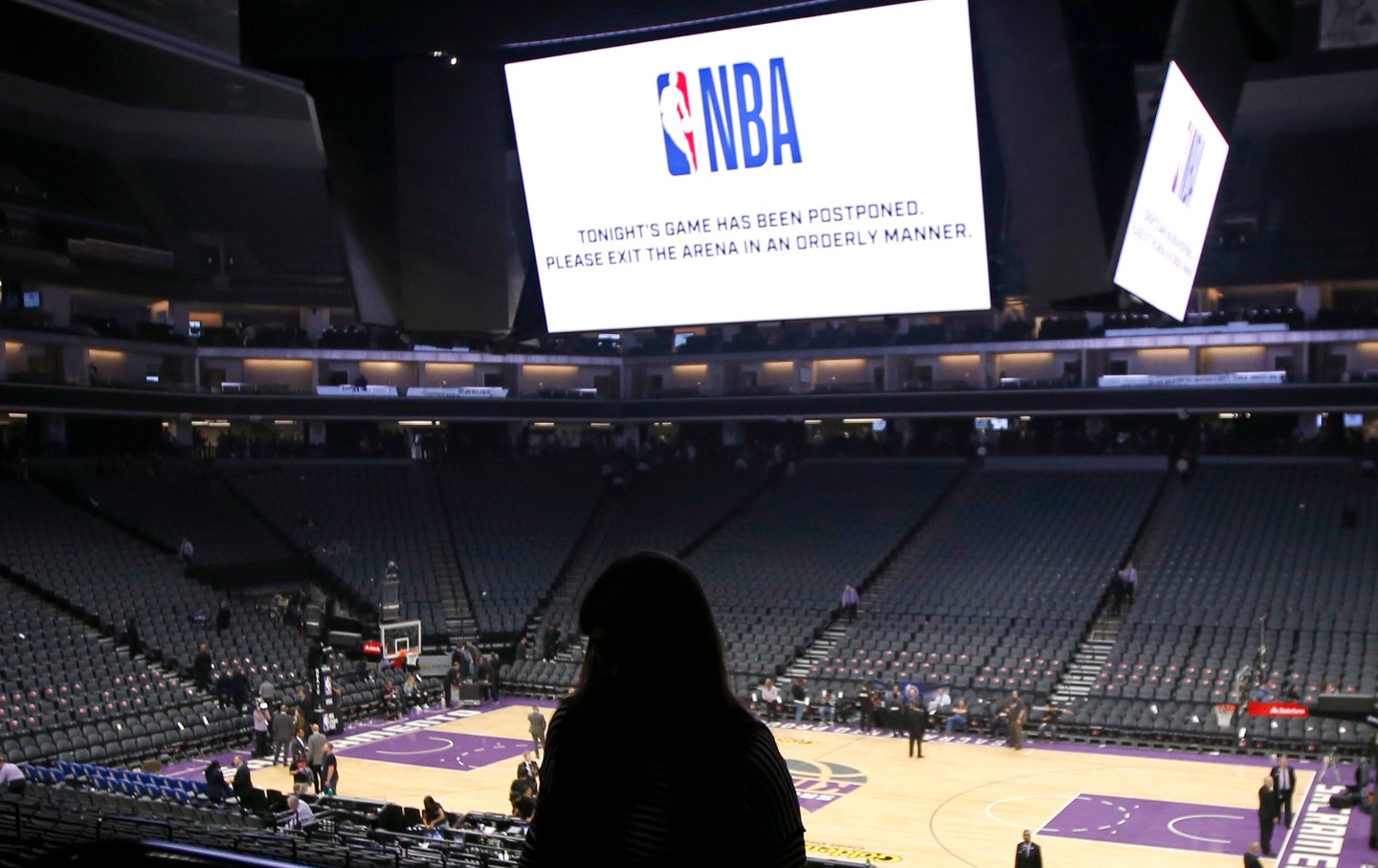
Fans leave the Golden 1 Center after an NBA game in Sacramento, California was postponed as a precaution against the coronavirus on March 11, 2020. (Rich Pedroncelli / AP

The National Basketball Association has acted with a speed that is putting other sports leagues, the NCAA, and particularly the federal government to shame. In the course of a single day, March 11—a day we will perhaps remember as the turning point when people began taking the coronavirus seriously—the NBA moved from planning to wait out the virus, only asking players to fist bump instead of high-fiving the fans, to calling for games to be played in empty arenas, to finally putting the entire season on hiatus.

The NBA made this unprecedented decision after Utah Jazz All-Star center Rudy Gobert tested positive for the virus. Earlier this week, in an act that will go down in history as a symbol of our own hubris, Gobert touched every microphone in the press room—mocking the very idea that there was a communicable virus in our midst. After his diagnosis, the Jazz game in Oklahoma City against the Thunder was canceled right before tip-off, with confused fans milling about the concourses and both teams quarantined back in their locker rooms. If there was one scene that speaks to how quickly we’ve gone from blasé to terrified, it was seeing Chris Paul, the All-Star point guard for the Thunder and a respected union leader, come over to the Jazz bench to see what the hell was going on and be waved away fiercely as if he was about to walk through hell in a gasoline suit.

The NBA had to make this decision, for the players’ safety as much as the public’s. Few professions involve more travel and interaction with literally millions of people than professional basketball. The league could have become a COVID-19 roadshow, infecting populations in city after city. Commissioner Adam Silver had no choice but to pull the plug.


The collateral damage will be stark. It’s not merely about the integrity of the 2019–20 season. That seems pretty irrelevant at the moment. The bigger concern is the pain this will cause communities, particularly the thousands of low-wage workers who labor in NBA arenas. For many families, one paycheck away from calamity, this loss of income is catastrophic. Only one NBA owner thus far, Mark Cuban of the Dallas Mavericks, has stepped forward and said that he is developing a plan for employees of the team and the arena, saying, “I reached out…to find out what it would cost to financially support people who aren’t going to be able to come to work.”

The 29 other billionaires who own these teams, for public relations reasons alone, need to step up and tell the public how they are going to help the workers, particularly the low-wage workers who make arenas run, through this difficult time. Bob Myers, the president of the Golden State Warriors, did say, “We feel for the workers, mostly, the low-wage earners that count on working our games.” But workers need more than their sympathy. They need paid leave.

And even paid leave won’t help the people who sell bootleg goods outside the arenas, making their living through the underground, informal economy that surrounds sporting events around the world. I spoke to one of those workers last night, who said to me, “I don’t know what I’m going to do. I need that money. Without it, my family is in hella trouble. And if we get sick, I don’t even know.”


We also need more NBA players’ using their platform to speak out during this difficult time. Monty Williams, coach of the Phoenix Suns, said earlier this week, “I heard the test costs like $1,400. Who can pay for that other than folks who have excess money? People are dying. That test should be free.”

That is step one. NBA players now affected by this could make a tremendous difference by spreading public awareness.

For now, given first the death of Kobe and Gianna Bryant and now the hiatus of the season, I think many fans echo the words of LeBron James, who tweeted, “Man we cancelling sporting events, school, office work, etc etc. What we really need to cancel is 2020!”

Dave ZirinTWITTER

Dave Zirin is the sports editor of The Nation.