Sunday, July 05, 2020

UPDATED 
Protesters In Baltimore Pulled Down A Statue Of Christopher Columbus And Threw It Into The Harbor

The statue is the latest in a list of monuments depicting enslavers and colonizers that have been torn down amid Black Lives Matter protests.


Stephanie K. Baer BuzzFeed News Reporter

Posted on July 4, 2020,

Protesters tore down a statue of Christopher Columbus and tossed it into the harbor in Baltimore Saturday night in what is the latest monument depicting enslavers and colonizers in the US to topple.

Videos showed demonstrators cheering as they pulled down the statue near the city's Little Italy neighborhood with rope, and later pushing it into the water.


spencer compton@spencercompton
Baltimore just tore down the Columbus statue ✊🏿✊🏾✊🏽✊🏼✊🏻 #blacklivesmatter12:54 AM - 05 Jul 2020
Reply Retweet Favorite


Dedicated in 1984, the marble statue is one of three monuments to Columbus in the city, according to the Baltimore Sun. This week, the city council introduced a bill to rename one of the Columbus statues in honor of victims of police brutality.


J. M. Giordano photo@jmgpix
Baltimore’s Columbus statue gets dumped in the harbor01:03 AM - 05 Jul 2020
Reply Retweet Favorite


Amid a global reckoning over police brutality and violence against Black and Indigenous people, protesters have been tearing down statues of Confederacy leaders, enslavers, and colonizers.

Last month, protesters brought down a bronze statue of Confederate president Jefferson Davis in Richmond, Virginia, and demonstrators in Boston beheaded a statue of Columbus.


MORE ON THIS
Protesters Tore Down A Statue Of Confederate President Jefferson Davis In VirginiaAmber Jamieson · June 11, 2020


Stephanie Baer is a reporter with BuzzFeed News and is based in Los Angeles.


Columbus statue toppled by Baltimore protesters
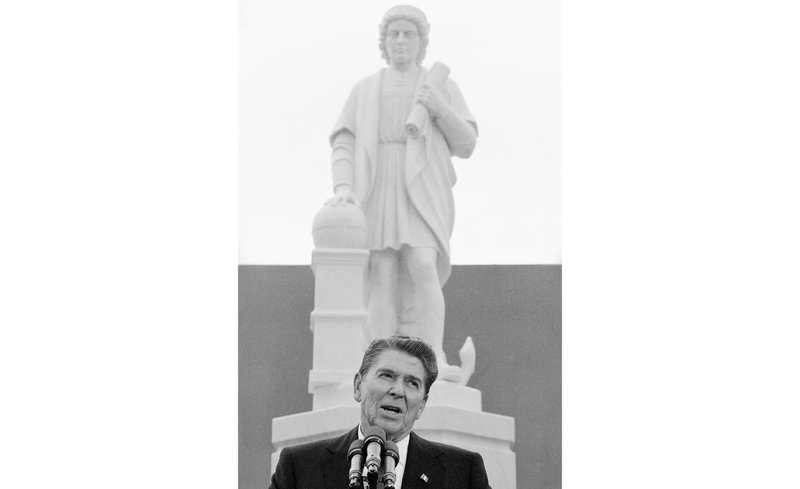
In this Monday, Oct. 9, 1984, file photo, President Ronald Reagan addresses a ceremony in Baltimore, to unveil a statue of Christopher Columbus. Baltimore protesters pulled down the statue of Christopher Columbus and threw it into the city's Inner Harbor, Saturday, July 4, 2020. (AP Photo/Lana Harris, File)

BALTIMORE (AP) — Baltimore protesters pulled down a statue of Christopher Columbus and threw it into the city’s Inner Harbor on Saturday night.

Demonstrators used ropes to topple the monument near the Little Italy neighborhood, news outlets reported.

Protesters mobilized by the death of George Floyd at the hands of police have called for the removal of statues of Columbus, Confederate figures and others. They say the Italian explorer is responsible for the genocide and exploitation of native peoples in the Americas.

According to The Baltimore Sun, the statue was owned by the city and dedicated in 1984 by former Mayor William Donald Schaefer and President Ronald Reagan.

A spokesman for Baltimore Mayor Bernard C. “Jack” Young told The Sun the toppling of the statue is a part of a national and global reexamination over monuments “that may represent different things to different people.”

“We understand the dynamics that are playing out in Baltimore are part of a national narrative,” Lester Davis said.

Statues of Columbus have also been toppled or vandalized in cities such as MiamiRichmond, VirginiaSt. Paul, Minnesota; and Boston, where one was decapitated.

The Latest: Confederate statue in Maryland toppled
yesterday

The Latest on protests over racial inequality:


(AP) LOTHIAN, Md. — A privately owned Confederate statue at a Maryland church has been toppled and vandalized, according to police.

The Capital Gazette reports that photos provided by Anne Arundel County police show that the statue at Mt. Calvary Anglican Church in Lothian was ripped off its concrete platform.

The word “racist” was written in red spray paint on the platform and descriptive plaque for the statue of Private Benjamin Welch Owens, who served in a Confederate Maryland artillery unit during the Civil War.

Police said the statue was last seen undamaged late Thursday. No suspects were immediately identified.

People aren’t stupid’: Pence’s virus spin tests credibility

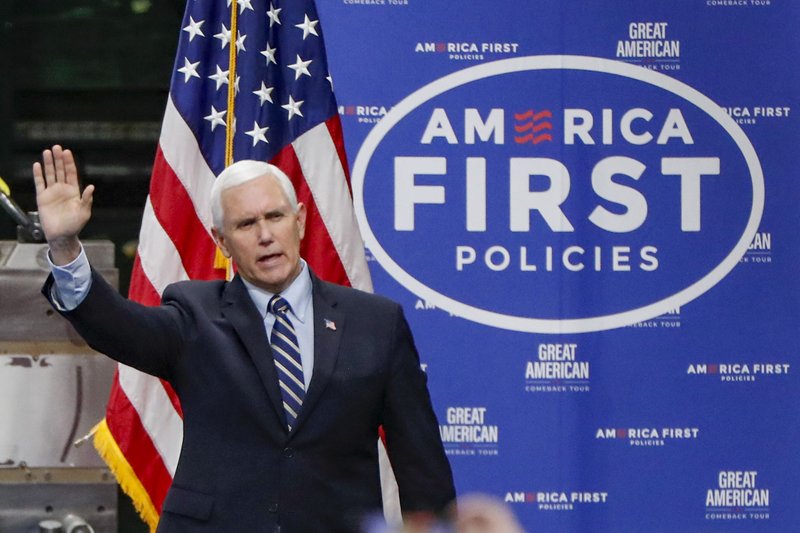
FILE - In this June 12, 2020, file photo Vice President Mike Pence, waves as he arrives to speak after a tour at Oberg Industries plant in Sarver, Pa. As the public face of the administration's coronavirus response. Vice President Mike Pence has been trying to convince Americans that the country is winning even as cases spike in large parts of the country. For public health experts, that sense of optimism is detached from reality. (AP Photo/Keith Srakocic, File)


WASHINGTON (AP) — Vice President Mike Pence has long played the straight man to Donald Trump, translating the president’s bombast into more measured, calming language.

His job has become even more difficult. As coronavirus cases spike across large parts of the country despite months of lockdown, Pence has spent the past week trying to convince the American public that things are going very well, even though they’re not.

“Make no mistake about it, what you see today is that America is going back to work and the American people are finding a way every day to put this coronavirus farther in the past,” he told CNBC the same day the country reported more than 55,000 new virus cases, a daily record.


For public health experts, the optimism has been unmoored from reality.

“It’s almost laughable because it doesn’t pass any test of credibility when we’re seeing spikes in cases, spikes in hospitalizations,” said Larry Gostin, who specializes in public health at Georgetown University Law School. “The American people aren’t stupid. They can see spin when there is spin.”

The most important thing Pence can do, Gostin said, “is to be honest with the American public. ... They need to be told the truth and then they need to be told what America is going to do to turn this around.”

It’s not the first time Pence has been forced to put his own credibility on the line as he serves as Trump’s most loyal soldier. It may be the most consequential.

While Trump has tried to distance himself from what he calls “the plague” as he pursues reelection, Pence has emerged as the public face of this phase of the outbreak, traveling frequently to virus hot spots, coordinating with governors and leading the administration’s coronavirus task force.

The role, according to those close to him, is a natural fit for Pence, a former Indiana governor who sees it as his job to defend the president and reopen the country as safely as possible. But allies are keenly aware that Pence’s political future will hinge on whether Trump wins a second term.

If Trump loses, and Pence makes his own run at the presidency in 2024, he probably would face many candidates from a new generation of politicians. That could include Nikki Haley, former ambassador to the United Nations and South Carolina governor, and Sen. Tom Cotton, R-Ark.

Robert Blendon, a professor of health policy and political analysis at the Harvard T.H. Chan School of Public Health, said Pence faces a “real dilemma” because Trump’s reelection depends so much on an economic rebound predicated on states reopening during the pandemic.
From a public health perspective, “We’re actually losing again. It’s getting worse. We’re going to have to cut back in the economy,” he said.

After spending time on the road highlighting reopening efforts, Pence traveled this past week to Arizona and Florida, states where cases are surging. He tried to make the case that the country is in a far improved position now than it was early on in the outbreak when testing capacity was dismal and doctors and nurses were desperate for basic protective equipment.

“The American people deserve to know that we’re in a much better place today, thanks to the whole-of-government approach, the whole-of-America approach that President Trump initiated at the very outset of the coronavirus pandemic,” Pence said Tuesday during a task force briefing held not at the White House but at the U.S. Public Health Service headquarters in Rockville, Maryland.

White House officials and allies stress there are positive signs beyond the flow of supplies, with deaths remaining down and several therapeutics on the market. The point of the lockdowns, they stress, was to flatten the infection curve to avoid overwhelming hospitals, not eliminate cases.

To further push that message, Pence is expected to resume campaign travel soon. Campaign officials met by phone on Thursday to map out media markets where they feel he could be beneficial.

While Trump favors large-scale rallies, Pence will continue to focus on more intimate settings, inducing diner visits, bus tours and smaller speaking engagements, especially in front of groups such as white evangelicals and suburban families who may be more receptive to a less hyper-political message.

Pence will focus on swing states by stressing local issues and trying to show voters how the administration has affected their lives for the good. He’s expected to spend plenty of time in states such as Wisconsin, Pennsylvania and Michigan, as well as Arizona and North Carolina, talking about bringing back manufacturing jobs. It’s a promise Trump made in 2016 that has been largely unmet.

At the same time, however, Trump’s campaign recently disbanded a team of staffers dedicated to Pence, including his communications director, spokesperson and the director of vice presidential operations. Strategy and planning are now being handled by Marty Obst, a longtime Pence adviser who served as his campaign manager in 2016, and Marc Short, his chief of staff.

While some described the move as a natural transition given the vice president already has a full staff at the White House, others said it suggested a diminished role on a campaign that sees Pence more as a surrogate than a principal.

Trump campaign spokeswoman Ali Pardo dismissed that suggestion, saying Pence “has played an integral role in promoting and implementing President Trump’s ‘America First’ agenda across the country.”

Pence has made clear he feels this is Trump’s campaign and he has every right to run it how he wants.

Barry Bennett, a longtime Republican strategist who worked for Trump in 2016, praised Pence’s performance.

“He has a very tough job. But so far I think he’s managed to do it with compassion and integrity,” he said. “He’s probably the only that’s come out of the pandemic experience with positive results.”

As monuments fall, Confederate carving has size on its side

By KATE BRUMBACK and RUSS BYNUM

1 of 3
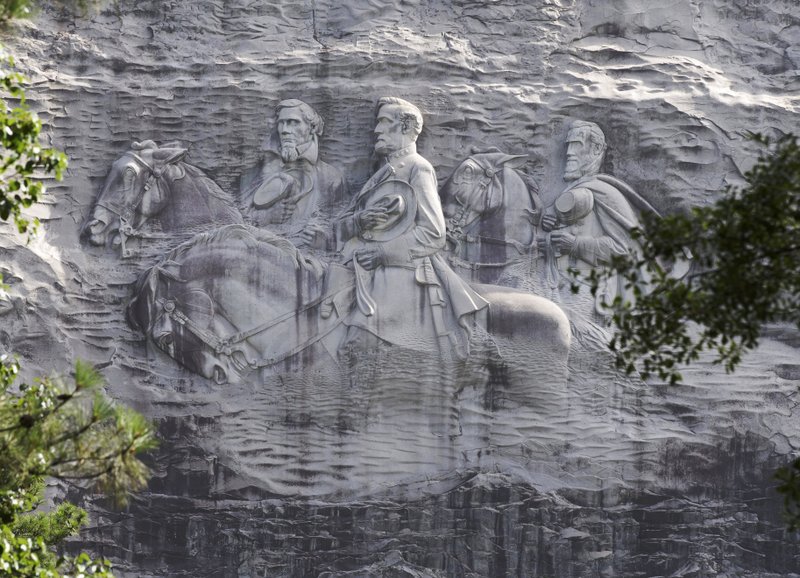
FILE - This June 23, 2015 file photo shows a carving depicting Confederate Civil War figures Stonewall Jackson, Robert E. Lee and Jefferson Davis, in Stone Mountain, Ga. The sculpture is America's largest Confederate memorial. (AP Photo/John Bazemore, File)
STONE MOUNTAIN, Ga. (AP) — Some statues of figures from America’s slave-owning past have been yanked down by protesters, others dismantled by order of governors or city leaders. But the largest Confederate monument ever crafted — colossal figures carved into the solid rock of a Georgia mountainside — may outlast them all.

Stone Mountain’s supersized sculpture depicting Gen. Robert E. Lee, Confederate President Jefferson Davis and Gen. Thomas J. “Stonewall” Jackson mounted on horseback has special protection enshrined in Georgia law.

Even if its demolition were sanctioned, the monument’s sheer size poses serious challenges. The carving measures 190 feet (58 meters) across and 90 feet (27 meters) tall. An old photo shows a worker on scaffolding just below Lee’s chin barely reaching his nose.

NICE WHITE PEOPLE
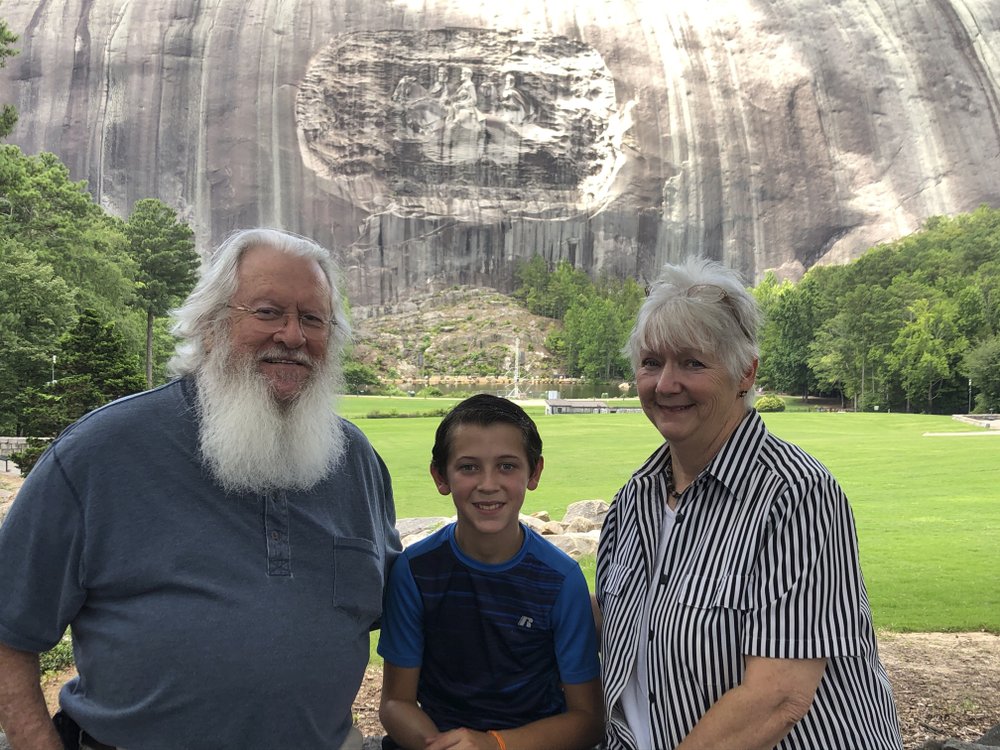
Paula and Michael Smith pose for a photo with their 10-year-old grandson, Evan, in front of a giant carving of Confederate figures during a visit to Stone Mountain Park, Monday, June 29, 2020. “The mountain itself is absolutely breathtakingly beautiful and the carving is an engineering marvel,” said Paula Smith, a 70-year-old white woman who dismissed talk of removing or altering the carving as an attempt to “steal American history.” (AP Photo/Kate Brumback)

Numerous Confederate statues and monuments to American slave owners have come down across the South amid recent protests against racial injustice. Stone Mountain hasn’t escaped notice.

After organizing a protest where thousands marched in neighboring Atlanta, 19-year-old Zoe Bambara held a demonstration June 4 with a much smaller group — her permit allowed no more than 25 — inside the state park where the sculpture has drawn millions of tourists for decades.

“The Confederacy doesn’t celebrate the South; it celebrates white supremacy,” said Bambara, who is Black. “The people on that mountain, they hated me. They didn’t know me, but they hated me and my ancestors. It hurts to see those people celebrated and a memorial dedicated to them.”

Still, Bambara admits she’s at a loss for what should be done with the massive monument, conceived some 50 years after the Civil War ended but not finished until 1972.

The sculpture’s creators used dynamite to blast huge chunks of granite away from the mountain, then spent years carving the detailed figures with hand-held cutting torches.

Erasing the carving would be dangerous, time-consuming and expensive.

The stone is likely too durable for sandblasting, said Ben Bentkowski, president of the Atlanta Geological Society. Controlled explosions using TNT packed into holes drilled in the mountainside would work, he said.

“With the logistics, the safety aspect of it, you’d have a budget certainly north of $1 million, I suspect,” Bentkowski said. “You’ll need insurance for the project, you’ll need hazard pay for people working on the surface of it. It could easily take a year or more.”
ADVERTISEMENT


There’s also a sizable legal obstacle.

When Georgia lawmakers voted in 2001 to change the state flag that had been dominated by the Confederate battle emblem since 1956, language to guarantee the preservation of the Stone Mountain sculpture was included as a bargaining chip.

The law states that “the memorial to the heroes of the Confederate States of America graven upon the face of Stone Mountain shall never be altered, removed, concealed, or obscured in any fashion.”

Ryan Gravel, an Atlanta-based urban designer, noted the law doesn’t mandate maintenance. He suggested allowing nature to take its course, letting vegetation grow over the sculpture from its nooks and crannies.

“I think we’re in a moment where pushing the limits of that law is possible,” Gravel said. “And certainly the scale of the challenge at Stone Mountain warrants that.”

Other ideas — such as adding a bell tower atop the mountain in honor of the Rev. Martin Luther King Jr. — have failed to take hold. And Democratic proposals to strip the protective language from Georgia law have fallen flat with the Republican-controlled Legislature.

Asked whether Stone Mountain still deserves special protection, GOP Gov. Brian Kemp didn’t give a direct answer when speaking to reporters June 26.

“As I’ve said many times, we can’t hide from our history,” Kemp said, while citing the new hate crimes law he signed the same day as a significant step in fighting racial injustice.

Stone Mountain wasn’t a battle site and had little historical significance to the Civil War. But 50 years after the war ended, the exposed surface of the mountain’s northern face sparked an idea among the United Daughters of the Confederacy.

“It looked like a giant billboard,” said Stan Deaton, senior historian for the Georgia Historical Society.

The group hired sculptor Gutzon Borglum — who later would carve Mount Rushmore — to design a massive Confederate monument in 1915.

That same year, the movie “The Birth of a Nation” glorified the Reconstruction-era Ku Klux Klan and Stone Mountain played a key role in its resurgence, marking its comeback with a cross burning atop the mountain on Thanksgiving night.

Budget problems plagued the Stone Mountain project and work on the sculpture languished until the state bought the mountain and surrounding land in 1958 for a public park. Finishing the monument gained renewed urgency as the civil rights movement brought unwanted change to defiant Southern states.

“It became the centerpiece of the park,” Deaton said. “There was never any doubt that the state’s intention of finishing this was of a piece with massive resistance.”

An estimated 10,000 people attended the monument’s dedication in 1970. Another two years passed before its official completion.

Five decades later, the park at Stone Mountain markets itself as a family theme park rather than a shrine to the “Lost Cause” mythology that romanticizes the Confederacy as chivalrous defenders of states’ rights. Its website highlights miniature golf and a dinosaur-themed attraction while downplaying the Confederate carving, Confederate flags and brick terraces dedicated to each Confederate state.

Paula and Michael Smith of Monticello, Georgia, visited Stone Mountain on Monday so their 10-year-old grandson could see the monument for the first time.

“The mountain itself is absolutely breathtakingly beautiful and the carving is an engineering marvel,” said Paula Smith, a 70-year-old white woman who dismissed talk of removing or altering the carving as an attempt to “steal American history.”

Jarvis Jones climbs the steep hiking trail on the back side of Stone Mountain several times a week. The 29-year-old Black man said he tries to avoid seeing the carving.

“I definitely understand everyone wants their history to be represented,” Jones said. “But when it comes to the oppression of other people, I think it needs to change.”

___

Bynum reported from Savannah, Georgia. Associated Press writers Ben Nadler and Jeff Amy in Atlanta contributed to this story.


Israeli leader’s son takes center stage in corruption sagas
RIGHT WING CONSPIRACY NUT

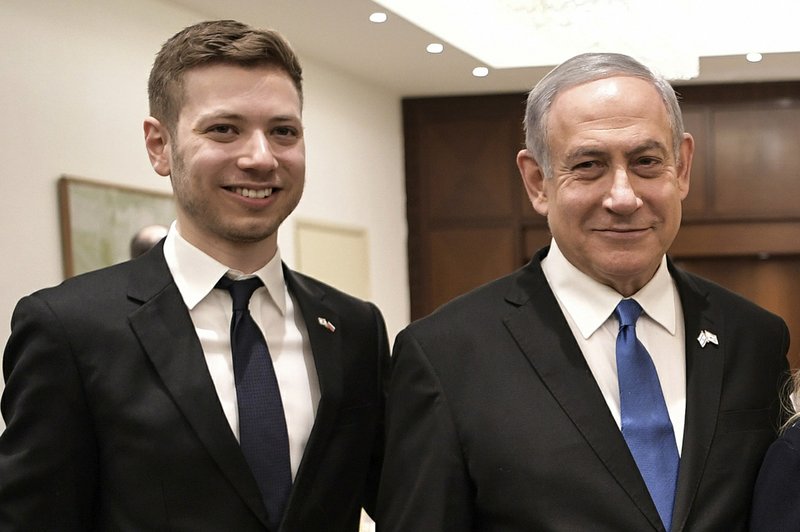
FILE - In this Jan. 23, 2020, file photo, Israeli Prime Minister Benjamin Netanyahu, second from left, and son Yair, left, pose for a photo in Tel Aviv, Israel, ahead of the World Holocaust Forum. As the scandal-plagued prime minister stands trial for corruption, his 28-year-old son has emerged as a driving force in a counterattack against critics and the state institutions prosecuting the longtime Israeli leader. A favorite of the prime minister’s nationalistic base and far right leaders around the world, Yair Netanyahu has become a fixture in the news. (Aleksey Nikolskyi/Sputnik Kremlin Pool Photo via AP, File)

JERUSALEM (AP) — As scandal-plagued Prime Minister Benjamin Netanyahu stands trial for corruption, his 28-year-old son has emerged as a driving force in a counterattack against critics and the state institutions prosecuting the longtime Israeli leader.

A favorite of the prime minister’s nationalistic base and far right leaders around the world, Yair Netanyahu has become a fixture in the news, clashing with journalists on social media, threatening lawsuits against his father’s adversaries and posting online content deemed so offensive that Facebook briefly suspended his account.

In the past month alone, he has called to banish minorities from Tel Aviv, tweeted a discredited conspiracy theory that former President Barack Obama was born in Kenya and intimated that a critical Israeli broadcast journalist slept her way up to her coveted job.

But his toughest broadsides have been directed at the Israeli media, judiciary and law enforcement for conducting what he has called a leftist, ideological crusade to topple his father. He’s called for the attorney general to be investigated for his “crimes,” compared the police chief to fictional mob boss Tony Soprano and described investigators as the Stasi, Gestapo and “the political police of the Israeli junta.”

It’s part of a campaign, echoed to a lesser degree by his father, that critics warn is eroding public faith in Israel’s democratic institutions.

“We would love to just disregard him as a curiosity, as this difficult kid who keeps embarrassing his father. But the truth is there is evidence that he is very influential,” said Raviv Drucker, a well-respected investigative TV reporter and favorite target of the Netanyahus, whom both father and son recently tweeted they would like to see imprisoned. “He holds very extreme positions and it affects the prime minister’s actions.”
Though he holds no official position, Yair Netanyahu is considered a key adviser and the mastermind of his father’s increasingly confrontational social media strategy.

Netanyahu faces charges of fraud, breach of trust and accepting bribes in a series of corruption cases stemming from ties to wealthy friends. He denies the charges, which follow years of scandals swirling around the family.

For years, it was his wife, Sara, who drew most of the fire because of her extravagant tastes, misuse of state funds and alleged abuse of her staff. But recently, his eldest son has taken center stage. He’s figured prominently in various scandals while earning a reputation of living a life of privilege at taxpayers’ expense.

Australian billionaire James Packer, one of the figures in the prime minister’s corruption indictments, reportedly gave the younger Netanyahu gifts that included stays at luxury hotels in Tel Aviv, New York and Aspen, Colorado, as well as the use of his private jet and dozens of tickets for concerts by Packer’s former fiancée, Mariah Carey. Nir Hefetz, a former Netanyahu aide turned state witness against him, told police that Yair Netanyahu was the major instigator of the bribery case against his father.

Yair Netanyahu has also sparked controversy by posting an anti-Semitic caricature aimed at his father’s critics, vulgarly confronting a woman who told him to pick up after his dog at a park, and tweeting that he hoped elderly leftist protesters would die of COVID-19.

The prime minister has been forced to denounce some of his son’s behavior, like a particularly lewd outing to a strip club with wealthy friends. But generally, he staunchly defends his son.

Anshel Pfeffer, a columnist for the Haaretz daily and author of a recent biography of the prime minister, said Yair Netanyahu enables his father to test boundaries of what the public will accept.

“If he goes too far, they can say it’s only Yair,” he said. “It gives him deniability, creates a gray area and blurs the lines on what the prime minister is saying on record.”
Yair Netanyahu was only 4 when his father first became prime minister in 1996 and has grown up in the limelight. During his compulsory army service, he was assigned as a liaison to foreign media. He was once court-marshaled for taking an unauthorized furlough.
He’s volunteered for local animal welfare organizations and briefly worked as a social media director for an Israeli NGO providing legal services to victims of Palestinian attacks. But he was put on leave after attacking Israel’s figurehead president for advocating Jewish-Arab coexistence.

As a private citizen, Yair Netanyahu has published op-eds for Breitbart, gone on U.S. and European speaking tours and voiced support for right-wing extremists in the U.S. and Europe. He has earned their praise in return.

Supporters claim he is a victim of the same people targeting his father. But the media have largely ignored his older half-sister Noa and his younger brother Avner, an unassuming 26-year-old university student who generally keeps to himself.

Yair Netanyahu, who still lives with his parents and declined to comment, claims to have no political aspirations. In his lone interview to Israeli media, he lamented last year to the pro-Netanyahu Channel 20 about the cost his family pays for their status. He said the three years his father was out of politics in the early 2000s were their happiest ever.

“My father decided to put the good life he had aside and get back into all this mud because of his calling,” he said. “My only political involvement is what you see on my private Facebook and Twitter.”

On Twitter, where he has more than 80,000 followers, he lashes out dozens of times a day and his feed often dictates the following news cycle. Facebook blocked his account for 24 hours in 2018 for sharing banned content and writing that he would prefer an Israel without Muslims.

His brand of provocation has proven irresistible to politicians, journalists and commentators alike, many of whom have been drawn into bouts of mud-slinging with him. Even so, at least a half dozen of his former targets refused to comment, citing his unofficial role and litigious nature.

—-

Follow Aron Heller on Twitter at www.twitter.com/aronhellerap
UPDATED
JULY 3 RESISTANCE TO TRUMPS INVASION OF SIOUX NATION
THE SAME NATION HE DECLARED WAR ON OVER THE 
KEYSTONE PIPELINE 


PURIFYING THE SPACE AND THE INVADERS
 WITH SACRED SAGE


DISARM, DEMILITARIZE, DEFUND, POLICE


LIKE THEIR PREDECESSORS THE WHITE SUPREMACIST
COLONIZERS BRING THEIR ARMY AND THEIR DISEASES
WITH THEM, TO THIS CULT RALLY OF ARYAN NATIONALIST
CHRISTIAN CONFEDERATES.

THE FIRST NATIONS HAVE SUFFERED HEAVILY

UNDER COVID-19 WITH NO FUCKING HELP FROM THE AMERICAN
GOVERNMENT


SINCE TRUMP HAS DECIDED IT'S 1968 AGAIN
 HERE  IS A RON COBB CARTOON FROM THEN
Ron Cobb & Earth Day

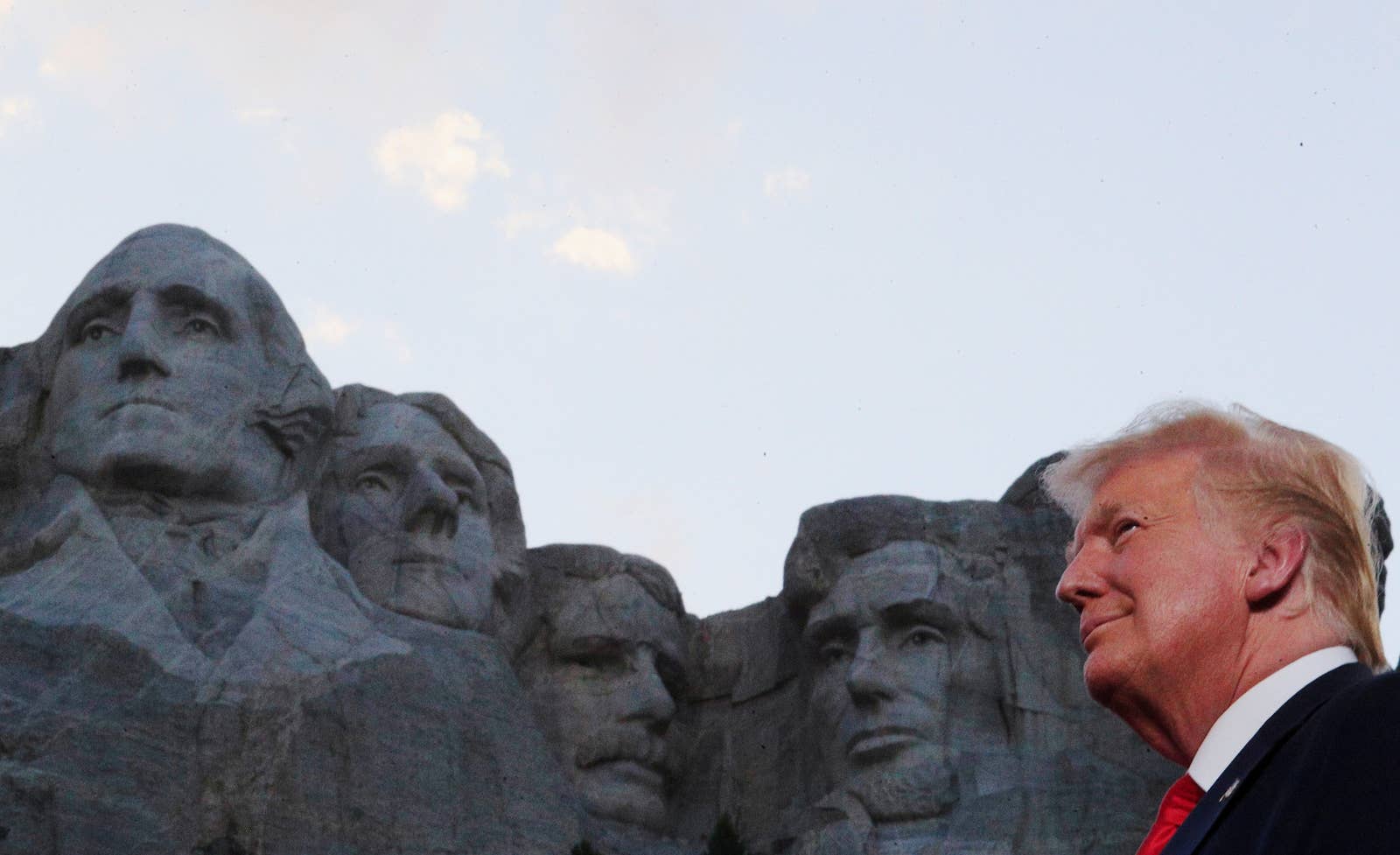
MEANWHILE RUMOURS PERSIST THAT TRUMP

WANTS TO BE ON MOUNT RUSHMORE IF HE
WINS RE-ELECTION 
SEEN HERE FRIDAY SIZING UP HIS PROFILE.


FROM


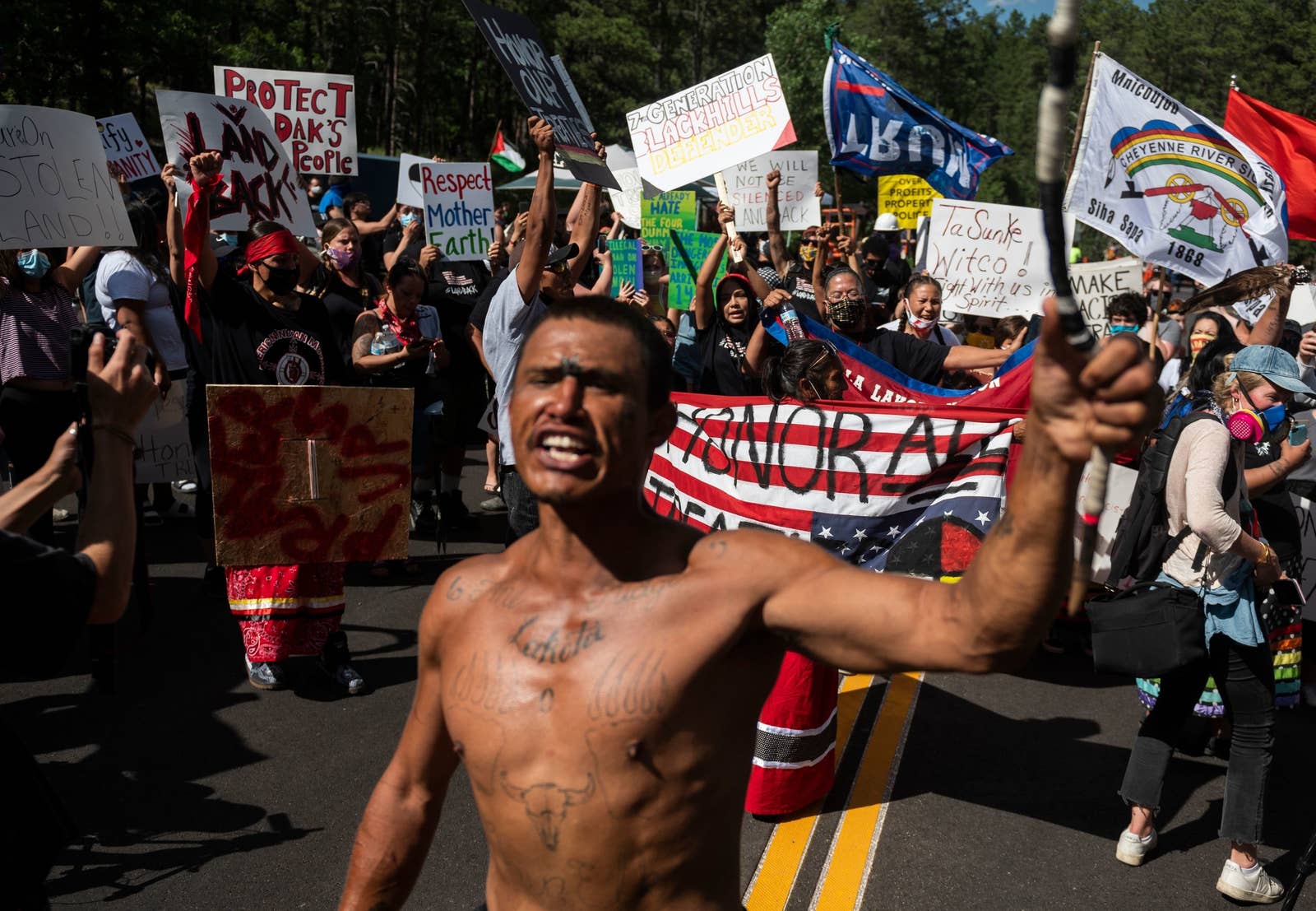
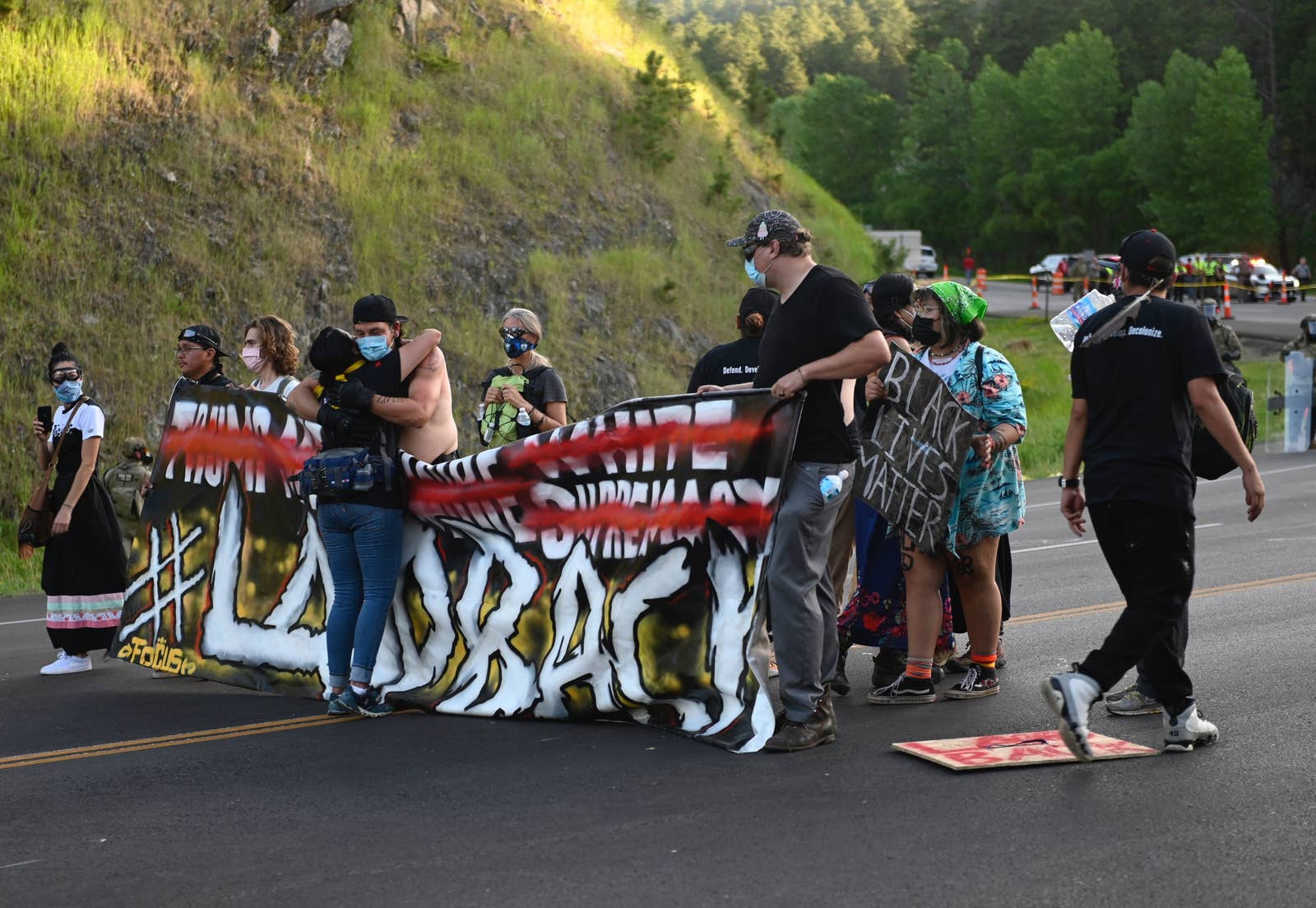
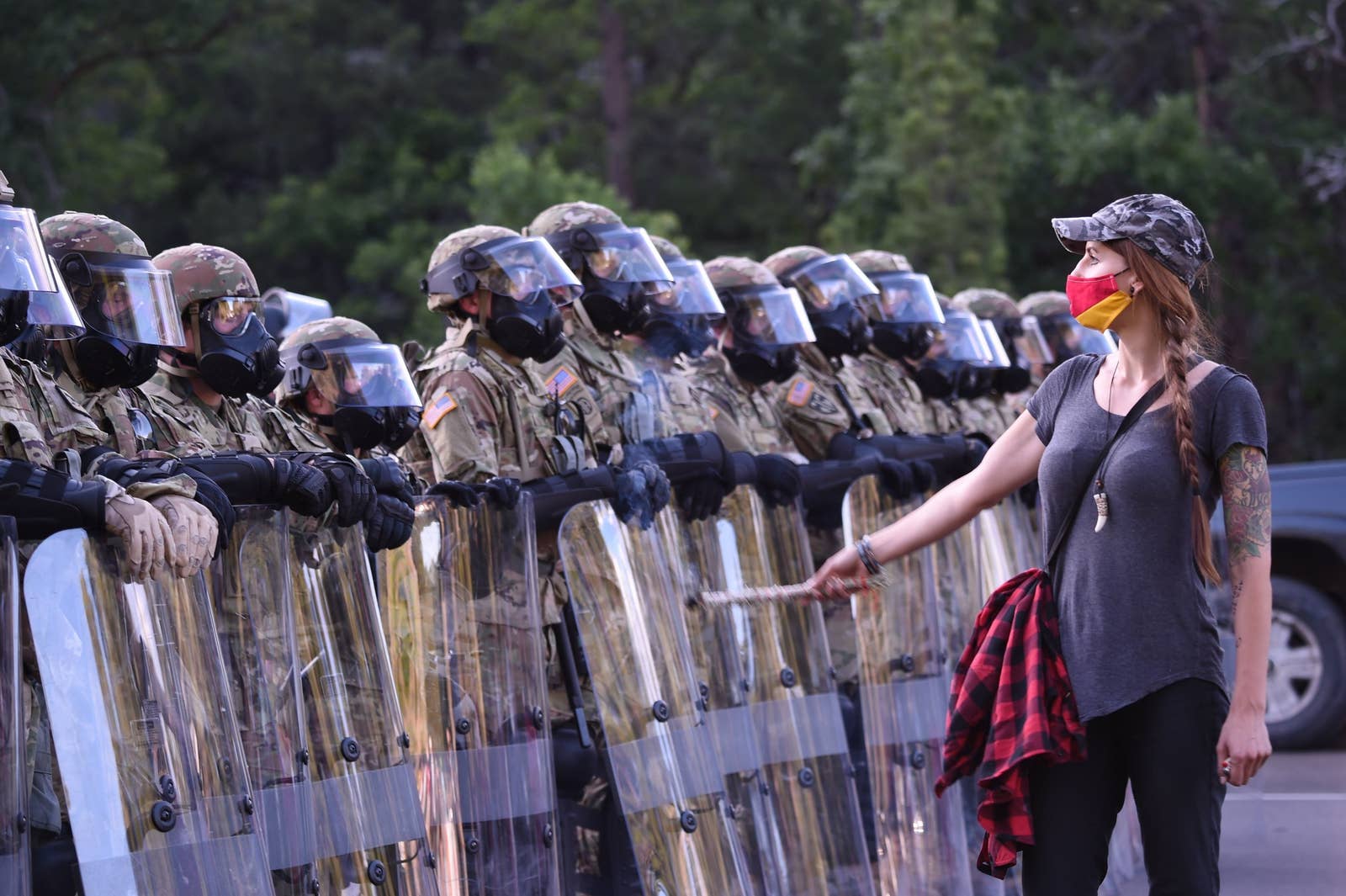
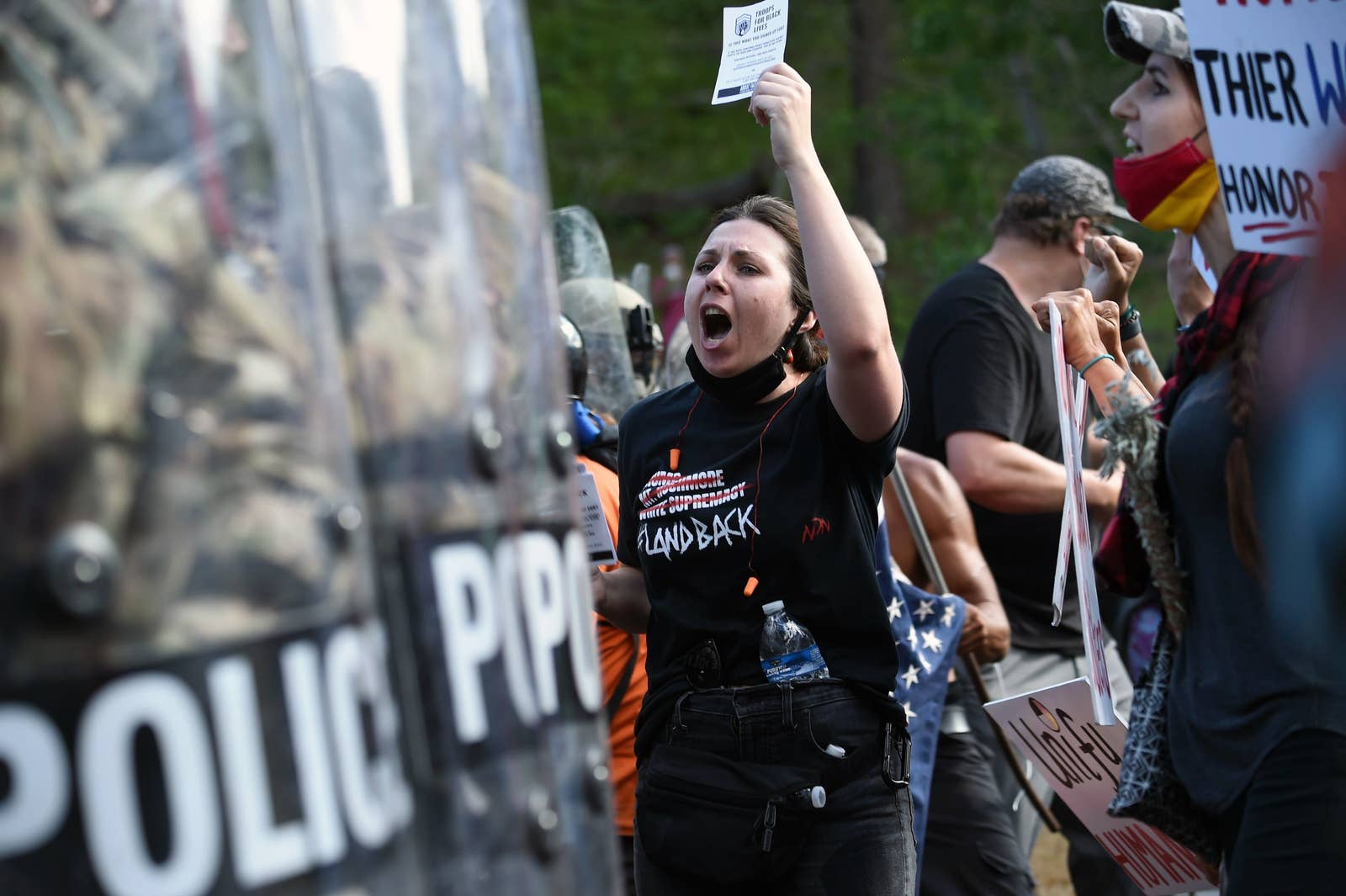
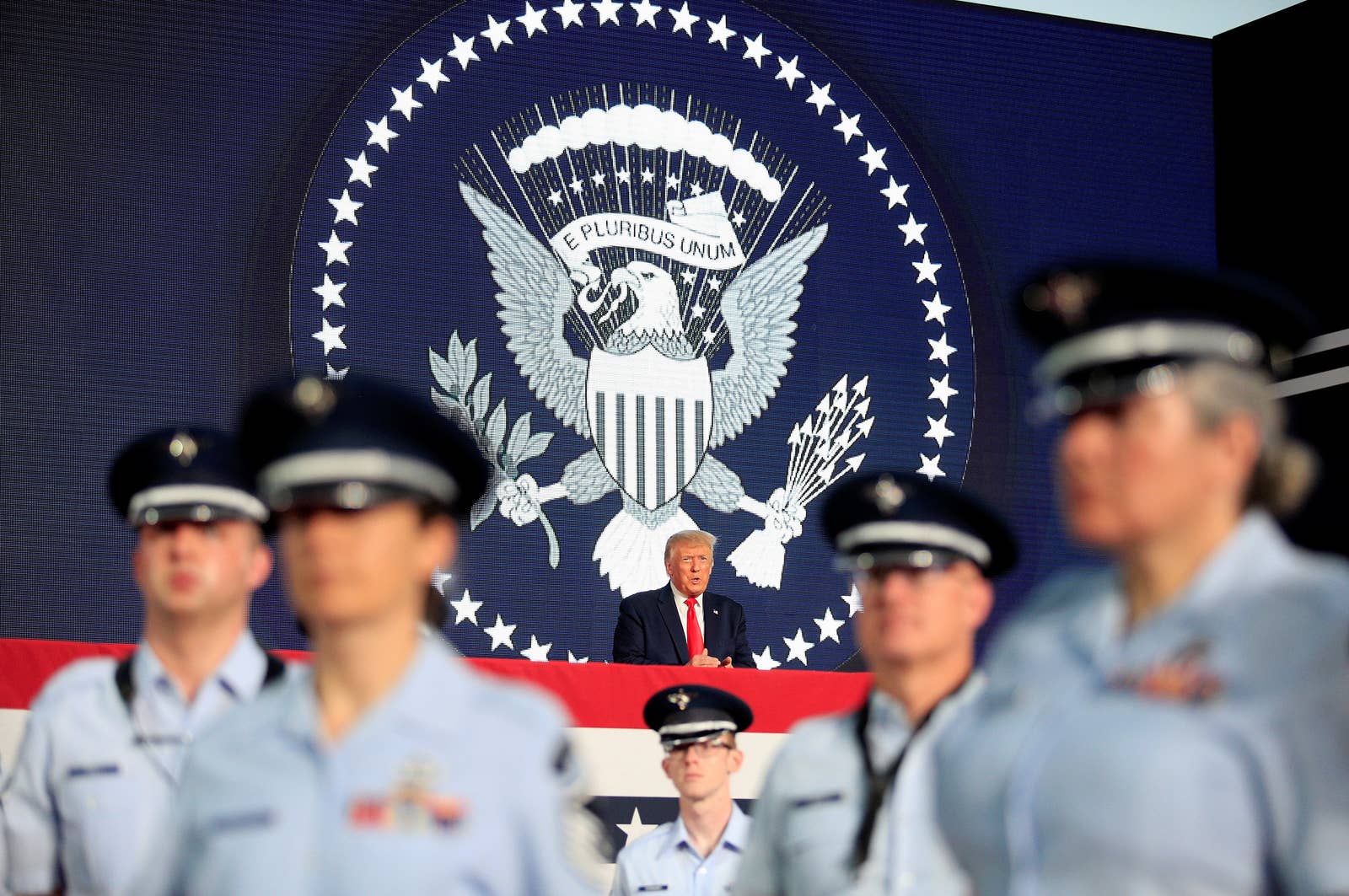
Here's What Trump's Visit To Mount Rushmore Looked Like


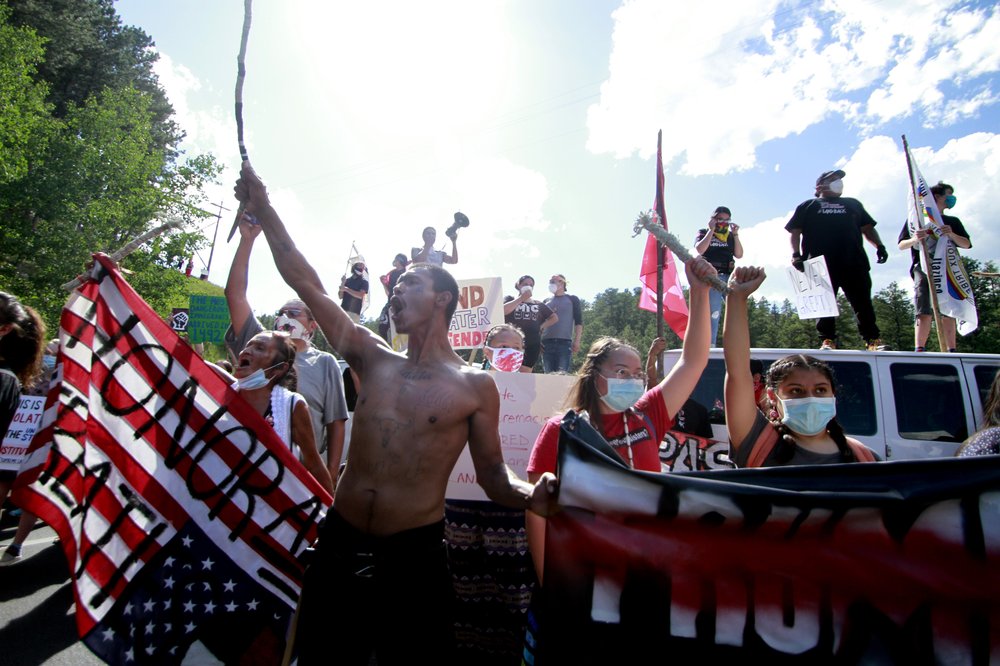
Leaders of several Native American tribes in the region raised concerns that the event could lead to virus outbreaks among their members, who they say are particularly vulnerable to COVID-19 because of an underfunded health care system and chronic health conditions.
“The president is putting our tribal members at risk to stage a photo op at one of our most sacred sites,” said Harold Frazier, chairman of the Cheyenne River Sioux Tribe.
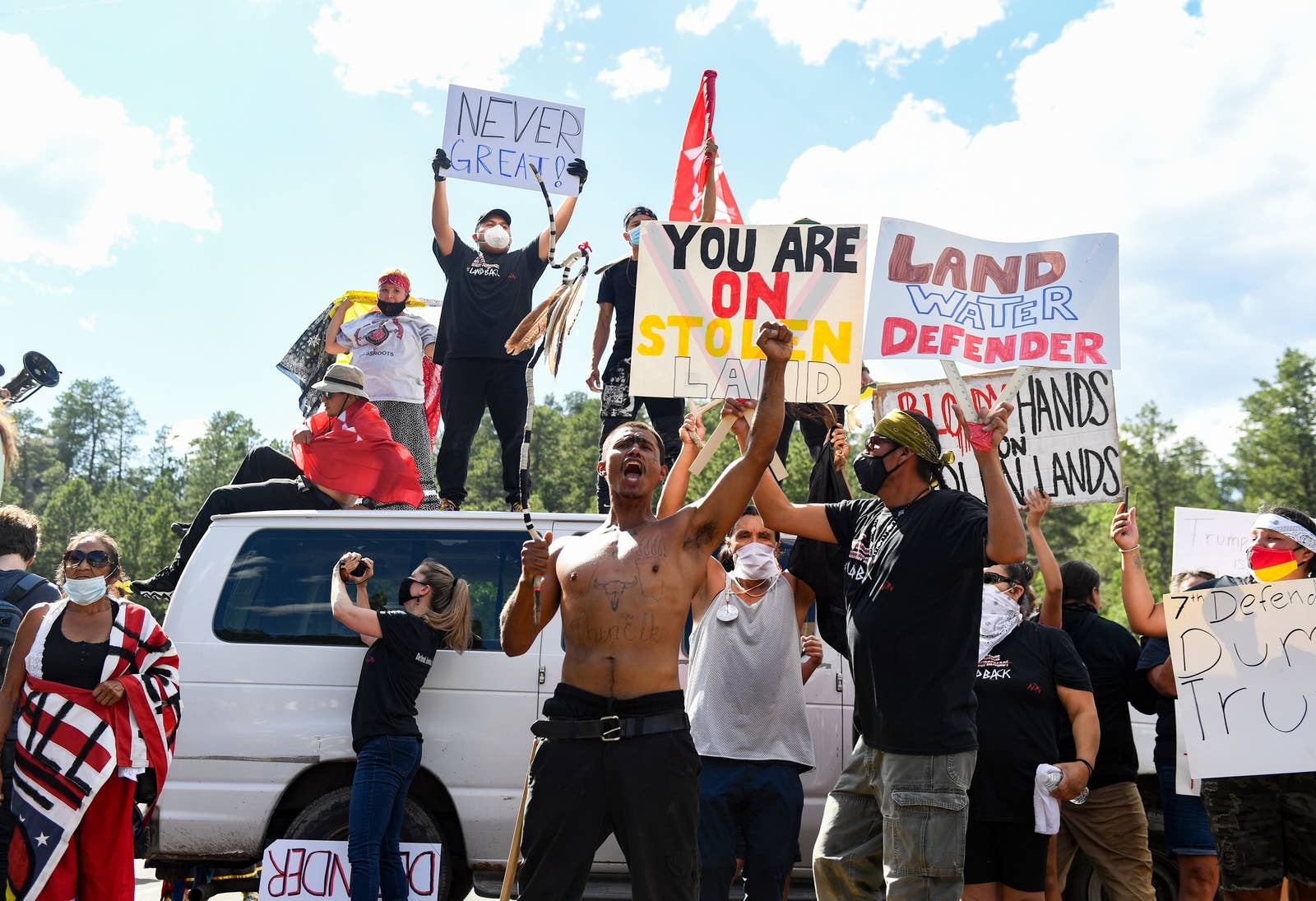
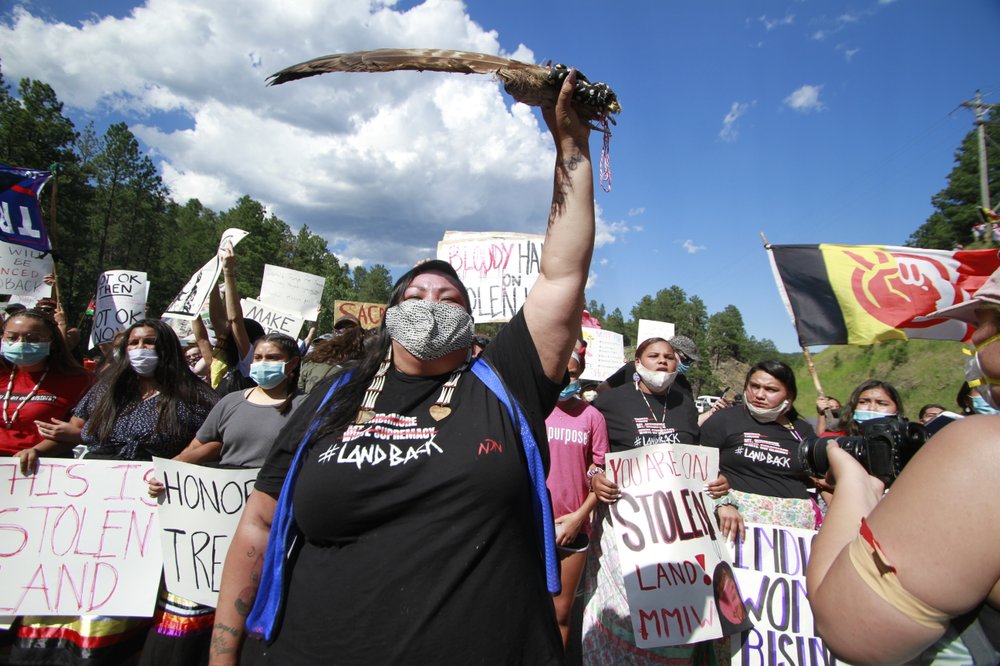
Some Native American groups used Trump’s visit to protest the Mount Rushmore memorial itself, pointing out that the Black Hills were taken from the Lakota people.
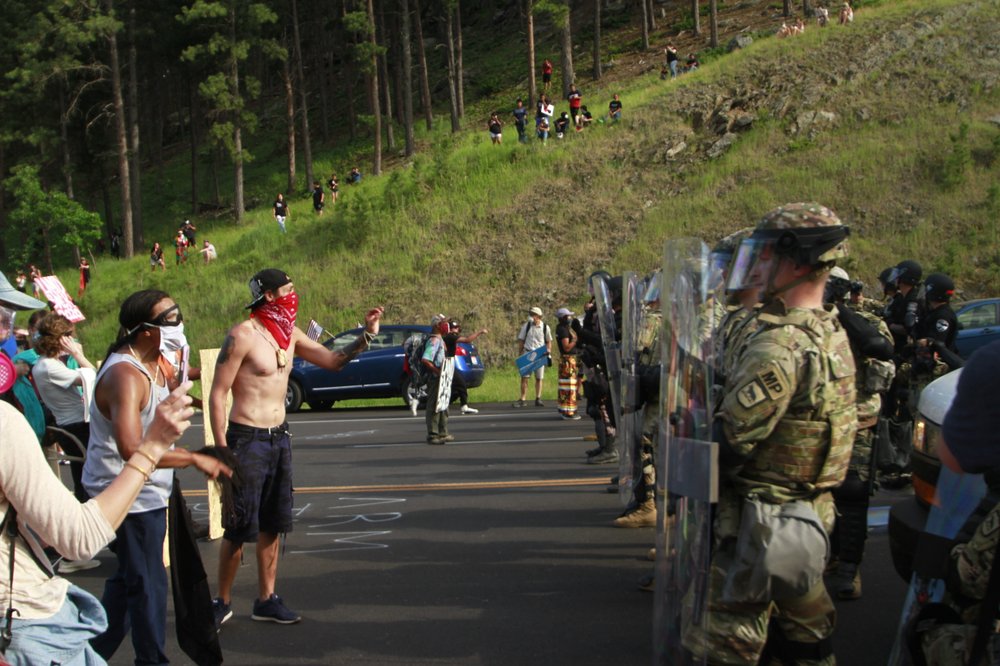
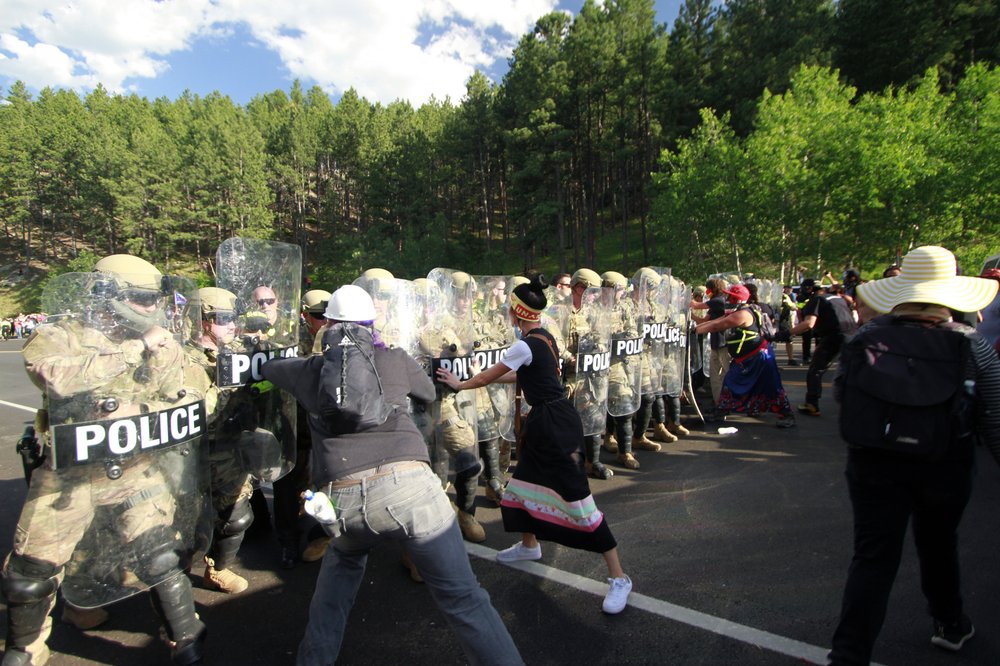
More than 100 protesters, many Lakota, lined the road leading from Keystone to the monument holding signs and playing Lakota music in 95-degree heat. Some held their fists in the air as cars loaded with event attendees passed by. Others held signs that read “Protect SoDak’s First People,” “You Are On Stolen Land” and “Dismantle White Supremacy.”
“The president needs to open his eyes. We’re people, too, and it was our land first,” said Hehakaho Waste, a spiritual elder with the Oglala Sioux tribe.

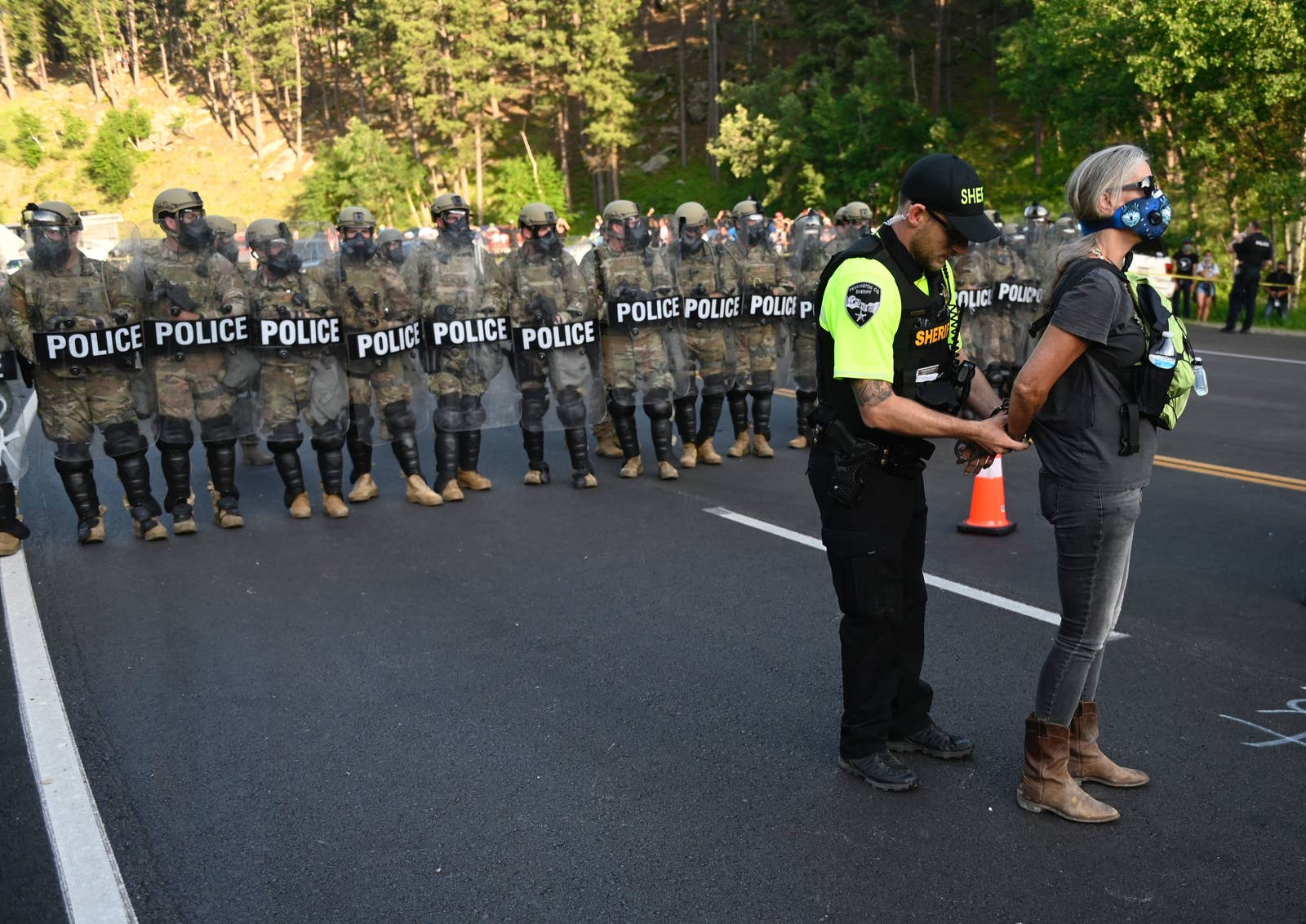
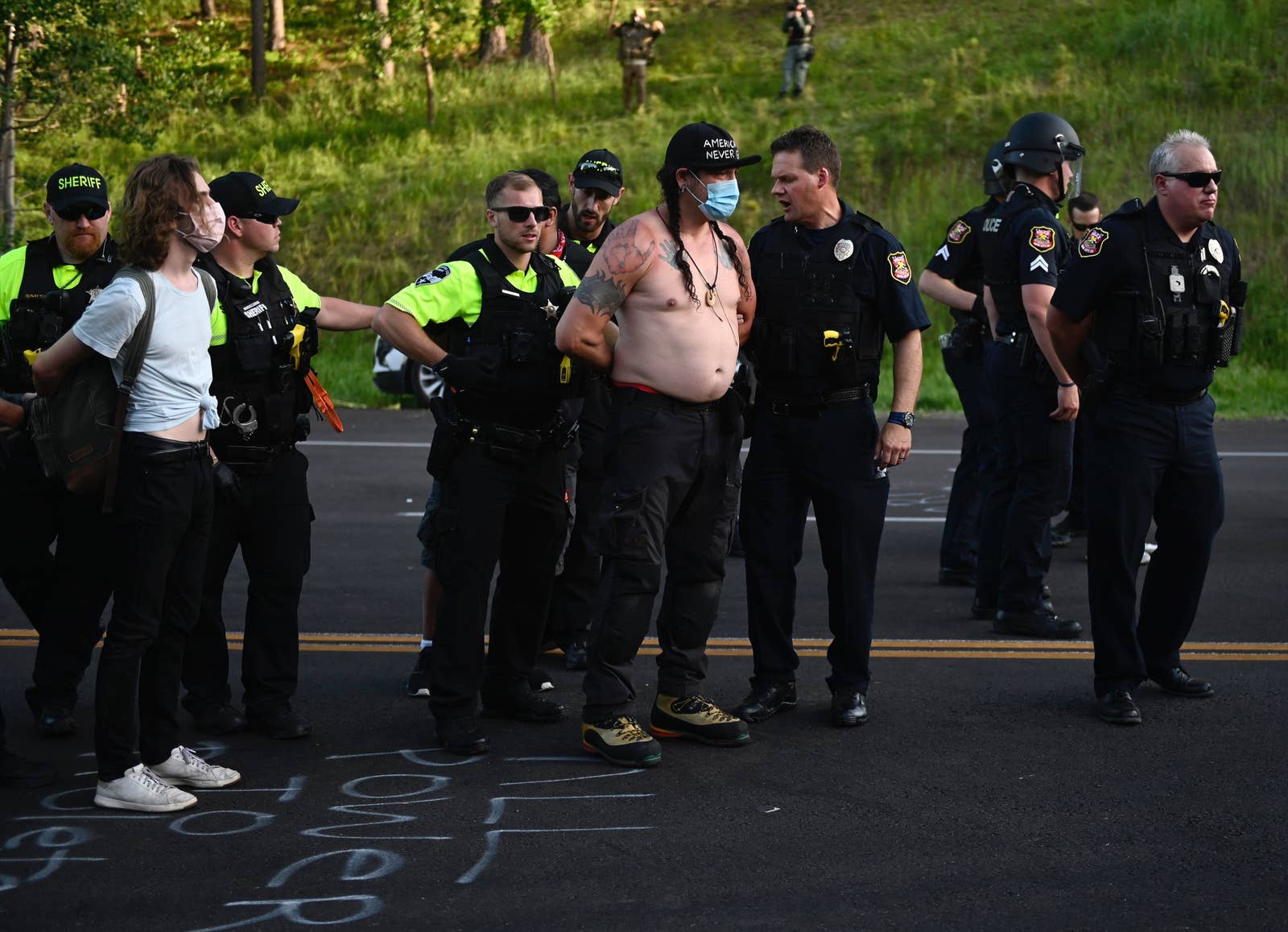
About 15 protesters were arrested after blocking a road and missing a police-imposed deadline to leave.

THAT OTHER PLAGUE
Crunch, crunch: Africa’s locust outbreak is far from over

1 of 6

Locusts swarm on a tree south of Lodwar town in Turkana county, northern Kenya Tuesday, June 23, 2020. The worst outbreak of the voracious insects in Kenya in 70 years is far from over, and their newest generation is now finding its wings for proper flight. (AP Photo/Boris Polo)

Locusts swarm on the ground south of Lodwar town in Turkana county, northern Kenya Tuesday, June 23, 2020. The worst outbreak of the voracious insects in Kenya in 70 years is far from over, and their newest generation is now finding its wings for proper flight. (AP Photo/Boris Polo)
NAIROBI, Kenya (AP) — The crunch of young locusts comes with nearly every step. The worst outbreak of the voracious insects in Kenya in 70 years is far from over, and their newest generation is now finding its wings for proper flight.

The livelihoods of millions of already vulnerable people in East Africa are at stake, and people like Boris Polo are working to limit the damage. The logistician with a helicopter firm is on contract with the United Nations Food and Agricultural Organization, helping to find and mark locust swarms for the targeted pesticide spraying that has been called the only effective control.


“It sounds grim because there’s no way you’re gonna kill all of them because the areas are so vast,” he told The Associated Press from the field in northwestern Kenya on Thursday. “But the key of the project is to minimize” the damage, and the work is definitely having an effect, he said.

For months, a large part of East Africa has been caught in a cycle with no end in sight as millions of locusts became billions, nibbling away the leaves of both crops and the brush that sustains the livestock so important to many families.

“The risk of significant impact to both crops and rangelands is very high,” the regional IGAD Climate Prediction & Applications Center said Wednesday in a statement.


For now, the young yellow locusts cover the ground and tree trunks like a twitching carpet, sometimes drifting over the dust like giant grains of sand.

In the past week and a half, Polo said, the locusts have transformed from hoppers to more mature flying swarms that in the next couple of weeks will take to long-distance flight, creating the vast swarms that can largely blot out the horizon. A single swarm can be the size of a large city.

Once airborne, the locusts will be harder to contain, flying up to 200 kilometers (124 miles) a day.

“They follow prevailing winds,” Polo said. “So they’ll start entering Sudan, Ethiopia and eventually come around toward Somalia.” By then, the winds will have shifted and whatever swarms are left will come back into Kenya.

“By February, March of next year they’ll be laying eggs in Kenya again,” he said. The next generation could be up to 20 times the size of the previous one.

The trouble is, only Kenya and Ethiopia are doing the pesticide control work. “In places like Sudan, South Sudan, especially Somalia, there’s no way, people can’t go there because of the issues those countries are having,” Polo said.

“The limited financial capacity of some of the affected countries and the lockdown due to the coronavirus pandemic have further hampered control efforts. Additionally, armed conflict in Somalia rendered some of the locust breeding areas inaccessible,” ICPAC expert Abubakr Salih Babiker and colleagues wrote in correspondence published in the journal Nature Climate Change this month.

Since “more extreme climate variability could increase the likelihood of pest outbreaks and spread,” they called for a better early warning system for the region and urged developing countries to help.

The World Bank earlier this year announced a $500 million program for countries affected by the historic desert locust swarms, while the FAO has sought more than $300 million.

The pesticide spraying in Kenya “has definitely borne fruit,” said Kenneth Mwangi, a satellite information analyst with ICPAC. There’s been a sharp decline from the first wave of locusts, and a few counties that had seen “huge and multiple swarms” now report little to none. Areas experiencing the second wave are notably the farthest from control centers, he said.

It’s been more challenging in Ethiopia, where despite the spraying, new locust swarms arrived from Somalia and parts of northern Kenya. “Unfortunately both waves have found crops in the field,” Mwangi said.

But without the control work, Polo said, the already dramatic swarms would be even more massive.


He and colleagues target the locusts in the early mornings before they leave their roosting spots and start flying in the heat of the day. The work has gone on since March.

“These plagues are part of nature,” Polo said. “They actually rejuvenate the areas. They don’t kill the plants, they eat the leaves. Everything grows back.

“They don’t harm the natural world, they harm what humans need in the natural world.”

___

Anna reported from Johannesburg.


IMPERIALIST TROPHIES OF COLONIALISM
Algeria buries fighters whose skulls were in Paris museum


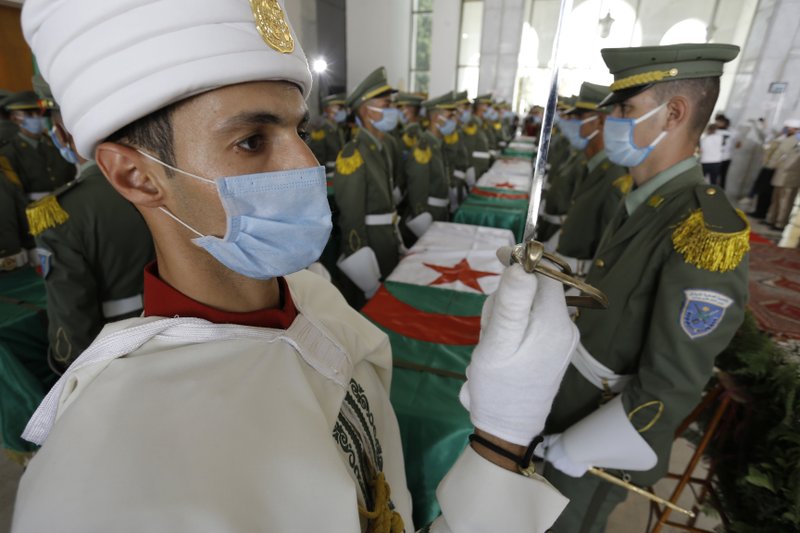
A soldier and members of the Algerian Republican Guard, guard the remains of 24 Algerians at the Moufdi-Zakaria culture palace in Algiers, Friday, July, 3, 2020. After decades in a French museum, the skulls of 24 Algerians decapitated for resisting French colonial forces were formally repatriated to Algeria in an elaborate ceremony led by the teary-eyed Algerian president. The return of the skulls was the result of years of efforts by Algerian historians, and comes amid a growing global reckoning with the legacy of colonialism. (AP Photo/Toufik Doudou)

MORE PICTURES
https://apnews.com/695349764cae2a309c6d4ca82cbdd35a

ALGIERS, Algeria (AP) — Algeria at last buried the remains of 24 fighters decapitated for resisting French colonial forces in the 19th century, in a ceremony Sunday rich with symbolism marking the country’s 58th anniversary of independence.

The fighters’ skulls were taken to Paris as war trophies and held in a museum for decades until their repatriation to Algeria on Friday, amid a growing global reckoning with the legacy of colonialism.

Algerian President Abdelmadjid Tebboune said he’s hoping for an apology from France for colonial-era wrongs.

“We have already received half-apologies. There must be another step,” he said in an interview broadcast Saturday with France-24 television. He welcomed the return of the skulls and expressed hope that French President Emmanuel Macron could improve relations and address historical disputes.

Tebboune presided over the interment of the remains Sunday in a military ceremony at El Alia cemetery east of Algiers, in a section for fallen independence fighters. Firefighters lay the coffins, draped with green, white and red Algerian flags, in the earth.

The 24 took part in an 1849 revolt after French colonial forces occupied Algeria in 1830. Algeria formally declared independence on July 5, 1962 after a brutal war.

Algeria’s veterans minister, Tayeb Zitouni, welcomed “the return of these heroes to the land of their ancestors, after a century and a half in post-mortem exile.”

Algerians from different regions lined up to pay respect to the fighters on Saturday, when their coffins were on public display at the Algiers Palace of Culture.

Mohamed Arezki Ferrad, history professor at the University of Algiers, said hundreds of other Algerian skulls remain in France and called for their return, as well as reparations for French nuclear tests carried out in the Algerian Sahara in the early 1960s.


In 1966, seven years after Algeria's National Liberation Front (FLN) successfully fought France for their country's independence, filmmaker Gillo Pontecorvo released the iconic The Battle of Algiers. Despite winning a Golden Lion at the Venice Film Festival and its widespread public influence, inspiring notable activists such as pro-Palestinians and the Black Panthers, the film was banned in France until the 1970s. Featuring interviews with revolutionary leaders such as Saadi Yacef, Algerian filmmaker Malek Bensmaïl looks back on the making of this landmark film half a century after its release. His doc presents us with an Algeria still gripped with pride for its independence, and one in which the annually broadcast The Battle of Algiers remains a staunch cultural phenomenon.

Gig workers face shifting roles, competition in pandemic

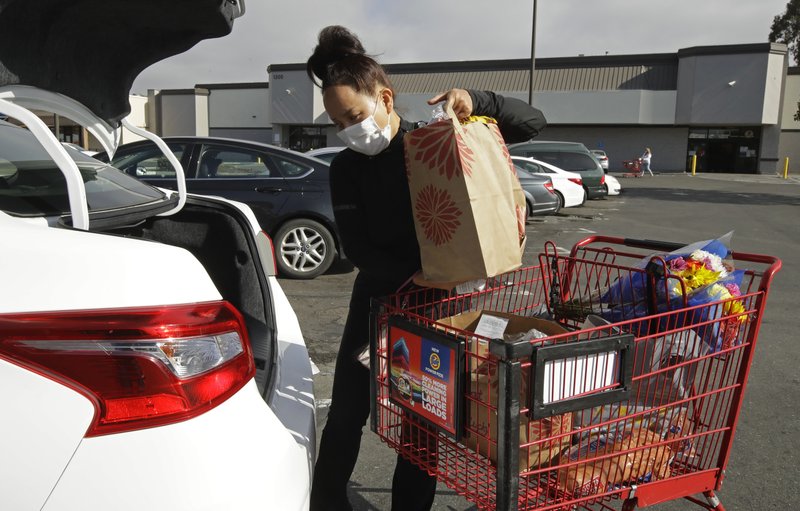
Instacart worker Saori Okawa loads groceries into her car for home delivery on Wednesday, July 1, 2020, in San Leandro, Calif. Okawa is one of an estimated 1.5 million so-called gig workers who make a living driving people to airports, picking out produce at grocery stores or providing childcare for working parents. But with the pandemic pummeling the global economy and U.S. unemployment reaching heights not seen since the Great Depression, gig workers are clamoring for jobs that often pay less while facing stiff competition from a crush of newly unemployed workers also attempting to patch together a livelihood until the economy recovers. (AP Photo/Ben Margot)


NEW YORK (AP) — There were the two-hour, unpaid waits outside supermarkets when San Francisco first started to lock down, on top of the heavy shopping bags that had to be lugged up countless flights of stairs.

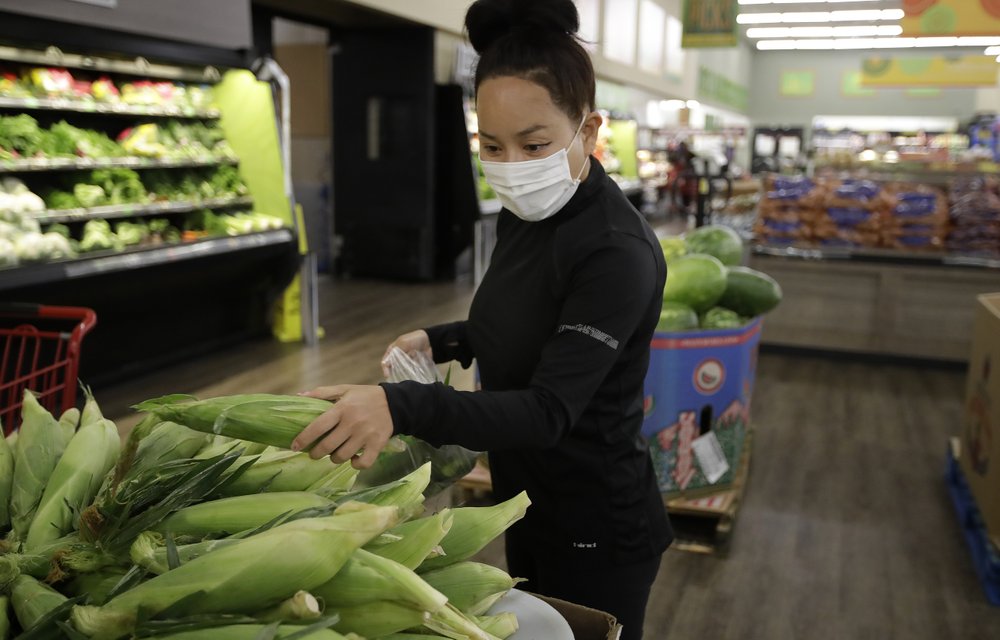
And yet even after signing up for several apps, 39-year-old Saori Okawa still wasn’t making as much money delivering meals and groceries as she did driving for ride-hailing giant Uber before the pandemic struck.

“I started to juggle three apps to make ends meet,” said Okawa, who recently reduced her work hours after receiving unemployment benefits. “It was really hard, because at that time, I could not afford to stay home because I had to pay rent.”


Instacart worker Saori Okawa shops for produce for home delivery on Wednesday, July 1, 2020, in San Leandro, Calif. Okawa is one of an estimated 1.5 million so-called gig workers who make a living driving people to airports, picking out produce at grocery stores or providing childcare for working parents. But with the pandemic pummeling the global economy and U.S. unemployment reaching heights not seen since the Great Depression, gig workers are clamoring for jobs that often pay less while facing stiff competition from a crush of newly unemployed workers also attempting to patch together a livelihood until the economy recovers. (AP Photo/Ben Margot)

Okawa is one of an estimated 1.5 million so-called gig workers who make a living driving people to airports, picking out produce at grocery stores or providing childcare for working parents. Theirs had already been a precarious situation, largely without safeguards such as minimum wage, unemployment insurance, workers compensation and health and safety protections.

But with the pandemic pummeling the global economy and U.S. unemployment reaching heights not seen since the Great Depression, gig workers are clamoring for jobs that often pay less while facing stiff competition from a crush of newly unemployed workers also attempting to patch together a livelihood - all while trying to avoid contracting the coronavirus themselves.

U.S. unemployment fell to 11.1% in June, a Depression-era level that, while lower than last month, could worsen after a surge in coronavirus cases has led states to close restaurants and bars.

Marisa Martin, a law school student in California, turned to Instacart when a state government summer job as paralegal fell through after a hiring freeze. She said she enjoys the flexibility of choosing her own hours but hopes not to have to turn to gig work in the future. The pay is too volatile — with tips varying wildly and work sometimes slow — to be worth the risk of exposure to the virus.

“We are not getting paid nearly enough when we’re on the front lines interacting with multiple people daily,” said Martin, 24, who moved in with her parents temporarily to save money.

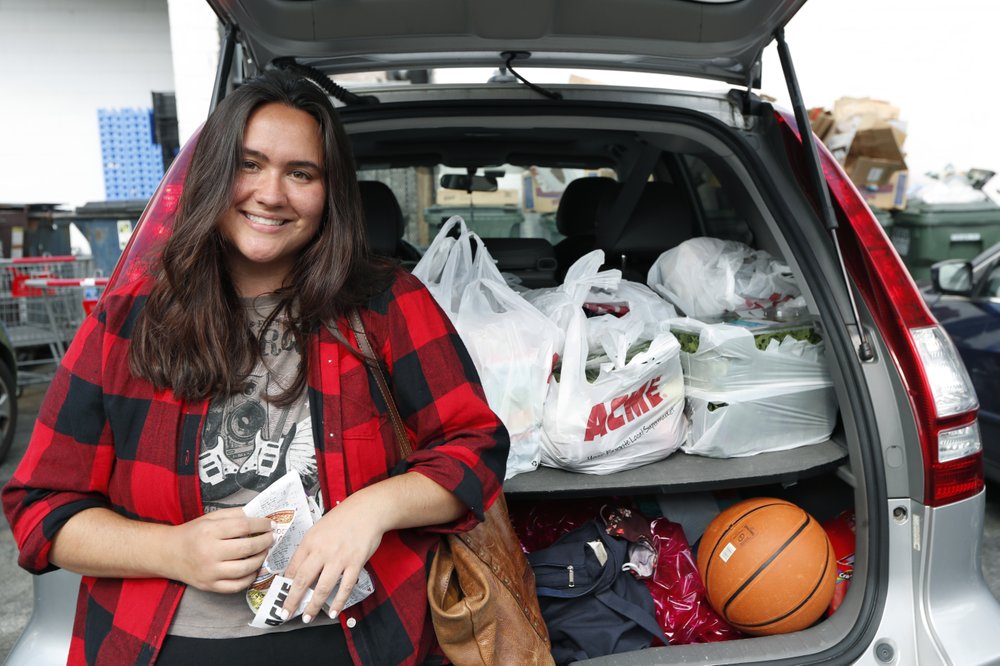
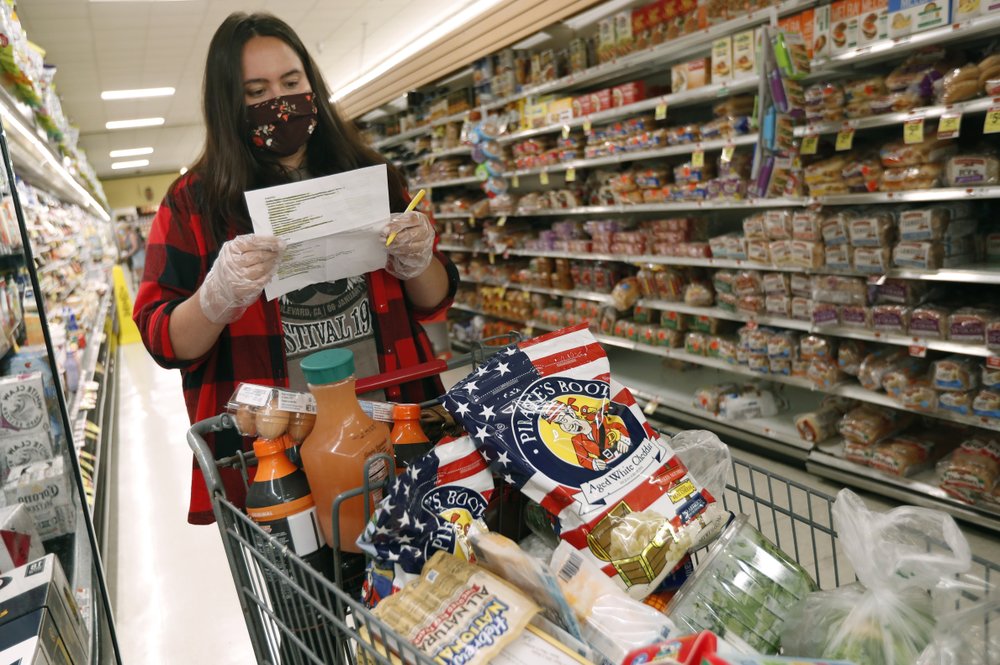
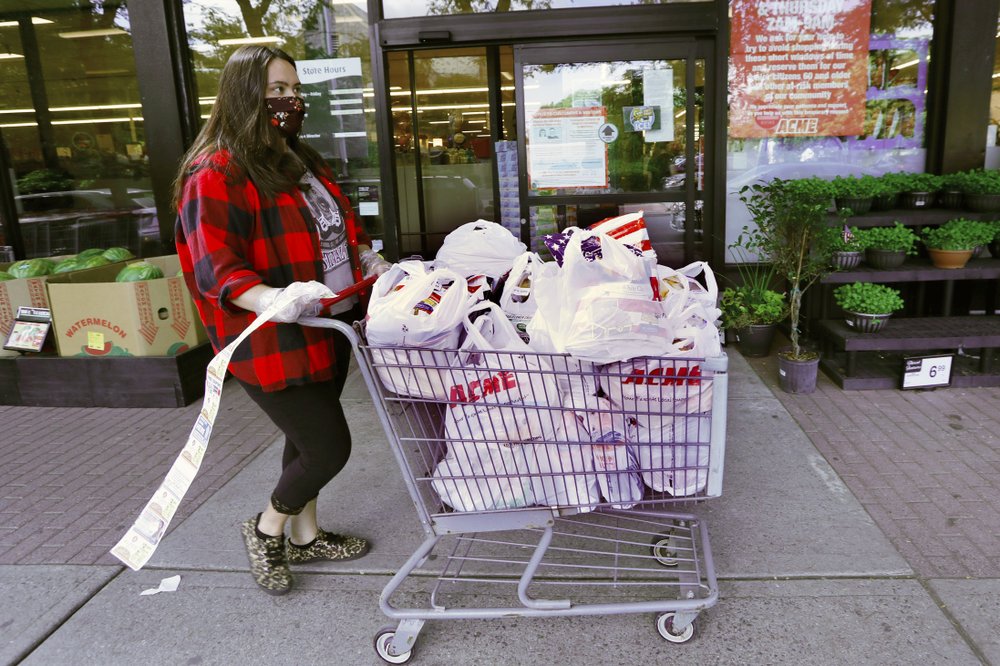
Alexandra Lopez-Djurovic poses for a photograph in the parking of an Acme supermarket after shopping for a client, Wednesday, July 1, 2020, in Bronxville, N.Y. Lopez-Djurovic was working full time as a nanny until her hours were cut substantially due to the coronavirus pandemic, so she started her own grocery delivery service that made up for some of her lost wages, but not all. With the pandemic pummeling the global economy and U.S. unemployment reaching heights not seen since the Great Depression, gig workers are clamoring for jobs that often pay less while facing stiff competition from a crush of newly unemployed workers also attempting to patch together a livelihood until the economy recovers. (AP Photo/Kathy Willens)


Alexandra Lopez-Djurovic, 26, was a full-time nanny in a New York City suburb when one of the parents she works for lost her job while the other saw his hours cut.

“All of a sudden, as much as they want me to stay, they can’t afford to pay me,” she said. Her own hours were reduced to about eight per week.

To make up lost wages, Lopez-Djurovic placed an ad offering grocery delivery on a local Facebook group. Overnight, she got 50 responses.

Lopez-Djurovic charges $30 an hour and coordinates shopping lists over email, offering perks the app companies don’t such as checking the milk’s expiration date before choosing which size to buy. Still, it doesn’t replace the salary she lost.

“One week I might have seven, eight, 10 families I was shopping for,” Lopez-Djurovic said. “I had a week when I had no money. That’s definitely a challenge.”

Upwork, a website that connects skilled freelance workers with jobs, has seen a 50% increase in signups by both workers and employers since the pandemic began, including spikes in jobs related to ecommerce and customer service, said Adam Ozimek, chief economist at Upwork.

“When you need to make big changes fast, a flexible workforce helps you,” he said.

Maya Pinto, a researcher at the National Employment Law Project, said temporary and contract work grew during Great Recession and she expects that many workers will seek such jobs again amid the current crisis.

But increased reliance on temporary and contract work will have negative implications on job quality and security because it “is a way of saving costs and shifting risk onto the worker,” Pinto said.

It’s difficult to assess the overall picture of the gig economy during the pandemic since some parts are expanding while others are contracting. Grocery delivery giant Instacart, for instance, has brought on 300,000 new contracted shoppers since March, more than doubling its workforce to 500,000. Meanwhile, Uber’s business fell 80% in April compared with last year while Lyft’s tumbled 75% in the same period.

For food delivery apps, it’s been a mixed bag. Although they are getting a bump from restaurants offering more takeout options, those gains are being offset by the restaurant industry’s overall decline during the pandemic.

Gig workers are also jockeying for those jobs from all fronts. DoorDash launched an initiative to help out-of-work restaurant workers sign up for delivery work. Uber’s food delivery service, Uber Eats, grew 53% in the first quarter and around 200,000 people have signed up for the app per month since March — about 50% more than usual.

“Drivers are definitely exploring other options, but the issue is that there’s 20 or 30 million people looking for work right now,” said Harry Campbell, founder of The Rideshare Guy. “Sometimes I joke all you need is a pulse and a car to get approved. But what that means is it’s easy for other people to get approved too, so you have to compete for shifts.”

Delivery jobs typically pay less than ride-hailing jobs. Single mom Luz Laguna used to earn about $25 in a half-hour driving passengers to Los Angeles International Airport. When those trips evaporated, Laguna began delivering meals through Uber Eats, working longer hours but making less cash. The base pay is around $6 per delivery, and most people tip around $2, she said. To avoid shelling out more for childcare, she sometimes brings her 3-year-old son along on deliveries.

“This is our only way out right now,” Laguna said. “It’s hard managing, but that’s the only job that I can be able to perform as a single mother.”

Other drivers find it makes more sense to stay home and collect unemployment — a benefit they and other gig workers hadn’t qualified for before the pandemic. They are also eligible to receive an additional $600 weekly check from the federal government, a benefit that became available to workers who lost their jobs during the pandemic. Taken together, that’s more than what many ride-hailing drivers were making before the pandemic, Campbell said.

But that $600 benefit will expire at the end of July, and the $2 trillion government relief package that extended unemployment benefits to gig workers expires at the end of the year.

“So many drivers are going to have to sit down and decide, do I want to put myself at risk and my family at risk once I’m not getting the government assistance?” Campbell said.
Virus, Floyd death merge in brutal blow to Black well-being
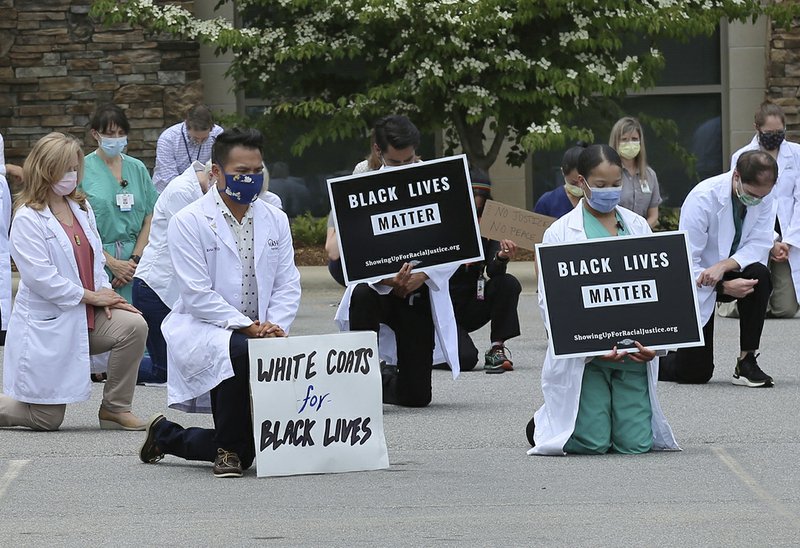
In this June 5, 2020 photo provided by the Mountain Area Health Education Center, physicians, residents and staff from the facility in Asheville, N.C., take a knee to show support for renewed calls for racial justice after the police killing of George Floyd. Government statistics from late January through May 30 suggest an increase in U.S. deaths from chronic diseases compared with historical trends. They include 7,000 excess deaths from hypertension, about 4,000 from diabetes and 3,000 from strokes -- all conditions that disproportionately affect Blacks, although the data don’t include race. (Brenda Benik/MAHEC via AP)

Doctors have long known that Black people suffer disproportionately.

Before the renewed cries of “Black Lives Matter,” they knew racism has very real, physical effects. They knew about socio-economic challenges that contribute to poor health. And they treated diabetes, hypertension and other chronic diseases that hit their Black patients harder than their white ones.

Then came the coronavirus and George Floyd, a crushing double blow to Black people’s well-being. Doctors and their patients are reeling from the impact.

“We are exhausted and we are not OK,” says Dr. Patrice Harris, who just ended a yearlong term as president of the American Medical Association — only the second black to head the group. She was speaking not so much for herself as for her community.

Police violence is always an injustice, “but its harm is elevated amid the remarkable stress people are facing amid the COVID-19 pandemic,” Harris and AMA Trustee Dr. Jesse Ehrenfeld said in a recent online opinion article.

Floyd’s death is the most extreme example of over-policing that has been linked with elevated stress, high blood pressure and other chronic illness that contribute to the high coronavirus death rates in Black people.

As their offices start reopening for regular appointments, doctors are bracing for the fallout: a wave of sicker, shell-shocked patients.

Dr. Brittani James is a primary-care doctor. Her clinic’s mostly Black neighborhood was one of the last in Chicago to get a COVID-19 testing site. They opened first in wealthier, whiter areas.

She said it’s heartbreaking to see many patients hit hard by the virus, while others grow sicker from chronic disease.

“As a Black doctor, I feel like I’m failing my patients every day,” she said.

While her clinic has remained open, many patients are too terrified of COVID-19 to come in. That means trying to treat complaints without physical exams or blood tests. She has tried sending patients prescriptions for blood pressure cuffs but some can’t afford the cost. The options are “have their blood pressure uncontrolled or adjust their medications blind.”

For every patient who has called for an appointment, there are 10 others she hasn’t heard from in months.

“There is no way that all of a sudden overnight there’s no more heart attacks, no more strokes, no more patients having poorly controlled diabetes,” she said. “We have all seen our patients’ visits stop. Which is scaring me a lot.”
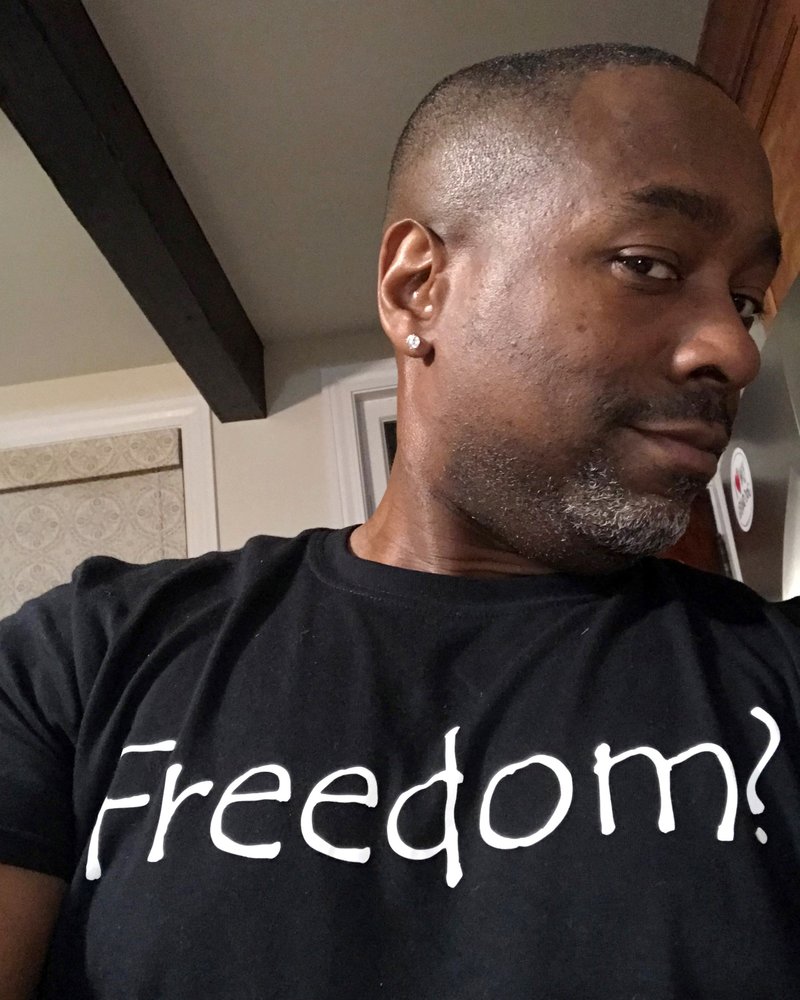
This May 2020 selfie photo provided by Terrence Nichols, 44, shows him in Chicago after a COVID-19 infection. Nichols has recovered physically from a relatively mild case of COVID-19, diagnosed in March. But as a Black man in Chicago, knowing its impact in his community has left Nichols feeling fearful, vulnerable and angry over the president’s push to reopen. (Terrence Nichols via AP)

It’s not just happening in Chicago.

James fears a “second wave” of worsening chronic illness and non-COVID-19 deaths is coming.

There are signs it is already happening.

Government statistics from late January through May 30 suggest an increase in U.S. deaths from chronic diseases compared with historical trends. They include 7,000 excess deaths from hypertension, about 4,000 from diabetes and 3,000 from strokes — all conditions that disproportionately affect Blacks, although the data don’t include race.

James says Floyd’s brutal death has added psychological trauma to the mix, and mental health care in many communities is scarce.

“There is an overwhelming need that we do not have the resources to address,” she said. “It’s devastating.”

Royanna Williams, 45, is a Black woman in Asheville, North Carolina, who suffers with persistent pain from autoimmune illnesses, which disproportionately affect Blacks.

Living with chronic illness had already left her anxious and depressed — feelings that have multiplied with the pandemic, Floyd’s death and the unrest that has followed.

“This right here is a whole ’nother ballgame,” she said.

Williams has started mental health televisits. They’ve helped.

She says white doctors have often discounted her pain and it has worsened as the pandemic has postponed her physical therapy sessions. Research has shown than Blacks are often under-treated for pain, partly because of false beliefs about supposed biological differences.

Now there’s evidence that Blacks with fever and cough are less likely than whites to be referred for COVID-19 testing, said Dr. Malika Fair, a health equity director at the Association of American Medical Colleges.

This even though Blacks are more likely to die from the disease. As of early June, an AP analysis found that roughly 26% of COVID-19 deaths were in Black patients, while Black people represented 13% of the population in the 40 states that provided detailed demographic data.

Rosetta Watson is only 38 but she has heart failure and needs valve replacement surgery. When COVID-19 hit Chicago in March, doctors postponed the operation indefinitely.

The virus has killed four of her relatives. She knows it could kill her too because of her poor health.

“I don’t know if I’m angry or am just numb to it,” Watson said.

Her doctor thinks her increasing fatigue may be from the leaky valve. She understands that COVID-19 cases are more urgent but the delays are frustrating.

Meantime, she has seen the protests on TV and supports the cause but not the property damage.

She’s been racially targeted, not by police but by strangers who disparage her white boyfriend with racist terms and by elderly neighbors in her apartment building who deride “you people” and won’t ride with her in the elevator.

“Seriously, it’s 2020. When we gonna grow up?” Watson said.

___

Follow AP Medical Writer Lindsey Tanner at @LindseyTanner.

___

The Associated Press Health and Science Department receives support from the Howard Hughes Medical Institute’s Department of Science Education. The AP is solely responsible for all content.
THIS AIN'T '68

Wide shift in opinion on police, race rare in US polling

By HANNAH FINGERHUT July 2, 2020

1 of 6

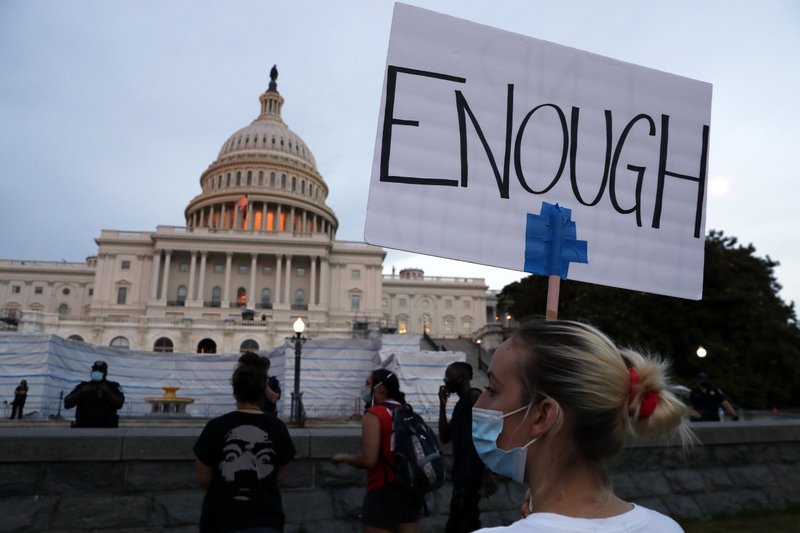
FILE - In this June 3, 2020, file photo, demonstrators protest the death of George Floyd, Wednesday, June 3, 2020, at the U.S. Capitol in Washington. It’s rare for public opinion on social issues to change sharply and swiftly. And yet in the wake of George Floyd’s death, polling shows dramatic movement in Americans’ opinions on police brutality and racial injustice. (AP Photo/Jacquelyn Martin, File)

WASHINGTON (AP) — It’s rare for public opinion on social issues to change sharply and swiftly. And yet in the wake of George Floyd’s death, Americans’ opinions about police brutality and racial injustice have moved dramatically.

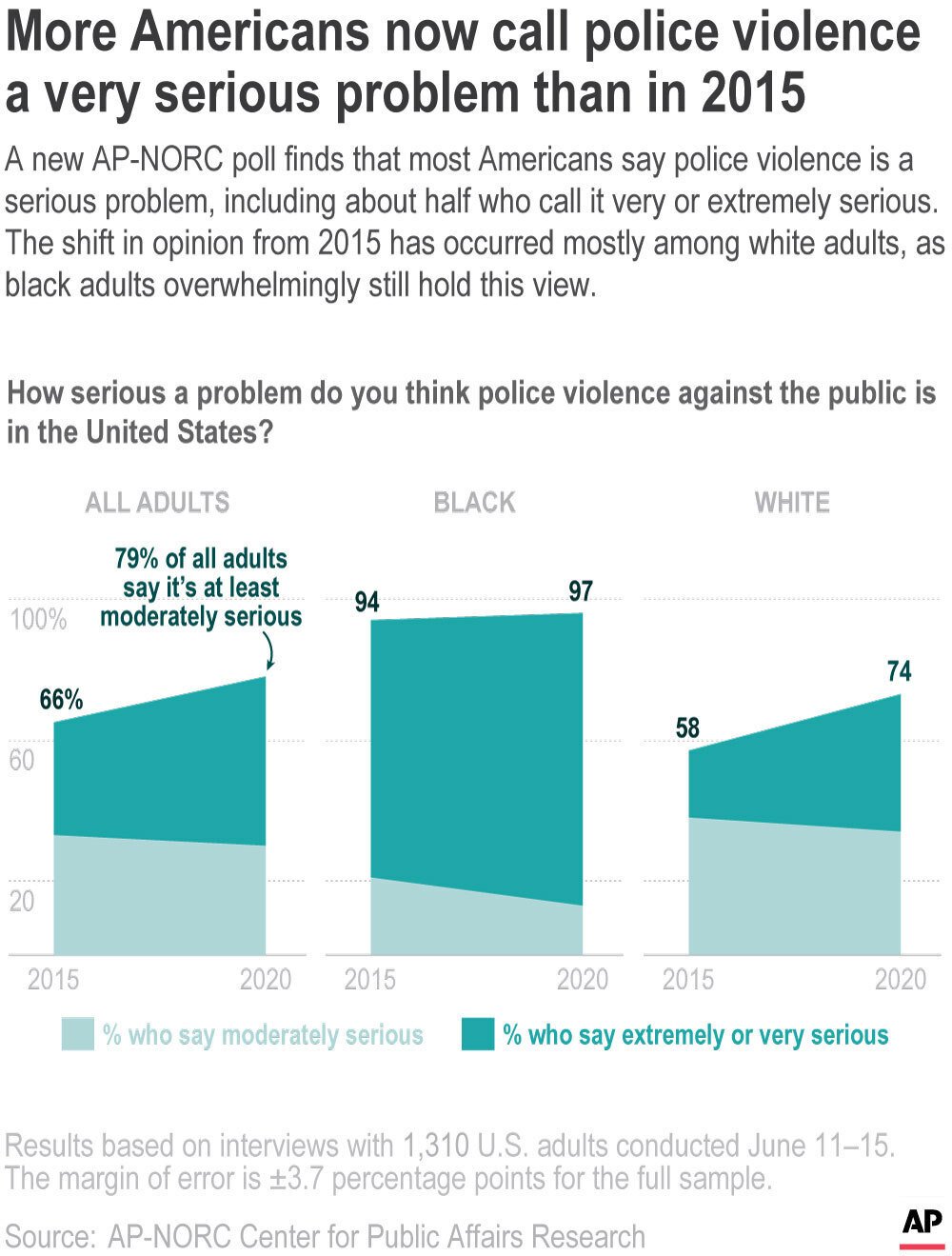
About half of American adults believe police violence against the public is a “very” or “extremely” serious problem, according to a poll conducted earlier this month by The Associated Press-NORC Center for Public Affairs Research. Only about a third said the same as recently as last September, as well as in July 2015, just a few months after Freddie Gray, a Black man, died in police custody in Baltimore.

Floyd, a Black man, died on May 25 after a white Minneapolis police officer pressed his knee into Floyd’s neck for nearly eight minutes. In the weeks that followed, protests erupted nationwide.

The recent shifts in public opinion stand out when compared with years of survey research conducted following similar slayings of Black people by police. They are distinct from slow and steady movement on other social issues, such as support for same-sex marriage. And there is evidence they may last.

“I think this seems to be something different from the gradual change that we often see with cultural and social issues,” said Jennifer Benz, the deputy director of the AP-NORC Center.

The new poll and recent trends from NORC’s General Social Survey, she said, are “suggestive that there’s been something brewing for the past couple of years that could well be leading to lasting change, as opposed to situational change.”

MORE ON THIS MOMENT

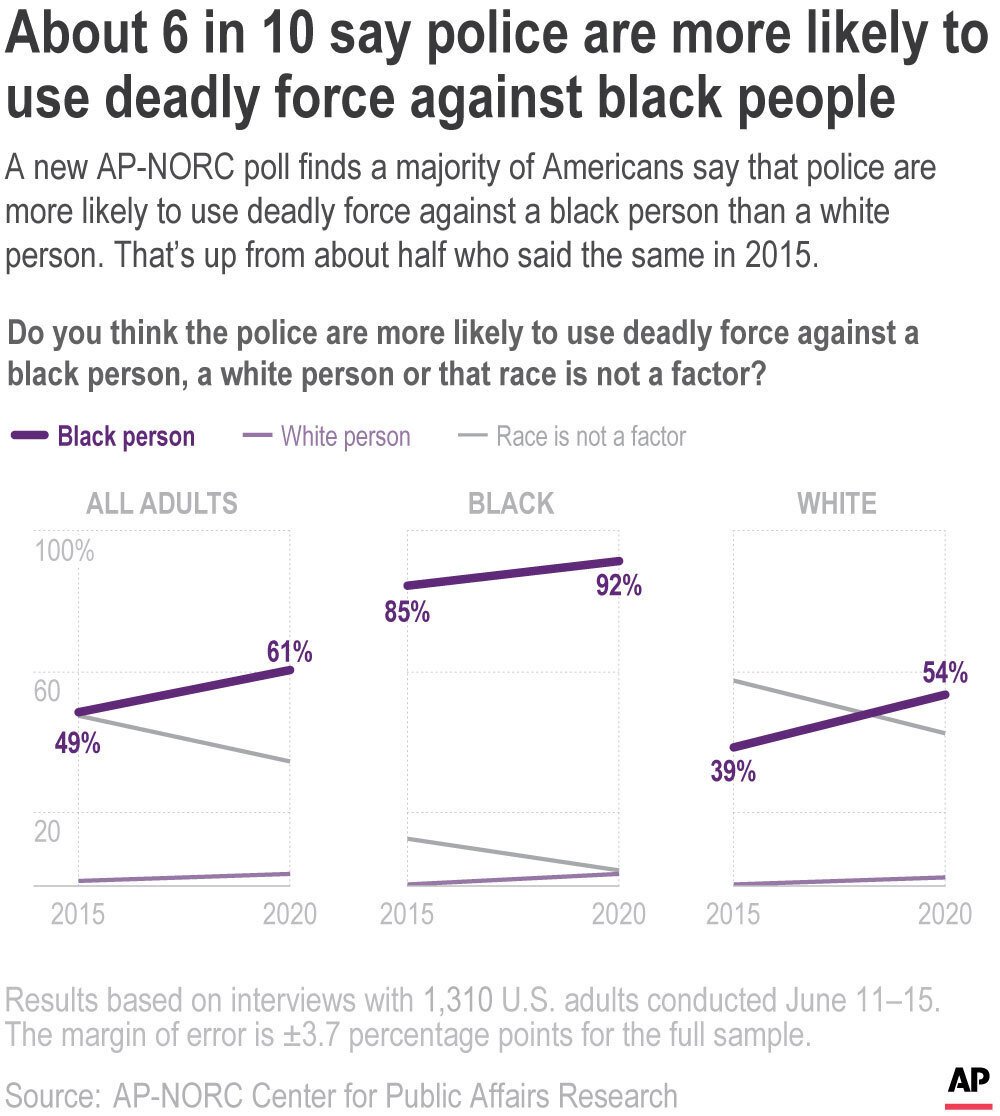
More Americans than in 2015 say police in most communities are more likely to use deadly force against a Black person than a white person, 61% today compared with 49% in 2015. Only about a third of Americans say the race of a person does not make a difference in the use of deadly force, compared with roughly half in 2015.

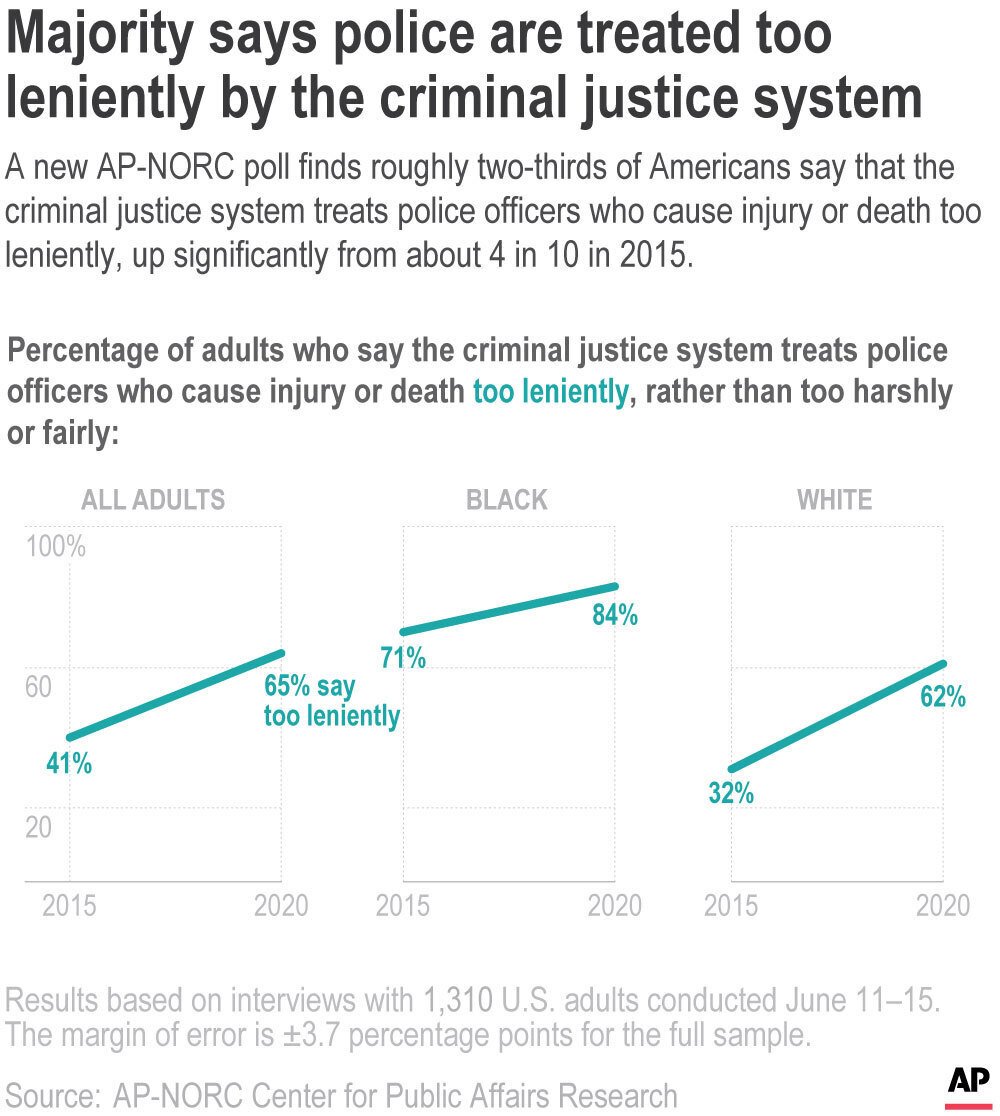
And 65% say that police officers who cause injury or death in the course of their job are treated too leniently by the justice system, compared with 41% in 2015. Fewer now think police are treated either fairly or too harshly.


The recent poll builds on marked changes in public attitudes toward race relations observed in the 2018 General Social Survey, a long-running poll of Americans that started in 1972. The percentage saying the country spends too little on improving conditions of Black Americans peaked at 52%, up dramatically from 30% in 2014. Republicans and Democrats alike were more likely to say that. The poll also found more Americans attributing racial disparities in income, jobs, housing and education to discrimination.

SLOW AND STEADY SOCIAL CHANGE

Opinion on social issues often change gradually over an extended period of time.

Just 11% of Americans said gay and lesbian people should have the right to marry in 1988, according to the General Social Survey. That grew to 31% by 16 years later, the next time the question was asked. But after that, support for gay marriage didn’t rise by more than 10 percentage points from one survey to the next. Support instead grew steadily over two decades to become the majority opinion, most recently at 68% in 2018.


The trend is similar in support for marijuana legalization. In 1973, the General Social Survey found that just 19% of Americans said marijuana should be made legal. Support ticked up and down for most of the following three decades, never exceeding 30%. It reached 31% in 2000 and steadily rose to 44% in 2010 and 61% in 2018. Like for same-sex marriage, the share saying marijuana should be legal never rose more than 10 percentage points from one poll to the next.

REACTIVE CHANGE

Sometimes, public opinion responds to specific events that bring attention to a social issue, but then returns back to a “normal” in quiet moments. Polling by Gallup is evidence of how American views on gun laws are responsive to mass shootings, with somewhat more saying they want to see laws on the sale of firearms made more strict in the aftermath of such an attack.


Support for stricter gun laws ticked up from 60% in February 1999 to 66% in late April that year, just after the shooting at Columbine High School in Colorado, which killed 21 people. By the early 2000s, the percentage of Americans preferring stricter gun laws slipped back down — as low as 51% in October 2002.

Gallup polling shows the trend has oscillated regularly since. It fell as low as 43% in 2011 but rose again to 58% the next time the question was asked in December 2012, after the shooting at an elementary school in Newtown, Connecticut, that killed 28 people. A year later, support fell back to 49%.

A similar bump again happened after the high school shooting in Parkland, Florida, in February 2018.

POLITICAL CHANGE

Meanwhile, significant shifts in public opinion inevitably follow presidential and midterm elections. In April 2016, before President Donald Trump was elected, just 34% of Republicans considered the nation’s economy to be in good shape, according to an AP-NORC poll. By March 2017, that figure rose to 63% and was 89% in January 2020 before taking a hit amid the economic fallout of the COVID-19 pandemic.

Meanwhile, according to Gallup polling, just 24% of Democrats in 2018 said they were satisfied with the country’s global standing, down 32 percentage points from 2017. What changed? Trump’s inauguration in 2017 following eight years of President Barack Obama’s time in office.


PROFOUND MOMENTS

But events or crises that touch most Americans can often be agents of change.

Approval of President George W. Bush went from 51% in the days just before the Sept. 11 attacks to 86% in the days just after, according to Gallup polling.

And more recently, the pandemic has deeply affected Americans’ views of their own lives. A May poll from NORC at the University of Chicago found the lowest percentage of Americans saying they are very happy in nearly five decades. Just 14% say they very happy today, down from 31% in 2018.___

Online:

AP-NORC: http://www.apnorc.org/.