Wednesday, September 22, 2021


IEEFA Update: Why Australia is a bigger carbon pariah than we think

Counting carbon-based exports burned and smelted by others makes Australia the world’s third largest emitter. We can’t disown them as easily as all that.

The Glasgow summit on climate change is looming, and we continue to see Australia pretending to be a small emitter of carbon dioxide on the global stage.

We continue to see Australia pretending

It is not by any means. It’s all about Scope III emissions. A subject that Australian governments don’t want to hear about. Both sides of politics are no better than the other, they both put their electoral interests ahead of any vision for the future.

Australia has to share responsibility for China’s emissions

As other countries begin to reduce demand for our mining products, Australia will need that vision to replace wishful thinking that promotes statements such as: Technology will fix things; If we don’t sell carbon-intensive products someone else will; We’re only responsible for 1.5% of the total carbon dioxide emissions; It’s China and India that need to change, not us.

I find myself wondering what future Australian generations will come to think of our current decision-makers.

But let’s get to the heart of the matter, Scope III emissions. Australia puts out data on Scope I and Scope II emissions, covering what we burn here, fugitive emissions, and purchased electricity and other energy.

Scope III emissions for companies look at the whole supply chain, such as transporting resources and, most important of all, the use of our supplied products.

So, for example, if we dig out a lump of coal, it doesn’t contribute much to global CO2. But when we ship it, and someone else burns it, the carbon dioxide release is much larger.

We don’t publish official Scope III emissions in Australia

To say we dig it out and supply it, but hey it’s not our responsibility if they choose to burn it, ignores the world our grandchildren will face.

It’s like those ads on television that push sports betting and other forms of gambling: Here is the product to bet all you want, but please be responsible with betting.

We don’t publish official Scope III emissions in Australia and, to be fair, part of the reason is that full supply chain calculations are not easy to make and only a handful of large-sophisticated companies do so.

Fortunately, these do include large mining companies such as BHP and Rio Tinto. They deserve credit for doing so (and may yet be the ones to take leadership for a sensible climate strategy). So, using factors from their calculations we can have a go at applying them to just three basic product types: metals, petroleum/gas and coal, for Australia as a whole. If someone can supply better Scope III data, please do so. But, in the meantime, let’s try to put some magnitude on our supply chain responsibility.

From 1.15pc to 9.4pc of emissions

In a nutshell, we take the mining company Scope I, II and III calculations, excluding anything produced in their overseas operations (like the Gulf of Mexico, Canada, etc).

The factors from this calculation are then applied to the government Scope I and II carbon dioxide data for metals, petroleum products and coal for the whole country. This focus is on mining and excludes Scope III from other industries.

Calculated this way, Australia is responsible for a total of 3320 million tonnes (Mt) of carbon dioxide in 2019, roughly five times the official Scope I and II number. Instead of 1.15% of global carbon dioxide, Australia would be responsible for 9.4% of the world’s carbon dioxide, third place globally.

Australia would be responsible for 9.4% of the world’s carbon dioxide, third place globally

If every country calculated their carbon dioxide including Scope III in this full supply chain sense, our Scope III carbon dioxide would need to be removed from other country’s numbers to avoid double counting.

Should such large numbers be a surprise? Australia is the largest exporter of iron ore, gas and metallurgical coal. It runs second in thermal coal. They are smelted and burned away from our shores.

This sheeting of supply chain responsibility to the home country, of course, is not going to happen. But these back of the envelope calculations illustrate the magnitude of the responsibility that Australia wishes to disown.

It is a case of “please take our products and if you choose to use them, well then it is nothing to do with us”.

Instead, both sides of politics duck and weave. Like swearing they didn’t ask the UK to go easy on them in the free trade agreement (FTA). Or the frenzied diplomacy to stop the UNESCO World Heritage Centre from declaring that our Great Barrier Reef is “in danger”, astounding as that seemed to most Aussies. All upside you would think.

But there were the coal ships to Japan, China, India and Korea to think of. Promises about zero net emissions in 2050 without pricing carbon because they will use things like carbon capture technology (that doesn’t deliver).

I suspect a future government dealing with the mess of climate change will probably apologise

The government of the biggest mining state literally crowing about growth and its budget surplus that is no fault of its own and oblivious to Australia’s large Scope III role in climate change.

All the while catastrophic climate events trend upwards. In the 1980s, such events averaged 292 a year, according to Munich Re, then 462 a year, in the 1990-2010 period, 730 in the last decade, and a record 980 in 2020.

I asked earlier what future generations will think of our current decision-makers? I suspect a future government dealing with the mess of climate change will probably apologise to the nation for the short-sighted leaders of today who didn’t have a plan that included our kids.

By guest contributor Adrian Blundell-Wignall 

This commentary first appeared in the Australian Financial Review on 13 September.

Related articles:

IEEFA Australia: There’s a better way to manage coal closures than paying to delay them

Energy Ministers and the energy industry should reject the ESB capacity mechanism proposal

21 September 2021 (IEEFA Australia): The Energy Security Board’s (ESB) proposal for consumers to pay conventional generators such as coal and gas an extra fee for their capacity, not just the actual power they produce, should be rejected by Energy Ministers at a forthcoming meeting this Friday argues a new report prepared by energy market analysts, IEEFA’s Johanna Bowyer and Green Energy Market’s Tristan Edis.

Uncertainty in the market is driving investment risk

The report analyses the ESB’s recommended capacity payment relative to a range of alternative reforms.

It finds that while the ESB has correctly diagnosed a range of ailments which inhibit the electricity market from replacing ageing and unprofitable coal generators on a timely basis, their prescribed treatment will make problems worse.

Johanna Bowyer, report co-author says the ESB identified a key challenge facing the national electricity market.

“Uncertainty in the market is driving investment risk,” says Bowyer.

“That uncertainty is driven by high levels of uncertainty around coal exits, short term market contracting, early mover disadvantage in power technologies subject to deflation, and unpredictable government intervention, among other things.

“The ESB’s capacity mechanism involves paying generators not for producing electricity, but for being able to prove they are available in certain periods of the year when there is a risk of an energy supply shortage.

“It’s like getting paid not for working every day, but for being able to prove you would be able to be at work on some of the busiest days of the year.”

Bowyer notes the capacity mechanism will provide an additional payment to existing coal, gas and hydro generators.

“The capacity payments would be expensive, up to $6.9 billion a year in cost to consumers, or $430 per household, using Western Australia’s capacity market as a benchmark,” says Bowyer.

The capacity payment will likely delay the exit of polluting coal plants

“It is likely to not only delay the exit of polluting coal plants, but it’s also poorly designed to support investment in new dispatchable and flexible capacity like batteries and pumped hydro.”

“Further, it won’t address the investor uncertainty facing the national electricity market, as it will only push the coal exit uncertainty problem further into the future, will not lengthen contracting terms, does nothing to address early mover disadvantage, and does not address the underlying challenges in the market which are driving government intervention.”

Tristan Edis, co-author of the report, says the capacity payments may not encourage the resources that the national electricity market really needs through the energy transition.

“Comments by Energy Minister Angus Taylor appear to indicate that batteries will be cut out from qualifying for capacity payments,” says Edis.

“This is based on a dubious claim that only power sources which can deliver capacity over long periods of time can fill the gap left by exiting coal.

“Analysis that takes into account variability of wind and solar power suggests that the vast bulk of the gap left by exiting coal can be filled with batteries capable of supplying power for around 6 hours or less.”

The authors note that an insistence on long duration resources acts as a subtle but decisive barrier to new entrant competitors in batteries as well as demand response.

The vast bulk of the gap left by exiting coal can be filled with batteries

The report finds there are many more targeted and more cost-effective mechanisms that could be employed instead which address the ailments facing the national electricity market.

“A strengthened regulatory regime for ensuring owners of large and aged power stations give at least three and half years notice of exit based on providing an upfront bond could reduce the uncertainty around coal exit,” says Edis.

“Furthermore, legislation could also be enacted to set out a schedule for coal generating units to be steadily retired once set amounts of new reliable replacement capacity are built. This would increase certainty around the exit of coal capacity thereby encouraging investment in new capacity.

“Government underwriting schemes could also reduce the early mover disadvantage in batteries and other technologies and encourage new entrants to build new dispatchable capacity.

“Furthermore, the introduction of an overarching emissions reduction policy for the national electricity market would be likely to reduce the extent of ad hoc and difficult to predict government interventions currently occurring to support renewable energy in order to reduce emissions.”

The report notes that contracts with individual generators to remain open as per the Victorian Government arrangement with Yallourn should be avoided as they can act to chill investment in new, more reliable and more durable dispatchable capacity.

Contracts with individual generators to remain open should be avoided

“The lack of transparency and competitive process also raises red flags about whether such a deal provides value for money relative to other options to ensure reliability,” says Edis.

“To address concerns around the heightened risk of abrupt coal closures in the interim period until completion of Snowy 2.0, Ministers could instead consider augmenting the existing energy only market with enhanced energy reserve mechanisms like the operating reserve or the jurisdictional strategic reserve. These recommendations from the ESB may be of merit.

“Energy Ministers and the energy industry should reject the ESB capacity mechanism proposal and instead explore other options which have the potential to be more effective in overcoming the challenges facing the national electricity market.”

Read the report: There’s a Better Way To Manage Coal Closures Than Paying To Delay Them How the Energy Security Board Made the Right Diagnosis but Recommended the Wrong Treatment

Media contact: Kate Finlayson (kfinlayson@ieefa.org) +61 418 254 237

Author contact: Johanna Bowyer (jbowyer@ieefa.org) and Tristan Edis (tristan.edis@greenmarkets.com.au)

About IEEFA: The Institute for Energy Economics and Financial Analysis (IEEFA) examines issues related to energy markets, trends, and policies. The Institute’s mission is to accelerate the transition to a diverse, sustainable and profitable energy economy. (www.ieefa.org)

Australia Claims 1.2% Of Global CO2 Emissions — Should Be 10%

3 Sisters of the Outback, Carisbrooke, Australia. Image by David Waterworth.

By David Waterworth
POLICY & POLITICS
Published 1 day ago

The hypocrites in Canberra blame the big emitters India and China for climate change, but the coal they are burning is ours. We dig the stuff out of the ground, sell it overseas, and wash our hands of the outcome. We claim to be low-carbon emitters, but it just isn’t true if you take into account Scope 3 emissions. Scope 1 and Scope 2 emissions come from how we produce here and how we burn here. Scope 3 covers the emissions after our product reaches its goal (the coal-fired power station in China, for example).

Australian politicians on both sides are putting their electoral and donor interests ahead of our grandchildren’s future. There’s more ball passing than a State of Origin rugby league match. It is time we brought the politicians to account.


BHP and Rio Tinto are taking the leadership position, filling the vacuum created by the Morrison Conservative government. The Australian government does not publish Scope 3 emissions — the emissions caused overseas when the countries we blame for the problem burn our coal — but the mining companies do.

Looking at their figures, we find that Australia is responsible for almost 10% of the world’s CO2 emissions, not the paltry 1.2% the government owns up to (the domestic figure — Scopes 1 & 2). It is the third highest emitter of greenhouse gases in world behind India and China. But the bronze medal is nothing to cheer about in this case.

We have had an apology to the stolen generation — those young indigenous people removed from their parents. This took many decades. I wonder how long it will take till we have a government that apologizes for stealing the future of all people by causing an overheating planet.


See more: “IEEFA Update: Why Australia is a bigger carbon pariah than we think.”


IEEFA Canada: Teck’s possible met coal exit an ominous sign for U.S. coal companies

Overseas demand, high prices and climate issues give Teck cover for met coal exitFacebook

IEEFA Teck Met Coal Mine MapTeck Resources, the Canada-based copper, zinc and coal mining company that is one of the biggest exporters of steelmaking coal in the world, is considering selling or spinning off its metallurgical coal operations, according to a Sept. 14 Bloomberg report.

Any divestment of its big coal mines in British Columbia could be a signal that the company sees its coal operations as an increasing hindrance to its ability to attract investors, maintain access to capital at low interest rates, get insurance, or raise its share price as financial firms increasingly distance themselves from doing business with coal companies.

Teck may also sense an opportunity to cash out while overseas demand and prices for its coal, particularly from China, are high. The company is also among the world’s major producers of zinc and copper, which were responsible for the majority of its revenue and gross profit in 2020— a reversal with its coal segment compared with recent years. The company would presumably continue to focus on those materials, since future growth appears strong because of their use in electrical and industrial components.

The news is significant because metallurgical coal has been regarded by some big U.S. coal companies as less vulnerable to the energy transition sweeping through power markets, which use thermal coal. Arch Coal and Alpha Metallurgical Resources, for example, have completely shifted their business strategies over the past three years to get out of thermal coal and focus instead on the met coal market. The strategy shift is so recent that Contura changed its name in February to “Alpha Metallurgical.” Arch is still in the process of lowering its thermal coal exposure, but it now calls those mines “legacy” operations.

Teck’s proposal signals that metallurgical coal may not be a safe financial haven, either. While steelmaking is still highly dependent on coal, that is likely to shift as companies seek to develop less carbon-intensive energy inputs in response to more restrictive government policies and public demand. The company has also reported that gross profits from coal plunged from more than $3 billion Canadian (about US$2.4 billion) in 2018 to just $277 million Canadian (US$216 million in 2020.

Teck is no stranger to the challenges of investing in fossil fuel production. The company’s proposed C$20 billion (US$15.6 billion) Frontier Oil Sands Mine Project in northern Alberta, which was supposed to produce as much as 260,000 barrels of oil daily, was cancelled last year amid persistently low oil prices and strong public opposition. The decision forced the company to take a C$1.13 billion (US$881 million) writedown. An IEEFA analysis of the Frontier project found it to be economically unviable, and noted that the initial governmental approval for the project showed a “reckless disregard for financials” by basing that approval on overly optimistic oil price forecasts.

Metallurgical coal may not be a safe financial haven

When Teck withdrew its application to the Canadian government for the Frontier project, CEO Don Lindsay wrote, “global capital markets are changing rapidly and investors and customers are increasingly looking for jurisdictions to have a framework in place that reconciles resource development and climate change . . . This does not yet exist here today.”

This attention to how quickly investor sentiment is shifting may be leading the company to reconsider its coal operations, which Bloomberg said could be valued at as much as $8 billion. Companies with fossil-fuel assets are being increasingly shunned by investors, lenders, and insurers.

Other large, diversified mining companies have recently been working to shed or spin off their coal, oil, and gas businesses. Rio Tinto, the global mining behemoth with US$44.6 billion in 2020 revenue, successfully finished selling off its coal assets in 2018—a playbook Teck may be seeking to emulate. Anglo American, another big global mining company, whose US$31 billion in 2020 revenue came primarily from iron ore, copper, platinum group metals and diamonds, exited the thermal coal sector this year, spinning off its South African operations and selling its stake in Colombia’s Cerrejón mine. At present, the company still controls significant metallurgical coal assets in Australia. 

Teck may sense that strong recent commodity prices and other global trade factors provide an opportunity to cash out of met coal when asset values are high. This would shield the company from growing investor concerns over coal, as well as future coal-market downturns, and enable it to focus on materials with rapidly growing demand from the energy transition. That could be a bad sign for the U.S. coal companies that have staked their future on met coal.

Seth Feaster (sfeaster@ieefa.org) is an IEEFA energy data analyst.


IEEFA: Accepting gas power plants as sustainable investments in Asian taxonomies heightens greenwash risk

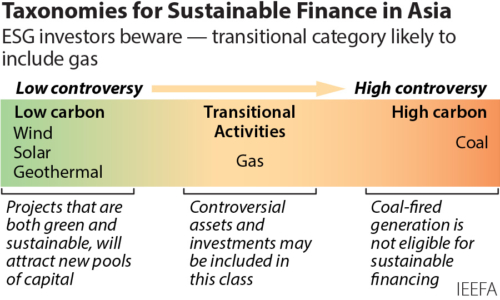
Accommodating the gas sector risks diluting standards and discouraging new pools of green capital

21 September 2021 (IEEFA Asia): Incorporating gas-powered generation as a sustainable investment into Asian taxonomies could have unintended consequences, finds a new report by the Institute for Energy Economics and Financial Analysis (IEEFA).

Doing so could lock Asia into a high-emitting future while also posing a credibility and greenwashing problem that Asian policymakers and ESG debt investors would be wise to avoid.

Taxonomies for sustainable finance in Asia

This is particularly important as Europe and the U.S. ramp up their climate ambition, with the U.S. Treasury releasing a guidance last month requesting multinational development banks rapidly align portfolios with the Paris Agreement, develop targets for green bonds, ‘green’ the partnerships with financial intermediaries, and align policy based operations with climate goals.

A taxonomy specifies the technical requirements of an asset or project that companies must satisfy to enable the labelling of the project as a green or sustainable investment, giving ESG investors reliable information on where to deploy capital to support the acceleration of a sustainable energy transition.

There are many Asian taxonomies in preparation

However, the report notes that controversial or ‘transitional’ economic activities such as gas-powered generation are likely to be recognised in Asian taxonomies as sustainable investments, with energy policy planners attempting to justify the merits of gas and LNG as a reasonable bridging fuel to greening the economy.

There are many Asian taxonomies in preparation that are designed to prioritise an ‘orderly transitional pathway’, including a regional taxonomy for Southeast Asia.

While most Asian taxonomies have yet to acknowledge the undue influence of the oil and gas industry, this will be controversial going forward as the region contemplates replacing coal-fired generation with gas-fired power.

“Gas is a fossil fuel and its high emissions—like coal’s—do not equate to it being a sustainable asset,” says report author Christina Ng.

“And after more than a decade’s effort, carbon capture is yet to be proven as economically and technically viable at scale, which creates a credibility issue for labelling gas power plants as sustainable investments.”

The report notes that financial institutions could also be entangled in greenwashing risk as many of them are lenders to gas-related power projects and are green/sustainable bond issuers themselves.

Financial institutions could be entangled in greenwashing risk

If a taxonomy recognises gas-powered assets as sustainable investments the proceeds from their green or sustainable bonds could be used to finance those assets. Under this scenario any such financial institution would fail the ESG market test.

Ng says policymakers and regulators that are hoping to unlock new pools of capital and meaningfully attract leading ESG investors must rationalise the issues related to gas as a sustainable investment or risk discrediting its taxonomy.

“Asian policymakers must anticipate the rigour with which ESG investors are analysing assets and using taxonomies in the most dynamic global markets,” says Ng.

The report notes policymakers considering adding gas-powered plants to an Asian taxonomy should consult widely first and consider what ESG debt investors—whose capital will determine the usefulness of a taxonomy—will be willing to fund under the sustainable label.

“ESG debt investors would need to be even more forensic in their research on what the different taxonomies will recognise and, as a result, what issuers will sell as ‘sustainable’,” says Ng.

ESG debt investors would need to be even more forensic in their research

“Investors could also be proactive and voice their concerns now over the direction of taxonomy discussions.”

Ng notes the existence of a sustainable finance taxonomy does not prevent projects that the taxonomy excludes—such as gas or carbon abatement projects—from being financed through conventional sources of finance. They just would not be labelled sustainable investments or qualify for sustainable debt instruments.

“If Asian policymakers and regulators want market development to proceed smoothly and taxonomies to be influential, now is the time to appreciate that industry is only one voice in market creation,” says Ng.

Read the report: Asian Hopes for Sustainable Finance Will Rest on More Credible Taxonomies – Accepting Gas Power Plants as Sustainable Investments Heightens Greenwash Risk

Media contact: Kate Finlayson (kfinlayson@ieefa.org) +61 418 254 237

Author contact: Christina Ng (cng@ieefa.org)

About IEEFA: The Institute for Energy Economics and Financial Analysis (IEEFA) examines issues related to energy markets, trends, and policies. The Institute’s mission is to accelerate the transition to a diverse, sustainable and profitable energy economy. (www.ieefa.org)


Offshore Wind Turbine Builder Vestas Closes Three Factories

vestas
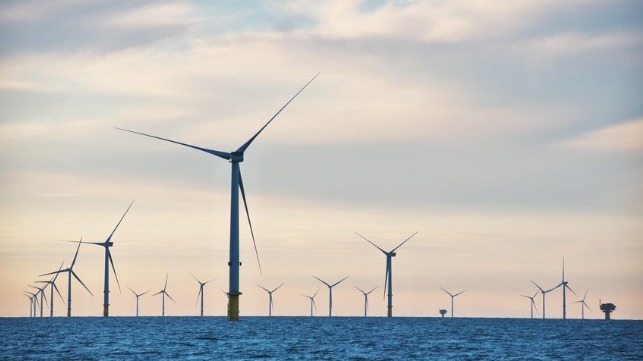
Vestas 9.5 MW turbines at the new Triton Knoll wind farm (RWE UK)

PUBLISHED SEP 21, 2021 12:33 AM BY THE MARITIME EXECUTIVE


After reporting mixed financial results in the second quarter, with rising revenue but slim margins, wind turbine manufacturer Vestas has announced that it is closing three of its factories in Europe, including a facility that makes power components for one of its largest offshore models.

Vestas is the leading manufacturer in the onshore wind turbine market, and it has a portfolio of offshore turbine models as well, including a new 15 GW giant with the largest swept area in the industry. Scale is key in offshore wind project developments, and Vestas' leap forward from 9.5 to 15 GW at the high end of its range will help it to keep pace with competitor Siemens Gamesa and GE, which have recently boosted the top end of their respective lineups to 14 GW.

Vestas’ factory in Esbjerg, Denmark makes power conversion modules for two previous generations of offshore wind turbine, the V164 and the 9.5 GW V174. The factory employs about 75 people, and it is on the list for closure. "As demand for these modules will gradually shift to markets primarily outside of Europe and be delivered via more localized manufacturing facilities, Vestas expects to conclude production of power conversion modules in Esbjerg during the first half of 2022," the company said. 

Vestas said that it will look for opportunities to relocate the staff currently working at its factory in Esbjerg to other sites in Denmark, where it has a total of nearly 6,000 employees. 

In Spain, Vestas will be closing a factory that makes control panels for the V164 offshore turbine and generators for its smaller 2 MW onshore turbines. Demand for the 2 MW platform is falling, Vestas will close its factory in Viviero and offer opportunities to employees to relocate to other sites; about 115 personnel will be affected. 

In Germany, Vestas is planning to sunset its factory in Lauchhammer, which makes a limited number of turbine blades for its V117 and V136 series. The company expects to make enough blades for these models using supply from its other factories around the world. The expectation is to end production in Lauchhammer by the end of 2021, and about 460 people will be affected. As elsewhere, Vestas will work to find new opportunities for employees who are displaced by the closure. 

"Today’s fast-moving energy transition, rapid introduction of new products and recent integration of our onshore and offshore business require us to further mature and evolve our supply chain network and manufacturing footprint," said COO and EVP Tommy Rahbek Nielsen. "I would like to emphasise that we are deeply committed to explore opportunities to relocate our colleagues, who unfortunately will be impacted by the cease of production at our factories in Lauchhammer, Viveiro and Esbjerg."


Vestas to Close Offshore Wind Factories in Denmark and Spain

Danish wind turbine manufacturer Vestas plans to cease production at its factories in Viveiro, Spain, and Esbjerg, Denmark, as well as the onshore wind factory in Lauchhammer, Germany.

Vestas said that the move is part of the company’s integration of its onshore and offshore business started after Vestas acquired a 100 per cent stake in MHI Vestas from Mitsubishi Heavy Industries.

The factory in Esbjerg employs approximately 75 people who manufacture power conversion modules for the V164 and V174 offshore turbines.

As demand for these modules will gradually shift to markets primarily outside of Europe and be delivered via more localised manufacturing facilities, Vestas expects to conclude the production of power conversion modules in Esbjerg during the first half of 2022.

The company will explore opportunities to relocate employees currently working at the factory in Esbjerg to other Vestas sites in Denmark.

The Viveiro factory employs approximately 115 people who manufacture generators for the 2 MW onshore platform as well as control panels for the V164 offshore turbine for markets outside of Spain.

Due to both the decrease in demand for the 2 MW platform and the need to optimise offshore manufacturing, it is no longer sustainable to continue activities in Viveiro, Vestas said.

Based on current plans, Vestas expects to finalise production in Viveiro end of 2021 and will offer opportunities to relocate employees currently working in Viveiro to other Vestas sites in Spain.

”Today’s fast-moving energy transition, rapid introduction of new products and recent integration of our onshore and offshore business require us to further mature and evolve our supply chain network and manufacturing footprint,” said Executive Vice President and COO Tommy Rahbek Nielsen.

”While Vestas will sustain a strong footprint in Europe across manufacturing and service activities, it’s always hard to make decisions that negatively affect our good, hardworking colleagues at Vestas. I would like to emphasise that we are deeply committed to explore opportunities to relocate our colleagues, who unfortunately will be impacted by the cease of production at our factories in Lauchhammer, Viveiro and Esbjerg.”

Where required by local law, Vestas will now initiate legal proceedings and negotiations with worker’s representatives and the local work councils for all affected employees. The total cost of this adjustment of Vestas’ manufacturing onshore and offshore footprint will depend on specifics related to the outcome of negotiations with work councils, sale of buildings, etc. As indicated in Vestas’ guidance for 2021, the total cost will be booked as special items related to the integration of the offshore business and will be recognised in the third quarter of 2021.


'MAYBE' TECH
SHELL'S SCOTTFORD REFINERY BLUE HYDROGEN CCS PROJECT

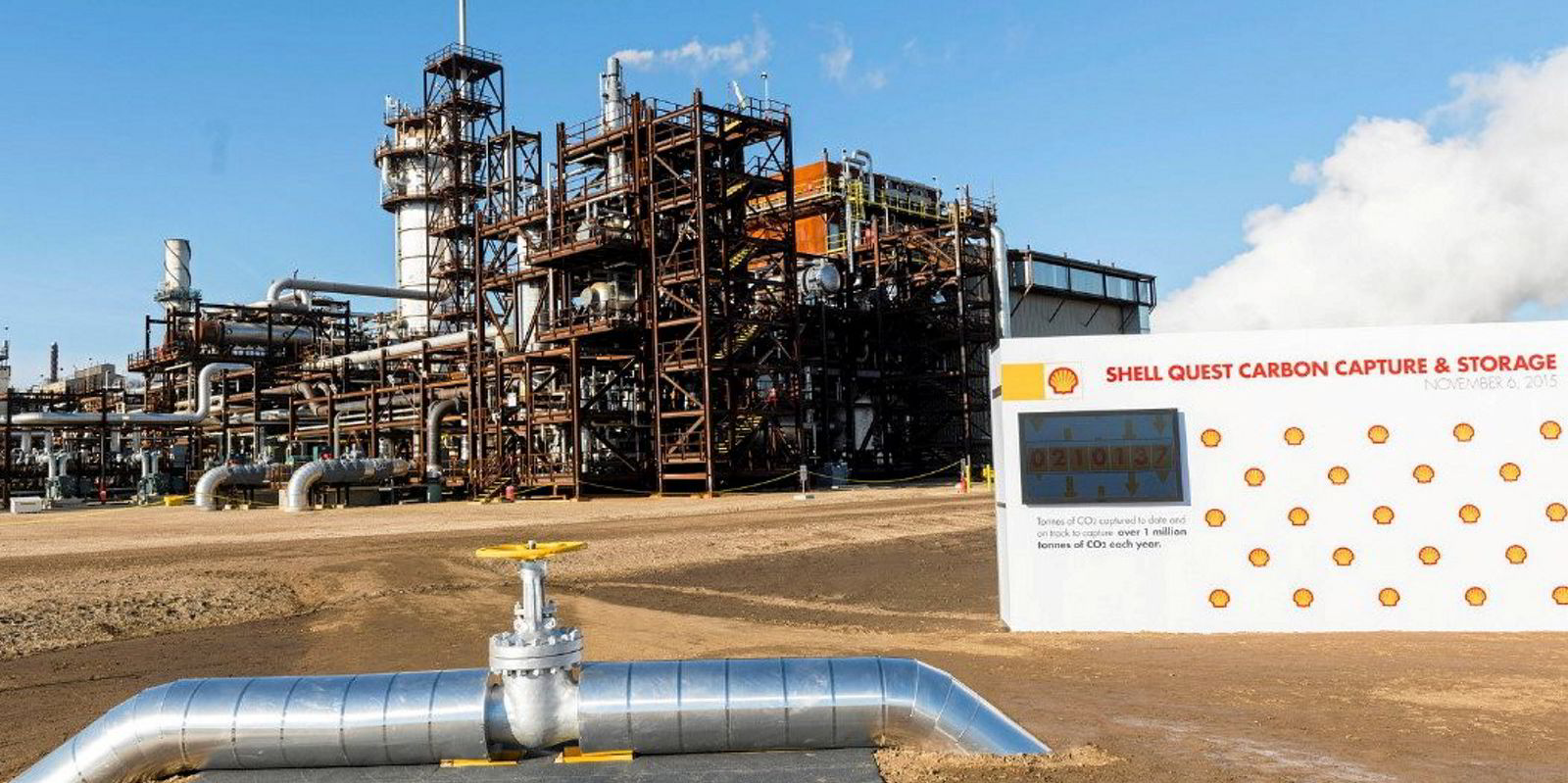
Shell's Quest CCS plant near Edmonton, Canada, which produces 900 tonnes of blue hydrogen per day.
Photo: Shell

Climate impact of blue hydrogen would be similar to green H2 if emissions were minimised: study


Reducing natural-gas leaks in the supply chain and increasing carbon capture rates would allow blue H2 to be a 'bridging technology', says global team of academics

Blue hydrogen — produced from natural gas with carbon capture and storage — can have a similar climate impact to renewable hydrogen, if two key requirements are met, according to a yet-to-be-peer-reviewed scientific study written by 16 researchers from around the world.


“If methane emissions from natural gas supply are low and CO2 capture rates high, blue hydrogen is comparable with green hydrogen in terms of impacts on climate change,” says the report, entitled On the climate impacts of blue hydrogen production.

The study — written by academics based in the UK, the US, Canada, Swizerland, Germany, Italy and the Netherlands — looks at what could feasibly achieved in terms of greenhouse gas (GHG) emissions from blue hydrogen production, in contrast to the recent controversial study that largely used historic data to claim that blue H2 is worse than natural gas for the climate.


“Our LCA [lifecycle assessment] of hydrogen production with CCS shows that the term 'blue hydrogen” as such can only be taken as synonym for ‘low-carbon’ hydrogen if two key requirements are met,” states the report, which has appeared on the pre-publication academic website ChemRxiv.

“First, natural gas supply must be associated with low GHG emissions, which means that natural gas leaks and methane emissions along the entire supply chain, including extraction, storage, and transport, must be minimized.

“Second, [methane] reforming technology with high CO2 capture rates must be employed.”

The report states that current carbon capture technology can “allow removal rates at the hydrogen production plant of above 90%”, pointing out that capture rates of “close to 100% are technically feasible, slightly decreasing energy efficiencies and increasing costs, but have yet to be demonstrated at scale”.

“Our main conclusion is that, if the above requirements are met, blue hydrogen can be close to green hydrogen in terms of impacts on climate change and can thus play an important and complementary role in the transformation towards net-zero economies.

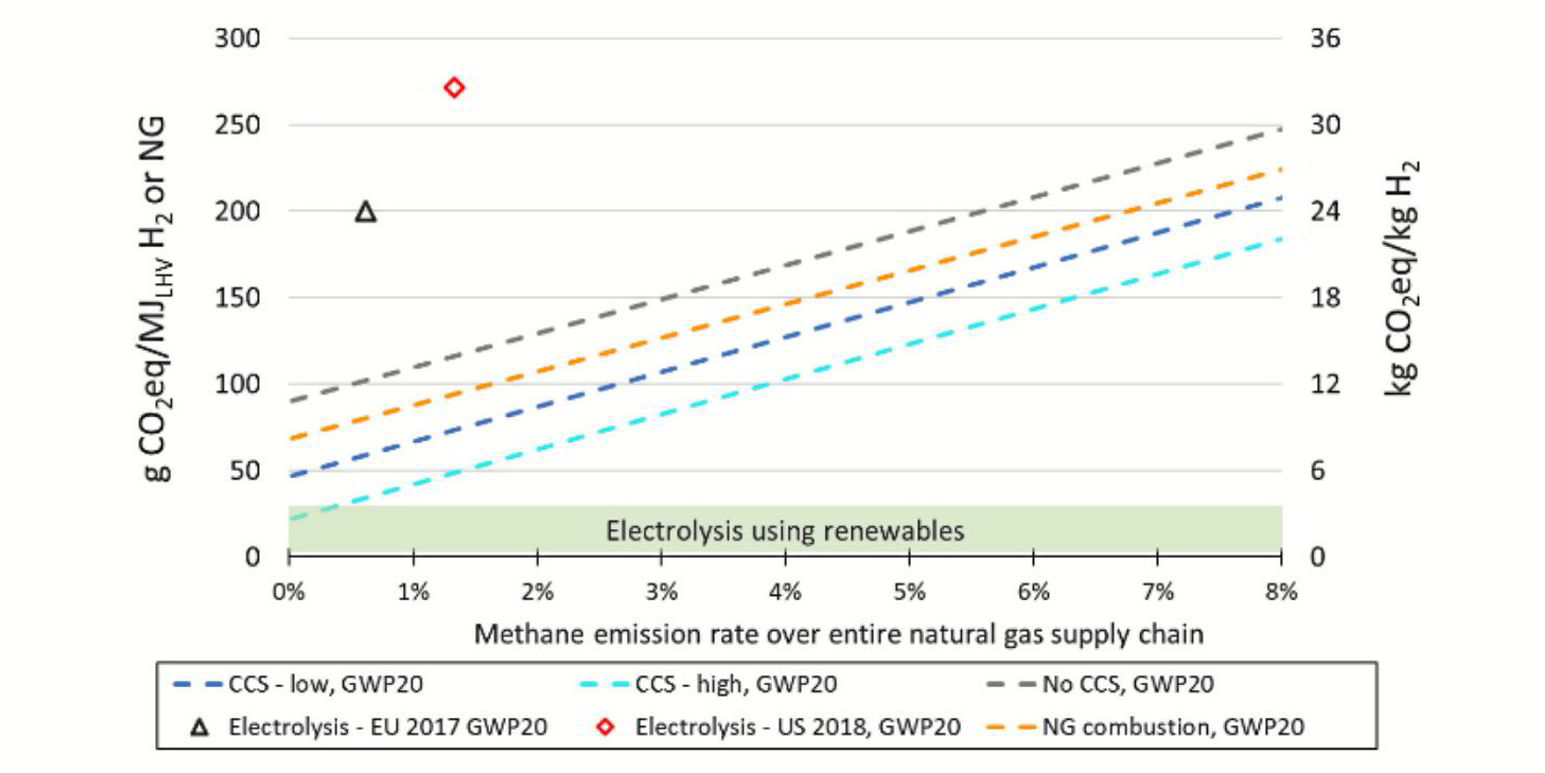
Chart from the study showing how blue hydrogen can just sneak into being comparable with green H2 in terms of climate impact, given low methane emissions and high carbon capture rates. Photo: Report authors/ChemRxiv CARBON CAPTURE IS ANOTHER MAYBE TECHNOLOGY

“In order to be competitive with green hydrogen in terms of climate impacts over the long-term, blue hydrogen should exhibit a life cycle GHG footprint of not more than 2-4 kg CO2 [equivalent per] kg. This is only possible with high CO2 removal rates [of 93%, using autothermal reforming] and methane emission rates below about 1% (GWP100) or 0.3% (GWP20).” [see panel below for explanation of GWP]

Part of this assessment is based on the assumption that “no single hydrogen production technology (including electrolysis with renewables) is completely net-zero in terms of GHG emissions over its life cycle and will therefore need additional GHG removal from the atmosphere to comply with strict net-zero targets.”

Presumably, this is a reference to greenhouse gases emitted in the process of producing, transporting and installing solar panels, wind turbines and batteries — although this is not explicitly addressed in the study.

The report states that one shale gas production region in the US has achieved methane emission rates “as low as 0.3-0.4%”, while in Norway, the UK and the Netherlands, “natural gas supply chains have emission rates typically below 0.5%”.

It adds that gas exporters such as Russia, Algeria and Libya have methane emission rates “around or significantly higher than 2%”.

The authors do concede, however, that “there is a very large uncertainty on these emissions, which needs to be urgently addressed by improved measurement, reporting, and disclosure”.

While the report states that “green hydrogen should be preferred [to blue]”, it explains: “Given the short- to medium-term capacity of green hydrogen, blue hydrogen can play a role as a bridging technology supporting the uptake of hydrogen infrastructure and hydrogen end-use transformation.”(Copyright)
GWP20 V GWP100


GWP100 and GWP20 refer to the global warming potential (ie, climate impact] over a 100-year-period and over a 20-year period. Methane is 84-87 times more powerful a greenhouse gas than carbon dioxide over 20 years, but only 28-36 times stronger over the course of a century.

Therefore, dramatically different conclusions can be reached depending on which GWP scenario is used.


'MAYBE' TECH
'Vast majority' of green hydrogen projects may require water desalination, potentially driving up costs


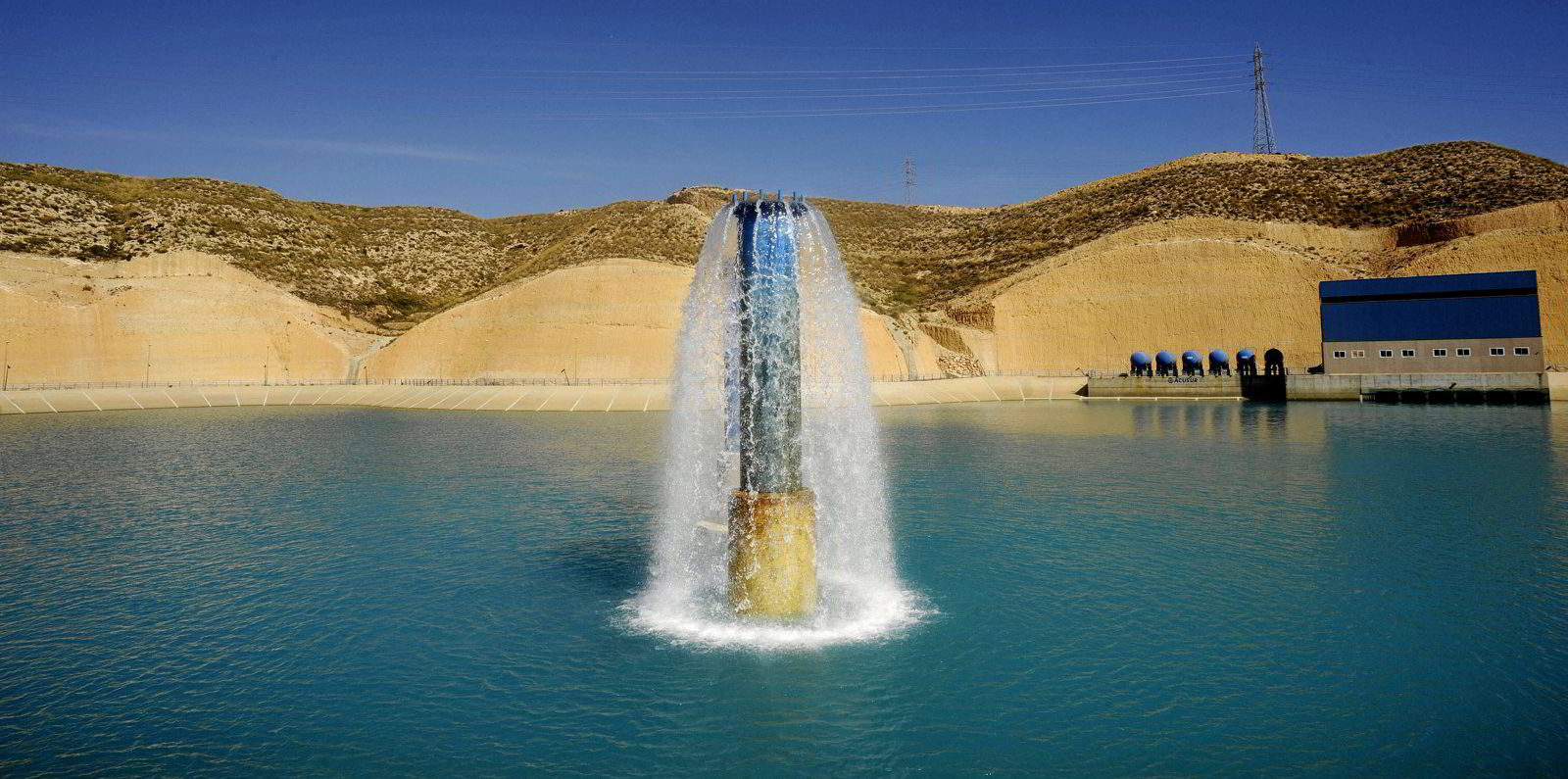
Fresh water is pumped into a reservoir after being treated at a desalination plant in southern Spain.Photo: AFP/Getty

Most of the 200GW-plus global pipeline is due to be built in arid water-stressed regions, says analyst Rystad Energy

Nearly 85% of the green hydrogen capacity in the global pipeline may need to source its water from desalination, adding substantially to the cost of the H2 produced, according to Rystad Energy.

The Norwegian analyst says that the 206GW of announced green hydrogen projects due to be built by 2040 would require a total of 620 million cubic metres (m3) of purified H2O per year, but that almost 85% of this capacity is due to be built in water-stressed regions such as Spain, Chile and Australia.


World’s first national green H2 tender attracts bids from power, gases, steel and LNG sectors
Read more


Hydrogen now firmly at the heart of the global race to net zero — for better or worse
Read more

Desalination of sea water or brackish groundwater may therefore be needed — a power-hungry process that would require additional renewable energy to ensure that the hydrogen is green, pushing up costs.

According to analyst Advisian, desalination costs $0.70-3.20 per m3 of purified water, depending on the size and location of the plant.

The production of green hydrogen uses renewable electricity to split water molecules into hydrogen and oxygen, with roughly 9m3 (9,000 litres) of purified H2O required for each tonne of H2. Desalination requires about 1kWh of electricity per m3 of purified water.

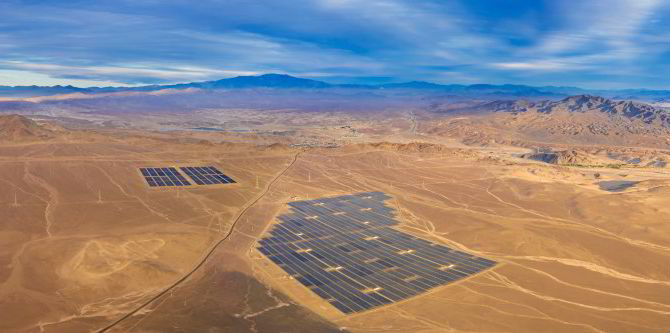
The price of renewable energy is the largest component of the cost of green hydrogen, so it is little wonder that many developers are seeking to build projects in sunny, arid, water-stressed regions where solar power would be cheap to produce.

“Our analysis finds that 14 green electrolyser projects are planned in countries with extremely high water-stress levels, 53 projects are in countries with high water stress, and 162 projects are located in regions with medium to high water stress,” said Rystad. “Hydrogen electrolyser projects in the high to extremely high water-stressed countries will almost certainly require desalination for their water supply — potentially implying a demand of 125.7 million cubic meters of water annually for desalination by 2040.

“Demand for desalination could grow fivefold to 526 million cubic meters by 2040 if all the hydrogen projects within regions with water stress levels above medium are realised.”

The analyst explains that the UN expects global freshwater demand to increase by 60% by 2025 — for agriculture alone.

“Therefore, regions with water stress levels above medium will most likely need to develop this additional desalination capacity to support green hydrogen facilities.”

Currently, only 1% of desalination projects around the world are powered by renewable energy, Rystad adds.(Copyright)
'MAYBE' TECH
A New Electrocatalyst Massively Improves the Commercial Viability of Green Hydrogen

Turning ordinary nickel and cobalt into key pathways for mass producing hydrogen.


By Chris Young
Sep 20, 2021

Petmal/iStock

Researchers from Curtin University identified a more efficient and affordable electrocatalyst to make green hydrogen from water, a press statement reveals. The new material has the potential to enable green hydrogen production at an unprecedented scale.

Scientists have typically used precious metal catalysts, such as platinum to accelerate the separation of water into hydrogen and oxygen. The Curtin team found that by adding nickel and cobalt to cheaper catalysts, they could enhance their performance, making them worth exploring as a commercially viable alternative. The researchers published the results of their findings in the journal Nano Energy.

"Our research essentially saw us take two-dimensional iron-sulfur nanocrystals, which don’t usually work as catalysts for the electricity-driven reaction that gets hydrogen from water, and add small amounts of nickel and cobalt ions," said lead researcher Dr. Guohua Jia. "When we did this it completely transformed the poor-performing iron-sulfur into a viable and efficient catalyst."

Green hydrogen bolsters the fight against climate change

Jia explains that the materials used during the research teams' experiment are more abundant and therefore more affordable. They are also more efficient than ruthenium oxide, the current benchmark material. "Our findings not only broaden the existing "palette" of possible particle combinations, but also introduce a new, efficient catalyst that may be useful in other applications. It also opens new avenues for future research in the energy sector, putting Australia at the forefront of renewable and clean energy research and applications."

Other countries such as France are also making concerted efforts to improve their green hydrogen production. Green hydrogen firm Lhyfe and French engineering school Centrale Nantes recently announced they would open the world's first offshore green hydrogen production plant off the coast of Le Croisic, France. Such efforts will bolster the uptake of hydrogen fuel, which is increasingly being utilized as an alternative to fossil fuels in a bid to turn the tide on the worst effects of climate change. Next, the Curtin researchers hope to conduct further tests with a view to testing the commercial viability of their electrocatalysts. Jia feels that more effort is needed from officials in Australia to improve on the figure of 21 percent of energy coming from renewables in the national energy market.