Saturday, November 27, 2021

Show-Me-a-saurus! Skeleton of a new type of dinosaur unearthed in Missouri


Mike Snider, USA TODAY
Sat, November 27, 2021

Scientists have identified not only the bones of a new dinosaur in southern Missouri, but also may have found a dinosaur hotbed.

The newly identified duck-billed dinosaur, named Parrosaurus missouriensis, grew to about 35 feet in length as an adult. Various dinosaur bones have been found at the dig site over the last eight decades, but now enough have been collected to make certain that a new genus and species had been discovered.

Just more than a month ago, researchers removed the dinosaur's body. "It was enormous, almost the size of a Volkswagen," said Guy Darrough, curator of the Sainte Genevieve Museum Learning Center in Ste. Genevieve, Missouri.

The discovery is like "hitting King Tut's tomb," said Darrough, who first began working at the site four decades ago. "I can't think of another discovery that would be bigger than dinosaurs in Missouri."

The finding also adds to scientists' knowledge of the ecology of the Western Interior Seaway, a body of water that divided North America more than 70 million years ago. While the majority of dinosaur finds have been in western states, this site in southern Missouri – it would have been on the seaway's eastern shore – has been yielding finds for decades.


A full-sized model of the Missouri dinosaur Parrosaurus missouriensis.

About 80 years ago at the site, scientists found the first dinosaur bones there; they were suspected to be the remains of a large sauropod, a plant-eating dinosaur, Darrough said. Charles Gilmore, a paleontologist at the Smithsonian National Museum of Natural History, looked at the bones and, along with Dan Stewart of the Missouri Geological Survey, wrote a paper on the dinosaur, which became known as Parrorsaurus missouriensis, according to the Bollinger County (Mo.) Museum of Natural History.

Another cache of bones – a skeleton of what they learned was a juvenile dinosaur and a dinosaur jaw with teeth – was found in the 1980s, after geologist Bruce Stinchcomb bought the property. Those bones suggested the dinosaur was not a sauropod but actually a hadrosaur, or duck-billed dinosaur.

Hadrosaurs have long been considered herbivores, but some findings in recent years suggest they might have eaten crustaceans, either opportunistically or accidentally.

Scientists had thought the dinosaur looked like the brontosaurus used in the Sinclair Oil advertising, "but it turns out it's a totally different type of dinosaur," Darrough said.

A fossil collector, Darrough asked if he could set up a greenhouse to dig there at the site and successfully found some dinosaur bones. Also found: the tooth of a dinosaur that is a relative to Tyrannosaurus rex.

Darrough contacted Peter Makovicky, a paleontologist who then was curator of dinosaurs at The Field Museum in Chicago. He traveled to Missouri in 2016 and soon had a dig team sent to the site.

"Most people thought we were finding mastodons and mammoths," Darrough said. "Those big animals are like, you know, 10,000 years old. But dinosaurs are like 70 million (years o). I knew they were dinosaur bones, but I just kept quiet."

Darrough was "a very serious fossil collector and actually knew his stuff," Makovicky said, but admitted to being "guarded, but very intrigued" about the find prior to arriving.

Peter Makovicky, at left, and Guy Darrough, examining the clay that may contain more bones of the Missouri dinosaur.

The site was "at the bottom of a glen in the Ozarks" and looked "like a frog pond," Makovicky said. "This didn't look like a dinosaur site. There was no exposed bedrock."

But they began finding bones including the tail, two arms and skull of a dinosaur that would have been around 35 feet long, Darrough said. And a little more than a month ago, they removed the body of that dinosaur. "It was enormous, almost the size of a Volkswagen," he said.

"It weighed over 2,000 pounds," said Makovicky, now a professor of earth and environmental sciences at the University of Minnesota.

Images from the dig site in southern Missouri where a new type of dinosaur, Parrosaurus missouriensis has been found. Team members Akiko Shinya (left) and MInyoung Son (right) are tunneling through the clay under the jacket to loosen it so it can be flipped and the underside wrapped with plaster bandages.

For perspective, the Tyrannosaurus rex was thought to be about 40 feet long and 12 feet tall, while the Supersaurus dinosaur, revealed earlier this month, is thought to be the longest dinosaur at between 128 and 137 feet.

Based on the findings of the skull, arms and tail section, Makovicky concluded the bones were those of a duck-billed dinosaur and, since the original dinosaur name applied to the site, has been christened Parrorsaurus missouriensis. The dinosaur had already been named the state dinosaur of the state of Missouri, based on the previous findings.

There site will likely yield remains of at least four different Parrosaurus missouriensis dinosaurs, Makovicky said.

"Potentially there's a lot more here," he said. "We're actually looking at something that might be a mass death occurrence, like an entire herd that perished and washed into this waterhole or lagoon."

Speaking of death at the dig site, continuing research resulted in the finding of the "bony armor from a giant crocodile," a crocodilian, said Darrough, whose Lost World Studios creates life-sized dinosaur models for museums and botanical gardens.


Vern Bauman directing removal of the massive plaster jacket containing part of the skeleton of the Missouri dinosaur, Parrosaurus missouriensis in 2021.


"These things are like 50 feet long and they're big enough to take down a dinosaur. So when the Parrosaurus herds would be coming down to take a drink, these guys could snag them around the neck and pull them into the water and drown them. When you get a crocodile big enough to take down a dinosaur that is a big crocodile."

Regardless of what else is found, the Missouri dig has been a great example of scientific collaboration between paleontologists and "dedicated and generous local volunteers, who essentially started this project over 30 years ago," Makovicky said.

And it has helped expand the knowledge of dinosaurs in the U.S. east of the Western Interior Seaway, which at one point spread to the Appalachian Mountains.

"Most of the dinosaurs that every 6-year-old is familiar with, Tyrannosaurs, your various horned dinosaurs and duck-bills, and so on, were living west of the Seaway," Makovicky said. "From the eastern seaboard and the Midwestern states, we have far, far less knowledge of dinosaurs. So when you actually find a site where you have not just scraps, but multiple skeletons together, that's a real windfall."

Follow Mike Snider on Twitter: @mikesnider.

This article originally appeared on USA TODAY: Dinosaur bones in Missouri unearthed, reveal new duck-billed species
Ancient DNA is revealing the genetic landscape of people who first settled East Asia


Melinda A. Yang, Assistant Professor of Biology, University of Richmond
Sat, November 27, 2021

Pulverized ancient bone can provide DNA to scientists for analysis. Xin Xu Institute of Vertebrate Paleontology and Paleoanthropology, CC BY-ND

The very first human beings originally emerged in Africa before spreading across Eurasia about 60,000 years ago. After that, the story of humankind heads down many different paths, some more well-studied than others.

Eastern regions of Eurasia are home to approximately 2.3 billion people today – roughly 30% of the world’s population. Archaeologists know from fossils and artifacts that modern humans have occupied Southeast Asia for 60,000 years and East Asia for 40,000 years.

But there’s a lot left to untangle. Who were the people who first came to these regions and eventually developed agriculture? Where did different populations come from? Which groups ended up predominant and which died out?

Ancient DNA is helping to answer some of these questions. By sequencing the genomes of people who lived many millennia ago, scientists like me are starting to fill in the picture of how Asia was populated.


Ancient skull without bottom jaw

Analyzing ancient genomes

In 2016, I joined Dr. Qiaomei Fu’s Molecular Paleontology Lab at the Institute of Vertebrate Paleontology and Paleoanthropology, Chinese Academy of Sciences in Beijing. Our challenge: Resolve the history of humans in East Asia, with the help of collaborators who were long dead – ancient humans who lived up to tens of thousands of years ago in the region.

Members of the lab extracted and sequenced ancient DNA using human remains from archaeological sites. Then Dr. Fu and I used computational genomic tools to assess how their DNA related to that of previously sequenced ancient and present-day humans.


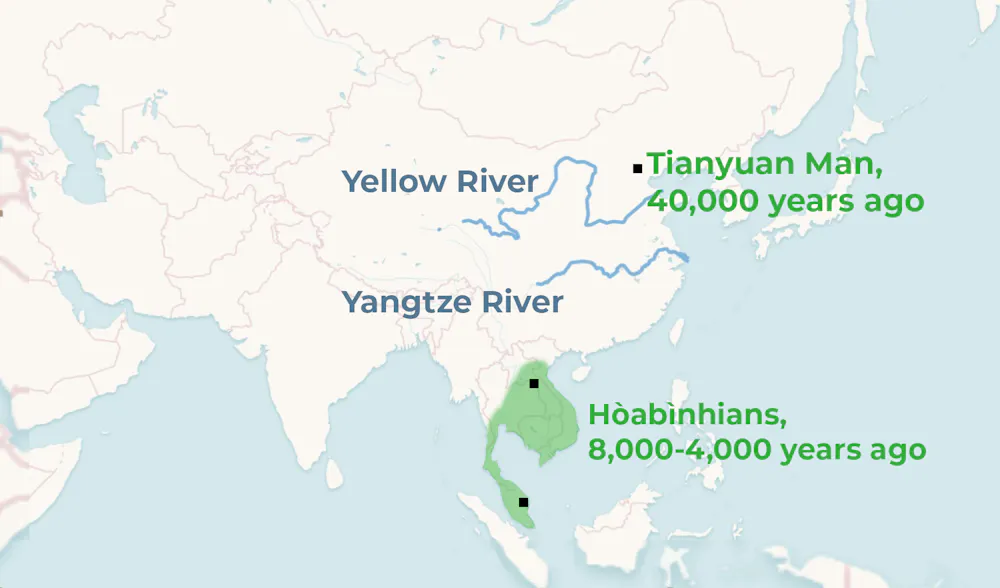
map where aDNA samples were excavated in Asia

One of our sequences came from ancient DNA extracted from the leg bones of the Tianyuan Man, a 40,000-year-old individual discovered near a famous paleoanthropological site in western Beijing. One of the earliest modern humans found in East Asia, his genetic sequence marks him as an early ancestor of today’s Asians and Native Americans. That he lived where China’s current capital stands indicates that the ancestors of today’s Asians began placing roots in East Asia as early as 40,000 years ago.

Farther south, two 8,000- to 4,000-year-old Southeast Asian hunter-gatherers from Laos and Malaysia associated with the Hòabìnhian culture have DNA that, like the Tianyuan Man, shows they’re early ancestors of Asians and Native Americans. These two came from a completely different lineage than the Tianyuan Man, which suggested that many genetically distinct populations occupied Asia in the past.

But no humans today share the same genetic makeup as either Hòabìnhians or the Tianyuan Man, in both East and Southeast Asia. Why did ancestries that persisted for so long vanish from the gene pool of people alive now? Ancient farmers carry the key to that answer.

DNA carries marks of ancient migrations

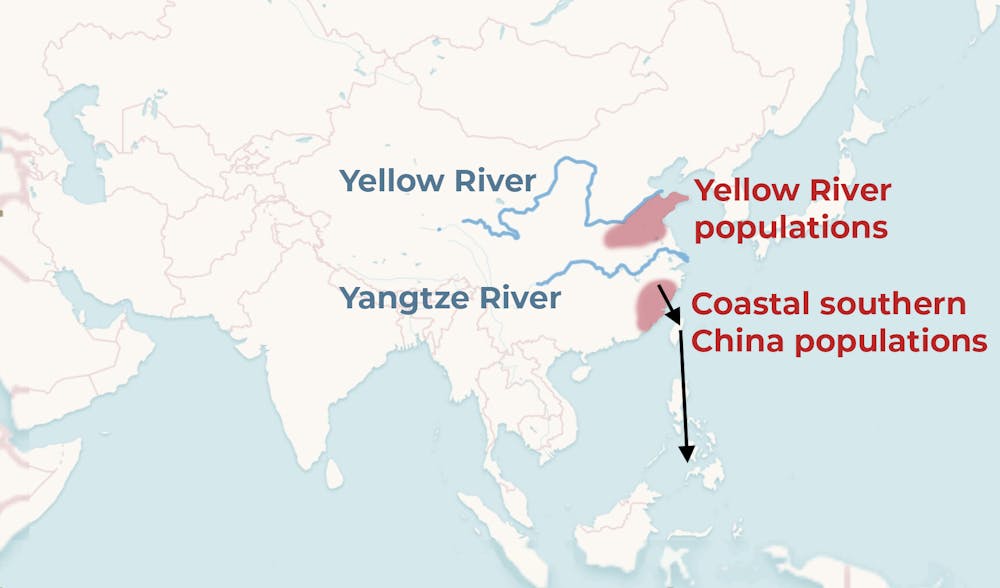
Based on plant remains found at archaeological sites, scientists know that people domesticated millet in northern China’s Yellow River region about 10,000 years ago. Around the same time, people in southern China’s Yangtze River region domesticated rice.

Unlike in Europe, plant domestication began locally and was not introduced from elsewhere. The process took thousands of years, and societies in East Asia grew increasingly complex, with the rise of the first dynasties around 4,000 years ago.


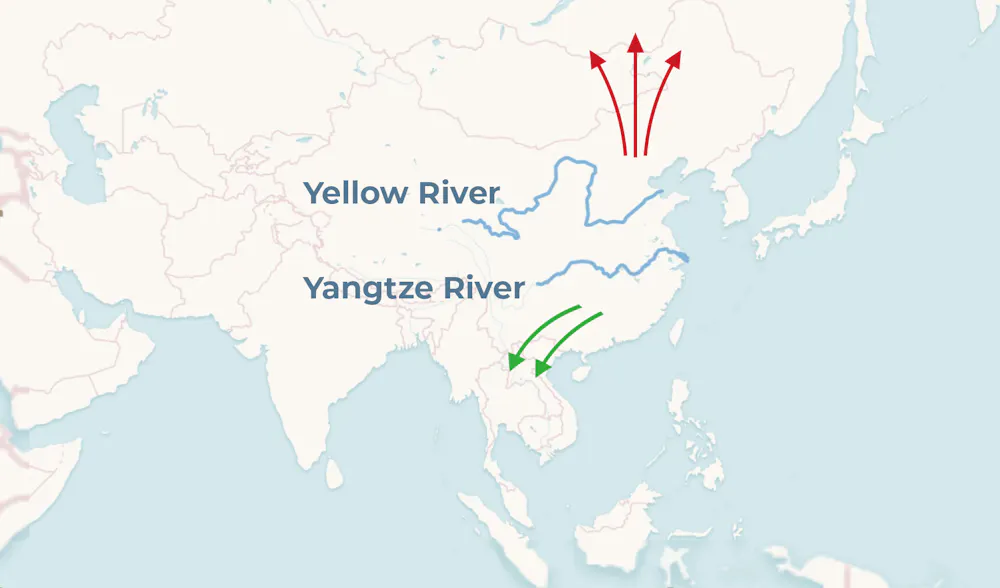
map showing migration of ancient people north from Yellow River area and south from Yangtze River area

That’s also when rice cultivation appears to have spread from its origins to areas farther south, including lands that are today’s Southeast Asian countries. DNA helps tell the story. When rice farmers from southern China expanded southward, they introduced not only their farming technology but also their genetics to local populations of Southeast Asian hunter-gatherers.

The overpowering influx of their DNA ended up swamping the local gene pool. Today, little trace of hunter-gatherer ancestry remains in the genes of people who live in Southeast Asia.


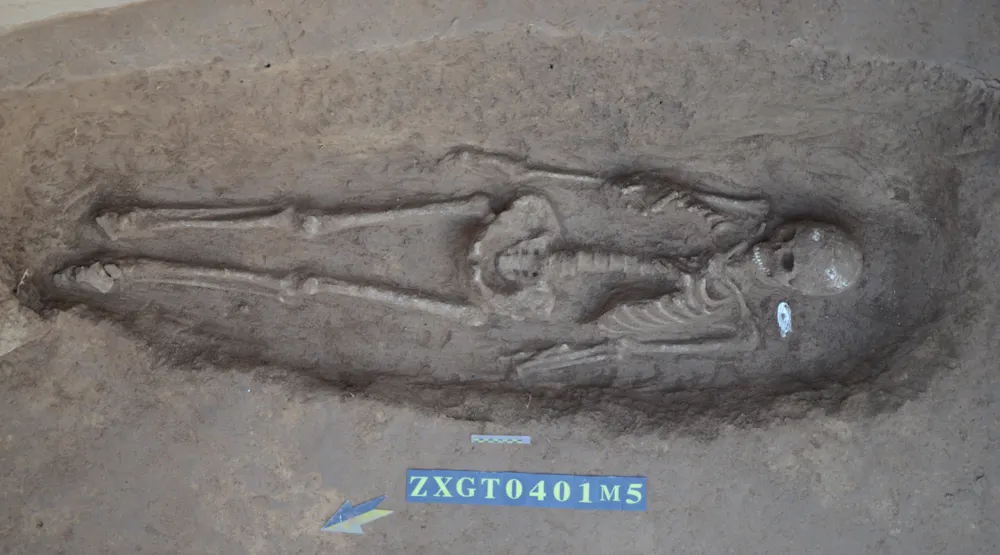
Excavation of human skeleton

Farther north, a similar story played out. Ancient Siberian hunter-gatherers show little relationship with East Asians today, but later Siberian farmers are closely related to today’s East Asians. Farmers from northern China moved northward into Siberia bringing their DNA with them, leading to a sharp decrease in prevalence of the previous local hunter-gatherer ancestry.

Scientist in protective gear pipetting under a hood

Past populations were more diverse than today’s

Genetically speaking, today’s East Asians are not very different from each other. A lot of DNA is needed to start genetically distinguishing between people with different cultural histories.


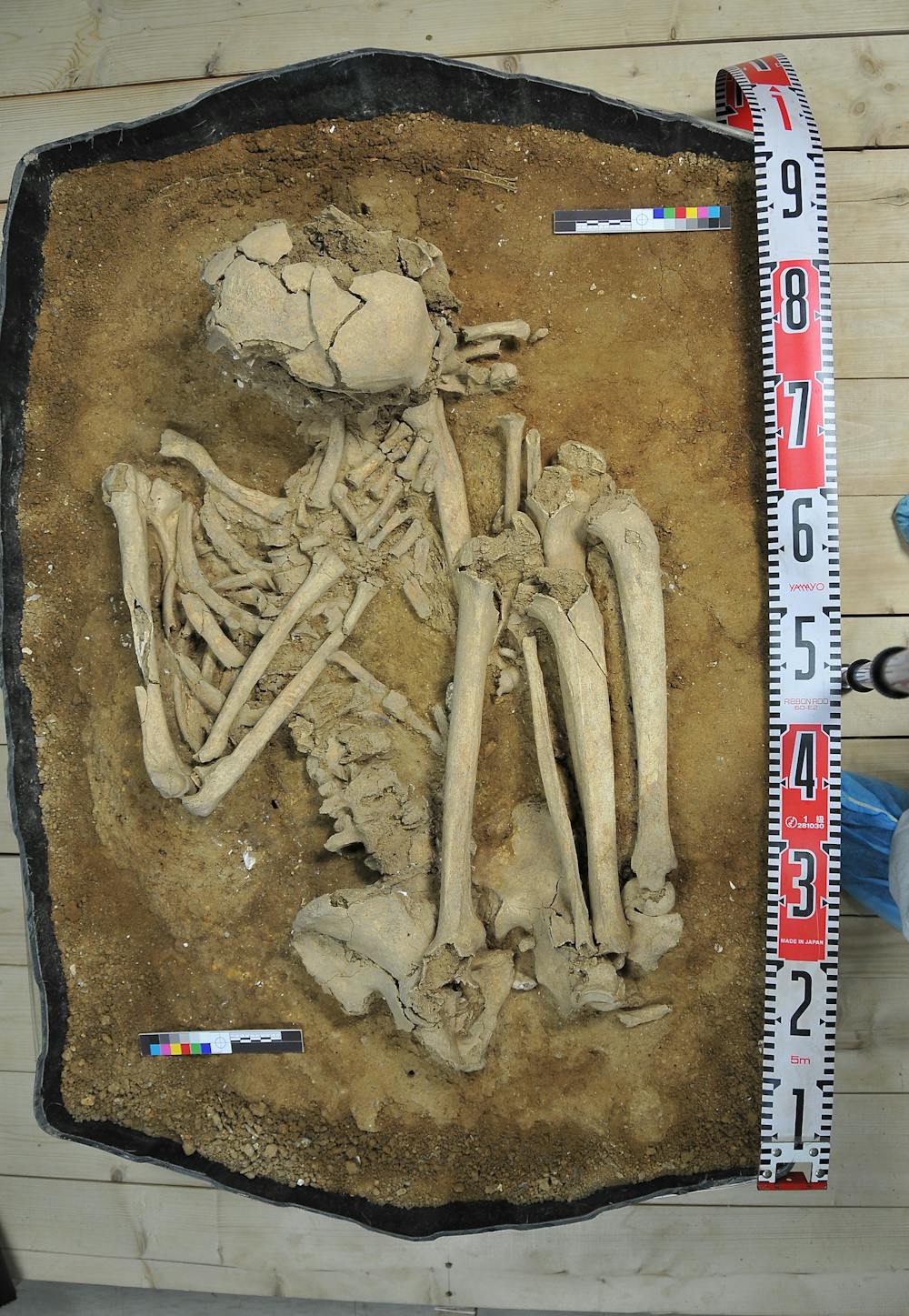
Folded up ancient skeleton being excavated

What surprised Dr. Fu and me was how different the DNA of various ancient populations were in China. We and others found shared DNA across the Yellow River region, a place important to the development of Chinese civilization. This shared DNA represents a northern East Asian ancestry, distinct from a southern East Asian ancestry we found in coastal southern China.

When we analyzed the DNA of people who lived in coastal southern China 9,000-8,500 years ago, we realized that already by then much of China shared a common heritage. Because their archaeology and morphology was different from that of the Yellow River farmers, we had thought these coastal people might come from a lineage not closely related to those first agricultural East Asians. Maybe this group’s ancestry would be similar to the Tianyuan Man or Hòabìnhians.


map showing different ancestral populations in Asia based on aDNA

But instead, every person we sampled was closely related to present-day East Asians. That means that by 9,000 years ago, DNA common to all present-day East Asians was widespread across China.

Today’s northern and southern Chinese populations share more in common with ancient Yellow River populations than with ancient coastal southern Chinese. Thus, early Yellow River farmers migrated both north and south, contributing to the gene pool of humans across East and Southeast Asia.

The coastal southern Chinese ancestry did not vanish, though. It persisted in small amounts and did increase in northern China’s Yellow River region over time. The influence of ancient southern East Asians is low on the mainland, but they had a huge impact elsewhere. On islands spanning from the Taiwan Strait to Polynesia live the Austronesians, best known for their seafaring. They possess the highest amount of southern East Asian ancestry today, highlighting their ancestry’s roots in coastal southern China.

Other emerging genetic patterns show connections between Tibetans and ancient individuals from Mongolia and northern China, raising questions about the peopling of the Tibetan Plateau.

Ancient DNA reveals rapid shifts in ancestry over the last 10,000 years across Asia, likely due to migration and cultural exchange. Until more ancient human DNA is retrieved, scientists can only speculate as to exactly who, genetically speaking, lived in East Asia prior to that.

[Understand new developments in science, health and technology, each week. Subscribe to The Conversation’s science newsletter.]

This article is republished from The Conversation, a nonprofit news site dedicated to sharing ideas from academic experts. It was written by: Melinda A. Yang, University of Richmond.

Read more:

Angkor Wat archaeological digs yield new clues to its civilization’s decline

Ancient DNA is a powerful tool for studying the past – when archaeologists and geneticists work together

Humans domesticated horses – new tech could help archaeologists figure out where and when

Melinda A. Yang does not work for, consult, own shares in or receive funding from any company or organization that would benefit from this article, and has disclosed no relevant affiliations beyond their academic appointment.
Hitler at home: How the Nazi PR machine remade the Führer's domestic image and duped the world


Despina Stratigakos, Vice Provost for Inclusive Excellence and Professor of Architecture, University at Buffalo

Sat, November 27, 2021,

On March 16, 1941 – with European cities ablaze and Jews being herded into ghettos – The New York Times Magazine featured an illustrated story on Adolf Hitler’s retreat in the Berchtesgaden Alps.

Adopting a neutral tone, correspondent C Brooks Peters noted that historians of the future would do well to look at the importance of “the Führer’s private and personal domain,” where discussions about the war front were interspersed with “strolls with his three sheep dogs along majestic mountain trails.”

For more than 70 years, we have ignored Peters’s call to take Hitler’s domestic spaces seriously. When we think of the stage sets of Hitler’s political power, we are more apt to envision the Nuremberg Rally Grounds than his living room.

Yet it was through the architecture, design and media depictions of his homes that the Nazi regime fostered a myth of the private Hitler as peaceable homebody and good neighbor.

In the years leading up to World War II, this image was used strategically and effectively, both within Germany and abroad, to distance the dictator from his violent and cruel policies. Even after the war began, the favorable impression of the off-duty Führer playing with dogs and children did not immediately fade.

A radical makeover

Nazi mythologies about Hitler’s origins emphasized his poverty and homelessness as a young man, as well as his disdain for creature comforts.

But once Hitler became chancellor – and particularly after the royalties from Mein Kampf made him a wealthy man – he focused considerable energies on the redesign and furnishing of his residences: the Old Chancellery in Berlin; his Munich apartment; and the Berghof, his mountain home on the Obersalzberg.

The timing of these renovations in the mid-1930s coincided with Hitler’s public makeover as a statesman and diplomat, a transformation also promoted by Leni Riefenstahl’s Nazi propaganda films.

The rough edges of the extreme anti-Semite and agitator of the masses were sanded away through the creation of a new, sophisticated persona that emerged in carefully crafted domestic surroundings. With silk curtains and porcelain vases, Hitler’s designers suggested an internal world that was both cultivated and peaceful.

Gerdy Troost, Hitler’s interior decorator, played an important role in conveying an image of her client as a man of taste and culture. Inspired by British design reform movements, she emphasized quality of materials and craftsmanship over showy display.

Hitler was an engaged client, and he admired her taste, although they sometimes clashed over his tendency toward the grandiose. A woman both respected and feared in Nazi Germany, Troost has been overlooked in histories written about the period. However new archival sources reveal the surprising extent of her influence over Hitler and her prominence within Nazi elite circles.

Hitler’s chalet


With views of Germany on one side of the mountain and Austria on the other, the Berghof was the most public of Hitler’s private homes, and it exerted a powerful hold on the Nazi imagination of empire.

Hitler and his publicists drew on mountain imagery from Germany’s literary and artistic movements (particularly Romanticism) to mythologize the Führer as a mystic leader who immersed himself in – and embodied – the terrible and magnificent forces of nature.

At the same time, the mountain served as a means to humanize Germany’s leader through his contact with animals as well as with children. In officially produced postcards, magazines and books, Germans consumed fantasies about an ideal domestic life rooted in the natural landscape.


In the expansive Lebensraum and pure mountain air, where the sun shone and blond children frolicked, the Nazis encouraged Germans to envision a blissful future in exchange for sacrifices to their pocketbooks and freedoms.
To the foreign press, a Bavarian gentleman

The rise of celebrity culture in the 1920s and 1930s created a voracious appetite for information about the daily lives of the rich and famous. Hitler’s team was quick to realize and exploit the public’s hunger, pioneering PR strategies that are commonplace today.

Journalists writing for the English-language press gobbled up the propaganda, fueling a false image of Hitler by publishing glowing stories of the Führer, even in the face of disturbing counter-realities.

On May 30, 1937 – a month after German planes bombed Guernica, Spain – The New York Times Magazine published a front-page article on Adolf Hitler’s idyllic mountain retreat.

In this admiring piece, penned by foreign correspondent Otto Tolischus, the skies were depicted not as a means of delivering destruction, but as a rarified topos of meditation, beauty and the simple life.

The article described how, surrounded by Alpine peaks, Germany’s leader communed with nature, contemplated the Reich and indulged his sweet tooth for chocolate. Hitler’s attack on Guernica and the suffering of its victims, later memorialized by Pablo Picasso, went unmentioned.

In November 1938, shortly after the annexation of Czechoslovakia’s Sudetenland – and the same month as the Night of Broken Glass – Homes and Gardens published a feature titled Hitler’s Mountain Home, which credited Hitler with the design of the Berghof. Applauding his taste, the article depicted his private life as one of refinement, gentle repasts and congenial friendships.

And days before the signing of the Nazi-Soviet Pact in August 1939, The New York Times Magazine published another enthusiastic article about the residence, one that again chronicled the Führer’s wholesome domestic life, unpretentious hospitality and love of sweets.

Life, Vogue and other widely circulated publications similarly offered readers the chance to pore over glossy photo essays of Hitler’s rooms.

But stories in the British press admiring Hitler’s gentlemanly tastes and pursuits evaporated with the start of hostilities. With German war planes bombarding the nation’s cities and towns, the Brits quickly lost interest in how Herr Hitler took his tea.

American audiences, on the other hand, were slower to admit they had been conned, which reflects the country’s broader ambivalence about involvement in another war.

During the final weeks of the war in Europe, the Berghof was bombed by the Allied Air forces and set aflame by Hitler’s departing SS troops. What survived was looted by local residents and American and French soldiers.

By 1947, the ruins had become a destination for throngs of curious tourists. Authorities were more troubled by Hitler’s loyalists, who made pilgrimages to the site to pay homage to their fallen leader. With approval from the American military, which occupied the Obersalzberg, the Bavarian government demolished what remained of the Berghof; the area was subsequently replanted with trees.

It was only in 2008 that an official sign was posted that identifies the former location of Hitler’s house. In English and German, it gives a brief history of the residence, one that shatters the widely propagated, simplistic view of its domestic function:

Hitler spent more than a third of his time in power here. Important political discussions and negotiations were conducted here and incisive decisions were made, which led to the catastrophes of the Second World War and the Holocaust, causing the death of millions.

Hitler’s successful domestic makeover – engineered by his designers and publicists – underscores the need to be far more critical of the industries that focus on home or lifestyle news, which can have enormous influence.

In recent years, Western media have fawned over Asma al-Assad, Syria’s First Lady, depicting her as a refining, domestic influence on her husband. While some of these outlets, including Vogue, have attempted to scrub online traces, the stories remain proudly posted on President Bashar al-Assad’s website.

When it comes to someone’s home, there’s often more than meets the eye.

This article is republished from The Conversation, a nonprofit news site dedicated to sharing ideas from academic experts.


Read more:

Why aren’t American museums doing more to return Nazi-looted art?

How World War II spurred vaccine innovation

The future of Mein Kampf in a meme world

Despina Stratigakos does not work for, consult, own shares in or receive funding from any company or organization that would benefit from this article, and has disclosed no relevant affiliations beyond their academic appointment.


Bioethicist: The climate crisis calls for fewer children


Travis N. Rieder, Director of the Master of Bioethics degree program at the Berman Institute of Bioethics, Johns Hopkins University

Sat, November 27, 2021

Should a future parent consider the impact more people will have on the Earth? 
child via www.shutterstock.com

In 2016, I found myself in the middle of a lively debate because of my work on climate change and the ethics of having children.

NPR correspondent Jennifer Ludden profiled some of my work in procreative ethics with an article entitled, “Should we be having kids in the age of climate change?,” which summarized my published views that we ought to consider adopting a “small family ethic” and even pursuing fertility reduction efforts in response to the threat from climate change. Although environmentalists for decades have worried about overpopulation for many good reasons, I suggest the fast-upcoming thresholds in climate change provide uniquely powerful reasons to consider taking real action to slow population growth.

Clearly, this idea struck a nerve: I was overwhelmed by the response in my personal email inbox as well as op-eds in other media outlets and over 70,000 shares on Facebook. I am gratified that so many people took the time to read and reflect on the piece.

Having read and digested that discussion, I want to continue it by responding to some of the most vocal criticisms of my own work, which includes research on “population engineering” – the intentional manipulation of human population size and structure – I’ve done with my colleagues, Jake Earl and Colin Hickey.

In short, the varied arguments against my views – that I’m overreacting, that the economy will tank and others – haven’t changed my conviction that we need to discuss the ethics of having children in this era of climate change.
How bad will things get?

Some comments – those claiming climate change is a hoax, devised by those who wish to control the world’s resources – are not worth responding to. Since 97 percent of all relevant experts cannot convince climate change skeptics of the basic scientific facts, then nothing I say will change their minds.

Other concerns, however, do require a response. Many people reacted to my work on procreation ethics by saying climate change will not be so bad, and so curbing individual desires, such as having children, in its name is unnecessary fear-mongering.

In my work, I suggest that 1.5-2 degrees Celsius warming over preindustrial levels will be “dangerous” and “very bad,” while 4 degrees C will be “catastrophic” and will leave large segments of the Earth “largely uninhabitable by humans.” Here is a very brief survey of the evidence for those claims based on what I consider reputable sources.

At 1.5-2 degrees C, a World Bank report predicts an increase in extreme weather events, deadly heat waves and severe water stress. Food production will decrease, and changing disease vectors will create unpredictable infectious disease outbreaks. Sea levels will rise, combining with increased storm severity to place coastal cities at risk. The World Health Organization (WHO) estimates that from the years 2030-2050 – as we reach this level of warming – at least 250,000 people will die every year from just some of the climate-related harms.


Perhaps many of us in rich countries (the “us” who might be reading this) will be largely protected from these early harms; but that doesn’t make them less real to the vulnerable citizens of, say, Bangladesh, Kiribati or the Maldives. In fact, it escalates the injustice, as the global wealthy have benefited from and contributed to climate change the most, while the global poor will be hurt first and worst.

At 4 degrees C warming, the World Bank predicts that every summer month will be hotter than any current record heat wave, making the Middle East, North Africa and the Mediterranean deadly during the summer months. Many coastal cities will be completely under water, and all low-lying island nations will likely have to be abandoned. Hundreds of millions, if not billions of people could become climate refugees, as their homelands become uninhabitable.

Based on these descriptions, I stand by my predictions.

No, environmentalists don’t hate babies

Other critics have argued that advocating for a lower birth rate = hating babies or being “anti-life.”

Obviously I don’t hate babies! I’m pretty wild about my own kid, and small humans in general.

This anti-life charge is more interesting, but equally wrong. The premise seems to be that those who wish to lower fertility rates must be misanthropic, or fail to see the value of humans. But that gets things exactly backwards: A radical concern for climate change is precisely motivated by a concern for human life – in particular, the human lives that will be affected by climate disruptions.

A valuable philosophical contribution here is the distinction between “making people happy” and “making happy people.” When I feed a hungry person, or prevent a harm from befalling someone, I improve a person’s well-being. But when I create a person whom I will then feed and prevent from harm, I make a person who will predictably be well off. In the first case, I added happiness to the world by helping an existing person; whereas in the second case, I added happiness by creating a person who will be happy. See the difference?

I, like many philosophers, believe that it’s morally better to make people happy than to make happy people. Those who exist already have needs and wants, and protecting and providing for them is motivated by respect for human life. It is not a harm to someone not to be created.

In fact, I would argue that it is more “anti-life” to prioritize creating new life over caring for, or even not harming, those who already exist.

Can the economy grow with lower population growth?


Another opposing argument: People are not only consumers – they are also producers, and so will make the world better.

Yes, humans are producers, and many wonderful things have come from human genius. But each person, whatever else they are (genius or dunce, producer or drag on the economy) is also a consumer. And this is the only claim needed in order to be worried about climate change.

The problem here is that we have a finite resource – the ability of the Earth’s atmosphere to absorb greenhouse gases without violently disrupting the climate – and each additional person contributes to the total amount of greenhouse gas in the atmosphere. So although humans will hopefully save us (we do, in fact, desperately need brilliant people to develop scaleable technology to remove carbon from the air, for instance), the solution to this cannot be to have as many babies as possible, with the hope that this raises our probability of solving the problem. Because each baby is also an emitter, whether a genius or not.

Lastly, there’s the view that lowering fertility rates will kill the economy.

Several commenters point to low-fertility countries like Japan, Italy and Germany, and argue that problems experienced by such countries are proof that the “real” population crisis is our dropping fertility rate. We need more babies to grow into healthy young producers to keep our economic engine humming.

The truth in this objection is the following: An economy that requires infinite growth to be healthy will be harmed in a world of finite resources. But if it’s true that our economies can’t survive slowing or even reversing population growth, then we’re in some trouble no matter what.

Why? It’s simple logic that we cannot grow our population forever. We can either reflect now on how to protect our economy while working toward a sustainable population, or we can ignore the problem until nature forces it on us, perhaps violently and unexpectedly.

I’ll conclude with one, final thought: I don’t enjoy arguing for a small family ethic, or a population engineering scheme. Despite snide accusations to the contrary, I get no research funds or any other incentive for making this case. I’m arguing these points because I’m genuinely worried about the future of our planet, and the people who will inherit it, and I believe difficult yet civil discussion is the crucial first step to making that future one we won’t be condemned for creating.

This article is republished from The Conversation, a nonprofit news site dedicated to sharing ideas from academic experts.

Read more:

Mental health: depression and anxiety in young mothers is up by 50% in a generation


Your choice of holiday destination is a political act


It’s harder than you might expect for charities to give back tainted money

Travis N. Rieder does not work for, consult, own shares in or receive funding from any company or organization that would benefit from this article, and has disclosed no relevant affiliations beyond their academic appointment.
Turkish police break up 'violence against women' protest

Women march against gender-based violence, in Istanbul

Thu, November 25, 2021,


ISTANBUL (Reuters) - Riot police fired pepper gas to disperse demonstrators who gathered in Istanbul on Thursday to protest violence against women, some chanting "government resign", nearly five months after Turkey withdrew from a treaty on the issue.

The group of several thousand, mostly women, marched to the city centre's Taksim Square, blocked off with barriers amid a heavy police presence. The police fired the gas and scuffled with the protesters after urging the crowd to disperse.

The protest, held to mark the international day for the elimination of violence against women, coincided with other small anti-government protests this week over the sharp slide in the value of the lira currency.


The protesters chanted and help up banners, demanding urgent action against gender-based violence in Turkey.

"We are not silent, not afraid, not obeying," chanted the demonstrators, who rushed at the police barriers.

At the start of July, Turkey withdrew from an international treaty to combat violence against women, known as the Istanbul Convention and negotiated in Turkey's biggest city in 2011, in a move strongly criticised by Western allies.

Erdogan announced the withdrawal in March, saying Turkey would use local laws to protect women's rights.


The day Josephine Baker refused to sing in segregated Miami club

Author: AFP|
Update: 27.11.2021 

In this photo taken on November 27, 1973, US-born dancer and singer Josephine Baker performs during a France-US gala at Versailles Castle, outside Paris / © AFP/File

In December 1950, Josephine Baker received a telegram from Copa City, a posh nightclub in Miami Beach, inviting her to give a series of concerts.

But with segregation rife in the United States, the Black French singer refused to perform in a venue where African-Americans were not accepted, a decision that became a turning point in her struggle for racial justice.

On November 30, the US-born star, who died in 1975 at age 68, will become the first Black woman to be entombed in the Pantheon in Paris, a mausoleum that houses the remains of the most notable figures of French history.

By the late 1940s, the singer, music hall dancer, and member of the French Resistance, Baker was already a world star who triumphed in the cabarets of Paris, where she had lived since 1925.

But even Baker's fame did not prevent her from facing discrimination in the country of her birth.

In 1948, many New York hotels refused to host Baker with her white husband, Frenchman Jo Bouillon. A trip she took to the American South that summer, alone and incognito, made her even more resentful.

That's why Baker did not hesitate to turn down Copa City's offer and repeat her stance to the manager of the club, Ned Schuyler, who personally travelled to Havana to try to convince her.

Segregationist laws in southern US states prevented African-Americans from accessing beaches, restaurants and other public venues, unless they worked there.

"I cannot work where my people cannot go," Baker told him, according to an article by Mary Dudziak, a civil rights historian in the United States. "It's as simple as that."

Faced with Baker's resolve, Schuyler signed a document that guaranteed entry to all customers regardless of their skin color.

- Historical tour -

On the opening night of her concert at Copa City in January 1951, Baker told the audience: "This is really my first appearance in this, my native land in 26 years."


Josephine Baker, seen here in 1968, will be the first Black woman to be entombed in the Pantheon in Paris, the mausoleum that houses the remains of the most notable figures of French history
/ © UPI/AFP/File

She added, according to Dudziak: "The other times didn't count. Now it is different. I am happy to be here and to be performing in this city under these circumstances when my people can be here to see me."

Baker's concerts at the Copa City were a success. Praised by the media, she undertook a new tour of the United States in 1951, demanding every time that the host desegregate.

In Los Angeles, Baker had a white man arrested for insulting her and refusing to eat breakfast alongside her. It would still be another 13 years before the Civil Rights Act of 1964 against racial segregation was passed.

Using her voice, her money and her popularity, Baker fought against racial discrimination in the United States.

"Because of her fame and her wealth, she was able to do things at the cutting edge of the civil rights movement that very few other people would have been able to do without danger of physical harm or state repression," Matthew Guterl, a professor at Brown University, explained in his book "Josephine Baker and the Rainbow Tribe."

- Accusations -


In this photo taken on June 23, 1949, Josephine Baker poses during an automobile elegance contest at the Bois de Boulogne near Pari
s / © AFP/File

But Baker's activism also began to make some people uncomfortable.

In October 1951, she complained that the waiters at the prestigious Stork nightclub in New York were ignoring her for being Black.

The ensuing scandal cost Baker some contracts she had signed to perform in clubs in the city. But the Stork Club faced no backlash.

Soon after, Baker was accused of being a Communist, a common complaint used to silence voices critical of the United States during Senator Joseph McCarthy's campaign against people perceived as disloyal.

After those accusations, Baker left the United States and did not return for the next decade.
ONLY FASCISTS OPPOSE AI
Thailand probes Amnesty International after ultra-royalist complaint


FILE PHOTO: A person holds a portrait of Thailand's King Maha Vajiralongkorn, as royalists wait for the arrival of royal couple, in Bangkok, Thailand, November 25, 2020

Fri, November 26, 2021

BANGKOK (Reuters) - Thailand is investigating whether Amnesty International has broken any laws, its prime minister said on Friday, after ultra-royalists called for the human rights group to be expelled for its support of activists facing prosecution.

An ultra-royalist group sent a letter to the government on Thursday saying Amnesty's campaigns to bring an end to criminal charges against protesters calling for reforms of the monarchy had undermined national security.

More than 1,600 activists are now facing security-related charges, including at least 160 people charged under Thailand's strict laws against insulting the monarchy, which carry a potential prison term of up to 15 years.

Traditionalist Thais consider the monarchy sacrosanct and view insults to King Maha Vajiralongkorn as a threat to the fabric of society. Youth-led protests which started last year have challenged the decades-old taboos against any criticism of the king.

Asked about the royalists' request at a news conference, Prime Minister Prayuth Chan-ocha, said: "We are checking whether there are any violations to the law and this involves the police and the interior ministry."

"If there are wrongdoings, then it (Amnesty's licence) will be revoked," he added.

Amnesty said in a statement that it has been in Thailand for several decades and will continue to work on preventing, monitoring and holding states, corporations and others accountable for human rights abuses under international law.

"We will continue to do this independently and impartially on the basis of facts," said Amnesty, which is among several human rights groups that have been vocal about the Thai government's prosecution of political activists.

(Reporting by Panu Wongcha-um; Editing by John Geddie, William Maclean)
Protesters block roads in Serbia over lithium mining project

Hundreds of environmental protesters blocked roads in Belgrade and other Serbian towns on Saturday, angered at mining giant Rio Tinto's plans to extract lithium in the Balkan nation.
© Andrej ISAKOVIC 
Hundreds of environmental demonstrators block a main highway in Belgrade on Saturday

Substantial deposits of lithium, a key component for electric car batteries, are found around the western town of Loznica, where the Anglo-Australian company has started to buy land but is still waiting for the green light from the state to begin mining.

In Belgrade, protesters blocked the main bridge in the capital and a major intersection for an hour, after scuffles with security forces who eventually let them carry on with their action.

"I am here because I don't want them to sell off the land of my ancestors. Serbia is not for sale," one of the protesters, Milan Milosavljevic, a 31-year-old musician, told AFP.


Protesters also blocked roads in several other Serbian towns, including Novi Sad in the north, central Kragujevac, Sabac in the northwest and the western town of Valjevo, according to the N1 television channel.

Rio Tinto discovered lithium reserves in the Loznica region in 2006.


The company intends to invest $2.4 billion in the project, according to Vesna Prodanovic, director of Rio Sava, Rio Tinto's sister company in Serbia.

mbs-rus/lpt/pvh/mbx
Iran riot police deployed after 67 arrested in Isfahan

Issued on: 27/11/2021 - 


Map locating Isfahan in Iran AFP

Tehran (AFP) – Riot police were deployed in force Saturday in the Iranian city of Isfahan, a day after dozens were arrested in violent protests over the drying up of a lifeblood river.

Security forces fired tear gas during the clashes with stone-throwers in the protest in the dry bed of the Zayadneh Rood river that crosses the city, Fars and ISNA news agencies said.

"We have arrested 67 of the main actors and agitators behind the troubles," police General Hassan Karami told on Saturday. He said between 2,000 and 3,000 "rioters" took part in the protest.

On Saturday, the situation was "calm" and streets empty, with riot police deployed on the city's Khadjou bridge, a Isfahan city resident said.

The demonstration was the latest since protests kicked off on November 9 in Isfahan, some 340 kilometres (210 miles) south of Tehran, a tourist magnet due to its majestic mosques and heritage sites, including a historic bridge across the river.

But it was the first to turn violent.

Between 30,000 and 40,000 farmers and city residents turned up for the gatherings last week, estimated Karami.

The riverbed has been the rallying spot for farmers and other people from across Isfahan province protesting the lack of water since November 9.

Drought is a cause, but they also accuse the authorities of diverting water from the city to supply the neighbouring province of Yazd, which is also desperately short on supplies.

"I used to walk along the riverbed with friends, but today the riot police are deployed in large numbers near the Khajou bridge and they are asking people to avoid the area," said a woman in her 50s.
'Mercenary thugs'

During the clashes on Friday, some people set fire to objects in the city, Fars and ISNA reported.

"After the farmers left, the opportunists and counter-revolutionaries were left behind, which made it easy for the security apparatus, especially the police, to identify and arrest those who destroyed public and state property," Isfahan police chief Mohammad-Reza Mirheidari said on television.

But members of the security forces were hit by fire from hunting rifles, he said, without specifying how many.

One of them was stabbed, although his condition was not believed to be critical.

A Fars journalist said two bulldozers were used to destroy a pipe taking water from Isfahan province to Yazd.

"Among the injured demonstrators, two are in a serious condition," Nourodin Soltanian, spokesman for Isfahan University of Medical Sciences, told the Mehr news agency on Saturday.

Recently, there have been almost daily protests in the region of Isfahan, which has been particularly hard-hit by drought.

On Saturday, the ultra-conservative daily Kayhan pointed the finger of blame for the violence at "mercenary thugs", whereas the pro-reform Etemad said the protests in Isfahan showed a "lack of trust in the government".

Last Sunday, more than 1,000 people marched towards the governor's office in the western province of Chahar-Mahal Bakhtiari to demand a solution to water shortages, state media reported.

According to Fars, farmers and local authorities struck a deal on Thursday about water distribution.

President Ebrahim Raisi met with representatives from the provinces of Isfahan, Yazd and Semnan earlier this month and vowed to resolve water issues.

Iran's supreme leader Ayatollah Ali Khamenei has said the topic is the country's top problem, without making reference to the protests.

© 2021 AFP
German car goals not tough enough to protect climate, NGOs say


Victoria Waldersee and Markus Wacket
Thu, November 25, 2021, 

BERLIN, Nov 25 (Reuters) - Environmental groups hoping for more radical action to promote electric vehicles were disappointed at Germany's new coalition agreement, saying it falls short of what was needed to meet climate goals.

The agreement by the Social Democrats (SPD), Greens, and liberal Free Democrats (FDP) included raising Germany's target for the number of electric vehicles (EVs) on roads by 2030 https://www.reuters.com/markets/commodities/new-german-government-aims-least-15-mln-evs-by-2030-2021-11-24 to at least 15 million and supporting expansion of charging infrastructure.

But key policies which environmentalists had demanded to reduce emissions further - like a speed limit on highways and higher taxes on fossil-fuel emitting cars - were missing, organisations including climate think-tank Agora and NGO Deutsche Umwelthilfe (DUH) said.

A commitment to meet the EU's proposal for an effective ban on carbon-emitting cars by 2035 'earlier' was seen as too vague.

"The transport sector section [of the agreement] violates the climate protection decision of federal courts," DUH said, referring to a ruling in Germany in May that the transport sector's emissions should be cut 50% by 2030 https://www.reuters.com/business/environment/germany-raise-2030-co2-emissions-reduction-target-65-spiegel-2021-05-05

"With what's written in that agreement, we will not achieve our climate targets," said Christian Hochfeld, director at think-tank Agora Energiewende.

'CATCH UP, GET BETTER'

Germany's world-leading auto industry is facing an existential challenge from carmakers in China and the United States in the global transition to EVs.

Outgoing chancellor Angela Merkel was criticised for not pushing the country's automakers to adapt more quickly to the pressures of climate change.

But carmakers and politicians have at times faced resistance from unions protecting the industry's 800,000 or so workers who fear that a quick and badly managed transition could cost tens of thousands of jobs.

Still, the presence of Germany's Greens in the new coalition meant climate advocates expected a clearer shift in policy, including harsher punishments for purchasing carbon-emitting cars.

A 6,000-9,000 euro($10,099.80) subsidy for electric cars is in place until 2025 but the agreement did not state whether it would be extended.

Meanwhile, an existing tax on gasoline, heating oil, coal and natural gas consumption - making combustion engine cars more expensive - will not be increased, the agreement said.

"It's not clear how they will incentivise people to buy these 15 million EVs. You could give people money to buy them, or you can make CO2 more expensive. But they didn't dare do that," car industry expert Ferdinand Duddenhoeffer said.

Carmakers BMW and Daimler welcomed the agreement's emphasis on expanding charging infrastructure, with auto industry VDA stating this was an area where Germany must "catch up and become significantly better on almost all fronts".

Still, Bernstein analyst Arndt Ellinghorst said EV subsidies would no longer be fruitful past 2025, as ultimately it was up to the market to offer more attractive and affordable models.

Signals like BlackRock's 700 million euro investment in charging venture Ionity https://www.reuters.com/markets/deals/blackrock-joins-e-car-charging-venture-ionity-788-mln-funding-round-2021-11-24 showed that private industry was filling the infrastructure gap, Ellinghorst said.

"I don't think we need the watering can from Berlin," he said. "This needs to be achieved by consensus across private industry sectors." ($1 = 0.8911 euros) (Reporting by Victoria Waldersee, Markus Wacket Editing by Keith Weir)