Wednesday, December 01, 2021

UK
Health Secretary delays NHS pay rise again – warning ‘budgets are already set’

Mr Javid also hints that any rise will be funded by the NHS rather than the Government.


1 December 2021

GOV.uk

Health unions have been calling for a restorative 12.5% pay rise for NHS workers since June 2020.

The Health Secretary has formally opened the 2022-23 NHS pay round – but delayed the recommendations of the independent pay review body until May 2022.

In a letter to the independent NHS Pay Review Body (NHSPRB) Mr Javid warns that “the NHS budget has already been set until 2024 to 2025” so any recommendations must be affordable.

He also hints at a lack of increased government funding for any rise, he added; “[the Government] must balance the need to ensure fair pay for public sector workers while protecting funding for frontline services and ensuring affordability for taxpayers”.

Before explaining; “We must ensure that the affordability of a pay award is taken into consideration to ensure that the NHS is able to recruit, retain and motivate its Agenda for Change workforce, as well as deliver on other key priorities, including ensuring the NHS has 50,000 more nurses by 2025 and tackling elective recovery.”

Health unions have been calling for a restorative 12.5% pay rise for NHS workers since June 2020 after real terms wages have fallen by around £6000 for an experienced frontline nurse.

The news comes only days after Javid asked retired NHS workers to return in an army-style reserves programme.

Keeping staff or delivering care.

The Royal College of Nursing (RCN) has condemned Mr Javid’s actions. RCN General Secretary and Chief Executive Pat Cullen, said: “This letter shows ministers have learnt nothing.

“By delaying to May 2022, the deal will not be ready for the new financial year. It is unacceptable to keep our members waiting yet again. His mention of ‘patience’ overlooks the fact that these are real people who need a fair salary.

“The Health Secretary is again trying to present a choice over keeping staff or delivering care. Safe care requires a fully staffed workforce but only days ago we learnt of a sharp increase in vacancies.

“Fair pay must be part of turning the tide. He must understand how staffing shortages are the very thing he cannot afford.”

Nurses United UK added; “We’re in the middle of a winter crisis where we don’t have the staff because of the pay and conditions this Government has created.

“How can this ex-banker pretend to be protecting the NHS and its staff? We need a restorative pay rise delivered right now, not in May 2022, to bring us back to safety. We need this Government to listen to health professionals, not their donors.”
TRADE & THE ENVIRONMENT
Is the climate crisis really on the WTO’s agenda?


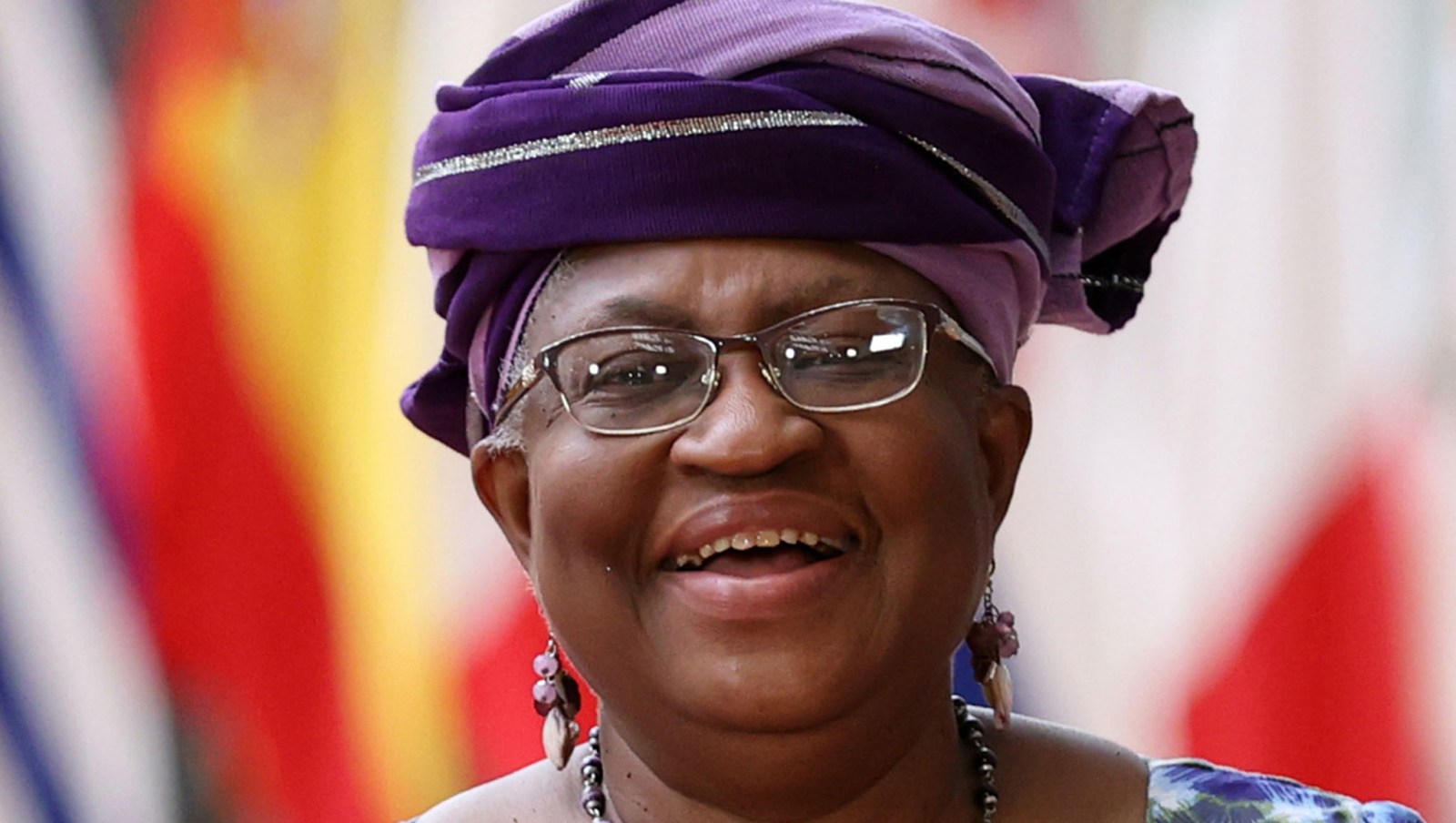
Ngozi Okonjo-Iweala, director-general of the World Trade Organization. 
(Photo: Dursun Aydemir/ Anadolu / Bloomberg via Getty Images)

By Julia Evans
29 Nov 2021 

Member states are pushing the climate crisis on the trade agenda at the upcoming Ministerial Conference in Geneva. But looking at the World Trade Organization’s track record, it could be too late before real change is seen.

For the first time since the creation of the World Trade Organization (WTO), the upcoming Ministerial Conference will see ministerial statements that address environmental issues, apart from fisheries subsidies reform which has been in negotiations for nearly 20 years.

Trade ministers from 164 member states of the WTO were meant to gather from 30 November at Geneva, Switzerland for the 12th Ministerial Conference (MC12) until 3 December — this has now been postponed because of the emergence of the Omicron coronavirus variant. No new date has yet been set.

The WTO is an intergovernmental organisation that operates the global system for trade rules and is a forum for negotiating trade agreements. The Ministerial Conference is the highest decision-making body of the WTO and usually takes place every two years, but hasn’t occurred since 2017.

Carolyn Deere Birkbeck, director of the Geneva-based Forum on Trade, Environment and the Sustainable Development Goals, said during a media briefing about the MC12 last Thursday that while the environment is not on the official agenda of the MC12 (except around the fisheries subsidy), this conference is significant because the member states that are part of these statements are recognising the bilateral relationship between environmental crisis and international trade.
 
Visitors look at a model of the LEAP turbofan aircraft engine at the General Electric booth at the China International Import Expo (CIIE) in Shanghai, China, on Monday, 8 November 2021. President Xi Jinping said at the opening of the CIIE that China would continue to open up and seek cooperation with international organisations such as the United Nations and World Trade Organization. 
(Photo: Qilai Shen / Bloomberg via Getty Images)

“They’re stressing the importance of environmental sustainability as a central issue for the WTO agenda. That’s big news” said Birkbeck. “And also they are saying not only that international trade and trade policy can support environmental and climate goals, but that it must.”

Birkbeck said these statements, while not committing any country to a specific action or regulation, are significant because it shows a recognition that the environmental crisis will have economic and trade impacts on many countries; for example, how natural disasters and climate shocks will affect production and supply chains.

Conversely, Birkbeck mentions how trade policies or subsidies can be harmful to the environment, but they can also be part of the solution.

The three declarations related to sustainability are a ministerial statement on trade and environmental sustainability, a ministerial statement on trade and plastic pollution and a ministerial statement on fossil fuel subsidy reform.

Birkbeck explained that these declarations are joint initiatives by member states committed to the idea that the WTO should take more action on the environment, initiatives that see a subgroup of members get together to promote dialogue or discussion of particular outcomes for a certain topic.

Almost half of the member states are involved in one or all of the statements. However, South Africa is not part of any. Birkbeck reflected that the participation reflects how tough it is for environmental issues to be addressed in the trade context.

Birkbeck said, “In my personal view, it’s vital that we have more developing country participation in all of these initiatives.”

Harro van Asselt, a researcher with SEI Oxford Centre and professor of climate law and policy at the University of Eastern Finland, said that the statement on fossil fuels opens the door to developing countries’ concerns.

Van Asselt said that these statements indicate, “that the specific needs and conditions of these countries need to be taken into account, as well as minimisation of the possible adverse impacts on their developments in a way that protects the poor and affected communities.”

Considering the major implications the implementation of carbon border taxes will have for South African exporters and the recent plans to get rid of fossil fuel subsidies that came out of COP26 (UN Climate Change Conference), you could assume that the WTO would take this push for climate to be on the trade agenda seriously.

Whether that will be the case is yet to be seen.

Negotiations to eliminate fisheries subsidies, which amount to $22-billion, are still not final and are nearly 20 years in the making

.
A visitor takes a photo of machine models at a Caterpillar booth at the China International Import Expo (CIIE) in Shanghai, China, on Monday, 8 November 2021.
(Photo: Qilai Shen / Bloomberg via Getty Images)

Van Asselt highlighted how the most recent estimate by the OECD was that fossil fuel subsidies amounted to $351-billion in 2020 — “which may be down from 2019 when it was $478-billion US dollars, but it’s also very likely that subsidies are again rebounding in the wake of the pandemic”, said van Asselt.

It might not be economical in the short term, but keeping prices of fossil fuels artificially low for customers will lock us into a high carbon emission future.

Van Asselt explained, “we know increasingly that fossil fuel subsidies not only have a major impact on the budgets of different countries, but also on environmental issues, because they encourage and induce fossil fuel production of fossil fuel consumption, which ultimately leads to greenhouse gas emissions… and they can really significantly hamper and delay the energy transition that is needed.”

Internationally, the climate crisis is not officially on any trade agenda, and considering the economic implications of eliminating fossil fuel subsidies, as one example, it might not be any time soon.

However, that these ministerial statements will be considered at the MC12 is a step forward for the climate movement.

“There’s a sense that the WTO can’t stand by the wayside while these environmental issues become more and more dominant as a priority for national governments and also on the global agenda,” reflected Birkbeck.

“Not being part of that push to drive forward a greener global economy makes the WTO seem to be sort of out of date, or out of touch with the key priorities and concerns of many governments around the world.” DM/OBP
Jamaican sprinter Thompson-Herah and Norwegian 400m hurdler Warholm named World Athletes of the Year


Issued on: 01/12/2021 

The Norwegian hurdler Karsten Warholma and the Jamaican sprinter Elaine Thompson-Herah, named World Athletes of the Year 2021. © Charlie Riedel & Matthias Schrader, AP - Montage France 24


Jamaica's Elaine Thompson-Herah and Norway's Karsten Warholm were crowned World Athletes of the Year on Wednesday after both produced astonishing, ground-breaking performances at the Olympic Games and beyond.

Thompson-Herah became the first woman to win back to back Olympic sprint doubles when she retained her 100m and 200m titles in Tokyo and capped a memorable Games with gold in the 4x100m relay. Her 100m time of 10.61 seconds and her 200m time of 21.53 were both the second-fastest in history.

Post-Olympics she scorched to 10.54 in Eugene, site of next year's world championships, edging her even closer to what had seemed the untouchable mark of 10.49 set by Florence Griffith-Joyner in 1988. The 29-year-old, fuelled by a return to full fitness and dramatic improvements in shoe technology, said she has that mark in her sights.

"I just take it year by year, I think I have more," she told World Athletics president Sebastian Coe on receipt of her award in Monaco. "I went very close to the world record, so anything is possible. There will be no hanging up of the spikes yet.

"Oregon is close to home, I hope I get some crowd there. That couldn't happen in Tokyo but hopefully in Eugene my friends and family can be there to cheer me on."

Twice broken world record

Warholm had only one race to concentrate on, the 400m hurdles, but he took total command of the event in an incredible year when he twice broke the world record and took Olympic gold in one of the greatest races of all time. Warholm would have had an impressive enough year just on the back of his first race when he finally broke American Kevin Young’s 1992 46.78 seconds world record with a 46.70 run on home soil in Oslo.

That time was obliterated in the Olympic final in Tokyo, however, when he clocked an unimaginable 45.94. American Rai Benjamin finished second in 46.17, also well inside the previous world record, and bronze medallist Alison dos Santos of Brazil was inside Young's time in 46.72.

Presenting the award, Coe said: "We were rendered speechless by your run." Warholm, 25, replied: "I'm so happy for this. When I first saw the time I thought it must be a mistake. It was a very intense race, I always go out hard and never know what's going on behind me.

"When I realised the time I thought 'I'll take it'."

The Inspiration award went to Mutaz Essa Barshim of Qatar and Italian Gianmarco Tamberi, who shared top step on the Tokyo Olympic high jump podium when, after both finished on 2.37 metres, Barshim asked officials “can we have two golds?”

When the official nodded in the affirmative the two athletes, who had both come back from similar serious Achilles injuries, exploded into joyous celebration.

American Olympic 800m champion Athing Mu won the female rising star award, while fellow American 17-year-old 200m sprinter Erriyon Knighton, who knocked off Usain Bolt's under-20 world record and finished fourth in the Olympic final, took the men's award.

(REUTERS)


Why The Canadian National Women’s Soccer Team Are Doris Anderson Award Recipients

Canada’s national women’s soccer team went to the Tokyo Olympics hungry for a gold medal win, and served one up on a platter—ultimately defeating Sweden in a riveting 3 to 2 upset.
© Provided by Chatelaine Canada's women's soccer team stand on a podium with their gold medals and flowers.

Sharine Taylor 1 day ago


“I am really proud and honoured to be part of this team and hope we made this country proud,” says mid-fielder Julia Grosso, who delivered the game-winning goal.

But while there’s lots to celebrate this year, the team is also using its platform to address a dark side of the sport.

In recent years, allegations of sexual abuse, misconduct and coercion have been made against women’s soccer coaches in Canada, the United States and beyond—allegations that often went unheard or were mishandled. As a result, before agreeing to play two exhibition matches in October, the team demanded that Canada Soccer—the governing body of the sport—commit to improving player safety, apologize to players who have experienced abuse and misconduct, and initiate an independent investigation into a former coach, who is now facing several sexual-offence charges.

Once Canada Soccer signed off and the team hit the field for their first exhibition game in Ottawa, they held a moment of silence before the opening whistle to show solidarity for players who have been victims of abuse.

Aside from making conditions safer for the next generation, the team also wants to stoke enthusiasm for the sport. “The biggest thing for this team,” says Grosso, “is inspiring the younger generation, to let them know to always follow their dreams and just never give up.”

Grosso’s own ambitions were powered by the same type of inspiration. “I remember watching the national women’s team at the Olympic Games and FIFA Women’s World Cups as a kid,” says Grosso, who was once a ballgirl for a Team Canada game. “Just watching some of the players really inspired me. I hope that this gold medal, for a little girl or little boy out there, will inspire the next generation to do the same thing.”

Meet all of our 2021 Doris Anderson Award winners here.


Resistance activities continue on Northwest B.C. pipeline construction site, police make 2 more arrests

Blockade activities continue near the Coastal GasLink (CGL) pipeline site in northwest B.C. as two more arrests were reported by the RCMP on Monday, Nov. 29.

RCMP North District spokesperson Cpl. Madonna Saunderson said, while patrolling, the police came upon a blockade on the Morice Forest Service Road near the 44 km mark.

“A vehicle had been placed across the road and three individuals dressed in camouflage were on the road and a fire had been lit on the road near the bridge,” said Saunderson in a statement.

While one individual left, the other two remained and were subsequently arrested for contempt of a court order and mischief. Coastal GasLink vehicles travelling behind CIRG (RCMP Community-Industry Response Group) were then able to continue up the road.

Both individuals have been released from custody pending a future court appearance, added Saunderson.

The arrests were made in the same area near Houston where 29 CGL pipeline opponents, including Gidimt’en Checkpoint’s spokesperson Sleydo’ (Molly Wickham) were arrested between Nov. 18 to 19.

All the arrested individuals were released with conditions, which included complying with the court ordered injunction obtained by CGL, and maintaining adequate distance from pipeline construction sites.

As resistance activities persist on the construction site to prevent the company from drilling underneath the Wedzin Kwa (Morice River), police will continue to patrol the area, Sauderson said, to ensure that the roads remain “accessible and unobstructed.”

However, owing to operational reasons, she would not provide a timeline of how long the police presence is expected to continue in the area, or the number of officers deployed.

In a social media post, Gidimt’en Checkpoint said the group will “never back down.”

“Despite racist, colonial state repression, Wet’suwet’en law will continue to be upheld,” said the group in a Nov. 29 Facebook post.

Binny Paul, Local Journalism Initiative Reporter, Terrace Standard
Argentine ex-president Macri charged in spying case: court


Argentina's former president Mauricio Macri has been charged in connection with claims he ordered illegal surveillance of relatives of sailors killed in a submarine accident in 2017 (AFP/JUAN MABROMATA)

Wed, December 1, 2021,

Argentina's ex-president Mauricio Macri was charged Wednesday with ordering the illegal surveillance, as head of state, of relatives of 44 sailors who died when a navy submarine sank in 2017.

Judge Martin Bava issued an indictment against the 62-year-old, now the country's right-wing opposition leader, for "the offense of carrying out prohibited intelligence actions."

He is also charged with "creating conditions for data of persons to be collected, stored and used," according to the 174-page ruling.

Macri, who was president from 2015 to 2019, risks between three and 10 years in jail for allegedly violating Argentina's intelligence laws.

At a preliminary court appearance earlier this month, the former president submitted a written statement in which he insisted: "I did not spy on anyone, I never ordered (anyone) in my government to spy on anyone."

The ARA San Juan sub disappeared in November 2017.

When it was found just over a year later, it was at a depth of more than 900 meters (2,950 feet) in a remote area of the South Atlantic, some 400 kilometers off the coast of Argentina.

It had been crushed from an implosion apparently caused by a technical fault. Authorities decided against attempting to refloat it.

Family members of the 44 crew members told investigators they were followed, wiretapped, filmed and intimidated into abandoning any claims related to the incident.

Macri was granted bail of 100 million pesos (about $990,000) by the judge, but is banned from leaving the country.

Macri had asked for the case to be thrown out on the grounds that the court did not have the authority to lift secrecy provisions on state intelligence to allow him to testify, but that request was rejected.

He claimed he was the victim of political persecution during campaigning for November 14 legislative elections in which Macri's Together for Change alliance ended up being the big winner.

A judge had earlier ordered the prosecution of secret service heads Gustavo Arribas and Silvia Majdalani, who reported to Macri at the time.

ls/mlr/sst
NOONE IS ILLEGAL
EU proposes longer legal limbo for migrants from Belarus

Issued on: 01/12/2021 


Protesters in Hajnowka, near the Polish-Belarusian border, drawing attention last month to the humanitarian situation of those migrants seeking to cross the border JANEK SKARZYNSKI AFP

Brussels (AFP) – The European Commission on Wednesday proposed letting member states bordering Belarus, and facing migrant flows allegedly orchestrated by Minsk, to keep arrivals' asylum claims in legal limbo for longer.

The measures would allow Poland, Lithuania and Latvia to extend the period allowed for new asylum claims to be registered from 10 days to four weeks, and to extend to four months the time limit for ruling on an application.

Migrant rights' groups slammed the changes as building up "Fortress Europe" and trashing the EU's reputation for humane treatment of asylum-seekers.

The EU home affairs commissioner, Ylva Johansson, told a media conference the situation at the Belarus borders for those EU countries was "unprecedented... and that's why we are doing all these measures".

She noted the situation was "de-escalating", with EU pressure prompting migrant-origin countries such as Iraq to halt Belarus-bound flights and to take back some of the thousands of migrants already in Belarus.

But she said the pressure remained for "flexibility... to deal with a danger, with a difficult and stressing situation".

Commission Vice President Margaritis Schinas said the bloc was in "firefighting" mode to tackle the "hybrid threat" of Belarus directing migrants towards the EU's borders.

However Poland called the proposal "counter-productive," saying it was not consulted.

"The Commission took the exact opposite solution to what we proposed," Poland's EU ambassador Andrzej Sados said.

"We proposed that the response to a hybrid attack should be the possibility of suspending asylum procedures, and not extending them."
'Fortress Europe'

Amnesty International criticised the proposal, saying the situation was already "perfectly manageable with the rules as they stand".

"Today's proposals will further punish people for political gains, weaken asylum protections, and undermine the EU's standing at home and abroad," said Eve Geddie, director of the group's European office.

Erin McKay, migration campaign manager at Oxfam, another NGO, said: "This proposal weakens the fundamental rights of asylum seekers and strengthens Fortress Europe, and goes against everything that EU should stand for."

The proposal needs approval from the EU's member states to go ahead.

The European Parliament is to be "consulted" on the proposal but has no power to derail it as it relies on a clause in an EU treaty that permits the "adoption of provisional measures in emergency migratory situations at the EU's external borders".

According to Commission figures, nearly 8,000 migrants have arrived in the EU from Belarus this year: 4,285 in Lithuania, 3,255 in Poland and 426 in Latvia.

Most of the irregular arrivals are from Iraq, Syria and Yemen, many of whom have told journalists they wanted to push further west into the EU -- to Germany, Finland or other countries -- to request asylum.
At least 12 dead

But Poland, Lithuania and Latvia have toughened their borders, deploying troops and barbed wire to try to prevent migrants crossing from Belarus.

Poland has taken the harshest stance, criminalising irregular border crossings and using a controversial state of emergency to impose a media blackout along its border region, preventing journalists and human rights organisations from witnessing the situation.

The state of emergency was on Wednesday extended for another three months, to the end of February.

Poland is also accused of forcibly pushing asylum-seekers who have irregularly entered its territory back over the border into Belarus -- an act known as "refoulement" that is forbidden under EU and international law.

It has also rebuffed pleas from the European Union to have personnel from the EU's Frontex border agency -- based in Warsaw -- help patrol its frontier.

Polish media estimate that at least 12 people have died on both sides of the border. Human Rights Watch this week accused both Warsaw and Minsk of serious human rights violations.

The Commission said the proposed measures would be "time limited and targeted" and in "full respect of fundamental rights and international obligations, including the principle of non-refoulement".

© 2021 AFP


After 80 years, siege of Leningrad survivors finally receive pension

Eva Krafczyk Nov 22, 2021

© Eva Krafczyk/dpa

Between 1941 and 1944 the German army besieged the city of Leningrad in its attempt to conquer the Soviet Union. The unfortunates forced to remain in the city suffered unimaginable hunger and cold, while the city's Jewish population, including the nearly 90-year-old Yulia Kinovskaya, dreaded an eventual German victory even more than most.

Frankfurt (dpa) – Georgi Korobov doesn't have many memories of the World War II siege of Leningrad, the German military blockade of the Soviet Union's second city, now once again known as St Petersburg.

"I only remember constant hunger and fear," the lean 83-year-old says. Korobov didn't only survive the siege of Leningrad, however. During the almost 900-day blockade, the arms factory his father worked for, including all its employees and their families, was evacuated to Stalingrad, a major industrial hub the Germans sought to bring under their control in another month-long battle.

Korobov was just 3 years old when the siege of Leningrad began, but it wasn't just war and hunger menacing his and his future wife Yulia Kinovskaya's families: as Jews, the prospect of the Germans taking the city was far more serious.

Despite this, 27 years ago, the couple decided to relocate to Germany, to join their daughter and grandchild in the city of Wiesbaden.

Making a new start was tough as they didn't speak German and their educational qualifications weren't recognized. Living on a meagre pension topped up by social benefits, they felt relieved to learn recently that Kinovskaya may soon be eligible for additional compensation for the horrors she suffered under the German siege, which claimed the lives of around 1.5 million people, most of them civilians.

Korobov and Kinovskaya were unable to take much with them when relocating to Germany in 1994. Kinovskaya takes out some tea cups with a blue flower pattern, one of the few keepsakes from the couple's past.

"Our great-granddaughter should have them one day," Kinovskaya says as she carefully picks up the pre-revolutionary porcelain.

The 89-year-old recently learned that she is now eligible to apply for a compensation pension for siege of Leningrad survivors, thanks to the Claims Conference, an alliance of Jewish organizations that continues to negotiate reparation payments with the German government 75 years after the end of the war.

While a lump sum payment was agreed upon years ago, the payment of a regular pension is aimed at providing longer-term support to the now elderly survivors. Indeed, many survivors are yet to receive any support, typically as many in Eastern Europe and the former Soviet Union were unable to file applications during the Cold War.

Pensions for those who performed forced labour or for those made to live in Jewish ghettos were only negotiated two decades ago. Much of the compensation process still involves identifying and fighting for recognition for different groups of survivors.

"Every year at the negotiating table we work to identify, recognize and achieve some measure of justice for every survivor and will continue to do so for as long as even one survivor remains with us," says Greg Schneider, Executive Vice President of the Claims Conference.

Ruediger Mahlo, the Claims Conference's representative in Germany, believes that the new pension is an important step towards justice.

"For almost three years, the inhabitants of Leningrad suffered indescribably during the German blockade," he says. "For the Jews who were trapped there, there was also the constant fear that the city would be captured by the German Wehrmacht, which would have meant certain death for them."

The additional monthly pension payment of 375 euros (429 dollars) would make a huge difference to survivors like Kinovskaya, who often live in impoverished conditions.

"For many, the question at the end of the month is whether to spend the money on food or on medication," says social worker Valentina Sustavova, who also looks after Holocaust survivors in Wiesbaden's Jewish community.

According to the Claims Conference, Jewish survivors who were in Leningrad for at least three months during the siege are eligible for the additional monthly payment.

"My mother was only 30 years old at the time, but her hair turned grey overnight during the air raids," she recalls.

The community building they lived in then didn't have a basement. "During the German air raids, we all met in the stairwell and hoped we would be spared."

Luckily, Kinovskaya's mother decided to hide in Russia instead of joining her grandparents in Ukraine. Kinovskaya's grandmother was shot by the Germans, while her grandfather was buried alive during a mass shooting.

Kinovskaya, who lived under the German blockade for more than a year before being able to escape with her mother and sister on a train journey that lasted weeks, says she hopes that with her new pension she'll finally be able afford a good seat at the philharmonic.


The American media missed the true nature of the GOP threat — but an international outlet nailed it

John Stoehr
November 30, 2021

White House press conference -- Screenshot

Jack Dorsey announced today plans to step down as head of Twitter. That prompted Candace Owens to say the following: “I’ve been telling people for years. Jack Dorsey is not your enemy. He is a prisoner at his own company. Good thing the Parler app is finally working properly and looks amazing. The communists will fully run Twitter soon.”

If you don’t already know Candace Owens, all you need to know is that she’s a koshering virtuoso. Like some Jewish people who make anti-Semitism seem respectable, Owens, who is Black, makes white supremacy seem fine and dandy. She appears to think Jack Dorsey had been some kind of bulwark against liberal sensibilities. Now that he’s leaving, she said, “the communists will fully run Twitter soon.”

I don’t care what Owens thinks about anything. Neither should you. Every word she says -- including “a” and “the” -- is a variety of bad faith. Even hyping Parler is deceptive. Authoritarians can’t succeed on the margins of media and society, where Parler is. To sabotage their enemies, they must appear as respectable as a Black woman koshering white supremacy. By blaming the “communists,” Owens is reminding followers of what they already believe true: they are the real victims.

While I don’t care about Owens, and neither should you, we should care about the use of the right’s rhetoric of slander, of which the word “communist” has long played a part in American history. Liberals and progressives first looked to the government as a force of social reform in the early 20th century. Around that time, the Russian Revolution occurred (1917). Since then, the American right has smeared liberals by associating their policies and objectives with godless communism.

The history of the rhetoric of slander is so pernicious it’s hard, if not impossible, for a lot of (white) Americans to see what might be obvious otherwise. When the right accuses liberals of being communist (or socialist), they are covering up the common purpose they share with actual communists. Both factions are collectivist. Both are implacable. Both aim to replace the established order. Both regard the process of democratic reform as liberal decadence requiring the purifying violence of revolution. The difference is origins. Communism is mob rule arising from the left. Fascism is mob rule arising from the right.

That such slander is so pernicious as to prevent most (white) Americans from seeing what might be obvious otherwise means there’s an opportunity for international media outlets to say what needs saying. Such is the case for The Globalist. Though based in Washington, the publication takes an international view of economics, politics and culture in order to inform readers “how the world hangs together.”

And as far as I know, editor Stephan Richter, who is German, and senior editor Alexei Bayer, who is Russian, are the only writers to connect the Republican Party and the Russian Revolution. In a piece posted this month, they said: “The parallels between the Leninist power usurpation in early 20th century Russia and the Trumpian brigades in today’s United States are becoming ever more eerie.”

Nothing in modern Western history has ever come so close to the storming of the Winter Palace in St. Petersburg as the events of January 6, 2021, in Washington, DC, when a riotous mob stormed the US Capitol. Ironically, these forces were out to preserve the rule of their “Czar”, Donald Trump, who had been defeated for re-election.

Most Americans associate mobs with the left on account of the right aggressively slandering the left for decades. Bayer and Richter, both of whom lived under the shadow of the Soviet Union, know better. While “the mob on the left also showed up in the summer of 2020 [and] turned legitimate protests against police brutality into a violent mob bacchanal,” they wrote, it’s the people ready to accuse the Democratic Party of being a den of communists who are the true heirs of chaos.

“The mainstream Democratic Party has denounced those riots,” Bayer and Richter wrote on Nov. 6. “Meanwhile, the Republican Party has transformed itself into the Party of Trump and therefore into the Party of Mob Rule. It is channeling its inner Leninist and baiting the mob.”
[The Democrats] passed an infrastructure bill and are proposing many long overdue measures to improve the lives of ordinary people. To this end, they are offering better health care, services for the elderly and educational assistance. Meanwhile, their Republican “colleagues” are stirring hatred in the mob toward all those measures — just like Lenin did back in 1917.

It’s an imperfect analogy. Like I said, the GOP is mob rule arising from the right. It seeks to maintain, to the point of open warfare, the hierarchies of power by which rugged white individuals stand on top. Lenin and his revolutionaries were mob rule arising from the left. They sought to flatten Russian society to the point of wholesale murder.

That it takes, however, an international media outlet that sees American politics from a European perspective to point out the similarities between them is instructive. The right’s rhetoric of slander has such a hold on Americans, most can’t see what’s in front of them.

John Stoehr is a fellow at the Yale Journalism Initiative; a contributing writer for the Washington Monthly; a contributing editor for Religion Dispatches; and senior editor at Alternet. Follow him @johnastoehr.
Without women and aid, Afghan economy will collapse, UN warns

Emmanuel DUPARCQ
Wed, 1 December 2021,


Without women and aid, Afghan economy will collapse, UN warnsWomen's jobs are "vital" to mitigating economic disaster in Afghanisan, the UN says (AFP/Hector RETAMAL)

When Maryam went shopping in Kabul this week after several weeks cooped up at home, the Afghan mother was shocked to discover food prices had doubled -- or even tripled -- at the market's well-stocked vegetable stalls.

"It's very expensive, it's clearly visible," the 52-year-old, who lost her job after the Taliban returned to power in August, told AFP.

On Wednesday, a United Nations report said Afghanistan and its population of roughly 40 million people have suffered an "unprecedented fiscal shock" since the Taliban takeover and the decision by the international community to withdraw billions in humanitarian aid.

The report predicts an economic contraction of around 20 percent of GDP "within a year, a decline that could reach 30 percent in following years".

"It took more than five years of war for the Syrian economy to experience a comparable contraction. This has happened in five months in Afghanistan," United Nations Development Programme (UNDP) Asia Director Kanni Wignaraja told AFP.

Another UN source said that such a situation was "never seen before. Even... Yemen, Syria, Venezuela don't come close."

For decades now Afghanistan's economy has been undermined by war and drought.

But it was propped up by international aid, which represented 40 percent of Afghanistan's GDP and financed 80 percent of its budget.

That was frozen when US-led international forces left the country and the Taliban took control.

"The sudden dramatic withdrawal of international aid is an unprecedented fiscal shock," Wignaraja said.

For Maryam, trying to buy food in the Kabul market, it spells potential disaster.

Her husband is ill, and cannot work. They have seven children. Under the previous government, she was a civil servant, supporting the family with her salary.

But the Taliban sent women home, only allowing certain female civil servants -- mainly those in education and health -- to return. They have been vague about whether women will be allowed to work in the future.

For now, Maryam no longer has an income.

"I have eight mouths to feed, eight people to clothe at home, everything is expensive, and for the moment it seems impossible for me to find another job," she says, not counting herself.

- 'Palliative' -

Added to this are the Western economic sanctions taken against the Taliban, including the freezing of $9.5 billion in assets of the Afghan central bank, which can no longer intervene to support the economy.

Afghan banks have been distributing money only in small amounts, with withdrawals limited to a maximum of $400 per week.

The economy is slowing down and unemployment is soaring. According to the UN, 23 million Afghans, more than half the population, are threatened by famine this winter.

"Afghanistan is in a humanitarian and development crisis that is becoming graver and needs to be immediately addressed to save lives," says the UNDP report, which estimates that $2 billion in emergency aid is needed just to bring the entire population back up to the poverty line.

If nothing is done, hard-won progress made by international aid in key areas such as education, health, gender equality, access to drinking water, and employment could all be lost, it says.

The UN agency fears the possible collapse of two key sectors: the banking system and energy, which would plunge the country into darkness.

In Doha, where the Taliban and the Americans are negotiating this week, the Taliban have again asked the Americans to release frozen funds to allow the economy to recover.

Washington has not responded to these requests, and has urged the Taliban to respect human rights and to give women and girls access to employment and education.

Depriving women of paid employment could drive GDP down by up to five percent, UNDP said, calling their jobs "vital to mitigate the economic catastrophe".

In addition, there is a loss in consumption -- women who no longer work no longer have a salary and can no longer buy as much as before to feed or equip their homes - which could reach $500 million per year, according to the UNDP.

Afghanistan "cannot afford to forfeit this", Wignaraja said, adding that young Afghan women must be allowed a post-secondary education they can work and contribute to the economy later.

emd/cyb/st/fox