It’s possible that I shall make an ass of myself. But in that case one can always get out of it with a little dialectic. I have, of course, so worded my proposition as to be right either way (K.Marx, Letter to F.Engels on the Indian Mutiny)
Thursday, December 16, 2021
Nanodiamonds are key to efficient hydrogen purification
This image offers an abstract visual representation of graphene oxide sheets (black layers) embedded with nanodiamonds (bright white points). The nanodiamonds exert long range electrostatic forces (nebulous white circles) which stabilize the sheets even in humid conditions creating a promising membrane material for hydrogen purification. (Ⓒ Yasuhiro Chida (Brocken 5) and Toru Tsuji (Photograph)). Credit: Ⓒ Yasuhiro Chida (Brocken 5) and Toru Tsuji (Photograph)
Nanodiamonds may be tiny, but they can help with one of the biggest problems facing humanity today: climate change.
Hydrogen, a clean-burning fuel, leaves nothing but water when consumed. Many countries view hydrogen as a way to a zero-carbon future, but switching to a hydrogen economy requires its production to be much more affordable than it is now.
In a study published in Nature Energy this month, researchers led by Kyoto University's Institute for Integrated Cell-Material Sciences (iCeMS) describe how nanodiamond-reinforced composite membranes can purify hydrogen from its humid mixtures, making the hydrogen generation processes vastly more efficient and cost-effective.
"There are several scalable methodologies to produce hydrogen, but hydrogen generally comes as humid mixtures and their purification is a challenge," says Professor Easan Sivaniah, who led the iCeMS team. "Membrane technology allows for energy-efficient and economical separation processes. But we need to have the right membrane materials to make it work," Sivaniah added.
Graphene oxide (GO), a water-soluble derivative of graphite, can be assembled to form a membrane that can be used for hydrogen purification. Hydrogen gas easily passes through these filters, while larger molecules get stuck.
Hydrogen is typically separated from CO2 or O2 in very humid conditions. GO sheets are negatively charged, which causes them to repel each other. When exposed to humidity, the negatively charged sheets repel each other even more, allowing water molecules to accumulate in the spaces between the GO sheets, which eventually dissolves the membrane.
Dr. Behnam Ghalei, who co-supervised the research, explained that adding nanodiamonds to the GO sheets resolves the humidity-induced disintegration problem. "Positively charged nanodiamonds can cancel out the membrane's negative repulsions, making the GO sheets more compact and water-resistant."
The team also included other research groups from Japan and abroad. The researchers at Japan Synchrotron Radiation Research Institute (SPring-8 / JASRI) conducted advanced X-ray studies. The Institute for Quantum Life Science (QST) helped with materials development. ShanghaiTech University (China) and National Central University (Taiwan) were involved in state-of-the-art materials characterizations.
"In our collaboration with Dr. Ryuji Igarashi of QST, we were able to access nanodiamonds with well-defined sizes and functionality, without which the research would not have been possible," says Sivaniah. "Importantly, Igarashi's group has a patented technology to scale up nanodiamonds production at a reasonable cost in the future."
Sivaniah says that nanodiamonds have potential uses beyond hydrogen production. Humidity control is also vital in a number of other fields, including pharmaceuticals, semiconductors, and lithium-ion battery production. Membrane technology could also revolutionize air conditioning by efficiently removing humidity. Air conditioners are among the most inefficient ways to cool, as a significant amount of the electricity used to power them is used to remove humidity, generating more CO2 emissions and creating a vicious spiral for global warming.
The Japanese government is deeply committed to a zero-carbon future. It has established a US$20 billion Green Innovation Fund to support joint partnerships between major industry players and entrepreneurial ventures that bring new technologies to the market.Novel hydrogen fuel purification membrane paves the way for greener future
More information:Overcoming humidity-induced catastrophic swelling of graphene oxide-based hydrogen membranes using charge-compensating nanodiamonds,Nature Energy(2021).DOI: 10.1038/s41560-021-00946-y
UK Half of new engineering recruits lack required skills A new survey suggests that less than half of new engineering recruits have the required skills for work within the industry. 16th December 2021
According to the report from the Institution of Engineering and Technology (IET), over two thirds (71 per cent) of the engineering workforce experiencing internal skills gaps say it is down to missing engineering or technical skills.
Nearly all (96 per cent) employers who had identified a skills shortage said that it impacts their business in some way, the most common of those being around recruitment.
Difficulties recruiting (50 per cent) or making recruitment timelines longer (47 per cent) were identified as common results. Less than half (45 per cent) of companies who see a skills shortage within young people provide additional training for apprentices and graduates, while 25 per cent simply recruit fewer apprentices and graduates as a result.
Lack of recruitment from a diverse talent pool may also be fuelling the problem, the report found — only a third of businesses were shown to be taking action to improve workforce diversity across gender (33 per cent) or ethnicity (30 per cent).
When asked what support businesses need from government to improve skills nationally, more funding for apprenticeships came out on top (54 per cent) with more support to train or re-skill in priority areas (51 per cent) and better careers advice in schools and colleges (49 per cent) next in line.
Simon Edwards, director of governance and external engagement at the IET, said that economic uncertainty caused by Brexit and Covid-19 has been a factor in the skills shortage coupled with the drive to deliver on net zero targets, resulting in an emergence of new engineering roles with new required skill sets.
“Workers are in high demand but we don’t have the readily available recruits with the right skills to fill the labour market — something we have been reporting via the skills survey for the last 15 years,” Edwards said. “Frustratingly, nothing has changed.”
He explained that this year, engineering employers are seeing a general lack of applicants for roles causing more difficulty in recruitment — 34 per cent reported this, a marked increase on 2020 (22 per cent).
“We are urging more businesses to provide work experience opportunities for young people to help with the rollout of T Levels and more apprenticeships. To solve this skills crisis there needs to be deeper engagement between government, employers and the education system to produce a talent pipeline that can sustain a thriving UK economy.”
Edwards added the IET has already called for the embedding of engineering into the existing science, technology and mathematics learning at primary school.
Despite the impact of the pandemic on recruitment and skills, firms remain positive about the future, the report said, with 79 per cent confident about the economic prospects for their firm and 77 per cent for the sector. However, three in ten companies have experienced decreased headcount over the last year and half of these attribute this directly to Covid-19.
Whilst 12 months ago the top priority was cutting costs (44 per cent), current top priorities for firms focus on improving profitability (67 per cent) and productivity (62 per cent).
Engineering employers recognised particular areas of skills as important for economic growth over the next five years, with design and manufacturing recognised as a key area by 36 per cent of respondents.
Most (64 per cent) have the skills they think they need, however energy and environmental sustainability was the second most cited area for growth (35 per cent) and only half (51 per cent) have the required skills. In light of this, only 50 per cent think it is achievable for their organisation to be net zero by 2050.
A California-based startup called H2 Clipper wants to resurrect the hydrogen-filled airship as a form of mass transport. The key difference is that it won't be transporting people, it will be transporting cargo, a press statement reveals.
The company aims to kickstart a green global cargo network by leveraging the world's renewed willingness to try alternative forms of transport following the IPCC's dire climate change report for 2021.
H2 Clipper claims its cargo airships can carry 8-10 times the payload of the best cargo plane over 6,000 miles (9,656 km), and it can do so at a quarter of the price. They will have a payload capacity of approximately 340,000 lb (150,000 kg) sitting in up to 265,000 cubic feet (7,530 cubic meters) of cargo space.
As for speed, the H2 Clipper would travel at a cruising speed of 175 mph (282 km/h), meaning it would move close to ten times faster than a cargo ship — though it would obviously lag behind a cargo plane in that department. The main advantage over today's cargo planes is that the H2 Clipper produces zero carbon emissions. Recommended videos Removing the need for large ground infrastructure
H2 Clipper's airships will run on hydrogen gas through a fuel cell with all-electric propulsion systems. As NewAtlas points out, their range of over 6,000 miles (~9,650 km) means that they can connect any two points on the globe with only one refuel stop.
As for transport costs, H2 Clipper says prices will range between $0.177 to $0.247 a ton per mile for distances between 1,000-6,000 miles (~1,610-9,650 km). That's a quarter of the price of aircraft cargo transportation, according to the company. While that is more expensive than cargo shipping, the shipping industry will likely be levied with heavy carbon taxes in the coming years as governments aim to cut down emissions.
H2 Clipper's concept hydrogen airships have a range of over 6,000 miles.
H2 Clipper's airships may also be able to cut out a certain portion of the logistics required for shipping and aircraft due to its vertical take off and landing (VTOL) configuration. Earlier this year, a Russian firm called Aerosmena also revealed plans to develop large cargo airships that would remove the requirement for large ground infrastructure. The real question may be, can firms like H2 Clipper and Aerosmena change the perception of hydrogen airships fueled by the Hindenburg disaster and earn flight certification in the coming years. According to H2 Clipper at least, its form of "100 percent emissions-free delivery of goods" will be "critical in the fight against climate change."
Almost 85 years on from the Hindenburg disaster and the future of hydrogen is… airships?
Start-up claims the cheapest and cleanest way to transport H2 over long distances will be hydrogen-powered zeppelins A rendering of the H2 Clipper airship. Photo: H2 Clipper
The dramatic explosion of the Hindenburg hydrogen airship in New Jersey in 1937 may have tainted public opinion about the safety of H2 for decades, but that has not prevented a US start-up from forging ahead with plans for a new generation of hydrogen-powered zeppelins.
Hydrogen: hype, hope and the hard truths around its role in the energy transition Will hydrogen be the skeleton key to unlock a carbon-neutral world? Subscribe to Accelerate Hydrogen, powered by Recharge and Upstream, and get the market insight you need for this rapidly evolving global market.
California-based H2 Clipper has been selected for inclusion in French software developer Dassault Systèmes’ 3DEXPERIENCE Lab accelerator programme, which the start-up says will “advance its mission of developing and commercializing a global fleet of 100% green airships that transform the hydrogen and air transport industry”.
Unlike the ill-fated Hindenburg, the H2 Clipper airship will not transport passengers, but only pure hydrogen. So H2 will be the fuel, the lifting gas and the cargo.
“H2 Clipper’s 21st-century airship is designed for transporting pure hydrogen from where it is least costly to produce to markets where clean energy is most needed, and for enabling a 100% carbon-free method of transporting freight and other cargo 7-10 times faster than by ship, truck, or rail, and at a 70% savings over traditional air transport,” the company said in a statement.
“As more hydrogen projects are announced globally, there’s a growing appreciation among leading analysts that one of the biggest challenges will be how to efficiently transport, distribute, and store hydrogen.”
H2 Clipper aims to build a prototype in 2024 and a full-sized version in 2027, which would use fuel cells and electric engines to travel at speeds of more than 175 miles per hour (280km/h), travelling distances of 6,000-plus miles (9,656+ km) in a single non-stop journey while transporting up to 150 tonnes of hydrogen.
Dassault says companies including H2 Clipper were selected for its accelerator programme by “demonstrating significant technological breakthroughs with the greatest potential to positively impact and transform society in alignment with one or more [UN] Sustainable Development Goals”.
“The aerospace and aviation revolution is being driven by breakthroughs in the use of renewable fuels such as hydrogen, as well as advanced material science and engineering,” said Frédéric Vacher, head of innovation at Dassault Systèmes. “We are pleased to support H2 Clipper to accelerate maturing these disruptive technologies to serve humankind.”
Could hydrogen airships return as fast, cheap, green cargo transports?
December 14, 2021 Is it time to resurrect hydrogen airships – not to carry passengers, but as fast, cheap and convenient cargo carriers? H2 Clipper
California startup H2 Clipper wants to bring back hydrogen-filled airships, claiming they can unlock completely green intercontinental cargo operations carrying 8-10 times the payload of any cargo plane over 6,000 miles, at a quarter of the price.
The H2 Clipper would carry payloads up to and beyond 340,000 lb (150,000 kg), says the company, and would offer up to 265,000 cubic feet (7,530 cubic metres) of cargo space. It wouldn't travel as fast as a plane, cruising at about 175 mph (282 km/h), but it would move boxes some 7-10 times faster than a boat (China to the US in 36 hours, for example) and with zero emissions.
Its lift gas would be hydrogen – providing some 8 percent more lift per volume than helium at something around 1/67th the price. Its propulsion would be fully electric, running on liquid hydrogen put through a fuel cell. H2 Clipper says it'd operate efficiently for missions ranging from under 500 miles (804 km) to "well over 6,000 miles (9,656 km)." That would link any two points on the globe with a single fuel top-up. In the current renders, the company shows the top of this huge aircraft covered in photovoltaic cells, which could theoretically enable it to generate its own hydrogen, if it were to carry a water source and an electrolyzer.
With the right provisions put in place, it could take goods right from a factory to a distribution center without needing additional ground transport stages to and from airports, thanks to its vertical takeoff and landing capabilities.
Hydrogen's taking off as a clean aviation fuel. Will it return for use as a lift gas? H2 Clipper
H2 Clipper says the economics will be attractive as well, estimating costs between US$0.177 to $0.247 per ton-mile for distances between 1,000-6000 miles. It says this is a quarter of the price of today's air transport. Certainly, it'll still be more expensive than sending things on a container ship, but it does potentially cut out additional logistics challenges at either end – and the shipping sector's emissions issues could well see it slapped with carbon taxes as the race to zero carbon by 2050 develops globally.
On the surface, it all looks to work pretty neatly. Of course, there's a large elephant in the room here, or at least a huge manatee: hydrogen, along with any other flammable substance, is currently prohibited as a lift gas in the United States and Europe, due to some high-profile dirigible disasters in the early 1900s, burned into the public consciousness by newsreels of the Hindenburg conflagration in 1937 that killed 35 of the 97 people on board.
But it's possible that all is not as it seems in this regard – and indeed there are several groups beginning to call foul on what they see is an unfair perception and legal treatment of hydrogen airships that could be holding back a valuable technology.
The H2Clipper would cruise at about 10,000 feet, lifted and propelled by green hydrogen H2 Clipper
The argument is well put in this recent piece by Eli Dourado, Senior Research Fellow at the Center for Growth and Opportunity at Utah State University. We'll bullet-point it here for you:
Hydrogen was initially banned as a lift gas in US military aircraft in 1922, after a rather theatrical exploding-balloon demonstration before Congress by a representative from the Bureau of Mines, which had found itself sitting on large helium reserves. In his 1969 book about the early days of the helium industry, Mines employee Clifford Stebel admits that the hydrogen should not have exploded in this scenario, and hints that he tampered with it: "Later, with a twinkle in his eye, Moore accused me of adding some air to the red balloon to create an explosive mixture—something I never admitted." The aviation business as a whole was in an embryonic phase in the early 1900s, and most modes of flight had less-than-stellar safety records, which have subsequently been addressed with rigorous standards and new technologies. Hydrogen airships should be afforded the same opportunity. Banning flammable substances from use generating aerostatic lift, but allowing them for use generating forward thrust, is absurd. Flammable fuel leaks have caused numerous aviation disasters without these substances being banned wholesale. The current FAA prohibition on hydrogen lift gas is only a guidance, and nearly every aircraft that goes through certification does so after negotiating a series of waivers and special conditions.
The full piece makes interesting reading. H2 Clipper, for its part, chips in to point out that extensive testing in the automotive industry has proven that hydrogen tanks can be shot with 50-caliber rifles, and hydrogen escaping into the air can be ignited with naked flames without causing explosions.
"With modern engineering standards," writes Dourado, "there is no doubt that hydrogen could be made a safe lifting gas." But, he points out, the only way to find out for sure would be to develop and certify a next-generation hydrogen airship, and this would require millions in investment, against the possible risk that the program might be shut down by regulations. Range figures of 6,000 miles and beyond would deliver reasonably quick intercontinental shipping with zero emissions H2 Clipper
It's a tough ask for investors, although a new class of investor might have the stomach to throw down. Green hydrogen projects are taking off at an extraordinary rate as countries and companies alike wrestle with the hurdles and opportunities of decarbonization. The investors behind these have plenty of skin in the game already, and an incentive not just to develop potential markets for their hydrogen, but to rehabilitate its image.
H2 Clipper's hydrogen cargo airships might be just the ticket. They present minimal risk to human life – they'll initially be piloted, but could eventually become completely autonomous. They present a useful middle ground in the transport logistics puzzle – cheaper than planes, faster than ships, virtually unlimited range and excellent operational flexibility. And there's currently no alternative if you want to cover serious distances without creating carbon dioxide emissions.
These airships could be immediately useful to the hydrogen industry, too; H2 Clipper says that if you're looking to export liquid hydrogen internationally, as many countries are hoping to do in bulk, its airships will beat rail, trucks, ships and even pipelines on price over distances greater than 1,000 miles – while delivering the H2 quickly to just about anywhere on Earth.
H2 Clipper Founder and CEO Rinaldo Brutoco presented at the 2nd International Hydrogen in Aviation Conference, held in Glasgow this September, saying that the company would commence drawings for a sub-scale prototype in 2022, hoping to fly it in 2024. Stretch goals include getting a dirigible into operation by 2026, and having 100 of them out there hauling cargo by the early 2030s.
It's a fascinating idea with some obvious hurdles to overcome. We'll be keeping an eye on the company's progress!
One of the main challenges for the future of hydrogen as a fuel source for air travel is infrastructure. Be that for hydrogen-electric or propulsion architecture relying on liquid H2, the puzzle of transporting the gas safely to airports to fuel aircraft (another matter) needs to be solved. One company believes it is on the way – with a good old-fashioned dirigible. However, the inventors of the H2 Clipper say it is nothing like the airships of old.
Will hydrogen-powered airships be the solution to hydrogen transportation?
Photo: H2 Clipper
Linking production and application
The H2 Clipper is an airship designed to transport pure hydrogen from where it is cheapest to produce to markets where it is needed to support green power projects. The dirigible itself will also be powered by green hydrogen to offer a carbon-free form of transportation and produce zero CO2 emissions.
The company behind the airship says that it will enable shipments of hydrogen and other cargo that will be seven to ten times faster than other modes of transport at a price that will be 70% lower than that of conventional airfreight.
It also attests that the H2 Clipper is uniquely suited to addressing the needs of an emerging hydrogen economy, providing a cost-efficient and dynamically scaleable approach to transporting the gas as demand grows over the following decades. It has trademarked it the ‘Pipeline in the Sky’.
“…(It) is able to scale up through making additional daily trips until the recurring volume of hydrogen being transported justifies investing in the fixed cost of a pipeline or establishing a dedicated supertanker route, at which time the H2 Clipper can simply shift its services to another emerging production site and/or destination,” the people behind the ’21st-century airship’ say.
The H2 Clipper will travel much faster than older airships.
Photo: Getty Images
In the sky by 2027 with the help of Dassault
The H2 Clipper will use hydrogen fuel cells coupled with electric engines to enable it to fly distances of over 6,000 miles at a speed of 175 miles per hour. It will have a lift capacity of 150 metric tons and a cargo area of 7,500 cubic meters. A detailed design and a prototype are scheduled for 2024. The target for having a fully-fledged airship in the sky has been set for 2027.
To support it in this endeavor, the H2 Clipper company has been selected for inclusion in the Dassault Systémes 3DExperience Lab innovation program. The program focuses on companies that envision a better and more sustainable way of life in alignment with the UN’s Sustainable Development Goals. Projects include whale-safe fishing, detecting neurological pathologies through brain-wave devices, geoponic farming, and mobile charging devices for electric vehicles.
“The aerospace and aviation revolution is being driven by breakthroughs in the use of renewable fuels such as hydrogen, as well as advanced material science and engineering. We are pleased to support H2 Clipper to accelerate maturing these disruptive technologies to serve humankind,” said Frédéric Vacher, Head of Innovation at Dassault Systèmes.
Hydrogen-powered zeppelins have to contend with one of the most potent negative public images in history. Photo: Getty Images
The public image legacy to overcome
Of course, airships and hydrogen have history. Say ‘zeppelin,’ and most people’s minds immediately conjure up images of the Hindenburg spectacularly going down in a sea of flames. The 1937 disaster essentially marked an end to the hydrogen-powered passenger-transporting dirigible era. Its powerful imagery aftermath will be a major obstacle to overcome in convincing the public that flying on hydrogen is safe. Perhaps a few years of high-speed zeppelins moving to and fro will contribute to shifting the general perception.
Linnea Ahlgren Lead Sustainability Journalist - With a Masters in International Relations, Linnea has combined her love for current affairs with her passion for travel to become a key member of the Simple Flying team. With eight years’ experience in publishing and citations in publications such as CNN, Linnea brings a deep understanding of politics and future aviation tech to her stories. Based in Amsterdam, Netherlands.
A concept aircraft unveiled by the Aerospace Technology Institute (ATI) could provide the blueprint for long-haul passenger flights using liquid hydrogen as fuel.
FlyZero midsize aircraft concept at airport (Image: ATI)
13th December 2021
According to ATI, up to 279 passengers could fly between London and San Francisco, USA direct or Auckland, New Zealand with one stop with the same speed and comfort as current aircraft.
Developed by a team collaborating on the FlyZero project, the concept shows the potential of green liquid hydrogen for air travel as it is a lightweight fuel with three times the energy of kerosene and sixty times the energy of batteries per kilogramme. Furthermore, no CO2 is produced when hydrogen is burned.
In a statement, FlyZero project director Chris Gear said: “At a time of global focus on tackling climate change our midsize concept sets out a truly revolutionary vision for the future of global air travel keeping families, businesses and nations connected without the carbon footprint.
“This new dawn for aviation brings with it real opportunities for the UK aerospace sector to secure market share, highly skilled jobs and inward investment while helping to meet the UK’s commitments to fight climate change.”
Through the development of concept aircraft FlyZero has identified the on-board technologies which, along with the infrastructure and ground equipment for refuelling, require rapid development to deliver zero-carbon emission flight. These advanced technologies include wings without fuel tanks (dry wings), hydrogen tanks, cryogenic fuel systems, fuel cells and electrical power systems and hydrogen gas turbines.
In early 2022, detailed findings from the FlyZero project will be published including three final aircraft concepts (regional, narrowbody and midsize), technology roadmaps, market and economic reports and a sustainability assessment.
“These designs could define the future of aerospace and aviation,” said Business Secretary Kwasi Kwarteng. “By working with industry, we are showing that truly carbon free flight could be possible, with hydrogen a front runner to replace conventional fossil fuels.
“Fuelling planes sustainably will enable the public to travel as we do now, but in a way that doesn’t damage the planet. It will not only help us to end our contribution to climate change, but also represents a huge industrial opportunity for the UK.”
ATI said that with a range of 5250NM, destinations including San Francisco (4664NM), Delhi (3642NM), Beijing (4414NM), Vancouver (4105NM), Mexico City (4815NM) and Rio De Janeiro (4983NM) are within reach from London. Destinations including Auckland (9911NM), Sydney (9188NM) and Honolulu (6289NM) are in reach with just one stop.
Powered by liquid hydrogen, the fuel is stored in cryogenic fuel tanks at around minus 250oC degrees Celsius in the aft fuselage and two smaller ‘cheek’ tanks along the forward fuselage, which will keep the aircraft balanced as the fuel burns off and eliminate the need for any additional aerodynamic structures.
The aircraft’s 54-metre wingspan will carry two turbofan engines powered by hydrogen combustion.
United takes next step toward commercial hydrogen flight
15th December 2021
US airline company United Airlines has taken an equity stake in UK based hydrogen-electric aviation specialist ZeroAvia.
Photo taken ahead of ZeroAvia’s maiden hydrogen electric flight in September 2020. Image: Zero Avia
United expects to buy up to 100 of the ZeroAvia’s ZA2000-RJ hydrogen-electric engines which could be retrofitted to existing aircraft as early as 2028. According to a company statement one potential use is on its CRJ-550, 50-seater aircraft.
Hydrogen-electric engines use electricity created by a chemical reaction in a fuel cell to power an electric motor instead of burning fossil fuel. Because no fuel is burned, there are no climate-harming emissions or carbon released into the atmosphere when the engines are operated.
The ZA2000-RJ is expected to be used in pairs as a new power source for existing regional aircraft. Under the agreement with United Airlines Ventures, United will pursue a conditional purchase agreement for 50 ZeroAvia ZA2000-RJ engines, with an option for 50 more, enough for up to 50 twin-engine aircraft which would be operated by United Express partners once they are fully developed and certified by regulators as soon as 2028.
“Hydrogen-electric engines are one of the most promising paths to zero-emission air travel for smaller aircraft, and this investment will keep United out in front on this important emerging technology,” said United CEO Scott Kirby.
Val Miftakhov, founder and CEO and of ZeroAvia said: ““This support by United, alongside our other forward-thinking partners, demonstrates the importance of hydrogen-electric propulsion in the future of sustainable flight. The United Express routes powered by hydrogen-electric aircraft will be enabling large numbers of passengers to take zero-emission flights well within this decade.”
ZeroAvia is accelerating development of its ZA2000 engine and will soon begin ground tests of its ZA600 in a 19-seat aircraft, with the aim of entering commercial service with this smaller engine by 2024. ZeroAvia’s roadmap calls for it to develop hydrogen-electric propulsion for progressively larger aircraft.
The company completed the world’s first hydrogen fuel cell powered flight of a commercial-grade aircraft in September 2020 from its R&D base at Cranfield airport in the UK.
In a separate development, ZeroAvia and De Havilland Aircraft of Canada Limited today (December 15 2021) announced that they have entered into a Memorandum of Understanding to develop a line-fit and retrofit program for De Havilland Canada’s aircraft using hydrogen-electric propulsion in new and in-service aircraft.
As part of the MOU, De Havilland Canada will be issued options to purchase 50 ZeroAvia hydrogen-electric engines. These options will be confirmed once a definitive agreement has been completed between De Havilland Canada and ZeroAvia.
As part of the program, ZeroAvia will develop a flight demonstrator, with De Havilland Canada’s support, using a Dash 8-400 aircraft to aid certification and showcase the operational and commercial potential of the 2MW+ powertrain (ZA2000) engine.
Some Northern residents vow to oppose federal regulations to release treated oilsands tailings water
Social Sharing
Facebook
Twitter
Email
Reddit
LinkedIn
'We're not going to sit back and allow this to happen,' says
Oil goes into a tailings pond at the Suncor tar sands operations near Fort McMurray, Alta., in September 2014. The federal government is now working toward setting standards for releasing treated tailings water back into the environment. (Todd Korol/Reuters)
Northerners say the federal government's plan to regulate the release of treated oilsands tailings water will be met with opposition by communities downstream.
As the N.W.T. Environment minister gears up for a diplomatic approach with Alberta and Canada, Dene leaders like Smith's Landing First Nation Chief Gerry Cheezie are prepared to take legal action with Dene Nation, and to bring their opposition to the release of tailings water all the way to Ottawa.
"It's unthinkable. It's a human rights issue … along with being environmental racism," said Cheezie, who argues that releasing water from tailings, the byproduct of the extraction process used to remove the oil from the sand and clay, violates treaty rights to access lands and waters.
"I can't believe the Government of Canada is willing to release this toxic sludge on our river and on our people," he said. "We're not going to sit back and allow this to happen."
Gerry Cheezie, chief of Smith Landing First Nation, argues the government's plan to release tailings violates treaty rights to access lands and waters. He called it a human rights issue and said it amounted to 'environmental racism.' (CBC)
A working group for Crown-Indigenous Relations and Northern Affairs Canada has been developing standards for releasing treated tailings water since the beginning of 2021. The draft regulations under the Fisheries Act are slated for 2024, with final regulations by 2025.
CBC reached out to the Ministry of Environment and Climate Change Canada, but the ministry did not provide a statement by publication time.
The release of oilsands tailings water to surface water is currently prohibited. Some experts argue that discharging treated water would be safer than allowing the tailings to accumulate, where they could accidentally be released in the event of a flood or other natural disaster.
WATCH | One way of treating oilsands waste water is using a carbon filter like your Brita:
John Brogly is the water director for Canada's Oil Sands Innovation Alliance (COSIA). In 2020, there were 57 active research projects through COSIA at a cost of $150 million and an additional 86 projects focused on water. 4:52
The ponds where the tailings are stored contain an estimated 1.4 trillion litres of tailings that have been deposited in the boreal forest since bitumen mining began in the 1960s.
That's enough to fill 560,000 Olympic swimming pools. If those pools were lined up end to end, they would extend 28,000 kilometres, roughly the distance from Yellowknife to the tip of Argentina — and back.
Cheezie said next year, Dene Nation will meet and mount an education campaign about the impact tailings water release would have on the North.
"We're totally opposed to treatment and release of tailings ponds into the Athabasca because eventually it will flow into the Great Slave and eventually end up in the Mackenzie River and ultimately end up in the Arctic Ocean. Most of our communities are along this river system."
Cheezie said the N.W.T. government should "take a stand" and not "hide" behind the transboundary water agreement with Alberta, which requires the province to inform the N.W.T. about changes that will affect the territory's waters.
He said that agreement has "no teeth" and is not protecting the North from pollutants.
Legal action a last resort: N.W.T. environment minister
N.W.T. Environment Minister Shane Thompson said the territory's deputy minister is emailing back and forth with Alberta's deputy minister, a line of communication that is open because of the transboundary water agreement.
According to a guidebook, the agreement, signed in 2015, is based on a commitment to maintain the shared waters and ecosystems of the Mackenzie River Basin and requires governments to notify each other of any development or activity, such as regulatory changes, that could affect shared water management.
"I have to believe in the system that we're going to have communications with the federal minister, the Alberta minister to work it out," Thompson said, noting that N.W.T. officials will meet with Alberta's office of the chief scientist in January.
He said sharing scientific information with Indigenous governments will form part of the territory's response. When the N.W.T. meets with its climate change council and Indigenous leadership, they will add water management to the agenda.
While he personally opposes the release of treated tailings water, the minister said he'll prioritize the science and put his faith in the transboundary water agreement.
N.W.T. Environment Minister Shane Thompson said that while he personally opposes the release of treated tailings, he'll prioritize the science and put his faith in conversations resulting from transboundary water agreement between Alberta and the territory. (Mario De Ciccio/Radio-Canada)
Thompson said considering legal action at this point is "too negative" and would be a last resort. He said Alberta honoured the agreement in 2020 during the Fort McMurray floods when the province warned the N.W.T. in a timely manner.
"They didn't wait a week. They didn't wait a month. It was within hours of water going over the top … they were already reaching out to us."
He said that notification shows the benefits of the agreement, which is "unheard of in other jurisdictions."
According to Thompson, N.W.T. government officials want to meet with federal Environment Minister Steven Guilbeault and Alberta's environment minister in 2022.
N.W.T. Premier Caroline Cochrane is headed to Ottawa this week. Cheezie said his hope is that she brings up this issue with the prime minister, "because it's going to destroy our people and our river."
A spokesperson for the premier wrote in an emailed that there is "no plan" to do so.
"We have heard the concerns of Indigenous governments, Indigenous organizations, and residents across the N.W.T., and we share these concerns" and the territory is waiting to receive more information before making a decision, the statement reads.
'We're the toilet bowl of Fort Mac'
At the edge of oilsands development, Alice Rigney, a Dene elder in Fort Chipewyan, has toured Suncor's reclamation lakes, including a pond along the Athabasca River.
While the ponds may "look appealing," she remains sceptical of those who say the tailings water can be released safely, because she says communities downstream already face health impacts.
Alice Rigney, an elder from Athabasca Chipewyan Nation, said the news that regulations are being developed to release treated tailings comes as no surprise, and that the land and water has already been radically changed by the effects of development upstream. (David Thurton/CBC News)
"The feds and the province say that it's OK, but we live downstream … all the people along the Mackenzie right to the Arctic Ocean. We're the toilet bowl of Fort Mac and if they lived here, I'm sure they would see it differently," she said.
"We have our experts — the land users, the people who are affected at this end and all the way up to the Mackenzie."
Rigney says water levels have dropped, the whitefish are gone, the commercial fishery is closed and there are no muskrats or berries to be found.
"Jackfish Lake used to be our pantry — we could fish and hunt, pick berries, my mom and dad used to move out there and there were thousands of fish for dry fish," a traditional method of preserving fish to eat later.
Rigney said even drinking water from the Athabasca River and inland streams is no longer acceptable and some lakes are drained.
She said the work to regulate the release of tailings water is "obviously made by people who can look at it from a distance in their Calgary office" and that no government should support industry's request to release treated tailings water.
"As Dene Indigenous people we are Earth watchers. I wanna leave this world knowing I did what I could for my grandson, for those yet to come. To protect the land and only take what you need," Rigney said.
"I'm not gonna move. I defend my home."
Albertans approve of more investment in renewable energies: poll
'It's more of an evolution than a shift'
Author of the article: jaldrich@postmedia.com Publishing date: Dec 15, 2021 •
Solar panels cover vehicle shelters at Royal Oak Audi in Calgary on July 29, 2019.
PHOTO BY MIKE DREW/POSTMEDIA
A Leger poll conducted for Postmedia showed 47 per cent of respondents from across the province approved of investment to help grow and diversify the economy, far surpassing any of the dozen other options.
“It’s more of an evolution than a shift,” Ian Large, executive vice-president for Western Canada for Leger, said in an interview with Postmedia on Tuesday. “More and more we’re hearing about renewable energy and alternative energy as options, and we’re learning in Alberta that we’re actually quite good at this.”
People were asked to list three sectors they wanted to see investment in — the next closest on the list for investment was agriculture and health sciences, both at 22 per cent.
The poll received 1,294 responses.
Trevor Tombe, a professor of economics at the University of Calgary, said the idea of diversifying from oil and gas tends to gain in popularity when the price of oil is down.
He said the province has taken big steps in recent years to diversify its energy source, pointing to wind farms, which are on pace to produce more energy in Alberta next year than coal.
The province also continues to push forward on other initiatives, such as solar and geothermal projects.
“We have much more of a diversified electricity mix . . . and we will probably see that continue,” said Tombe. “Not because of government policy as much as just technological change in solar and wind, and us having a comparative advantage in both of those — that’s a natural evolution in that sector.”
He said the biggest challenge in diversification will be market access and who we send our energy to, and the regulatory challenges involved.
The bigger split in public perception came on whether the oil and gas industry is doing enough to combat climate change, with 41 per cent saying it is and 39 per cent saying it is not.
This comes despite advancements in production efficiencies for oil and gas, carbon capture and storage, and hydrogen fuels.
An artist’s rendering of the ATCO Group’s Deerfoot solar project to be built at the corner of 114th Avenue and 52nd Street S.E. in Calgary.
PHOTO BY CNW GROUP/ATCO LTD
“The perception among other Canadians is you drive up the highway and it’s just those pumpjacks doing their thing, and it’s oil and gas and gas flares,” said Large. “The imagery that Canadians are exposed to about energy in Alberta is not big wind farms and solar farms, it’s the tailings ponds and oilsands. There’s an opportunity for Alberta and the Alberta government to speak more forcefully about where Alberta is investing in these things.”
One of the big issues, the poll indicated, is when Albertans feel they are being dictated to rather than being included in the discussion about practical ways to improve their carbon footprint.
Forty per cent of those polled said agreements made at the recent COP26 climate change conference in Scotland would have a negative effect on Alberta, while only 15 per cent said it would have a positive effect. Premier Jason Kenney charges that the agreements, brokered by Prime Minister Justin Trudeau, were made without proper consultation with the provinces or industry.
The Business Council of Alberta (BCA) this summer began working on an across-the-board study called Define the Decade that could help chart the direction of energy and the operation of the province for the next 10 years. Central to this study is the energy sector, which includes oil and gas and its future role.
In recent years, oil and gas companies have made themselves more resilient by streamlining operations, which will allow them to hit higher or similar revenue levels without as much production. Meanwhile, recent reports show the industry could introduce up to 30 per cent more automation to improve the environmental and cost end of production.
Alicia Planincic, an economist with the BCA, pointed to projects such as the Oil Sands Pathway to Net Zero as being on the front lines of this effort.
“I think it’s just about how do we more systematically and through a policy perspective . . . build on the momentum that is already happening in a way that really moves the dial, and in a way that’s going to have the biggest impact for Albertans and ultimately the world,” she said, “so that we can not just do well in this space but truly lead in this space.”
CEOs from all sectors of industry, including oil and gas, as well as a panel of advisers from across Alberta are combining on the project. The first of four reports were released in the past week and looks at Alberta’s current position.
Key to this transition will be the educational component to focus on developing new and emerging technologies.
NYC moves to stop new buildings from using natural gas
Wed., December 15, 2021
NEW YORK (AP) — New York City is poised to bar most new buildings from using natural gas within a few years, after lawmakers voted Wednesday to make the United States' most populous city a showcase for a climate-change-fighting policy that has been both embraced and blocked elsewhere.
If Democratic Mayor Bill de Blasio signs the measure, as expected, most construction projects submitted for approval after 2027 would have to use something other than gas or oil — such as electricity — for heating, hot water and cooking. Some smaller buildings would have to comply as early as 2024.
Hospitals, commercial kitchens and some other facilities would be exempt.
Supporters say it's a substantial and necessary move to combat global warming. Heating, cooling and powering buildings accounts for nearly 70% of the city's emissions of carbon dioxide and other heat-trapping gases.
New buildings' stoves and furnaces would use electricity generated partly from burning natural gas and other fossil fuels, but backers say the change still would keep millions of tons of carbon dioxide out of the atmosphere over time. They argue it would boost momentum ahead of a statewide requirement to use 70% renewable energy by 2030, up from about 30% now.
“This is a huge, huge step forward," said Alex Beauchamp of Food & Water Watch, an environmental group. He called the legislation “a real game-changer on the national scene."
Berkeley, California, debuted the idea of banning gas hookups for new buildings in 2019. The measure faces an ongoing court challenge from a restaurant association, but San Francisco, Seattle and a few dozen other U.S. cities — mainly in California — have followed suit.
It’s too early to gauge the impact, said Amy Rider of the Building Decarbonization Coalition, which advocates for such laws.
The town of Brookline, Massachusetts, has passed one twice. It was retooled and reapproved this summer after the state attorney general blocked the first version, saying it intruded on state authority. The AG hasn't taken action against the new effort to date.
At the same time, states including Arizona, Oklahoma and Texas have barred cities from enacting such laws, saying that consumers should have their choice of energy sources. In Texas, the effort began before, but gained all the more steam after, a February storm spawned massive power outages that left many households shivering without electricity, heat or drinkable water for days.
In New York, shifts toward electric vehicles, furnaces and appliances are “expected to create long-term upward pressure” on electricity use, according to the New York Independent System Operator, which oversees the state’s electricity supply.
The organization said in a recent report that it's still studying how those trends will affect the power system, but it forecasts that electricity demand in winter could surpass summer peaks by about 2040.
The state envisions big increases in wind and solar power, among other approaches to meet its renewable energy targets and growing demand. Some projects are in the works.
Still, some building interests worried at a City Council hearing last month that banning new natural gas hookups could strain the electrical grid. It already struggles during heat waves in the city, sometimes resulting in sizeable neighborhood outages.
James Whelan, who runs a landlords’ lobbying group called the Real Estate Board of New York, said Wednesday that it gets the importance of moving away from fossil fuels, but “these policies must be implemented in a way that ensures that New Yorkers have reliable, affordable, carbon-free electricity.”
Real estate groups also pressed to push back the deadlines for nixing gas, saying that alternative technologies — such as electric heat pumps that transfer heat between indoors and outdoors — need more time to develop, particularly for skyscrapers.
Utilities, meanwhile, have sounded economic alarms, while saying they support and are working on greening the energy supply.
“We have real concerns that, as envisioned, these (proposals) may result in increased energy costs for customers,” Bryan Grimaldi, a vice president of power provider National Grid, told council members last month. Con Edison, which serves much of the city, encouraged them to help poorer renters with what it characterized as increased costs of electric heating.
Both utilities greeted Wednesday's vote with measured statements, with Con Ed saying that a “clear-cut path toward electrification of most new buildings is a sensible and necessary step.”
Environmental groups say electric doesn't necessarily mean more expensive. In fact, they say it's just the opposite in some new, energy-efficient buildings. They also note that natural gas prices fluctuate, having risen notably this year before recently dropping somewhat.
Considering that residents have been told to forgo plastic bags and straws and take other steps to preserve the planet, it’s time for legislators to look beyond individual behavior to building emissions, Council Member Alicka Ampry-Samuel told her colleagues Wednesday before they approved her legislation by a 40-7 vote, with one abstention.
Associated Press writers Kathleen Ronayne in Sacramento, California, and David Klepper in Providence, Rhode Island, contributed to this report.
Jennifer Peltz, The Associated Press
Norfolk Southern, Kansas City Southern receive A-minus environmental ratings
Railroads join CN, CSX with high marks from global non-profit CDP
December 13, 2021
LONDON — Norfolk Southern and Kansas City Southern have received A-minus ratings from global environmental non-profit CDP for their efforts to address climate change.
Earlier, Canadian National and CSX had been recognized as among 200 companies worldwide named to CDP’s “A list” [see “Canadian National, CSX named …,” Trains News Wire, Dec. 7, 2021].
Norfolk Southern says its rating largely reflects its plan for a science-based emissions reduction of 42% reduction by 2034 from its 2019 figure, as well as participation in forest carbon projects, increased locomotive fuel efficiency, and more use of biofuels.
“Reducing our carbon footprint is central to how we operate our company – it’s good business and good for the planet,” Josh Raglin, Norfolk Southern chief sustainability officer, said in a press release. “Whether that’s through more efficient locomotives or setting aggressive goals for ourselves, we aim to make the most environmentally friendly way to move freight over land even more sustainable. Importantly, our efforts also have a positive impact on the carbon footprint of our customer’s supply chain operations.”
Kansas City Southern notes its A-minus is an improvement from its 2020 score, and reflects its carbon emissions reduction target and other sustainability efforts.
“At KCS, through smart, targeted investments, technological enhancements, and streamlined operations, we have improved fuel efficiency at a rate that outpaces our emissions reduction goals,” Kayden Howard, KCS vice president health, safety and environmental, said in a press release. “We’re incredibly proud to be recognized by the CDP for our environmental leadership and transparency, and we will continue to explore innovative ways to reduce our carbon footprint, for the good of our business, our people, and our planet.”
A Global Breakdown of Greenhouse Gas EMISSIONS BY SECTOR
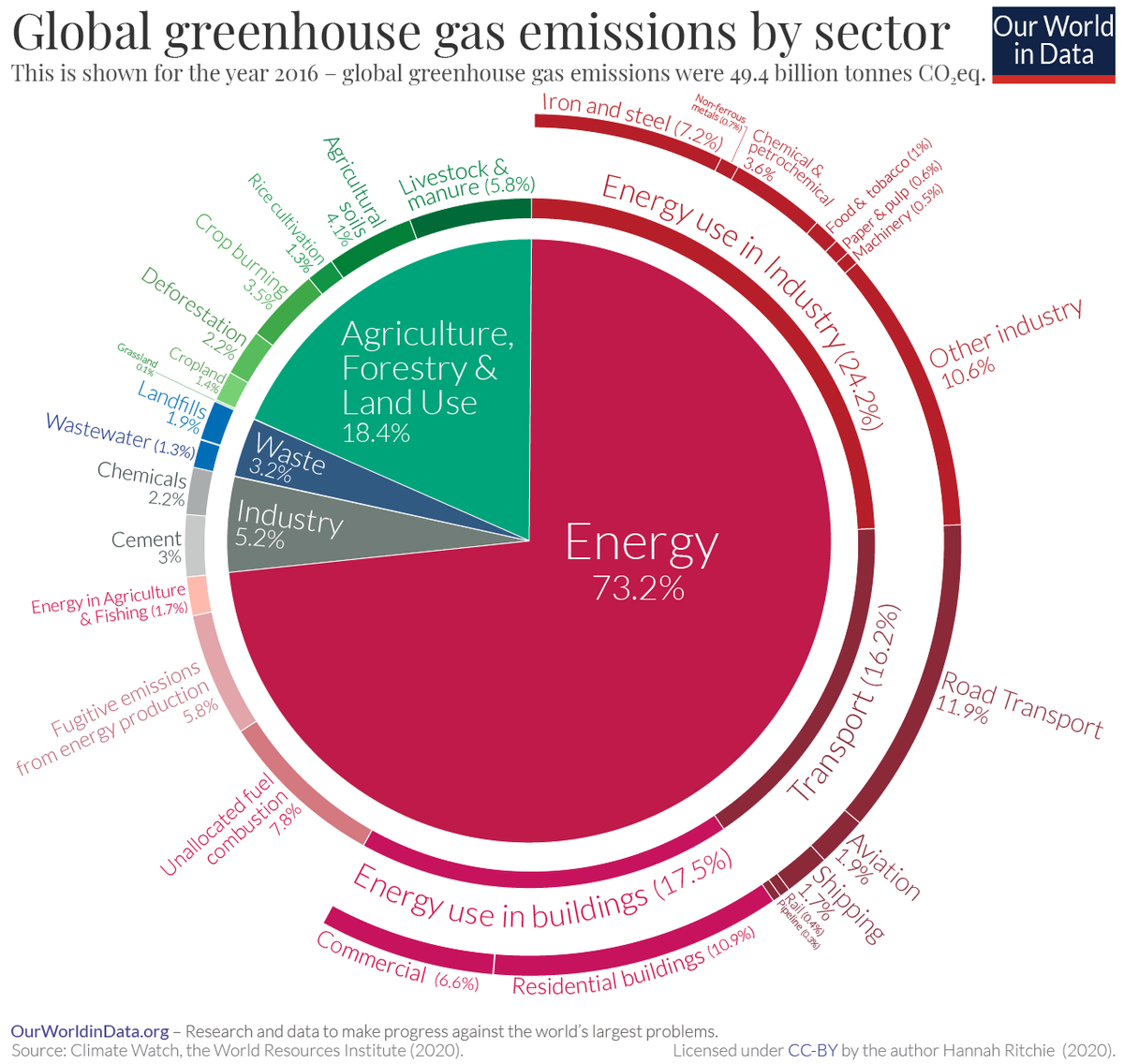
A Global Breakdown of Greenhouse Gas Emissions by Sector
In a few decades, greenhouse gases (GHGs)—chiefly in the form of CO₂ emissions—have risen at unprecedented rates as a result of global growth and resource consumption.
To uncover the major sectors where these emissions originate, this graphic from Our World in Data pulls in data from 2016 courtesy of Climate Watch and the World Resources Institute, when total emissions reached 49.4 billion tonnes of CO₂ equivalents (CO₂e).
Sources of GHG Emissions
Global GHG emissions can be roughly traced back to four broad categories: energy, agriculture, industry, and waste. Overwhelmingly, almost three-quarters of GHG emissions come from our energy consumption.
SectorGlobal GHG Emissions Share
Energy Use 73.2% Agriculture, Forestry & Land Use 18.4% Industrial processes 5.2% Waste 3.2%
Within each category, there are even more granular breakdowns to consider. We’ll take a closer look at the top two, which collectively account for over 91% of global GHG emissions.
Energy Use
Within this broad category, we can further break things down into sub-categories like transport, buildings, and industry-related energy consumption, to name a few.
Sub-sector GHG Emissions Share
Further breakdown
Transport 16.2%
• Road 11.9% • Aviation 1.9% • Rail 0.4% • Pipeline 0.3% • Ship 1.7% Buildings 17.5% • Residential 10.9% • Commercial 6.6% Industry energy 24.2% • Iron & Steel 7.2% • Non-ferrous metals 0.7% • Machinery 0.5% • Food and tobacco 1.0% • Paper, pulp & printing 0.6% • Chemical & petrochemical (energy) 3.6% • Other industry 10.6% Agriculture & Fishing energy 1.7% - Unallocated fuel combustion 7.8% - Fugitive emissions from energy production 5.8% • Coal 1.9% • Oil & Natural Gas 3.9%Total73.2%
Billions of people rely on petrol and diesel-powered vehicles to get around. As a result, they contribute to almost 12% of global emissions.
But this challenge is also an opportunity: the consumer adoption of electric vehicles (EVs) could significantly help shift the world away from fossil fuel use, both for passenger travel and for freight—although there are still speedbumps to overcome.
Meanwhile, buildings contribute 17.5% of energy-related emissions overall—which makes sense when you realize the stunning fact that cities use 60-80% of the world’s annual energy needs. With megacities (home to 10+ million people) ballooning every day to house the growing urban population, these shares may rise even further. Agriculture, Forestry & Land Use
The second biggest category of emissions is the sector that we rely on daily for the food we eat.
Perhaps unsurprisingly, methane from cows and other livestock contribute the most to emissions, at 5.8% total. These foods also have some of the highest carbon footprints, from farm to table.
Another important consideration is just how much land our overall farming requirements take up. When significant areas of forest are cleared for grazing and cropland, there’s a clear link between our land use and rising global emissions.
Although many of these energy systems are still status quo, the global energy mix is ripe for change. As the data shows, the potential points of disruption have become increasingly clear as the world moves towards a green energy revolution.
For a different view on global emissions data, see which countries generate the most CO₂ emissions per capita.
This article was published as a part of Visual Capitalist'sCreator Program, which features data-driven visuals from some of our favorite Creators around the world.