Sunday, December 26, 2021

Efficient or resilient: Alberta must find the right balance to protect our food supply

Heat dome illustrated the fragility of mainstream farming, writes researcher

Researcher Tatenda Mambo is managing the University of Calgary's Simon Farm project. (Riley Brandt, University of Calgary)

This column is an opinion by farmer and researcher Tatenda Mambo. For more information about CBC's Opinion section, please see the FAQ.


Last summer, a brutal heat dome knocked out crops across the prairies. But on our experimental farm just south of Calgary, it also gave a measure of hope.

At the University of Calgary's Simon Farm Project near Blackie, Alta., we're testing whether the traits found in locally-saved and traditional seed varieties can bring more resilience to our food production in the face of climate change.

It's part of a larger research effort to help Alberta's farmers shift their practices and weather the increased drought we know is coming.

The heat showed a difference between the various seed varieties we were testing, and it was staggering.

Most potatoes, kale and other plants from the seed of national distributors succumbed to the heat and withered away. The same plants from the locally-saved seed held on. 

This seed was from farmers in the region who had been planting and gathering it for at least 10 years, letting it acclimatize to our conditions. At the end of the day, despite four weeks of no significant rain and  27 C heat, we still got a modest harvest from the locally-acclimatized seed.

Of course, this is just one extreme summer and the work is ongoing, but the resilience of local seeds has been documented by other researchers. Traditional or Indigenous agricultural practices around the world have shown we can work with nature to produce our food in a manner that can restore and support ecological functions rather than degrade and erode them. And if we go back to incorporate these techniques, we can create a system that is more resilient.

Efficient or redundant

Recent events such as COVID-19, the 2021 drought, and the effects of the atmospheric rivers in B.C., shine a light on the fragility of our food systems. We saw simultaneous food dumping and supply disruptions, lost crops, and increased need for emergency food services. 

This is because within our food system and rippled throughout society is an inherent tension between efficiency (streamlined approaches to doing things) and redundancy (multiple approaches to doing things). This impacts resilience. 

On Simon Farm, Tatenda Mambo says most of the potato plants grown from the seed of national distributors did not survive the extreme heat and drought last summer. (Submitted by Tatenda Mambo)

You need the right balance between these two elements to create sustainable systems. Too much efficiency and the system becomes brittle, with disruptions causing system failures that have difficulty rebounding. Too much redundancy causes stagnation.

403 varieties of peas

Simon Farm is one of several efforts to learn how to bring resilience back into our food systems in ways that are ecologically sound and, eventually, commercially competitive.

With seeds, for example, the traditional practice of planting and harvesting seed meant farmers used to have many varieties of a single crop. For example, there used to be over 403 varieties of peas and today we only find 25. This has reduced resilience, but many farmers buy seed from distributors because it's easier and normally more cost effective.

On Simon Farm, we also increase the diversity of plants that we grow together. Rather than planting one crop per bed, our beds are filled with a mix of plants selected to support the overall growth and success of the beds. Together, they deter pests, enhance soil fertility, reduce compaction, shade the bed to conserve moisture, or fix nitrogen.

This diversity in crops is less efficient, but it enables resilience in both the short and long term.

Potatoes and kale growing last summer on Simon Farm. The farm deliberately mixes plants in their beds to strengthen the soil. These plants were grown from locally-harvested seed. (Submitted by Tatenda Mambo)

We rotate annual crops suited to our climate, and have perennial crops such as sunchokes, asparagus and sorrel. The produce is donated to the High River Food Bank.

Wide adoption still a dream

The next major step for the farm is a passive solar greenhouse to enable vegetable production into the winter months, when the need for fresh produce is highest locally. Unlike much of the greenhouse industry in Alberta, it will largely depend on the sun for heat during the winter, and will tap low grade geothermal energy to regulate temperature extremes. 

The truth is climate change will bring both challenges and opportunities to our agricultural sector. In some ways, it will no longer be prudent for our food system to cheaply provide us whatever we want to eat, regardless of the season. 

But Alberta has untapped resources that can strengthen regional food production and leverage skills and infrastructure already present. Already, we have great examples of farmers working to restore the soil and being supported by customers buying their products directly. The Blue Mountain Biodynamic Farms in Carstairs, Alta., is one good example. Other organizations such as YYC Growers and Organic Box distribute locally-produced food to clients year-round. Local greenhouse operators are already using geothermal heat, and there's huge potential to use excess heat from repurposed orphan wells or industrial activities.

The tools are there. But while we have innovators in this field, we are a ways off from wide scale adoption. Government policies focused on export, the current supply chain and even crop insurance, are still all skewed toward conventional practices that fail to account for the problems they create, leaving our system fragile.

We need to recognize that change is coming. The question is whether we will lead it or be victims of it.


CBC Calgary: The High Cost of Food

CBC Calgary is using community insight to help understand the gaps in Calgary's food system. Add your cell phone number to share tips on saving money and help document how the high cost of food is changing the way we eat and shop. Read the series at cbc.ca/costoffood.

'There's fosters leaving left, right and centre': Pet surrender requests and COVID-19 lead to increased need for animal fosters in Edmonton

Author of the article:Kellen Taniguchi
Publishing date:Dec 26, 2021
These two domestic rabbits are being fostered by Katryna Patterson, a volunteer with Infinite Woofs Animal Rescue Society, until they are adopted. 
PHOTO BY LARRY WONG /POSTMEDIA NETWORK


A staggering number of pet surrenders amid the COVID-19 pandemic has led to an increased need for animal foster homes in Edmonton, according to one local rescue.

Katryna Patterson, who volunteers as a small animal foster for Infinite Woofs Animal Rescue Society (IWARS) in the city, said she currently has seven rabbits living with her — the most she’s ever had at one time.

“I have three foster rabbits and four rabbits of my own. They’re really busy right now,” said Patterson.

The need for her to care for three rabbits at a time is partially due to the lack of foster homes available, she added.

“There’s fosters leaving left, right and centre,” said Patterson. “I don’t necessarily know all the personal reasons as to why, but I would definitely say a lot of it is probably COVID-related. People seem to be moving, a lot of the people I meet in passing, some of them are downsizing and they can’t keep the animals.”

IWARS hasn’t been taking in new rabbits since springtime and Patterson said once one rabbit is adopted there is always another needing a home.

Volunteer fosters are responsible for taking care of animals until they are adopted, including taking them to the necessary vet appointments.

Alisha Petryshyn, admin team member and cat foster with IWARS, said the need for dog and cat foster homes is also high.

She said surrender requests, specifically for dogs, have skyrocketed this year and there is no sign of it slowing down. During the summer and early fall, the rescue was receiving 70 to 80 dog surrender requests per month, compared to about 30 per month prior to the pandemic.

“I’d say it’s like two prongs — there’s a lot of owner surrenders for specific reasons and then there’s kind of the stray population that has kind of exploded in many areas, especially more rural and remote areas,” said Petryshyn.

Petryshyn said more than 400 dogs were adopted from IWARS in 2020 and if they had more foster homes available they probably would have been able to take triple the number of adoption requests.

“In all worlds, but for the dog team, we turn away dogs pretty much on a daily basis just because we don’t have enough foster homes or we aren’t able to support, for example, a very critical medical patient at this time,” Petryshyn said. “We don’t have a shelter and all of our fosters go directly into homes so we need to have available and appropriate homes for all animals before we can commit.”

Anyone interested in fostering can fill out the application form under the volunteer tab on the rescues’ website at www.infinitewoofs.com , reach out to them on Facebook or contact them at info.iwar@gmail.com

 Nova Scotia

How storing energy without batteries could be key to N.S. giving up fossil fuels

Wayne Groszko says storing energy as heat is an affordable

alternative to lithium ion batteries

Thermal storage options can store heat for use in hot water and space heating, at a fraction of the cost of lithium ion batteries, says Wayne Groszko, a scientist at the Nova Scotia Community College. (Moria Donovan/CBC)

In a laboratory at the Nova Scotia Community College sit two water tanks bristling with copper wires. They don't necessarily look like a piece of renewable energy technology. But they may nonetheless play a role in reducing one of the province's greatest sources of greenhouse gas emissions. 

In Nova Scotia, as much as 60 per cent of the energy consumption comes from space heating, a figure that rises to 80 per cent when hot water is included. 

As the province looks toward its new target of moving off coal-fired power by 2030, and achieving net-zero by 2050, researchers say storing heat — including through some of the thermal energy storage options being investigated at NSCC — could help bring about that transition. 

"If you can find a way to store heat for when you need it later, and if that happens to be more affordable than installing a bunch of batteries to store electricity, which it often is, then that can give you a lower-cost solution to storing your energy," said Wayne Groszko, applied energy research scientist at the Nova Scotia Community College.

"So thermal energy storage, we see as part of a future in which all, or most, of our electricity on the grid is from renewable sources."

Solving the variability challenge

In the future, an increasing proportion of energy around the world, including in Nova Scotia, is likely to come from wind and solar. 

But a central challenge with these technologies is their variability, said Groszko. "Basically, that doesn't necessarily correspond with when you need that energy. And so having some way to store the energy when it's plentiful, and use it later, is very key."

Technology like lithium ion batteries are one answer, but are relatively expensive, have a limited lifespan and use raw materials, such as lithium and cobalt, that exist in limited quantities.

Given that much of the ultimate use of energy in Nova Scotia is to generate heat anyway, storing that energy as heat is an affordable alternative, Groszko said.

One example is a hot water tank — a technology most people already have in their homes. Such a tank could be superheated on a windy day to store that energy. Then, when the wind drops, the tank's heaters could be turned off, and the energy released as hot water or space heating. 

Groszko says hot water tanks can be superheated on a windy day, storing the energy. When the wind drops, the tank's heaters could be turned off and the energy released as hot water or space heating.  (Moira Donovan/CBC)

In Groszko's lab, the team is investigating how this can be accomplished with smart controllers, which can switch the heater on and off remotely in response to demand on the grid, while still leaving enough hot water available to take a hot shower, for example.

"That's the kind of the experiments we're working on, is how to integrate this relatively simple technology into people's lives," said Groszko.

"The idea is you shouldn't notice it, you should just use your hot water as usual. But in the background, it's saving demand on the grid when it's needed, and then putting it back in later."

This would also reduce costs for households, when coupled with time-of-day electricity rates. 

Another option involves using phase-change materials, which store energy by, for instance, moving from liquid to solid. A 2020 report by the International Renewable Energy Agency estimated the global market for thermal energy storage like phase-change materials could triple by 2030. 

Phase-change materials — which are a version of the handwarmers shown here — store energy by moving between states. (Moira Donovan/CBC)

Several companies in the Maritimes are investigating the possibility of integrating phase-change materials into heat sources to allow more integration of renewables. 

One is Fredericton-based Stash Energy. Dan Curwin, director of business development, said they've developed heat pumps with phase-change material storage built in, to store energy from renewable sources like hydro when it's plentiful, such as overnight, and discharge it in the morning when demand is high, to be stored up again from renewables like solar during the day. 

This can help with the integration of renewables and with greater adoption of electric heat pumps, which are the most efficient heating option but risk overburdening the grid. 

Curwin said the company has partnerships with efficiency agencies across Atlantic Canada and New England, as well as housing authorities such as Housing Nova Scotia that recognize the particular burden posed by heating costs. 

"With batteries, or with electric vehicles, it's generally higher-income individuals who are able, at least right now, to purchase those systems," Curwin said. "But space heating and cooling is a huge piece of people's monthly bills. And we do want to make sure that we can get the system to a point where it's available for everyone, not just for the people who can purchase it because they want to, essentially."

Daniel Larsen, the company's co-founder, said now that they've developed a system that can efficiently heat and cool while allowing access to affordable energy through storage, the next step is to work with partner agencies to make the system attainable to households. 

"Access to renewable energy cannot be just for people who have money. So it's absolutely about making a product that's accessible to everyone," said Larsen.

The company hopes to have the units available in Nova Scotia through a larger demonstration project by next fall. 

Sean Kelly, director of clean energy for the Nova Scotia environmental charity Clean Foundation, said the need to improve access to affordable energy is particularly high in Nova Scotia. The province has some of the highest rates of energy poverty — which some researchers define as households spending more than six per cent of their income on energy for heat and other purposes — in the country, according to the Canadian Urban Sustainability Practitioners. 

"We have to deal with energy poverty at the same time as climate action, because they're both quite intertwined," said Kelly.

Technologies and policies that allow more households to be part of the energy transition, while also lowering energy costs, are an important part of taking action on climate change, Kelly said. 

"Climate change doesn't sit just with the environment movement, it's something we all have to be involved in," Kelly said.

"These sorts of clean energy initiatives will benefit those living on lower incomes more than almost anyone else. I mean, who needs lower energy [costs] more than someone living on lower income?"

Back in the NSCC lab, Groszko said some of the technology his lab is investigating is currently available through utilities and wholesalers, but is not yet available at the consumer level. 

In the future, though, he said by allowing more households to participate in the transition to renewable energy, thermal storage options could tap into Nova Scotians' willingness to help with that transition.

"Over the past 10 years, Nova Scotians have improved their energy efficiency dramatically, and I think there's a certain amount of pride about that," he said. "It's something that I think a fair number of people would be interested in continuing to move in the right direction."

P3 PUBLIC PENSIONS FUND PRIVATE BUSINESS
Fairfax buys back $1-billion of shares after CPPIB, OMERS investment

DECEMBER 26, 2021

Fairfax Financial Holdings Limited bought back US$1 billion of its own stock at a premium price on Christmas Eve, after selling a stake in a subsidiary to institutional investors OMERS and the Canada Pension Plan Investment Board for US$900 million.


Fairfax, a global property and casualty (P&C) insurance company, in November announced plans to buy back up to 8.7 percent of its own stock for between US$425 and US$500 for each subordinated voting share. At the same time, Toronto-based Fairfax said it had acquired its Stamford, Conn.-based division Odyssey Group Holdings Inc. Sold a 9.9 percent stake in CPPIB and OMERS, Canada’s two largest pension fund managers.

Fairfax is the latest in a string of Canadian financial services companies to initiate significant share buybacks, as regulators ease capital restrictions imposed during the pandemic and allow banks and insurers to cash in as they see fit.
advertisement

Toronto-based Fairfax last Friday set the buyback price on its buybacks using a “modified Dutch auction,” which allows shareholders to choose the price they are willing to tender their stock at. According to a report by Scotiabank analyst Phil Hardy, the auction was “slightly oversubscribed”.

Fairfax received two million shares at the top end of its pre-set range at US$500 each. That day, Fairfax shares closed at US$464.02 on the New York Stock Exchange, so the buyback played out at an 8 percent premium to where the company’s stock was trading at the time.

The decision to sell a stake in a subsidiary and use the capital to buy back the shares “provided a great solution for increasing book value per share in the near term while supporting future growth,” Mr. Hardy said.

The CPPIB and OMERS investments valued Odyssey at 1.7 times its book value. In contrast, the buyback saw Fairfax repurchase its shares at a 10 percent discount to the company’s reported book value, which is US$561.88 per share. Mr Hardy said: “The Odyssey deal highlights a significant gap between Fairfax’s share price and the estimated intrinsic value of the company and its holdings.”

Fairfax, controlled by entrepreneur Prem Vatsa, also raised capital in October by selling a 14 percent interest in London-based reinsurance subsidiary Brit Ltd to OMERS for US$375 million.

Historically, Fairfax has used the cash generated from its operating companies and investments to grow through acquisitions, rather than paying for share buybacks. In recent years, the company expanded into India and Africa.

The property, casualty and reinsurance industries are consolidating around their biggest players, which includes Fairfax. “With the P&C business becoming more risky and complex, the capital requirements and the need for reinsurance will increase,” Swiss Re, the world’s largest reinsurance company, said in a recent report. The Zurich-based company said: “Asset will be the fastest-growing segment, with global premiums projected to grow 5.3 percent annually through 2040. Climate risk will be the main driver of asset growth.”

Fairfax is expected to continue snapping up smaller rivals. In a report last week, RBC Capital Markets analyst Mark Dwley said: “The company has more than $1 billion in holding company cash and has the operational flexibility to pursue a variety of near-term and long-term growth initiatives and acquisitions.” “


Canada And The UK Are Eyeing Massive Tidal Power Developments

  • The UK plans to invest $26 million per year into funding for tidal power.

  • Canada is also betting big on tidal power, hoping to harness some of the world’s highest tides in Nova Scotia.

  • While Scotland and Canada become pioneers in tidal energy technology, the rest of the world is sitting and waiting to see if these investments pay off.

Tidal power is expected to grow exponentially over the next decade as several countries boost investments in the renewable energy source. As Scotland secures funding for a huge new project, Canada expects to start operations in 2022. While financing is an issue, due to high set-up and operational costs, other countries could also start to establish tidal projects if early developments are seen to be a success.  Scottish firm Nova Innovation has secured a $2.83 million investment from the European Innovation Council Accelerator Fund for its planned Upscaling Tidal Energy Manufacturing and Production Output project. Nova aims to construct a 200-kilowatt tidal turbine that is more compact, reducing both the weight and cost of the machinery. 

The company was also granted planning permission for a 30-megawatt tidal development in the U.K.’s Isle of White this month. Work on the Perpetuus Tidal Energy Centre (PTEC) will commence in 2023 to be completed by 2025. It is expected to be “England’s first multi-megawatt tidal stream power generation project.” 

Nova hopes to carry out a third project in Wales - the Morlais tidal demonstration project. Natural Resources Wales stated, “The project is for the installation and commercial demonstration of multiple tidal energy devices and will provide an area for the offshore development of renewable energy sources across 35km2  to the west of Anglesey [in Wales].”

As part of the U.K. government’s renewable energy strategy, it has earmarked almost $26.7 million a year in funding for tidal power. This brings the total annual national investment via its renewable energy auction scheme to $380 million. This funding will contribute towards Britain’s goal of cutting carbon emissions by 78 percent by 2035 and eventually achieving net-zero by 2050. The government hopes this will help develop the tidal industry as well as create new jobs across the country. 

In Canada, Sustainable Marine hopes to have its new tidal project up and running by 2022. Having constructed an onshore electrical substation in Nova Scotia, it plans to use the PLAT-I tidal energy platform to harness the power of some of the world’s highest tides to provide energy to the grid next year. It will be the first floating tidal platform to connect directly into the power grid.

The company also made a multi-million-dollar investment in the Tidal Pioneer in the region, marine operations support vessel. Sustainable Marine plans to carry out an extensive monitoring and evaluation program to see what impact the new project has on marine life in the region. It hopes to use Nova Scotia’s natural resources to develop the province’s renewable energy sector. 

Other countries have also shown interest in future tidal energy developments but are put off by the high setup and operational costs involved. India has the opportunity to become a major tidal energy generator, with an estimated 54 gigawatts (GW) of potential ocean energy, but has not yet carried out tests to explore the practically exploitable potential.

India has long considered the potential of its tidal power. However, after starting two projects - a 3.75-megawatt project in West Bengal in 2007 and a 50-megawatt development in Gujarat in 2011 – it decided costs were simply too high to continue. But now the government is suggesting that these costs need to be reevaluated due to innovations in technology and machinery, to be compared effectively to other renewable energy projects such as solar and wind power production.

So, is now the time to invest? Those working in the sector point out that tidal energy seems to have been generally overlooked when thinking about how to develop the renewable energy sector. At present, there are around 60 megawatts of wave and tidal energy installations worldwide, largely due to high prices and competitive alternatives. A scientific analysis of the current cost of tidal power operations suggests that costs need to be reduced from $320 per MWh to below $200 per MWh to make this a viable energy option. 

Another U.K. company, Orbital Marine, hopes its 72-meter submarine-esque O2 tidal turbine will provide the learning stage needed to attract greater interest in the sector. The company hopes the use of innovative technology will help to reduce project costs, aiming to attract greater funding for future projects.

With the potential for tidal power to provide a tenth of the U.K.’s energy, is it money worth spending? Dan McGrail, CEO of Renewable UK explains, “we need a range of renewable technologies to get us to net zero as fast as possible.” Further, “as an island nation with superb tidal energy resources to harness, it is clear that tidal stream should have a key role to play in our shift to clean energy.”

 While Scotland and Canada become pioneers in tidal energy technology, the rest of the world is sitting and waiting to see if these investments pay off. Harnessing the power of a greater range of natural resources, without contributing to environmental degradation, will help countries achieve carbon reduction targets. But the high cost involved in something largely unknown has, so far, put many governments off. 

By Felicity Bradstock for Oilprice.com

Kyrgyzstan pushing for out-of-court settlement with Centerra
Reuters | December 21, 2021

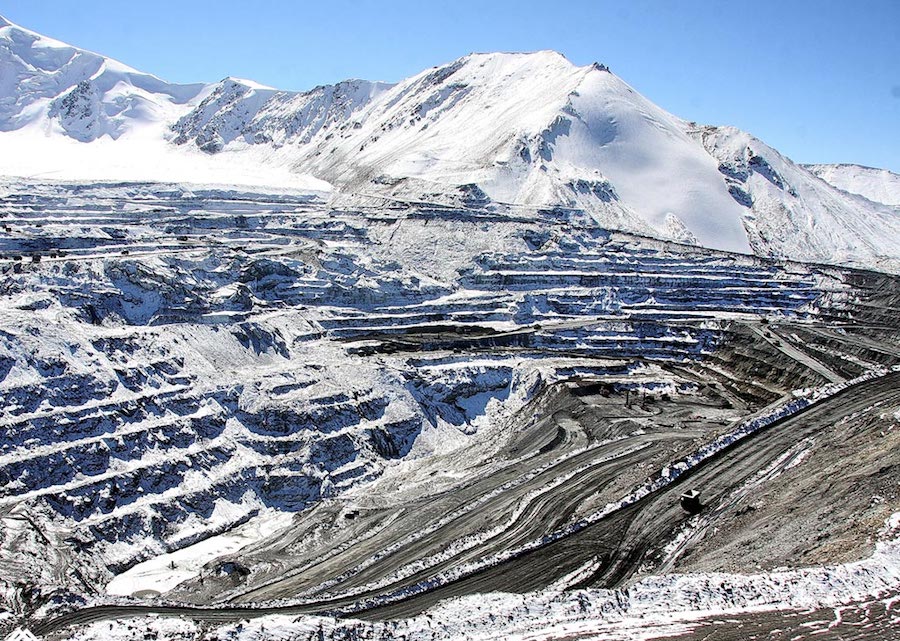
The vast open pit Kumtor mine is Kyrgyzstan’s largest gold operation. (Image courtesy of Kumtor Gold Company.)

Kyrgyzstan is pushing for an out-of-court settlement with Canada’s Centerra Gold to resolve a dispute in which the state seized the company’s Kumtor mine and both sides launched legal challenges, a source close to the government said.


Centerra in May kicked off arbitration against the Kyrgyzstan government, after it took over the country’s biggest mine for allegedly posing danger to human lives or the environment.

A Kyrgyzstan court imposed $3.1 billion fine on Kumtor Gold Company (KGC), which operates the 550,000-ounce gold mine, after ruling that the firm had violated environmental laws by placing waste rock on glaciers.

Centerra and Kyrgyzstan have a long history of disputes over how to share profit from the former Soviet republic’s biggest industrial enterprise, the Kumtor mine.

International arbitration proceedings are costly processes that can last years.

A potential settlement between the parties was discussed at a meeting in Geneva that took place on Sept. 28-30, the source close to the government and a second source with knowledge said.

The source close to the government added that Kyrgyzstan is still keen to find an out-of-court settlement within the next few weeks after the September meeting ended without a deal.

Kyrgyz Deputy Prime Minister Edil Baisalov said in a statement: “We remain open to reaching an out-of-court settlement that satisfies all parties. However, we are also ready to pursue legal arbitration to its proper and just conclusion.”

The Central Asian country would continue to investigate “compelling evidence” of corruption and other violations by Centerra, he said.

Centerra has denied all the allegations.

The September meeting included discussions around the future of the Kumtor mine, alleged damages to the environment and tax losses, losses incurred by Centerra since the mine was seized and the potential sale of a 26% stake in Centerra held by state-owned Kyrgyzaltyn JSC.

Centerra froze the government’s stake when it seized the mine, meaning it does not have voting rights, nor is it entitled to dividends.

Centerra declined to comment on a potential settlement and the Geneva meeting and referred to an October statement, saying that the company “remains open to a consensual resolution of the Kyrgyz government’s claims, but it has to reflect fair value for the mine and compensation for other damage caused by the government’s actions.”

A top-10 shareholder in Centerra told Reuters it would be in the best interests of both parties to negotiate a settlement as soon as possible and avoid a protracted legal battle.

Centerra has said it would be able to survive without the Kumtor mine, as its Canadian and Turkish assets are on track to achieve consolidated free cash flow between $125 million to $175 million in 2021, enough for the company to be debt-free, with a cash position of $911.7 million this year.

While regarding Kumtor Gold as a national enterprise, Kyrgyzstan would face issues selling its gold freely, after its state gold refinery was excluded by an international list of acceptable sources.

Kyrgyzstan also launched a separate lawsuit on Wednesday alleging that Centerra had blocked user and administrator access to Kumtor’s computers since May 2021.

The latest stand-off between the two sides began shortly after Sadyr Japarov came to power in Bishkek following violent riots last October.

Centerra’s share price has dropped by 39% this year.

(By Clara Denina and Zandi Shabalala; Editing by David Evans and Matthew Lewis)
Gensource Potash bags synergistic Tugaske project in Saskatchewan
Henry Lazenby | December 21, 2021

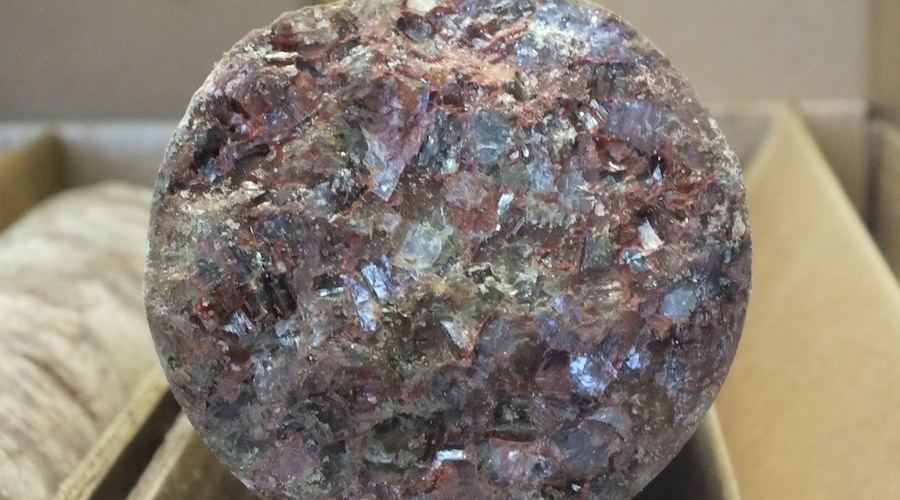
Potash core from the Tugaske project. (Image courtesy of Gensource Potash).

Gensource Potash (TSXV: GSP; AIM: GSP) has increased its potash asset base by purchasing an additional 7,244 hectares at C$14.26 per hectare of land directly abutting its Tugaske project in southwest Saskatchewan, providing it with a potential new project.


Gensource aims at becoming one of the lowest-cost producers in North America with its shovel-ready, high-margin Tugaske project.

Due to Block 59 being directly next to the existing KL245 lease and near the resource confirmation wells that Gensource has drilled over the past several years, the data from those wells will apply to Block 59.

This optimizes and leverages Gensource’s existing investments in geological and geophysical exploration and analysis, making the process of defining a resource on Block 59 more efficient from both a cost and time perspective.

Further, being a separate mining permit, Block 59 is expected to create a future project area, different from the company’s existing leases KL244 and KL245, capable of implementing even more potash production modules under Gensource’s modular business model.

Unlike other producers that use a spoke and hub system to sell and distribute their product, Gensource production will go straight to the end-user through its offtake agreement with Chemical marketing company HELM.
Innovative model

For farmers that have felt their supply chains squeezed by the larger producers that have made up the traditional oligarchic system, this represents a new way of doing business that provides them with an element of control.

“We are already seeing new players following Gensource’s lead, but the combination of Gensource’s technical expertise to actually implement a project, innovative business thinking, and first-mover advantage means exciting things ahead for the company as we engage with new potential partners for future projects,” Gensource CEO Mike Ferguson said in a media release.

Gensource announced in September a C$50 million equity investment commitment into the 250,000 tonnes per annum Tugaske potash project. HELM has committed to purchasing all the mine production for ten years. It will invest in the project once the remaining equity and debt financing have been concluded.

Gensource has created a special purpose vehicle called KClean Potash Corp to finance, own, construct and operate the Saskatoon project. It will be owned by Gensource (67%) and HELM (33%) following final equity investments.

Management believes that Saskatchewan contains the world’s largest resource of potash-bearing ores, found in the Prairie Evaporite Formation. Discovered in the 1940s, the resource is rich, widespread and consistent in its grades and thicknesses and is very well understood.

The company has secured C$280 million debt financing from senior lenders KfW IPEX-Bank & Société Générale. Half of the debt facility is expected to be supported by credit insurance issued by Euler Hermes.
Potash price

Ferguson is encouraged by recent potash market moves.

“The presence of today’s higher prices will, no doubt, bring additional new projects to the industry; however, it is important to note that Tugaske does not rely on the current high prices to be economically sound. Tugaske was developed under much lower potash pricing scenarios than we are seeing today and shows robust economics at both low and high pricing environments; this is one of many fundamental and differentiating strengths of the project,” he said.

Fertilizer prices have shot up over the past year, with prices of major fertilizer products throughout North America increasing by more than 50%. The average retail potash prices across the US increased from $380 per tonne in 2020 to $661 per tonne in 2021 to date. The last time the potash price was above $600/t per tonne was in November 2012.

Despite dropping from recent highs at C48c, shares in Gensource are still trading more than 57% higher over the past 12 months at 31.5c. It has a market capitalization of C$131.9 million.
Sweden could take global lead in green steel production – report

MINING.COM Staff Writer | December 22, 2021

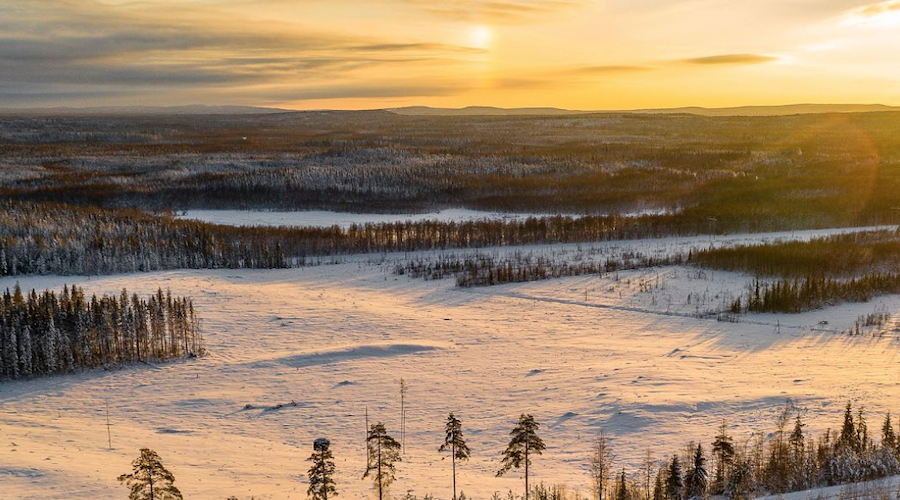
H2 Green Steel plans to build a large-scale CO2-free steel production facility at this site in Sweden’s Boden-LuleÃ¥ region. (Image courtesy of H2GS).

A new report by Wood Mackenzie states that Sweden could become a pioneer in green steel production as at least two initiatives by HYBRIT and H2 Green Steel, separately, have been launched with a target to manufacture 10 million tonnes (mt) of fossil fuel-free crude steel annually by 2030.


HYBRIT is a joint venture between Swedish steelmaker SSAB, iron-ore miner LKAB and utility Vattenfall, while H2 Green Steel is a company backed by Vargas Holding – the same investment firm that co-founded Northvolt.

According to the market researcher, the nordic country could take the lead when it comes to the environmentally friendlier version of the alloy, despite the fact that its current production is not particularly large. Sweden’s steel industry manufactured 4.4mt of crude steel (3.4mt of finished steel) in 2020, representing 3.2% of crude steel production (2.5% of total finished steel production) across EU-27 and the UK.

“Sweden’s decarbonization drive in the steel industry signals substantial cost reduction potential for green steel over the coming decades, due primarily to the declining cost of renewables and green hydrogen and increasing carbon prices,” Wood Mackenzie’s principal analyst, Sohaib Malik, wrote in the report.

“The country boasts Europe’s largest iron ore reserves and excellent renewable energy resources – two primary prerequisites for the production of green hydrogen and decarbonized crude steel.”

According to Malik, at a levelled cost of electricity at $30 per megawatt-hour, wind power is a highly economical source of power generation in Sweden today. Meanwhile, further cost reductions are expected with better financing structures for onshore wind, lower capex for onshore and offshore installations, technological optimization for asset management and state support for offshore grid infrastructure.

The analyst also said that alkaline electrolysis technology is most likely to play a key role in green hydrogen production which he emphasized is crucial for Sweden’s green steel production.

The WoodMac expert also pointed out that compared to proton exchange membrane electrolysis, alkaline electrolysis has a lower capex of $925 per kilowatt today and it is expected to halve by 2030, enabling a levelled cost of $1 per kilogram of green hydrogen using onshore wind power.

For Malik and report co-author Mingming Zhang, alkaline electrolysis and renewable energy from onshore wind will produce the most cost-effective green crude steel in Sweden.

“Assuming a carbon price of $100/t, green steel producers could benefit from $85/t of carbon credits. Better financing models for onshore wind and 48% lower capex for alkaline technology in 2025 yield steel cost of $360-390/t in carbon price scenarios ranging between $50/t and $150/t,” they estimated in the report.

In Zhang’s view, producing green steel with cost parity to conventional steel in the 2020s is quite possible if natural gas-based direct reduction iron and electric arc furnace steelmaking processes are used as a baseline.

“Global steel demand will reach 1,872mt a year by 2030, 6.4% higher than in 2020. The case for green steel will grow stronger as its cost reduces. In addition, the success of green hydrogen to produce green steel at a commercial scale will justify the enthusiasm around its ability to accelerate decarbonization,” the analysts concluded.