Sunday, December 26, 2021

NDP call on the Liberal government to uphold commitments on human rights 


Posted: December 25, 2021 

Five years ago, the United Nations Security Council adopted Resolution 2334 on Israel and Palestine. The resolution was passed and is binding under international law. It stresses that the status quo is not sustainable and that significant steps are urgently needed in order to stabilize the situation and to reverse negative trends on the ground, which are steadily eroding the two-State solution.

Among other things, the resolution called on States to distinguish between the territory of the State of Israel and the territories occupied since 1967. It called on Israel to immediately and completely cease all settlement activities in the occupied Palestinian territory--including East Jerusalem --and for immediate steps to prevent all acts of violence against civilians.

New Democrats mark the fifth anniversary of this resolution by urging the Government of Canada to uphold UNSCR 2334 and to call on the Government of Israel to halt all settlement activity in occupied Palestinian territory, including East Jerusalem. New Democrats also urge Canada to end all trade and economic cooperation with illegal settlements in Israel-Palestine.

Recent comments by Canadas new Foreign Affairs Minister regarding Palestinians are troubling. Equally concerning is her silence regarding Israels designation of six Palestinian human rights organizations as terrorists - an unjustified attack on civil society that will have severe consequences for the children and families who receive critical services from these organizations. We call on Minister Joly to explain how Canada intends to make tangible contributions toward peace and security in Israel and Palestine - rather than supporting the status quo.

The Canadian government should do its part to create the conditions for peaceful co-existence in viable, independent states with agreed-upon borders. By failing to call out Israel for breaching international law and violating the human rights of the Palestinian people, Canada is contributing to the problem.

On the fifth anniversary of UNSCR 2334, we call on the Liberal government do its part for peace and to stand up for international law and human rights.

Ottawa

Pet owners worry as COVID-19 outbreaks among staff close veterinary hospitals

All 3 hospitals closed to all but true emergencies, redirect to

Montreal, Toronto

The Alta Vista Animal Hospital is one of three veterinary hospitals in Ottawa that has had to close its doors this week because multiple employees tested positive for COVID-19. (Félix Desroches/CBC)

Pet owners in the Ottawa area may have some difficult decisions to make this holiday season if their pets require veterinary care after all three emergency clinics in the city have had to shut their doors because of COVID-19 outbreaks among staff.

The Ottawa Veterinary Hospital and the Ottawa Emergency and Specialty Hospital will only be open for life-threatening conditions, but both companies told CBC they cannot guarantee everyone will be seen.

The Alta Vista Animal Hospital, the largest of the three hospitals which offer emergency care, is only offering curbside pickup for prescriptions of pet food and life-saving medications.

"It's been really emotionally hard on the staff. We want to get open as soon as we can," said Julie Dwyer, an area manager with VCA Canada, which operates the Alta Vista Animal Hospital and the Ottawa Veterinary Hospital. 

A sign on the door of the Alta Vista Animal Hospital tells clients the hospital has had to shutter its doors as of Thursday night because of a number of COVID-19 cases among employees and other staff who have had to isolate. (Félix Desroches/CBC)

She said the Alta Vista location has never closed its doors in its 70 years in operation, including during the 1998 ice storm when much of eastern Ontario was without power for multiple days, nor during the first 21 months of the pandemic. 

Even with 165 employees, including 30 veterinarians, the current outbreak has put a significant strain on staff as other employees have also had to self-isolate per new Ontario guidelines.

"When you have a positive employee, that might expose 12 to 15 to 20 people and so when that starts to spread, we now just do not have the staff ... to operate the hospital."

Take extra precautions to protect pets, hospital urges

Dwyer urged people to be extra cautious with their pets over the holidays, ensuring they're not given any toxic plants or foods, such as chocolate.

In an emergency, people can either call the animal poison control hotline or access an online triage system where they can speak to a vet.

If someone has a true emergency, they can call either the Ottawa Veterinary Hospital or the Ottawa Emergency and Specialty Hospital, but there is no guarantee a pet will be able to be seen. People may be redirected to clinics in Montreal, Laval, Que., or Toronto.

Owner of Mr. Meowgi worried

The closures worry Katie O'Rourke whose cat Mr. Meowgi, has to take a puffer twice daily because of asthma, and also relies on a rescue inhaler, for emergencies.

Katie O'Rourke's cat, Mr. Meowgi, has to be given a puffer twice daily because of asthma, and also has a rescue inhaler in case of an attack. (Submitted by Katie O'Rourke)

"It's kind of scary for me because I don't know, if there was an emergency, if I could make it to Montreal," she said. "And if your pet's in stress, it's usually something that needs immediate attention."

O'Rourke said she understands vets and clinics are doing their best and need to take care of themselves, especially as the Omicron variant spreads rapidly across Ottawa.

"We need to cut them some slack, but we also need to know that our pets can be taken care of if they have an emergency."

With files from Malcolm Campbell


B.C. couple donates pristine parcel of rainforest, land in Bella Coola Valley


Parcel of rainforest gifted

A pristine piece of land in the Bella Coola Valley will continue to be untouched after a B.C. couple donated the land to the Nature Conservancy of Canada.

Harvey and Carol Thommasen purchased 122 hectares of land on the riverfront in 2018 intending to make it a bird sanctuary and protect it.

Since then, the area has been a thriving rainforest, floodplain and riverside habitat that supports an abundance of wildlife and plant diversity. It's also home to thriving grizzly bears and many other animals.

"Harvey, who is the donor, he set up quite a few wildlife cameras in the area and he has video of beavers, cougars, wolves and deer,” says West Coast program director Steven Godfrey.

Once a doctor, Harvey’s passion was conservation and he even wrote a book about birds on the central coast.

The area is adjacent to the traditional Nuxalk village site of Nutl’lhiixw and the present-day Burnt Bridge Conservancy, home to a grove of old-growth red cedars.

Godfrey says the Nature Conservancy of Canada received consent from the Nuxalk First Nation to work in the area and they will continue to work closely with them.

“We are grateful to the Nukalk Nation for their confidence in us to care for this portion of their ancestral territory, and for the vision and commitment of Harvey and Carol in protecting this land,” says Godfrey. "Its conservation value is significant, especially for the riparian habitat it provides for juvenile coho and pink salmon, and its importance for grizzly bear, wolf and many other species of wildlife.”

A Nuxalk Nation councillor says they’re committed to protecting vulnerable ecosystems in their territory.

"We have given our support to the Nature Conservancy of Canada to manage this area as we believe they will be able to protect this land for our Putl’lt — those who are not yet born,” says Iris Siwallace.

As for the future plans of the property, Godfrey says it will remain untouched.

“Mostly, we just want to see it kept in its natural state as possible,” he says. "We might manage invasive species or put up some access signs if necessary but for the most part we want to steward it to maximize its conservation value.”

Godfrey explains that land and valley bottoms tend to be converted to agricultural uses or are often used for logging.

"Just to have a piece of land that is set aside for its ecological value and wildlife habitat is really important," he says.

The location is not accessible to the public, but there are trails in the provincial parks nearby.

SCHADENFREUDE

More snow in forecast for Greater Victoria, wind chill values near -20 C for parts of Island

While the snow may be good news for sledders, police reported “degrading road conditions” throughout the capital region, creating less-than-ideal driving conditions. 
12262021-snow-langford-drivebc
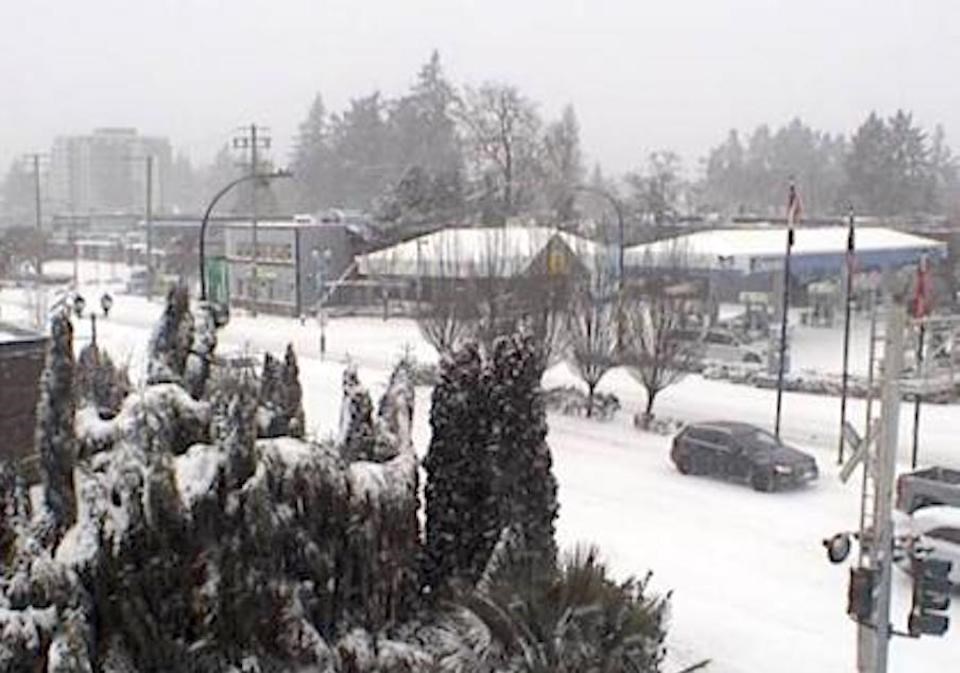
Snow on Veteran's Memorial Parkway at Goldstream Avenue in downtown Langford on Sunday, Dec. 26, 2021. 

As snow continues to fall throughout parts of Vancouver Island with multiple warnings in effect for freezing temperatures, snowfall, and hazardous highway conditions, police are advising drivers stay of the roads if possible. 

While the snow may be good news for people enjoying snow sports and children looking to toboggan, Saanich police reported “degrading road conditions” throughout the capital region this morning, creating less-than-ideal driving conditions. 

“Avoid driving unless necessary as icy roads and snow continue to build up on all roadways,” advised Saanich Const. Spencer Loverock. 

Environment Canada updated an Arctic outflow warning early Sunday for Greater Victoria and eastern Vancouver Island forecasting wind chill values as low as -20 C — near record cold temperatures — today through Wednesday. 

An Arctic ridge of high pressure over the B.C. Interior will bring “strong and bitterly cold outflow winds” to coastal communities beginning tonight, said the national weather forecaster. The outflow winds will create wind chill values of -20 and lower. Mainland inlets and areas are more likely to experience these very cold wind chill values. 

Environment Canada also issued a snowfall warning advising that an “unstable air mass” and colder outflow winds will bring further accumulations of up to five centimetres of snow throughout Greater Victoria and the Gulf Islands. That warning was lifted just before 11 a.m. Even greater amounts could fall on the east coast from Duncan to Nanaimo, where the warning remains in effect. 


The weather forecaster is advising Islanders to adjust their driving as “rapidly accumulating snow will make travel difficult.” Another 5 cm of snow is forecast to fall over the Malahat portion of the Trans-Canada Highway from Goldstream to Mill Bay. 

Drive B.C. has issued a winter driving advisories for Highway 14 between Metchosin and Sooke, the Trans-Canada between Chemainus and Mill Bay, and the Malahat. Travel is not recommended unless absolutely necessary.

Several B.C. Transit routes in Greater Victoria have detours due to the snow.

The Victoria Harbour Cats baseball team, on its official Twitter page, offered to get vulnerable seniors, fans and supporters, to essential destinations using its four-wheel-drive vehicle. 

More than 1,000 B.C. Hydro customers in the central Island were without power early Sunday morning. By 10 a.m., that number was down to about 340 customers around Courtenay, Nanaimo, and Qualicum Beach. 

Cold weather prompted the opening of a warming centre in Victoria at the James Bay United Church at 511 Michigan St. from 8:30 a.m. to 7:30 p.m. starting Christmas Day until Dec. 29.

An emergency warming centre has also been opened in Campbell River. It will operate from 8 p.m. to 8 a.m. nightly until Dec. 30.

Meanwhile, bird lovers are reminding residents with hummingbird feeders to keep them filled and unfrozen. The B.C. SPCA advises feeders that are left empty or left to freeze can lead to starvation for the birds that have come to rely on them.

“If you commit to winter feeding, you must commit fully," says the SPCA website. Non-migratory hummingbirds may come to rely on this food source and will suffer if it is interrupted.

In current freezing temperatures, its advised to bring your feeder in overnight to prevent freezing and put it back out first thing in the morning or alternate between two feeders.

Metro Vancouver wakes up to a 'White Christmas' — in pictures
It was a rare snowy Christmas Day morning around Metro
Vancouver

Posted: Dec 25, 2021

Several ducks are seen swimming in a Vancouver park on Christmas Day
alongside a family enjoying the snow with their dog. (Enzo Zanatta/CBC)


An Anna's hummingbird is pictured sitting on a snowy stem in Richmond, B.C. on Christmas Day. (Submitted by Richard Topping)

A pond in a Vancouver park is seen flanked by snow-blanketed trees. (Enzo Zanatta/CBC)

B.C. bracing for extreme cold, near record lows expected in Metro Vancouver
By Elizabeth McSheffrey Global News
Posted December 26, 2021 
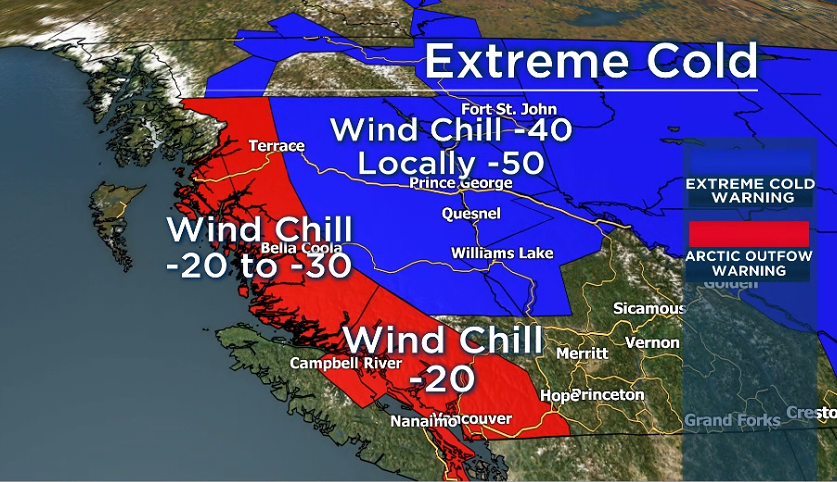
A frigid arctic air mass has arrived over the South Coast, as forecast. Daytime highs will be below seasonal by several degrees this week, with the coldest being today through Tuesday. Global New

Environment Canada has issued warnings for extreme cold, winter storms, snowfall and chilly Arctic winds for much of the province.


A “bitterly cold airmass” has settled over the B.C. Interior, the federal agency said Sunday, warning that overnight lows could range between minus 30C and minus 50C with the wind chill.

Records were broken in Agassiz, Burns Lake, Port Alberni and Vernon on Sunday, with temperatures of minus 11.9C, minus 38.6C, minus 12.3C and minus 19.2C, respectively.

Vernon made the greatest leap — it’s previous record for Dec. 26 was minus 15.4 in 2008.
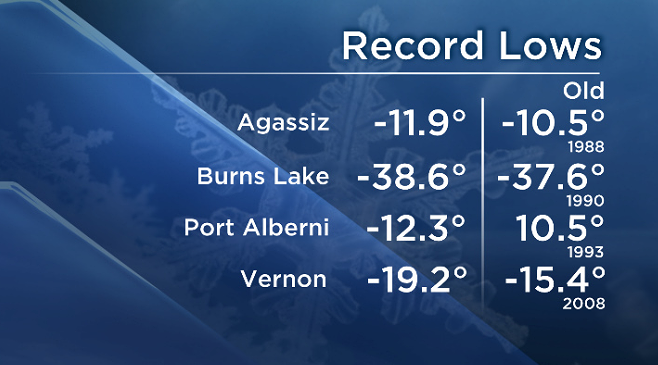

Some parts of B.C. have already shattered records for the coldest Dec. 26 on record. Global News

READ MORE: Flooding, fires and heat: A year of unprecedented weather extremes in B.C.


Extreme cold warnings are in effect for the Cariboo region, 100 Mile area, Peace River region, Cassiar Mountains, and Bulkley Valley and the Lakes District.

A warning has also been issued for Fort Nelson, Williston, Yellowhead, McGregor, Prince George, Watson Lake, the Muncho Lake and Stone Mountain parks, and Stuart-Nechako region.

The cold will last until Monday morning, Environment Canada forecasts, with some moderation in temperature on Monday afternoon.

B.C. evening weather forecast: Dec. 25B.C. evening weather forecast: Dec. 25

Meanwhile, Arctic wind warnings have been issued for the Central Coast regions, East Vancouver Island, Greater Victoria, the Howe Sound area, Metro Vancouver, the Sunshine Coast, and Fraser Valley.

Wind chills below minus 20C are expected between Sunday night and Wednesday, with “near record temperatures” early in the week, said Environment Canada.

The City of Vancouver has released a list of facilities with shelter space, including the Langara YMCA, Cascades and Tenth churches, the Evelyne Saller Centre, and the Bud Osborn EWR.

On Sunday, temperatures were 10C below the seasonal average for Vancouver with a high of minus 4C and a wind chill of minus 13C.

The winter conditions also prompted a series of travel advisories and road closures throughout the province, along with ferry cancellations in Upper Arrow Lake on Sunday morning.

Via DriveBC, the Ministry of Transportation is discouraging non-essential travel on several portions of Highways 1, 14, 17 and 3.

A snowfall warning of up to four centimetres has also been issued for East Vancouver Island.

4 of the top 5 coldest places on Earth right now are in Canada

Laine Mitchell
Dec 25 2021

Andrei Stepanov/Shutterstock

It was a cold Christmas Day for some Canadians, with four of the top five coldest places on Earth right now being in Canada.

The cold streak doesn’t just extend to the top five, either. Of the top 15 coldest spots, 10 are in Canada as well.


According to a new weather report from WX-Now, which tracks the world’s most extreme weather, four of the top five coldest places on Earth right now are actually in Canada.

A spot in Russia claims the top spot, and after that, it’s Canadian cold making up the rest of the top five.

The coldest place on the planet, Jakutsk, Russia, is mind-numbingly brisk at -48ºC.

In second, third, and fourth place are locations in Yukon, ranging from -44ºC to -40ºC. We are shivering just thinking about those temperatures!

The fifth coldest place on the planet is Linderb Landing, Northwest Territories, at a chilly -39ºC.


WX Now

In addition to Canada filling up the top five, there are six other spots in the country listed within the top 15, including the Dease Lake Coastal Station in British Columbia at -38ºC, ranking sixth, and more spots in Yukon and Nunavut.


WX Now

The full list of the world’s chilliest countries can be found here.

So, there you have it.

Keep warm with your coffee and Christmas presents today. Some people in Canada are sure to endure a chilly, chilly Christmas Day.
PART RELIGION, PART PSYCHOTHERAPY
Healing myself the Pagan way: how witchcraft cast a spell on me

‘Perhaps witchcraft was in my blood – my very first word was “moon”.’ Jennifer Lane. Photograph: Shaw & Shaw/The Observer

Witchcraft and its deep connection with nature restored my mental health

Jennifer Lane
Sun 26 Dec 2021

Witchcraft has always played a large role in my life. While many kids were learning badminton or taking trombone lessons, I was reading up on spellcraft and ways to plant my herb garden. I grew up in the late 1990s when my cultural life became saturated with Buffy the Vampire Slayer, Charmed and Sabrina the Teenage Witch. Channel-hopping without stumbling across a young woman with magical powers was virtually impossible. But the draw wasn’t just the empowerment that spells and telekinetic forces threw my way; I was intensely charmed by witchcraft’s connection with the world outside and the earth around me.

In the evenings I spent time in my garden wrapped up in scarves and blankets to watch the different phases of the moon pass each night; I learned the names of wildflowers growing at the side of the road where no one cast a second glance and wondered how I could use them in a spell. These small things gave me an overwhelming sense of calm, so enthralled was I by constellations, intricate root systems and the dashes of magic I found around me. Perhaps witchcraft was in my blood – my very first word was “moon”.

So, as an adult, it seemed incredibly natural to me that witchcraft would be the safe haven I returned to in order to recover my mental health after a workplace ordeal left me suffering from depression.

Back in 2018, the world started to look a little hazy to me. For as long as I could remember, I had been told the direction my life would take: I would do well in school, go to university and get a good job. But, in my new communications role at a fast-paced agency, I struggled to come to terms with my reality – I was waking up in cold sweats at 4am every morning and, whenever I washed my hair, long tendrils would pull free from my scalp and form a dark pool at my feet.
I was waking up in cold sweats at 4am every morning

On top of the physical symptoms of anxiety, I noticed that as the job grew more stressful, my mood tumbled downwards until I was in a state of depression for months at a time.

And so, in the winter of 2018, after realising how disconnected I had become from myself and the nature-loving woman I had once been, I knew something had to change. I decided to break away – I quit.

In the aftermath and panic of walking away from a job that paid my bills and gave me some semblance of a normal person, I decided to use this newfound time to re-connect with my longtime love of bubbling cauldrons, flickering candles and the occult in an effort to restore balance in my life and heal my mental health.

Witchcraft falls under the umbrella term of Paganism – a form of spiritual practice that involves a deep reverence of the earth. While the term “witch” is now incredibly nuanced and there are many different names for people who practise forms of magic, I think it is hard to find a Pagan who isn’t involved in saving the planet in some way. I believe that a witch is someone who is deeply in touch with people, plants and animals, and knows how to work with their innate power to bring about change in the world, usually through magical forces. This could be through spells, ritual work or through concocting brews and elixirs made from potent ingredients, although there are many ways to work with the magical world.

Much as the Romantic poets showed their appreciation for nature by writing about its beauty, now Pagans throw their arms up to the sky to welcome in the rain when it is needed, grow native plants to feed the bees and only take as many leaves from nature as they need so as not to disrupt the balance of local flora. This care for and worship of the natural world in the face of climate change is perhaps why witchcraft and Paganism are the perfect practices to help us reconnect with the world and survive in the 21st century.

My year of witchcraft unfolded before me and I took the first steps to recover my mental health. I was shaky at first, unused to allowing myself the time to do anything other than “be productive”. I started by observing the Pagan festivals – or sabbats – commonly followed by witches, including Yule (the winter solstice), Imbolc (the first signs of spring in February) and Ostara (the spring equinox). Each of these festivals has a different tradition associated with it, and during the winter festivals, I focused on spending time outside, soaking up the pale fractions of vitamin D that the sun would allow, and sitting under the trees to feel their deep-seated power thrumming directly below me in the ground.

I gave myself time to just be in nature and connect with its sounds and feelings, allowing it to trigger the healing processes in my brain. I breathed deeply; I smiled when I saw a flash of a plump, pink bullfinch in the hedgerow. Witchcraft is so intensely wrapped up in nature that the link to mental health is clear. The benefits of spending time outdoors are well-documented, with one study reporting that spending at least two hours outside every week could boost physical and mental wellbeing significantly. As spring approached, instead of the dark fingers of anxiety that had tapped on the back of my neck for the past year, I began to feel hopeful for the first time in a long time.
I sat under trees to feel their power thrumming beneath me in the earth

As a teenager, I had spent so much time out in nature, spotting birds with my dad and going on long family rambles that ended with jam sandwiches and crisps in the car. I would come home shattered, but knowing the sounds of birds, replaying the call of a blackbird, wren or oystercatcher in my head while many of my friends spent their weekends in crowded shopping malls. The idea that I had become so disconnected from these flurries of feathers and muddy boots made me nervous and rattled my core. Slowing down and appreciating the magic of the cycles of life again opened up my sense of wonder for the natural world that had been lacking for so many years.

Of course, we are at a point in history where we are experiencing a massive shift in working patterns and environments and it is only natural that we would look to practices that ground us – practices and rituals that were lost during the industrial revolution, when huge swathes of the population were uprooted from their rural country homes and cut off from their connection with nature.

The pandemic gave some of us a few moments to sit back and reflect on our priorities. Research showed that 46% of people were looking to quit their job this year and do something different now that remote working is a possibility. People have been spending more time in nature and in their gardens, giving us the headspace to ask: w hat makes us happy? What makes us feel most like ourselves? What would we do if anything was possible?

Light a vanilla-scented candle; add Himalayan salt to your bath; wrap seaweed around your face. Self-care has become yet another compulsory measure to add to our busy days to stave off the pandemic burnout. Of course, people got exhausted before the 21st century, but the past two years have brought self-love practices to the fore. We’ve seen big companies giving their staff time off to help reverse the epidemic of anxiety, and employees are being told to get out in nature, download Headspace and learn to meditate.

But wouldn’t it be better if we took a pause before we got to the point of a panic attack?

As we come to re-examine office structures and working life, many people are looking to find a deeper connection with the natural world and their place within it. However, birdwatching and outdoor yoga aren’t for everyone – some of us need something more charged and immersive in order to help us rediscover our true selves. Returning to my love of witchcraft that started when I was a teenager helped me to refocus my energies and see the world through a new lens – one where nature, cycles and my own wellbeing are the focal points.

As we continue to reach dizzying heights in the technological age, witchcraft can help us see the magic of the everyday and bring us back down to earth where we can plant two outstretched hands in the moss.

Jennifer Lane is an author and nature writer. Her book The Wheel: A Witch’s Path Back to the Ancient Self (September Publishing, £14.99) 
After years in limbo, an Afghan interpreter prepares to celebrate his first Christmas in Canada


Michael Lee
CTVNews.ca Writer
 Friday, December 24, 2021
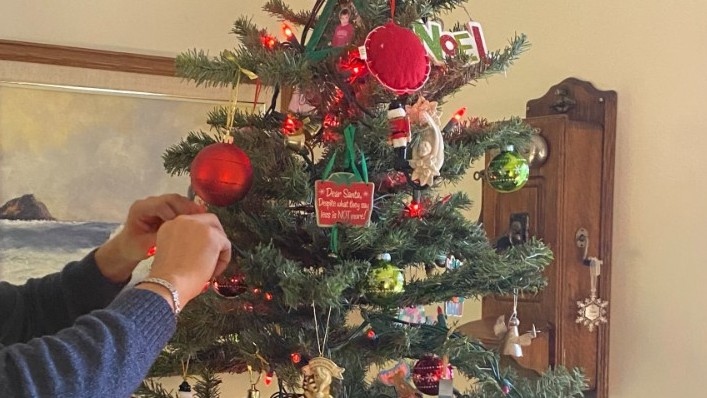
A former Afghan interpreter fixes holiday decorations on a Christmas tree in his new home of Canada after spending years in Indonesia trying to seek asylum. (Supplied by Wendy Long)

With a smile on his face and a red Santa Claus hat atop of his head, a former Afghan interpreter fixes holiday decorations on the branches of a familiar sight this time of the year — a classic Christmas tree.

The Afghan refugee, who spent years in Indonesia trying to seek asylum, arrived in his new home of Canada earlier this month.

While not among the many interpreters, and their families, who have fled Afghanistan this year following the withdrawal of U.S. and NATO troops, and the subsequent takeover by the Taliban, his story is one that will be familiar to many.

"After eight years, finally, you will go and live as a human being," the former interpreter said during a Zoom call. CTVNews.ca is not naming him due to the current dangers in Afghanistan where his family still lives.

"That you can be free, you have the right of education, you have the right of work, you have the right of to live in society as a human being, so I was overwhelmed by, like, a happy feeling."

INDONESIA

The man became an interpreter in Afghanistan back in 2012, working initially for a Canadian security company and later with U.S. forces.

He says the salary was good and he hoped it would serve as a way for him to eventually get out of Afghanistan and one day get a better education — and a better life.

In August 2014, he decided to leave the country due to the dangers there, departing first for India as a relatively safer alternative to neighbouring Pakistan. After about a couple of months, he left for Malaysia before landing in Jakarta, Indonesia, in November 2014.

Although he believed the resettlement process would be shorter, he would spend the next four years in a detention centre for asylum seekers as he waited to be recognized as a refugee — his options being either to wait to be resettled or return to Afghanistan.

He described the centre as being overcrowded, where people often came down with disease and frequently protested the conditions.

Indonesia has seen an increase in the number of asylum seekers arriving in the country over the past couple of decades. As of September 2021, more than 13,000 people were registered in Indonesia as refugees or asylum seekers, more than half of which were from Afghanistan, the United Nations High Commissioner for Refugees reports.

However, the country is not a signatory to the 1951 UN Refugee Convention or 1967 Refugee Protocol, and does not allow asylum seekers to work or have access to schools or public hospitals.

"You're not allowed to work, you're not allowed to travel freely, you're not allowed to go to certain places," the former interpreter said.

He says he shared his experiences on social media, which is how he got the attention of the group of five people who would later support his private sponsorship to Canada.

GROUP OF FIVE


Wendy Long, the founder of the organization Afghan-Canadian Interpreters who helped with the man’s resettlement, says it struck her as "un-Canadian" that people were left behind.

While not in the military herself, Long founded Afghan-Canadian Interpreters in 2017, with the aim of advocating for those who helped Canadian Armed Forces during the war in Afghanistan. She, along with her husband, Doug, and son, Devon, were all part of the former interpreter’s sponsorship group.

"We had tried to go over there to help them and give them a better life, and it really did not work out," said Long, who joined the former interpreter during his Zoom interview with CTVNews.ca.

She says it was in November 2018 that an individual in Canada brought the former interpreter’s situation in Indonesia to her attention, and she believed he could be privately sponsored to come to Canada under what is referred to as a group of five, where five or more Canadian citizens or permanent residents collectively arrange to sponsor a refugee.

By around August and September 2019, she says a group was committed, with the application sent in February 2020, just before the World Health Organization declared COVID-19 a pandemic that March.

The pandemic greatly impacted all private sponsorships, as well as immigrations, Long says, delaying a process that would have otherwise taken about a year by another six to eight months.

Following his time in the detention centre, the former interpreter says he was placed in accommodations through the International Organization for Migration, living in a room with other refugees. Throughout much of that time, he says he volunteered with the UNHCR as an interpreter.

As he waited for his application to go through, he says he tried his best to stay healthy and motivated, and ultimately not lose hope.

"You basically just sit there and you wait," Long said. "The only advantage of being in Indonesia is that technically the Taliban will not come and kill you."

But years of sitting and doing nothing, she said, "is not a way to live, and many lives are just sitting there being wasted."

Then, this past November, the man received confirmation that his application to come to Canada had been approved.

After a two-day journey that saw him transit through Istanbul, Turkey, without a shower or bed to sleep on, he finally arrived at Toronto Pearson International Airport earlier this month.

Although his welcoming committee wasn't as large as those seen during pre-COVID-19 times, Long said she was able to be among the few people who happily greeted him at the airport.

His journey had finally come full circle.

'PEOPLE DO NOT HAVE TWO YEARS IN AFGHANISTAN'


Although the federal government has promised to bring 40,000 Afghan refugees to Canada, Immigration Minister Sean Fraser has said the process could take up to two years — something Long said should have been done a long time ago.

"People do not have two years in Afghanistan," she said. "The humanitarian crisis is growing day by day. Food, employment, people don't have money for anything and it's not viable for them to be told, 'You need to go and get a passport from the Taliban and give them all of your information so that they can come and knock on your door.' Especially for many of these people, we're bringing them out of Afghanistan because they're at risk."

She said even though the U.S. withdrawal was known back to when Donald Trump was president, Canada still didn't have a process in place and, instead, entered into a federal election.

Long said there are millions of refugees who are ready to be resettled and just need someone to sponsor them, pointing to organizations such as Northern Lights Canada that are helping to resettle refugees from around the world.

In the meantime, she said she is working on helping three more Afghan refugees in Jakarta come to Canada, also through private sponsorship, within the next few months.

"So I'm hoping that coming into the new year, further efforts diplomatically will be underway to effectively get people that are within Afghanistan out and bring them to safety for further processing, and then onward travel to Canada, but we will see," Long said.

'I'M READY TO JUMP ON'


The situation in Afghanistan had a profound impact on the former interpreter.

His family, who he has not seen for about eight years, has been able to live in relative safety, but he still worries about the Taliban's hold over the country.

He recently spoke to his mother, who thought he was still in Indonesia and was overjoyed to hear he had made it to Canada safely.

He currently lives in the Niagara region and, the day after he landed, got a social insurance number.

He says his "humble" request is for Canadians to come together to help more refugees, many of whom are skilled, educated and just need their group of five.

As the eldest sibling in his family, he also says he feels a responsibility to take care of them. His hope is to get an education, find work and acquire a home, so he may one day have a place for his family to stay if he can find a way to bring them over.

"Any kind of job available, I'm ready to jump on."

With files from The Associated Press

Tom Thomson art exhibition shines spotlight on issues of authenticity


DECEMBER 25, 2021

‘Tom Thomson? The ‘Art of Authentication’, which opens in September, is organized around five elements of certification: signature, style, content, content and origin.


There are about 40 works hanging right now in the Tom Thomson exhibition at Hamilton’s Art Gallery. Two in particular are the stars of the show, or at least its raj d’etre. These two works may or may not be painted by Mr. Thomson.


“Tom Thomson? The Art of Authentication,” which travels to Kingston in February, is a thoughtful show that doesn’t offer a conclusive yes or no. The exhibition came together as the result of coincidence, collaboration and creativity. And it is much more than Mr. Thomson himself.

“We’re really just using that,” says Toby Bruce, director, exhibitions and collections and senior curator at AGH. “The lovely byproduct is that you also get to see this amazing collection from Thomson.”

In his brief career as a painter before his mysterious death in 1917, Mr. Thomson produced hundreds of oil sketches. And, as the show’s catalog notes, he’s one of the most faked Canadian artists.

People working in historical Canadian art get a lot of inquiries that go something like this: I bought this painting at a flea market and I have reason to believe it’s Tom Thomson. can you see?

Tom Thomson’s Ragged Lake, 1915 Oil on Wood 21.2. × 26.2 cm Art Gallery of Hamilton Gift of Mrs. GY Douglas, 1963Hamilton’s Art Gallery

But when Ms. Bruce received this particular inquiry from a Mississauga man in 2014, it came with some support from June Brammel, a prominent art restorer who worked for AGH. A “TT” signature was revealed by Ms. Brammel when she cleaned the piece.

The man bought the work—at the Freelton Antique Mall north of Hamilton—for about $100 because it caught his eye. There was some suggestion that it might be Thomson, but that was not enough for him to take it seriously. It was so dirty that he sat in a drawer in the guest bedroom of his tiny house for almost two years before he pulled it up and brought it to a friend, Ms. Brammel. He says that after working On top of that for a few months, Ms. Bramall told him she thought the piece was accurate – the terminology used in the certification. (Not identifying the person, who is concerned about being named because of the painting’s potential value.)

Ms. Brammel, who died in 2018, helped get her in touch with Ms. Bruce.

“We do not certify as institutional curators,” says Ms. Bruce. But she was curious. He mentioned it soon after, while working on a project with Alicia Boutillier, chief curator/curator of Canadian historical art at the Agnes Etherington Art Center at Queen’s University in Kingston.

“And I said it’s very strange, you know, just six months ago, I had a similar situation,” says Ms. Bautillier. The painting that was brought to him was found in an antiques shop in southwestern Ontario, circa 1985. (The owner of that painting declined to speak with The Granthshala.)


Tom Thomson First Snow, 1916 Oil on composite wood-pulp board 21.5 × 26.7 cm Agnes Etherington Art Centre, Queen’s University, Kingston Gift of the Queen’s University Art Foundation, 1941Agnes Etherington Arts Center

Around the same time, a news story caught his attention: the Vancouver Art Gallery had acquired 10 works, said to be by a group of seven member JEH MacDonald, who had been buried for more than 40 years at his former property north of Toronto. Was. But questions were raised about the work, as reported.

In response, Montreal-based gallerist and Canadian historical art expert Alan Klinkhoff proposed inviting a panel of experts to establish and assess one or more sketches with known McDonald’s sketches.

The light bulb went off: Ms. Bruce and Ms. Bautillier conceived an exhibition about certification, with the two sketches under consideration as nuclei.

The Hamilton sketch depicts a dock with a boathouse and a canoe floating on the lake. The Kingston sketch depicts trees in the snow, focusing on the trunks.

The exhibition, which opens in September, is organized around five elements of certification: signature, style, subject matter, content and origin.


Tom Thomson The Birch Grove, Autumn, 1915-16 oil on canvas 101.6 × 116.8 cm Art Gallery of Hamilton Gift of Roy G. Cole, in memory of his parents, Matthew and Annie Bell Gilmore Cole, 1967Hamilton’s Art Gallery

The show begins with a gallery of six works that hang on the wall, without labels. There is a known fake. The audience is invited to determine which one it may be. This is the section that deals with signatures – one of the first things to be checked by experts in an authentication attempt. But Mr. Thomson rarely signed off on his work. Even when he did, the signings changed over the course of his career; His initial signature was larger, cursive and “far more declarative”, the catalog notes.

In the Materials section, the important role of scientific analysis is examined: techniques that allow experts to examine the paint that the artist used, or for materials that were not available to the artist.

In style, one of the works in question hangs with a known Thomson; The wall labels are placed away so that the audience can re-evaluate. They are invited to consider things like brush strokes and color.

While departure from an artist’s known work can be a red flag, there are always inconsistencies. “As Alicia says, you always have to be open to the fact that artists are not always going to work in a box,” says Ms. Bruce. “It could have been something they were trying.”

The show also considers what is really in the picture. Is this the place the artist is known for? Does it correspond to known functions? But just because Mr. Thomson didn’t paint buildings often doesn’t mean he never did. “The subject matter can be a slippery exercise,” says Ms. Bautillier during a virtual tour of the exhibition.
Tom Thomson, Burn Country c. 1915 Oil on composite wood-pulp board 21.4 × 26.5 cm Tom Thomson Art Gallery, Owen Sound Gift of The Lyceum Club and Women’s Art Association of Owen Sound, 1967Tom Thomson Art Gallery

Finally, the show looks at the origins, the ownership history of the painting. Here, detective work often focuses on what is written or stamped on the back of the work, and supporting documents.

The show ends with two known fakes who were part of a high-profile court case in the 1960s.

By the end, the audience often has an opinion. “People are very divided,” says Ms. Bruce. Some would say that there is no way or that both paintings are not Thomson’s; Others are sure they are not perfect. Visitors love the opportunity to exercise, be the judge, even without the satisfaction of a certain answer.

Co-curators won’t say what they think. “My own sober opinion changes,” says Ms. Bautillier.

“We are not Thomson experts,” adds Ms. Bruce. “The real purpose of that for us, and I think where the project has really been a success, is it’s all the behind the scenes work that the curators, historians, dealers, patrons do when they try and proofread something And the public is very fascinated by that.”

Thomson’s official certification is extremely difficult; There are few experts who are willing to do so at this time. Basically, the only opportunity to certify a work is to sell it at auction, as auction houses may still be willing to do the work and take responsibility for it

.
Tom Thomson Woods in Winter, c. 1917 oil on wood 14.5 × 20 cm Tom Thomson Art Gallery, Owen Sound Gift of Lewis (Thomson) Henry, sister of Tom Thomson, 1967Tom Thomson Art Gallery

Joan Murray, the Thomson specialist who wrote her Catalog Risen (which lists every known authentic work of a particular artist), retired from the privately conducted Thomson’s active investigation in 2016 and will not be included in the catalogue.

It is proposed to open a kind of appendix with a non-certification register of works and supporting research material. Acceptance would not imply certification, but it would be a way to track potential Thomson and supporting research material in a central registry.

“In the next hundred years, more works by Tom Thomson will emerge, as predicted by Joan Murray himself,” reads a draft proposal for the registry prepared by Angie Littlefield, an expert whose books include Tom Thomson’s Fine Kettle of Friends: Biography, History, Art and Food, “The art historical and research communities need to be on the ground floor of collecting the valuable materials that can arise from discoveries like these.”

The two works that form the nucleus of this exhibition are candidates.

The show kicks off in Hamilton on January 2 and is scheduled to open in Agnes on February 26. After that, the pictures will be returned to their owners. The Mississauga man plans to bring his house and hang it on the wall.
Rare ‘thunder bird’ fossil gives researchers clue to demise of Australian species of megafauna


At 230kg Genyornis newtoni weighed around five or six times as much as an emu and stood about two metres tall
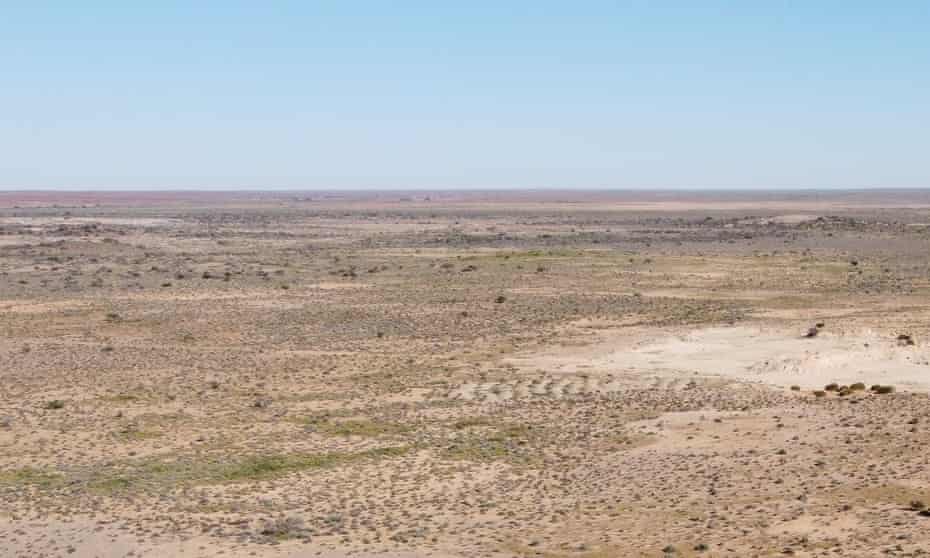
Genyornis newtoni once roamed Australia’s interior before a change in climate turned lakes and forests into flat desert. Photograph: Brook Mitchell/Getty Images


Australian Associated Press
Sun 26 Dec 2021

Flinders University researchers may have discovered what ultimately led to the extinction of the last of Australia’s massive thunder birds, Genyornis newtoni.

The clue came with the discovery of a rare fossil. The find, by researchers at Flinders University, unveiled severe bone infections in several dromornithid remains mired in the 160 sq km beds of Lake Callabonna fossil reserve, 600km northeast of Adelaide.

At 230kg Genyornis weighed around five or six times as much as an emu and stood about two metres tall, but becoming stuck in the treacherous mud of the lake wasn’t the only concern facing the giant birds.


It appears some also had a painful disease, which lead researcher Phoebe McInerney says would have hampered their mobility and foraging.

“The fossils with signs of infection are associated with the chest, legs and feet of four individuals,” the PhD candidate said. “They would have been increasingly weakened, suffering from pain, making it difficult to find water and food.

“It’s a rare thing in the fossil record to find one, let alone several, well-preserved fossils with signs of infection. We now have a much greater idea of the life challenges of these birds.”

The study found about 11% of the birds were suffering from osteomyelitis.

“We see frothy and woven bone, large abnormal growths and cavities in their fossil remains,” McInerney said.

Finding multiple individuals in the population with osteomyelitis suggests a somewhat complex situation may have caused the phenomenon.


Study co-author associate prof Lee Arnold dated the salt lake sediments in which genyornis was found, linking them with a period of severe drought beginning about 48,000 years ago.

At the time, the thunder birds and other megafauna, including ancient relatives of wombats and kangaroos, were facing major environmental challenges.

As the continent dried, large inland lakes and forests began to disappear and central Australia became flat desert.


With conditions worsening, associate prof Trevor Worthy believes food resources would have been reduced, placing considerable stress on the animals.

“From studies on living birds, we know that challenging environmental conditions can have negative physiological effects,” he said. “So we infer that the Lake Callabonna population of genyornis would have been struggling through such conditions.”

It now appears the effects of severe drought phases included high rates of bone infection, with weakened individuals more likely to become mired in the deep mud and die.

With no conclusive evidence to suggest Genyornis newtoni survived much past this time, it’s likely protracted drought and high disease rates contributed to its eventual extinction.

The research findings have been published in Papers in Palaeontology.

Canada’s first new nuclear reactor in decades is an American design. Will it prompt a rethink of government support?

Ontario Power Generation chose GE Hitachi Nuclear Energy to build a light water reactor at its existing Darlington nuclear power plant, a decision that could shape Canada’s nuclear industry for decades to come.
GLOBE AND MAIL
PUBLISHED 1 HOUR AGO
A visitor to the Darlington Nuclear Generating Station in Clarington, Ont., looks out onto the facility grounds during a tour in February 2016.
FRED LUM/THE GLOBE AND MAIL

Ontario Power Generation’s selection of GE Hitachi Nuclear Energy to help build a small modular reactor (SMR) at its Darlington station in Clarington, Ont., set in motion events that could shape Canada’s nuclear industry for decades to come.

OPG’s choice, announced in December, is the BWRX-300. It’s a light water reactor, the variety most popular in developed countries, and quite unlike Canada’s existing fleet of CANDU heavy water reactors. Though not exactly small – the BWRX’s 300-megawatt nameplate capacity is roughly equivalent to a large wind farm – it would produce only one-third as much electricity as traditional reactors. It would use different fuel, produce different wastes and possibly have different safety implications.

The Darlington SMR would be the first BWRX-300 ever constructed. By moving first, OPG hopes Ontario will become embedded in a global supply chain for these reactors.

“OPG ourselves, we don’t really get anything out of it – it’s a lot of work,” said Robin Manley, OPG’s vice-president of nuclear development. “Our goal is to have as many contracts signed with Canadian suppliers as we possibly can.” But that might not satisfy some critics, who’ve protested OPG’s selection of a U.S. design by GE Hitachi, which is based in North Carolina.

It does seem to confirm the end of Canada’s tradition of homegrown reactors. The BWRX-300 would be Canada’s first new reactor since Darlington Unit 4 in Ontario, completed in 1993. According to Mycle Schneider Consulting, the average age of the country’s 19 operational reactors is 38 years. Attempts to update the CANDU design proved largely fruitless; OPG and Bruce Power opted to refurbish reactors at Darlington and Bruce stations to operate another few decades, while sizing up SMRs as a possible next act.

Time is running short. This decade is widely regarded as crucial for building emissions-free generation capacity. SMRs will be late to that party even if this BWRX-300 is built on time. Delays and cost overruns, ever-present risks with any reactor, could kill its prospects.

The partnership with OPG represents a major coup for GE Hitachi, a U.S.-Japanese alliance that set up its SMR subsidiary in Canada less than a year ago. There are at least 50 SMR designs worldwide, but most exist only on paper; vendors compete vigorously to sell to experienced nuclear operators such as OPG because they represent an opportunity to build a bona fide reactor that might entice other clients. For the same reason, OPG’s decision is a blow to the losing candidates, Oakville, Ont.-based Terrestrial Energy Inc. and X-energy, an American vendor.

“There’s lots of enthusiasm among nuclear reactor designers, developers and national laboratories, and academic nuclear engineering departments” about SMRs, said Edwin Lyman, director of nuclear power safety at the Union of Concerned Scientists, who published a report on SMR reactor designs in early 2021. “There’s a lot of supply but there’s not much demand, because utilities don’t want to be guinea pigs.”

Nuclear industry executives and government officials hope the Darlington SMR will be the first of many deployed in Ontario and beyond. SaskPower is also shopping; it has collaborated with OPG since 2017, and said the BWRX-300 is among its candidates. Canada has a small population, so observers doubt the country could support supply chains for multiple reactor designs.

But OPG’s selection of an American SMR has drawn some sharp criticism. Some observers assumed Terrestrial enjoyed a home turf advantage, particularly in light of the federal government’s decision to invest $20-million toward its Integral Molten Salt Reactor (IMSR). The Society of Professional Engineers and Associates, a union representing engineers and others working on CANDU reactors, complained that “priority should have been given to Canadian design.”