Tuesday, January 04, 2022

The importance of volcanoes, on Earth and beyond


December 30, 2021

Volcanoes need a new agent. Whenever an eruption starts somewhere on Earth, we’re barraged with news of destroyed buildings, closed airspace, evacuated people and, at worst, injuries and deaths. These extreme impacts do happen during some eruptions, but as any volcanologist would remind you, volcanoes spend most of their lives not erupting. Yet these geologic wonders are still painted as villains in the media, in movies and in books. Robin George Andrews might be that agent volcanoes need to change their public persona, as his new book, “Super Volcanoes: What They Reveal About Earth and the Worlds Beyond,” tries to rehabilitate their image and set them as vital features on and off the Earth.

Even the term “super volcano” was created for the Hollywood ideal of a giant, deadly eruption. There is no technical definition of when a run-of-the-mill volcano upgrades to a super volcano; the term is used to refer to the massive, apocalyptic eruptions that many fear could happen in places like the Yellowstone Caldera in Wyoming. The sorts of eruptions that would fit into the notional definition of “super” haven’t happened for thousands of years, yet even volcanologists have conceded that the term is here to stay.

Andrews’s stated goal is to use his enthusiasm for volcanoes to reboot how we think about these fiery forges. A scientist turned science writer, Andrews realized that the world of academic research on volcanoes wasn’t why he pursued deeper volcanic knowledge while getting his PhD from the University of Otago in New Zealand. Instead, he wanted to spread the gospel of volcanism to the masses that think of them only as portents of doom. In “Super Volcanoes,” he weaves a path through some of the most important recent eruptions and discoveries.

Starting with the 2018 eruption of Kilauea in Hawaii, Andrews jumps back and forth from the past to the present to reveal the history of modern volcanology. Thomas Jaggar’s first attempts to take the temperature of lava in the early 20th century are woven into stories of the start of the 2018 lava flows that buried multiple communities on the slopes of Kilauea. The frantic response to the 2018 eruption is recounted through the eyes of U.S. Geological Survey geologists such as Christina Neal and Wendy Stovall, who put us in their boots as lava fountains are pouring molten rock onto houses and roads.

Super Volcanoes
What They Reveal about Earth and the Worlds Beyond
By Robin George Andrews
Norton.
312 pp. $27.95

Our current understanding of volcanic processes is the thread that connects the chapters. It is surprising to realize that it has been less than 100 years since we recognized the Yellowstone Caldera and its history of enormous eruptions that Andrews calls “Mephistophelian paroxysms.” Yet, even as we learn about these cataclysmic eruptions from Yellowstone that blanketed ash across territory from Montana to Louisiana, it is really the science of volcanoes that drives Andrews’s prose: “But the world won’t end. It would not even come close to bringing civilization crashing down. We know this, because this experiment has already been run.”

In the first half of the book, Andrews takes us on a whirlwind tour of volcanoes in all corners of the globe. We join the scientists who study volcanoes and volcanic processes and learn how these processes affect people and life. Andrews has a tendency to introduce us to new characters with a Dickensian rapidity that lessens the impact of all these amazing scientists, but he does show us that the world of volcanology is a broad, diverse community.

In its second half, the book dives deep into the nature of extraterrestrial volcanism. Andrews takes us to Mars, the moon, Venus and the outer planets, mostly on a hunt for how volcanoes are linked to the potential for life on other worlds. At times you do feel like you’ve wandered into a different book. But no matter — Andrews creates a sense of wonder in the reader over the detection in September 2020 of a gas most people have never heard of, phosphine, a chemical compound that’s one part phosphorus and three parts hydrogen. “And the world went bananas,” Andrews writes of that observation, because phosphine has been suggested to be a chemical sign of life. In this case, it would be life in the clouds of our sister planet Venus.

Andrews is gifted in describing volcanic processes in ways that most people can comprehend. When discussing the extremely unusual carbon-rich lavas from Oldoinyo Lengai in Tanzania, he notes that nearby “there is a big chunk of mangled up continental rocks, a 3-billion-year-old or older lump named the Tanzanian craton. Over its lengthy history, mantle plumes have risen . . . tickling the underbelly of the craton and supplying it with plenty of carbon.”

Andrews provides illuminating analogies that capture the uncertainty and unknowns of volcanology. In describing how we don’t know the relationship between big asteroid impacts on the moon and the massive lava flow fields that mark the dark areas on its near side, he writes, “It’s a bit like coming home to find your dog destroyed the pillows on the couch, the toilet paper, the television remote and a few books: you don’t really know which of these fundamental acts of destruction happened first, or last.”

Andrews admits that what he really wants to be is a time traveler. This is clear from “Super Volcanoes.” The book excels when he drops us into a foreign location or time, like a devastating eruption of Yellowstone or in the atmosphere of Venus, and paints us a picture of actually being there. Yet, as we all know, we’re not time travelers. Volcanoes can help record times past, and Andrews reminds us that there is a reason we’ve been writing about them since the time of Pliny: “Time moves on. But volcanoes and eruptions have a timeless effect on our minds, whether we are watching their embers on land, underwater, or in space.”


By Erik Klemetti is an associate professor of earth and environmental sciences and journalism at Denison University. He writes “Rocky Planet,” a column for Discover, and covers volcanic eruptions around the world on Twitter.


Logging in watersheds among stressors for declining Pacific salmon, experts say

Logging stress on salmon

The compounding effects of climate change and logging are contributing tothe degradation of Pacific salmon habitat, experts say, adding a reassessment of watershed logging and restoration practices will be key to helping struggling fish populations.

Younes Alila, a professor in the department of forest resources management at the University of British Columbia,said decades of clear-cut logging across B.C. have disrupted the landscape's natural mechanisms for mitigating floods and landslides.

Such events along with heatwaves, wildfires, drought and so-called atmospheric rivers of heavy rain are becoming more frequent and severe, which could have significant consequencesfor freshwater salmon habitat, Alila said in an interview.

Before logging, the forest canopy helps to collect rainfall and shade snowpack, slowing down the springtime melt, Alila said. The trees also pump moisture out of the ground, increasing the soil's capacity to absorb runoff, he said.

Clearcutting or logging everything in a given cutblock dominated the province's forest industry in the latter half of the 20th century and it's commonly practised in combination with different approaches that leave more trees standing.

Alila said his research over the last 15 years has consistently shown that clear-cut logging increases the size and frequency of floods of all return periods, referring to the estimated years between floods of a similar size or intensity. What would have been 10, 20, 50 or 100-year floods are all recurring more often after logging, he said.

"That's a huge increase in the flood risk on downstream communities," Alila said.

It's also a risk to salmon, which need certain conditions to spawn including gravel to provide protection for delicate eggs and fry.Surging waters can wash the gravel away, scour eggs from the riverbed or suffocate them with sediment, he said.

With some B.C. salmon populations declining to historic lows, the provincial and federal governments have allocated hundreds of millions of dollars for recovery efforts in recent years, including grant programs aimed at habitat restoration.

Similar to floods,clear-cut logging and forest service roads also increase the severity and frequency of landslides, Alila said. Slides carry debris and sediment that can in turn render habitat unsuitable for spawning and the rearing of juvenile fish.

Slopes become unstable without tree roots as anchors, he said, while the logging roads alone add to the risk as ditches and culverts divert underground runoff to the surface, pushing more water, sediment and debris downstream at a faster pace.

Alila said he's conducting research in one watershed in B.C.'s Interior that's 8,000 square kilometres in size with more than 18,000 kilometres of forest service roads.

"That density of road network is all over B.C. This watershed is no exception," he said.

It takes decades for forests to recover their full hydrological functionality after being logged and replanted, Alila added.

The effects of logging are compounded by climate change, which is stoking increasingly intense wildfires that leave behind "hydrophobic" or water repellent soil, he said. The charred soil gradually recovers its ability to absorb moisture, but the years after a severe wildfire are especially risky for flooding and landslides, he said.

At the same time, Alila said climate change will bring more frequent and severe atmospheric rivers that will push heavy rain further into B.C.'s wildfire-worn Interior.

Forests also provide shade and kelp keep streams cool, while logging in riparian areas can push water temperatures above the 18 to 20 C that salmon can typically withstand, especially when combined with the effects of climate change, said Jonathan Moore, a professor of biological sciences at Simon Fraser University.

"The more logging that happens, the less climate change it can withstand," said Moore, whose work focuses on aquatic ecosystems. "Reciprocally, the more watersheds are protected, the more climate change resilient they are."

Moore points to a 2017 study published in the Journal of Environmental Management that examined how stream temperatures in two river basins in Oregon might respond to the restoration of vegetation and "channel morphology," or the interplay between the force of water and the stability of a river's bed and bank.

The researchers found that a combination of channel narrowing and restoring riparian areas could reduce peak summer water temperatures by 1.8 and 3.5 C in the neighbouring river basins, offsetting the projected impacts of climate change.

Their modelling predicted that cooler temperatures as a result of basin-wide restoration would lead to increases in the abundance of juvenile chinook salmon, even when climate change projections for the 2080s were taken into account.

Trees, branches and woody debris that naturally fall into streams also provide nutrients and shelter for migrating and juvenile salmon, Moore noted.

A recent study by Moore and his colleagues found that a combination of changes in ocean and freshwater habitats had driven steep declines in five salmonid populations over 40 years in a river on the northeastern tip of Vancouver Island.

In fresh water habitat, "the strongest signal by far was forestry," he said.

Alila said he hopes the government will recognize that forestry practices need to change significantly, and not just through "tinkering" with existing legislation, in order to protect both salmon habitat and communities from floods and slides.

"If the government doesn't do it voluntarily, they're going to be forced to when we experience ... more of the same flooding that we experienced this fall," he said.

A series of atmospheric rivers brought record-setting rainfall to southwestern B.C. in November, causing destructive landslides and flooding that severed key transportation routes and inundated a prime agricultural area east of Vancouver.

The B.C. government introduced amendments to existing forestry legislation earlier this fall, promising to reshape forest management with a focus on sustainability.

With the proposed changes, a new system of 10-year forest landscape plans developed with First Nations, local communities and other stakeholders would prioritize forest health, replacing the stewardship plans developed largely by industry, Forests Minister Katrine Conroy told a news conference at the time.

Past policies "left too much control of the forest operations in the hands of the private sector" and limited the province's ability to fight climate change, protect old-growth forests and share benefits with local and Indigenous communities, she said.

The B.C. Council of Forest Industries supports "modernizing and further strengthening forest policy to ensure we have a strong, sustainable, and competitive forest sector,'' president Susan Yurkovich said in a statement when the amendments were announced.

John Betts, the executive director of the Western Forestry Contractor's Association, said in a statement provided by the province at the time the announcement was made that the changes would allow the government to better manage forest resources for both climate change and the cumulative effects of resource development.

"For our reforestation sector, it means we will be managing stands and implementing forest practices more sensitive to the complexities and dynamics of how our forest and range ecosystems connect over the landscape and time."


Kerstin Perez is searching the cosmos for signs of dark matter

“There need to be more building blocks than the ones we know about,” says the particle physicist.


Jennifer Chu | MIT News Office
Publication Date: January 2, 2022
PRESS INQUIRIES

“We measure so much about the universe, but we also know we’re completely missing huge chunks of what the universe is made of,” Kerstin Perez says.
Credits:Photo: Adam Glanzman


Kerstin Perez is searching for imprints of dark matter. The invisible substance embodies 84 percent of the matter in the universe and is thought to be a powerful cosmic glue, keeping whole galaxies from spinning apart. And yet, the particles themselves leave barely a trace on ordinary matter, thwarting all efforts at detection thus far.

Perez, a particle physicist at MIT, is hoping that a high-altitude balloon experiment, to be launched into the Antarctic stratosphere in late 2022, will catch indirect signs of dark matter, in the particles that it leaves behind. Such a find would significantly illuminate dark matter’s elusive nature.

The experiment, which Perez co-leads, is the General AntiParticle Spectrometer, or GAPS, a NASA-funded mission that aims to detect products of dark matter annihilation. When two dark matter particles collide, it’s thought that the energy of this interaction can be converted into other particles, including antideuterons — particles that then ride through the galaxy as cosmic rays which can penetrate Earth’s stratosphere. If antideuterons exist, they should come from all parts of the sky, and Perez and her colleagues are hoping GAPS will be at just the right altitude and sensitivity to detect them.

“If we can convince ourselves that’s really what we’re seeing, that could help point us in the direction of what dark matter is,” says Perez, who was awarded tenure this year in MIT’s Department of Physics.

In addition to GAPS, Perez’ work centers on developing methods to look for dark matter and other exotic particles in supernova and other astrophysical phenomena captured by ground and space telescopes.

“We measure so much about the universe, but we also know we’re completely missing huge chunks of what the universe is made of,” she says. “There need to be more building blocks than the ones we know about. And I’ve chosen different experimental methods to go after them.”

Building up


Born and raised in West Philadelphia, Perez was a self-described “indoor kid,” mostly into arts and crafts, drawing and design, and building.

“I had two glue guns, and I remember I got into building dollhouses, not because I cared about dolls so much, but because it was a thing you could buy and build,” she recalls.

Her plans to pursue fine arts took a turn in her junior year, when she sat in on her first physics class. Material that was challenging for her classmates came more naturally to Perez, and she signed up the next year for both physics and calculus, taught by the same teacher with infectious wonder.

“One day he did a derivation that took up two-thirds of the board, and he stood back and said, ‘Isn’t that so beautiful? I can’t erase it.’ And he drew a frame around it and worked for the rest of the class in that tiny third of the board,” Perez recalls. “It was that kind of enthusiasm that came across to me.”

So buoyed, she set off after high school for Columbia University, where she pursued a major in physics. Wanting experience in research, she volunteered in a nanotechnology lab, imaging carbon nanotubes.

“That was my turning point,” Perez recalls. “All my background in building, creating, and wanting to design things came together in this physics context. From then on, I was sold on experimental physics research.”

She also happened to take a modern physics course taught by MIT’s Janet Conrad, who was then a professor at Columbia. The class introduced students to particle physics and the experiments underway to detect dark matter and other exotic particles. The detector generating the most buzz was CERN’s Large Hadron Collider in Geneva. The LHC was to be the largest particle accelerator in the world, and was expected imminently to come online.

After graduating from Columbia, Perez flew west to Caltech, where she had the opportunity to go to CERN as part of her graduate work. That experience was invaluable, as she helped to calibrate one of the LHC’s pixel detectors, which is designed to measure ordinary, well-known particles.

“That experience taught me, when you first turn on your instrument, you have to make sure you can measure the things you know are there, really well, before you can claim you’re looking at anything new,” Perez says.

Front of the class


After finishing up her work at CERN, she began to turn over a new idea. While the LHC was designed to artificially smash particles together to look for dark matter, smaller projects were going after the same particles in space, their natural environment.

“All the evidence we have of dark matter comes from astrophysical observations, so it makes sense to look out there for clues,” Perez says. “I wanted the opportunity to, from scratch, fundamentally design and build an experiment that could tell us something about dark matter.”

With this idea, she returned to Columbia, where she joined the core team that was working to get the balloon experiment GAPS off the ground. As a postdoc, she developed a cost-effective method to fabricate the experiment’s more than 1,000 silicon detectors, and has since continued to lead the experiment’s silicon detector program. Then in 2015, she accepted a faculty position at Haverford College, close to her hometown.

“I was there for one-and-a-half years, and absolutely loved it,” Perez says.

While at Haverford, she dove into not only her physics research, but also teaching. The college offered a program for faculty to help improve their lectures, with each professor meeting weekly with an undergraduate who was trained to observe and give feedback on their teaching style. Perez was paired with a female student of color, who one day shared with her a less than welcoming experience she had experienced in an introductory course, that ultimately discouraged her from declaring a computer science major.

Listening to the student, Perez, who has often been the only woman of color in advanced physics classes, labs, experimental teams, and faculty rosters, recognized a kinship, and a calling. From that point on, in addition to her physics work, she began to explore a new direction of research: belonging.


She reached out to social psychologists to understand issues of diversity and inclusion, and the systemic factors contributing to underrepresentation in physics, computer science, and other STEM disciplines. She also collaborated with educational researchers to develop classroom practices to encourage belonging among students, with the motivation of retaining underrepresented students.

In 2016, she accepted an offer to join the MIT physics faculty, and brought with her the work on inclusive teaching that she began at Haverford. At MIT, she has balanced her research in particle physics with teaching and with building a more inclusive classroom.

“It’s easy for instructors to think, ‘I have to completely revamp my syllabus and flip my classroom, but I have so much research, and teaching is a small part of my job that frankly is not rewarded a lot of the time,’” Perez says. “But if you look at the research, it doesn’t take a lot. It’s the small things we do, as teachers who are at the front of the classroom, that have a big impact.”

End of bonus likely caused spike in

retirements at City of Calgary in 2021

Council voted to scrap long-running retirement allowance

for city employees, effective last week

The benefit dated back to the 1960s and wasn't part of any collective agreements. (David Bell/CBC)

Officials believe the end of the City of Calgary's retirement allowance for its employees sparked an increase in retirements last year.

In 2019, city council voted to do away with the long running retirement bonus for its employees.

As a retention incentive, the city offered a retirement payment to employees with more than 25 years of service that was equivalent to the cost of their annual vacation entitlement.

So if long time employees earned six weeks of vacation time annually, the city would pay them six weeks of salary to take with them when they retired.

The benefit dated back to the 1960s and wasn't part of any collective agreements.

Council viewed it as an anachronism, and that doing away with it could save about $4.3 million a year.

In voting to scrap the allowance, council was advised by the city solicitor to give adequate notice to employees, so it fixed Dec. 31, 2021 as the date it would be abolished.

Data from the city shows that approximately 600 employees retired in 2021, up from the normal average of about 350 annual retirements in recent years.

The city's manager of talent management, Bill Oakes, said it's thought that the end of the retirement allowance played a hand in that increase.

"We don't ask employees for the reasons for their retirement," said Oakes.

"However, we suspect that for those employees that were eligible to retire — being that they were 55 or older — and if they were planning on retiring [in 2021] or in the near future, that this would be enough of an incentive, I guess, for them to want to take advantage of having this opportunity available to them."

Retirees believed to set record in 2021

Oakes said it's believed 600 retirements in a single year would set an all-time record for the city.

With more than 14,000 employees, he said the increase in departures isn't expected to pose any serious problems for the city or its many services.

"We have things like succession plans in place and work on developing our employees," said Oakes.

"We are fortunate enough to have pretty good bench strength there for people to be able to move into roles and good ability to recruit within the market that we have here in Calgary."

Oakes said Dec. 31 marked a hard stop for the allowance for its management staff. But the allowance will actually continue for a time for its unionized employees, as the withdrawal of the bonus may be a factor in the collective bargaining process with civic unions.

CPS also impacted

The end of the allowance also caused a spike in retirements at the Calgary Police Service.

Up to the end of November, 76 retirements had occurred in 2021. That was up from the 39 departures that happened in 2020.

Data from CPS shows its 2021 retirements included 30 civilian staff and 46 officers.

Deputy police chief Raj Gill said the number of officers departing will pose a bit of a challenge.

Retirements at the City of Calgary, including police, are way up, in part, due to the elimination of retirement allowances. (Calgary police)

He said there have been some limitations on the size of each recruit class during the pandemic. It's anticipated it may take up to a year to fill the newly vacated positions, in addition to the annual recruitment that takes place.

That will place more pressure on front line officers, so Gill said steps are being taken internally to ensure the number of officers on the street is maintained.

"We are looking at redeploying certain other resources, and also how we can adjust some of our normal business to make sure that we provide the front line members with the support and the resources that they need," said Gill.

"So, there are impacts to the organization until we are able to fill the vacancies and address the attrition that we've experienced."

Could take a year to hire replacements

In a normal year, Gill said there are generally more retirements in the first half of the year. But in 2021, more retirements came in the last half of the year and it's believed that the end of the retirement allowance was behind that.

He estimates it could take up to a year to fill all of the retirements with new recruits.

Gill said 112 officers were hired in 2021, which was short of the goal that CPS had set for the year.

However, he said it is finding outstanding applicants who want to join CPS, and their hiring target for 2022 is to train 135 new recruits.

"We have fantastic people who continue to want to be members of the Calgary Police Service," Gill said.

"So it is something that we're very proud of in terms of our recruiting standard and the type of people that we're hiring, and we continue to hire high quality people."


Op-Ed: Is Economic Growth Compatible With Decarbonization?

New research says that the answer is "yes"

pixabay
Pixabay file image

PUBLISHED JAN 2, 2022 4:43 PM BY GEMINI NEWS


[By Edgar Hertwich]

Economic growth is the aim of many policies. Still, economic growth is also the ultimate cause of pollution and climate change. A growing consensus of activists and scientists calls for ending economic growth and even “de-growth” in rich countries – pointing to the urgent need to protect nature and preserve resources for future generations.

All economic activity requires energy, and in our modern world, most of the power comes from fossil fuels which cause carbon emissions.

Think tanks and industry associations suggest that we need to pursue “green growth.” Yet what is the empirical evidence for the emissions-increasing effect of economic growth? Is it possible to have green growth, meaning economic growth that does not increase but reduces greenhouse gas emissions?

Many studies have looked at the historical data for carbon emissions and economic activity, as measured by the gross domestic product (GDP). Researchers have identified a wide range of relationships, looking at various sets of countries and periods. While some research suggests that economic growth leads to rapid increases in carbon emissions, other studies have found a modest increase or even a decrease.

Economic growth increases carbon emissions

We have assembled and analyzed the largest dataset of countries’ carbon emissions and underlying energy and economic variables. Our statistical analysis ascertained that economic growth increases carbon emissions.

Every percent growth raises emissions by a percent. We could gain this insight only by identifying other factors that also affect the rise in emissions. These factors provide us with the levers we need to halt global warming.

All economic activity requires energy, and in our modern world, most of the power comes from fossil fuels which cause carbon emissions. Hence, it is not surprising that more economic activity leads to higher carbon emissions. Not all economic activity is equally energy-gorging, however, and not all energy sources contribute the same amount of carbon emissions.

How can previous research offer such a divergence of findings regarding the same underlying relationship? Most studies looked at subsets of the data we used. They treated economic growth as the only factor determining carbon emissions. In our study, we identified several factors which have independently influenced countries’ carbon emissions. The most important of these are economic productivity, the mix of energy sources, industry’s share of the GDP, and electricity.

Some countries shifted to renewable energy

We found that during periods of economic growth, some countries increased their share of coal in the energy mix and thus increased their carbon emissions even faster. Other countries, meanwhile, shifted away from coal to gas or away from fossil fuels to renewable energy sources and therefore decreased their carbon emissions.

Some countries turned to electricity and reduced their emissions. In contrast, others continued to use fossil fuels, and their emissions remained high.

Scientists have long debated whether carbon emissions reductions and economic growth can co-exist. The developments of the last decade show impressively that the answer is: Yes.

New Zealand, Sweden, and the United Kingdom have achieved this feat, amongst others. It requires, however, that the driving factors contributing to reduced carbon emissions rise fast enough to offset the upward pressure caused by economic growth.

Services instead of industrial production

New renewable energy sources need to compensate for the increase in the energy demand because of higher economic growth and replace some coal or gas fueling the economic activity. Or new and more profitable economic activity replaces previous, more polluting one, such as business services in the UK replaced industrial production.

The faster a country grows, the more difficult it is to achieve this balance. This reality is one reason why no emerging economy has achieved emissions reductions while continuing its pace of economic growth. Green growth is possible but requires strong climate policies. De-growth will reduce emissions but may rob us of the means to invest in decarbonization.

It is essential to change the economic structure of development activity towards a service economy and shift the energy supply toward renewable sources and nuclear power. Doing so can reduce the harmfulness of economic development.

Basing development on coal and oil and changing industrial structure afterward is harmful to the environment and economically wasteful and politically challenging. It is wiser to change the sequence: Clean up first, and then invest in development.

Prof. Edgar Hertwich is International Chair of NTNU's Industrial Ecology Programme.

A version of this opinion piece was previously published in Norwegian, in Dagens Næringlsiv. It appears here courtesy of NTNU / SINTEF and may be found in its original form here.

The Waste Age

Recognising that waste is central, not peripheral, to everything we design, make and do is key to transforming the future


Moving scrap, including computers keyboards and other e-waste, at the former Agbogbloshie dump in Ghana in March 2009. Photo by Andrew McConnell/Panos

Justin McGuirk is the chief curator at the Design Museum in London. His writing has appeared in The New Yorker, The Guardian and e-flux, among many others. He is the author of Radical Cities: Across Latin America in Search of a New Architecture (2014).

Edited by Sally Davies
3,200 words


The opposition between ‘nature’ and ‘culture’ is problematic for many reasons, but there’s one that we rarely discuss. The ‘nature vs culture’ dualism leaves out an entire domain that properly belongs to neither: the world of waste. The mountains of waste that we produce every year, the torrents of polluting effluent, the billions of tonnes of greenhouse gases, the new cosmos of microplastics expanding through our oceans – none of this has ever been entered into the ledger under ‘culture’. Of all the products of human hands, it’s the oeuvre that no one wants to own, discuss or preferably even see. Yet it can’t be assimilated into ‘nature’ either, at least not in the way that pre-industrial waste has been for millennia. This new, ‘improved’ waste is incompatible with Earth – too chemical, too durable, too noxious and, ultimately, too voluminous.

Waste is precisely what dissolves the distinction between nature and culture. Today, when the very weather is warped by the climate crisis, and plankton thousands of metres deep have intestinal tracts full of microplastics, the idea of a nature that is pristine or untouched is delusional. Nature and waste have fused at both planetary and microbiological scales. Similarly, waste is not merely a byproduct of culture: it is culture. We have produced a culture of waste. To focus our gaze on waste is not an act of morbid negativity; it is an act of cultural realism. If waste is the mesh that entangles nature and culture, it’s necessarily the defining material of our time. We live in the Waste Age.

If we look at the material ages of human history, from the Stone Age and the Bronze Age through to the Steam Age and the Information Age, we get the illusory sense that hard things are dematerialising. In fact, the opposite is true. The Steam Age launched a great explosion of material goods that has mushroomed exponentially ever since, while statistics about our current rates of waste numb the mind. What does it mean to say that, by 2050, as much as 12 billion tonnes of plastic will have accumulated in landfills or the natural environment? What does it mean to observe that more than a million plastic bags are consumed every minute globally, and that this amounts to between 500 billion and 5 trillion a year? Such numbers present a seemingly precise quantification yet one that’s utterly ungraspable. The average person just translates them into ‘a shitload’.
A plastic bag discovered at a depth of approximately 3,700 metres around the Enigma Seamount during a 2016 exploration of the Mariana Trench. Courtesy NOAA

This is where the naming of ages becomes useful. The Anthropocene, or the age of human-driven planetary change, helps to evoke the new geological layer we are forming, a new planetary crust composed of our fossil-fuel residues, bottle tops and cigarette butts. Could we imagine any more literal entanglement of nature and waste? Some prefer a more political definition, the Capitalocene, which points the finger at a specific economic system: capitalism. But to say that we live in a Waste Age is to acknowledge both its geological and economic dimensions. It is to acknowledge that culture produces not just architecture and ingenious devices, but also a million plastic bags a minute. It is to acknowledge that growth is entirely dependent on the relentless and ruthlessly efficient generation of waste.

Is this an ungenerous and pessimistic take on human activity in the 21st century? On the contrary. Invoking the Waste Age offers the opportunity for a radical shift in late-capitalist civilisation. Only by recognising the scale of the crisis can we reorient society and the economy towards less polluting modes of producing, consuming and living. The problem is that waste has always been a marginal issue, both literally and figuratively. It has been dumped in and on the peripheries, consigned to that mythical place called ‘away’. It has always been an ‘externality’, an unavoidable byproduct of necessary industrialisation. But it is now an internality – internal to every ecosystem and every digestive system from marine micro-organisms to humans. If waste truly were to be a central issue – brought into the heart of every conversation about how things are extracted, designed and disposed of – it would transform society beyond recognition. To invoke the Waste Age is to usher in the hope of a cleaner future.

Waste as a phenomenon is actually a relatively recent concept. It was only with the advent of the Industrial Revolution, and its massive stimulation of production, that the material byproducts of extraction and manufacturing began to accumulate in mountainous heaps. The modern idea of waste, then, is only 250 years old.

Contrary to what we might assume, wastefulness is not a natural human instinct – we had to be taught how to do it. Disposability was one of the great social innovations of post-war society in the United States. When the first disposable products became available in the 1950s, from TV-dinner meal trays to cocktail cups, consumers had to be persuaded that this magical new substance – plastic – was not too good to be thrown away. They had to be instructed in the advantages of the throwaway society. Corporations – in particular, the petrochemicals industry – spent many years and millions of dollars lobbying for the replacement of paper grocery bags with plastic ones. With the advent of supermarkets, and a help-yourself service culture, every product now had to be individually packaged to survive on the shelves. And with the full bloom of convenience culture and take-away everything, disposability reached its apogee.

Some observers were quick to disapprove. Vance Packard’s book The Waste Makers (1960) offered a searing critique of the midcentury US at the height of its consumerist pomp. He details at length the different forms of planned obsolescence, from products engineered to fail to those that are simply meant to be more desirable than last year’s model. And, at almost every level of society, it is understood that such obsolescence is a necessary feature of a healthy economy – from politicians to cynical businessmen, to disillusioned (but compliant) designers, to consumers who think it is their patriotic duty to shop and support the economy. The very idea of the ‘lifetime guarantee’ conjured up the spectre of unemployment and shuttered factories. The Waste Makers is an X-ray of the American way of life – a society that replaced scarcity with overabundance, force-fed on easy credit and urban sprawl. Packard sees the problem as largely ethical – his concern is moral decay and the ‘sell, sell, sell’ commercialisation of everyday life. Yet at no point does he envision an ecological catastrophe. Soon after, Rachel Carson’s Silent Spring (1962), about the devastating effects of agricultural pesticides, would start to alert people to this problem.

Waste is deliberately generated as the very metabolism behind economic growth

By 1950, the world was producing about 2 million tonnes of plastic each year. In 2019, it was 368 million tonnes, with more plastic produced in the past decade than ever before. Nearly half of all plastic waste (47 per cent) comes from packaging, while 13 per cent comes from textiles. As David Farrier writes in his book Footprints: In Search of Future Fossils (2020): ‘it is likely that every single piece of plastic ever produced and not incinerated still exists somewhere in some form’. It’s believed there are more than 5 trillion pieces of plastic in the world’s oceans, many in the gyre known as the Great Pacific Garbage Patch. In his novel The Peripheral (2014), William Gibson accelerates this diffuse mess into an island with its own city, a plastic landmass inhabited by transhuman ‘patchers’. It’s a darkly humorous piece of dystopian fiction, and one that grasps the fact that the plastics industry is in no mood to shrink. In fact, fossil-fuel companies, bracing themselves for a drop in petrol use, are gearing up to massively increase plastics production. And who will stop them?

To say that we live in the Waste Age is not to focus attention on an unpleasant but marginal problem; it’s to say that the production of waste is central to our way of life. Waste is deliberately generated as the very metabolism behind economic growth. And while the waste crisis and the climate crisis are not the same thing, waste is a major driver of climate change. Plastic production is the second-largest source of industrial greenhouse gases, and methane generated in landfills is another significant contributor.

But to invoke the Waste Age is also to claim that waste is one of the great material resources of our time. It acknowledges the tremendous untapped value in what we throw away. Take the tens of millions of tonnes of electronic scrap that we discard every year. Instead of recycling it, countries such as the UK have been shipping it to Ghana – where it used to amass in Agbogbloshie, a large informal settlement in the capital Accra. Although it has since been dismantled by the authorities, for years Agbogbloshie was at the heart of a complex, internationally connected local economy, where e-waste was mined for precious metals and valuable parts. The methods can be noxious – plastic wires burned to release the copper – but the principle is sound. Some estimate that by 2080 the largest metal reserves will not be underground but in circulation as existing products. About 7 per cent of the world’s gold supplies, for instance, are trapped inside electronics. Suddenly ‘above-ground mining’ starts to make sense.

You might think that I’m suggesting that recycling is the answer to this crisis. Far from it. Recycling rates are pathetically inadequate, and in many countries the system is essentially broken. The notion of recycling works to justify the production of more virgin plastics and other materials, as if it’s alright because they will be recycled, when they won’t. Recycling will play an important role in the transition to the new economy – whatever that looks like – but it’s not enough on its own.

Meanwhile, any attempts to blame consumers for the waste crisis or the failures of recycling are, at best, wide of the mark and, at worst, deeply cynical. This was illustrated when it emerged that, contrary to government claims, more than half of the plastic purportedly recycled in Britain had instead been shipped abroad to be dumped or incinerated. In 2020 alone, more than 200,000 tonnes of our ‘recycled’ plastic was dumped and burned in Turkey. What a mockery of the consumer labour that went into sorting and rinsing yoghurt pots and milk bottles.

Similarly, post-consumer waste is only a small part of the problem. When it comes to e-waste, by far the greatest percentage has already been produced before a device is even purchased: the mining and manufacturing processes generate quantities of waste that no amount of recycling can come close to remediating. Since most of this waste happens ‘upstream’, before shoppers put their hands in their pockets, the onus is on governments to legislate, just as they have on other issues in the past – from banning of chlorofluorocarbons in fridges to mandating tempered glass in car windscreens. Manufacturers, too, must shoulder their responsibilities, but they can’t be relied upon to do the right thing.

What role can and should designers play in all this? Design has been a driving forces behind our prodigious waste streams in the past century. As the handmaidens of commerce, designers have been complicit in the throwaway economy: manufacturing planned obsolescence, promoting convenience culture, entombing products in layers of seductive packaging. In short, they’ve been doing what designers do best – creating desire. Paradoxically, even when designers achieve a sense of permanence, it is illusory; the iPhone seemingly achieved the Platonic ideal of the smartphone, only to be replaced year after year because of software innovations and the need to stimulate new sales.

However, the culture of design is changing, and the outlook of young designers today is very different from that of their predecessors. Many have very little interest in producing more stuff, and are much more invested in understanding the extractive processes behind products and their afterlives. Shorn of blissful ignorance and only too alert to the mounting crisis around us, designers are reinventing themselves as material researchers, waste-stream investigators and students of global economic flows.


From pig to plate, and everything else. All images from the book PIG 05049 (2007) © and courtesy Christien Meindertsma


1 of 8


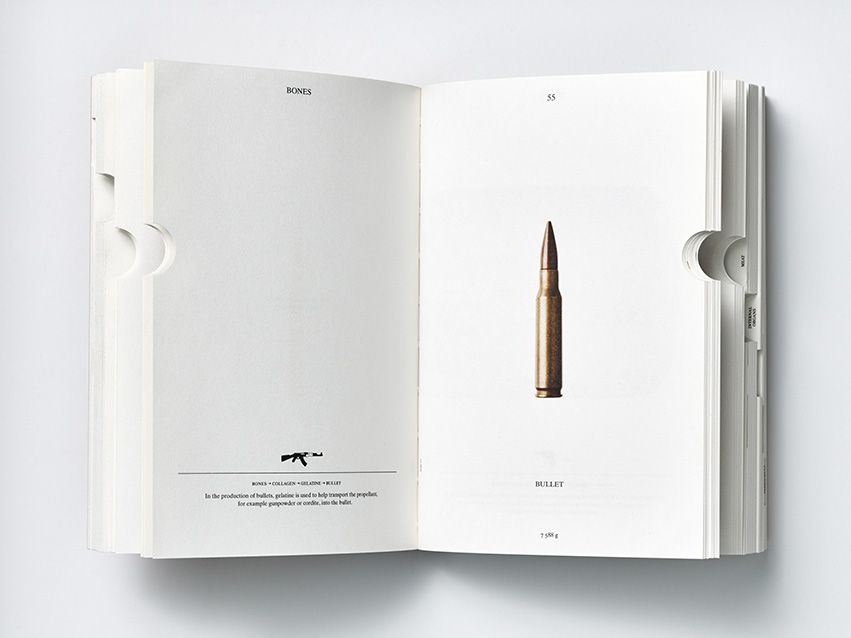
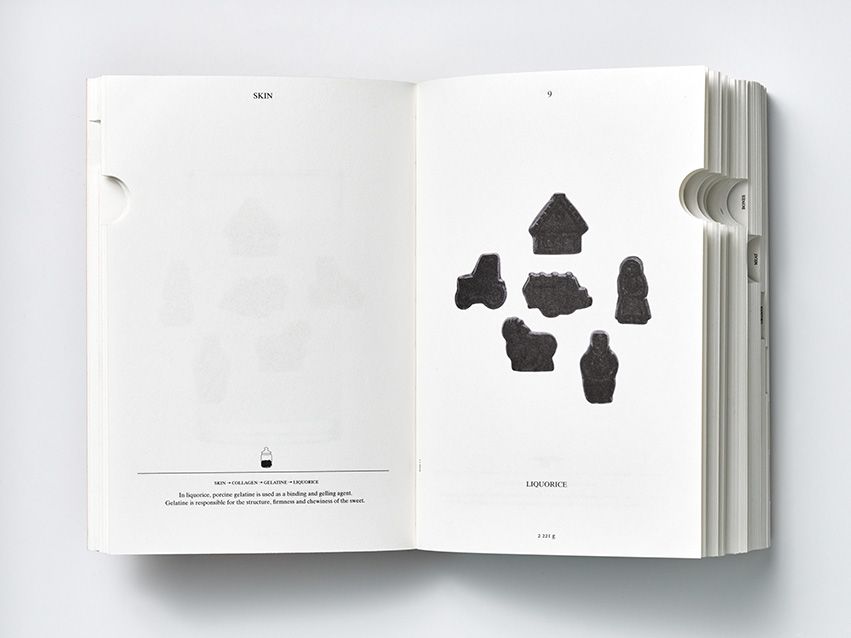
The Dutch designer Christien Meindertsma was at the forefront of this shift more than a decade ago with her book PIG 05049 (2007), which mapped all of the parts of a single pig to their destinations in shampoo, chewing gum, bullets and a host of other unexpected products. She has since investigated what remains in the ash from waste incinerators, how to recycle woollen jumpers, and the potential uses of ripped-up linoleum. Formafantasma, two Italian designers of the same generation, have conducted in-depth research into the recycling of electronic waste and the history of the timber industry. The studio’s Simone Farresin and Andrea Trimarchi now teach a course called Geo-Design at the Design Academy Eindhoven in the Netherlands that calls attention to the geopolitical forces shaping the design industry. For designers of this stripe, the physical object is no longer an end in itself but a vehicle towards understanding the complex systems that produce it, and the even more opaque systems that dispose of it.

The most sustainable building is the one that already exists, yet developers are incentivised to build anew

Interrogating these systems is vital for reducing waste and pollution at each stage of an object’s life, from extraction to decomposition. If every product was evaluated in terms of how much waste it generated or how brief its lifespan was likely to be, it would transform the discipline, and consumer behaviour along with it. In many cases, those objects would not be brought into being in the first place. But how can designers implement strategic change when they must fulfil the briefs of their paymasters? The last thing any manufacturer or politician wants is reduced production. Well, in that case, designers need to convince them.


The 2017 transformation of the social housing complex Cité du Grand Parc in Bordeaux in France by the architects Lacaton & Vassal. Photo by Laurian Ghinitoiu

Interior of an apartment’s ‘winter garden’ extension by Lacaton & Vassal. Photo by Laurian Ghinitoiu

The apartments’ original unextended layout. Image © and courtesy Lacaton & Vassal/Druot/Hutin

Extended layout, with the winter garden/balcony extensions in blue. Image © and courtesy Lacaton & Vassal/Druot/Hutin

Materials and process for the winter garden extension. Image © and courtesy Lacaton & Vassal/Druot/Hutin
1 of 5


The designer’s powers of persuasion lie in making change manifest in tangible forms. Take the built environment, which accounts for 38 per cent of all carbon emissions when you factor in construction and energy use. We know that the most sustainable building is the one that already exists, and yet developers are still incentivised to demolish and build anew. The architects Lacaton and Vassal in Paris view demolition not just as waste but as a form of violence against the environment. In their transformation of social housing blocks that were once slated for demolition, they have demonstrated numerous times that such buildings can be adapted in ways that don’t just improve the architecture but also the residents’ quality of life. This is a powerful act of persuasion because it gives other municipalities the precedent they need when they are under pressure to demolish a run-down tower block.

These acts of persuasion are happening across every design discipline. Architects building taller structures with cross-laminated timber show that it’s possible to move away from carbon-heavy and hugely polluting construction mainstays such as steel and concrete. In consumer electronics, companies such as Fairphone and Framework design smartphones and laptops with modular parts, so that everything from batteries and cameras to motherboards can be replaced as they decline or evolve. While Apple and Microsoft have long used proprietary screws, glues and all manner of other strategies to prevent repair (though they’ve recently amended their policies somewhat), Fairphone and Framework are setting an ethical standard that one hopes consumers will find persuasive. In fashion, which is believed to be the second or third most polluting industry in the world, designers such as Stella McCartney, Bethany Williams and Phoebe English are demonstrating that it is possible to create desirable clothes out of recycled materials, dead stock and waste textiles. Granted, all of the above are still outliers – minnows in the mainstream – but their power lies in helping us see what a great abstraction such as ‘decarbonisation’ can look like at the everyday level.

As the public becomes more aware and more discerning, manufacturers will feel greater pressure to change – and more fundamentally than today’s epidemic of greenwashing suggests. But if the principles outlined above were widespread, it would challenge the industrial paradigm of the past 100 years. What does a society look like in which fridges last 50 years, not five? Where individual ownership of goods is replaced by communal sharing? Where distributed manufacturing is the norm, such that distant factories and global supply chains give way to more local, bioregional and artisanal production, close to the point of purchase? What are the implications of a world in which some products last forever and others, made of organic materials, decompose in days?

Our aesthetic sensibilities might have to adapt. After nearly a century of appreciating the hard-smooth-shiny perfection of plastics, we might need to embrace irregularity, imperfection, decay and decomposition. Many of these ideas and the products that could spring from them are nascent or niche. Critics will say ‘How do you scale that up?’ – to which we could retort that this impulse towards expansion is part of the problem. In the end, perhaps bigness is best replaced by myriad small-scale solutions.

There is hope, of sorts, in mushrooms. Mycelium has become the experimental material du jour, used in everything from bricks to handbags, but that is not the hope that I was referring to. Rather, it’s the fungus as a metaphor – an organism that can not only survive but even thrive in damaged landscapes, and help to restore them. The American anthropologist Anna Lowenhaupt Tsing has written compellingly about the ability of the matsutake mushroom to revive pine forests that have been ravaged by fire. ‘Matsutake’s willingness to emerge in blasted landscapes,’ she writes in The Mushroom at the End of the World (2015), ‘allows us to explore the ruin that has become our collective home.’

Mycorrhizal fungi create symbiotic networks with tree roots, nourishing them and enabling life after ecological catastrophe. This is a powerful demonstration of what Tsing calls ‘entangled ways of life’, and it is precisely that entanglement that designers are beginning to learn – the way in which every object is connected to the world, through myriad social and ecological processes, from raw material to waste material. And just as the 20th century was a summer of plenty, when we could consume and discard with abandon, so the 21st century will be defined by an autumnal scarcity, in which we have to be more resourceful and sparing – keeping our eyes trained on the forest floor.

This essay appears in conjunction with the exhibition ‘Waste Age: What Can Design Do?’, running at the Design Museum, London until 20 February 2022.

Lychee Genome Tells a Colorful Story About an Ancient Tropical Fruit

Lychees

Fresh lychees.

Radiant and flavorful, lychees were so beloved that they were domesticated not just once in ancient times, but independently in two different regions of China, a study finds.

They’re prickly on the outside, sweet on the inside, and beloved for their iconic pink shells and pearly, fragrant fruit. In the U.S., you might encounter them as a flavorful ingredient in bubble tea, ice cream, or a cocktail. You can also peel them and eat them fresh.

Lychees have been grown in China since ancient times, with records of cultivation dating back about 2,000 years. Fresh lychees were an object of such desire that in the Tang Dynasty, one emperor set up a dedicated horse relay to deliver the fruits to the imperial court from harvests made far to the south.

Now, scientists have used genomics to peer even deeper into the lychee’s history. And in the process, they’ve uncovered insights that could help shape the species’ future, too.

“Lychee is an important tropical agricultural crop in the Sapindaceae (maple and horse chestnut) family, and it is one of the most economically significant fruit crops grown in eastern Asia, especially so to the yearly income of farmers in southern China,” says Jianguo Li, PhD, professor in the South China Agricultural University (SCAU) College of Horticulture and a senior author of the study. “By sequencing and analyzing wild and cultivated lychee varieties, we were able to trace the origin and domestication history of lychee. We demonstrated that extremely early- and late-maturing cultivars were derived from independent human domestication events in Yunnan and Hainan, respectively.”

Additionally, “We identified a specific genetic variant, a deleted stretch of genetic material, that can be developed as a simple biological marker for screening of lychee varieties with different flowering times, contributing importantly to future breeding programs,” adds Rui Xia, PhD, professor in the same college at SCAU and another senior author of the research.

“Like a puzzle, we’re piecing together the history of what humans did with lychee,” says Victor Albert, PhD, University at Buffalo evolutionary biologist, also a senior author of the study. “These are the main stories our research tells: The origins of lychee, the idea that there were two separate domestications, and the discovery of a genetic deletion that we think causes different varieties to fruit and flower at different times.”

The study will be published today (January 3, 2022) in Nature Genetics. It was led by SCAU in collaboration with a large international team from China, the U.S., Singapore, France, and Canada.

Senior authors are Rui Xia, Jianguo Li, and Houbin Chen from SCAU; Ray Ming from the University of Illinois at Urbana-Champaign; and Victor Albert from UB. First authors are Guibing Hu, Junting Feng, Chengming Liu, and Zhenxian Wu from SCAU; Xu Xiang from the Guangdong Academy of Agricultural Sciences; Jiabao Wang from the Chinese Academy of Tropical Agricultural Sciences; and Jarkko Salojärvi from the Nanyang Technological University.

A fruit so beloved, it was domesticated more than once

To conduct the study, scientists produced a high-quality “reference genome” for a popular lychee cultivar called ‘Feizixiao’, and compared its DNA to that of other wild and farmed varieties. (All the cultivars belong to the same species, Litchi chinensis).

The research shows that the lychee tree, Litchi chinensis, was likely domesticated more than once: Wild lychees originated in Yunnan in southwestern China, spread east and south to Hainan Island, and then were domesticated independently in each of these two locations, the analysis suggests.

In Yunnan, people began cultivating very early-flowering varieties, and in Hainan, late-blooming varieties that bear fruit later in the year. Eventually, interbreeding between cultivars from these two regions led to hybrids, including varieties, like ‘Feizixiao’, that remain extremely popular today.

The exact timing of these events is uncertain. For instance, the study suggests that one milestone, the evolutionary split between L. chinensis populations in Yunnan and Hainan, which took place before domestication, could have occurred around 18,000 years ago. But that is only an estimate; other solutions are possible. Still, the analysis provides a fascinating look at the evolutionary history of lychees and their link with humans.

When will this lychee tree flower? A simple genetic test could tell

The study not only adds new chapters to the history of the lychee; it also provides an in-depth look at flowering time, a hugely important trait in agriculture.

“Early-maturing lychees versus late-maturing lychees came from different places and were domesticated independently,” says Albert, PhD, Empire Innovation Professor of Biological Sciences in the UB College of Arts and Sciences. “This, by itself, is an interesting story, but we also wanted to know what causes these differences: Why do these varieties fruit and flower at different times?”

By comparing the DNA of many lychee varieties, the team identified a genetic variant that could be used to create a simple test for identifying early- and late-blooming lychee plants.

The variant is a deletion — a chunk of missing DNA — that lies near two genes associated with flowering, and may help to control the activity of one or both of them.

Yunnan cultivars that bloom very early have the deletion, inheriting it from both parents. Hainan varieties that mature late do not have it at all. And Feizixiao — a hybrid with nearly equal amounts of DNA from each of the two regional populations — is “heterozygous” for the deletion, meaning that it has only one copy inherited from one parent. This makes sense, as Feizixiao flowers early, but not extremely early.

“This is very useful for breeders. Because the lychee is perishable, flowering times have been important to extending the season for which the lychee is available in markets,” Albert says.

Sequencing the lychee genome is only the start

The team at SCAU initiated the lychee genome study as part of a bigger project that hopes to greatly expand what we know about the DNA of important flowering plants within the same family, Sapindaceae.

Sapindaceae is a large family that includes many economically important plants,” Xia says. “So far, only a few of them, including lychee, longan, rambutan, yellowhorn, and maple, have had their full genomes sequenced.”

“We, the College of Horticulture at SCAU, are working on a large collaborative project of sequencing more Sapindaceae species native to China and of economic importance, such as rambutan, sapindus (soapberries) and balloon vine, aiming at broad and thorough comparative genomics investigations for Sapindaceae genomics,” Xia adds. “The main research interests will be flowering, secondary metabolism leading to flavors and fragrances, flower and fruit development, among others.”

Reference: “Two divergent haplotypes from a highly heterozygous lychee genome suggest independent domestication events for early and late-maturing cultivars” 3 January 2021, Nature Genetics.
DOI: 10.1038/s41588-021-00971-3