Sunday, January 09, 2022

How Israel is burying the last prospects for a Palestinian state

Analysis: With house demolitions reaching record highs, the Bennett government has also advanced settlement plans which would be a death blow to the already slim prospects for a two-state solution.

Analysis
Ali Adam
06 January, 2022

For decades, successive Israeli governments have cumulatively worked to expand and deepen control over the occupied Palestinian territories (oPt) to prevent the establishment of a Palestinian state.

However, the current government, led by far-right Israeli Prime Minister Naftali Bennett, seems to have taken it upon itself to end any remaining prospects for Palestinian self-determination once and for all.

“Since the theoretical ‘government of change’ came to power half a year ago, it has successfully undertaken systematic measures to sabotage any remaining viability of a negotiated political solution and severely undermine Palestinian human rights,” Ir Amim, an Israeli anti-occupation advocacy group, said in December.

"Since Bennett assumed office, there's been an unprecedented escalation by the Israeli government in terms of advancing settlement expansion in the most sensitive areas that impacts the viability of the two-state solution"

Over the past few months, the Bennett government has been advancing settlement construction in locations that would entail a death blow to any future efforts for the establishment of a viable and contiguous Palestinian state.

According to a recent report published by Haaretz, the Israeli government is currently promoting a new widespread settlement project across East Jerusalem – a move that would result in the eviction of Palestinian residents from their homes.

The six planned settler neighbourhoods would be located in Sheikh Jarrah, Beit Safafa, Sur Baher, Beit Hanina, and near the Old City’s Damascus Gate.

These planned settlements also come on the heels of highly controversial and politically consequential settlement plans which the Israeli government has advanced in recent months.

Israel's home demolition policy: A form of ethnic cleansing
Analysis Emad Moussa

In mid-October, Israel approved the expropriation of land for the Givat Hamatos settlement in southern Jerusalem. Infrastructure work has already begun, with the government planning to construct 1,257 new housing units despite international outcry.

In the same month, the Israeli government also advanced the construction of 3,400 housing units in the E1 area to expand the Maale Adumim settlement.

Any further construction in these two controversial areas has long been considered a red line by the international community as it means effectively dissecting the West Bank in two, rendering a two-state solution impossible.

Construction in Givat Hamatos would surround East Jerusalem and cut it off from the southern West Bank, while settlement expansion in the E1 area would bisect the West Bank and torpedo any prospects of a viable and contiguous Palestinian state.

“Since Bennett assumed office, there’s been an unprecedented escalation by the Israeli government in terms of advancing settlement expansion in the most sensitive areas that impacts the viability of the two-state solution,” Palestinian political analyst Muhammad Shehada told The New Arab.

“Almost all of the settlement projects that had been shelved by Israel since 2012 due to international pressure, are now being unabashedly advanced by Bennett’s government,” he said.
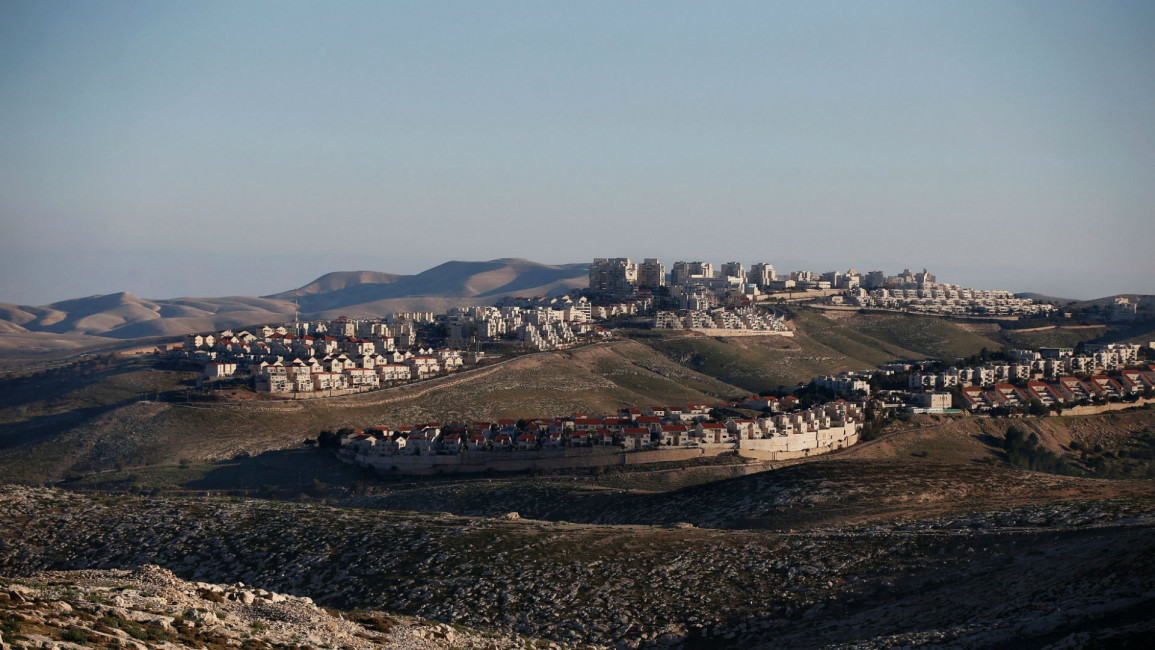
Israel is advancing settlement construction in locations that would be a death blow to a viable and contiguous Palestinian state, such as the E1 area. [Getty]

“If completed, these settlement projects will terminate any remaining possibilities for Palestinian statehood, and will cantonize the Palestinian territories into isolated enclaves,” Shehada added.

“These settlements projects surrounding Jerusalem, in particular, will isolate the city from the rest of the Palestinian territories, and radically alter its demographic reality”.

Despite decades of impunity for settlement construction, Israel has in the past refrained from building in these sensitive areas for fear of an international response.

But with Bennett, a former head of the settler Yesha council, as prime minister, and a US administration largely indifferent to the Israeli-Palestinian conflict, that seems to have changed.

Shehada believes the lack of international accountability that Israel has been afforded over the decades is certainly part of its decision to advance these new settlement plans.

"The Bennet government took advantage of international silence and the complicity of certain Arab countries that normalised ties with Israel, to intensify these settlements projects, especially surrounding the city of Jerusalem"

“What has encouraged Israel to advance these sensitive settlements projects is the failure of the international community to translate international resolutions against Israeli settlements into practical steps on the ground, and its failure to impose consequences on Israel,” Shehada said.

“The Bennet government took advantage of international silence and the complicity of certain Arab countries that normalised ties with Israel, to intensify these settlements projects especially surrounding the city of Jerusalem,” he added.

Since assuming office, the Biden administration has been reluctant to engage with Israel-Palestine beyond reinforcing the status quo.

This has included bolstering the Palestinian Authority while refusing to exert any real pressure on Israel at all, whether concerning house demolitions, the Gaza war, or new settlement plans.

As such, even the routine condemnation of settlement plans has been interpreted as diplomatic lip service rather than opposition.
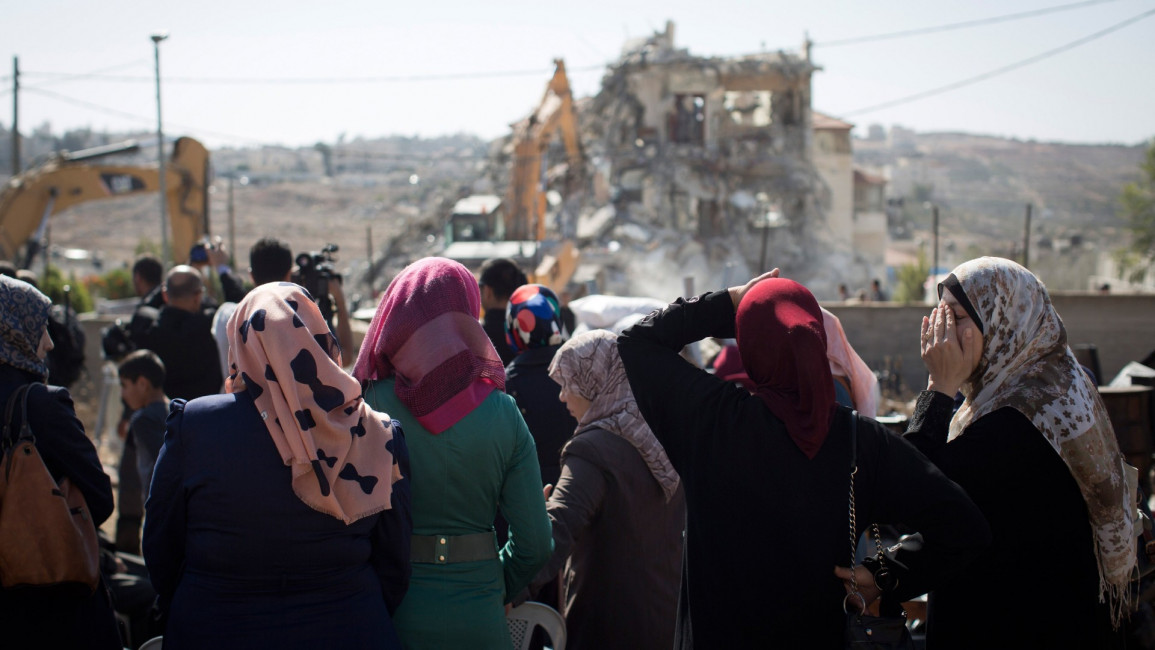
2021 saw a five-year high in Palestinian home demolitions, according to rights groups. [Getty]

At the end of October, a source close to Bennett told Zman Yisrael, The Times of Israel’s sister site, that Israel believed the Biden administration was indifferent to the new settlement plans.

“Contrary to the impression they’re trying to make, the Americans don’t care that much about the Ministry of Construction and Housing’s decision, and they have no problem tolerating it,” the source said

“This construction is not part of the conversation we are having with the Americans. We noticed that,” the source added.

The extent of the impunity Israel feels was reflected by the decision to announce the expropriation of public land for the Givat Hamatos settlement while Israeli FM Yair Lapid was visiting Washington in October.

Indeed, this preferential US treatment of Israel is unlikely to change, despite military aid that could be used as leverage to extract minimal concessions, such as a settlement freeze, from Tel Aviv.

Additionally, the Biden administration is seriously considering adding Israel to the US waiver programme, a benefit being considered without reciprocal concessions.

The lack of US interest in the conflict has tangible repercussions on the ground. In addition to settlement building, recent months have also seen a sharp increase in settler violence against Palestinians, and, notably, the designation of Palestinian human rights groups as terrorist organisations.

House demolitions have also escalated, a policy that often works hand in hand with settlement expansion.

Since the Bennett government assumed office in June 2021, 472 structures have been destroyed, including 90 donor-funded structures, affecting 10,273 Palestinians.

In-depth Sally Ibrahim

This represents an astounding 143% increase in Palestinians affected by demolitions under the Bennett government compared to a similar period in 2020, according to the United Nations Office for the Coordination of Humanitarian Affairs (UNOCHA).

The total number of house demolitions in 2021 marked a five-year high, according to B’Tselem, while the destruction of non-residential structures, including agricultural, business, or public structures, reached the highest number since 2012.

“Expanding these particularly dangerous settlement projects makes clear that the Israeli government’s ‘shrinking the conflict’ mantra has only ever been about optics, PR, and lip service,” Shehada said.

“What’s more problematic is that the Biden administration is playing along; applauding whenever Israel throws some occasional crumbs of mercy on the occupied Palestinian population, and looking the other way when Israel bulldozes the two-state solution,” he added.

Ali Adam is a journalist and researcher whose work focuses on issues linked to the Israeli-Palestinian conflict
The Republican Party's Islamophobia shows no signs of abating


Brooke Anderson
Washington, D.C.
06 January, 2022

In-depth: The blatant Islamophobia targeted against Democratic Representative Ilhan Omar shows no sign of stopping as anti-Muslim speech becomes increasingly normalised within the Republican Party.

When Representative Lauren Boebert suggested at a town hall event in October that Ilhan Omar was a suicide bomber, and then promptly apologised for what seemed to be passing off the comment as a misguided attempt at humour, the issue surprisingly seemed to be put to rest. But it was only the beginning.

Days later, following a phone call ostensibly meant to mend fences, Omar hung up after Boebert reportedly asked her to apologise for her own past controversial statements (for which she had already apologised). She then followed up with more Islamophobic comments.

It’s unclear why Boebert had a change of heart, or if she had from the start meant for the call to not go well as a publicity stunt. What is clear is that her Islamophobic attacks on Omar were followed by death threats to Omar and a fundraising boon for Boebert.

“In any normal workplace, engaging in anti-Muslim bigotry against your co-worker would be a dangerous offense,” Edward Mitchell, deputy director of the Council on American-Islamic Relations, tells The New Arab. “Islamophobia is one of the last acceptable forms of bigotry in the US.”


"Unfortunately, it's not new to American Muslims to see Islamophobic statements. What's new is the escalation of anti-Muslim attacks that have been coming from influential people in society, such as sitting members of congress"

These ongoing public provocations from Boebert show no sign of stopping anytime soon. Indeed, others have joined the attacks on Omar with similar rhetoric. Representative Marjorie Taylor Greene has recently used the term “jihad squad” to refer to the group of progressive lawmakers, repeating what Boebert had said back in October.

More recently, in late December, following Omar's criticism of Senator Joe Manchin’s absence of support for the Build Back Better Bill, conservative radio host Ben Shapiro repeatedly stated sarcastically that Omar was “wildly popular” in West Virginia, what appeared to be a thinly veiled reference to her background compared with residents of the majority-white rural state.


Voices  Mobashra Tazamal

Why have some of the Republican party’s most extreme – though increasingly mainstream – members chosen Omar as a target?

She is not the first Muslim member, with Keith Ellison (also from Minnesota) predating her by a decade, nor is she the first woman. But she is the first African refugee to be part of the US Congress, and as an outspoken member of the squad (of progressive congress members who began entering office in 2018) whose multiple identities have sparked the disdain of high-profile bigots, she has consistently been a target of hateful rhetoric.


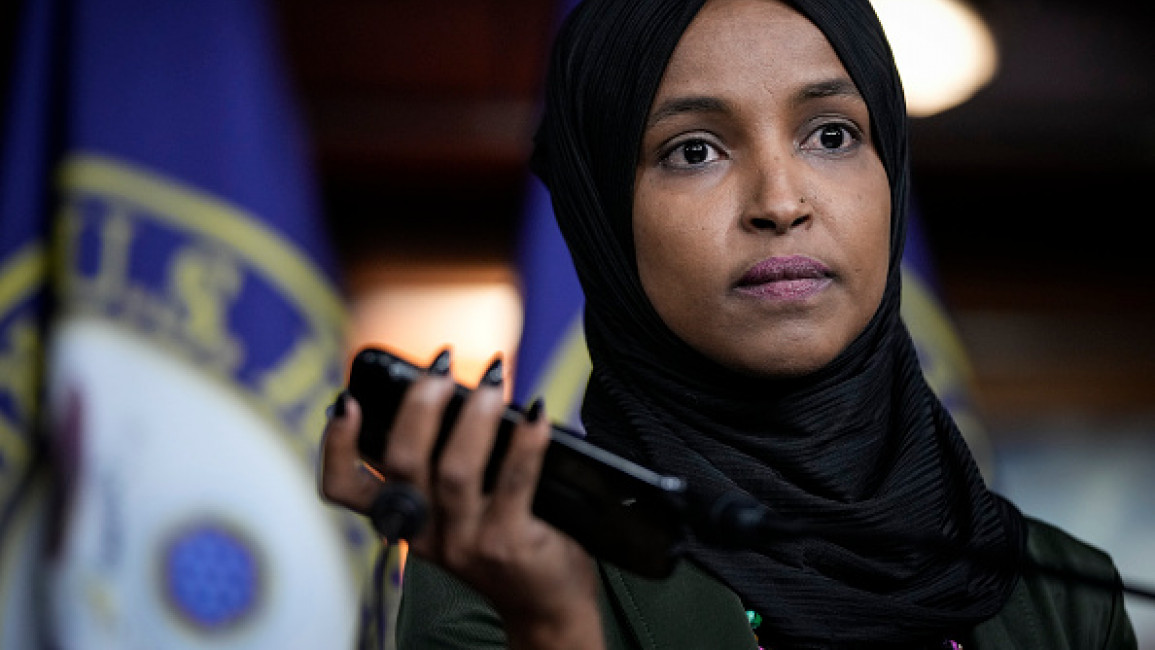
Omar plays a voicemail death threat she received after Boebert's Islamophobic comments during a news conference about Islamophobia on Capitol Hill on November 30, 2021 in Washington, DC. [Getty]

“Unfortunately, it’s not new to American Muslims to see Islamophobic statements. What’s new is the escalation of anti-Muslim attacks that have been coming from influential people in society, such as sitting members of congress. These are supposed to be role models in society. They’ve been trafficking in anti-Muslim hate,” Nihad Awad, executive director of the CAIR, tells The New Arab.

“The new thing is that Islamophobia is being normalised and weaponised and now it’s really inciting hate and violence against member of our community,” said Awad, noting a nationwide spike in anti-Muslim hate crimes, which he sees as inextricably linked to public statements of hate.

In a December opinion piece for The Hill, Fox News political analyst Juan Williams remarked that “Somewhere, former Congressman Steve King must be saying: ‘If only I had waited two years to air my views on white supremacy...’”

The analyst was referring to the former Iowa congressman’s bigoted remarks, which included Islamophobic references to Omar. House minority leader Kevin McCarthy condemned King’s openly racist remarks as “beneath the dignity of the party of Lincoln and the United States of America." McCarthy stripped King of his House committee assignments in January 2019.

Analysis Brooke Anderson

Around the same time, in an incident specifically targeting Omar, a poster for a Republican event at the state capitol in West Virginia showed her face in front of an image of the burning twin towers in New York during the 9/11 attacks. The state party immediately condemned and removed the poster, saying they did not endorse hate speech or hateful views.

These days, it appears that not only are the Islamophobic attacks getting more frequent, but they are also largely going unchecked by the Republican Party leadership.

Indeed, some of the very politicians who have accused Omar of anti-Semitism (comments for which she apologised at the time), have their own habits of anti-Semitic remarks, which include regular references to billionaire philanthropist George Soros, Jewish space lasers (which Greene blamed for the California wildfires), and repeated comments by former president Donald Trump of Jews controlling US politics.

To the extent that there is a modicum of pushback on the right to this ongoing trend of bigoted rhetoric, the few politicians who do speak up are already seeing threats to their own political positions.

Nancy Mace, a representative from South Carolina, considered a moderate Republican and one of the few who has been publicly denouncing the Islamophobic comments against Omar, found herself a target of Marjorie Taylor Greene on Twitter, accusing her of not being a real conservative. Mace called her a “religious bigot.”

"These days, it appears that not only are the Islamophobic attacks getting more frequent, but they are also largely going unchecked by the Republican Party leadership"

Possibly more telling of the GOP’s dedication to its most extreme base is its plans to run more conservative candidates against Mace in her next primary election, despite her location in a swing district.

In mid-December, the House passed legislation to combat Islamophobia, pledging a special envoy. This followed a resolution by progressive members of Congress to strip Boebert of her committee assignments following her Islamophobic remarks.

But without Republican support against this growing trend of Islamophobic rhetoric, some worry the trend will likely continue.

“I expect this to continue,” Najee Ali, president of the Democratic Club of Southern California, tells TNA.

“It sends a horrible message for those watching what’s going on. They’ll be emboldened, and it will become cancerous. The only way to stop these disparaging comments is to bring everyone together and set the rules of engagement. No one has to agree politically, but they have to respect their fellow colleagues.”

Brooke Anderson is The New Arab's correspondent in Washington DC, covering US and international politics, business, and culture.
Intel reports repeatedly failed to forecast Capitol riot

By ERIC TUCKER and MICHAEL BALSAMO

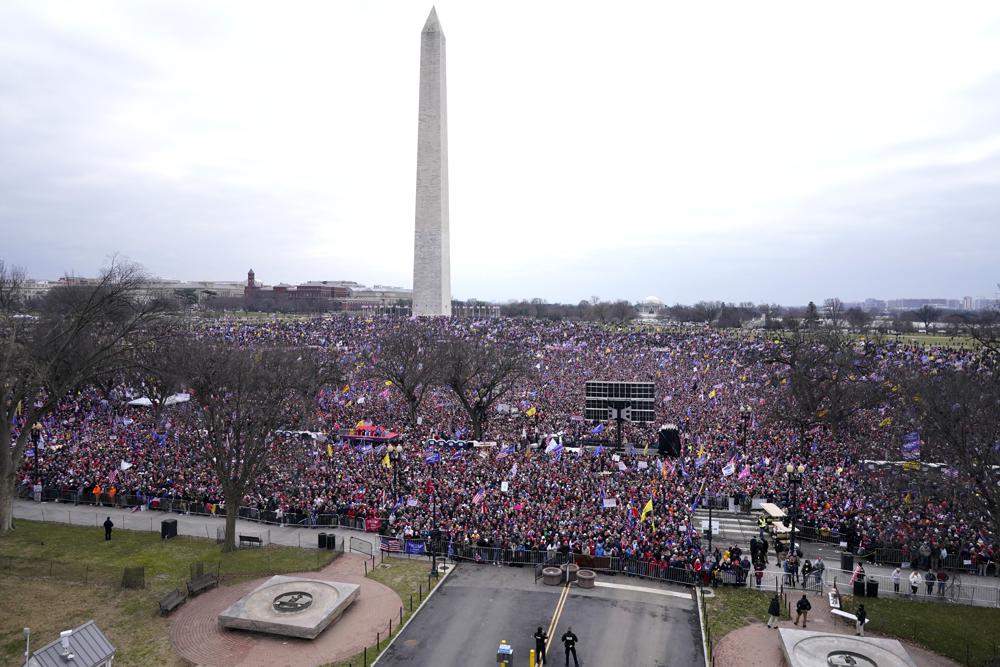
With the Washington Monument in the background, people attend a rally in support of President Donald Trump on Jan. 6, 2021, in Washington. Intelligence reports compiled by the U.S. Capitol Police in the days before last year's insurrection envisioned only an improbable or remote risk of violence, even as other assessments warned that crowds of potentially tens of thousands of pro-Trump demonstrators could converge in Washington to create a dangerous situation. (AP Photo/Jacquelyn Martin, File)

WASHINGTON (AP) — Intelligence reports compiled by the U.S. Capitol Police in the days before last year’s insurrection envisioned only an improbable or remote risk of violence, even as other assessments warned that crowds of potentially thousands of pro-Trump demonstrators could converge in Washington and create a dangerous situation.

The documents, obtained by The Associated Press, underscore the uneven and muddled intelligence that circulated to Capitol Police officers ahead of the Jan. 6 riot, when thousands of Donald Trump loyalists swarmed the Capitol complex and clashed violently with law enforcement officers in their effort to disrupt the certification of the results of the 2020 presidential election. The intelligence reports in particular show how the police agency, up to the day of the riot itself, grievously underestimated the prospect of chaotic violence and disruptions.

The contradictory intelligence produced by law enforcement leading up to the riot has been at the forefront of congressional scrutiny about the Jan. 6 preparations and response, with officials struggling to explain how they failed to anticipate and plan for the deadly riot at the Capitol that day. The shortcomings led to upheaval at the top ranks of the department, including the ouster of the chief, though the assistant chief in charge of protective and intelligence operations at the time remains in her position.

There was, according to a harshly critical Senate report issued in June, “a lack of consensus about the gravity of the threat posed on January 6, 2021.”

“Months following the attack on the U.S. Capitol, there is still no consensus among USCP officials about the intelligence reports’ threat analysis ahead of January 6, 2021,” the report stated.

The documents, known as a “daily intelligence report” and marked “For Official Use Only,” have been described over the last year in congressional testimony and in the Senate report. The AP on Friday evening obtained full versions of the documents for Jan. 4, 5 and 6 of last year. The New York Times highlighted the Jan. 4 report in a story last year on intelligence shortcomings.

On each of the three days, the documents showed, the Capitol Police ranked as “highly improbable” the probability of acts of civil disobedience and arrests arising from the “Stop the Steal” protest planned for the Capitol. The documents ranked that event and gatherings planned for Jan 6. by about 20 other organizers on a scale of “remote” to “nearly certain” in terms of the likelihood of major disruptions. All were rated as either “remote,” “highly improbable” or “improbable,” the documents show.

“No further information has been found to the exact actions planned by this group,” the Jan. 6 report says about about the “Stop the Steal” rally.

The Million MAGA March planned by Trump supporters is rated in the document as “improbable,” with officials saying it was “possible” that organizers could demonstrate at the Capitol complex, and that though there had been talk of counter-demonstrators, there are “no clear plans by those groups at this time.”

Another event by a group known as Prime Time Patriots was similarly described as having a “highly improbable” chance for disruption, with the report again stating that “no further information has been found to the exact actions planned by this group.”

Those optimistic forecasts are tough to square with separate intelligence assessments compiled by the Capitol Police in late December and early January. Those documents, also obtained by AP, warned that crowds could number in the thousands and include members of extremist groups like the Proud Boys.

A Jan. 3, 2021, memo, for instance, warned of a “significantly dangerous situation for law enforcement and the general public alike” because of the potential attendance of “white supremacists, militia members and others who actively promote violence.”

“Unlike previous post-election protests, the targets of the pro-Trump supporters are not necessarily the counter-protestors as they were previously, but rather Congress itself is the target on the 6th,” the report states.

Adding to the mixed intelligence portrait is a Jan. 5 bulletin prepared by the FBI’s Norfolk field office that warned of the potential for “war” at the Capitol. Capitol Police leaders have said they were unaware of that document at the time. FBI Director Chris Wray has said the report was disseminated through the FBI’s joint terrorism task force, discussed at a command post in Washington and posted on an internet portal available to other law enforcement agencies.

Capitol Police officials have repeatedly insisted that they had no specific or credible intelligence that any demonstration at the Capitol would result in a large-scale attack on the building. Despite scrutiny of intelligence shortcomings, Yogananda Pittman, the assistant chief in charge of intelligence at the time of the riot, remains in that position.

The current police chief, J. Thomas Manger, defended Pittman in a September interview with the AP, pointing to her decision when she was acting chief to implement recommendations made by the inspector general and to expand the department’s internal intelligence capabilities so officers wouldn’t need to rely so heavily on intelligence gathered by other law enforcement agencies.
[Discussion Article] Reflections on the Fascist Threat – From the 1930s to Today


December 9, 2021
https://imhojournal.org/imho_author/barbara-epstein/

Should the Left unite with the center – or the progressive liberals – against fascism? Thoughts from a veteran socialist. First presented at a November 21, 2021 meeting of the Los Angeles chapter of the International Marxist-Humanist Organization — Editors

I’ve been asked to talk about the danger of fascism in the US. The verdict in the Kyle Rittenhouse case has just accelerated the danger of fascism in this country. What it means is that the right wing doesn’t need a militia, they can just send out a call and their supporters, including 17-year-olds, can go to demonstrations with guns and shoot if they feel endangered. I don’t know what more to say.

There is more than a danger that the Republicans will gain a clear majority in Congress in the 2022 midterm elections and that the Republican Party will win the 2024 election, possibly putting Trump back in office. If this were to happen the Republicans would control not only the Supreme Court, as they do now, but also the House and the Senate. There would be greater restrictions on who could vote, reactionary laws would be passed, and the Republican Party would gain a lock on power that would be very difficult to overcome.

The danger we face is of fascism, not authoritarianism. Authoritarianism means rule by one person or group. It may not be accompanied by major upheavals or conflict. Fascism, on the other hand, describes a system in which a group comes to power, and maintains its power, by inflaming existing prejudices and conflicts and setting one or more sectors of a population against others. Fascism thrives on internal conflict and violence. In the US, it rests on racism and, to a lesser but growing extent, antisemitism, and it also rests on sharpening the differences between cultural and or political groups, creating crises that escalate and promote violence, inflaming racism, and creating conflicts among whites as well. A fascist system involves violence from above and also promotes violence between groups within the population. An escalation of this sort is a real possibility, which none of us wants. That means that we have to take it seriously, and we have to be smart about how we go about opposing it.

In thinking about how to oppose it we have to recognize the capacity of the left to make mistakes, sometimes mistakes with serious consequences. I want to first talk about a mistake made by the Communist International, and in particular the German Communist Party, in the late 1920s and early 1930s, that cleared the way for the victory of fascism. And then I want to talk about an approach being taken by many on the left today that I think increases the chances of Republican victories in 2022 and 2024. The first was a problem of ultraleftism– that is, setting the Communist movement against the rest of the left, the second is a problem of what I would call moralism. Though they are not the same, I think the two have in common that they convey a sense of superiority to others that can get in the way of our efforts to win those who are not part of the left over to our side.

The first case: in 1928 the Communist International, or Comintern, which officially represented all the Communist parties in the world but was dominated by the Soviet leadership, adopted what was called the policy of the Third Period. According to this policy, Communist parties around the world were to refuse to ally with other parties of the left and were to attack social democratic organizations, socialist parties affiliated with the Second International, as social fascists.

The leaders of the Bolshevik Party had expected that the Bolshevik Revolution would be followed by similar revolutions elsewhere in the capitalist world, particularly in Europe. This had not happened. By 1928 signs of economic depression were appearing, soon to be greatly magnified following the US stock market crash of 1929. Soviet leaders concluded that the period of capitalist stability that had followed the Bolshevik Revolution was coming to an end, that capitalism was on the verge of collapse, and that Communist parties should prepare to lead that revolution by discrediting rival socialist parties, especially the socialist parties that, especially in Europe, had gained large memberships and established themselves electorally. The Soviet, or Comintern, view, in 1928, was that the first period had been that of the Bolshevik Revolution, the second period consisted of the stabilization of world capitalism that followed, and the oncoming third period would be that of the worldwide collapse of capitalism.

The purpose of Soviet attacks on all other socialist organizations was to eliminate competition for leadership of the supposedly imminent revolutions, to clear the way for Communist-led revolutions. It was also to discredit and undermine the influence of other organizations, especially socialist or social democratic parties, that wanted significant reform but were ambivalent about the extent to which the existing capitalist system should be dismantled, and thus, in the Communist view, stood in the way of revolution.

In the late nineteen-sixties, a version of this view also took hold: there were many activists who believed that revolution was imminent, that it was liberals who were standing in the way of revolution. In the US the word “liberal” is extremely elastic, ranging from corporate liberals – who were leading the Vietnam War – to those who opposed the war, supported civil rights and civil liberties, but without calling for a fundamental restructuring of society. The view of many on the left was that liberals, a category including both corporate liberals and humanist liberals, were standing in the way of the revolution. Attacks on social democrats by Communists, in the late 1920s and early 1930s, were an earlier version of the same thing.

These views, held by Communists in the early 1930s, and young activists in the late sixties, assumed that the question was, who was standing in the way of the revolution, not whether desire for a revolution was widespread enough for it to take place. In both cases, it was those who were closest to the radical movement – social democrats or liberals – who were seen as the problem, not the right, which was, in both cases, gaining power. But this talk is about Germany in the early 1930s, where the belief that there was going to be a revolution had far more serious consequences than a similar belief among student leftists in the 1960s US.

Third Period policy had different consequences in different countries. In the US, Communists alienated members of the Socialist Party and others on the left with their attacks. But the policy also led Communists to organize ostensibly revolutionary unions, that is, unions outside the American Federation of Labor, and thus to organize workers that the American Federation of Labor would not organize, including Black sharecroppers, Latino farmworkers, and others. The American Communist Party was at that time quite small and had very little if any influence in electoral politics.

In Germany, the consequences were quite different. The German Communist Party was the largest in the world, outside the Soviet Union, and played a significant though hardly decisive role in German elections. In 1928 the Social Democratic Party, the backbone of the Weimar Republic and its social reform legislation, won nearly 30% of votes, the largest percentage among the very large numbers of competing parties. The German National Party, a far-right nationalist party that rejected the Weimar Republic and its reforms, and that wanted Germany for ethnic Germans, came in next, the conservative but not nationalist Catholic Centre Party third, and the Communist Party fourth, with over 10% of the vote. The Nazi Party received less than 3% of the vote. In the next election, of 1930, the Social Democrats still came in first but with a lower percentage of the vote than in 1928, the Nazis shot up to second with over 18% of the vote, and the Communist Party came in third with 13%. The National Party dropped to 7%; many of its former supporters were now voting Nazi. In 1932 the Nazis came in first with over 37% of the vote, the Social Democrats second with 21%, continuing their decline, and the Communists third with over 14%, higher than previously.

What all this means is, the Social Democratic vote remained significant but was declining, the Communist vote had increased enough to alarm right wingers but nowhere near enough to win, and the Nazis were way ahead of any other party. The Nazi plurality enabled President Hindenburg to appoint Hitler chancellor.

What made it possible for the Nazis, the vote for whom, in 1928, had been negligible, to become the rulers of Germany in 1932? This is a complex story the details of which are not worth addressing here. But the background was that while the Weimar Republic involved a parliament, and normally the chancellor was a member of the majority party in the Reichstag, there was also a president, not responsible to the Reichstag, and with the power, under certain circumstances, to dissolve the Reichstag and appoint a new chancellor. Hindenburg, the president, was a right winger with no sympathy for the Social Democrats, and he was surrounded by a circle of advisors determined to bring Germany under the control of the nationalist far right. Hindenburg’s advisors did not want the Nazis in power but believed that they could be used to defeat the Social Democrats and eliminate Communist influence (and possibly Communists themselves), while being kept under control.

This turned out to be wrong: the Nazis took over. The Nazi Party won a plurality in 1932, Hindenburg appointed Hitler Chancellor, and the Reichstag fire took place soon after. The Nazis blamed the fire on the Communists though it was probably set by the Nazis. The Nazis rounded up, imprisoned and murdered leftists, primarily Communists. By the time Hitler was installed as Chancellor Communists not already in prison fled the country or went underground. The Nazis gained total power.

Some have argued that if the Communists and Social Democrats had formed a joint slate, they would have defeated the Nazis. The combined vote for the two parties in 1932 was close to but did not quite equal the Nazi vote in that election. If the Communists and Social Democrats had not been attacking each other, a joint slate might have attracted more supporters than the Nazis: in the context of depression, nationalism, meaning hostility to and a desire to get rid of Jews and immigrants, was rampant, and this as well as widespread popular anger benefitted the Nazi Party, which was growing very fast. Even if a joint Social Democratic/Communist slate had won in 1932, the Nazis might well have come to power at the next election. A joint slate of the left would have given the left more time, which could conceivably have made a difference. But between the rapid rise of the Nazi movement and the fact that Hindenburg and those around him were doing their best to undermine the Social Democrats and destroy the Communist Party, it is unlikely that a narrow victory of the left in the 1932 election would have eliminated the threat of a Nazi victory the next time.

And the left had its own problems. In their expectation, and advocacy of, an imminent socialist revolution, and in their attacks on the Social Democrats as the obstacle to that revolution, the German Communists were talking to themselves. No one else thought that a socialist revolution was about to take place in Germany, and there was no evidence of it. A united slate of Social Democrats and Communists would have been better that competition between the two, but what was really necessary was the formation of a coalition against fascism including not just the socialist left but others as well. Communists and Social Democrats could have approached the center-of-the-road Catholic Center Party, which had at times aligned itself with the Social Democratic Party. A substantial part of the support for the Nazis came from rural Protestants, who opposed the Weimar Republic and its reforms, and who were repelled by Berlin, with its large population of immigrants and Jews, and its avant-garde culture. The Socialist Party and the Communists would not have been likely to find many supporters for a broad anti-fascist coalition in the countryside, but in Germany’s cities they might well have. Had the German Communists recognized that socialism was not around the corner but that fascism was, and had they been willing to ally with the Social Democrats and other parties and speak to a broad audience, a movement capable of resisting fascism might have been formed.

Instead, the German Communists especially were talking to themselves. No one else thought that a Communist revolution was around the corner, and there was no evidence of it.

I have told this story about the German Communists and what they failed to do in the early nineteen-thirties because I think the US left is now in some ways also engaged in talking to itself rather than to those who need to be won over. The concept of white privilege is fundamentally a moral principle: it calls on white people to recognize that they are better off than Blacks and other people of color. It is not clear what this is expected to lead to, beyond feelings of guilt. Poor and working-class white people, on the whole, and many white middle-class people as well, do not consider themselves privileged and are likely to be offended by this concept. It would be much better, I think, to tell white people that they should join in the struggle against racism because racism is bad for them, too: it creates barriers between them and people of color and empowers the right, which enacts policies that advantage the rich and make life more difficult for everyone else.

The deeper problem, I think, is that much of the left/progressive community has come to define itself more in terms of its culture and its language than in terms of organization or organized struggle. Meanwhile, we are at a turning point in efforts to limit the heating of the earth: if the Republican Party takes power in the US the consequences for the global environment could be devastating. I think that the left needs to shift its focus from culture and language to developing the organizations and strategy that might prevent the right from coming to power
One year after the Capitol riots, America’s white supremacists remain the biggest risk to its democracy

One year after a mob of Trump supporters stormed the US Capitol, President Biden wants to start a "new chapter". But there has been an acute failure by the US government to tackle the attack's white supremacist roots, writes Richard Sudan.


Richard Sudan
06 Jan, 2022

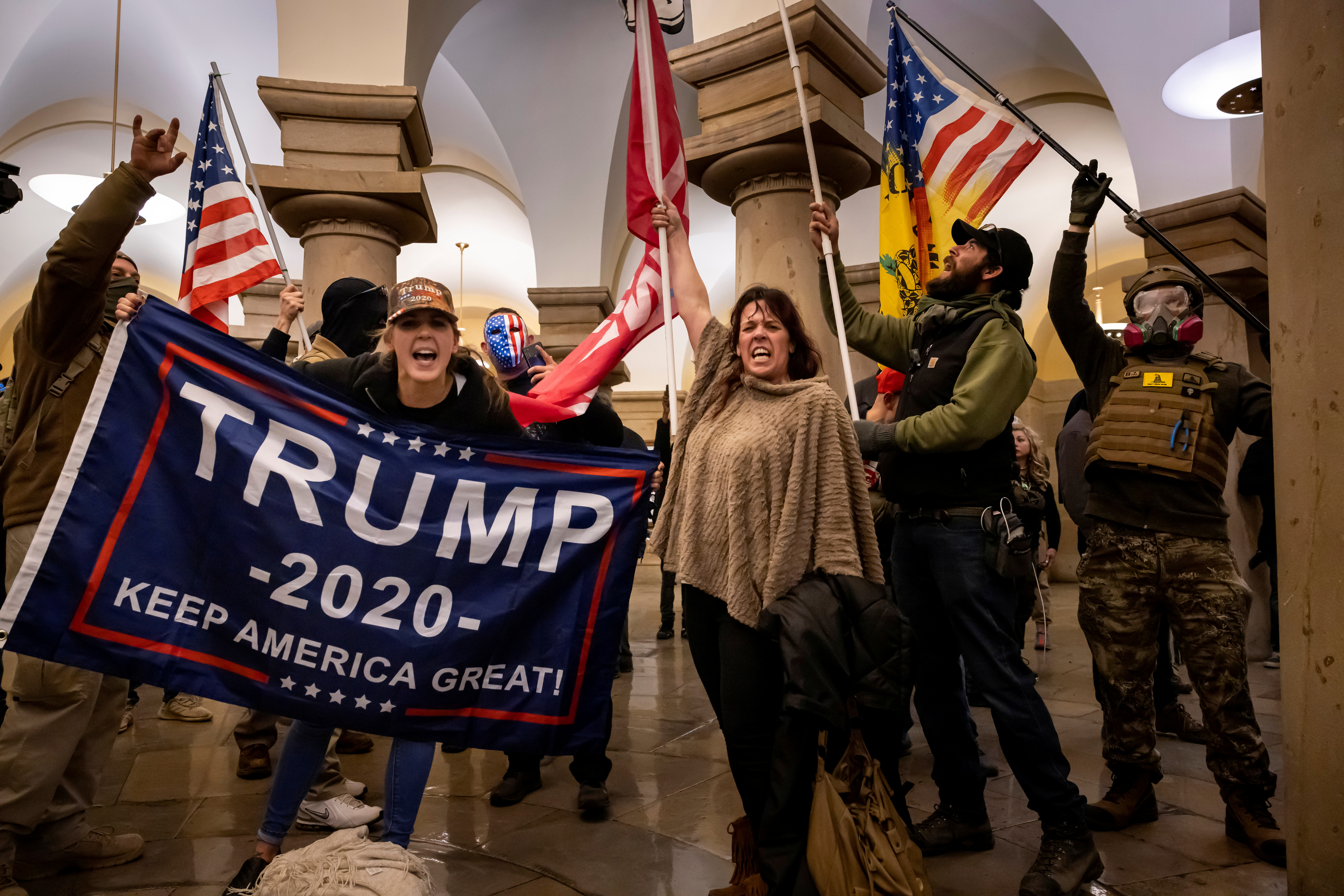
Trump supporters breached security and stormed the US Capitol as Congress debated the 2020 presidential election Electoral Vote Certification on January 6, 2021, in Washington, DC.

One year ago, thousands of people stormed the US Capitol, ransacking the very buildings at the heart of US democracy. Regardless of whether white supremacy had previously been embraced, side-lined or denied by Americans, here it was on naked display proudly parading through the streets for the entire world to see.

Black communities have, of course, been terrorised by white supremacy in all its forms for hundreds of years. But it took Jan 6 to pierce the consciousness of many people - and that should not be the case.

The previous year leading up to the Capitol riots had seen a wave of Black Lives Matter protests sweep the country, which eventually spread around the world, leading to calls for the police to be reformed and even defunded. This even reignited calls for African-American descendants of slaves to be allocated reparations to address the longstanding and demonstrably provable racial imbalance in the country.

White supremacists swarming the capitol on Jan 6th was, at least in part, a direct backlash to the growing demands for racial justice for Black people in the United States. While they were encouraged by Trump and other politicians, it is important to remember that white supremacy is not a right or left issue. And the vast array of protesters which took part represented a wide spectrum of American society and professions including law, law enforcement, and the armed forces. A significant portion of that crowd were undoubtedly card-carrying white supremacists.

"Black communities have, of course, been terrorised by white supremacy in all its forms for hundreds of years. But it took Jan 6 to pierce the consciousness of many people - and that should not be the case"

Eventually, several weeks after the Capitol siege, FBI director Christopher Wray acknowledged that Jan 6 constituted an act of domestic terror. Not only that, but the FBI have also admitted that white supremacy is the most significant and growing domestic terror threat on US soil, accounting for the lion’s share of the FBI’s resources.

You might think that for a nation that famously coined the phrase “the war on terror” that the obvious threat of white supremacist extremism within its own borders might lead to a war on white supremacy. But far from this happening, it seems as though white supremacy was the talk of the town for only a few weeks in 2020 - enough time to safely get the openly racist Trump out of office.

Conversations about reparations too, were very popular in the run up to the election, but fizzled out following Biden’s victory. Biden even pledged to meet rapper Ice Cube to discuss reparations and a plan for Black America. This meeting, of course, never transpired.

But one year on, and despite President Biden’s commemoration speech calling for a “new chapter”, there has been an acute failure by the American government to tackle white supremacy, which remains a life or death issue for Black Americans. The conditions that produced the Capitol siege remain in place and wilfully unchallenged. Far from healing any racial divides as some liberal pundits sought to frame the election, the polarisation that characterised the campaigns merely exposed the fragility of it.

The report into the events of Jan 6 is moving at a snail’s pace. While some of the perpetrators have since been jailed, there have been widespread accusations that the sentences handed down by judges have often amounted to little more than slaps on the wrist. While Black and non-white people have been jailed for much longer for much less, those involved in a significant act of domestic terror have not received punishments which reflect the severity and significance of what took place at the Capitol.

Groups like the Proud Boys, Oath Keepers and other white supremacist militia, who played a role in the Capitol riots, have not been added to any US list of domestic terror groups. Canada did make the move, by designating the Proud Boys as such, but the United States has failed to do so. In the United States, the ties between many corrupt police officers and links to white supremacist groups, with many being active members, have been well exposed.

White supremacist violence at Capitol was anything but unprecedented

A solid investigation into the ties of some politicians to the groups that participated in storming the Capitol has been stalled at every juncture. Roger Stone, a former key ally of Donald Trump, was famously pictured with Oath Keeper members thought to have taken part in the riots on the morning of the riots themselves. Stone of course has denied having any prior knowledge of the events which took place later in the day.

There have been suggestions too, that some law enforcement officers not only had prior knowledge of what would take place at the Capitol on Jan 6, but that some actively took part in the violent scenes and encouraged it. One year on and that rabbit hole in particular seems to have been avoided at all costs.

In many ways, much of this is nothing new. The lines between the system, law enforcement and white supremacy are increasingly blurred. White vigilantism in the United States is not only relatively unpunished but is often rewarded, with Kyle Rittenhouse offering a case in point. This in itself sets a very dangerous precedent going into 2022, and it is a precedent that remains unchallenged.

"For America to finally get its house in order, and to tackle the ongoing scourge of racism that blights the nation, it needs to "stop denying racism, and start dismantling it""

The reality is, much like in the UK, the US’s long-standing relationship and systemic love affair with white supremacy runs deep with strong foundations that can’t be removed overnight, even with the political will, however an uncomfortable truth it might be for some.

US Federal authorities have known of the threat to national security that white supremacy poses for decades. Jan 6 was not so much a culmination of the problem, as some like to frame it, but rather symptomatic of a much wider issue- “chickens coming home to roost” if you will.

For America to finally get its house in order, and to tackle the ongoing scourge of racism that blights the nation, it needs to heed the words of the UN High Commission on Human Rights and to “Stop denying racism, and start dismantling it”. It’s not enough to pay lip service to the causes of Jan 6. The conditions which produce it must be eradicated, once and for all.

Richard Sudan is a journalist and writer specialising in anti-racism and has reported on various human rights issues from around the world. His writing has been published by The Guardian, Independent, The Voice and many others.

Opinions expressed in this article remain those of the author and do not necessarily represent those of The New Arab, its editorial board or staff.
Tehran rally demands justice on anniversary of jet downing

The New Arab Staff & Agencies
08 January, 2022

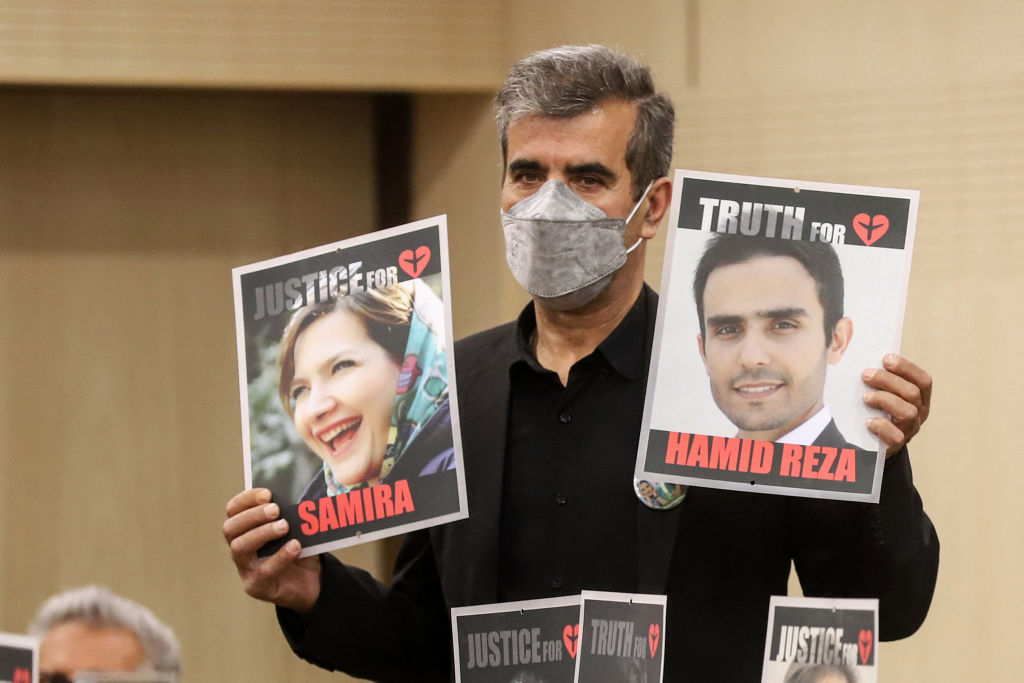
Relatives of the victims of the Iranian armed forces' accidental downing of a civilian Ukrainian airliner have held a rally demanding justice for their loved ones.


Families of the victims of the Ukrainian airliner downing have demanded justice [Getty]


Families of those who died when Iranian armed forces shot down a Ukrainian airliner two years ago demanded justice for the 176 victims at a commemoration in Tehran on Saturday.

Ukraine International Airlines flight PS752 was shot down shortly after take-off from Tehran's Imam Khomeini airport on January 8, 2020, killing all 176 people on aboard. Most were Iranians and Canadians, including many dual nationals.

Three days later, the Islamic republic's armed forces admitted to downing the Kyiv-bound plane "by mistake."

Relatives of the victims gathered at the crash site near the airport to mark the anniversary, local media reported.

They held up pictures of their loved ones, laid flowers and lit candles in their memory, while calling for "Justice! Truth!", videos shared on social media showed.

State television separately published an interview with the mother of Zahra Hassani Saadi, who died in the crash, in which she questioned the authorities' handling of the case.

"We have several questions, who will answer us? Why wasn't the flight cancelled? Why was the cruise missile fired? We don't know and no one explained it to us," she asked.

At another gathering, held inside the airport on Saturday, relatives called for a "fair investigation" into the incident, ILNA news agency reported.

On Friday a commemoration was held in Tehran's largest cemetery, Behesht-e-Zahra.

"We hope that the legal process of this case will end soon in the judiciary, so that the ones who made the error can be identified, and this will reduce the suffering of the bereaved families," state news agency IRNA quoted Vice President Amir Hossein Ghazizadeh Hashemi as saying there.

At the time of the incident Iranian air defences were on high alert for a US counterattack after Tehran fired missiles at a military base in Iraq that was used by American forces.

Those missiles came in response to the killing of Major General Qasem Soleimani in a US drone strike near Baghdad's international airport. Soleimani headed the foreign operations arm of Iran's Islamic Revolutionary Guard Corps.

Iran's judiciary said in November that a trial had opened in Tehran for 10 military members in connection with the jet's downing.

On Friday Iranian officials said payments of $150,000 have started to be made to victims' families.

Separately, a Canadian court awarded more than $80 million in compensation to the families of six of the victims in a decision made public Monday.
Colorado’s Suburban Firestorm Shows the Threat of Climate-Driven Wildfires is Moving Into Unusual Seasons and Landscapes

Backyard fences, decks and landscaping helped spread the flames through suburban neighborhoods and shopping malls baked by global warming.


By Bob Berwyn
January 7, 2022

The Marshall Fire continued to burn out of control on Dec. 30, 2021 in Broomfield, Colorado. Credit: RJ Sangosti/MediaNews Group/The Denver Post via Getty Images

When he saw smoke in the air around Boulder, Colorado on Dec. 30, Tom Veblen walked up a trail near his home to check it out. Veblen, a professor emeritus of geography at the University of Colorado Boulder who has been studying forest ecology, wildfires and climate change since the mid-1970s, said he could see that the Marshall Fire, on the southern edge of the city, was already jumping over distances of several hundred yards.

The winds were so strong that he said he struggled to open his car door, and to stay on his feet in the powerful gusts. Wooden fences separating yards in the suburbs sprawling in the distance looked like burning fuses, as winds gusting faster than 100 mph pushed the flames along them to ignite decks, roofs and residential landscaping. The firestorm would eventually engulf shopping malls and a hotel.

As a resident of a neighborhood he had previously believed to be a safe distance from the fire-prone forests, Veblen felt a sudden and unfamiliar sense of vulnerability.

“Sure, I knew that Chinook winds could drive winter grassland fires to spread very rapidly, but in the past we just did not have all the driving factors align so perfectly—wet spring producing abundant grass fuels, one of the warmest and driest June-Decembers on record and then an ignition at the base of the mountains.” Local topography also contributed to the intensity, with a canyon opposite the fire acting like a nozzle, blasting winds from the peaks onto the flames and pushing the fire east into suburban neighborhoods.

The Marshall Fire ultimately burned some 6,200 acres, destroying at least 1,084 homes and seven commercial structures, before it was largely smothered by a New Year’s Eve snowfall. On Wednesday, investigators reported they had found partial human remains assumed to be those of one of the two people still missing after the fire. Insured losses are estimated at about $1 billion, making it Colorado’s most destructive fire on record in terms of property loss.

In the days since the fire, Veblen said he’s had many conversations with neighbors and friends, some feeling a combination of survivor’s guilt and post traumatic stress disorder, and all wondering how worried they should be about wildfires burning into suburbia in the future.

“I told them that, this winter, we’re probably going to be OK,” he said. But with the warming and drying climate shortening the snow season and desiccating grasses and brush more each year, chances are growing that similar drought, heat and wind will align more frequently to drive wildfires into the cold seasons and developed landscapes where they were once rare.

In the meantime, few residents of rapidly expanding suburbs in which most of the vegetation has been planted by homeowners and developers realize that they are living in an expanding “Wildland Urban Interface,” or WUI, in which wildfires can threaten their homes and lives. In some areas with little natural vegetation, wooden fences and decks, wood-framed houses, flammable roofs and landscaping are the biggest source of fuel, which can burn down into glowing chunks that are lofted by high winds to help a fire hopscotch through neighborhoods.

“We could have another fire starting in Sunshine Canyon in some of those grassy areas and burn right down into Boulder,” he said. “We could call it a freak event, but we know that it’s not. It’s just a matter of those conditions setting up again.”
Jordan Hymes gets a hug from her grandmother Nancy Grigon, left, as her grandfather Guy, right, looks towards their burned out subdivision in the Coal Creek Ranch subdivision in the aftermath of the Marshall Fire on Dec. 31, 2021 in Louisville, Colorado. Hymes and her family lost their home of ten years. The fire may have potentially burned 1,000 homes and numerous business. The fast moving fire was stocked by extremely dry drought conditions and fierce winds, with gusts topping 100 mph, along the foothills. Credit: Helen H. Richardson/MediaNews Group/The Denver Post via Getty Images

A visit Friday to the towns devastated by the Marshall Fire by President Biden, Colorado Gov. Jared Polis and Rep. Joe Neguse (D-Boulder), could help jump-start the conversations needed to address the threat, he said.

“The important message our society needs to hear from them is that this is an example of a climate-enabled event, and the probability of similar events will continue to increase as we have continued warming,” he said. “Unless we keep fossil fuels in the ground, these events are going to get more frequent and worse.”
New Climate, New Fuels and New Fires

“It’s clear the climate change is increasing the likelihood of these types of events,” said University of Montana fire ecologist Phil Higuera, who is currently a visiting fellow at the Cooperative Institute for Research in Environmental Sciences at the University of Colorado, Boulder, studying the relative influence of climate, vegetation and human activity on wildfire trends.

“What I don’t want to see is a reaction of, ‘Oh, this is such an extreme event that we can’t do anything about it,’” he said. “Yes, this fire was very bad luck, but we shouldn’t be rolling the dice with fire in December.”

Yet research, including a landmark 2019 study of fire weather indices, shows that global warming is loading those dice for more winter fires. Warmer temperatures and decreasing precipitation increasingly leave fuels like trees and brush tinder dry late in autumn and early winter, and increase the probability that snow-free Decembers will leave grasses, decks and roofs uncovered and vulnerable to wind-driven sparks and embers that could ignite them.

What used to be the start of the season that brought snow to the West and cool, rainy conditions to many other parts of the country is now sometimes more like late summer. Even if global warming didn’t ignite the Marshall Fire, “there really is a seasonality change that is the main climate factor,” said UCLA climate researcher Daniel Swain, who studies extremes like fires and floods. “Usually by this time of year, there is just more moisture on the ground.”

For more than 20 years the region has endured alarmingly rapid aridification that has shrunk snowpacks, dried up river flows and lowered groundwater levels. Denver, just south of the Marshall Fire, experienced one of its longest snowless stretches on record just prior to the blaze, while much of the West blistered through an extreme autumn heat wave.

Winter fires are not unheard of in Colorado, or in grassland like where the Marshall Fire was first sighted, Swain noted.

“That is not quite as surprising as what happened next,” he said. “It started there, burned a few hundred acres within 10-15 minutes, then it came across shopping malls … a significant extent of tract homes, a fair bit of vegetation in people’s yards and city parks. This is not a wild place, not a remote place.”

“That’s why we get these eerie images,” he said, alluding to social media posts of people fleeing from shopping mall pizza parlors and medical workers watching the fire from a hospital window as near-hurricane force wind gusts pushed fire and smoke plumes east into the towns of Superior, with a population of 13,077, and Louisville, with 20,860 residents.

The images of fires around shopping malls are jarring, Swain said, “And yet as bewildering as it is, we’ve seen it in any number of large, wind-driven fires in recent years.”

Swain said several recent California fires were similar to the Marshall Fire, including the 2017 Tubbs Fire that burned more than 5,000 structures in Santa Rosa, the 2018 Camp Fire that killed more than 80 people when it destroyed the town of Paradise, and the Carr Fire, also in 2018, which jumped the Sacramento River in Northern California to spread into Redding, a city of 90,000 people.

Swain said the temperatures on the day of the Marshall Fire ignited were unremarkable for December in Boulder, with highs in the 40s. But that contrasted sharply with a “multi-month period of almost continuously balmy and record-warm temperatures leading up to this event, with many days making into the 60s and 70s during October and November and overnight lows rarely getting below freezing,” he said. “It was those antecedent record warm and dry conditions that were key in setting the stage.”

And the winds that drove the fire were like nothing he had ever encountered before. “The strongest I have ever experienced anywhere in the world while outdoors,” said Swain, who had to wear protective glasses to protect his eyes from airborne pebbles and roof shingles, with gusts “rushing downward over the Front Range foothills, creating very erratic windflow and occasional tornado-strength vortices. At one point, I witnessed one of these clear-air vortices cross the road and uproot a tree.”

With the increasing confluence of extreme fire weather conditions like high winds and extended droughts and heat waves, “there are a lot of places that are at similar risk, including many of the suburban areas around the Front Range,” Swain said. “But it’s really hard to prepare. There aren’t any simple interventions.”
Preparing for Wildfires in Suburbia

One part of the solution clearly lies in revising building codes to ensure that most construction and landscaping materials are non-flammable, even in areas that appear to be far from wildfire threats, said Veblen, an expert in the geography of fire. Such measures are becoming more common in areas where fire hazards are widely recognized, and the destruction of the Marshall Fire could inform how the boundaries of those zones are drawn in the future.

Since fires cross between jurisdictions, Veblen said that state rules would be most useful, but are unlikely to happen in Colorado, a home rule state where most land use decisions are made by local governments. So that leaves it up to county commissioners, “who need to feel they have the political support of the people so they can resist the influence of the building and real estate interests, which nearly always oppose any mandatory measures that make building more costly,” he said.

A meaningful change to building practices could also be spurred by the insurance industry, which could make sure that people who, for example, build with flame-resistant brick, pay less for fire insurance policies than those who build with flammable materials.

Apart from the built environment, he said the Marshall Fire will also trigger some “serious rethinking” of wildfire mitigation and the management of open space and parklands, which are among the key amenities that make the nearby homes desirable in the first place.

“We know that up until 1950 it was mostly ranchland,” he said, with grazing cattle keeping grasses short and less prone to fire. Residential development started after World War II and accelerated in the 1970s.

“The most important thing we’ve done is change the fuels by putting structures all over the foothill ecotone,” Veblen said. Some early reports on the Marshall Fire suggest the fire may have slowed down when it reached one of the few small areas where cattle still munch the grass, so it could be that managed grazing could be a fire mitigation strategy, he added. Restoring wetlands and stream corridors to the point that they sustain live vegetation could also help by adding moist fire buffers to the landscape.

The Marshall Fire and similar blazes burning in unusual landscapes and seasons could also challenge assumptions about how to reduce the wildfire hazard in areas far from the towns that burned—the fire-prone zone where forests spill off the lower slopes of the Rockies onto the plains. There, the long-standing thinking has been to thin woody fuels.

“But if you thin out ponderosa pine, it increases resources for grass to grow,” Veblen said. “So we said, ‘Sure, let’s have some grass fires, that will be beneficial.’ But no one was thinking about this. Wow, this fire event is changing my perspective on where it is or is not safe from fire.”


Bob Berwyn
Reporter, Austria
Bob Berwyn an Austrian-based freelance reporter who has covered climate science and international climate policy for more than a decade. Previously, he reported on the environment, endangered species and public lands for several Colorado newspapers, and also worked as editor and assistant editor at community newspapers in the Colorado Rockies.


Social Media and Capitalism: People, Communities and Commodities

Co-publisher:Zand Graphics Ltd

There have been numerous studies done on social media or communication in general. However, most of these studies have neglected a recent and critical element of social media- Social Media Commerce. The present book is one of the first books to focus strictly and solely upon this phenomenon of social accumulation of profits through promoting commercial activities on social media. In this regard, the book presents itself to be a pioneering study within Digital Capitalism Studies.

The introduction will lay out the basics of how communication is being used by capitalism to further oppression and exploitation. It will primarily talk about digital capitalism and the relationship which digital capitalism shares with labour within the society. The introduction will provide a basic framework within which the subsequent chapters can be located. Some of the concepts and ideas which will be highlighted in the introduction are:

  1. Digital Capitalism
  2. Usage of Communication as a means of production
  3. Societal Alienation within digital capitalism
  4. The element of “Accumulation” within digital capitalism and its importance within capitalism.

The introduction will also provide an overview of Marxist-Humanist theory along with a brief history of its formation. The chapter will initially highlight some of the aspects of the work of Raya Dunayevskaya, the pioneer of the Marxist-Humanist theory. Taking cue from that, the chapter will then mainly discuss Henri Lefebvre, Herbert Marcuse and Erich Fromm, especially the aspects of their work relevant to current book. The chapter will also point out theoretical advances made by contemporary Marxist-Humanists like Kevin Anderson and Peter Hudis.

The first chapter looks at the element of social media commerce in general. It will, at first, explain the fundamental aspects of “Social Media Commerce” and its differences with other modes of digital commercial activities such as e-commerce websites and used-goods-digital storefronts. It will present a chronological description of the evolution of social media commerce, specifically ‘Facebook marketplace’. The chapter will explore the political economic perspective of this mode of commerce and its intersections with the revenue model based on targeted advertisements. The chapter will introduce some of the central concepts used in the book, namely:

  1. Social Media Commerce
  2. Real Subsumption
  3. Social Media as a techno-social system

The second chapter will emphasise the theory of ‘property’. It will highlight the various theories regarding how property has been conceptualised.

This chapter will lay out the differences between personal and private property within capitalist social structures. The chapter will take references primarily from Marx’s Capital (All 3 Volumes) along with some of Engels’ works. In addition, the chapter will also provide an overview of the anarchist idea of property, mainly focusing on Proudhon and his debate with Marx and Engels. The final section of this chapter will also outline a theory of ‘digital and information’ property, which will be engaged with in details

The third chapter will focus on the usage of social media commerce within the Global North, primarily focusing on the study conducted by the author in Aotearoa New Zealand. The chapter will talk about how social crisis and human needs play a part in making these practices popular within the non-capitalist classes. Apart from the general results of the study which has used volunteer sampling and in-depth interviews to gather the qualitative data, two detailed accounts of social media commercial sellers will also be included. One of the two subjects of the study is an immigrant from the east, which will aid in establishing the relationship between race and social media commerce.

The chapter will emphasise the concept of “Property” within capitalism and the relationship between personal and private property from a political economic perspective. The chapter will analyse the relationship between these digital platforms and the other tangible methods of profit accumulation within capitalist and semi-capitalist economies. Finally, the chapter will put forward how under real subsumption, contemporary capitalism has transformed itself by inventing new modes of accumulation, which hinge upon dissolving the differences between personal and private property holdings.

The final pre-conclusive chapter attempts to provide an overview of how accumulation proceeds through social media within the Global South. This chapter will be primarily based on the study conducted by the author within the city of Hyderabad in India, with questions similar to those used in the case of the Global North. This chapter will emphasise upon the concept of “freedom” from a Hegelian-Marxist perspective and its manipulation within social media commerce by capitalism. The methodology adopted for the chapter will remain same as that of the previous chapter, i.e., volunteer sampling along with in-depth interviews, a rationale for which will be provided.

The chapter will analyse, or rather evaluate, the various elements of socio-economic crisis and human needs, as laid out in the previous chapter, within the context of the Global South. In doing so, this chapter will present a comparative analysis of social media commerce and its associated processes within the Global North and the Global South. The chapter will emphasise the various aspects of social structures, which play a pivotal role within capitalist accumulation processes. Specifically speaking, the third chapter will be about creating an intellectual dialogue between the Global North and the Global South, in terms of the relevance and usage of social media commerce by capitalism in both the contexts.

The conclusion will start with putting forward the importance of digital spaces within the general social space. Taking cue from this, the conclusion will talk about how abject alienation within the social spaces renders the alienation within these digital spaces invisible. The chapter will mainly focus on the perspectives developed by Raya Dunayevskaya and Henri Lefebvre, in putting forward a Marxist-Humanist account of contemporary capitalist exploitation within digital capitalism. The conclusion will bring out the importance of human subjectivity in addressing the questions of capitalist exploitation.

The conclusion will also focus on the factors of the successes of models like AIRBNB, in the Global North, and Oyo Rooms, in India. By doing so the conclusion will present a causal relationship between social alienation and the success of these models of capitalist exploitation. At the end, the conclusion will proceed towards analysing the usage of established communicative networks by capitalism to exploit the working class both digitally and physically, and the need of addressing this mode of exploitation from a Marxist-Humanist perspective, which takes an adequate cognisance of both human subjectivity and political economy.


Table of Contents

Introduction: Marxist-Humanist Theory

Chapter 1 Social Media and the Commerce Therein

Chapter 2 The Theory of Property

Chapter 3 Accumulation in the Global North

Chapter 4 Accumulation in the Global South

Conclusion: Marxist-Humanist Approach to the Issue

Notes

Appendices

Bibliography

ISBN Print: 978-1-988832-89-0
ISBN eBook: 978-1988832-90-6
Publication Date: August 2021
Binding Type: Soft Cover
Trim Size: 6in x 9in
Language: English
Colour: B&W


For retail trade, library, university and college bookstores in:

You can also order many of our books at https://www.lulu.com/shop

For all other enquiries, contact info@darajapress.com.