Tuesday, February 15, 2022

Fukushima Takes a Turn for the Worse


 Facebook

Photograph Source: IAEA Imagebank – CC BY 2.0

Tokyo Electric Power Company-TEPCO- has been attempting to decommission three nuclear meltdowns in reactors No. 1 No. 2, and No. 3 for 11 years now. Over time, impossible issues grow and glow, putting one assertion after another into the anti-nuke coffers.

The problems, issues, enormous danger, and ill timing of deconstruction of a nuclear disaster is always unexpectedly complicated by something new. That’s the nature of nuclear meltdowns, aka: China Syndrome debacles.

As of today, TEPCO is suffering some very serious setbacks that have “impossible to deal with” written all over the issues.

Making all matters nuclear even worse, which applies to the current mess at Fukushima’s highly toxic scenario, Gordon Edwards’ following statement becomes more and more embedded in nuclear lore: “It’s impossible to dispose of nuclear waste.” (Gordon Edwards in The Age of Nuclear Waste From Fukushima to Indian Point)

Disposing of nuclear waste is like “running in place” to complete a marathon. There’s no end in sight.

As a quickie aside from the horrendous details of the current TEPCO debacle, news from Europe brings forth the issue of nuclear power emboldened as somehow suitable to help the EU transition to “cleaner power,” as described by EU sources. France supports the crazed nuke proposal but Germany is holding its nose. According to German Environment Minister Steffi Lemke: “Nuclear energy could lead to environmental disasters and large amounts of nuclear waste. (Source: EU Plans to Label Gas and Nuclear Energy ‘Green’ Prompts Row, BBC News, Jan. 2, 2022) Duh!

Minister Lemke nailed it. And, TEPCO is living proof (barely) of the unthinkable becoming thinkable and disastrous for humanity. Of course, meltdowns are never supposed to happen, but they do.

One meltdown is like thousands of industrial accidents in succession over generations of lifetimes. What a mess to leave for children’s children’s children over several generations. They’ll hate you for this!

In Fukushima’s case, regarding three nuclear power plants that melted all-the-way (China Syndrome), TEPCO still does not know how to handle the enormously radioactive nuclear fuel debris, or corium, sizzling hot radioactive lumps of melted fuel rods and container material in No. 1, No 2 and No.3, They’re not even 100% sure where all of the corium is and whether it’s getting into underground water resources. What a disaster that would be… what if it is already… Never mind.

The newest wrinkle at TEPCO involves the continuous flow of water necessary to keep the destroyed reactors’ hot stuff from exposure to air, thus spreading explosively red-hot radioactivity across the countryside. That constant flow of water is an absolute necessity to prevent an explosion of all explosions, likely emptying the streets of Tokyo in a mass of screaming, kicking, and trampling event to “get out of town” ASAP, commonly known as “mass evacuation.”

The cooling water continuously poured over the creakily dilapidated ruins itself turns radioactive, almost instantaneously, and must be processed via an Advanced Liquid Processing System (ALPS) to remove most radioactive materials (???) housed in a 17-meter (56 feet) tall building on the grounds of the disaster zone.

Here’s the new big danger, as it processes radioactive contaminated water, it flushes out “slurry” of highly concentrated radioactive material that has to go somewhere. But where to put it?

How to handle and dispose of the radioactive slurry from the ALPS is almost, and in fact may be, an impossible quagmire. It’s a big one as the storage containers for the tainted slurry quickly degrade because of the high concentration of radioactive slurry. These storage containers of highly radioactive slurry, in turn, have to be constantly replaced as the radioactivity slurry eats away at the containers’ liners.

Radioactive slurry is muddy and resembles a shampoo in appearance, and it contains highly radioactive Strontium readings that reach tens of millions of Becquerel’s per cubic centimeter. Whereas, according to the EPA, 148 Becquerel’s per cubic meter, not centimeter, is the safe level for human exposure. Thus, tens of millions per cubic centimeter is “off the charts” dangerous! Instant death, as one cubic meter equals one million cubic centimeters. Ahem!

Since March 2013, TEPCO has accumulated 3,373 special vessels that hold these highly toxic radioactive slurry concentrations. But, because the integrity of the vessels deteriorates so quickly, the durability of the containers reaches a limit, meaning the vessels will need replacement by mid-2025.

Making matters ever worse, if that is possible, the NRA has actually accused TEPCO of “underestimating the impact issue of the radioactivity on the containers linings,” claiming TEPCO improperly measured the slurry density when conducting dose evaluations. Whereas, the density level is always highest at the bottom, not the top where TEPCO did the evaluations, thus failing to measure and report the most radioactive of the slurry. Not a small error.

As of June 2021, NRA’s own assessment of the containers concluded that 31 radioactive super hot containers had already reached the end of operating life. And, another 56 would need replacement within the next 2 years.

Transferring slurry is a time-consuming highly dangerous horrific job, which exposes yet a second issue of unacceptable risks of radioactive substances released into the air during transfer of slurry. TEPCO expects to open and close the transfers remotely (no surprise there). But, TEPCO, as of January 2, 2022, has not yet revealed acceptable plans for dealing with the necessary transfer of slurry from weakening, almost deteriorated containers, into fresh, new containers. (Source: TEPCO Slow to Respond to Growing Crisis at Fukushima Plant, The Asahi Shimbun, January 2, 2022)

Meanwhile, additional batches of a massive succession of containers that must be transferred to new containers will be reaching the end of shelf life, shortly.

Another nightmarish problem has surfaced for TEPCO. Yes, another one. In the aftermath of the 2011 blowup, TEPCO stored radioactive water in underground spaces below two buildings near reactor No.4. Bags of a mineral known as zeolite were placed to absorb cesium. Twenty-six tons (52,000 lbs.) of bags are still immersed with radiation readings of 4 Sieverts per hour, enough to kill half of all workers in the immediate vicinity within one hour. The bags need to be removed.

TEPCO intends to robotically start removing the highly radioactive bags, starting in 2023, but does not know where the bags should be stored. Where do you store radioactive bags containing enough radioactive power to kill someone within one hour of exposure?

Additionally (there’s more) the amount of radioactive rubble, soil, and felled trees at the plant site totals 480,000 cubic meters, as of 2021. TEPCO is setting up a special incinerator to dispose of this. Where to dispose of the incinerated waste is unknown. This is one more add-on to the horrors of what to do with radioactive material that stays hot for centuries upon centuries. Where to put it?

Where to put it? Which is the bane of the nuclear power industry. For example, America’s nuke plants are full of huge open pools of water containing tons of spent nuclear fuel rods. If exposed to open air, spent fuel rods erupt into a sizzling zirconium fire followed by massive radiation bursts of the most toxic material known to humanity. It can upend an entire countryside and force evacuation of major cities.

According to the widely recognized nuclear expert Paul Blanch: “Continual storage in spent fuel pools is the most unsafe thing you could do.” (see- Nuclear Fuel Buried 108 Feet from the Sea, March 19, 2021)

It’s not just Fukushima that rattles the nerves of people who understand the high-risk game of nuclear power. America is loaded with nuclear power plants with open pools of water that hold highly radioactive spent fuel rods.

What to do with it?

Robert Hunziker lives in Los Angeles and can be reached at rlhunziker@gmail.com.

The Smearing of Emma Watson


 Facebook

Drawing by Nathaniel St. Clair

Anyone who has ever been critical of Israeli actions toward the Palestinian people knows what to expect next—an avalanche of pit-bull attacks and smears that their criticisms of Israel are motivated by racism and anti-Semitism. The latest example is the response to actress Emma Watson’s pro-Palestinian Instagram post, which led (predictably) to Israeli officials and supporters accusing her of anti-Semitism. Among many others, former Israeli UN Representative Danny Danon—in a tone-deaf post—wrote, “10 points from Gryffindor for being an antisemite.”

The purpose of such false accusations is of course to deflect attention away from what is happening on the ground—the real (war) crimes that Israel is perpetrating against the Palestinian people—to the supposed motivations of the critics. Unable to defend its criminal actions, all that Israel’s increasingly desperate defenders have left is smear and innuendo, as the attacks on Emma Watson make clear.

But the accusations may also have some other unintended consequences—they make real anti-Semitism (the right-wing fascist variety that really does hate Jews as Jews) more respectable and legitimate—and thus even more deadly. In that sense, the Zionist defenders of Israel are among the most dangerous purveyors of contemporary anti-Semitismthe hatred of Jews as a collective.

There are two steps to how these unintended consequences are blundered into.

First, there is the claim that Israel and Jewishness are the same thing—that Israel is not the state of all its citizens but is the state of the Jewish people alone. The nation-state law, passed in 2018—which gives Jews alone the right of self-determination in Israel, recognizing Hebrew as the sole official national language, and establishing “Jewish settlement as a national value”—makes the link between the Israeli state and Jewishness formal and official. Similarly, the widely adopted International Holocaust Remembrance Alliance (IHRA) definition of anti-Semitism cites one example as “the targeting of the state of Israel, conceived as a Jewish collectivity” and has a similar thrust—Israel equals Jews.

The second step is the increasing visibility of Israeli violence toward Palestinians. Although Israeli propaganda had succeeded for decades in deflecting mainstream attention away from Israel’s crimes, the cloak of invisibility created by its public relations efforts—its hasbara—is disintegrating before the force of reality, its own increasingly cruel and vicious actions, as well as the work of the growing number of pro-Palestinian activists around the world who are using the power of social media to bypass the normal media gatekeepers. While anyone with a passing knowledge of the situation has long known about the brutal matrix of violence and control—from the river to the sea—exerted by Israel over the Palestinian population, that understanding is now increasingly visible and mainstream. (As evidence of this, Emma Watson’s post quickly drew over 1 million likes.)

The problem for all of us, not just Israel, is when these two things are put together—the equation of Israel with Jews and the visibility of Israeli atrocities—then Jews as a whole become tarred with the crimes of the Israeli state. As the Israeli journalist Gideon Levy wrote in 2015, “Some of the hatred toward Jews elsewhere in the world—emphatically, only some and not all of it—is fed by the policies of the state of Israel and especially by its continuing occupation and abuse, decade after decade, of the Palestinian people.”

In this process, the danger is that actually existing anti-Semitism is being made more respectable as there seems to be some rational basis for it—Israeli atrocities. At a time when the real and dangerous anti-Semitism of the fascist right is on the rise—remember the white supremacist Charlottesville thugs were chanting “Jews will not replace us”—the last thing that is needed is to give it any sheen of respectability, as, albeit unwittingly, do those who insist on the indissoluble link between the brutal violence of the Zionist project and Jewishness.

Such a link is of course nonsense. Jews of all political stripes have long been on the front lines of the fight against the racist Zionist enterprise, insisting that it has no part in their own Jewish values based on a belief in universal—not particular—human rights. It is why groups such as Rabbis for Human Rights act as human shields against the attacks on Palestinians by settlers and the Israel Defense Forces. The fight against Israeli policies and Zionist violence is driven by the concerns of social justice and solidarity, not racism toward Jews.

Emma Watson is part of an exponentially fast-growing choir of decent like-minded men and women of good faith all over the world, united in their belief that all people, irrespective of their ethnicity or their religion or their nationality, must have inalienable human rights, including the right to life and liberty and self-determination, from every river to every sea everywhere. That includes the long-suffering people of Palestine. The attempted weaponization of anti-Semitism against this movement not only weakens the term as a description of real fascist racism, but in fact serves to legitimate it. If criticizing cruel Israeli policies toward the Palestinians is anti-Semitic, then what is so wrong with anti-Semitism, so this misguided line of thinking goes. As Robert Fisk once noted, “if this continued campaign of abuse against decent people, trying to shut them up by falsely accusing them of anti-Semitism, continues, the word ‘anti-Semitism’ will begin to become respectable. And that is a great danger.”

The solution to this is clear: break the erroneous link between Israel and all Jews (between Israel and Judaism) and concentrate on the reality that the Zionist enterprise is an old-fashioned settler-colonial project—driven in large part by the geopolitical interests of its principal sponsor, the United States. Once we eliminate the obfuscation and confusion that result from the lazy (but calculated) accusation of anti-Semitism, the building of an unstoppable international movement of justice for the Palestinians can continue. Let’s get to it!

This article was produced by Globetrotter.

Sut Jhally is professor emeritus at the University of Massachusetts at Amherst and founder and executive director of the Media Education Foundation. Roger Waters is a musician.

The Terrible Fate Facing the Afghan People


 Facebook

Photograph Source: DVIDSHUB – CC BY 2.0

On February 8, 2022, UNICEF (the United Nations Children’s Fund) Afghanistan sent out a bleak set of tweets. One of the tweets, which included a photograph of a child lying in a hospital bed with her mother seated beside her, said: “Having recently recovered from acute watery diarrhea, two years old Soria is back in the hospital, this time suffering from edema and wasting. Her mother has been by her bedside for the past two weeks anxiously waiting for Soria to recover.” The series of tweets by UNICEF Afghanistan show that Soria is not alone in her suffering. “One in three adolescent girls suffers from anemia” in Afghanistan, with the country struggling with “one of the world’s highest rates of stunting in children under five: 41 percent,” according to UNICEF.

The story of Soria is one among millions; in Uruzgan Province, in southern Afghanistan, measles cases are rising due to lack of vaccines. The thread to the tweet about Soria from UNICEF Afghanistan was a further bleak reminder about the severity of the situation in the country and its impact on the lives of the children: “without urgent action, 1 million children could die from severe acute malnutrition.” UNICEF is now distributing “high energy peanut paste” to stave off catastrophe.

The United Nations has, meanwhile, warned that approximately 23 million Afghans—about half the total population of the country—are “facing a record level of acute hunger.” In early September, not even a month after the Taliban came to power in Kabul, the UN Development Program noted that “A 10-13 percent reduction in GDP could, in the worst-case scenario, bring Afghanistan to the precipice of near universal poverty—a 97 percent poverty rate by mid-2022.”

The World Bank has not provided a firm calculation of how much of Afghanistan’s GDP has declined, but other indicators show that the threshold of the “worst-case scenario” has likely already passed.

When the West fled the country at the end of August 2021, a large part of the foreign funding, which Afghanistan’s GDP is dependent on, also vanished with the troops: 43 percent of Afghanistan’s GDP and 75 percent of its public funding, which came from aid agencies, dried up overnight.

Ahmad Raza Khan, the chief collector (customs) in Khyber Pakhtunkhwa in Pakistan, says that exports from his country to Afghanistan have dropped by 25 percent; the State Bank of Pakistan, he says, “introduced a new policy of exports to Afghanistan on December 13” that requires Afghan traders to show that they have U.S. dollars on them to buy goods from Pakistan before entering the country, which is near impossible to show for many of the traders since the Taliban has banned the “use of foreign currency” in the country. It is likely that Afghanistan is not very far away from near universal poverty with the way things stand there presently.

On January 26, 2022, UN Secretary-General António Guterres said that “Afghanistan is hanging by a thread,” while pointing to the 30 percent “contraction” of its GDP.

Sanctions and Dollars

On February 7, 2022, Taliban spokesperson Suhail Shaheen told Sky News that this perilous situation, which is leading to starvation and illness among children in Afghanistan, “is not the result of our [Taliban] activities. It is the result of the sanctions imposed on Afghanistan.”

On this point, Shaheen is correct. In August 2021, the U.S. government froze the $9.5 billion that Afghanistan’s central bank (Da Afghanistan Bank) held in the New York Federal Reserve. Meanwhile, family members of the victims who died in the 9/11 attacks had sued “a list of targets,” including the Taliban, for their losses and a U.S. court later ruled that the plaintiffs be paid “damages” that now amount to $7 billion. Now that the Taliban is in power in Afghanistan, the Biden administration seems to be moving forward “to clear a legal path” to stake a claim on $3.5 billion out of the money deposited in the Federal Reserve for the families of the September 11 victims.

The European Union followed suit, cutting off $1.4 billion in government assistance and development aid to Afghanistan, which was supposed to have been paid between 2021 and 2025. Because of the loss of this funding from Europe, Afghanistan had to shut down “at least 2,000 health facilities serving around 30 million Afghans.” It should be noted here that the total population of Afghanistan is approximately 40 million, which means that most Afghans have lost access to health care due to that decision.

During the entire 20-year period of the U.S. occupation of Afghanistan, the Ministry of Public Health had come to rely on a combination of donor funds and assistance from nongovernmental organizations (NGOs). It was as a result of these funds that Afghanistan saw a decline in infant mortality and maternal mortality rates during the Afghanistan Mortality Survey 2010. Nonetheless, the entire public health care system, particularly outside Kabul, struggled during the U.S. occupation. “Many primary healthcare facilities were non-functional due to insecurity, lack of infrastructure, shortages of staff, severe weather, migrations and poor patient flow,” wrote health care professionals from Afghanistan and Pakistan, based on their analysis of how the conflict in Afghanistan affected the “maternal and child health service delivery.”

Walk Along Shaheed Mazari Road

On February 8, 2022, an Afghan friend who works along Shaheed Mazari Road in Kabul took me for a virtual walk—using the video option on his phone—to this busy part of the city. He wanted to show me that in the capital at least the shops had goods in them, but that the people simply did not have money to make purchases. We had been discussing how the International Labor Organization now estimates that nearly a million people will be pushed out of their jobs by the middle of the year, many of them women who are suffering from the Taliban’s restrictions on women working. Afghanistan, he tells me, is being destroyed by a combination of the lack of employment and the lack of cash in the country due to the sanctions imposed by the West.

We discuss the Taliban personnel in charge of finances, people such as Finance Minister Mullah Hidayatullah Badri and the governor of the Afghanistan central bank Shakir Jalali. Badri (or Gul Agha) is the money man for the Taliban, while Jalali is an expert in Islamic banking. There is no doubt that Badri is a resourceful person, who developed the Taliban’s financial infrastructure and learned about international finance in the illicit markets. “Even the smartest and most knowledgeable person would not be able to do anything if the sanctions remain,” my friend said. He would know. He used to work in Da Afghanistan Bank.

“Why can’t the World Bank’s Afghanistan Reconstruction Trust Fund (ARTF) be used to rush money to the banks?” he asked. This fund, a partnership between the World Bank and other donors, which was created in 2002, has $1.5 billion in funds. If you visit the ARTF website, you will receive a bleak update: “The World Bank has paused disbursements in our operations in Afghanistan.” I tell my friend that I don’t think the World Bank will unfreeze these assets soon. “Well, then we will starve,” he says, as he walks past children sitting on the side of the street.

This article was produced by Globetrotter.

Vijay Prashad’s most recent book (with Noam Chomsky) is The Withdrawal: Iraq, Libya, Afghanistan and the Fragility of US Power (New Press, August 2022).

The Case for Equal Protections for Wolves Throughout Their Range


 Facebook

Gray wolf. Photo: Jeffrey St. Clair.

Last week, the U.S. District Court of Northern California handed down a landmark ruling that struck down the Trump administration’s nationwide de-listing of wolves under the Endangered Species Act. Hailed as a major conservation victory, the ruling grants strong federal protections in the Great Lakes region and along the West Coast, as well as some Interior West states where wolf populations are just beginning to establish themselves. Unfortunately, the court ruling does nothing to curb the extinction agendas of the state governments in Idaho, Wyoming and Montana – the states where the threats to wolves are greatest.

If wolves deserve federal protections across the vast majority of the United States, based on the the best available science, then the need for federal oversight is even more compelling in these three states. The Biden administration now has the opportunity – indeed, the responsibility – to protect wolves under the Endangered Species Act throughout the western states, providing equal protection under the law.

All three states recently changed their laws and regulations to maximize the slaughter of wolves, seeking to turn back the clock and repeat the 19th Century wolf extinction policies cooked up by the livestock industry and a handful of rabidly anti-wolf hunting organizations.

Wyoming is the original bad-actor state, and adopted a state management plan that marks wolves for extinction across 85% of the state. It also subjected the remainder (the lands surrounding Yellowstone and Grand Teton National Parks) to aggressive levels of trophy hunting. Under this plan, it is perfectly legal to kill a wolf at any time of year, by multiple means, without so much as a bag limit or even a hunting license. It was Wyoming that showcased the horrific practice of “coyote whacking,” running down both wolves and coyotes with snowmobiles repeatedly, until they are killed. When a Wyoming legislator introduced a bill to ban this practice, it was swiftly killed in committee, granting a level of legislative approval to a barbaric practice that should land the offender in prison.

Idaho is doing its best to catch up, with the legislature passing a bill taking control of wolf management – over the objections of its own Fish and Game Commission – and authorizing year-round trapping throughout much of the state and allowing trophy hunters to purchase unlimited quantities of wolf tags with a goal of eliminating 90% of the state’s wolf population. The bill authorizes hunters to pursue wolves on ATVs and snowmobiles, allows aerial gunning, and allows baiting and night-vision goggles to be used. Ignoring other pressing needs like education spending, the State of Idaho also authorized $1 million in taxpayer funds specifically to kill wolves.

In Montana, aggressive expansion of hunting and trapping seasons has resulted in a bloodbath at the hands of trophy hunters. Some 24 of the wolves who live in Yellowstone National Park – including the entire Phantom Lake Pack – have been killed over the past year after wandering across the Park boundary into unprotected Montana lands where trophy hunting is authorized. The Indigenous group Protect the Wolves petitioned the states of Montana and Wyoming to block hunting and trapping within a Sacred Resource Protection Zone extending for 31 miles around both Yellowstone and Grand Teton National Parks, but state governments showed depraved indifference for the fate of National Park wolves, beloved by millions of Americans, authorizing hunting to extend right up to Park boundaries. The killings not only disrupt social relationships among Yellowstone wolves, but also interfere with scientific studies and disrupt natural processes.

All three of these anti-wolf state governments are actively “managing” (a generous euphemism for this killing free-for-all) wolves down to their target of 15 packs in each state, a level that fails to maintain a minimum viable population of wolves in the region. It’s a recipe for extinction, which is exactly what the livestock producers and their allies want, and exactly what the Endangered Species Act is intended to prevent. Protecting wolves in eastern Washington and Oregon is also needed to prevent excessive wolf killings in reprisal for livestock losses.

Recently, conservationists petitioned the Biden administration to list wolves as endangered throughout the West. The agency issued a positive 90-day finding, acknowledging that substantial scientific information indicates that listing could be warranted. It’s now time for the U.S. Fish and Wildlife Service to follow through on its legal obligations and extend equal federal protections for wolves throughout the western states, including those states where the wolves are presently targeted most aggressively for elimination.

Erik Molvar is a wildlife biologist and is the Laramie, Wyoming-based Executive Director of Western Watersheds Project, a nonprofit group dedicated to protecting and restoring watersheds and wildlife on western public lands.

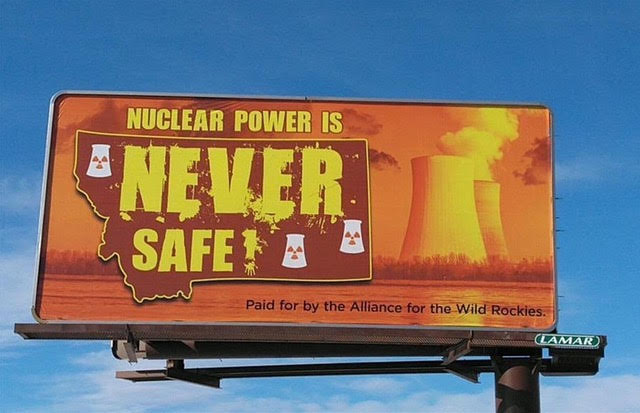
The Alliance needs your help to fight nuclear reactors in Montana


 Facebook


For the last 44 years nuclear power in Montana has been banned unless approved by the voters. The ban was passed by Citizen Initiative, but Republican majorities in the 2021 Montana legislature repealed the ban and Republican Governor Gianforte signed the bill into law. Now, these same Republicans want to build nuclear reactors in Montana to replace the dirty, obsolete coal-fired power plants at Colstrip. There are similar proposals for Wyoming’s shuttered coal plants as well as new reactors at the Idaho National Laboratory.

The Alliance for the Wild Rockies is fighting these proposals and we could really use some help! We have paid to put up two billboards so far and if you’d like to help keep Montana nuke-free it’s quick and easy to donate via our GoFundMe site. Any donation helps, but the more you donate the more we can fight nuclear power.

Many people – and unfortunately a growing number of so-called “green” organizations – see nuclear power as a great non-carbon source of electricity. But the former heads of nuclear regulatory bodies across Europe and the US put out a statement in January voicing their opposition to nuclear energy as a climate solution, writing: “The reality is nuclear is neither clean, safe or smart; but a very complex technology with the potential to cause significant harm. Nuclear isn’t cheap, but extremely costly.” They also added that nuclear power is “unlikely to make a relevant contribution to necessary climate change mitigation needed by the 2030s due to nuclear’s impracticably lengthy development and construction time-lines, and the overwhelming construction of the very great volume of reactors that would be needed to make a difference.”

Gregory Jaczko, former chairman of the US Nuclear Regulatory Commission confirmed that assessment, saying: “Nuclear has shown time and time again that it cannot deliver on promises about deployment and costs. And that’s really the most important factor when it comes to climate.” Jaczko also said we can replace carbon-producing electricity with renewables and he’s right. New renewable sources of electricity as well as ever-improving electricity storage capacity are being built on time and on budget and are generating affordable electricity, unlike nuclear reactors.

2021 report from Wall Street firm Lazard estimated the cost of new nuclear energy at $131 to $204 per megawatt-hour compared to an average cost of $27/MWh for utility-scale solar and $25/MWh for wind. The lower cost for renewable energy more than pays for electricity storage to back up renewable energy.

Mining uranium for nuclear reactor fuel is also dangerous since mining facilities produce tailings that are piled in impoundments close to the mine. These tailings pose serious environmental and health risks from radon emissions, windblown dust, and leaching of contaminants – including heavy metals and arsenic – into the water.

From 1944-1986 the United States extracted 4 million tons of uranium ore from 500 mines on Navajo land that were then abandoned. The rates of lung cancer and other diseases affecting Navajo people living near the mine rose drastically. The Navajo were able to stop uranium mining on their land but these problems still exist with other uranium mines today and should not be ignored in considering the future of nuclear energy.

Due to the fact that uranium is mined in other states and must be shipped into Montana, building nuke plants in Montana to replace the old coal-fired generators will impact people and the environment far from our borders. Moreover, Montana doesn’t need the power since we already export about half of the electricity we generate to other states. This is strictly a high-cost, high-risk scheme to replace 50-year old, uneconomical and environmentally destructive coal plants with uneconomical and dangerous nuclear reactors.
Bottom line is that building nuclear reactors at the headwaters of the greatest rivers in the nation is not just a concern for Montanans but also for all Americans. After all, we outlawed nukes 44 years ago until that ban was overturned last year by an arrogant and ignorant Republican-dominated Legislature and the first Republican governor in 16 years.

The choice is clear: We can and should focus on fighting global warming with conservation, renewable energy generation, and electricity storage – or we can go down an extremely expensive, environmentally-destructive path of nuclear energy that has failed time and time again while leaving behind a legacy of radioactive waste that remains deadly for thousands of years.

The Alliance for the Wild Rockies is working hard to stop the effort to build nuclear reactors in Montana – and we sure would appreciate it if you can find a few bucks to help us out. Thanks!

Mike Garrity is the executive director of the Alliance for the Wild Rockies.