Tuesday, February 15, 2022

Climate change: The Brazil resort town disappearing into the sea

Video by: Selina SYKES Issued on: 

Vultures roam the sand in the Brazilian resort town of Atafona amid the ruins of the latest houses destroyed by the sea, whose relentless rise has turned the local coastline into an apocalyptic landscape.

FEMICIDE
Afghanistan domestic abuse: Taliban closure of shelters leaves thousands at risk

Issued on: 15/02/2022 

Video by: Shirli SITBON

The Taliban authorities have shuttered shelter houses in Afghanistan since Aug. 6, eliminating the final sanctuary for Afghan women fleeing home violence and domestic abuse.
Thousands of nurses strike in Australia for higher wages

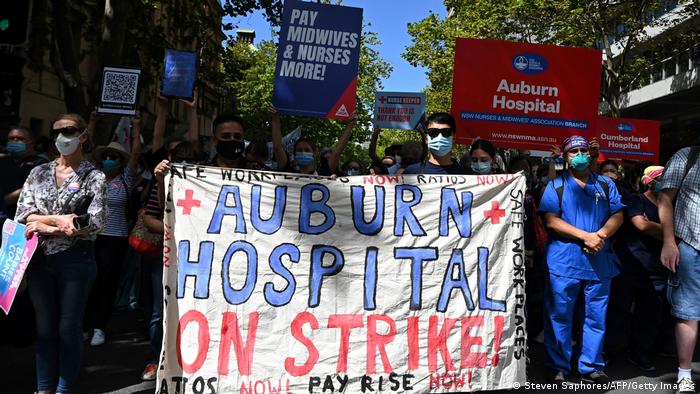
Thousands of nurses have rallied in Sydney to protest their workload and demand better pay. 


A massive surge in omicron cases has overwhelmed Australia's hospital system

Australia's most populous state of New South Walessaw its first nurses' strike in nearly a decade on Tuesday. Nurses said they wanted better pay for their jobs and a better balance between their numbers and patients requiring their services.

Brad Hazzard, NSW's health minister, said the strikes were "unfortunate" and "disappointing," especially because they came in defiance of a last-minute state order that asked nurses to call off their protest over risks to public health.

Thousands of nurses and midwives protested at the parliament building in Sydney in solidarity.

They carried placards reading "Need more nurses now" and "Stop telling us to cope."

Cases have been steadily falling in Australia, but frustration from an overwhelming surge of omicron infections over the last few months remains.

Australia recorded nearly 2.4 million cases after the first case of omicron was detected last November. The total number of confirmed COVID cases stands at around 2.6 million, and the total number of deaths at 4,664.

The country, which is set to open borders to vaccinated international travelers from February 21 after nearly two years, on Tuesday reported just over 24,900 cases in the previous 24 hours.
‘Hang in there’: French far-right candidate Zemmour touts encouragement from Trump

Benjamin DODMAN - 

Days after poaching Marine Le Pen’s only senator, French presidential hopeful Éric Zemmour stole another march on his far-right rival by touting a “long and friendly” conversation with Donald Trump, the former US president whose support Le Pen had long courted, in vain.

Trump, whose 2016 presidential run has been cited as a blueprint for Zemmour’s current Élysée Palace run, urged the former far-right pundit to "stand his ground, hang in there and keep his spirits up" in a 40-minute phone conversation late on Monday, Zemmour’s spokesman Guillaume Peltier told the France 2 broadcaster. "Tenacity and stamina" will pay off, Trump reportedly said.

A prolific writer and advocate of the "Great Replacement" theory, according to which liberal elites are plotting to replace French nationals of white stock with immigrants, Zemmour has dominated the early stages of the presidential campaign in the raucous, aggressive and iconoclastic manner of Trump – albeit with the veneer of cultured sophistication generally expected of a French presidential candidate.

Fashioning his pitch on Trump’s successful White House run, Zemmour has positioned himself as an outsider to traditional parties and the French political establishment. A string of mishaps saw him dip in the polls at the start of the year, but the political novice has since bounced back, notably poaching high-profile defectors from both the mainstream conservatives and Le Pen’s traditional far right.

Zemmour, 63, is currently fourth in opinion polls but closing down on both Le Pen and the conservative candidate, Valérie Pécresse. The trio are competing for an increasingly porous right-wing electorate, blurring the line between mainstream conservatism and the far right. With left-wing candidates in the doldrums, whoever wins this three-way race on the right looks set to take on the incumbent, Emmanuel Macron, in the April 24 run-off.'


Trump, Zemmour ‘pushing for the same thing’

Zemmour's team said the call with Trump on Monday had been "long and friendly" and had covered migration, security and economic issues in both countries. "They're both pushing for the same thing – Donald Trump wants the US to remain the US, and Eric Zemmour wants France to remain France," the campaign said in a statement.

Like the former US president, Zemmour has cast himself as a truth-teller unconstrained by political correctness. His background as a talk-show pundit also mirrors Trump’s former TV stardom. While Le Figaro, France’s traditional newspaper of the right, lent him credibility with a weekly column, it was CNews, a Fox News-styled television channel, that gave him a prime-time national audience – and a platform to lambast French elites and voice vitriolic comments about Muslims and immigrants.

Zemmour, who has three convictions for hate speech, recently called for the European Union to build a wall along "all its borders" to keep out immigrants, apparently inspired by Trump's project, never realised, to build a wall on the US border with Mexico. The cover of his latest book, “France has not said its last word”, featuring Zemmour arms crossed in front of the French flag, was also modelled on Trump’s 2015 release “Great Again”.

The phone call with Trump, whose support Le Pen has courted in the past, will be seen as a further blow to the head of the National Rally. It comes just days after the party’s only senator, Stéphane Ravier, defected to Zemmour’s camp. In her 2017 presidential campaign, Le Pen sought to display her proximity to Trump when she travelled to the Manhattan business headquarters of the former US president, only to slip out discreetly when nobody received her.

Zemmour’s spokesman Peltier, who defected from the mainstream conservative party Les Républicains, said his team had approached Trump's staff several times and had been "very pleased to take that call". He added: "It's very clear to everybody that the duel emerging in France is between Emmanuel Macron and Éric Zemmour."


Ethiopia lifts wartime state of emergency, three months earlier than expected


Issued on: 15/02/2022 - 


The state of emergency was imposed in November, when rebels from the Tigray People's Liberation Front (TPLF) threatened to advance on Addis Ababa, Ethiopia’s capital. In the photo, rebels are pictured near Debre Tabor, on December 6, 2021. © Solan Kolli, AFP

Text by:NEWS WIRES
2 min

Ethiopia’s parliament on Tuesday lifted a state of emergency imposed last November when Tigrayan rebels threatened to advance on the capital, the foreign ministry said, easing restrictions earlier than expected.
ADVERTISING


“The House of Peoples’ Representatives of #Ethiopia has approved today the lifting of the six-month state of emergency,” the ministry said on Twitter.

The vote by lawmakers followed a proposal by Prime Minister Abiy Ahmed’s cabinet last month to ease the state of emergency, which was initially supposed to last until May.

Tuesday’s vote to lift the decree was opposed by 63 of the 312 lawmakers who attended the session while 21 others abstained.

The state of emergency was declared on November 2 after fighters from the Tigray People’s Liberation Front (TPLF) seized two crucial towns about 400 kilometres (250 miles) from Addis Ababa.

The measure triggered mass detentions of ethnic Tigrayans in Addis Ababa and elsewhere, sparking condemnation from rights groups including Amnesty International.

It was not immediately clear if or when the people detained under the emergency decree would be released.

The state of emergency coincided with a mass mobilisation campaign credited—along with drone strikes—with pushing the TPLF back into Tigray, with the rebels’ withdrawal in December raising hopes of an end to the 15-month war.

Addis Ababa announced it would not pursue the rebels into Tigray, but in recent weeks, residents and aid workers have reported a string of deadly air strikes—including drone strikes—targeting the region.

The TPLF last month announced a military operation in the neighbouring Afar region, saying the move was in response to attacks by pro-government forces, dampening hopes of a ceasefire.
Aid blockade

The grinding conflict has left thousands dead and forced many others to flee their homes with hundreds of thousands driven to the brink of starvation, according to the United Nations.

Tigray itself has for months been subject to what the UN says is a de-facto blockade. The United States has accused the Ethiopian government of preventing aid, and it in turn has blamed the rebels for the obstruction.

Foreign envoys have been pushing hard for a ceasefire and expanded aid access to conflict-hit areas while Addis Ababa blames rebel incursions for the supplies shortage.

The US special envoy for the Horn of Africa David Satterfield was expected to visit Ethiopia earlier this week to meet with government officials as well as representatives of humanitarian organisations.

Nearly 40 percent of people in Tigray, a region of six million people, face "an extreme lack of food", the UN said last month.

The dire assessment published by the World Food Programme (WFP) came as humanitarian groups increasingly curtail activities because of fuel and supply shortages.

The World Health Organization on Tuesday called for "unfettered access" into war-wracked Tigray, saying its first delivery of life-saving medical supplies since July last year had stalled due to lack of fuel.

Fighting broke out in Tigray in November 2020 after Prime Minister Abiy Ahmed sent troops to topple the TPLF, the region’s former ruling party, saying the move came in response to rebel attacks on army camps.

(AFP)


European Commission demands France disclose sale of spying equipment to Egypt

February 15, 2022 

European Commission President Ursula von der Leyen holds a press conference 
in Brussels, Belgium on 8 February 2022 
[Dursun Aydemir/Anadolu Agency]

February 15, 2022 

The European Commission called on France to disclose whether it provided Egypt with internet and communications surveillance and espionage equipment, as French media has recently claimed.

This comes days before Egyptian President Abdel Fattah Al-Sisi is expected to take part in the joint European and African Union summit being held in Brussels on 17-18 February.

Human Rights Watch has described the visit as highly problematic, as the Egyptian government is responsible for horrific and systematic abuses.

European Commission President Ursula von der Leyen said she is in contact with the relevant French authorities to ensure that sales of these technologies comply with EU export rules.

Many European Parliament deputies called on the commission to intervene in December after a report by the French investigative website Disclose revealed that three French companies had transferred espionage technologies to the Egyptian government and supervised the operation of a monitoring network aimed at collectively gathering information from telecom networks in the north African country.

The report, which was based on hundreds of classified French military documents, said the French government had approved the sale of a mass surveillance system to the Sisi regime.
NSO Group on shaky footing worldwide

Tamara Nassar Power Suits 15 February 2022

Israeli spyware firm NSO Group is embroiled in a national scandal alleging its technology was used to spy on Israelis. Omar MarquesZUMA Press

Following a particularly bad year, Israeli spyware firm NSO Group is stepping into 2022 on even shakier footing.

After it was almost driven to ruin by lawsuits and blacklists during 2021, the notorious spy company is embroiled in a national scandal alleging its technology was used to spy on Israeli citizens.

The Israeli police used Pegasus, the company’s signature product, to spy on senior government officials, journalists, public figures and protest leaders, Israeli business publication Calcalist recently revealed.

Mayors of several Israeli cities, staff of a major Israeli newspaper, and officials from multiple ministries were among those hacked by the malware.

Former Israeli Prime Minister Benjamin Netanyahu’s inner circle was also targeted, including two of his advisers and his son Avner Netanyahu.

Emi Palmor, the former director-general of the justice ministry, was also hacked by the spyware. Notably, Palmor spent years at Israel’s justice ministry enforcing censorship of Palestinians’ speech before she was hired by Facebook’s oversight board.

The Israeli police were essentially phishing “for intelligence even before any investigation had been opened against the targets, and without judicial warrants,” Calcalist reported.

The Pegasus spyware is one of the most sophisticated tools known in the surveillance industry. Upon successfully installing it on a target’s phone, those doing the spying can extract a terrifying amount of data, including pictures, recordings, screenshots, passwords, and email and text messages.

Hackers can also turn on the camera and record audio remotely, controlling the device at will. Infection can be difficult or impossible to detect for an average user, and has typically required expert analysis.

“The use of Pegasus wasn’t local or limited to a small number of cases,” Calcalist said. It was “one of the most useful tools” used by the Israeli police.

The newspaper described how the technology was used to obtain private information about the sexual activities of at least one activist in order to gain “leverage.”

This is reminiscent of how members of the Israeli military intelligence branch Unit 8200, from which many workers at NSO Group were recruited, previously admitted to prying into the most intimate private data of Palestinians, including financial and sexual information, in order to blackmail them.

Widespread public outcry broke out in Israel and the minister of internal security Omer Barlev reportedly moved to establish a commission to investigate the matter.

Besides needing “to learn exactly what happened,” Prime Minister Naftali Bennett all but endorsed the Israeli police’s use of NSO Group technology to spy on Palestinian citizens of Israel.

“You want a tool like this when you’re fighting crime families and serious offenses,” Bennett said last week.

“I don’t want to discard the tool itself, rather to regulate its use.”

Bennett said such tools were “very important in the war against terror,” but that it was “not intended for widespread ‘phishing’ of Israeli citizens or public figures in the State of Israel.”

If Israel’s self-investigations into its crimes against Palestinians are any indication, NSO Group will receive a slap on the wrist at best, and the probe would serve as a fig leaf to whitewash other such dealings.

NSO Group has worked hand-in-glove with Israel’s defense ministry since its founding and requires its license for sales. The firm reportedly lends itself to cement Israel’s interests abroad.

On Sunday, Tel Aviv daily Haaretz reported that Israel’s international spying and murder agency Mossad used NSO Group’s Pegasus technology to spy on cellphones “unofficially.”

The newspaper said this occurred under former Mossad chief Yossi Cohen, citing unnamed NSO Group employees.

Mossad officials frequented the Herzliya headquarters of the company, near Tel Aviv, the employees added, sometimes bringing “officials from foreign countries as part of an effort to sell them the software,” Haaretz said.
FBI acquires Pegasus

Meanwhile, NSO Group has also been making headlines in US-based publications for other allegations of misuse.

The New York Times Magazine revealed last month how the FBI had purchased spyware technology from NSO Group.

Pegasus was long marketed as a tool that could hack all but American phones. In this way, Israel assured the US that NSO Group’s foreign clients would not spy on Americans.

“But it also prevented Americans from spying on Americans,” The Times said.

So NSO Group made an exception.

It designed a product, called Phantom, that could be sold exclusively to US government agencies and could be used to hack into US phone numbers.

The FBI bought that product, but claims to have never used it against Americans pending figuring out the laws that would allow it to do so.

It’s unclear whether the FBI used the product or not, but it is notable that even while engaging in discussions that spanned “two presidential administrations,” it renewed its subscription with NSO Group.

The magazine does not seem to question the FBI’s claim to have decided “not to deploy the NSO weapons.”
“Bags of cash”

Meanwhile, a former vice president of a California-based telecom company said NSO Group had offered his firm “bags of cash” in exchange for access to global cellular networks.

Gary Miller, who worked for Mobileum at the time, claims to have been on a 2017 call when the offer was made by Shalev Hulio, co-founder of NSO Group, and another affiliated representative.

As of last June, Miller works for Citizen Lab, a Toronto-based research group that has released numerous reports and exposés about NSO Group technology. Analysts at Citizen Lab examine phones to find traces of Pegasus.

Curiously, Miller is a client of Whistleblower Aid, an organization reportedly led by shady figures with prior close ties to the US State Department and the intelligence apparatus.

One of its most prominent recent clients was Frances Haugen, the former Facebook product manager who leaked internal documents that accused the company of harming girls’ body image, among other things.

Haugen was brought before Congress to provide ammunition for those demanding more censorship and control of public discussion on Facebook under the guise of stopping countries like China and Iran from using the platform for nefarious ends – a repurposing of the same old Russiagate narrative.

She was hailed as a heroic “whistleblower.”

It’s unclear why someone like Miller, who is now working for a group that historically exposed NSO Group, is the client of such an outfit.
Safeguards and credibility

In response to lawsuits and press exposés about how its technology was misused to target journalists, human rights defenders and politicians, NSO Group’s defense has remained consistent.

NSO Group has repeatedly stated that it only sells its products to governments and government agencies, and that it implements rigid safeguards to protect against misuse.

The spyware firm’s recent scandals reveal that misuse was more widespread than previously thought.

An unnamed source told Calcalist that NSO Group is more involved in running the spyware than they claim.

The most important information about spying operations and the information obtained from them is generated and held on cloud infrastructure run by NSO Group, not the client, according to the source.

NSO Group therefore cannot fully claim ignorance or lack of responsibility over the misuse of its products. Its services don’t end after the transaction is complete, but entail an ongoing process where the company constantly provides assistance.

This is not a transaction in which NSO Group sends a “CD ROM” to its clients and washes its hands, as economist and researcher Shir Hever recently told The Electronic Intifada Podcast.

Rather, it’s a subscription-based transaction that ensures there is continuous communication and assistance from the firm.

The same source told Calcalist that clients can disable logs and thus hide certain information about spying targets. This suggests that the NSO Group gives license to its clients to spy on whomever they want in the shadows regardless of whether they follow the general PR claim of pursuing “criminals.”

If the current national scandal of NSO Group can tell us anything, it is simply that technology of this sort is ripe for abuse by both inventor and client. Human rights activists and others are bound to suffer the consequences.

Tamara Nassar's blog
Cambodia delays controversial internet gateway

Cambodia is delaying an internet gateway that had raised concerns around privacy and free speech (AFP/TANG CHHIN Sothy) (TANG CHHIN Sothy)

Tue, February 15, 2022

Cambodia is delaying an internet gateway that had raised concerns around privacy and free speech, halting its planned mid-week implementation due to Covid-19 related disruptions, a government official said Tuesday.

Activists and UN rights experts had called for a halt to the project, which will funnel all web traffic through a state-controlled entry point, saying it would have a "devastating" effect on freedom of expression and privacy.

"The implementation of (National Internet Gateway) will be postponed due to the disruption caused by the spreading of Covid-19," So Visothy, secretary of state for the Telecommunications Ministry told AFP.

"We will keep you updated when we have the new date," he said, but declined to comment on if part of the system was already in operation.

The gateway, due to come into effect February 16, appeared to be taking Cambodia down a path beaten by Phnom Pehn's major economic partner China -- which keeps the online world behind a "Great Firewall" and blocks major Western platforms such as Twitter, Facebook and YouTube.

Earlier on Tuesday, the Cambodian Foreign Affairs Department issued a statement attacking foreign media reporting critical of the scheme.

A spokesman insisted it was being set up in a "transparent manner" and that consultations had been held with experts and relevant institutions.

"The establishment of a national internet gateway... serves as an effective tool to enhance national revenue collection," the spokesman said, adding it would also help thwart cyber crimes, illicit online gambling and internet scams.

"The government respects the individuals rights to privacy and freedom of expression and protects personal data," the spokesman said.

They said allegations that Cambodian authorities would monitor and conduct surveillance of internet activity, intercept and censor digital communication, and collect personal data were "unfounded".

In 2021, at least 39 Cambodians were arrested, jailed or had arrest warrants issued against them for online posts that fell foul of government censors, according to the Cambodian Center for Human Rights (CCHR).

The gateway, announced last year, comes ahead of expected elections in 2023 and the CCHR said its completion could allow the government to block dissenting views online in the run-up to polls.

Reporters Without Borders denounced the scheme as "a level of information control unseen since the Khmer Rouge dictatorship".

UN human rights experts warned earlier this month the gateway could pose a serious negative impact on internet freedom, human rights defenders and civil society in the country, further shrinking the already-restrictive civic space in Cambodia.

"Once the genie is out of the bottle it is very hard to be contained again," UN experts said in a statement.

ss-lpm/rbu/ssy
EU watchdog wants Pegasus surveillance tool to be banned

The EU's data protection watchdog is calling for a ban on the controversial spyware tool Pegasus. Regulators have said the software, developed by Israeli-based NSO Group, could lead to an unprecedented level of spying.


Pegaus was created by the Israeli NSO group

The European Union Data Protection Supervisor (EDPS) on Tuesday proposed a bloc-wide ban on use of the Pegasus spyware tool, saying it was the best way to guard against unwarranted spying on consumers.

The recommendation follows media reports alleging the product has been used by certain governments to spy on human rights activists, journalists and politicians.

Why did regulators recommend a ban?

The EPDS said Pegasus combined "a level of intrusiveness that is incomparable with what we have seen before, with features capable to render many of the existing legal and technical safeguards ineffective and meaningless."

The product, from Israeli developer NSO, is seen as having the potential to turn a phone into a pocket spying device.

"Pegasus represents a paradigm shift in terms of access to private communications and devices, which is able to affect the very essence of our fundamental rights, in particular the right to privacy," the EDPS said in its report.

"This fact makes its use incompatible with our democratic values. Therefore the EDPS believes a ban on the development and the deployment of spyware with the capability of Pegasus in the EU would be the most effective option to protect our fundamental rights and freedoms."

The EDPS said it could not rule out a need for the spyware to be deployed in exceptional circumstances, for instance, to prevent a very serious imminent threat such as terrorism.

The watchdog proposed a list of "steps and measures as a guarantee against unlawful use," in the event that it was deployed.

Some EU governments, including Hungary and Poland, have admitted to having bought Pegasus from the NSO Group.

Powerful tool for good — or ill

NSO, the company behind the tool, has said its product has helped to prevent terror attacks, gun violence and has helped break up pedophilia, sex and drug trafficking rings.

The spyware grants "complete, unrestricted access to the targeted device," the EDPS said.

Research from Amnesty International's Security Lab shows that the tool allows the attacker so-called "root privileges" on the device to the extent that "Pegasus can do more than what the owner of the device can do."

As a result, the software could allow the attacker to gain access to digital credentials and impersonate the victim to access personal information and financial assets.

Evidence has mounted showing the potential for abuse of the tool for questionable motives.

A sweeping journalistic investigation last year by the Paris-based nonprofit journalism group Forbidden Stories appeared to show the extent of Pegasus's use in more than 50 countries.

It found a list of thousands of potential surveillance targets, including 180 journalists, 600 politicians, 85 human rights activists and 65 business leaders.

NSO has said it does not operate the system, nor is it involved in any way in the system, once sold to governmental customers.

Claims of spying on citizens

Israel itself has been subject to global pressure over allegations that Pegasus has been abused.

Meanwhile, Israeli media has reported that the secret spyware was also turned on the country's own citizens, including those not suspected of criminal activity and without a judge authorizing the surveillance.

Business daily Calcalist reported last week that police used the Pegasus spyware to hack the phones of former Prime Minister Benjamin Netanyahu's son, along with aides and other members of his inner circle.

Netanyahu has previously accused law enforcement of unfairly targeting him, although it's unclear why the software would have been used against those close to the former premier.

NSO has said it could not confirm or deny any current or potential customers for Pegasus.

This report was written in part with material from Reuters news agency

How states hunt critics abroad

It's not just the mafia that kidnaps people. Governments also abduct opposition figures abroad to keep them in custody and under control. Three states are especially prone to breaking international law.    


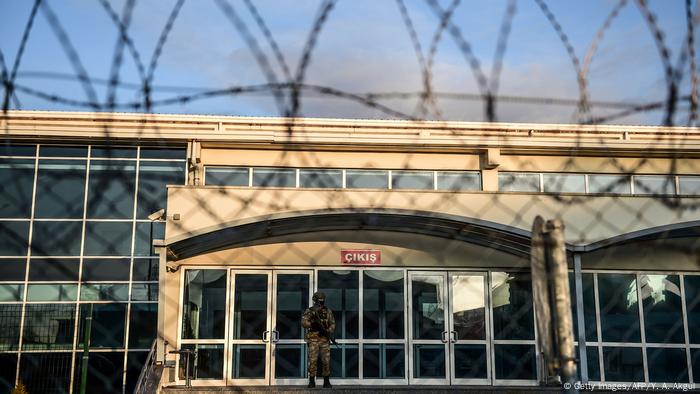
At this Turkish prison in Silivri, kidnapped people await their trial

The only trace left of him was his car, the doors open,the tires flat. Orhan Inandi, director of a school in Bishkek, Kyrgyzstan, disappeared in 2020. There were no witnesses.

An investigative team was set up, and circumstantial evidence was evaluated. Even the Kyrgyz president got involved.

Weeks later, it was clear that Inandi had been kidnapped. Not by bandits or the mafia — the Turkish secret service MİT arrested and illegally took him out of the country because he was said to have supported political opponents of Turkish President Recep Tayyip Erdogan. Inandi is thus one of the most recent cases of state kidnapping. 

From murder to mobbing

In fact, according to the US think tank Freedom House,at least 31 states have broken international law by persecuting citizens abroad since 2014. In addition to illegal kidnappings, persecuting states often rely on the country's cooperation in which opposition figures reside, urging them to be deported. 

Assassinations and non-lethal attacks as well as intimidation are also on the list. Furthermore, some people disappear forever without a trace. "Regimes can reach exiles more easily than ever before," said Freedom House expert Isabel Linzer, "including in the form of spy programs, through surveillance and intimidation on social media." 
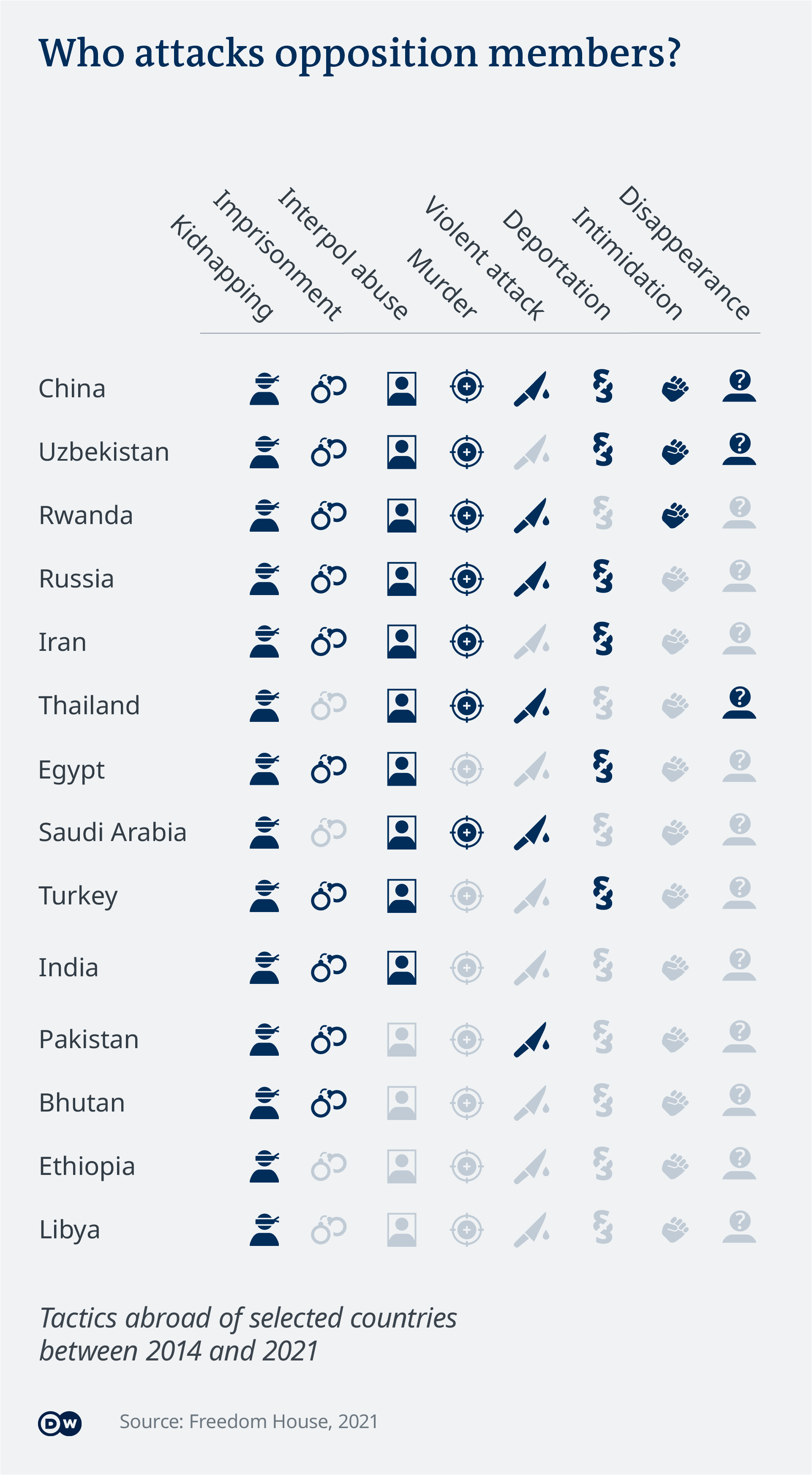

Kidnappings and arrests were among the most common state crimes abroad.

According to Freedom House,a total of 607 murders, kidnappings and other attacks have been documented since 2014. The report, however, does not include cyberespionage and online harassment. "But even that is an incomplete snapshot of a much larger problem," said Linzer, who compiled the data, "and it's definitely getting worse."

Andreas Schüller of the European Center for Constitutional and Human Rights agrees. "International law is less and less respected and enforced, especially by authoritarian states," he said. 

As reported by Freedom House, China, Turkey and Egypt attack nationals on foreign territory most frequently. Nevertheless, it is not just a practice of these states, said Schüller. "The US has also made use of it in its War on Terror and has not properly addressed and sanctioned it to date." These include, for example, the CIA's kidnapping and torture of German Khaled al-Masri and its plans to assassinate Julian Assange, as Yahoo News first reported.

Such actions are not only morally reprehensible but also illegal, Schüller explained. However, sitting heads of state also enjoy immunity before the courts of other states, but not, for example, heads of secret services who order kidnappings or murders.

Often, rising numbers of attacks are related to major political events, after which governments want to silence or control opposition figures in exile.

China: Hunt for Uyghurs in exile

According to Freedom House, China, the most aggressive persecutor state, could be proven to have significantly more cases in 2015 than before. The year before, China had started to suppress and assimilate the Turkic ethnic group of the Uyghurs in the province of Xinjiang in the name of the "People's War on Terror."
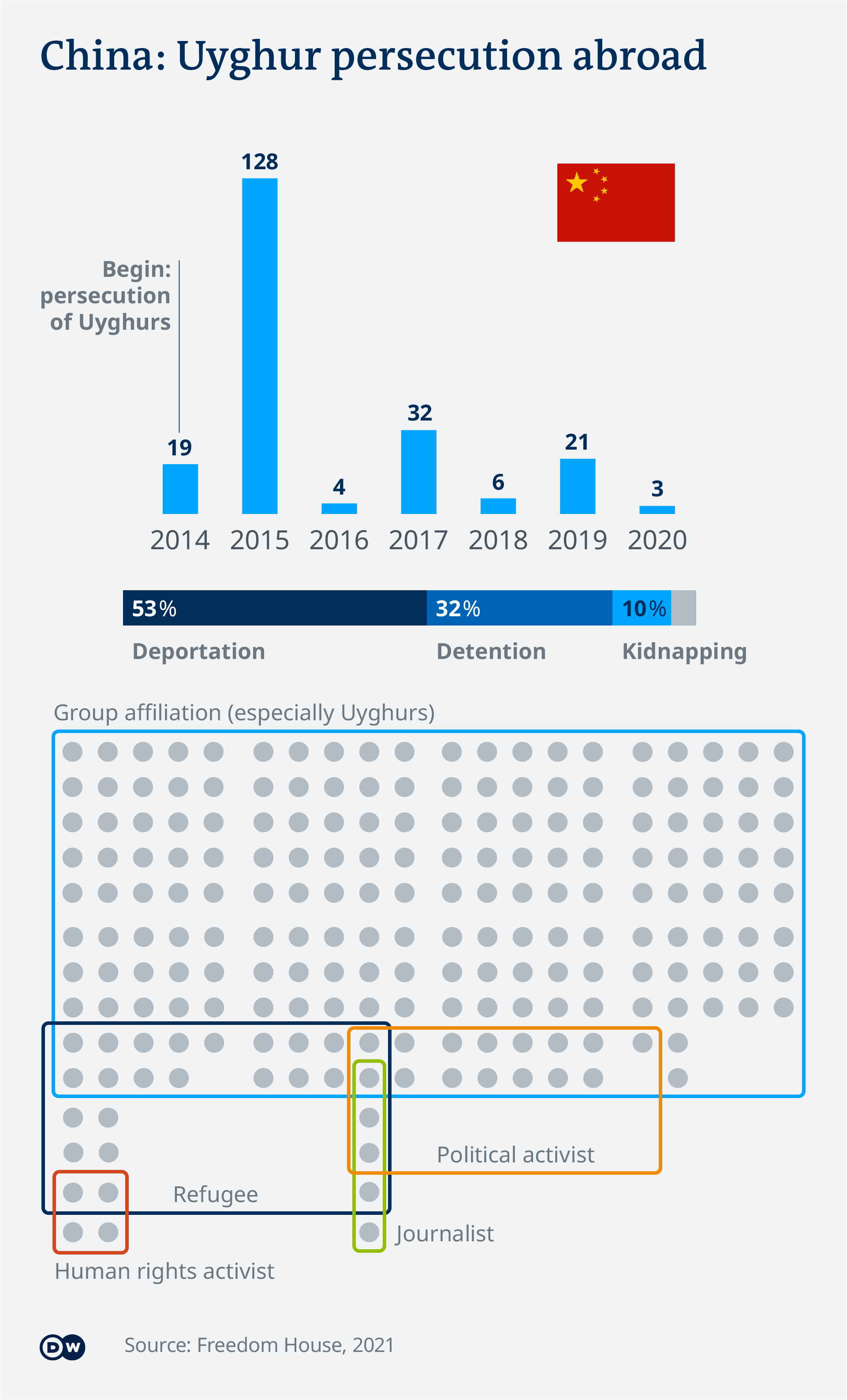

According to Freedom House, since 2014, Turkey has been the state that has kidnapped people abroad the most. The accusation used: terrorism, extremism, and anti-state actions.

Meanwhile, China continues with aggressive policy abroad. In doing so, China often relies on the countries' cooperation where the victims are located. Countries such as Thailand stage trials without legal proceedings after the arrest, ending with deportation to China. This maintains the appearance of due process of law. China's regime used abductions without a trial in only 10% of the cases documented by Freedom House.

Murder and assassinations are rare

However, particularly shocking cases, such as the poison attack on Kremlin critic Alexei Navalny or the murder of journalist Jamal Khashoggi, are more prominently discussed in public. Since 2014, however, "only" 26 international murders and 20 assaults have been documented. Russia tops the list with seven deadly assassinations.

Most countries that resort to measures contrary to international law tend to bring their opponents under control through arrests, deportations and especially kidnappings. The number of such crimes is 12 times higher.

Egypt also prosecutes opposition figures abroad exclusively through nonlethal means, Freedom House reports suggest. Most recently, the number of arrests, kidnappings and deportations of political activists in exile skyrocketed in 2019. The country on the Nile thus violates the relevant international standards most frequently in the Arab region. 
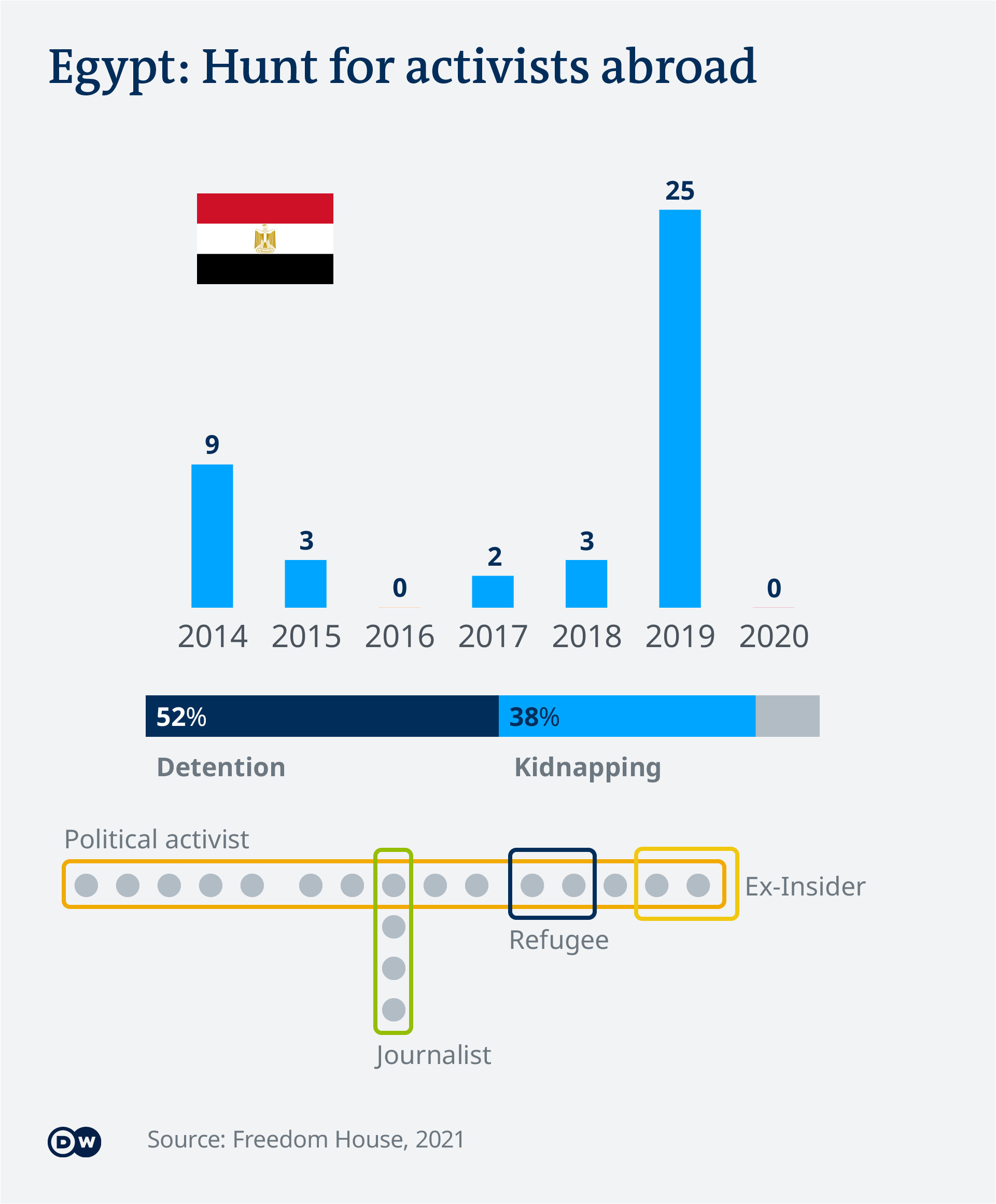

Egypt mainly persecutes political activists abroad and justifies this almost exclusively with terrorism and extremism.

Turkey: Government celebrates breach of international law

Turkey is even more active than Egypt, cracking down on opponents abroad, mainly actual and alleged supporters of the Gulen movement since the failed coup against Erdogan's government in 2016.

Like Egypt, Turkey rarely relies on cooperation with countries where victims have been located. Instead, illegal kidnappings are the method of Ankara's choice, said Linzer.

"No other country in the world has carried out such a large number of repatriations from that many different countries in recent years," she added.

Often, such actions remain under the radar. "Most people have probably never heard of Turkey 'bringing back' people from Kenya, for example," she said. 
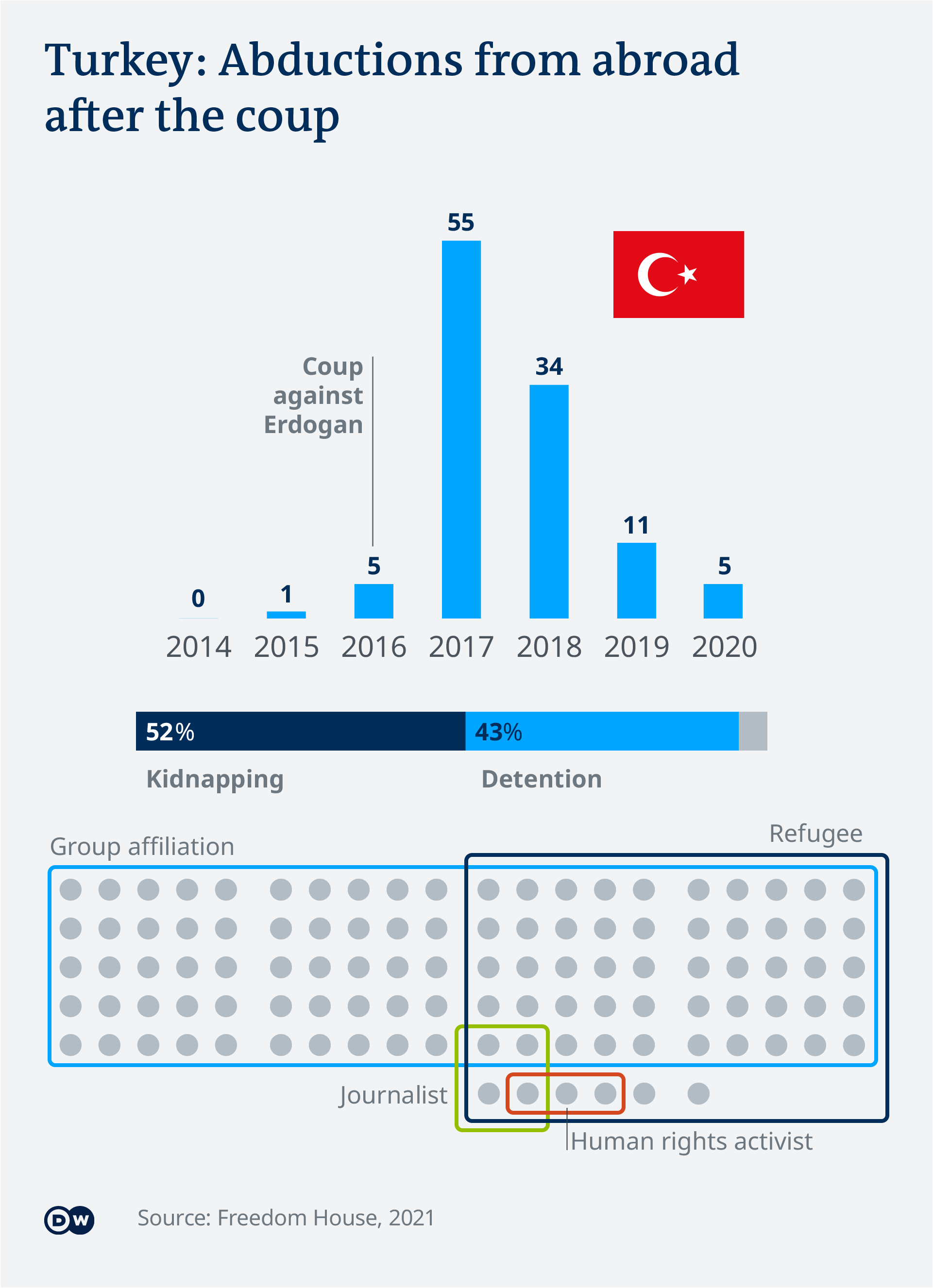

China mainly attacks Uyghurs abroad.

Nevertheless, Turkey is not acting secretly. On the contrary: While many countries cover up or deny kidnappings, government representatives boast about illegal seizures with the help of the Turkish secret service MİT and react aggressively to criticism. Experts fear that Turkey's actions could become a model for other countries. UN investigators have already called on Turkey to stop the kidnappings in a public letter.

'It's not OK to kidnap people'

"But we've also seen some good steps to combat transnational repression," said Freedom House's Linzer. Sweden and other Nordic countries, for example, have passed laws against so-called "refugee espionage" that explicitly prohibit collecting information on people who have fled.

In addition, sanctions could be imposed on members of the aggressor state's government or arms embargoes. Expulsion of diplomats would also be an adequate step. In the end, Linzer said, it's about raising the cost of such actions and "creating international norms that say, 'No, it's not OK to kidnap people.'"

In the case of kidnapped school principal Orhan Inandi, such consequences have so far failed to materialize. Photos from Turkey's Silivri prison released in November 2021 show Inandi alive with one arm tied in a sling. His wife wrote that her husband did not receive any medical treatment after being tortured in jail, and suffered a bone fracture. For months, her husband has not been able to move his arm, Inandi's wife said.

Edited by: Peter Hille and Jakov Leon.