Monday, February 28, 2022

Coastal GasLink Fined $72,500 for Environmental Infractions

The pipeline firm was penalized for violations including allowing sediment to flow into sensitive watersheds.


Amanda Follett Hosgood
25 Feb 2022TheTyee.ca
Amanda Follett Hosgood is The Tyee’s northern B.C. reporter. She lives in Wet’suwet’en territory. Find her on Twitter @amandajfollett.

An image taken by enforcement officers with BC’s Environmental Assessment Office in October shows a muddy plume of water from a Coastal GasLink worksite entering the Clore River, east of Kitimat.

Coastal GasLink has been ordered to pay a $72,500 fine for environmental violations that continued for at least a year along its 670-kilometre pipeline route through northern B.C.

Applications are now open for the six-month Tula Immersion Journalism Fellowship at The Tyee.

While the fine is a result of erosion and sediment-control issues identified at multiple locations during inspections in April and May last year, the problems were first brought to light by B.C.’s Environmental Assessment Office in October 2020. They remained a year later, the EAO found in followup inspections.

In an email to The Tyee, a spokesperson for Coastal GasLink said the issues had been resolved by the time the penalty was issued this month.

The company blamed the scale of the project, the changing nature of erosion and sediment control, and the terrain the pipeline passes through for the challenges.

“Coastal GasLink is committed to the construction of the project in a safe and environmentally responsible manner,” it said. “Despite these challenges, Coastal GasLink is continuing to protect the environment and work towards compliance with the requirements of our regulators. Coastal GasLink continues to co-operate with the EAO and all other appropriate regulatory agencies to meet their requirements, standards, expectations and reviews.”

The pipeline has been at the heart of a high-profile conflict over Indigenous rights, as Wet’suwet’en hereditary leadership opposes the project through its traditional territory. The company and provincial government have pointed to benefit agreements signed between Coastal GasLink and five of the nation’s six band councils as support for the project.

At the centre of the conflict is a worksite near the Morice River, known to the Wet’suwet’en as Wedzin Kwa, where the company is preparing to drill its gas pipeline under the river.

In September, nation members and supporters evicted pipeline workers from the area and established a camp at the site. In November, RCMP enforced an injunction previously granted to Coastal GasLink and arrested 30 people over two days.

Last week, Coastal GasLink reported that masked assailants, some wielding axes, had threatened employees in a nighttime raid on the drill site, causing millions of dollars in damage to equipment.

Over the weekend, the company said it was working to contain the impacts from engine fluids that had spilled into the environment as a result of fuel lines severed during the incident.

It’s not the first time hydrocarbons have been released along the project corridor.

In May 2020, two diesel spills were reported at separate locations in the Morice area, one at a Coastal GasLink work camp and another at a remote RCMP detachment set up to police the pipeline conflict. Each spill was estimated at 500 litres.

Last August, two separate spills at the same Coastal GasLink work camp released up to 50 litres of diesel and 940 litres of diesel exhaust fluid into the environment just days apart.

The company has also been issued warnings for leaving food waste unsecured and failing to implement proper signage near environmentally sensitive features along the pipeline corridor.

However, the recent penalty levied against the project is tied to the company’s failure to prevent sediment from flowing into environmentally sensitive waterways.

The project’s erosion and sediment control issues were first identified by the province during inspections in October and November 2020, when EAO compliance and enforcement officers found the company was not complying with a condition of its Environmental Assessment Certificate that required it to implement an Environmental Management Plan.

An inspection report released in December 2020 found contractors weren’t complying with erosion-control measures in Coastal GasLink’s Environmental Management Plan, allowing sediment to flow into fish-bearing streams.

The report noted the company had not implemented mitigation measures in its erosion and sediment control plan and had failed to do more detailed planning to prevent pollution.

The EAO issued an order that required the company to control sediment flowing into waterways and hire an independent erosion and sediment-control auditor.

Coastal GasLink was also ordered to pay a $10,000 inspection fee at that time.

While initial inspections focused on 400 kilometres of the pipeline route to the north and east of Prince George, followup inspections last April and May took place at various locations between Chetwynd and Smithers. The EAO documented dozens of sites where sediment was seen flowing into watercourses and wetlands and where erosion and runoff control measures were not functioning or were overwhelmed.

At a location where the pipeline route skirts Gosnell Creek, a major tributary of the Morice, the report described how construction caused sediment to flow into an adjacent lake at “multiple locations.” It also found that the company had not posted signs to identify sensitive environmental features and that it had conducted inadequate streambank restoration.
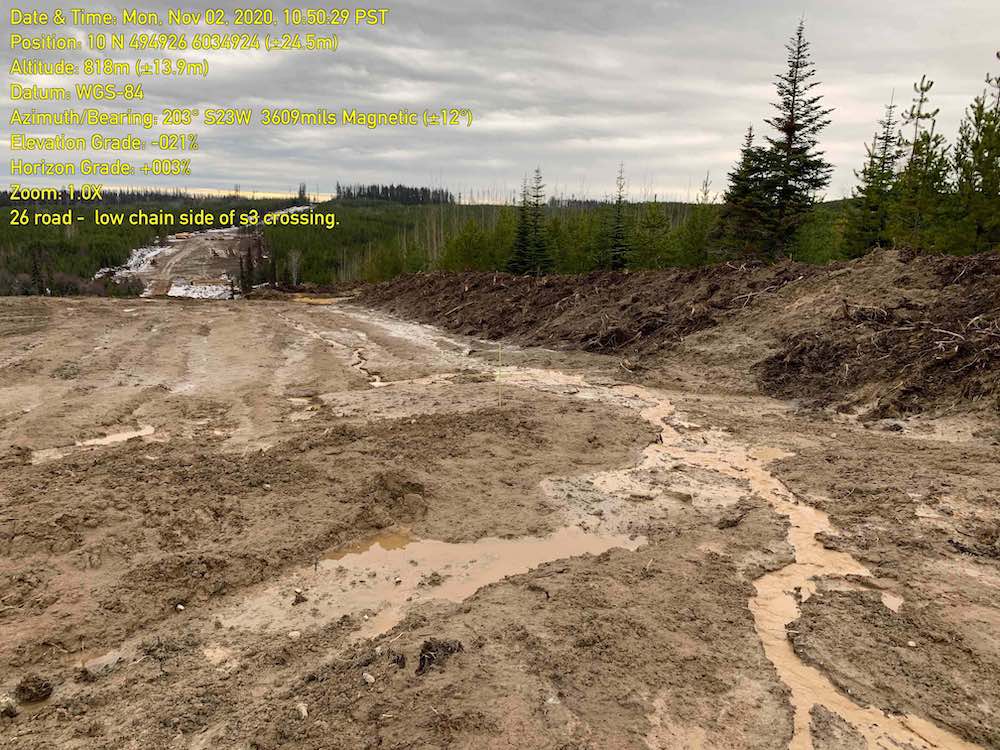
The Environmental Assessment Office cited Coastal GasLink for failures building its pipeline, such as here, north of Prince George, where a large area was stripped of vegetation, allowing runoff into a fish-bearing stream. Photo via BC government.

In a report issued in September, the EAO recommended an administrative penalty under the province’s Environmental Assessment Act.

A month later, followup inspections again found that the company had still failed to comply with order EN2020-011. It recommended a second administrative penalty in December for continued violations.

That recommendation is still under review, a Ministry of Environment spokesperson said in an email to The Tyee.

Initially, the Ministry of Environment said penalties could run in the millions of dollars, with up to $750,000 imposed for each day Coastal GasLink remained out of compliance. It added that court-imposed penalties of up to $1 million for a first conviction and up to $2 million for subsequent convictions were also possible under the Environmental Assessment Act.

However, a ministry spokesperson later amended that figure, noting that the maximum fine for failing to comply with an order under the act is $100,000.

A 28-page administrative penalty assessment posted Wednesday by the EAO notes that the pipeline project crosses about 625 watercourses and other waterbodies, and many others are in close proximity to the route. It describes surfaces exposed to erosion, sediment-laden water flowing into streams and unmaintained sediment-control fencing at 26 locations along the 670-kilometre pipeline route.

“The nature of the contravention is considered to be moderate to major,” the assessment reads. “Non-compliance with the requirements of the Environmental Assessment Act… undermines the effectiveness of the act in addressing the adverse effects of regulated projects.”

The EAO’s assessment began with a base penalty of $62,500 and added $5,000 as a result of Coastal GasLink’s compliance history. It also increased the fine by $10,000 for the company’s repeated contraventions.

It declined to add to the fine for deliberate contravention, noting no evidence that the company had intentionally defied the act.

And while it had originally added $1,000 for economic benefit derived by the company as a result of the infractions, it reversed that decision based on responses from Coastal GasLink, which successfully argued that costs to remediate the issues outweighed any benefits.

It then reduced the amount by $5,000 based on actions the company said it was taking to correct the contravention.


Still No Penalties for Coastal GasLink Environmental Violations
READ MORE

The assessment also quotes from Coastal GasLink’s response to the EAO’s inspection record from last spring, which notes that beginning in January 2021 the company was under provincial health orders to reduce its workforce.

However, the EAO concluded that the non-compliances regarding erosion and sediment control did not stem from reduced workforce numbers and noted that issues along the project corridor pre-date the January 2021 provincial health order. It added that workforce restrictions were no longer in place at the time of the inspections in April and May.

“However, given the time frame that workforce restrictions were in place it is not unreasonable to conclude that the workforce restrictions may have impacted the ability of crews to fully comply,” it said.

Coastal GasLink recently graded its environmental record in an annual self-compliance report sent to the EAO in January.

While the company found it complied with most conditions, it noted “ongoing compliance concerns” related to erosion and sediment control and added the project had “minor non-conformances” with its Environmental Management Plan last year.


Punishment for Pipeline Protesters, but Not for Pipeline Firm’s Violations?
READ MORE

“Examples of both these minor non-conformances and identified non-compliances include issues related to: erosion and sediment control, animal attractants, waste management, signage, hydrocarbon management, spill prevention and response, secondary containment, watercourse reclamation and maintenance of electric fencing,” it said.

“Coastal GasLink finally notes that it continues to have compliance concerns associated with ESC at individual sites along the project. Coastal GasLink confirms that it is actively working to resolve identified ESC issues as they present and continues to plan activities to proactively mitigate these issues before they occur.”

Because Coastal GasLink’s fine exceeds $25,000, the company could request a review by the EAO’s chief executive assessment officer.

However, a spokesperson with B.C.’s Ministry of Environment confirmed in an email to The Tyee that the company had not done that before the seven-day window to request a review closed this week.

It has 30 days to pay the fine.
What the West Should Do about Putin
A professor of international security weighs in.

Stefan Wolff 
24 Feb 2022
The Conversation
Stefan Wolff is a professor of international security at the University of Birmingham. This article was originally published by the Conversation

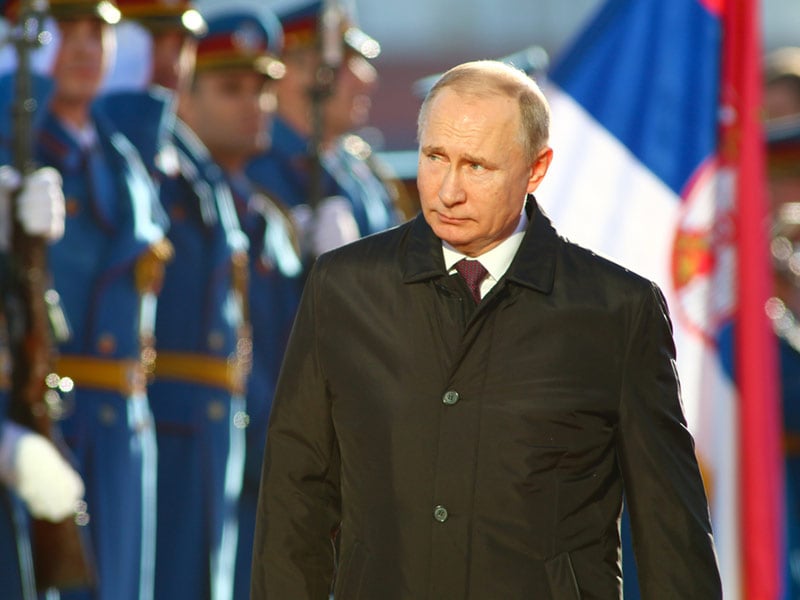
The West did little when Russia invaded Georgia in 2008 and annexed Crimea in 2014. It won’t be possible, however, to ignore Putin’s invasion of Ukraine. Image via Shutterstock.

With the full-scale invasion of Ukraine, Vladimir Putin has overstepped an important line. The West sat by and did little when Russia invaded Georgia in 2008 and annexed Crimea in 2014. But the full-scale invasion of Ukraine that is currently underway is impossible to ignore. Putin’s actions and his justifications cast serious doubt over the possibility of any kind of credible diplomacy with Russia at this stage of the conflict.

The Russian president’s intentions have been crystal clear since his rambling speech on Feb. 21 in which he talked of Russia’s “empire,” after which he recognized the breakaway republics of Donetsk and Luhansk as independent states. Now he is directing a “special military operation” in Ukraine, supposedly justified by threats to Russia from Ukraine. Diplomacy has failed to deter Putin and to pull Russia back from the brink. It is unlikely to be useful, or welcome, in the current situation.

What is needed now is a policy of containment and the reassurance of NATO and EU members. Russia needs to feel real deterrence against any further military escalation, which will bring home to Putin the cost of sustaining this adventurism. The latter would involve further increasing sanctions on Russia — including on Putin and his inner circle and their wider families — and everything that will support Ukraine militarily, but, for now at least, short of actual troop deployments by western countries.

It will also be important to co-operate with China as part of this process. Relations between China and the West may not be at their warmest, but both sides share an interest in stability in the region where China has made significant investments through its Belt and Road Initiative over the past decade. China has repeatedly balanced its support for Russian demands for a new European security order with an emphasis on the importance of respecting the sovereignty and territorial integrity of states.

Thus, it is by no means inevitable that China will offer a potential “lifeline” to Russia in terms of economic and financial support, or political backing at the UN and in other regional and international forums. While it is unlikely that China will openly side with the West against Russia, it could play a vital role of pushing Russia towards a return to diplomacy out of self-interest, given its substantial investments in Ukraine.

Under Putin, Russia has also tried to reassert its great power status elsewhere — from Central Asia to the south Caucasus, from Syria to Libya and Mali. This gives the West potentially additional leverage to put pressure on Russia, drain its resources and make Putin’s military invasion of Ukraine unsustainable.

Security first


The question is, what should happen when we reach a stage at which diplomacy may once again be a useful tool to restore international peace and security? First, the issue will be about what format discussions with Russia might take. Given the complexity of the crisis, these would need to happen locally, between Russia and Ukraine, and more broadly, between Russia and the West.

This is because humanitarian issues need to be addressed alongside the restoration of Ukraine’s sovereignty and territorial integrity and the establishment — or revitalization — of mechanisms to prevent future crises from escalating into war. Such a process needs to recognize that the issues and stakes are much wider than Ukraine.

These discussions will not be possible in the short term. But in the medium to long term, there is no viable alternative to renewed diplomatic engagement. This is not to predict the success of future diplomacy, which will be difficult to achieve given the very different visions of possible endgames that the different players have at the moment. Instead, it is to recognize that diplomacy is a necessary mechanism to restore order from the current instability.

Restoring and sustaining international order

For Ukraine, the immediate concern is an end to the invasion and a stabilization and de-escalation of the situation on its internationally recognized borders. Beyond that, maintaining the support of a united international stance of non-recognition of Russia’s land-grab in Crimea and Donbas is crucial.

Recovering from what will most likely become a protracted and damaging military confrontation on Ukrainian soil will put additional strain on Ukraine’s institutions and social fabric and will require broad international financial and technical support. In the long term, restoration of its full sovereignty and territorial integrity needs to remain in focus.

For the West, containing Russia’s aggression and keeping the western alliances (EU and NATO) united and intact are the obvious key short-term objectives. With a longer-term focus, the restoration of a viable European (and international) security order needs to be achieved — this will involve managing the West’s broader security relationship with Russia.

By contrast, Putin — and this is where the challenge for diplomacy arises — will want to see an acceptance of the new status quo that he hopes will emerge. This would allow him the consolidation of his own Eurasian sphere of influence that keeps both the West and China at bay and establishes Russia as a third pole in a new tri-polar world order.

Will diplomacy achieve the miracle of working out an acceptable and sustainable compromise? Any answer to this question can only be speculative at this point. But what we do know — to some extent — is that much will depend on individual leaders. The “big three” — Joe Biden, Xi Jinping and Putin himself — will be the key to what comes next in diplomatic terms. But second-tier leaders, such as those at the helm of the EU, Germany, France, and the U.K., will be critical to this dialogue as well.

It will also depend on the costs inflicted on Russia in response to its transgressions and whether these in turn create domestic pressures at home for Putin.

And diplomatically, it will depend on the effectiveness of the formats in which diplomacy will be conducted: both specific to the current crisis and more generally in relation to the future international order.
Meet the Face of Global Fascism

Ten things to know about Putin’s past, his designs on Ukraine and the dire road ahead.
25 Feb 2022TheTyee.ca
Tyee contributing editor Andrew Nikiforuk is an award-winning journalist whose books and articles focus on epidemics, the energy industry, nature and more.

‘Democracies will face higher energy prices, severe inflation, and rampant political volatility. War has a way of begetting more war.’ 
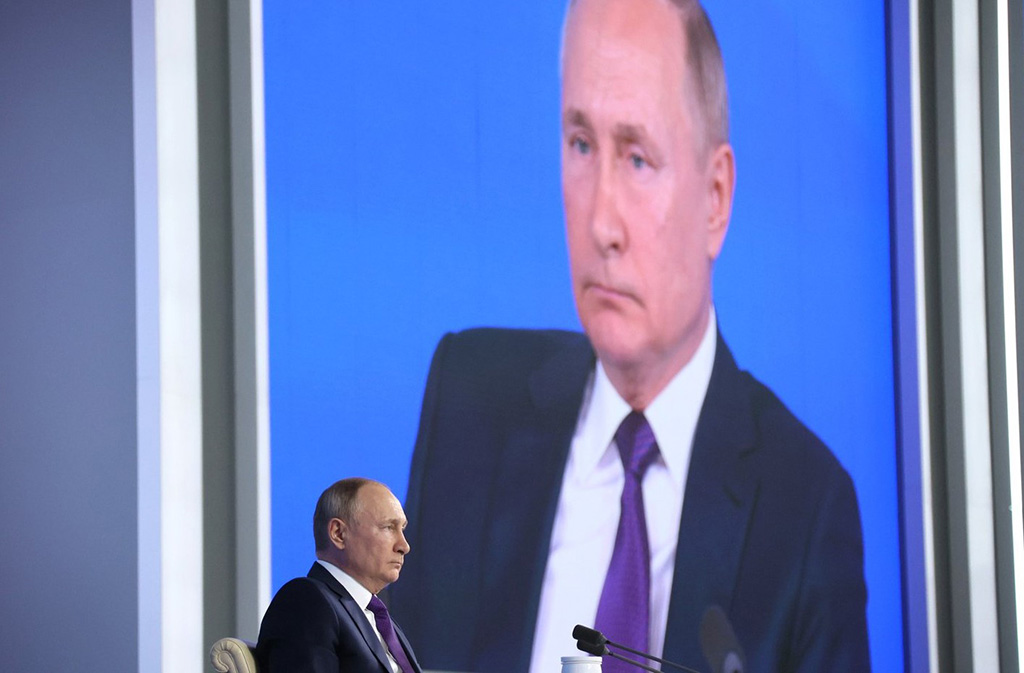
Photo via Kremlin RU.

The unprovoked invasion of Ukraine by Vladimir Putin will change our economic and political lives more than the pandemic.

When one of the world’s most powerful petro-states declares war in order to “denazify” a legitimate democracy with a Jewish president, don’t expect life to continue as normal.

Thanks to Putin’s aggression, democracies will face higher energy prices, severe inflation, rampant political volatility, and unexpected consequences throughout the global economy. War has a way of begetting more war.

By invading Ukraine, Putin is also openly signalling to neighbouring democracies that he considers them weak and manageable. Sanctions cannot hurt or dissuade this dictator who has imperial ambitions wrapped in a quasi-religious crusade.

Putin has also calculated that the world will not risk nuclear war just to save a struggling democracy of 44 million in Ukraine.

But long before Putin put his troops on the ground, he actively worked to undermine the factual world of western democracies with disinformation campaigns that rattled both Europe and the United States.

The U.S. historian Timothy Snyder, an expert on the blood-soaked lands of Eastern Europe, starkly warned us about Putin in 2018 with the publication of The Road to Unfreedom. The book remains an indispensable guide to the horror show now unfolding before us.

Snyder laid out the new fascism. To make Russia, a fragile petro-state, look strong, Putin has sown division in western democracies. Long before “fake news” dominated North American airwaves, Russia attacked factual reality in Ukraine.

It then supported populist and fascist movements throughout Europe. It openly supported a Syrian tyrant, in part to destabilize Europe with a wave of migrants. At the same time, it funded white supremacists as civilization’s saviours.

Whether we wish to acknowledge it or not, the actions of Putin’s government — from the support of populist parties in Europe to his dangerous alliance with Donald Trump — have already totally changed our political realities. And this is what fascism does: it replaces fact with fiction and transforms citizens into zombies.

Here are 10 things you need to know about the new global face of fascism.


1. Vladimir Putin rose to power in the shadow of Boris Yeltsin after the dissolution of the Soviet Union. In 1998, the ailing Yeltsin appointed the head of Federal Security Service (formerly the Soviet Union’s dreaded KGB) as president. Then-unknown Putin soon generated a crisis — a series of bombings across the country — to raise his political profile. Putin identified the culprit as a republic in southwest, Chechnya. And so the second Chechen war brought a new strongman to power.

2. The collapse of the Soviet Union in 1991 greatly shaped Putin’s view of the world. The young intelligence officer watched as a global price collapse unhinged the hegemony of the Soviet Union. That autocracy had been based on cheap oil and generous energy subsidies to client states. But when production and revenues dropped by 50 per cent, the authoritarian regime collapsed. Putin viewed the event an unmitigated tragedy and vowed to reverse it.

3. As a student of oil and its corrosive powers, President Putin acted quickly to consolidate all energy production back into the hands of state. He removed the country’s most powerful oligarchs from Russia’s oil and gas companies and nationalized the industry. He then let in a few western players, such as Exxon Mobil, to help revitalize Russia’s oil patch.

As oil prices rose between 2000 and 2014, Putin used the flow of petro money to form a new social compact with Russians. He provided “growing living standards in exchange for popular acquiescence to his continued rule.” He also used oil revenue to rebuild Russia’s military machine.

4. Whenever asked about his historical or philosophical influences, Putin cites an obscure Russian fascist by the name of Ivan Ilyin. Born into a noble family in 1883, Ilyin embraced white fascism as a response to Red fascism, also known as Bolshevism. Ilyin openly admired both Mussolini and Hitler and dreamed of a fascist Europe. Not surprisingly he remained a forgotten Russian émigré who died in Switzerland in 1954.

5. In his writings, Ilyin consistently advocated for a unique brand of Russian fascism. First and foremost he imagined Russia as an innocent Christian “Spirit” that the West had repeatedly tried to corrupt. Russia, in other words, was always a political innocent requiring an imperial defence.

Second, he refuted the rule of law and regarded lawlessness as patriotic act: “The fact of the matter is that fascism is a redemptive excess of patriotic arbitrariness,” he wrote.

Third, he believed that only a dictator could save Russia in its constant historical struggle against evil: a redeemer with a mystical connection to his people and history. In Ilyin’s religious worldview, all politics becomes “the art of identifying and neutralizing the enemy.” Only a healthy Russian empire could deliver salvation against the godless agents of globalism.

6. Since 2005, Putin, a master of propaganda, has quietly and persistently rehabilitated Ilyin’s Russian brand of fascism. That year he even organized the forgotten man’s reburial in Moscow. Putin and his fellow oligarchs began to embrace Ilyin’s ideas freely, because they provided a cover for the dysfunction of Russia, a petro-state ruled by robber barons where the rule of law meant nothing.

Snyder exposed these dangers in 2018, writing, “Ilyin’s ideas sanctified radical inequality at home, changed the subject of politics from reform to innocence, while defining the West as a permanent source of spiritual threat.”

7. Putin did not openly begin to oppose European democracies and NATO until the presidential election of 2012. That rigged performance required outright digital manipulation that stretched all credulity: 99.8 per cent of the ballots in Chechnya and mental hospitals all went to Putin’s United Russia party. To defend such outrageous fraud and to redirect Russia’s bruised emotions, Putin openly identified the decadent West as a permanent enemy that sought to contaminate the purity of Russian civilization with gay rights. (Demands for democracy therefore equaled sodomy.)

In opposition to Europe, Putin now celebrated something called “Eurasia,” or an empire for Russia. An independent Ukraine represented a threat to his vision because it offered Russians an alternative to Putin’s lawless oligarchy.

8. Meanwhile, Putin’s Russia solidified its position as the world’s third largest extractor of oil and gas. Hydrocarbon exports accounted for 43 per cent of the government’s total annual revenue between 2011 and 2020. Oil money enriched the oligarchs, rebuilt the military and funded disinformation campaigns abroad. Russia exports five million barrels of oil a day, almost all of which goes to Europe, Germany, the Netherlands and Poland. The remainder is piped to Asia, with China accounting for 31 per cent.

Russia contains the world’s largest natural gas reserves and supplies, about 40 per cent of the EU’s natural gas. Germany, Italy, France and Belarus are the most dependent. Putin is banking that this pronounced energy dependency will weaken any European response to the invasion of Ukraine.


What the West Should Do about Putin
READ MORE

9. In 2014, Putin ended all pretense of a “post-world war order” by invading Ukraine with Russian troops, and by launching a cyber offensive and disinformation campaign. He replicated those tactics to even greater effect on social media in the 2016 U.S. election by exploiting that nation’s growing divisions. Certainly, Putin was pleased with the result. As the journalist Masha Gessen noted after Trump’s election, the businessman was “probably the first candidate in history to win the presidency despite having been shown repeatedly by the national media to be a chronic liar, sexual predator, serial tax-avoider, and race-baiter who has attracted the likes of the Ku Klux Klan. Most important, Trump is the first candidate in memory who ran not for president but for autocrat — and won.”

10. Historian Snyder notes that Putin controls a weak state that can’t provide water and heat for one-third of its hospitals. To project strength, the autocrat must make democracies look more disorderly than Russia’s oligarchy. Because Russia can’t address its problems, it must therefore export them — everything from disinformation to lawlessness to inequality abroad. The more democracies celebrate wealthy billionaires and nationalist movements, the more they look like Russia. The more they celebrate emotion and falsehood, the more Putin wins — for the moment.
Where Do We Go from Here?
We’ve watched radicalization happen in real time. But we can loosen the alt-right’s grip on Canada.


Jennifer Wolowic 
22 Feb 2022
The Conversation
Jennifer Wolowic co-leads the Strengthening Canadian Democracy Initiative at the Simon Fraser University Morris J. Wosk Centre for Dialogue.
 This article originally appeared in the Conversation Canada.

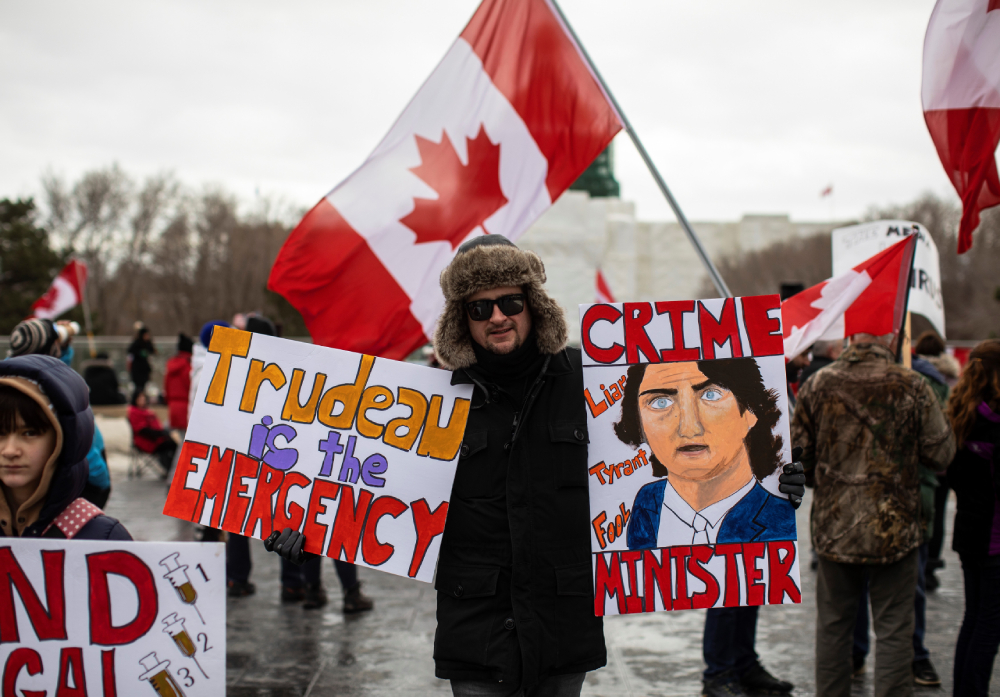
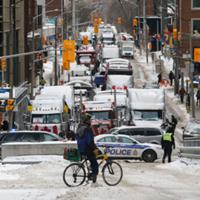
We’re reaping the erosion of skills citizens need for ‘competent democracy.’ For solutions, look to Europe. Photo of Feb. 19 demonstrator in Edmonton by Cole Burston, the Canadian Press.

While enacting the Emergencies Act may clear our streets, the protests have revealed the foothold alt-right extremism has in Canada. The government response has been outmatched by internet-based misinformation, organization and recruitment.

Applications are now open for the six-month Tula Immersion Journalism Fellowship at The Tyee.

For the last three weeks, we have watched radicalization happen in real time.

Experts note that radicalization often begins with a person’s desire to belong, and belonging is cultivated around shared interests, fears and opportunities to feel heard. People then join a group by embracing the shared symbols and rhetoric — movements become radical extremism when people embrace personal attacks as a means to feel empowered at the expense of others.

Supporters of the “freedom convoy” have used COVID-19 vaccine mandates as a rallying cry and hatred has been used to empower and bind the movement together. Leaders of the movement are using common populist tools to turn frustrations into rhetoric of rage and symbols of fear.

The result: more than 400 reported incidents of hate in Ottawa in three weeks.

The Tyee is supported by readers like you Join us and grow independent media in Canada


While “freedom convoy” supporters may be a minority in Canada, social science has shown it only takes a committed minority to shift a whole group.

To turn back the tides of radicalization and hate, Canada needs investments in our democratic culture, improvements in policing and support for grassroots efforts. We can look to international and local examples for practical solutions.

Invest in democratic culture


Canada ranks as one of the strongest democracies in the world, but our research at the Simon Fraser University Morris J. Wosk Centre for Dialogue’s Strengthening Canadian Democracy Initiative has shown that many people have a hard time explaining how their personal actions relate to democracy. Democracy feels disconnected from community and civic life.

To heal the rift, we can look to the Council of Europe for help. Their Reference Framework of Competences for Democratic Culture names a total of 20 critical understandings, values, attitudes and skills that people must cultivate in competent democracies. The framework also puts these ideas into practice for ministries of education and practitioners.

As part of its commitments to democracy, the federal government needs to invest in a national effort to develop its own framework of democratic skills, attitudes and knowledge, immersed in truth and reconciliation and adapted to our particular form of immigration and multiculturalism.

We need a formal process for creating a national dialogue about the attitudes and behaviours we want in our democracy.

Invest in police reform

Canadians promote respect for the rule of law, but the protests have documented the truth: the law treats Canadians differently based on their skin colour.

RCMP are quickly militarized to push Indigenous people off their land when they blockaded pipelines, but police have not removed white protesters with the same vigour.

The hypocrisy of the last three weeks erodes trust in all our institutions.

To restore trust, the rest of Canada should follow Nova Scotia’s lead. Last month, Halifax released a list of 36 recommendations to re-task police, reform practices and accountability to improve public safety.

All levels of government need to invest in similar commissions and, more importantly, enact their recommendations.


Invest in de-radicalization

The federal government may have a 2018 National Strategy on Countering Radicalization to Violence, and invested in countering misinformation through its Digital Citizen Initiative, but they have yet to be scaled up effectively.

To shrink the foothold of alt-right fascism, we can look to Norway and Germany’s EXIT programs. These approaches model a national strategy that supports grassroots counselling and family support to help those leave radicalized groups.


Most Disagree with Convoy Truckers on Vaccine Mandates and Lockdowns
READ MORE

They encourage people to build new productive relationships and promote trust among communities and institutions. They are hailed as one of the most successful de-radicalization strategies, and in Norway, their efforts are believed to have eliminated the threat entirely.

Effective grassroots programs exist in North America and can be scaled. Life After Hate uses support networks to help people move away from radicalization. In Canada, the Organization for the Prevention of Violence works with communities to develop public education campaigns tailored to different extremist beliefs. These approaches also fulfil the need for community that often draws people to extremism in the first place.

Most de-radicalization approaches emphasize using dialogue: building empathy and exploring the values and motivations at the foundation of someone’s ideas.

It’s challenging to forcibly convince someone they are wrong, but loved ones can reintroduce them to trustworthy news sources, reduce confirmation bias and reconnect with communities that bring them joy.

Invest in local democracy


Convoy Pushback: ‘Thank You Health Workers’
READ MORE

If radicalization is tempting because it creates belonging and a sense of empowerment, we need to invest in democratic forms of those experiences in our own backyards.

Scotland, for example, has passed the Community Empowerment Act. The act provides a fund to allow communities to tackle poverty on their own terms. It also creates community councils to elevate citizen voices in government and encourages deliberative activities to involve residents in solutions.

Canada often creates funding opportunities and programs to encourage solutions to important problems — it’s time to ensure those take place at national and local levels to promote democratic skills, belonging and empowerment. Proven solutions exist. We just need to invest in them.

Kelly Grounds co-authored this article. She has worked as a junior policy analyst in cybersecurity and as a research assistant on disinformation projects.

War in Ukraine

(Statement of the Internationalist Communist Tendency)

We reproduce here and make our own the international Declaration that the Internationalist Communist Tendency (ICT) has just adopted. In the face of imperialist war, the affirmation and defense of consistent proletarian internationalism – that is, to the point of revolutionary defeatism against "one's own" bourgeoisie – is the first task of communist minorities. That we can, on this occasion, speak with one voice can only strengthen the internationalist camp – its class unity – and its reach into the proletarian ranks. But above all, we want to support the general, but nevertheless concrete, orientations that the ICT puts forward and that we, for our part, do not cease to put forward because they correspond to the stakes of the present historical situation and course, which are basically determined by the alternative international proletarian revolution or generalized imperialist – and nuclear – war.

Crisis and war feeding each other “ are creating fertile ground for the revival of the class war ”, the comrades rightly say. In parallel, or more precisely in close connection with this perspective, we revolutionaries must “ devote  our energies to building the international revolutionary party so that it can bring its tactics and strategy to the wider working class. ” In doing so, the united defense of proletarian internationalism and the slogan of revolutionary defeatism become, and must become, a moment of the struggle for the communist party of tomorrow.

This is also why we support and endorse the Declaration of the ICT.

The IGCL,28 February 2022


War in Ukraine: Imperialist Rivalry in a Global Economic Crisis

No War but the Class War! Neither NATO nor Putin!

(Statement of the Internationalist Communist Tendency)

The war in Ukraine goes on. Despite some hesitation by Germany, France and Italy, Putin calculated that the US and Western allies (NATO) would not give up on their economic and financial sanctions, or recognise Russia’s acquisition of Crimea via a "referendum". More importantly, he recognised Biden's (and Zelensky's) desire to incorporate Ukraine into NATO. If that happened, Russia would have the missiles in their backyard. It was a risk that Putin was not prepared to take, not only for the sake of national security, but also to maintain his "lifetime" presidency, as well as Russia’s role of gas and oil supplier to Europe. Last, but not least, Putin does not want to look as though he had lost across the board without even putting up a fight. Plan A was to use diplomatic "weapons" alongside military deterrence (movement of troops on the borders of Ukraine) to frighten the Zelensky government whilst pushing the two separatist republics of Donetsk and Luhansk in the Donbas, with their strategic ports in the Azov Sea and rich coal mines, towards self-determination.

Plan B (the actual invasion of Ukraine) was dramatically put into effect when all the assumptions of plan A failed due to Biden's negative response to all of Putin’s demands. Moreover, even though it is marginal to the strategic competition between the two imperialisms, we should also remember that the American

President is on the threshold of mid-term elections and his approval ratings are considerably down.

Therefore, pushing Russia to this "extreme" act is a sort of victory which will inevitably bring old Europe closer together, away from Russian energy blackmail (with more sales for US gas from fracking) and closer to the US as the military links within NATO are reinforced. But at the same time it is compelling Russia to extend its growing links with China. Imperialist confrontations are thus now all the more dangerous.

We are chronicling a war that was widely anticipated and that simple common sense could have avoided.

But common sense is not an economic category. It does not belong to the inalienable interests of the imperialists in question, interests which, in order to be achieved, can quite possibly lead to war. Neither does common sense govern the actions of a capitalism which is increasingly in crisis, much less imperialism as a whole which inevitably takes on aggressive forms.

A New Historical Phase

In this historical phase we have to deal with three aspects which are dramatically part of every war, whether or not in the Middle East, whether they are oil wars, strategic conquests or proxy wars.

The first aspect concerns the lack of a political movement strong enough to counter the crises of capitalism and the ensuing wars which are the temporary "solution" to its contradictions. The scattered revolutionary organisations are not, at the moment, a strong enough political reference point to pose an alternative to the barbarism of capitalism.

The second aspect is inextricably linked to the first. In the absence of a revolutionary political party, in the absence of a mass mobilisation against war and the crises of capitalism that generate wars and the ruling class ideology that justifies them, the massacre of proletarians, wage workers, used as instruments of war themselves, becomes an unavoidable consequence.

The third point concerns the weapons the bourgeoisie uses to oblige masses of workers — whose labour-power in peacetime is exploited to the last drop — to become ‘cannon fodder’ in times of war. Somehow the masses fall in with the interests of capital which are, by definition, opposed to theirs. These weapons are many and varied: they range from the use of organised religion, the idea of "exporting democracy" in order to overthrow dictatorships which, paradoxically the same powers have financed, and politically supported, if not armed to the teeth until that time. Last but not least, imperialism plays the nationalist card. In this case, nationalism of the "Great Russian" variety. Before the war the game had worked perfectly. Putin has always appealed to the unity of the Slavic people of "Greater Russia" as a single ethnic group under a symbolic single homeland. Russians, Belarusians and Ukrainians, up to the Maidan uprisings (2014) that brought down the pro-Russian Yanukovych, were blood brothers for Putin. They were to be treated as part of an ethnic nationalism as false as its promoter, but functioning in the interests of Russian

imperialism.

Once the war began, the nationalist card was used for the Russian-speaking populations of Donbas, inciting them to secede from Ukraine with military support from the "Russian Motherland" to punish the renegade Ukraine.

The NATO powers have responded with increased sanctions with the aim of further embarrassing Russia, but in doing so could also embarrass important members such as Germany, France and Italy. NATO secretary Stoltenberg is threatening to intervene militarily if an allied country is threatened. Meanwhile, the Moscow-Beijing axis has been strengthened. The oil sanctions on Nord Stream 2 would be replaced by

Russia's oil and gas exports to China and the Chinese "silk road" project would continue to have Russia itself as one of its terminals.

The Revolutionary Response

These are facts created by imperialism. Their moves, their goals. There is no choice for revolutionaries. We do not stand with NATO for the defence of a false democratic freedom. We do not support Russia in the name of vital strategic interests or ideological nostalgia that would like to revive the glories of a non-existent socialism despite a first, unique and inspiring, proletarian revolution in 1917. By the 1920s due to the failure of the international revolution it was isolated and defeated. In this regard, it should not be forgotten that fringes of pseudo-communists and the left around the world "cheer" for Russia when imperialist forces come to blows, simply because they oppose American imperialism. They never ask what Russia is today, or pose the question of internationalism and of the class war, and its possible revival. In terms of the outlook for the international working class, currently things are not going well. Though strikes are rising they are few and far between. Many are sectional and thus easily prevented by the trade unions from developing a deeper questioning of a capitalism in crisis. Political organisations capable of significantly putting forward a social alternative to capitalism do exist, but as yet do not have the strength to affect the wider working class which, at the moment, passively puts up with the dominant ideology of their respective national bourgeoisies. But the crisis goes on. Its impact is already creating a new wave of attacks on workers everywhere. These attacks and the increasing danger of all-out war are creating fertile ground for the revival of the class war.

Our revolutionary response to the barbarism of imperialism is to devote our energies to building the international revolutionary party so that it can bring its tactics and strategy to the wider working class and so fight against the death grip of nationalism, the revival of bourgeois-democratic ideology, and fake “socialist” myths (such as the possibility of “socialism in one country”). In this way the international working class will be able to take the revolutionary path to genuine socialism against all the capitalist exploiters, all imperialisms and their wars. In the meantime imperialism offers us only more barbaric tragedies: wars, famine, death, ethnic cleansing and genocide, refugees in search of a better world that does not exist but which still has to be built. This is the task of the world working class. Our war is the class war to rid the world of these atrocities.

Internationalist Communist Tendency, 27 February 2022


Canada’s First Black Nurses, and How to Save the System

As burn-out mounts, a history book reminds we must improve conditions as we seek new recruits.


Crawford Kilian 25 Feb 2022TheTyee.ca
Crawford Kilian is a contributing editor of The Tyee.
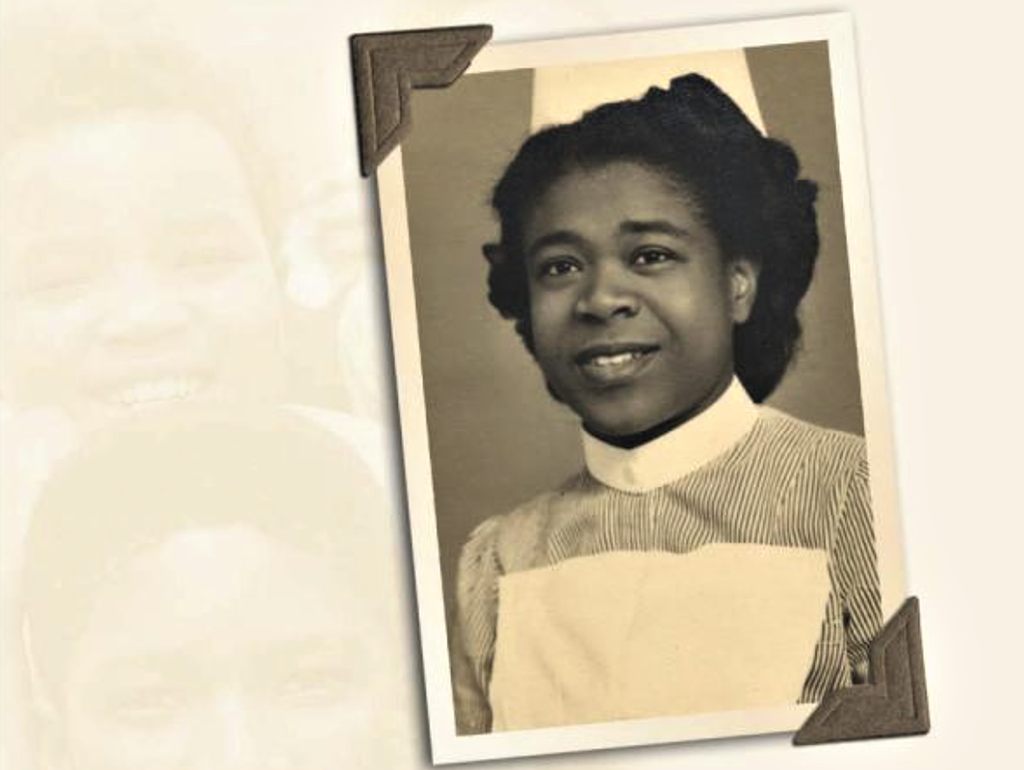
A detail from the cover of Moving Beyond Borders shows one of many Black recruits who, beginning in the 1940s, broke the colour barrier in Canadian nursing.

Moving Beyond Borders: A History of Black Canadian and Caribbean Women in the Diaspora
By Karen Flynn
University of Toronto Press (2011)

Canadian health care is two years into a pandemic, and its troubles are only just beginning. This book points to a solution.

Doctors, nurses, technologists and other staff are exhausted. Many are quitting, or taking early retirement, or dying. Those who remain are overworked and taking abuse and violence from some of the people they’re trying to save.

And whatever the politicians say about “living” with COVID, health-care workers will still have to care for COVID patients who die with it, as well as all the other routine duties involved in looking after an aging Canada.

The BC NDP’s new budget is a case in point. The Hospital Employees’ Union responded to it with a warning from HEU secretary-business manager Meena Brisard: “The budget includes 6.6 per cent increase to core health spending in 2022–23 but holds planned spending increases in future years below the levels needed to support health-care delivery in the face of a growing and aging population, and inflation.

“We strongly support the premier’s efforts to secure a higher level of support from the federal government for health-care spending. But we also need to plan today for the health-care system we need in the years ahead.”

The BC Nurses’ Union, meanwhile, has surveyed its members and found them alarmingly ready to leave the profession. Two out of five nurses in their 20s said they were likely to leave after the pandemic, and over a third of those in their 30s.

As for the future, the BCNU said: “As the pandemic wears on, we are asking that a plan be developed that addresses the crippling staffing shortage, unrealistic working conditions, and recruitment and retention of nurses in every part of this province.

“The results show us that nurses are more willing to stay in the profession if they are better protected from violence in the workplace, if they have unfettered access to PPE and have enough nursing colleagues to meet the demands of the health-care system.”

Even if today’s nurses stay in their jobs, the profession is still understaffed. The B.C. government is adding 602 new nursing seats to programs that now have about 2,000, but even that is unlikely to meet growing future needs — especially if attrition continues.

We’ve been here before, scrambling for more people to staff a health-care system trying to meet sharply increased demand. We will likely do it the same way now that we did in the decades after the Second World War: by recruiting overseas. But this time we’ll have to do it while also transforming the whole system.

Karen Flynn, an associate professor at the University of Illinois, published the remarkable book Moving Beyond Borders: A History of Black Canadian and Caribbean Women in the Diaspora in 2011. She interviewed 35 Black Caribbean and Canadian women who had entered nursing from the 1940s to the 1960s. Most had been recruited to work in Britain’s new National Health Service, and were trained in British hospitals. They eventually migrated to Canada, sometimes after a return to the Caribbean.

On its face, Dr. Flynn’s book might seem to be focused on Black medical history, offering a study of some of the first Black women to break into a hitherto white profession. But in 2022, it looks like a manual on how to save the whole health-care system. Her interviews go deep into the nurses’ childhoods and the mid-century cultures of Canada, Britain and the Caribbean. She learns how the nurses grew up with norms of gender and race and class, and how they dealt with both individual and systemic racism.

By showing us these women’s origins, and the system they contended with, Flynn offers guidelines for our own system, which still retains many of the weaknesses of the 1950s and ’60s. Black nurses learned how to work around those weaknesses, or even ignore them, while still delivering excellent care. We’ll have to look for similar traits in the health-care workers of the coming decades.

Recruited out of desperation


Capable though they were, Flynn’s young women were recruited out of desperation to staff a system that didn’t think much of them. Britain’s Caribbean colonies had long been impoverished and forgotten, but the new National Health System faced a critical shortage of skilled labour after the war. Canadian Black women were equally impoverished, and perhaps more aware of this inequity than their counterparts in the Caribbean.

Once in Britain, the young women encountered racism at every level, from patients who didn’t want to be touched by Black hands to matrons who referred to them using slurs.

They found themselves on the bottom of a hierarchy, with white male doctors at the top and white female nurses and matrons just below them. All nurses were expected to behave like proper white middle-class girls; that put the Black students at an instant disadvantage. One 1960s student grew a big Afro, and kept her nurse’s cap so far back on it that her matron could barely see it — a daring act of resistance.

Another act of resistance was to refute their white instructors’ biases by becoming the best students in class, and then the best nurses in the hospital. But it took infinite patience to endure the casual bigotries of their teachers and colleagues.

‘De-skilling’ professionals


Black nurses who migrated to Canada carried the prestige of their British training and experience, but found themselves in a very different culture: jobs they did routinely in Britain were now the preserve of doctors only; the nurses themselves were “de-skilled” with tasks that should have belonged to nurses’ aides and orderlies. Some moved on to better careers in U.S. cities like Detroit.

No doubt much has changed in Canadian health care since the 1960s, but racism remains ingrained against Indigenous people in the system. And after all these years, it’s still a persistent problem for Black Canadian nurses.

The Registered Nurses’ Association of Ontario recently published the report of its Black Nurses Task Force, saying: “RNAO recognizes that racism is a public health crisis that contributes to health and socioeconomic disparities and must be urgently dismantled. RNAO launched its Black Nurses Task Force in June 2020 to acknowledge, address and tackle the anti-Black racism deeply ingrained in the nursing profession.”

Health-care professionals should read the report, as well as Dr. Flynn’s book, while taking detailed notes. It’s no longer enough to recruit people of colour on the principle that “any warm body will do.” Recruitment will require understanding the cultural backgrounds of potential health-care workers, and assessing their ability to work within a system while also dismantling its racist, classist and sexist components.

Recruit the best

Regardless of race, class or gender, every health-care worker should be scouted like a promising high school hockey player, recruited into top schools and rigorously trained. Hospitals and clinics should compete for such graduates, offering excellent pay, working conditions and support.

Many will be Indigenous, Black or from overseas; immigrant health-care workers should be welcomed like foreign investors, not like unqualified imposters. Varied backgrounds, training and skills should be judged as advantages. It should be cheap and easy for immigrants to train to meet local standards.


Nurses Are in Crisis, and Banging Pots Isn’t Going to Fix It READ MORE

Like the British in the 1940s, we may well need to attempt to draw from lower-income countries who already lack enough workers for their own needs. Rather than grab the best for ourselves, we could help fund their medical and nursing programs and train their teachers, on a scale that would enable such countries to export health-care workers, like the Philippines and Cuba. We could then recruit the graduates we need, while their classmates work in hospitals around the world.

Yes, it would be expensive. It would upset the status of the doctors and administrators now at the top of the hierarchy, and the cost would annoy taxpayers who think they’ll never get sick. Some people would still come out of hospital complaining about the food or the beds instead of marvelling that they’re still alive thanks to the care they got.

But however costly it may be to train and employ workers in our future health-care system, it will be vastly cheaper than burning them out and throwing them away. The pandemic has shown us that inequality — whether from racism, sexism or classism — is a health threat at least as serious as COVID-19 itself. A society that cares about its caregivers will be far happier and healthier than one caring only for those at the top.

‘I Was a Racketeer for Capitalism’
Now is an apt moment to read up on a US marine named Smedley Butler.


Crawford Kilian 22 Feb 2022TheTyee.ca
Crawford Kilian is a contributing editor of The Tyee.

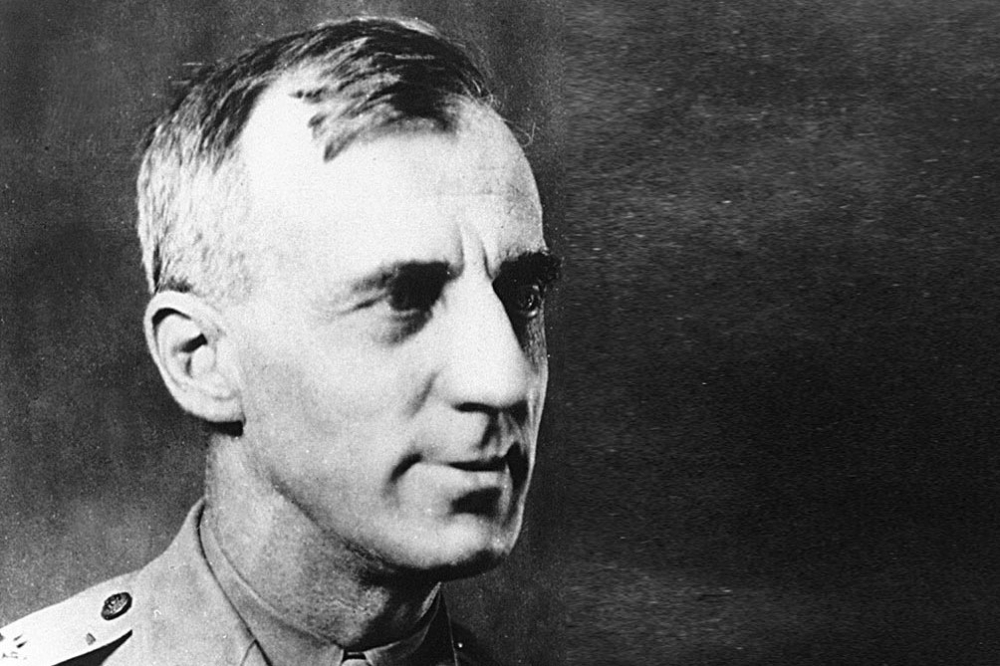
Smedley Butler died on the eve of the Second World War: 
‘An idealistic boy grown into a monster, he served his country by ruining other countries beyond repair.’ 
Photo via Wikimedia.

Gangsters of Capitalism: Smedley Butler, the Marines and the Making and Breaking of America’s Empire
By Jonathan Katz
St. Martin’s Press (2022)

The life and confessions of Smedley Butler make interesting reading as schemers subvert the electoral process in the U.S., and as Canadians behold the assault on their own government by capital occupiers backed by mysterious money and tactical assistance.

Who is Smedley Butler? Once upon a time, he was America’s archetypal warrior, a U.S. Marine general who became the model for soldiers in Hollywood movies. He was literally present at the creation of the American empire, from Latin America to the Philippines — a professional toppler and installer of regimes who shaped over a century of imperial policy and administration.

Butler was even approached to lead a coup against his old friend Franklin Delano Roosevelt. For the masters of high finance who tried to recruit him for that job, democracy had become an inconvenience to be tossed away.

Today Butler is almost forgotten, an embarrassment even to the marine corps. That’s because he described his 30-year career by calling himself a racketeer, a gangster for capitalism. He gave anti-war speeches on college campuses and died of cancer in 1940, the day before Hitler invaded Russia.

Jonathan Katz has resurrected Butler from 80 years of obscurity in this surprising and very well-written book. He has also explored a part of American history that Americans prefer to forget, and examined the 21st-century consequences of 19th-century presidents’ imperial ambitions.

Smedley Butler was a lucky man, born into a prosperous Philadelphia Quaker family; his father was a congressman. When the Spanish-American War broke out in 1898, Butler was only 16. Despite his age and his family’s Quaker pacifism, he was eager to help liberate Cuba from the Spanish empire. He managed to get himself into the U.S. Marines and (after very little training) shipped to Cuba as a second lieutenant. Of all places, he came ashore at Guantánamo, where he took part in some combat.

Enforcer for the banks


Then he was caught up in a whirlwind: he went to the Philippines, where the Filipinos were resisting their new masters; he fought in China as part of an international force to suppress the Boxer Rebellion. In Latin America, he was in the U.S. invasion of Veracruz during the Mexican Revolution, guarded Panama during the digging of the canal, and eventually invaded most of the nations of Central America as well as Haiti and the Dominican Republic. And this was in just the first 20 years of his hitch.

Butler was advancing proudly racist American policies everywhere he served: Chinese, Filipinos, Central Americans and Caribbean islanders were ipso facto inferior peoples, useful as cheap labour or not at all. American investors in such countries expected the marines to protect their investments, and they did. American banks almost worked from a script: lend money to a government, wait until it has trouble repaying it, then send in the marines to oust the government and find a puppet president who will rob his country to pay the banks. (This was when the term “banana republic” first appeared.)

Katz describes Butler’s forays in Central America as rollicking adventures, young American men roaming Nicaragua and Honduras with guns and having a great old time. Butler saw a problem though: his marines were too few to police all of America’s new colonies and client states. He began to think of how to recruit local toughs and train them as “national guards.” When he got chances to implement his idea, he launched the careers of many dictators, from the Somozas of Nicaragua to Trujillo in the Dominican Republic and the Duvaliers of Haiti. As Roosevelt said of Somoza, “He’s a son of a bitch, but he’s our son of a bitch.”

As the de facto ruler of Haiti during its first marine occupation, Butler established the detested practice of corvée — obliging Haitians to pay a tax or do unpaid labour instead. In the world’s first Black republic, which had fought a great revolution to free itself, this looked like the return of slavery. Nonetheless, it continued for years.

He also invented what we now know as counter-insurgency. Butler made friends with villagers in rebel-held areas, treating them well and exploiting their conflicts with rebels. It worked well enough in Haiti to end armed resistance, but less well in later American wars like Vietnam and Afghanistan.

Probably his worst act in Haiti was to walk into the Haitian parliament with some of his men and simply shut it down at gunpoint. It would not meet again for years, and Haiti’s continued political instability can be traced largely to that incident.

When the U.S. entered the First World War, Butler was bitterly disappointed to be left in charge of Haiti. After almost 20 years of beating up small countries, he wanted to test himself against a European enemy. But he didn’t get to Europe until the closing days of the war, and found himself in charge of a camp in France for servicemen returning to the U.S.

Katz argues that the experience may have changed Butler: He was dealing with American combat survivors, men suffering terrible physical and mental wounds. Perhaps they reminded him of his own bullet wounds and the nervous breakdown he’d had in the Philippines. Butler became their advocate, pestering the higher-ups to provide better care for returning veterans. He had always understood that his Latin American adventures had been to benefit investors and banks; now he began to wonder about the motives behind wars between empires.

‘Gruff but lovable’


Still, he remained in the service for another decade. Assigned to a new marine base in San Diego, Butler became a technical advisor for Tell It to the Marines, a 1926 Hollywood movie starring Lon Chaney. He taught Cheney how to behave like a marine, and Chaney behaved like Smedley Butler, a “gruff but lovable” guy. The movie was a big hit and created an archetype for future Hollywood war films.

By the late 1920s, Butler was back from another hitch in China, this one spent watching Japanese encroachment and clashes between Nationalists and Communists — and protecting property in Tianjin owned by Standard Oil. He also received unexpected gifts from two villages, one where his marines had rebuilt a bridge, and the other where he had kept the Nationalist army from entering and looting. Butler knew it; it was a “Boxer Village” where he’d been shot almost 20 years before while killing many of the villagers. He now gained a new respect for some of the people he’d been fighting, and new doubts about what he’d been doing with his life.

In some financial trouble as the Depression hit, Butler found he could make money as public speaker. To 700 guests at a Pittsburgh banquet, he described how he’d kept a Nicaraguan president in office by declaring opposition candidates to be bandits; then he followed up with the story about dissolving the Haitian National Assembly at gunpoint. The audience ate it up, but author Sinclair Lewis turned it into a national scandal because such outrages were still going on.

Butler’s career was dead in the water, and another speech sank it. He described how Mussolini, driving a friend of Butler’s through northern Italy, had run over and killed a child. Mussolini had dismissed the accident: “It was only one life.”

That speech got Butler a court martial, which was eventually dropped. He then retired and began a new career as a critic of U.S. policy. The Bonus Marchers arrived in Washington in the summer of 1931, veterans out of work and demanding promised back pay for their wartime service. Butler urged them to stay until their demands were met. A few days later, Gen. Douglas MacArthur ordered troops to attack the marchers’ shantytown.

Bizarrely, Butler was approached a few years later by people who wanted him to lead another veterans’ march on Washington — for the purpose of ousting Roosevelt and installing a new “secretary of general affairs” as dictator. The bankers behind the scheme, he was told, were torn between Butler and “a more authoritarian general: Douglas MacArthur.”

Butler blew the whistle and testified before the new House Un-American Activities Committee (which would later focus on communists only). But nothing happened. People laughed it off. As Katz observes, “Americans had been trained to react in just that way” — to laugh off real plots by those same bankers, plots which Butler had carried out with considerable force.

War is a racket’

In his last years Butler published a booklet, War Is a Racket, in which he saw bankers and industrialists as the racketeers. In an article for a socialist magazine, he described his career as “a high-class muscle man for Big Business, for Wall Street and for the bankers. In short, I was a racketeer for capitalism.”

Jonathan Katz has brilliantly structured his book with chapters about his own visits to the places where Butler served, from Guantánamo to China, Haiti to the Philippines. Katz shows how those countries still live with his legacy of brutal local police and military forces, dictators and oppression. If you seek his monument, look at Duterte’s Philippines or Ortega’s Nicaragua.

Smedley Butler emerges in Katz’s book as a kind of tragic villain. An idealistic boy grown into a monster, he served his country by ruining other countries beyond repair, and eventually seeing how much harm he had done. If the Americans today fret about migrants from Central America and Haiti, or the revived hostility of China, they can now see the origin of those threats.

Canadians, too, might find in this tale a reminder that for many who are rich and powerful democracy is an OK notion until it gets in their way. Then the plotting and scheming starts. Smedley Butler was not the last racketeer for capitalism.
In the Streets of Moscow, Russians Are Shocked by Putin’s War

Vladimir Putin claims that he is “demilitarizing” Ukraine by invading it with tanks and bombs. In Moscow, ordinary Russians don’t understand what their government is planning — but they’re shocked by the assault on a neighboring country.

A protester with a mask reading “No War” is apprehended by police. (Moskvichmag.ru)


BYALEXEY SAKHNIN
JACOBIN
02.27.2022


Unlike the residents of Donetsk, Kharkiv, and Odessa, on February 24, Muscovites did not hear explosions in their city. Russian citizens learned about the outbreak of war, which the spokesperson for the Foreign Ministry described as “an attempt to prevent a global war,” from the news.

The president’s spokesman, Dmitry Peskov, sounded confident that “Russians will support the operation in Ukraine just as they supported the recognition of the DNR and LNR,” referring to the Donetsk and Luhansk Peoples’ Republics. But on the evening of the first day of the war, several thousand Muscovites gathered on Tverskaya Street to express their disagreement with him. The police blocked Pushkin Square, but people moved in fairly dense crowds along the boulevards, Tverskaya, and the surrounding alleys. Young faces predominated.

The same young faces prevailed ten years ago on Bolotnaya Square and Sakharov Avenue during the anti-Putin protests of 2011–12. But the atmosphere has changed radically over the years. In 2012, the “angry citizens” were proud of their gushing “creativity”: hundreds of slogans, banners, and chants. Their authors were competing in wit. Now people mostly moved in silence. They chanted a single slogan: “No to War!” At least 955 people were detained in the evening.

There were not as many protesters as at the biggest rallies in recent years, but not as few as one would expect on a Thursday evening, the first day of the war, when confusion and depression everywhere reigned. But most of these people were, if not hardened protesters, in one way or another a part of the opposition milieu. The politicized middle class is predictably dissatisfied with the radical moves of the country’s leadership. But what about the vast majority of Russians not involved in this antiwar movement? I spoke to some of them.
Who Needs War?

“Of course I am against the war,” says a mother walking with her children in Tagansky Park. “Who needs war? I feel very sorry for the people. I cried all day today. I’m afraid for my children. What will happen to them?”

Her two children, who look about six and eight years old, meanwhile, happily run around us. But at one point the boy stops, snuggles up to his mother, and asks, “Mom, can Snoop become a service dog so that he can protect us?”

I walked from Taganskaya Square to the Pokrovsky Monastery near Abelmanovskaya Zastava. I approached all kinds of people: young girls, grannies selling flowers, workers in yellow municipal vests, and pilgrims going to worship St Matrona of Moscow. I asked a few simple questions. Almost everyone readily answered. There were those who came up to me themselves. Many spoke hastily, as if they were finally breaking a vow of silence.

“Very bad!” said two girls of about eighteen. “Very bad!”

The enthusiasm and support that the president’s spokesman hoped for is absent. Out of thirty or forty respondents, only one — a young man of conscription age — spoke about patriotic support for the Russian authorities’ actions: “This is our land. It must be protected. If they send me, then I will go where I am told to.”

But when I asked him what awaits us in the near future, he answered without much patriotic pathos: “I think some foreign social networks will be banned. As for the rest. . . . Bread for 500 rubles, a euro for 500 [the exchange rate is currently around 1 to 100]. Our government makes a lot of mistakes. But once we’ve started, we need to see this through to the end.”

Everyone else voiced feelings ranging from fear to resentment. I did not meet anyone psychologically prepared for disturbing news from the front. People simply could not explain why Russian troops were digging into Ukrainian territory. No one gave them any convincing answers. Older people remembered 2014 and the Crimean spring.

“It was somehow easier then,” said a man in his forties whom I stopped outside a branch of Sberbank. “There was a sense of unity. And a sense of justice, or something. Back then our people were offended — and we stood up for them. And we took what was ours. And now I do not understand. Why did we invade?”

“Sociologists say that the military action in Ukraine, which began today, came as a surprise to Russian society and formed a situation of mass shock. Analysts are pointing out that people turned out to be unprepared for a military confrontation,” admits the pro-Kremlin Nezigar channel on Telegram.
No One Asked Us

Two guys are coming out of a café. I turn to them with questions about the war, the exchange rate, and the consequences. They, like everyone else, don’t understand this war. “We don’t want to think about it. We don’t think about it. That’s why we can’t say anything intelligible,” says one of them.

The other adds: “It’s like something divine . . . something cosmic. What can you do about it? It just goes without saying, for Christ’s sake. We should get out of here. Go to the countryside, to the woods. We should light fires. And not think.”

This motif came up very often in my sociological experiment. People encounter something that exceeds their ability to understand. War. Something that does not fit into their moral coordinates. It’s not a defensive war. It has no particular reason. And they shrug off this news that they are unable to do anything about.

“I forbade my mother to watch the news,” says a middle-aged woman. “I told her to watch My Fair Nanny. It’s a good show! But don’t read the news! It’s bad for you.”

A couple of college freshmen told me that today their classmates are unwilling or afraid to discuss politics. “There’s a feeling that they just don’t notice. They try not to notice.” A lot of people have the same impression.

“It amazes me that everyone is silent, as if this is normal” says an indignant worker with a mustache from the municipal energy company. “They’re just glued to their cell phones, that’s all!”

But this feeling of general indifference may be deceptive. Almost all my respondents told me they had discussed the shocking news in one way or another. Many admitted to spending “all day” on it. But the heated conversations with loved ones contrasted with a city that (for now) continues to go through its daily routine. And many feel like they are the only ones here experiencing anxiety, powerlessness, and loneliness. Although, in the passing crowd, almost everyone is probably experiencing these feelings right now and for the same reason.

No one has asked these men and women — or anyone else in the country — what they think. Do they think they should send Russian tanks and planes into the former fraternal republic? Are they willing to make sacrifices for the sake of what Putin calls the “denazification of Ukraine”? Do they believe that the country’s security requires extreme measures? It was only one day into the war, but many already felt the need to talk about it, to voice their opinions. At least just to be heard.

“Will you really write that I am against the war?” an old woman outside a grocery store naively asked me.
The Main Problem

“It’s as if there are no other things [the state] could be doing!” the elderly flower seller told me in a low voice.


Yesterday, my neighbor’s son had a major accident because the road just collapsed from underneath him. Well really, is it so necessary for them to start a war somewhere? Wouldn’t it be better to lay the asphalt normally? Here I am, an old woman, standing here peddling. My pension is not enough. Well at least I lived somehow. And now? Like under the Germans, is it war again?

Six women in their fifties stand in a circle near the Marksistskaya metro station with their bags on pedestals.

“Yes, it’s alarming, of course,” said the most boisterous among them. “And I am very afraid. For our husbands, for our children. They may be drafted. But we hope that it will all come to an end soon. That our people will quickly restore order there. But there’s a war, guys. . . . It’s the twenty-first century, and we’re at war. If it starts on a large scale, it will affect everyone.”

“So we’re not going to be flying to Egypt anytime soon?” I ask the woman who was just talking about her recent trip.

“Of course we will, God willing” she answers. “Everything will be all right. Everything will be fine! I think we have a strong army, and it won’t affect us, the civilians, anytime soon. We have a great president. So it’s not the main problem . . .”

The woman stammers. Her stream of optimism can’t find an outlet. Her friends shake their heads: “No, Lena. This is fucked up. This is the main problem now.”

This piece was first published by Moskvichmag.ru, and translated into English for LeftEast.

ABOUT THE AUTHOR
Alexey Sakhnin is a Russian activist who was one of the leaders of the anti-Putin protest movement from 2011 to 2013. He is a member of the Progressive International Council.

The return of nature in the Anthropocene. A critique of the ecomodernist 'good Anthropocene' (draft 2019 forthcoming) docx

2019, In Arias-Maldonado, M., & Trachtenberg, Z. (Eds.). (2019). Rethinking the Environment for the Anthropocene: Political Theory and Socionatural Relations in the New Geological Epoch. Routledge.
2392 Views19 Pages

The concept of Anthropocene seems to represent a new opportunity for Earth scientists and social (de)constructivists to definitely abolish the distinction between nature and society, to affirm human power on the planet and to allege the definitive ‘end of nature’. Indeed, the fact that humanity is about to be acknowledged as a new geological force represents the last chance for the Promethean triumphalism, embodied by geo and eco-constructivists (Neyrat, 2015), to prosper upon the wreckage of its own ecological collapse. This position can be summarised in McKibben terms: ‘we now live in a world of our own making’. I will argue, against this view, that to acknowledge that nature and society are more and more intertwined around us - and inside us - is not enough to abandon the analytic distinction between aspects deriving from human societies and those deriving from nature’s ‘non-identity’ (otherness). In other words, natural objects have still agency and human societies themselves are materially anchored in biophysical conditions that transcend them. The contradiction between the claim that humans are new “planetary managers” or “Earth engineers” and our obvious inability to control our environmental impacts on the planet constitutes one major sign of natural agency, or what I call ‘the return of nature’. Moreover, I will show that the concept of Anthropocene aims at pursuing an unapologetically anthropocentric world picture in order to justify further capitalist exploitation of the Earth (Crist, 2013). The Anthropocene promoters, driven by a complex mix of economic, scientific and political motives, tend to encourage the hubristic modern faith in technology to fix problems created by technology itself. Against the arrogance contained in this concept, I argue that the repeated failures of ecological modernisation and environmental managerialism should be an opportunity to re-think our place on the planet and to accept the fragility and vulnerability of the human species in the face of complex and unpredictable natural phenomena. In short, what needs to be developed is not a new form of human hubris but our capacities for gratitude, humility, respect and restraint.