Understanding Homelessness in Canada: From the Street to the ClassroomHave you ever wondered why homelessness exists in Canada? This free ebook brings together lived experience representation and the most recent research to explore homelessness from a range of different perspectives. Kristy Buccieri, James Davy, Cyndi Gilmer, and Nicole Whitmore | ||||
| ||||
Monday, February 28, 2022


More People Are Microdosing for Mental Health. But Does It Work?
Scientists are split over whether the benefits some microdosers experience are a placebo effect or something more.

Credit...River Cousin
By Dana G Smith
Scientists are split over whether the benefits some microdosers experience are a placebo effect or something more.
Credit...River Cousin
By Dana G Smith
NEW YORK TIMES
Feb. 28, 2022
Joseph started microdosing psychedelics five years ago to try to improve his mental health. “I was just kind of in this depression, in this rut,” he said. “I was unhappy and angry and agitated all the time, and it went against the way that I saw myself.”
Depression and anxiety run in Joseph’s family, and he’d been prescribed Prozac as a kid. But when symptoms of depression returned in his early 30s, he didn’t want to go back to a prescription drug.
Joseph, an Austin-based designer (he asked to withhold his full name, citing privacy concerns surrounding mental health issues and illegal drug use), came across research from Johns Hopkins University about psilocybin, the active ingredient in hallucinogenic, or “magic,” mushrooms. In a small study, full doses of the drug helped cancer patients cope with depression and anxiety. Then he read anecdotes of Silicon Valley influencers claiming increased energy from taking tiny doses of psychedelics. So he decided to start microdosing a few times a week, eating a “small nibble” — about half an inch — of mushrooms to see if it would improve his mood.
Almost immediately he started seeing a benefit. “It just kind of boosted my morale,” he said. “I was in a little bit better mood. I had a little bit more pep to my step. I was having a little bit more fun, feeling a little bit more excited about things.”
Microdosing is typically defined by experts as taking 5 percent to 10 percent of a full dose of a psychedelic, usually LSD or psilocybin, as a way to get the supposed mental health benefits of the drug without the hallucinogenic high. For instance, in a clinical setting, a 155-pound man might take 20 milligrams of psilocybin for a full psychedelic experience. For a microdose, he’d take only one to two milligrams. At that level, taken several times a week, some claim the drugs improve their mood, boost their creativity and give the world a brighter, shinier quality, like it’s in high-definition.
“It’s akin to walking outside and the sun is suddenly out,” said Erin Royal, 30, a bartender in Seattle who microdoses one or two times a week with mushrooms she forages from nearby forests. “It reminds you that you are a person who can feel positive things and notice things that are beautiful.”
In practice, only about a third of people who microdose carefully measure the amount of the psychedelic they are taking; most take just enough to begin feeling some effects, which usually start after an hour and last four to six hours. That requires some trial and error — particularly when eating mushrooms, which can vary in psilocybin concentration. (The most commonly reported negative side effect of microdosing is accidentally taking too much, which isn’t dangerous but can be inconvenient if you’re at the office. Researchers also say frequent repeated doses of a psychedelic could theoretically stress the heart.)
Research into the mental health benefits of full doses of psychedelics is promising, and one early-phase study even found that psilocybin, at high doses, may be as effective as a selective serotonin-reuptake inhibitor for treating depression. Full doses of psychedelics help the brain develop new cellular connections, a process called neuroplasticity, and there’s some evidence that microdoses produce similar changes.
So many of the scientists who pioneered research into full doses of psychedelics have started studying whether a microdose might also be beneficial. But evidence is limited, and experts are divided about how microdosing helps people — or if it does at all.
Much of the early research into microdosing has been anecdotal, consisting of enthusiastic survey responses from users who experienced enhanced attention and cognition, feelings of well-being and relief from anxiety and depression. Lab studies of psilocybin and LSD microdoses tend to support these claims, showing improvements in mood, attention and creativity. But these studies have generally been small, and they didn’t compare a microdose to a placebo.
“You probably only participate at this point in a trial in microdosing if you really have a strong belief that this might help you,” said Dr. David Erritzoe, clinical director of the Centre for Psychedelic Research at Imperial College London. And when people expect to benefit from a drug, they typically do.
The two largest placebo-controlled trials of microdosing were published last year, and they both suggest that the benefits people experience are from the placebo effect. In the studies, volunteers used their own drugs to participate and, unknown to them, received either active doses or a placebo packaged in identical capsules. At the end of several weeks, almost everyone’s mood and well-being had improved, regardless of what they had taken.
“I was initially surprised but also a bit disappointed by the results, because when we set up the study we were quite optimistic that microdosing could have an effect” beyond a placebo, said Michiel van Elk, an assistant professor of cognitive psychology at Leiden University in the Netherlands who led one of the trials.
Dr. Erritzoe, who ran the other study, found that the drug’s efficacy was tied to users’ expectations. If they took a placebo but thought it was a microdose, they felt better, and if they had an active dose but wrongly guessed it was a placebo, they did not.
A third placebo-controlled trial, published earlier this month from the University of Chicago, tried to get around user expectations by giving participants four microdoses of LSD over the course of two weeks, but without telling them about the purpose of the study or even what they were taking. Once again, there was no difference between the LSD and placebo groups.
Still, some scientists point to evidence showing that microdosing has a direct impact on the brain to argue that its benefits are real. Using neuroimaging technology, researchers have shown changes in brain activity and connectivity after single small doses of LSD that are similar to what’s seen with larger amounts of the drug. And a study in Denmark found that a microdose of psilocybin activated nearly half of the specific type of serotonin receptors that psychedelics act on to produce their hallucinogenic effects.
“I wouldn’t say it’s all placebo. Clearly, it’s an active drug,” said Harriet de Wit, a professor of psychiatry and behavioral neuroscience at the University of Chicago who led several of the studies. “We see brain changes that are a little bit like the high dose effect,” which suggests the smaller doses are acting on the same systems.
Some microdosing researchers, like Dr. de Wit and Dr. van Elk, remain optimistic that tiny amounts of hallucinogenic drugs will ultimately prove beneficial for mental health and cognition. They say that the design of the placebo-controlled trials may be to blame for their lack of significant findings. The studies may not have run for long enough, or the tests and questionnaires used during the studies may not fully capture the benefits some people experience from microdosing.
On the other side, Dr. Erritzoe said that just because a drug has an impact on the brain doesn’t mean it has any therapeutic value. “If you can’t see in a proper trial that it works for the symptoms, for things that people can actually detect and feel and experience in their lives, then it’s just not that interesting,” he said.
“I’m not trying to shoot down microdosing,” he added. “I’m just being cautious and saying at the moment, it does not look particularly optimistic.”
One of the biggest problems with microdosing research is that it’s hard to block the placebo effect in studies of a psychoactive substance. In Dr. Erritzoe’s trial, 72 percent of people correctly guessed what they had taken, which means it’s no longer blinded. For the studies showing effects in the brain, the biggest changes came at the higher end of the microdosing spectrum — 20 to 26 micrograms of LSD and 3 milligrams of psilocybin — an amount where people often start noticing the drug’s effects.
Out of the lab, most users dose themselves aiming for a similar subtle awareness that they’ve taken something. At that level, the microdose might be closer to a half dose, or their expectations could heighten the drug’s benefits because they can feel that it’s doing something.
As a result of these difficulties and the lack of conclusive findings, Dr. van Elk has abandoned microdosing research to go back to studying large doses of the drugs. Dr. Erritzoe said once his next study ends, he’ll probably do the same.
Both Joseph and Ms. Royal are aware that the benefits of microdosing could be a placebo effect. But for them, how it works matters less than the fact that it’s helped. These days, Joseph said his depression has improved thanks to a regular meditation practice, although he still microdoses occasionally if he starts feeling down.
After several years of microdosing, he said the biggest change he’s experienced is a general shift in his mind set — something that’s harder for scientists to measure. “I started because I read that it helps with depression,” he said. “But as I’ve moved on, it’s helped really a lot more with mental and personal growth and outlook on life — how you want to live and your existence in the world.”
Dana Smith is an award-winning health and science writer based in Durham, North Carolina. Her work has appeared in The Atlantic, The Guardian, Scientific American, Popular Science and more.
Feb. 28, 2022
Joseph started microdosing psychedelics five years ago to try to improve his mental health. “I was just kind of in this depression, in this rut,” he said. “I was unhappy and angry and agitated all the time, and it went against the way that I saw myself.”
Depression and anxiety run in Joseph’s family, and he’d been prescribed Prozac as a kid. But when symptoms of depression returned in his early 30s, he didn’t want to go back to a prescription drug.
Joseph, an Austin-based designer (he asked to withhold his full name, citing privacy concerns surrounding mental health issues and illegal drug use), came across research from Johns Hopkins University about psilocybin, the active ingredient in hallucinogenic, or “magic,” mushrooms. In a small study, full doses of the drug helped cancer patients cope with depression and anxiety. Then he read anecdotes of Silicon Valley influencers claiming increased energy from taking tiny doses of psychedelics. So he decided to start microdosing a few times a week, eating a “small nibble” — about half an inch — of mushrooms to see if it would improve his mood.
Almost immediately he started seeing a benefit. “It just kind of boosted my morale,” he said. “I was in a little bit better mood. I had a little bit more pep to my step. I was having a little bit more fun, feeling a little bit more excited about things.”
Microdosing is typically defined by experts as taking 5 percent to 10 percent of a full dose of a psychedelic, usually LSD or psilocybin, as a way to get the supposed mental health benefits of the drug without the hallucinogenic high. For instance, in a clinical setting, a 155-pound man might take 20 milligrams of psilocybin for a full psychedelic experience. For a microdose, he’d take only one to two milligrams. At that level, taken several times a week, some claim the drugs improve their mood, boost their creativity and give the world a brighter, shinier quality, like it’s in high-definition.
“It’s akin to walking outside and the sun is suddenly out,” said Erin Royal, 30, a bartender in Seattle who microdoses one or two times a week with mushrooms she forages from nearby forests. “It reminds you that you are a person who can feel positive things and notice things that are beautiful.”
In practice, only about a third of people who microdose carefully measure the amount of the psychedelic they are taking; most take just enough to begin feeling some effects, which usually start after an hour and last four to six hours. That requires some trial and error — particularly when eating mushrooms, which can vary in psilocybin concentration. (The most commonly reported negative side effect of microdosing is accidentally taking too much, which isn’t dangerous but can be inconvenient if you’re at the office. Researchers also say frequent repeated doses of a psychedelic could theoretically stress the heart.)
Research into the mental health benefits of full doses of psychedelics is promising, and one early-phase study even found that psilocybin, at high doses, may be as effective as a selective serotonin-reuptake inhibitor for treating depression. Full doses of psychedelics help the brain develop new cellular connections, a process called neuroplasticity, and there’s some evidence that microdoses produce similar changes.
So many of the scientists who pioneered research into full doses of psychedelics have started studying whether a microdose might also be beneficial. But evidence is limited, and experts are divided about how microdosing helps people — or if it does at all.
Much of the early research into microdosing has been anecdotal, consisting of enthusiastic survey responses from users who experienced enhanced attention and cognition, feelings of well-being and relief from anxiety and depression. Lab studies of psilocybin and LSD microdoses tend to support these claims, showing improvements in mood, attention and creativity. But these studies have generally been small, and they didn’t compare a microdose to a placebo.
“You probably only participate at this point in a trial in microdosing if you really have a strong belief that this might help you,” said Dr. David Erritzoe, clinical director of the Centre for Psychedelic Research at Imperial College London. And when people expect to benefit from a drug, they typically do.
The two largest placebo-controlled trials of microdosing were published last year, and they both suggest that the benefits people experience are from the placebo effect. In the studies, volunteers used their own drugs to participate and, unknown to them, received either active doses or a placebo packaged in identical capsules. At the end of several weeks, almost everyone’s mood and well-being had improved, regardless of what they had taken.
“I was initially surprised but also a bit disappointed by the results, because when we set up the study we were quite optimistic that microdosing could have an effect” beyond a placebo, said Michiel van Elk, an assistant professor of cognitive psychology at Leiden University in the Netherlands who led one of the trials.
Dr. Erritzoe, who ran the other study, found that the drug’s efficacy was tied to users’ expectations. If they took a placebo but thought it was a microdose, they felt better, and if they had an active dose but wrongly guessed it was a placebo, they did not.
A third placebo-controlled trial, published earlier this month from the University of Chicago, tried to get around user expectations by giving participants four microdoses of LSD over the course of two weeks, but without telling them about the purpose of the study or even what they were taking. Once again, there was no difference between the LSD and placebo groups.
Still, some scientists point to evidence showing that microdosing has a direct impact on the brain to argue that its benefits are real. Using neuroimaging technology, researchers have shown changes in brain activity and connectivity after single small doses of LSD that are similar to what’s seen with larger amounts of the drug. And a study in Denmark found that a microdose of psilocybin activated nearly half of the specific type of serotonin receptors that psychedelics act on to produce their hallucinogenic effects.
“I wouldn’t say it’s all placebo. Clearly, it’s an active drug,” said Harriet de Wit, a professor of psychiatry and behavioral neuroscience at the University of Chicago who led several of the studies. “We see brain changes that are a little bit like the high dose effect,” which suggests the smaller doses are acting on the same systems.
Some microdosing researchers, like Dr. de Wit and Dr. van Elk, remain optimistic that tiny amounts of hallucinogenic drugs will ultimately prove beneficial for mental health and cognition. They say that the design of the placebo-controlled trials may be to blame for their lack of significant findings. The studies may not have run for long enough, or the tests and questionnaires used during the studies may not fully capture the benefits some people experience from microdosing.
On the other side, Dr. Erritzoe said that just because a drug has an impact on the brain doesn’t mean it has any therapeutic value. “If you can’t see in a proper trial that it works for the symptoms, for things that people can actually detect and feel and experience in their lives, then it’s just not that interesting,” he said.
“I’m not trying to shoot down microdosing,” he added. “I’m just being cautious and saying at the moment, it does not look particularly optimistic.”
One of the biggest problems with microdosing research is that it’s hard to block the placebo effect in studies of a psychoactive substance. In Dr. Erritzoe’s trial, 72 percent of people correctly guessed what they had taken, which means it’s no longer blinded. For the studies showing effects in the brain, the biggest changes came at the higher end of the microdosing spectrum — 20 to 26 micrograms of LSD and 3 milligrams of psilocybin — an amount where people often start noticing the drug’s effects.
Out of the lab, most users dose themselves aiming for a similar subtle awareness that they’ve taken something. At that level, the microdose might be closer to a half dose, or their expectations could heighten the drug’s benefits because they can feel that it’s doing something.
As a result of these difficulties and the lack of conclusive findings, Dr. van Elk has abandoned microdosing research to go back to studying large doses of the drugs. Dr. Erritzoe said once his next study ends, he’ll probably do the same.
Both Joseph and Ms. Royal are aware that the benefits of microdosing could be a placebo effect. But for them, how it works matters less than the fact that it’s helped. These days, Joseph said his depression has improved thanks to a regular meditation practice, although he still microdoses occasionally if he starts feeling down.
After several years of microdosing, he said the biggest change he’s experienced is a general shift in his mind set — something that’s harder for scientists to measure. “I started because I read that it helps with depression,” he said. “But as I’ve moved on, it’s helped really a lot more with mental and personal growth and outlook on life — how you want to live and your existence in the world.”
Dana Smith is an award-winning health and science writer based in Durham, North Carolina. Her work has appeared in The Atlantic, The Guardian, Scientific American, Popular Science and more.

Diana Beresford-Kroeger at her home in Ontario. “If you build back the forests, you oxygenate the atmosphere more, and it buys us time,” she said.Credit...Nasuna Stuart-Ulin for The New York Times
By Cara Buckley
Feb. 24, 2022
MERRICKVILLE, Ontario — There aren’t many scientists raised in the ways of druids by Celtic medicine women, but there is at least one. She lives in the woods of Canada, in a forest she helped grow. From there, wielding just a pencil, she has been working to save some of the oldest life-forms on Earth by bewitching its humans.
At a hale 77, Diana Beresford-Kroeger is a medical biochemist, botanist, organic chemist, poet, author and developer of artificial blood. But her main focus for decades now has been to telegraph to the world, in prose that is scientifically exacting yet startlingly affecting, the wondrous capabilities of trees.
Dr. Beresford-Kroeger’s goal is to combat the climate crisis by fighting for what’s left of the great forests (she says the vast boreal wilderness that stretches across the Northern Hemisphere is as vital as the Amazon) and rebuilding what’s already come down. Trees store carbon dioxide and oxygenate the air, making them “the best and only thing we have right now to fight climate change and do it fast,” she said.
Her admirers, who included the late biodiversity pioneer E.O. Wilson, say what sets Dr. Beresford-Kreoger apart is the breadth of her knowledge. She can talk about the medicinal value of trees in one breath and their connection to human souls in the next. She moved Jane Fonda to tears. She inspired Richard Powers to base a central character of his Pulitzer-prize winning novel, “The Overstory,” in part on her: He has called her a “maverick” and her work “the best kind of animism.”
Dr. Beresford-Kroeger has also cultivated an arboreal Noah’s Ark of rare and hardy specimens that can best withstand a warming planet. The native trees she planted on her property in this rural village sequester more carbon and better resist drought, storms and temperature swings, she said, and also produce high quality, protein-rich nuts. If industrial logging continues to eat away at forests worldwide, soil fertility will plummet, and Dr. Beresford-Kroeger, an Irishwoman, is haunted by the prospect of famine.
She is an independent researcher, unaffiliated with any institution, funded by her writings and the sale of her rare plants; she wanted freedom to study and spread her ideas without any strictures.
“Often these kinds of brilliant pioneers are outliers who don’t play by the rules,” said Ben Rawlence, an English writer who found himself “sitting at her feet doing a master’s in the boreal forest packed into three days” while researching his new book “The Treeline: The Last Forest and the Future of Life on Earth”.
“People like her are very important,” he said. “They can integrate the depth of different disciplines into a total picture.”
Dr. Beresford-Kroeger didn’t set out to be an outlier. Born in England and raised in Ireland, she studied botany and biochemistry at the University College Cork before coming to America in 1966 to research organic and radionuclear chemistry at the University of Connecticut. Three years later, she moved to Canada to study plant metabolism at Carleton University, and then do cardiovascular research at the University of Ottawa, where she began working as a research scientist in 1972.
But she faced sexism, harassment and, in that part of Loyalist Canada, anti-Irish sentiment, she said. She left academia in 1982, as much repelled by the toxicity as she was drawn to a deeper calling, rooted in a childhood that was both Dickensian and folkloric.
 A childhood portrait of Dr. Beresford-Kroeger, painted by her father, in her home.Credit...Nasuna Stuart-Ulin for The New York Times
Dr. Beresford-Kroeger was orphaned at 12. Her father, an English aristocrat, died under mysterious circumstances, while her mother, who traced her lineage to ancient Irish kings, perished in a car crash. Dr. Beresford-Kroeger was taken in by a kindly if neglectful uncle in Cork, and spent her summers with Gaelic-speaking relatives in the countryside.
There, under the tutelage of a maternal grandaunt, she was taught ancient Irish ways of life known as the Brehon laws. She learned that in Druidic thinking, trees were viewed as sentient beings that connected the Earth to the heavens. She was also versed in the medicinal properties of local flora: Wildflowers that warded off nervousness and mental ailments, jelly from boiled seaweed that could treat tuberculosis, dew from shamrocks that Celtic women used for anti-aging.
As a university student a few years later, Dr. Beresford-Kroeger put those teachings to the scientific test and discovered with a start that they were true. The wildflowers were St. John’s Wort, which indeed had antidepressant capacities. The seaweed jelly had strong antibiotic properties. Shamrocks contained flavonoids that increased blood flow. This foundation of ancient Celtic teachings, classical botany and medical biochemistry set the course for Dr. Beresford-Kreoger’s life. The more she studied, the more she discovered that the symbiosis between plants and humans extended far beyond the life-giving oxygen they produced.
“Every unseen or unlikely connection between the natural world and human survival has assured me that we have very little grasp of all that we depend on for our lives,” she wrote in her most recent book, “To Speak for the Trees.” “When we cut down a forest, we only understand a small portion of what we’re choosing to destroy.”
Deforestation, she continued, was a suicidal, even homicidal, act.
“We’ve taken down too much forest, that’s our big mistake,” Dr. Beresford-Kroeger said during a recent chat in her hand-built home, as her husband, Christian Kroeger, puttered in the kitchen, making lunch. “But if you build back the forests, you oxygenate the atmosphere more, and it buys us time.”
The Beresford-Kroegers live south of Ottawa, down a long country lane on a 160-acre parcel of land they bought decades ago. Their house is filled with well-thumbed books, fingers of sunlight, thriving plants and Boots, their rescue cat. Dr. Beresford-Kroeger writes all of her papers and books by hand, and doesn’t have a smartphone or computer or any social media accounts. When she needs to Zoom, she pops down to the local library and uses a public desktop.

Dr. Beresford-Kroeger’s husband, Christian Kroeger, read aloud from “Under the Cedars and the Stars,” by the Irish author and Catholic priest Patrick Augustine Sheehan.
Credit...Nasuna Stuart-Ulin for The New York Times
Outside the house, her treasured trees grow, all climate-change resistant to varying degrees: the kingnut, a blue-needled fir and a rare variant of the bur oak. She began creating her arboretum after learning that many key tree species prized by First Nations people for medicines, salves, oils and food had been razed by colonizers centuries ago.
“These trees have fed the continent before in the past,” she said. “I want them available there for people in the future.”
Over the years, she painstakingly tracked down, across the continent and beyond, rare seeds and saplings native to Canada. “I thought, ‘Well I’m going to repatriate these trees,’” Dr. Beresford-Kroeger said. “I am going to bring them back to here, where I know they’re safe.”
She also knew if the “repatriated” plants and trees were shared far and wide, they’d no longer be lost. She and Christian began giving away native seeds and saplings to pretty much anyone who asked. Among the tens of thousands of recipients were local Hell’s Angels, who roared up to their doorstep to collect black walnut seedlings, wanting to grow the valuable trees on their property nearby. “I put them in the back of their motorbikes, their Harley-Davidsons, she said. “I thought I’d die of a heart attack. But they were very nice to me.”
In her forties, Dr. Beresford-Kroeger turned to writing, though it would take a decade to find a publisher for her first manuscript. She has since published eight books, at least a couple of them Canadian best sellers. One was about holistic gardening, another about living a pared-down life. But her main focus was the importance of trees.
She wrote about the irreplaceability of the boreal forest, which principally spans eight countries, and “oxygenates the atmosphere under the toughest conditions imaginable for any plant.” She introduced her “bioplan”: If everyone on earth planted six native trees over six years, she says it could help to mitigate climate change. She wrote about how a trip to the forest can bolster immune systems, ward off viral infections and disease, even cancer, and drive down blood pressure.
There have been skeptics. One publisher admonished her for being a scientist who described landscapes as sacred, she said. The head of a foundation, while introducing her following a screening of “Call of the Forest,” a documentary about her life, let slip that he didn’t believe a word of what she said.
Bill Libby, an emeritus professor of forest genetics at the University of California, Berkeley, said he initially had reservations when Dr. Beresford-Kroeger offered a biological explanation for why he felt so good after walking through redwood groves. She attributed his sense of well-being to fine particles, or aerosols, given off by the trees.
“She said the aerosoles go up my nose and that’s what makes me feel good,” Dr. Libby said.
Outside research has supported some of those claims. Studies led by Dr. Qi Ling, a physician who coedited a book for which Dr. Beresford-Kroeger was a contributor, found visits to forests, or forest bathing, lessened stress and activated cancer-fighting cells. A 2021 study from Italy suggested that lower rates of Covid-19 deaths in forested areas of the country were linked in part to immunity-boosting aerosols from the region’s trees and plants.
“I was laughed at until fairly recently,” Dr. Beresford-Kroeger said, her Irish accent still strong. “People all of a sudden seem to be waking up.”
Nowadays, Dr. Beresford-Kroeger is in great demand, a shift she attributes to mounting fears about the environment and a hunger for solutions.
In 2019, Carleton University awarded her a doctorate in biology along with an honorary doctor of law degree for her climate work. The next year, she was a guest on one of Jane Fonda’s televised climate action teach-ins. She regularly delivers virtual talks to universities and keynote addresses to organizations (“I had goose bumps talking to her,” said Susan Leopold, the moderator of her talk at the 2021 International Herb Symposium). She is helping to plan medicinal healing gardens in Toronto and outside Ottawa as she finishes a new book about how people are spiritually connected to nature. “The publishers can like it or bloody lump it,” she said.
During a tour of her forest and gardens, Dr. Beresford-Kroeger spoke with wonder about how ancient Celtic cures were almost identical to those of Indigenous peoples, and waxed poetic about the energy transfer from photons of sunlight to plants’ electrons during photosynthesis.
Then she advised a reporter to lean against a tree before writing. People, she said, should look at forests as “the sacred center of being.”
“Without trees, we could not survive,” she said. “The trees laid the path for the human soul.”

Outside the house, her treasured trees grow, all climate-change resistant to varying degrees: the kingnut, a blue-needled fir and a rare variant of the bur oak. She began creating her arboretum after learning that many key tree species prized by First Nations people for medicines, salves, oils and food had been razed by colonizers centuries ago.
“These trees have fed the continent before in the past,” she said. “I want them available there for people in the future.”
Over the years, she painstakingly tracked down, across the continent and beyond, rare seeds and saplings native to Canada. “I thought, ‘Well I’m going to repatriate these trees,’” Dr. Beresford-Kroeger said. “I am going to bring them back to here, where I know they’re safe.”
She also knew if the “repatriated” plants and trees were shared far and wide, they’d no longer be lost. She and Christian began giving away native seeds and saplings to pretty much anyone who asked. Among the tens of thousands of recipients were local Hell’s Angels, who roared up to their doorstep to collect black walnut seedlings, wanting to grow the valuable trees on their property nearby. “I put them in the back of their motorbikes, their Harley-Davidsons, she said. “I thought I’d die of a heart attack. But they were very nice to me.”
In her forties, Dr. Beresford-Kroeger turned to writing, though it would take a decade to find a publisher for her first manuscript. She has since published eight books, at least a couple of them Canadian best sellers. One was about holistic gardening, another about living a pared-down life. But her main focus was the importance of trees.
She wrote about the irreplaceability of the boreal forest, which principally spans eight countries, and “oxygenates the atmosphere under the toughest conditions imaginable for any plant.” She introduced her “bioplan”: If everyone on earth planted six native trees over six years, she says it could help to mitigate climate change. She wrote about how a trip to the forest can bolster immune systems, ward off viral infections and disease, even cancer, and drive down blood pressure.
There have been skeptics. One publisher admonished her for being a scientist who described landscapes as sacred, she said. The head of a foundation, while introducing her following a screening of “Call of the Forest,” a documentary about her life, let slip that he didn’t believe a word of what she said.
Bill Libby, an emeritus professor of forest genetics at the University of California, Berkeley, said he initially had reservations when Dr. Beresford-Kroeger offered a biological explanation for why he felt so good after walking through redwood groves. She attributed his sense of well-being to fine particles, or aerosols, given off by the trees.
“She said the aerosoles go up my nose and that’s what makes me feel good,” Dr. Libby said.
Outside research has supported some of those claims. Studies led by Dr. Qi Ling, a physician who coedited a book for which Dr. Beresford-Kroeger was a contributor, found visits to forests, or forest bathing, lessened stress and activated cancer-fighting cells. A 2021 study from Italy suggested that lower rates of Covid-19 deaths in forested areas of the country were linked in part to immunity-boosting aerosols from the region’s trees and plants.
“I was laughed at until fairly recently,” Dr. Beresford-Kroeger said, her Irish accent still strong. “People all of a sudden seem to be waking up.”
Nowadays, Dr. Beresford-Kroeger is in great demand, a shift she attributes to mounting fears about the environment and a hunger for solutions.
In 2019, Carleton University awarded her a doctorate in biology along with an honorary doctor of law degree for her climate work. The next year, she was a guest on one of Jane Fonda’s televised climate action teach-ins. She regularly delivers virtual talks to universities and keynote addresses to organizations (“I had goose bumps talking to her,” said Susan Leopold, the moderator of her talk at the 2021 International Herb Symposium). She is helping to plan medicinal healing gardens in Toronto and outside Ottawa as she finishes a new book about how people are spiritually connected to nature. “The publishers can like it or bloody lump it,” she said.
During a tour of her forest and gardens, Dr. Beresford-Kroeger spoke with wonder about how ancient Celtic cures were almost identical to those of Indigenous peoples, and waxed poetic about the energy transfer from photons of sunlight to plants’ electrons during photosynthesis.
Then she advised a reporter to lean against a tree before writing. People, she said, should look at forests as “the sacred center of being.”
“Without trees, we could not survive,” she said. “The trees laid the path for the human soul.”
Dr. Beresford-Kroeger in a grove of dwarf bird’s nest spruce on her property.
Credit...Nasuna Stuart-Ulin for The New York Times
Cara Buckley is a climate reporter who focuses on people working toward solutions and off-the-beaten-path tales about responses to the crisis. She joined The Times in 2006 and was part of a team that won a Pulitzer Prize in 2018 for reporting on workplace sexual harassment. @caraNYT • Facebook
Cara Buckley is a climate reporter who focuses on people working toward solutions and off-the-beaten-path tales about responses to the crisis. She joined The Times in 2006 and was part of a team that won a Pulitzer Prize in 2018 for reporting on workplace sexual harassment. @caraNYT • Facebook
How union drives in Mexico help workers on both sides of the border
These are vital, promising steps under the USMCA, which requires Mexico to enforce the labor rights needed to lift up workers there and, in turn, level the playing field for workers north of the border.

This article was produced by the Independent Media Institute.
What Tom O’Shei remembers most about his visit to Mexico in 2019 is the determination he glimpsed in the hundreds of Mexican workers who paraded through the port city of Lázaro Cárdenas and stopped to pray at a monument honoring a pair of murdered union activists.
Although the marchers gathered to remember the past, O’Shei knew their thoughts were also fixed on a future day when they’d win their fight for labor rights and help build a fairer economy across North America.
That day is edging closer under the 19-month-old United States-Mexico-Canada Agreement (USMCA), which American labor leaders and their allies pushed over the finish line with provisions aimed at ending the exploitation of workers in all three countries.
Thousands of workers at a General Motors plant in Silao, a few hundred miles north of Lázaro Cárdenas, voted by a landslide on February 3 to join a real union and fight for decent pay and working conditions. And long-mistreated workers at auto parts manufacturer Tridonex, just across the border from Brownsville, Texas, are scheduled to vote on February 28 on choosing their own union.
These are vital, promising steps under the USMCA, which requires Mexico to enforce the labor rights needed to lift up workers there and, in turn, level the playing field for workers north of the border.
“I’m sure it’s going to help with other facilities going forward,” explained O’Shei, president of United Steelworkers (USW) Local 135L, who looks for workers at other Mexican plants to emulate the union drives at GM and Tridonex. “They’re no different than us. They want to be able to feed their families.”
“When they do well, we do well, because our work is less likely to be outsourced to a country paying its workers a decent wage,” added O’Shei, who represents hundreds of USW members at the Sumitomo plant in Tonawanda, New York, and twice joined USW delegations that traveled to Mexico to stand in solidarity with union supporters there.
Under the USMCA’s failed predecessor, the North American Free Trade Agreement (NAFTA), employers shifted a million manufacturing jobs to Mexico to take advantage of the low wages as well as the lack of labor rights, weak safety standards and lax environmental regulation.
This race to the bottom decimated northern manufacturing communities while holding Mexican workers in poverty. Workers at the GM plant in Silao, for example, make only a few dollars an hour.
The February 2006 explosion at the Pasta de Conchos mine, which killed 65 people, underscored the safety lapses Mexican workers faced under NAFTA, as did the police killings of the two union supporters in Lázaro Cárdenas during a strike that followed the mining tragedy.
Mexican workers who tried to organize during the NAFTA era did so at the risk of their lives, and the government forced Napoleón Gómez Urrutia, the president and general secretary of Los Mineros, one of the country’s few real labor unions, into exile in Canada for more than 12 years.
“We don’t have to take a beating or see people we know die because they were fighting for representation,” observed O’Shei, marveling at the perseverance of union activists in Mexico.
The USMCA requires Mexico to give workers the right to form independent unions, elect their own leaders and vote on real contracts. The changes empower workers—like those at GM and Tridonex—to oust corrupt protection unions that conspired with employers to suppress wages and silence dissent.
And the USMCA includes first-of-its-kind enforcement mechanisms to prevent Mexican employers and anti-union thugs from thwarting organizing drives or otherwise violating new labor rights.
Last year, for example, the fake union at the GM plant in Silao tampered with ballots during a contract vote to hold on to power. The U.S. government filed a complaint under the USMCA, and Mexican authorities ordered a revote.
Workers then rejected the rigged contract by a huge margin. That set the stage for the workers’ vote on February 3 to bring in true representation—the National Independent Union for Workers in the Automotive Industry, or SINTTIA.
The AFL-CIO and Mexican labor activists, among other groups, filed their own complaint last year after Tridonex harassed and fired hundreds of workers attempting to organize.
The company settled the allegations by agreeing to provide hundreds of thousands of dollars in back pay and setting up a hotline for workers to report labor violations, among other penalties. Finally, on February 28, workers fed up with years of abuse will have the chance to elect a legitimate union and take control of their futures.
To sustain the kind of cross-border solidarity pivotal in these cases, the USW regularly sends delegations to Lázaro Cárdenas.
In 2019, O’Shei and the other USW representatives marched through the city shoulder to shoulder with Mexican workers, including members of Los Mineros. The American and Mexican workers exchanged T-shirts in an expression of solidarity.
And the USW delegation attended a Los Mineros union meeting and other events, where O’Shei met Juan Linares, a union leader, who spent years in prison for refusing to inform on fellow union supporters.
“That’s not something a lot of people would do,” O’Shei said. “He’s probably one of the most impressive people I’ve ever met. It’s invigorating to be around people who are so close to their struggle to organize, to see the enthusiasm and love they have for their union.”
When billionaires don’t pay taxes, people ‘lose faith in democracy’
The rich can live lavishly by employing a technique known as “Buy, Borrow, Die,” in which they buy or build assets, borrow against them and then avoid estate and gift taxes when they die.

Last year, ProPublica began publishing “The Secret IRS Files,” a series that has used a vast trove of never-before-seen tax information on the wealthiest Americans to examine their tax avoidance maneuvers.
Since then, the Biden Administration and Democrats in Congress have been trying to close loopholes in the code and raise taxes on the rich to fund their legislative priorities. But the efforts have stalled, amid claims by Republicans that tax increases on billionaires would “destroy investment in America and punish success in America” and resistance from key Democrats, Sen. Joe Manchin, who called such a plan divisive, and Sen. Kyrsten Sinema, who has opposed tax increases more broadly.
Ron Wyden, the Oregon Democrat who chairs the Senate Finance Committee, is one of the top experts in Congress on tax matters and an advocate of raising taxes on the rich. He has proposed a bill that would build on his past efforts to tax the wealthiest. The most recent legislation would tax people with $1 billion in assets (or $100 million in income for three years in a row) not just on their income as it is traditionally defined but also on the growth of their wealth each year. It would take a bite out of so-called unrealized gains, taxing a rise in the value of the stocks, bonds and other assets owned by the ultrawealthy — even if they didn’t sell the assets. For assets that are not readily traded, Wyden’s bill would impose a deferred tax, an annual interest charge that would be added to any capital gains tax owed when the wealthy person sells the asset.
Wyden’s bill seeks to counteract a technique that the ultrawealthy can use to avoid income taxes: They hold on to their assets and simply avoid the income — and tax — that comes when they sell them. The rich can live lavishly by employing a technique known as “Buy, Borrow, Die,” in which they buy or build assets, borrow against them and then avoid estate and gift taxes when they die.
We checked in with the senator to ask about his proposal and the prospects for any new laws in the coming year.
The interview that follows has been edited and condensed for clarity.
As you know, we’ve been reporting on how little tax the ultrawealthy in America pay. Our reporting for the first time has put names and faces and specifics on this issue by pointing out that Jeff Bezos and Elon Musk and the like have paid zero in taxes in recent years. And that the ultrawealthy really pay a low rate when compared to their wealth growth. I’m wondering if seeing these numbers has had an effect on your thinking, and if you think there’s been an effect on colleagues of yours who may not have had this full appreciation the way you did?
The answer is really yes and yes. It has affected me, and it’s affected, I believe, other senators. And the fact is my bill raises $557 billion, and it does so by simply requiring billionaires to pay taxes every year, the way nurses and firefighters do. At the same time, I feel very strongly — and this is the point where I think we’ve made real headway — this is about more than revenue. This is about fixing a thoroughly broken tax code and showing working people in America that billionaires don’t get to play by a different set of rules. My view is the big scandal is what’s legal. When you walk these people through it, it causes people to lose faith in government, lose faith in democracy.
What really causes people to lose faith? I think the fact that billionaires occasionally pay zero in taxes will strike most people as wrong. But are there other things that strike you as really jeopardizing their faith in the system?
The fact is it’s so brazen. Some of the leading conservative publications write articles: “Buy, Borrow, and Die if you want to pay little or nothing. Here is the plan.” I tell people about this at my town hall meetings and everybody starts hollering: “Don’t let people back here get played as suckers by letting billionaires pay little or nothing for years on end while those of us who represent a vast majority of Americans get hammered.”
We’ve been struck that some of the most loyal and closest readers of our stories have been the wealth advisory industry, figuring out a how-to manual. This is not what we intended …
You have a proposal, which you alluded to, that would raise in your estimate almost $600 billion over 10 years. What are the prospects for that? Because you re-upped a version of that last year and it was quickly shot down by Joe Manchin, as I understand.
A couple of things, first of all, Joe Manchin has always said that he believes that the wealthiest should pay their fair share. And that’s very much in sync with what we say. And I go on to say that paying your fair share and being successful are not incompatible. That’s one of the things that special interests that have opposed my proposal say: “Oh, this is going to keep people from being successful.” Are you kidding me?
We know that there are lots of lobbyists and PR firms working around the clock to protect the status quo. There are terrific organizations like Patriotic Millionaires and Americans For Tax Fairness, but they just don’t have the same resources that the billionaires have. That’s why we’re trying to get the message out and lay out that this is basically a fairness issue. This is fundamentally about fairness so the affluent pay their fair share and it is not going to unravel the American dream of being successful.
The other part about this is the double standard. We had another hearing last week, and some of the conservative Republicans were talking about Earned Income Tax Credit recipients being the problem with tax evasion and noncompliance. The reality is you can be a tax cheater, a wealthy tax cheater. You can have one of these very large passthroughs and you are more likely to get hit by a meteor than you are to get audited.
In another part of our series, we focused on the ways that fortunes can persist from generation to generation. We wrote a story about the Scrippses and Mellons and their heirs getting vast amounts of income from fortunes that were created over 100 years ago. We also wrote about how many of the current 100 wealthiest people in the country are using GRATs [Grantor Retained Annuity Trusts] and other trusts to avoid paying income taxes. Is that on the agenda in DC? I know there was a proposal out of the House with the original version of Build Back Better, but is fixing that on the agenda, still?
I’m glad you asked that question. We get around that and stepped-up basis [the provision that, at the time of a person’s death, wipes out any increases in the value of their holdings for tax purposes, allowing people to pass on assets without paying capital gains tax] and all these things [with my proposal], because the billionaires could pay taxes each year and their heirs no longer get to wipe out billions and billions of dollars worth of gain. And I support proposals to fix GRATs. We’ve worked on them, and the bottom line is the overarching change, which is that billionaires are going to pay taxes every year.
So you’re saying under that proposal all these other fixes like stepped-up basis wouldn’t be as important. But is something like ending stepped-up basis, which was floated earlier this year, still on the table?
I’ll give you an example. I worked for a long time on the idea of making it crystal clear that farms and family-owned small businesses were fully exempt from [my proposal to end] stepped-up basis. But the ultrawealthy just kept saying, “Oh, the sky’s going to fall” once we allow this. Everybody is going to get hit with their farm and their small business and the like, and basically what they do is they play to people’s fears and try to create enough lobbying pressure. The billionaires try to get these small guys out in front to do their bidding for them.
And one quick thing. This is about a billionaires income tax. It’s a very important differentiation. This is about paying every year. They’ve got a stock account, for example, and this year it’s $20 billion and next year it goes up to $23 billion. They pay the capital gains tax on three billion bucks, because we feel that they’re basically evading capital gains taxes. And this is the way we respond with a billionaires income tax. And we chose that word very specifically.
Right. It’s a definition of income. It’s a definition that some economists have embraced. It’s not the orthodox definition. It’s not the definition that is in the current tax system, of course.
It’s particularly important when people say, “Oh, well, what are we going to do if it goes down?” Well, our proposal would account for losses as well.
But the fact is that extra $3 billion that they have this year that they didn’t have last year, they can use for all kinds of things. They can borrow against it. They can have a wonderful lifestyle, they can do all kinds of things. It’s very real to them in terms of how they can use it. And it’s immediate.
Now, I was interested in the counterarguments because one of those is that if they take a loss, how does that get accounted for in the system? The other is that you don’t want to force people into having to sell to raise cash to pay the tax. Another argument is that this will push people into illiquid, hard-to-value assets and out of the public markets. And I’m curious how you address all these objections.
We technically make that unlikely because the hard assets, they pick up interest charges as time goes along.
Washington seems to be very focused on marginal rates, on income tax with the traditional definition of income. I wonder what you think of that, if that’s kind of frustrating to you?
There can be that argument for raising those marginal rates, particularly on, again, wealthy people. But here’s an example of the kind of bizarre reality you get. I went to school on a basketball scholarship, dreaming of playing in the NBA — pretty ridiculous idea because I’m 6-foot-4 and made up for it by being kind of slow. I still kind of follow basketball. And as we heard about the fact that some members wanted to raise marginal rates and weren’t going to do anything on billionaires, it became clear to me that you could have a young basketball player, first one to go to college, get a scholarship. They come out, get a big contract. It’s all income. They’re going to come out under the marginal rate. Meanwhile, the owner of the club who is a billionaire doesn’t pay, themselves. an income tax, gets off scot-free. How is that fair?
That is the other point that you guys are raising.
What could be the basis of some kind of compromise that could shift this dynamic, because it sort of stalled last year?
We have looked at virtually every other approach to ensure a sense of fairness, that billionaires would pay taxes every year, like nurses and firefighters. And a number of the people who are most knowledgeable on the other side have actually committed candor when they said, [your bill] will actually require that we pay something every year, and everything else that’s been put out there can basically be gamed. People in the industry who are the advocates for the billionaires said that it’s going to be hard to avoid.
I’m not sure anything is going to get a perfect solution, but this is the one they’re really worried about because I can explain it pretty straightforwardly. If you make $3 billion between ’22 and ’23, you pay a capital gain rate at 23.8%.
One other point: We had folks say that they were concerned about founders of companies, and so we’ve made some adjustments to allow founders of companies to designate some stock as nontradable.
We’re always listening to members and trying to respond to their concerns.
People would say, “Well, what about philanthropy?” Well, philanthropy is terrific. We encourage it, but you have Medicare and Social Security and these critical needs that need to get addressed. Because if we’re all in this together, philanthropy is not going to take care of Medicare and Social Security.
These proposals, and your proposal in particular, are being blocked by members of your own party. Do you have any understanding of what Joe Manchin would support or what Kyrsten Sinema would support?
I’m not going to speak to the concerns of any one member, but let’s put it this way: No member is saying that they are publicly opposed to the idea of billionaires paying their fair share.
I’m not underestimating the power of the billionaires. You got to get everybody on board, got to hit 50 votes. And that’s what we’re focused on. But nobody has publicly said that billionaires shouldn’t pay their fair share. And the reason why is because this idea has enormous potency with people.
Do you think that anything can be done before the midterm elections?
We’re doing everything we can to come back as soon as possible from what happened in December. It kind of went off the rails. The next round of discussion will be built on health care, particularly holding down the cost of prescription drugs and filling in gaps in the Affordable Care Act like Medicaid coverage, our Clean Energy for America bill, which says for the first time the more you reduce carbon emissions, the bigger your tax savings, and then revenues evaded by tax avoidance and closing loopholes.
Gotcha. And another big problem here is that the IRS is in profound straits with the budget problems and tens of thousands of employees having left. How dire a situation is that, and where is the consensus to fund the IRS adequately?
So, first of all, as the chairman of the finance committee, I have led the effort, the pushback against Republican cuts in the IRS budget for years. Republicans in their big 2017 tax bill didn’t do anything to deal with the IRS budget cuts.
Now, I also want to take this opportunity because people have asked about the ability to administer our bill. There isn’t any issue with the IRS valuation because the value of stocks and the like is easily known and nontradable assets are only taxed when sold, just like today, so that “oh my God, Western civilization is going to end,” the IRS can’t administer it, I think is just contradicted by the facts which I just gave you. And, by the way, when billionaires said it’ll be difficult to comply, they got armies of accountants and lawyers to help them avoid taxes, paying as little as possible. They can just use their accountants and lawyers to comply and pay what they owe.
I’ll just for my closure say that, when you really look at the challenges for democracy, tax fairness is one of the keys and that’s what this is all about. Yes, it’s about raising over $550 billion — no question, it’s the biggest revenue raiser in the package — [but] this is about core issues of fairness.
Why the TMX Will Endlessly Spill Taxpayers’ Money
Trudeau’s boondoggle — $21.4 billion and rising — includes a sucker’s deal that keeps Canadians forever on the hook, explains economist Robyn Allan.
Andrew Nikiforuk
23 Feb 2022
TheTyee.ca
Tyee contributing editor Andrew Nikiforuk is an award-winning journalist whose books and articles focus on epidemics, the energy industry, nature and more.
Tyee contributing editor Andrew Nikiforuk is an award-winning journalist whose books and articles focus on epidemics, the energy industry, nature and more.
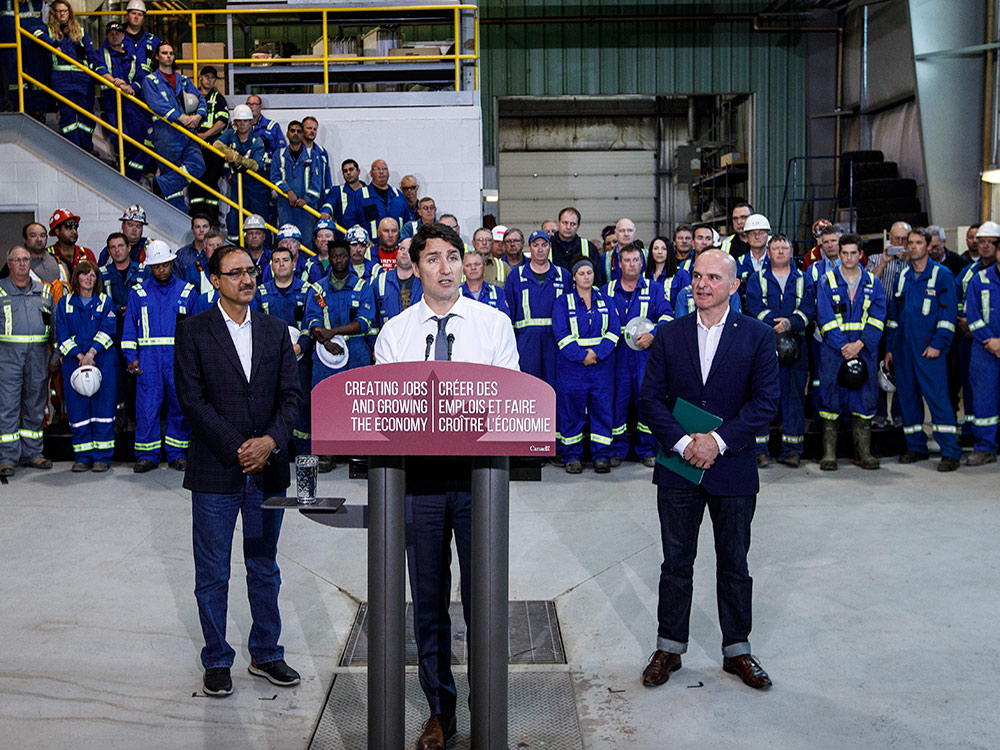
Prime Minister Justin Trudeau boasts of TMX benefits to Canadians at the Trans Mountain Terminal in Edmonton on July 12, 2019.
Photo by Jason Franon, the Canadian Press.
Don’t say the independent economist Robyn Allan didn’t warn you.
Four years ago, the former CEO and president of ICBC said that Prime Minister Justin Trudeau’s rash purchase of the economically troubled Trans Mountain expansion project would end up costing taxpayers billions.
And then more billions.
At the time Allan accused the Trudeau government of not being transparent or honest about escalating costs on a project that proposed to triple bitumen shipments from 300,000 barrels a day to 890,000 barrels a day for Asian markets.
She then estimated that taxpayers would foot a bill as high $20 billion right here in the pages of The Tyee.
And what did the Trudeau government reveal last week while Ottawa was under siege by angry occupiers? That its uneconomic pipeline, less than 50 per cent complete, will now cost at least $21.4 billion.
That’s a 70 per cent jump above the last inaccurate price tag of $12.6 billion offered by the government just two years ago.
Moreover, the megaproject won’t be finished for another year, if that.
Meanwhile, Finance Minister Chrystia Freeland talked about borrowing more money from public debt markets or the very bank, TD Securities, that originally, in 2018, recommended that Kinder Morgan sell to the Canadian government its 66-year-old pipeline along with engineering plans for an expansion.
Freeland promises that “no more additional public money” will go into the project.
But Allan told The Tyee this week that such a claim is absolute nonsense, because “all borrowing by Crown corporations is ultimately backed by taxpayers.”
Interest charges on existing government loans of $13 billion for the TMX project are already costing $700 million in interest every year, added Allan.
“The government-owned project has been badly mismanaged. The budget is out of control. The shippers, due to their contracts, are not responsible for the cost of the majority of the overruns, and taxpayers are being seriously misled,” Allan said.
Allan isn’t alone in that grim assessment. Gwyn Morgan, the former CEO of Encana (now Ovintiv) told Bloomberg News that the cost overruns posed a grand risk to Canadian taxpayers.
“In the commercial (real) world, no one’s going to finance a project running vastly over budget, with no firm remaining cost or startup date,” Morgan told Bloomberg.
‘It makes even less sense now’
Allan, the former senior economist for the BC Central Credit Union, first challenged the project’s economics back in 2013 and hasn’t stopped since. In her opinion, “It didn’t make any sense then, and Kinder Morgan knew it. And it makes even less sense now.”
Kinder Morgan Canada assured the National Energy Board in its 2013 project application that its U.S. parent had the money to build the then $5.4-billion project at the time. But that heavily indebted company did not.
So the Canadian subsidiary approached the Alberta government in 2014 for financial aid. But then-premier Alison Redford flatly refused to get involved.
The project’s business case has always been dubious. The only reports claiming that a profit could be made selling bitumen to overseas Asian markets were all paid for by Kinder Morgan. Critics have consistently raised doubts about such claims.
The most lucrative market for Canadian bitumen remains U.S. Gulf Coast refineries, which pay a premium for the heavy crude. Last year David Hughes, one of Canada’s foremost energy analysts, calculated that TMX was not needed, given additions to existing North American pipeline systems.
“The federal government, which owns TMX, has claimed higher prices are available in offshore markets that could be accessed by completing the TMX project,” wrote Hughes. “This is clearly not the case, as a detailed analysis of historical prices in Asia and transportation costs has shown. In fact, shippers on TMX stand to lose US$4-6 per barrel compared with U.S. exports on existing pipelines.”
As cost estimates for the project continued to climb, Kinder Morgan realized that the bulk of construction cost overruns would fall on the company and not shippers due to locked-in 20-year shipping contracts. It even warned shareholders of the risk in 2018 as projected costs rose above $7.4 billion.
About that time, the U.S. firm claimed that environmental protests and regulatory hurdles — all duly predicted by the company in its corporate presentations — made the project untenable.
Without providing any public cost benefit analysis or independent reports on the project’s finances, the Trudeau government bought the old pipeline and expansion plans for $4.5 billion in 2018.
Kinder Morgan executives paid their negotiating team US$575,000 in bonuses after sealing the deal. It might seem that Canadian taxpayers paid U.S. executives in Texas approximately C$750,000 in bonuses for outwitting the Trudeau government.
Tolls that keep on leaking money
But the big problem with galloping cost overruns boils down to tolls, says Allan: pipelines typically pay for their capital costs by charging shippers a toll to transport oil through their pipe.
But the contracts with oil products shippers such as Canadian Natural Resources Ltd., Suncor and Cenovus stipulate that a large share of the cost overruns can’t be passed on in tolls. They were signed when the pipeline was budgeted at $7.4 billion. Therefore, fully 75 per cent of the cost overruns at that time could not be passed on.
“No one in Ottawa or the tarsands will discuss the toll rates,” said Allan.
She says that taxpayers, not bitumen shippers, are not only liable for the majority of cost overruns now totalling $14 billion but will be subsidizing some of the richest oil companies in Canada with artificially low tolls that won’t reflect the cost of the project.
This sorry development may also explain why companies like Cenovus, CNRL and Suncor aren’t really complaining or panicking about rampant cost overruns.
“Why should they worry?” asked Allan. “Their tolls have been subsidized for any project costs exceeding $7.4 billion.”
“When Trans Mountain and the shippers know it’s not the shippers but the taxpayers who are paying for the majority of the project overruns, where’s the need for budget control?”
Alex Pourbaix, CEO of Cenovus, the largest shipper on the expanded pipeline, expressed little concern about the cost overruns. “While no one wants to see cost increases, they are often a fact of life with projects of this size,” he told the Globe and Mail last week.
Pourbaix didn’t mention that, if Allan is correct, taxpayers and not Cenovus would be paying for much of these increases.
Fiascos and potential conflicts
Ever since Trudeau bought the project in 2018, the project has been embroiled in one fiasco after another.
Safety issues shut down construction for months in 2020 and 2021 as the company repeatedly replaced contractors. Then came wildfires, floods and galloping inflation as well as upgrades and changes.
Concerns about potential conflicts of interest also dog the project. William Downe, who chairs the Trans Mountain board of directors, had a long career with BMO. And the government now says BMO is one of its financial advisers.
Brian Ferguson, the former CEO of Cenovus Energy, also sits on the Trans Mountain board and has sat on the TD Bank board since 2015. TD Securities advised Kinder Morgan on the sale of the pipeline to Trudeau’s government by providing a Fairness Opinion report.
There is more. Cenovus is the largest shipper on the project’s expansion (125,000 barrels a day). And Finance Minister Chrystia Freeland has identified TD Securities as another key advisor on how to handle project debt.
And then there is that small issue of climate change, added Allan.
“This project is a global-warming machine by the very fact it proposes to move more than half a million barrels of high-carbon bitumen a day. The very people who had their homes flooded by atmospheric rivers or burned by heat domes are now being asked to pay for this global-warming machine.”
Now a project that the government swore would only cost $7.4 billion has soared to $21.4 billion. And it is not even half finished.
Trans Mountain Deal Was Structured to Bleed Billions, Finds Economist
Don’t say the independent economist Robyn Allan didn’t warn you.
Four years ago, the former CEO and president of ICBC said that Prime Minister Justin Trudeau’s rash purchase of the economically troubled Trans Mountain expansion project would end up costing taxpayers billions.
And then more billions.
At the time Allan accused the Trudeau government of not being transparent or honest about escalating costs on a project that proposed to triple bitumen shipments from 300,000 barrels a day to 890,000 barrels a day for Asian markets.
She then estimated that taxpayers would foot a bill as high $20 billion right here in the pages of The Tyee.
And what did the Trudeau government reveal last week while Ottawa was under siege by angry occupiers? That its uneconomic pipeline, less than 50 per cent complete, will now cost at least $21.4 billion.
That’s a 70 per cent jump above the last inaccurate price tag of $12.6 billion offered by the government just two years ago.
Moreover, the megaproject won’t be finished for another year, if that.
Meanwhile, Finance Minister Chrystia Freeland talked about borrowing more money from public debt markets or the very bank, TD Securities, that originally, in 2018, recommended that Kinder Morgan sell to the Canadian government its 66-year-old pipeline along with engineering plans for an expansion.
Freeland promises that “no more additional public money” will go into the project.
But Allan told The Tyee this week that such a claim is absolute nonsense, because “all borrowing by Crown corporations is ultimately backed by taxpayers.”
Interest charges on existing government loans of $13 billion for the TMX project are already costing $700 million in interest every year, added Allan.
“The government-owned project has been badly mismanaged. The budget is out of control. The shippers, due to their contracts, are not responsible for the cost of the majority of the overruns, and taxpayers are being seriously misled,” Allan said.
Allan isn’t alone in that grim assessment. Gwyn Morgan, the former CEO of Encana (now Ovintiv) told Bloomberg News that the cost overruns posed a grand risk to Canadian taxpayers.
“In the commercial (real) world, no one’s going to finance a project running vastly over budget, with no firm remaining cost or startup date,” Morgan told Bloomberg.
‘It makes even less sense now’
Allan, the former senior economist for the BC Central Credit Union, first challenged the project’s economics back in 2013 and hasn’t stopped since. In her opinion, “It didn’t make any sense then, and Kinder Morgan knew it. And it makes even less sense now.”
Kinder Morgan Canada assured the National Energy Board in its 2013 project application that its U.S. parent had the money to build the then $5.4-billion project at the time. But that heavily indebted company did not.
So the Canadian subsidiary approached the Alberta government in 2014 for financial aid. But then-premier Alison Redford flatly refused to get involved.
The project’s business case has always been dubious. The only reports claiming that a profit could be made selling bitumen to overseas Asian markets were all paid for by Kinder Morgan. Critics have consistently raised doubts about such claims.
The most lucrative market for Canadian bitumen remains U.S. Gulf Coast refineries, which pay a premium for the heavy crude. Last year David Hughes, one of Canada’s foremost energy analysts, calculated that TMX was not needed, given additions to existing North American pipeline systems.
“The federal government, which owns TMX, has claimed higher prices are available in offshore markets that could be accessed by completing the TMX project,” wrote Hughes. “This is clearly not the case, as a detailed analysis of historical prices in Asia and transportation costs has shown. In fact, shippers on TMX stand to lose US$4-6 per barrel compared with U.S. exports on existing pipelines.”
As cost estimates for the project continued to climb, Kinder Morgan realized that the bulk of construction cost overruns would fall on the company and not shippers due to locked-in 20-year shipping contracts. It even warned shareholders of the risk in 2018 as projected costs rose above $7.4 billion.
About that time, the U.S. firm claimed that environmental protests and regulatory hurdles — all duly predicted by the company in its corporate presentations — made the project untenable.
Without providing any public cost benefit analysis or independent reports on the project’s finances, the Trudeau government bought the old pipeline and expansion plans for $4.5 billion in 2018.
Kinder Morgan executives paid their negotiating team US$575,000 in bonuses after sealing the deal. It might seem that Canadian taxpayers paid U.S. executives in Texas approximately C$750,000 in bonuses for outwitting the Trudeau government.
Tolls that keep on leaking money
But the big problem with galloping cost overruns boils down to tolls, says Allan: pipelines typically pay for their capital costs by charging shippers a toll to transport oil through their pipe.
But the contracts with oil products shippers such as Canadian Natural Resources Ltd., Suncor and Cenovus stipulate that a large share of the cost overruns can’t be passed on in tolls. They were signed when the pipeline was budgeted at $7.4 billion. Therefore, fully 75 per cent of the cost overruns at that time could not be passed on.
“No one in Ottawa or the tarsands will discuss the toll rates,” said Allan.
She says that taxpayers, not bitumen shippers, are not only liable for the majority of cost overruns now totalling $14 billion but will be subsidizing some of the richest oil companies in Canada with artificially low tolls that won’t reflect the cost of the project.
This sorry development may also explain why companies like Cenovus, CNRL and Suncor aren’t really complaining or panicking about rampant cost overruns.
“Why should they worry?” asked Allan. “Their tolls have been subsidized for any project costs exceeding $7.4 billion.”
“When Trans Mountain and the shippers know it’s not the shippers but the taxpayers who are paying for the majority of the project overruns, where’s the need for budget control?”
Alex Pourbaix, CEO of Cenovus, the largest shipper on the expanded pipeline, expressed little concern about the cost overruns. “While no one wants to see cost increases, they are often a fact of life with projects of this size,” he told the Globe and Mail last week.
Pourbaix didn’t mention that, if Allan is correct, taxpayers and not Cenovus would be paying for much of these increases.
Fiascos and potential conflicts
Ever since Trudeau bought the project in 2018, the project has been embroiled in one fiasco after another.
Safety issues shut down construction for months in 2020 and 2021 as the company repeatedly replaced contractors. Then came wildfires, floods and galloping inflation as well as upgrades and changes.
Concerns about potential conflicts of interest also dog the project. William Downe, who chairs the Trans Mountain board of directors, had a long career with BMO. And the government now says BMO is one of its financial advisers.
Brian Ferguson, the former CEO of Cenovus Energy, also sits on the Trans Mountain board and has sat on the TD Bank board since 2015. TD Securities advised Kinder Morgan on the sale of the pipeline to Trudeau’s government by providing a Fairness Opinion report.
There is more. Cenovus is the largest shipper on the project’s expansion (125,000 barrels a day). And Finance Minister Chrystia Freeland has identified TD Securities as another key advisor on how to handle project debt.
And then there is that small issue of climate change, added Allan.
“This project is a global-warming machine by the very fact it proposes to move more than half a million barrels of high-carbon bitumen a day. The very people who had their homes flooded by atmospheric rivers or burned by heat domes are now being asked to pay for this global-warming machine.”
Now a project that the government swore would only cost $7.4 billion has soared to $21.4 billion. And it is not even half finished.
Trans Mountain Deal Was Structured to Bleed Billions, Finds Economist
READ MORE
Allan takes no comfort whatsoever in the accuracy of her economic warnings.
“What disturbs me most is this,” said the economist. “As the truth of the full costs unfold and taxpayers realize the huge burden, it will erode faith in our democracy even more, and we can’t afford any more erosion of that faith.”
She still thinks a fiscally prudent government should kill the project: “They can stop it now and cut our losses. Industry doesn’t need the capacity, but they can’t talk about that fact because their shipping contracts forbid them from talking negatively about the project until it is completed.”
Moreover, she adds, the provision of jobs and the wages that go with them have exceeded all estimates due to cost overruns.
“If the government doesn’t cancel the project right away, the pipeline will be a $30-billion boondoggle by the time they close the books.”
And don’t say Robyn Allan didn’t warn you.
Allan takes no comfort whatsoever in the accuracy of her economic warnings.
“What disturbs me most is this,” said the economist. “As the truth of the full costs unfold and taxpayers realize the huge burden, it will erode faith in our democracy even more, and we can’t afford any more erosion of that faith.”
She still thinks a fiscally prudent government should kill the project: “They can stop it now and cut our losses. Industry doesn’t need the capacity, but they can’t talk about that fact because their shipping contracts forbid them from talking negatively about the project until it is completed.”
Moreover, she adds, the provision of jobs and the wages that go with them have exceeded all estimates due to cost overruns.
“If the government doesn’t cancel the project right away, the pipeline will be a $30-billion boondoggle by the time they close the books.”
And don’t say Robyn Allan didn’t warn you.
Subscribe to:
Posts (Atom)