Thursday, June 09, 2022

ESG insiders demand course correction to fix industry woes

With ESG being increasingly maligned these days from both the inside and the outside, some of the industry’s early devotees say it’s time for a course correction.

Jerome Dodson, the retired founder of one of the world’s largest ESG-focused investing firms, said a dedicated watchdog is needed to help police marketing claims. Marcela Pinilla, who’s worked in the business for 15 years, said environmental, social and governance issues need to be considered separately as opposed to lumped together under one acronym. And Matthew Kiernan, a pioneer of ESG corporate ratings, said both the industry and regulators need to double their efforts to stamp out exaggerated claims and root out bad actors.

The current maelstrom should be seen as “manna from heaven,’’ said Kiernan, co-founder of Invest Green, a Toronto-based firm that educates investors on sustainable investing. “It should ideally catalyze a big shakeout, an incursion on greenwashing and result in a smaller, leaner industry with much better clarity and quality.''

The list of insiders discomfited by the growth of the industry —  valued at about US$40 trillion by analysts at Bloomberg Intelligence — has jumped exponentially in the past year. They bemoan newer entrants that have jumped on the bandwagon to market investments that have little real-world impacts. They say widely used ESG ratings are riddled with errors and need to be standardized, and they want asset-management firms to to face tougher scrutiny.

After doing little during the early years of the ESG bonanza, regulators are trying to catch up. Just last month, the US Securities and Exchange Commission proposed a slate of  new restrictions aimed at ensuring ESG funds accurately describe their investments. Some also would need to disclose the aggregated greenhouse gas emissions of companies they’re invested in, according to the SEC.

Dodson, who used to run Parnassus Investments and has described the market boom as “disconcerting,’’ called for the creation of  a group modeled on Wall Street watchdog, Financial Industry Regulatory Authority. It should be a nonprofit organization backed by the government that charges fees, conducts audits and exams, and has enforcement powers, he said. 

The end result would be more firms getting kicked out of the business for failing to adhere to the highest investing and marketing standards, said Dodson, who retired last year from Parnassus, which he founded in 1984. The firm now manages US$47 billion from San Francisco.

When the investment strategy was conceived in the mid-2000s, its intention was to help investors measure risks and opportunities from environmental, social and corporate governance-related issues. It’s now morphed into a myriad of investment strategies ranging from mutual funds to complex derivatives designed by Wall Street banks. 

For Pinilla, director of sustainable investing at Boston-based Zevin Asset Management, the criticisms are welcome because they shine a spotlight on widening concerns about industry practices, especially among newer entrants. This rethink will help separate “the wheat from the chaff,’’ she said. “We need to be examined. It will help people get more precise about what exactly they’re doing.’’

Pinilla said ESG needs to be “decentralized” so those making claims specifically spell out their analysis of risks associated with “the E, the S and the G.” For example, investors would analyze workplace diversity as a separate topic from greenhouse gas emissions and corporate governance rather than lumping their analysis together, she said.  

“While they intersect, they need to be understood individually, not neatly bundled together,’’ she said.

It’s an approach that would make it harder for fund managers to claim that Tesla Inc., for example, lives up to the ESG label. While the electric-vehicle maker meets the standards of an environmentally friendly stock, its track record on social and governance issues raises a lot of awkward questions. 

Early signs have emerged that investors are souring on the process. They pulled a record net US$2 billion from US equity exchange-traded funds in May, ending three years of inflows, according to Bloomberg Intelligence. The redemptions are early signs of investors’ concerns about ESG as global financial markets are rattled by inflation and the ongoing war in Ukraine.

Kiernan, whose scores became the foundation for those sold today by MSCI Inc., the world’s biggest provider of ESG ratings, said the industry needs to double its efforts to fix the ratings system because they’re inconsistent and too many money managers use them to decide what stocks to buy.

Additionally, industry groups need to raise their standards to winnow out fund managers who aren’t following through on their commitments to the strategy, while institutional investors need to be more discerning about which managers they give their money to so that money only flows to those that are doing bona fide sustainable investing, he said.

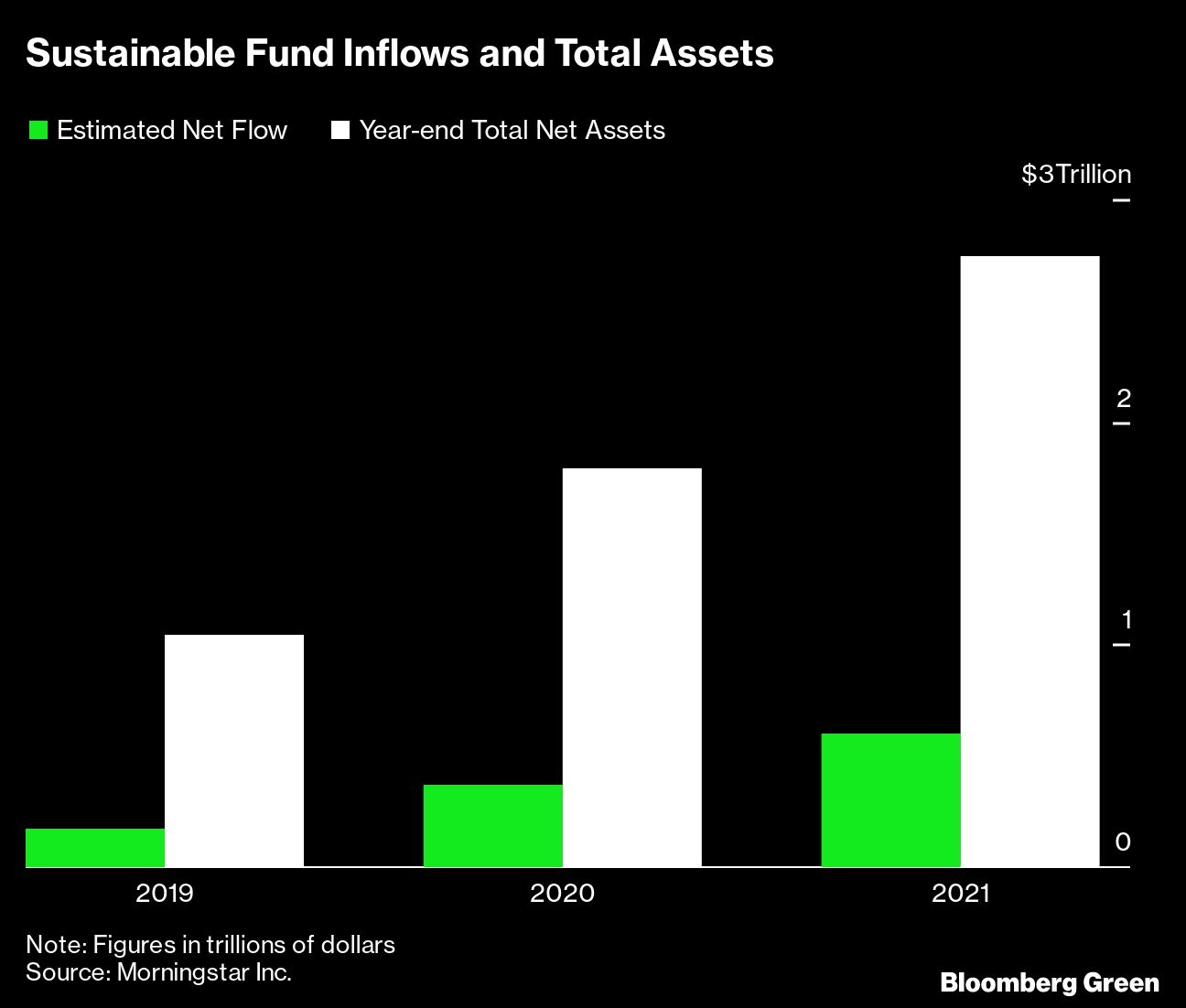
If these three steps are taken, the amount of money investing in so-called sustainable funds would drop in half from the US$2.7 trillion now estimated by Morningstar Inc., Kiernan said. While there will be “a rather awkward transition,’’ it will ultimately result in genuine ESG funds “standing out and attracting more capital,” he said.

Anti-deep sea mining rally held on Ocean’s Day

Nelson Bennett- Business in Vancouver | June 9, 2022 

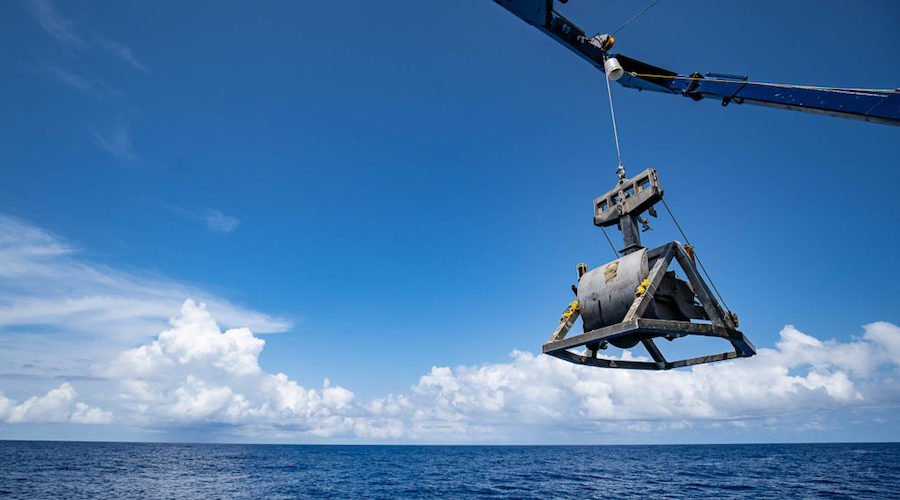
Image from DeepGreen Metals.

A deep-sea mining pilot expected to occur later this year 1,300 nautical miles southwest of Sandiego, California was the subject of a rally in Vancouver Wednesday.


Wednesday was Oceans Day, and one of the companies blazing a path in the new frontier of deep ocean mining – The Metals Company (Nasdaq:TMC) — is incorporated in the Cayman Islands but headquartered in Vancouver.

Two of its early investors are from Vancouver — mining mogul Frank Giustra and Brian Paes-Braga, founder of Lithium-X (TSX-V:LIX), which he sold in 2018 for C$265 million ($209m).

The Metals Company was formed last year through a C$2.9 billion ($2.29bn) merger between Vancouver’s DeepGreen Metals with a special-purpose acquisitions company, Sustainable Opportunities Acquisition Corp.

The company’s stock hit a high of $12.45 September 13, 2021, but has since fallen to $1.42 – perhaps a reflection of just how risky investors consider this new process for mining the ocean floor for minerals may be. No one has yet done it on a commercial scale.

The company and its technology partner, Allseas, recently marked the commissioning of key components of the underwater mining system that will be used to scoop up metals-rich pollymetallic nodules laying on the ocean floor in an area known as the Clarion Clipperton Zone between Hawaii and Mexico.

The company also released video of the trials of the collector vehicle designed to comb the ocean floor, scooping up the nodules and pumping them to a platform on the surface of the ocean.

“This latest development builds upon earlier successful trials of the nodule collector vehicle in deep-water in the Atlantic as well as harbour wet testing and shallow-water drive tests in the North Seas, and comes in advance of full pilot nodule collection trials…in the Clarion Clipperton Zone of the Pacific Ocean later this year,” the company says in a news release.

Deep ocean mining is governed by the International Seabed Authority (ISA), which has estimated that there could be 21 billion of tonnes of polymetallic nodules in the Clarion Clipperton Zone between Hawaii and Mexico, containing an estimated six billion tonnes of manganese, 234 million tonnes of copper, 270 million tonnes of nickel and 46 million tonnes of cobalt.

These metals are critical for making batteries, the demand for which is soaring for electric vehicles. The International Energy Agency (IEA) has estimated a sixfold increase in critical metals, including battery metals, will be needed to fuel the energy transition over the next decade, and there are concerns that terrestrial mines simply can’t be built in time to meet the demand.

The Metals Company holds exploration and commercial rights in the zone and has royalty agreements with three Pacific Island Nations — Tonga, Kiribati and Nauru. The company’s industrial and technology partners include Maersk and the Allseas Group S.A., a Swiss company that developed the harvesting machine that will be used.

Last year the company released an environmental impact report. It notes that the Abyssal Plain where the nodules would be harvested is at a depth of 4 to 6 kilometres, and is relatively barren.

“Less than 10% of all marine life lives below 4,000 meters,” the report notes. “The abyssal plain is a very challenging place for organisms to live because of the enormous pressure, the lack of light and the poor availability of food at these depths. There are no plants.

“A few large mobile species such as ratfish and shrimp do live on the abyssal plain and can swim, so they will be able to move away from the areas disturbed by nodule collection.”

Despite those assurances, Michelle Connolly, a project manager for Ecotrust Canada, says deep sea mining could put marine life at risk.

“We want to stop deep sea mining before it starts,” she said in a news release. “There is a rising demand for minerals for electric cars and other technologies. We do not believe that putting ocean life at risk for energy is acceptable.”

(This article first appeared in Business in Vancouver)
Court document disputes Enbridge claims regarding Line 5 shutdown

FRONT PAGE
JUN 9, 2022
GRAHAM JAEHNIG
Staff Writer
gjaehnig@mininggazette.com


ANN ARBOR — According to Enbridge’s website, a Line 5 shutdown would put Ohio refineries at risk. The closure of one of those refineries could result in the loss of $5.4 billion in annual economic output to Ohio and southeast Michigan, and the loss of thousands of direct and contracted skilled trades jobs

A Line 5 shutdown would compromise crude supply to 10 refineries in the region to varying degrees, directly affecting fuel prices. Enbridge said the information was provided by PBF Energy, which operates one of two refineries in Toledo. PBF Energy is one of the largest independent petroleum refiners and suppliers of unbranded transportation fuels, heating oil, petrochemical feedstocks, lubricants and other petroleum products in the United States.

However, filings in a lawsuit between Enbridge and the Bad River Band Tribe of Wisconsin released last week quote Enbridge’s Neil K. Earnest, independent energy industry consultant hired by the Canadian pipeline company, who said: “I estimate that a Line 5 shutdown will have a small impact on Michigan gasoline, jet fuel and diesel prices, likely less than one cent per gallon.”

The court filing contradicts recent predictions in an analysis for energy industry advocacy group Consumer Energy Alliance, which issued a report in February that predicted as much as a 9.47 to 11.66 percent spike in fuel prices, Sheri McWhirter reported on mlive.com on Wednesday. Four months ago, that would have been about 40 cents per gallon; at today’s prices it would be closer to 52 cents per gallon.

The National Wildlife Federation has been at the forefront of this issue, knowing that the pipeline running through the Straits of Mackinac is a disaster waiting to happen and a violation of sovereign tribal treaty rights, stated Anna Marie Zorn, in the Wednesday NWF article.

“My estimate of the increase in Wisconsin transportation fuel prices is the same as that for Michigan gasoline prices, i.e., approximately 0.5 cents per gallon,” Earnest wrote, states a June 8 press release from Fossil Free Media, a nonprofit media lab that supports the movement to end fossil fuels and address the climate emergency.

Enbridge’s Line 5, has run under the Straits of Mackinac for 69 years.

The company has spent millions to push misleading advertising and public statements. Shut down Line 5, it said, and gasoline prices in the state will skyrocket, said Fossil Free Media.

“Once again Enbridge has been caught misleading the public on Line 5, prioritizing their profit margins over Great Lakes water, wildlife, and our way of life.,” said Beth Wallace, Great Lakes freshwater campaigns manager for the NWF. “All should see clearly now, by their own expert’s admission, that Enbridge’s arguments and reality go together like oil and water. Greed and profiteering are at the center of Enbridge’s campaign to keep this 70-year-old pipeline running and not Michiganders’ best interests.”

Fossil Free Media stated that Sean McBrearty, campaign coordinator for Oil & Water Don’t Mix, commented, saying:

“What we suspected for years is true, and now we hear it through Enbridge’s own words in court: The products that travel through Line 5 have no effect on gasoline prices in Michigan. These court filings totally vindicate the responsible and courageous leadership of Gov. Gretchen Whitmer and Attorney General Dana Nessel, who have worked tirelessly to protect our Great Lakes from a massive oil spill.”

Enbridge’s court filing isn’t the first time its own documents show how little Line 5 has to do with gasoline prices, Fossil Free Media said. The 2017 Dynamic Risk study, funded by Enbridge, showed decommissioning Line 5 would result in price impacts of roughly 2 cents per gallon on gasoline and approximately 5 cents per gallon on propane.

Line 5 runs from Canada, through Wisconsin and Michigan, before crossing back into Canada near Port Huron. Line 5 splits into two sections on the bottom of the Straits of Mackinac, where an oil spill would be catastrophic for the Great Lakes.

Fossil Free Media said it its release that Line 5 has spilled 33 times and at least 1.1 million gallons along its length since 1968. Enbridge’s Line 6B spilled 1.1 million gallons of tar sands bitumen into the Kalamazoo River in 2010, the largest inland spill in American history.

“Line 5 is located in the worst possible place for an oil spill in the Great Lakes, according to experts at the University of Michigan,” said Michelle Woodhouse, water program manager for Environmental Defence in Canada. “With its own words, Enbridge’s court document confirms a recent report the Environmental Defence commissioned that showed a price impact of 2 cents per liter at the pumps in Ontario when Line 5 shuts down. The biggest economic threat we face is the danger Line 5 poses to the Great Lakes ecosystem.

U.S. natural gas prices slump after fire at Texas LNG terminal

U.S. natural gas prices tumbled after a fire broke out at a Texas export terminal, threatening to leave supplies of the fuel stranded in shale basins despite surging overseas demand.

The fire is under control at Freeport LNG’s terminal in Quintana, Texas, about 65 miles (105 kilometers) south of Houston, company spokeswoman Heather Browne said Wednesday. The incident happened at about 11:40 a.m. local time and an investigation is ongoing, she said, adding that there were no injuries or risks to the surrounding community.

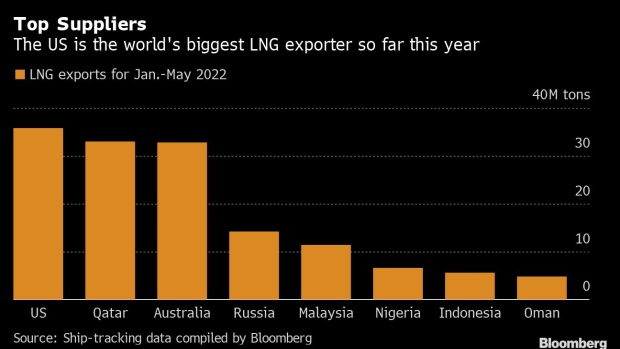
Freeport is one of seven US liquefied natural gas export terminals, which receive gas via pipeline and liquefy it before loading the super-chilled LNG onto tankers. The terminals have helped the US emerge in the past few years to vie with Qatar and Australia for position as the No. 1 exporter of LNG. As Europe clamors for cargoes after Russia’s invasion of Ukraine, the blaze could have a significant impact on global supplies of the fuel.

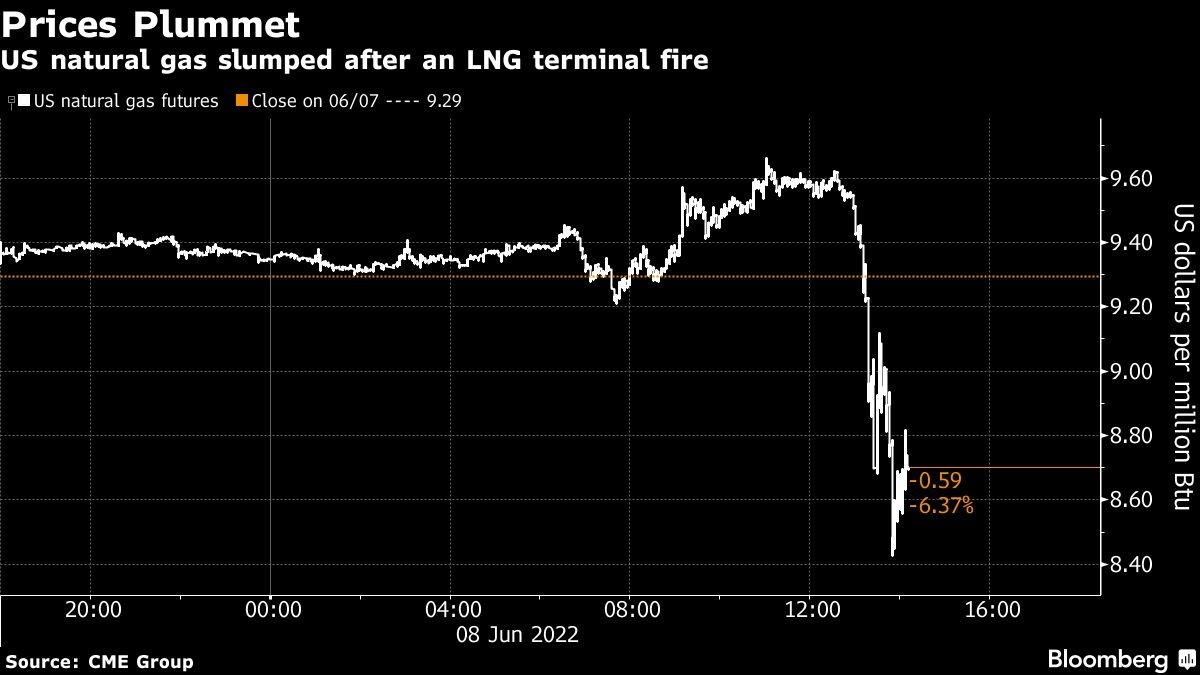
US natural gas futures for July delivery slid as much as 9.3 per cent to US$8.427 per million British thermal units in New York after reports of the fire first emerged, halting a rally that sent prices to fresh 13-year highs earlier. The contract settled down 6.4 per cent at US$8.699. Prices have more than doubled this year, as US gas stockpiles remain well below normal levels.

The fire is “going to curtail exports and alleviate some of the strain on US supplies,” said John Kilduff, a partner at hedge fund Again Capital in New York. US consumers “should benefit from lower prices, but Europe and Asia will probably pay higher prices.”

Freeport receives about 2 billion cubic feet of gas per day, or roughly 16 per cent of total US LNG export capacity. The tanker Elisa Larus is currently at the terminal, though it’s under way using its engine, according to vessel tracking data compiled by Bloomberg. That suggests the tanker may be moving away from Freeport. 


Natural Gas Prices Tank Again As Freeport LNG Remains Shut For Almost A Month

  • Natural gas prices fell another 7.5% percent on Thursday morning.
  • Freeport LNG outage to lead to drop in exports to Europe and Asia.
  • The cause of the explosion on Wednesday remains unclear.

Amid robust demand for U.S. LNG, one of the biggest liquefaction facilities on the Gulf Coast, Freeport LNG, will be out of commission for at least three weeks following an explosion yesterday.

An explosion rocked the Freeport LNG liquefaction plant yesterday morning, with its cause as of yet unclear. An investigation is ongoing, but according to the operator of the facility, Freeport LNG, the facility will remain shut down for weeks. It accounts for a fifth of total U.S. liquefaction capacity.

The Freeport facility has three liquefaction trains, and a fourth is being constructed. Its current gas processing capacity is 2.1 billion cu ft daily. With the outage, the situation with U.S. LNG exports will become problematic, as evidenced by the gas market’s reaction to the news of the explosion.

Initially, prices fell as traders worried that the outage would reduce American LNG’s market share, per a Financial Times report from earlier today. Bloomberg noted that the fire means a lot of gas will remain stranded at the fields amid surging demand for gas overseas.

Yet prices on international LNG markets might react differently because the Freeport LNG outage effectively means there will be less natural gas for export, especially to energy-thirty Europe and Asia.

In Europe, gas prices have been on the decline for the past few days as an early start of summer reduced immediate demand. An ample supply of LNG has also contributed to the price trend. With the outage, this trend might at some point reverse.

Asian demand, however, is on a strong rise as buyers seek to build inventory for the winter season, Bloomberg reported this week, which is lending further upward support to prices.

“LNG prices remain well above where they normally are, even adjusting for higher crude oil prices,” Sanford C. Bernstein analysts said in a note, as quoted by Bloomberg. “We expect this to be a lull before what looks like a tough winter ahead for consumers.”

Oilprice.com


European Gas Soars as Fire in US Compounds Russia Supply Concern

(Bloomberg) -- Europe’s natural gas prices surged after a fire at a large export terminal in the US promised to wipe out deliveries to a market that’s on high alert over tight Russian supplies.

Benchmark futures traded in Amsterdam snapped a six-day falling streak, while UK prices jumped more than 34%. The Freeport liquefied natural gas facility in Texas, which makes up about a fifth of all US exports of the fuel, will remain closed for at least three weeks. The US sent nearly 75% of all its LNG to Europe in the first four months of this year.

The closure comes as pipeline supplies from Europe’s top providers are also capped. Key facilities in Norway are undergoing annual maintenance this week, while Russia’s supplies are below capacity after several European buyers were cut off for refusing to meet Moscow’s demands to be ultimately paid in rubles for its pipeline fuel. 

“An export halt during the high demand winter months would have triggered a much bigger reaction, but the event highlights Europe’s precarious situation and it would likely signal an end for now to the calm trading seen in recent weeks,” said Ole Hansen, head of commodity strategy at Saxo Bank A/S.

Europe has been particularly reliant on US LNG to help offset risk of disruption to Russian pipeline imports, and ample supplies of the fuel in the past weeks had calmed the market after wild swings earlier this year. 

“The rising importance of US gas exports to a gas-hungry Europe has been clearly highlighted by price movements on either side of the pond these past few hours,” Saxo Bank’s Hansen said.

The extent of the damage to the Freeport facility is not yet clear, but the fire could potentially knock out abut 16% of total US LNG export capacity “for an unknown period if the fire damage proves difficult to repair,” analysts at Evercore ISI said in a note. 

Dutch front-month gas, the European benchmark, traded 12% higher at 89.13 euros per megawatt-hour by 8:53 a.m. in Amsterdam. The contract dropped 16% over the previous six sessions. 

UK next-month futures jumped to 174.14 pence a therm. Send-outs from Britain’s LNG terminals, a key European destination for US cargoes, fell about 30% Thursday to the lowest since mid-March. 

Even with tepid consumption in most of Europe amid mild weather that means that energy companies may have to turn to gas inventories just as storage levels have improved recently, getting closer to historic averages. 

LNG buyers will probably start hunting for replacement shipments from the spot market, but there is a dwindling amount of supplies available, according to traders in Asia. The move is likely to boost already intense competition between Asia and Europe for the fuel. 

Gas flows from Norway rebounded after a one-day halt of the giant Troll field for annual tests on Wednesday, but are still below normal as seasonal works at a number of facilities continue. Shipments of Russian gas via the Nord Stream pipeline to Germany will continue to edge down on Thursday, grid data show.

©2022 Bloomberg L.P.

Pipelines unclogged, but Canadian crude now faces U.S. Gulf Coast glut


By Nia Williams and Arathy Somasekhar

(Reuters) - After long being deeply discounted for years because of a lack of pipelines, Canadian heavy crude is finally trading like a "North American" grade, moving in tandem with U.S. sour crudes sold on the Gulf Coast after Enbridge Inc expanded its Line 3 pipeline late last year.

Unfortunately for Canadian producers, the Gulf is awash in sour crude thanks to Washington's largest-ever release from the Strategic Petroleum Reserve (SPR) that will amount to 180 million barrels over a six-month period, in an attempt to tame high fuel prices after Russia's invasion of Ukraine.


© Reuters/ADREES LATIFFILE PHOTO: 
The Bryan Mound Strategic Petroleum Reserve is seen
 in an aerial photograph over Freeport, Texas

Millions of barrels of sour crude are flooding the market from storage caverns in Louisiana and Texas. Heavy grades like Mars and Poseidon at the U.S. Gulf Coast, the world's largest heavy crude refining center, are languishing.

Western Canada Select (WCS) sold more than 3,000 kilometres (nearly 2,000 miles) away in Hardisty, Alberta, is getting dragged down with them.

The discount on July WCS for delivery in the Hardisty crude hub reached more than $20 a barrel below the West Texas Intermediate benchmark last week, the widest since early 2020.


"It's not great timing," said Rory Johnston, founder of the Commodity Context newsletter based in Toronto. "The vast majority of what's coming out of the SPR is medium sour crude. It's hitting directly at that marginal pricing point for WCS."

The sour Gulf surplus is undermining what some market players expected to be a period of stronger WCS demand in Hardisty, as maintenance on oil sands projects reduces supply and as U.S. refineries exit turnarounds.

Other factors causing the WCS discount to widen include the high price of natural gas, which increases the cost of refining heavy crude, and increased demand for lighter products like gasoline, BMO Capital Markets analyst Randy Ollenberger said in a note.

PIPELINE CAPACITY

Canada exports around 4.3 million barrels per day (bpd) to the United States, according to U.S. Energy Information Administration (EIA) data, but until last year demand to ship crude on export pipelines exceeded capacity, leaving barrels bottlenecked in Hardisty.

In 2018, the discount on WCS in Hardisty blew out to more than $40 a barrel, prompting the Alberta government to restrict output.

Now there is sufficient pipeline capacity, WCS trades around the same level as comparable crudes like Mexico's Maya. This means Canadian producers get that value, minus the spot pipeline tariff to the U.S. Gulf Coast, which is roughly $10 a barrel.

Canadian production is forecast to rise 200,000 bpd by the end of 2022, according to the EIA. That could cause bottlenecks to re-emerge until the Trans Mountain pipeline expansion to Canada's Pacific coast is completed in 2023, adding 600,000 bpd of capacity, said RBN Energy analyst Robert Auers.

"However, a massive blowout in differentials, like we saw in 2018, is unlikely since producers are likely to be prepared for such a scenario and quickly ramp up crude-by-rail volumes in anticipation of such an event," Auers said.

(Reporting by Nia Williams; Editing by Marguerita Choy)

Gas exporters see growing support for East Coast plant in Canada

Canada’s natural gas companies say there’s growing domestic support for new energy infrastructure to facilitate exports to Europe, even as the country pursues aggressive climate-change targets. 

Tim Egan, president of the Canadian Gas Association, said he believes the public is beginning to recognize that boosting exports to countries like Germany is the most significant way Canada will be able to help counteract Russia’s aggression against Ukraine. He cited recent polling that shows widespread approval for a shift in policy.

“I think Canadians are seeing what’s going on in Europe and are saying, ‘Look, there must be way we can help,’” Egan said by phone.

The energy crisis has given a boost to Canada’s fossil-fuel sector, which had been hemmed in for years by slumping prices and tightening environmental restrictions. 

Prime Minister Justin Trudeau’s government is attempting to balance exporting more energy to help supply world markets while still making progress on decarbonizing production. Trudeau has targeted a 42 per cent cut to oil and gas emissions by 2030.


While a major exporter of natural gas, Canada currently lacks a liquefied natural gas terminal that could directly supply allied nations across the Atlantic Ocean. 


BOOSTING PRODUCTION

A public opinion survey conducted in April by Leger Marketing Inc. for the gas association found 58 per cent of respondents supported exports of LNG from the east coast, compared to 17 per cent opposed and the remainder unsure. When Europe and the Ukraine war were specifically mentioned, support rose to 63 per cent, according to the online poll.

The same proportion, 58 per cent, also said they would back the construction of new east coast terminals to export gas, with 21 per cent in opposition. That includes 63 per cent support in Atlantic Canada, where any such facility would likely be located.

In the short term, Canada has pledged to increase its exports to the US to help indirectly free up supplies to Europe, aiming to boost shipments by the equivalent of 100,000 barrels per day by the end of the year.

There are other new developments being considered that could allow Canada to ship directly to Europe, but will face more environmental scrutiny and opposition.

Natural Resources Minister Jonathan Wilkinson has already pointed to one project that could be in operation by 2025. It would see Spain’s Repsol SA convert an existing LNG import facility in New Brunswick into an export terminal. Most of the infrastructure is already in place, meaning it may not need an extensive regulatory process, the minister said. 

However, Repsol currently uses the terminal to supply gas to the US, and it’s unclear if the company is prepared to make the switch. Supplying the terminal with gas from Western Canada would also require the existing pipeline network to be expanded, which could be politically difficult.

Other longer-term projects have been floated, but they would be new facilities and would require lengthy environmental assessments. Proposals include one in Nova Scotia by Pieridae Energy Ltd., one in Quebec by GNL Quebec Inc., and another in Canada’s easternmost province by LNG Newfoundland and Labrador Ltd.

Egan -- whose association represents Canadian distributors of natural gas -- said he’s heard plenty of interest in access to Canadian gas in his own conversations with diplomats from European countries.

“I’ve met with roughly half of them,” Egan said. “The overwhelming response is: Please try to do more, and more quickly. It’s the Europeans who are very blunt about this.”

Trudeau is scheduled to be in Germany later this month for a Group of Seven leaders summit, where European energy security is expected to be a top agenda item. 


Merchandise trade data released Tuesday shows Canada had $21.8 billion in natural gas exports over the last 12 months through April -- almost double pre-pandemic levels, and the highest since 2009.

Caisse de Depot to invest US$5B in Dubai port operator

Dubai is selling stakes in some of its most prized assets, including the port that helped transform the city into a global trade hub, to a Canadian fund as the emirate seeks to alleviate its debt burden. 

Caisse de Depot et Placement du Quebec agreed to invest US$5 billion in the Middle East’s biggest port and two industrial zones, according to a statement Monday. Other long-term investors will have the opportunity to acquire additional stakes for as much as US$3 billion by the end of the year. 

Under the agreement, the Montreal-based pension manager will invest US$2.5 billion in the Jebel Ali Port, Jebel Ali Free Zone and National Industries Park. It’s doing the deal through a new joint venture in which it will hold a stake of about 22 per cent, with the remainder of the transaction being financed by debt. 

The transaction values the assets, which are controlled by state-owned DP World, at about US$23 billion including debt. It builds on an existing venture between DP World and CDPQ formed in 2016 to invest in ports around the world. 


HIGH GROWTH

“The familiarity with the management team helped us in doing this transaction,” Emmanuel Jaclot, head of CDPQ’s infrastructure business, said in an interview Monday. “The zone of Middle East, Africa and South Asia is in a different growth trajectory, and this deal helps us to diversify our exposure to this high-growth region.”

CDPQ has committed financing for the US$2.5 billion of debt it’s putting into the deal, he said. The second tranche of US$3 billion is also likely to be equally split between equity and debt, Jaclot said. 

The fund is keen to further grow its infrastructure portfolio, which has doubled in the last three and half years, and transportation is a key focus area, according to Jaclot. 

DP World has been exploring the sale of equity stakes in certain assets as the emirate works to reduce the debt pile that helped finance the city’s growth. Dubai took DP World private in early 2020 to help the company better manage its borrowings. 


CUTTING DEBT

The deal “achieves our objective of reducing DP World’s net leverage” to below four-times net debt to earnings before interest, taxes, depreciation, and amortization, Chief Executive Officer Sultan Ahmed Bin Sulayem said in the statement. “We believe this new partnership will enhance our assets and allow us to capture the significant growth potential of the wider region.”

With the investment, DP World “may be on track for an upgrade to BBB at Fitch as it could deleverage to below 5x net debt-to-Ebitda,” said Sharon Chen, a credit analyst at Bloomberg Intelligence. “Its balance sheet may strengthen” and the deal “may help repay US$7 billion of debt due 2023.”

  • Remote work creating schism as option unavailable to many workers

Employees like Matt Fairbanks are one of the reasons the hospitality and restaurant industry is struggling to find workers even as the pandemic wanes. 

The 34-year-old former bartender has moved from slinging beers in Toronto to selling software to restaurants for a Saskatchewan company — which he does remotely. 

"I was always kind of one foot out of the hospitality industry and the pandemic really showed me how vulnerable the work was and the instability of it all," he said in an interview. 

Gone are the harrowing commutes, while the additional flexibility has improved his work-life balance. Fairbanks's company allows employees to work from out of the country for up to 90 days, take unlimited vacation and travel or work from anywhere in Canada. 

"I've actually encouraged a lot of my friends from the restaurant industry to kind of look at other options and change kind of how they're doing their life, too." 

Remote work flourished during the pandemic as companies temporarily closed their offices, but it has created a schism among Canadian workers. While 40 per cent of work in Canada can be done remotely, experts say, that means 60 per cent of workers are unable to access this benefit because they are required to be on-site. 

And that can create resentment and a backlash from workers viewed as essential, such as nurses, ambulance workers and retail employees, who were applauded during the pandemic but are unable to realize the benefits that come from working remotely, said change management expert Linda Duxbury, a Chancellor’s Professor of management at Carleton University’s Sprott School of Business, who has studied remote work for decades.

"The problem we're going to have here is we're going to create two classes of workers — the haves and the have nots," she said in an interview.

Those who can work remotely, particularly professionals such as accountants, lawyers and tech workers, flourished financially during the lockdowns while those forced to work on-site were often overworked or lost their jobs entirely amid reduced capacity and businesses that shuttered for good. 

That second group was told they were valued and important "and now they don't feel important," Duxbury said. 

The ability to work remotely has been one of the pivotal moments in the history of work, even though its application is generally limited to knowledge workers, said Erica Pimentel, assistant professor of accounting at the Smith School of Business at Queen’s University. 

"So when 60 per cent of the workforce is excluded from this massive change, well that's obviously going to have some implications for society," she said, because it's very inconsistent in how it affects the population at large. 

Duxbury cautions that the jury is still out on remote work, or what she calls "enforced work from home." She constantly hears from businesses seeking best practices and examples of what others are doing. But she said it's too early to assess the work style as everybody is experimenting with different models. 

"Remote work during the pandemic was one big giant experiment. Now we're moving to the second experiment, the follow up, which is hybrid work," she said. 

The appropriateness of remote work is very job dependent. It isn't conducive to brainstorming, socialization, coaching, mentoring, onboarding, team-building and client satisfaction. 

And while people who work from home put in far more hours — estimated at four to 10 additional hours per week — data suggests it hasn't increased productivity, Duxbury said. 

"Just because we worked 100 per cent remote for the last two plus years doesn't mean it's a sustainable model for a lot of people and a lot of jobs moving forward." 

Despite the drawbacks, remote work is being increasingly favoured, especially by generation Z, digital natives who have always had access to the internet and social media, said Pimentel. 

This cohort is coming of age and joining the workforce with new attitudes about employers' duty to them and how different parts of their lives fit together that is different from millennials, generation X and baby boomers, who are in many cases now the bosses.

"And so there's this generational like mismatch between bosses and their employees and everybody is unhappy." 

Many companies would rather have employees return to the office full-time, but are facing stiff opposition from workers who have grown to like working from home, said Duxbury. Faced with record job vacancies amid decades-low unemployment rates and threats of resignations, employers have been forced to be flexible. 

That means employees with a skill that's in demand are able to negotiate better work conditions than somebody without those skills. 

Tech workers, who accounted for most of the three per cent of Canadians who worked remotely before the pandemic, are among those in the driver's seat now.

Demands to work remotely have gone from being the exception to the rule because it's so hard to compete for talent, said Kristina McDougall, founder and president of executive search firm Artemis that specializes in tech employment. 

"Unless there is an absolute reason why you physically need to be present, like you're working on a robot or you need to be in the building, most organizations are having to be flexible," she said. 

The growth in remote work has also transformed where companies source their workforce because people can work anywhere and don't have to be near a company headquarters. That widens the jobs an individual can consider, but it also gives companies a wider pool of candidates as well as increased competition with other potential suitors. 

McDougall believes the movement to remote work is permanent for sectors like technology because the pandemic has proven that organizations can get things built with people working remotely. 

"You can't put the genie back in the bottle. People are now finding it trivial that they might need to go into an office every day." 

CIBC ramps up Big Banks' hunt for staff with wage pledge

Canadian Imperial Bank of Commerce is boosting its minimum wage and pledging to push it even higher in the next few years as tight labor markets force banks into fierce competition for workers.   

The lender’s minimum wage will rise to $20 per hour in Canada and US$20 in the US in July, and the bank is committing to raise those figures to $25 and US$25 by the end of 2025, according to a statement from Chief Executive Officer Victor Dodig on Thursday. The bank is also providing a 3 per cent raise for workers in the six lowest levels of its pay scale next month. 

“These investments build on the steady, strategic targeted investments we have been making as we continue to ensure we pay competitively and recognize the contributions of our team, particularly at a time when the cost of living has been increasing,” Dodig said in the statement.

The bank’s minimum entry wage for merit-based pay team members is currently $17. The 3 per cent increase applies to roles including contact center agents, mobile adviser and investment adviser assistants.

Canada’s banks are boosting pay, especially for employees in the lower tiers of their pay scale, to attract and retain workers in a historically tight labor market. Canada’s unemployment rate hit a low of 5.2 per cent in April -- the lowest in data going back to 1976. 


Royal Bank of Canada said last month that it would spend more than $200 million on pay increases, benefits and other incentives to retain workers. The bank is raising base salaries by 3 per cent in the four lowest levels of its pay scale, accounting for almost half of its workforce. 

Bank of Nova Scotia is raising pay for workers in assistant manager roles and below, representing half of its Canadian employees, by 3 per cent as of June 20. The increase, announced to employees last month, is in addition to regular year-end salary adjustments. 

Bank of Montreal in October said it was raising its minimum wage for US branch and contact-center employees to US$18 an hour, a 20 per cent bump.

CIBC, Canada’s fifth-largest lender by assets, had about 47,800 employees as of the end of its most recent fiscal quarter, according to a company filing.

Molson Canada reaches tentative agreement with striking employees in Montreal

The Canadian Press
06/09/22

Guests walk past tanks at the Molson Coors Canada Fraser Valley Brewery in Chilliwack, British Columbia, Tuesday, Sept. 17, 2019.
Bloomberg/Darryl Dyck

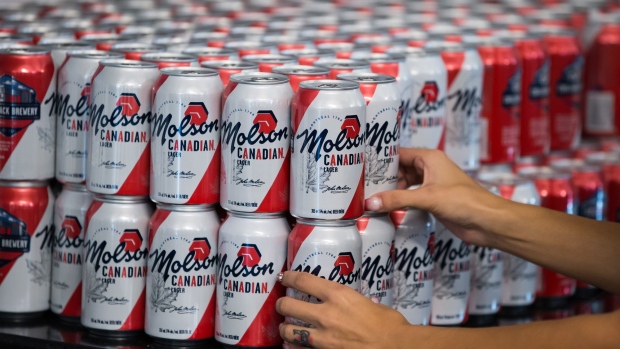
A tentative agreement has been reached between Molson Canada and the union representing some 425 workers in the Montreal area who have been on strike since March.

Both the Teamsters union and the Montreal-based beverage company confirmed the deal today.

Details of the tentative agreement are not being disclosed before they are presented to members.

The dispute has focused particularly on wages amid rampant inflation, along with pension and work scheduling issues.

Local union president Eric Picotte says the three aspects of the dispute "have been addressed to our satisfaction."


Union members went on strike on March 25 and then rejected a company offer. Workers will vote on the agreement-in-principle Friday evening, with approval leading to a return to work next week.

STRIKING MOLSON WORKERS REJECT OFFER AS PICKET LINES STRETCH INTO 11TH WEEK

Hundreds of striking Molson Canada workers have rejected an offer from the beverage company, keeping more than 400 employees on the picket lines and bar owners with less on tap.

Teamsters Canada says the union local last week voted 92.4 per cent against a collective agreement put on the table by the 236-year-old brewery in Montreal.

Teamsters spokeswoman Catherine Cosgrove said concerns over salary remain front and centre amid rampant inflation, on top of pension and work scheduling issues.

"As good as it may seem, the workers have to make sure they are not losing money by accepting the contract as presented," she said. The parties did not sit down to negotiate until May 23, she added.

Molson Coors spokesman François Lefebvre said the rejected deal marks its final offer following the walkout on March 25, with managers now having to deliver beer themselves under a contingency plan.

"This offer was more than generous. And this offer would have made our employees have the highest paying jobs in the beer industry in Quebec," he said in an interview. "The bars are kind of being held hostage."

Renaud Poulin, head of the Quebec bar owners' association, says numerous pubs in more far-flung parts of the province are missing suds due to the 73-day strike.

"It’s pretty tough. Everyone’s missing beer. We don’t have all the brands," he said.

Quebec's labour tribunal issued an interim order last month requiring Molson Canada to stop employing replacement workers until a union complaint can be heard by the quasi-judicial body.