How the north came into its allure and the south lost its glory
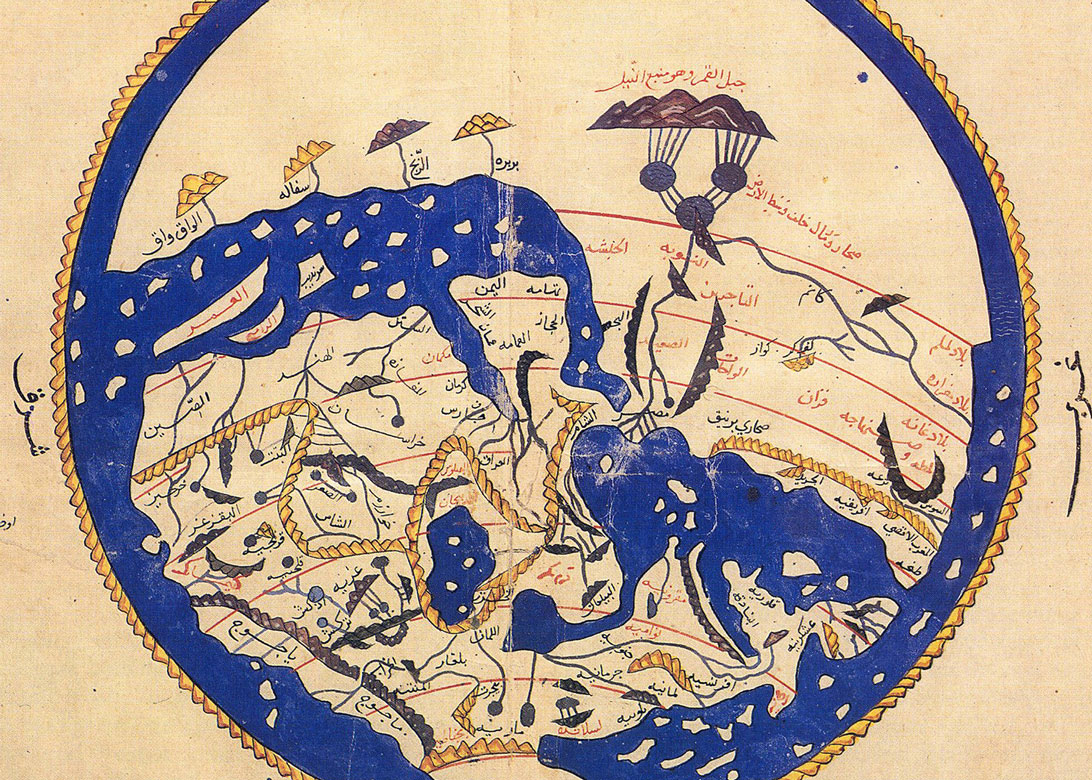
World map prepared by the Arab geographer Muhammad al-Idrisi (1100-1165) for King of Sicily Roger II
/ Universal History Archive / Getty Images
Where is “north”? Take, for example, the volcanic Bouvetøya or Bouvet Island. This ice-covered speck of Norway, about 19 square miles in area and inhabited by seals, penguins and seabirds, has been a nature preserve for half a century. In 1739, French mariner Jean-Baptiste Charles Bouvet de Lozier and his companions sighted it, but forbidding glacial cliffs prevented them from landing. Britain first claimed this remote outpost, but after Norway’s Harald Horntvedt explored it more thoroughly and planted the Norwegian flag there in 1927, Britain eventually ceded its claim. In one sense, Bouvetøya lies in the North — but only from the perspective of the South Pole. The island is located between South Africa and Antarctica and is also known as “the last place on earth.”
The north begins where the south ends. But where is the border between them, how can we recognize it, and who has the right to define it? For the German poet Johann Wolfgang von Goethe, the Brenner Pass in the Alps connecting Austria and Italy constituted the “dividing line between the South and the North.” His contemporary, historian August Ludwig von Schlözer took up this question and wrote: “We Germans do not consider ourselves to be part of the North; only the Frenchman views our land as his North, and he speaks of Berlin as we do of Stockholm. Spanish writers commonly understand the North as Great Britain, and it is of course natural that African geographers and historians refer to the Mediterranean as the North Sea and believe that all Europeans are northern peoples.”
The concept of “North” (and of “South” respectively) represents a space both real and imaginary. At the beginning of the 19th century, before the competing concepts of the “West” and the “East” became Europe’s dominant paradigm, Russia was commonly considered part of the North.
The center of the world for the Europeans of antiquity, for people like Herodotus (c. 484-c. 425 BCE), was the extended Mediterranean. This is evident in a map of that era that depicts the Mediterranean, the Black Sea and their environs relatively realistically, whereas the northwest of the European continent is rendered as a single curved line that offers no intimation at all of the British Isles or Scandinavia. That wasn’t Herodotus’ or anyone else’s fault, of course. People could only depict on their maps what they knew from personal experience — or had at least read or heard about. The North was a phantasmagoric dark spot beyond the border of the Greco-Roman universe, on the other side of the Alps and the Black Sea. The ancient Greeks invented the legendary region of Hyperborea and located it in the European northeast, beyond the north wind Boreas, which was itself named after the god who brought winter. They imagined it as a land of plenty, populated by giants, wise, happy and immortal, who devoted themselves to music and dance and knew neither illness nor other human plagues. The catch was that there was no way for mortal men and women to get there. The Greek geographer Strabo, who came much later (c. 64 BCE-c. 24 CE), already had a far more concrete view of the North as encompassing northwestern Gaul, the British Isles, the Lower Rhineland and Scandinavia.
For a long time, in Europe, the North was considered the realm of the devil, the place from whence evil would come upon the world. By contrast, the Middle East was where the religions of the Old World had developed. The prophet Jeremiah further fleshed out the dichotomy, specifying that evil would take the form of invading northern hordes. In the superstitions of many cultures, northern peoples of various stripes have been considered harbingers of doom. Most famously the barbarian hordes from the North were blamed for the fall of Rome, while scholars now believe it collapsed under the weight of its own internal conflicts. Since antiquity, the North (as well as the West) was regarded as a region of cold and darkness, devoid of sunlight and inimical to life. This convenient interpretive system remained in place throughout the Middle Ages and continued in the speculations of 16th- and 17th-century alchemy.
The 12th-century medieval mystic Hildegard von Bingen derived her world view from Adam’s turn to the East after his creation. To Adam’s right was the blessed South, and to his left was the dark North. According to Hildegard, the north was the direction from which the church was menaced, and a “threatening, angrily growling bear” was the origin of the “godless” North Wind, “divorced of any utility, felicity and holiness” and bringing only misfortune and storms. The perniciousness of the North Wind was the basis for the character of the other three winds, which blew in opposition to it. These vague ideas about the North became more concrete as contact, both hostile and friendly, was established with the people who lived there.
Forays by aggressive Scandinavian warriors from the north left many people in the south fearing for their lives. The commercial network of the Vikings was gigantic, stretching from the northern Atlantic to Russia, Central Asia and the Arabian Peninsula. In this sense, they were pioneers of globalization, dealing in honey, amber, dried meat and pelts. They also sold loot from the cities they sacked. Their boats were powered by the strength of human arms and the wind. When winds were favorable, they were even able to sail their vessels against river currents, having adopted the square-rig sail that had been used for centuries in the Mediterranean. In 860 CE, the Varangians, a Swedish subgroup of the Vikings in an extended sense of the term, attacked Constantinople, and in 885 CE, Danish Vikings invaded Paris. In subsequent centuries, the Normans conquered Normandy, southern Italy and England.
The Vikings weren’t the only ones sailing the seas of the High North and establishing connections. Irish monks are thought to have sailed to the Faroe Islands and Iceland as early as the seventh century — most likely they were looking for solitude rather than trying to convert the few heathens who had settled there. In 1136, a monastery was founded in Arkhangelsk in northern Russia, and a century after that, monasteries dotted the map in Scandinavia and Iceland. With the increasing activity of missionaries, Christianity would also remain an important bond connecting Europe’s North and South for centuries — until the Reformation and the Thirty Years’ War, which would pit northern and southern Europe against one another.
How did cartographers eventually decide to put the north exclusively at the top of their maps? And why did this mode of representation become the dominant one? The practice goes back to second-century Greco-Roman mathematician and astronomer Claudius Ptolemy, if we are to believe the surviving copies of his works made by Byzantine monks more than 1,000 years later, in the 13th century. The cartographers who created the first mappa mundi — Gerardus Mercator, Henricus Martellus Germanus and Martin Waldseemüller — respected Ptolemy as a leading authority, took their cues from him and adopted his habit of putting the north at the top. Nonetheless, the Christian maps of the Middle Ages chose another perspective. A map of Europe and Africa made by Venetian seafarer and cartographer Andrea Bianco in the 15th century has the east on top and Jerusalem in the middle. Similarly, in maps from the Islamic world, north often appears at the bottom, as in Moroccan Muhammad al-Idrisi’s Tabula Rogeriana, made in 1154 for King Roger II of Sicily. The same is true of the 1459 mappa mundi of Fra Mauro, even if it is today usually reprinted in repolarized form (it just has to be flipped on its head to make sense to us). One possible reason is that 15th-century compasses pointed south. While it’s difficult to generalize about the sophisticated Chinese mapmaking tradition, the famous “Composite Map of the Ming Empire,” possibly created at the end of the 14th century, has north at the top. With the waning of Christian or Muslim views of the world that had put the east or south at the top, the north secured its fixed spot at the top of maps. But as self-evident as that shift might seem today, there was no strictly logical reason for the change.
Apart from Ptolemy’s precedent, there are at least two other potential reasons why north drifted to the top of maps. One is its use in navigation. Before the compass was imported from China via the Arab world around 1300, European seafarers used the stars to tell what direction they were headed in. The most useful one was the North Star, since it remained in one place, almost exactly at due north, while the other fixed stars seemed to move around the sky because of Earth’s rotation. The compass likewise pointed north (with the exception mentioned earlier).
Invented in China some 2,000 years ago during the Han dynasty, the compass was made of naturally magnetized lodestone and used for geomancy (a method of divination that interprets markings on the ground or the patterns formed by tossed soil, rocks or sand) and fortunetelling. By the time it came to be used for navigation on the seas, during the Song dynasty, it already had the needles we associate with the compass today. Another plausible explanation may be that information on the upper margin of maps was more easily visible and thus made to seem more important. European mapmakers, of course, lived in the Northern Hemisphere, so they may simply have wanted to see their own homeland as occupying a privileged position in the world.
When Geneva historian Paul Henri Mallet published translations of Old Norse tales written down in the 13th century, including the Prose Edda and excerpts from the Poetic Edda from Iceland, this triggered a new perception of Scandinavia in the eyes of many European intellectuals, including German poet Johann Gottfried Herder. He developed a euphoric sense of belonging to an imagined homeland in the North. Old Norse mythology offered an alternative to a stale classicism that venerated Greco-Roman legends and myths. Many people at the time were sick of the South. While Herder was opposed to the idea of distinct races, he was convinced that one human race had diversified into different cultures: “In all the different forms in which the human race appears on earth, it is nonetheless everywhere one and the same human species.” However, this sort of “cultural pluralism” didn’t prevent Herder from thinking in racist categories; he asked his readers “to sympathize with the Negro, but not despise him, since the conditions of his climate could not grant him nobler gifts.” He had few sympathies with the Chinese, “who, in their own corner of the earth, refrained, like the Jews, from mixing with other peoples.”
Herder’s rejection of the genealogy of Noah was unambiguous: “The various efforts of people to make all nations of the earth, according to this genealogy, into descendants of the Hebrews and half-brothers of the Jews, contradicts not only chronology and the entire history of humanity but also the standpoint of this narrative itself. … Enough of it! The fixed center of the largest part of the world, the primeval mountains of Asia, provided the first place of residence for the human race.” For Herder there were two basic coordinates: the North and Asia.
Even beyond Germany, he was an important force in paving the way for the categories “Aryan” and “Semitic” that, as Maurice Olender stressed in “The Languages of Paradise” (1993), “would influence scholarship in the human sciences throughout the nineteenth century.” Herder found a spiritual ally in Friedrich Schlegel, who had learned some Sanskrit during a stay in Paris and who declared at an 1805 lecture, “Everything absolutely everything, comes from India!” Schlegel also revived the term Aryan as a combination of the Sanskrit name “Ari” (meaning, among other things, lion, brave, inner skin and eagle) with the German word “Ehre” (honor). The concept can be traced back to the 18h-century French Orientalist Abraham-Hyacinthe Anquetil-Duperron, who coined it in his translation of the Avesta, the holy book of Zoroastrianism. It was subsequently adopted by linguists in various countries.
However, at the turn of the 19th century, more and more people were no longer content to learn about the North from the comfort of their reading chairs and were willing to get their shoes a bit muddy to see it for themselves, both scientists and more romantic travelers. This was partly because the French Revolution made it more difficult and sometimes impossible to travel to central Europe, whereas English and German travelers could reach Scandinavia and Scotland without any great problem. Increasingly, tourists began visiting the North rather than the sites of antique culture in Italy and Greece. To stand in the Roman Forum as the first Caesar Augustus did or visit the ruins of Pompeii, one of the most dramatic natural disasters of antique Italy, had lost some of its appeal.
But how would the North of the mind materialize? While some of the travelers followed in the footsteps of the great Carl Linnaeus, who had undertaken a botanical-ethnographic trip to Lapland, among them were readers of the Genevan philosopher Jean-Jacques Rousseau who were hoping to find people in a “state of nature” — noble savages. Or they had heard about the wonders of the midnight sun and the majestic fjords of Norway. Journeying to Scotland, as to Scandinavia, didn’t present foreign visitors with a particularly stern test of courage. There, too, it was easier for women to travel than in the South or in the Middle East, particularly on their own. Emilie von Berlepsch, who visited in 1799, was a close acquaintance of Herder and, as she proudly described herself, “the first German woman who traveled to the fatherland of the bard [Ossian].” Having set off from Hamburg, she made landfall near Glasgow on the “classical ground of Ossian’s songs.” She believed that bagpipe music, which had “quite unpleasantly assaulted” her ears, must be a recent distortion of Scandinavian culture: “It is impossible to conceive of the beautiful, gentle emotions of Ossian arising during and being accompanied by this shrill bleating.”
In the summer of 1794, English author and women’s rights activist Mary Wollstonecraft made a journey through southern Norway, western Sweden, Denmark and northern Germany with her 1-year-old daughter, Fanny, and her governess. This was hardly a vacation trip. Wollstonecraft was there on a mission. With England and France at war, she was trying to help the American business owner Gilbert Imlay, who had attempted to smuggle a large amount of silver from France to Scandinavia. According to Wollstonecraft’s “From Letters Written during a Short Residence in Sweden, Norway, and Denmark,” she wanted to find a ship and retrieve the cargo.
Around the same time, naturalist Giuseppe Acerbi set off from Lombardy for the North. Why did he, a man of the South, “a native of Italy, a country abounding in all the beauties of nature, and the finest productions of art, voluntarily undergo the danger and fatigue of visiting the regions of the Arctic Circle?” His answer to his own question: “There is no people so advanced in civilization, or so highly cultivated, who may not be able to derive some advantage from being acquainted with arts and sciences of other nations, even of such as are the most barbarous.” The ultimate destination of his voyage was the North Cape: “Here everything is solitary, everything is sterile, everything sad and despondent. The shadowy forest no longer adorns the brow of the mountain; the singing of the birds, which enlivened even the woods of Lapland, is no longer heard in this scene of desolation; the ruggedness of the dark grey rock is not covered by a single shrub; the only music is the hoarse murmuring of the waves, ever and anon renewing their assaults on the huge masses that oppose them.”
Do cold north winds correspond with the mentality of the people living there? Does the lack of warmth mean that northern people lack passion? Is there a connection between their toughness and the harshness of the landscape? Speculations about how climatic conditions affect people’s mental and physical constitution began in antiquity and can be found across the ages.
A passage from the enormously popular polemic “Les Semaines” (The Weeks) by the 16th-century Huguenot writer Guillaume de Saluste Du Bartas read:
The northern-man is fair, the southern foul:
That’s white, this black; that smiles and this doth scoul;
Th’one blithe & frolike, th’other dull & froward;
Th’one’s full of courage, th’other fearfull coward;
Th’one’s hair is harsh, big, curled, th’others slender;
Th’one loveth labour, th’other books doth tender;
Th’one’s hot and moist, the other’s hot and dry.
The French philosopher Montesquieu used the contrast between a cold cultural zone and a hot one as the basis for a cultural anthropology that privileged the man of the North, insofar as he remained on his home terrain, over the man of the extreme South. Crucially, Montesquieu disputed that there were any inherently northern or southern character traits, insisting instead that people were formed by their surrounding climate. In his 1748 essay “Of Laws in Relation to the Nature of the Climate,” he conflated climate and mentality in idiosyncratic fashion: “The inhabitants of warm countries are, like old men, timorous; the people in cold countries are, like young men, brave. If we reflect on the late wars … we shall find that the northern people, transplanted into southern regions, did not perform such exploits as their countrymen who, fighting in their own climate, possessed their full vigor and courage.” Furthermore, Montesquieu made the remarkable observation: “I have been at the opera in England and in Italy, where I have seen the same pieces and the same performers: and yet the same music produces such different effects on the two nations: one is so cold and phlegmatic, and the other so lively and enraptured, that it seems almost inconceivable.” He also held that freedom, such as it existed in Europe, originated with the Scandinavian peoples, whereas he associated the South and the Orient with a distorted picture of despotism he believed still predominated there.
A few years later, in his lectures on physical geography, German philosopher Immanuel Kant assigned humanity to various “races” with differing characters. He proposed: “If one enquires as to the sources of the forms and temperament inherent in a people, then one need only consider the variations of animals in relation of form and behavior, for as soon as they are transported to a different climate, different air and food, etc., make them to be different from their descendants. A squirrel that is brown here will become grey in Siberia. A European dog taken to Guinea will become misshapen and bald, and so will its descendants.” Kant expanded this logic to human beings: “The descendants of the northern peoples who went to Spain not only have bodies that are not nearly as strong as they were originally, but also their temperament has changed into one very different from that of a Norwegian or Dane. The inhabitant of the temperate zone, especially in its central part, is more beautiful in body, harder working, more witty, more moderate in his passions, and more sensible than any other kind of people in the world. Consequently, these people have always taught the rest [of the world] and vanquished them by the use of weapons. The Romans, Greeks, the ancient Nordic peoples, Genghis Khan, the Turks, Tamburlaine, and the Europeans after Columbus’s discoveries, have astounded all the southern countries with their arts and their weapons.” Kant suggests a familiarity with circumstances in faraway places, which is ironic, because he spent nearly all his life in Königsberg (today, the Russian exclave of Kaliningrad), in provincial East Prussia, and received much of his knowledge from often obscure travel accounts and from conversing with sailors at the harbor of his home city.
Another passionate participant in the discussion about northern and southern people was Friedrich de la Motte-Fouqué, a Prussian officer from an aristocratic Huguenot family, whose most famous work, aside from the fairy tale “Undine,” was the Nibelungen trilogy “The Hero of the North,” in which he appropriated elements of Norse mythology. In 1828, he published a book responding to Alexander von Humboldt titled, “The Man of the South and of the North.” While he ascribed a great flexibility to both north and south, he wrote: “As it happens, people of the south are often found sunken in a certain external calm that almost resembles beatitude but that is anything but. If there’s disturbance making it undeniable clear that they reside not in the land of fulfillment but rather in the fundamentally impoverished one of privation, the rage that elicits resembles that of the lion or tiger. By contrast, the man of the north can be better compared with the eagle, which also prefers to live in that region. Wrathfully hard where there is battle, but also silently alert and scanning in the distance, he never lapses back into that deceptive comfort that views the outbreak of martial struggle as something monstrous and entirely unexpected.”
Ernst Moritz Arndt, who made several trips to Sweden and was one of the most important early 19th-century German nationalist writers of the Napoleonic Wars and beyond, came late to the discussions concerning people of the north and south. His thoughts were guided by the principle that people became like their land. In 1844 he wrote: “Much here in the North that seems born happy and triumphant remains undeveloped or semi-developed like a clump of substance, rotting away in the fullness of its germs and drives that never finds the necessary sun. In the south, everything finds its natural development easily. In the north, a lot decays because of overabundance that cannot gain proportion and form.”
As evenhanded as Arndt sounds here, he thought the halfway point between the Arctic and the Equator was the ideal soil for cultural development — not coincidentally this was where he himself called home. For Arndt, the Germans were the epitome of settledness despite admittedly being, “as Christians, roving pilgrims and foreigners on earth in all respects.” The antithesis of Germans, in Arndt’s eyes, were “the Jews and gypsies scattered and intimidated across the great world, who never had a place on earth where they had the right to lay their heads.”
Obsessed with all things German and preaching a philosophy of Nordic love of nature, Arndt wasn’t even slightly interested in the historical and cultural connections between Europe and India that many of his contemporaries were investigating. His world was divided along clear lines: on the one hand the Germanic tribes, on the other the Romans; on the one hand the Germans, on the other the Jews; on the one hand the forest, on the other the desert. He degraded the semi-nomadic Sámi people as “spoilers of the forest,” while on another occasion he berated Italy as the “land of lemons and bandits.”
A little later, the talk about North, South and East and the peoples and mentalities associated with these directions began to take a decidedly different turn. In 1853, the French diplomat Joseph Arthur de Gobineau published the first half of his study “The Inequality of the Human Races.” He broke humanity down into the “white, yellow, and black” races — intending them to be understood in precisely that hierarchical order. Gobineau had a romanticized fascination for all things Oriental, and the following year brought an opportunity to further develop his ideas in a place that suited his fancy when he was sent to Tehran as a secretary to the French diplomatic mission there. During his three-year stay, he threw himself into learning the Persian language and Persian history. Before he began working on his book, he had spent the preceding decade studying the leading philosophers of his time. In 1843, Alexis de Tocqueville, one of France’s major liberal intellectuals and the author of “Democracy in America,” engaged Gobineau’s services for a research project on the origins of customs and morals in modern Europe.
For Gobineau, humanity was in decline, and racial intermingling was the reason. He loathed democracy and revolution and considered the Germanic peoples to be the creators of modern European culture, calling the Baltic coast and the Scandinavian Peninsula the “maternal lap of nations.” He considered the Aryans — the “honorable men” — to be superior. Gobineau turned the term Aryan, which until that point had only been used in a linguistic sense, into an ideological cypher for “Indo-Germanic.” The basis of this shift in meaning was a fateful conflation of the supposed congenital nature of a person (“race”) and their culture (“language”).
While the use of the term “Nordic,” which is connected to the German “nordisch,” meaning belonging to the North of Europe, can be traced long back in time, Russian-French anthropologist Joseph Deniker, chief librarian at the Paris Natural History Museum from 1888, first applied the term “nordique” to the concept of “races.” Things gained further momentum during the early 20th century, when racial categories were linked with earlier mythic ideas about Northern and Southern mentality and the idea of “blood.”
One important work in this context was “The Passing of the Great Race; or, The Racial Basis of European History,” published in the United States in 1916 and still one of the most famous and notorious racist texts ever. Its author, Madison Grant, was the scion of a wealthy New York family who devoted himself to his racial obsessions. Grant promoted the “Nordic race” as superior and responsible for Western civilization’s greatest achievements. His book discussed the geographical migration of peoples and “races” and glorified light skin and blond hair. In Grant’s view, the “great race” had originated in the forests and plains of eastern Germany, Poland and Russia. He also advanced the strange notion that Leonardo da Vinci, Michelangelo and Dante must have had “Nordic blood.”
While German philosopher of history Oswald Spengler, in his epochal work “The Decline of the West” (1918), didn’t lionize the North to the extent of many of his contemporaries, he nonetheless gave a decisive role in the course of world history to the people who lived there, writing that the “old Northern races, in whose primitive souls the Faustian [spirit] was already awakening, discovered in their grey dawn the art of sailing the seas which emancipated them. The Egyptians knew the sail, but only profited by it as a labor-saving device. They sailed, as they had done before in their oared ships, along the coast to Punt and Syria, but the idea of the high-seas voyage — what it meant as a liberation, a symbol — was not in them.” “Because of an internal reason,” Spengler wrote, the men of antiquity — and thus of the South — could not become conquerors, and “the Romans made no attempt to penetrate the interior of Africa.”
Intellectuals across Europe continued to glorify the North, reaching higher and higher levels of hyperbole. The South didn’t even enjoy its symbolic monopoly on the light anymore: Scandinavia as the realm of the midnight sun and bright light. The dark days and long nights of winter that weighed so heavily on the first European travelers to the region were hardly ever mentioned.
Speculative theories proliferating about “the North” and “the South” possessed an irresistible appeal to those who repeatedly tried to define those concepts. In 1929, Prussian Culture Minister and Orientalist Carl Heinrich Becker wrote: “The South is what we don’t have but desire. The North is very different. We feel the North present deep within our most personal life. We cannot escape it. It lives in our blood, in the mysterious depths of our personality as a people and as individuals. Our creative spirit somehow comes from the south, but the primeval creative power of our soul is of northern origin.”
After Adolf Hitler had come to power, the Nazis found like-minded allies in the nearby South, in Italy. And since Nazi ideologues understood the ancient Greeks as part of the “Aryan race,” there were no obstacles to enlisting them for the cause, especially as National Socialist visions of the ideal human body were borrowed from sculptures of ancient Greek athletes. This logic was extended to include the notions that “Aryans” had founded the antique culture of southern Europe during the migration of peoples and that the Greeks were “Aryan brothers” of the Germans, who, curiously, were also seen as having come down from the North. In a 1935 proclamation by Bernhard Rust, the Nazi minister for science, education and popular training, this vacuous theory was declared a fact that was henceforth to be promoted without contradiction: “World history is to be presented as the history of racially determined ethnicities. Taking the place of the school of ‘ex oriente lux’ (meaning “from the East comes the light”) is the knowledge that at least all of the Occidental cultures — in Asia Minor, Greece, Rome and the rest of the European countries — are primarily the work of Nordic peoples, most of whom prevailed in battle with other races.” And the Nazis had no objection to depictions of Italian and Arcadian landscapes, and Roman virtues were proclaimed as German ones as well, since both groups were considered Indo-Germanic. The Germanic tribes were thus no longer seen as the antipode of the Romans, as they had been in previous simple North-South antitheses. The main line of conflict now ran between Germanic people and Semitic people, especially the Jews, with all the disastrous consequences that ensued.
Where is “north”? Take, for example, the volcanic Bouvetøya or Bouvet Island. This ice-covered speck of Norway, about 19 square miles in area and inhabited by seals, penguins and seabirds, has been a nature preserve for half a century. In 1739, French mariner Jean-Baptiste Charles Bouvet de Lozier and his companions sighted it, but forbidding glacial cliffs prevented them from landing. Britain first claimed this remote outpost, but after Norway’s Harald Horntvedt explored it more thoroughly and planted the Norwegian flag there in 1927, Britain eventually ceded its claim. In one sense, Bouvetøya lies in the North — but only from the perspective of the South Pole. The island is located between South Africa and Antarctica and is also known as “the last place on earth.”
The north begins where the south ends. But where is the border between them, how can we recognize it, and who has the right to define it? For the German poet Johann Wolfgang von Goethe, the Brenner Pass in the Alps connecting Austria and Italy constituted the “dividing line between the South and the North.” His contemporary, historian August Ludwig von Schlözer took up this question and wrote: “We Germans do not consider ourselves to be part of the North; only the Frenchman views our land as his North, and he speaks of Berlin as we do of Stockholm. Spanish writers commonly understand the North as Great Britain, and it is of course natural that African geographers and historians refer to the Mediterranean as the North Sea and believe that all Europeans are northern peoples.”
The concept of “North” (and of “South” respectively) represents a space both real and imaginary. At the beginning of the 19th century, before the competing concepts of the “West” and the “East” became Europe’s dominant paradigm, Russia was commonly considered part of the North.
The center of the world for the Europeans of antiquity, for people like Herodotus (c. 484-c. 425 BCE), was the extended Mediterranean. This is evident in a map of that era that depicts the Mediterranean, the Black Sea and their environs relatively realistically, whereas the northwest of the European continent is rendered as a single curved line that offers no intimation at all of the British Isles or Scandinavia. That wasn’t Herodotus’ or anyone else’s fault, of course. People could only depict on their maps what they knew from personal experience — or had at least read or heard about. The North was a phantasmagoric dark spot beyond the border of the Greco-Roman universe, on the other side of the Alps and the Black Sea. The ancient Greeks invented the legendary region of Hyperborea and located it in the European northeast, beyond the north wind Boreas, which was itself named after the god who brought winter. They imagined it as a land of plenty, populated by giants, wise, happy and immortal, who devoted themselves to music and dance and knew neither illness nor other human plagues. The catch was that there was no way for mortal men and women to get there. The Greek geographer Strabo, who came much later (c. 64 BCE-c. 24 CE), already had a far more concrete view of the North as encompassing northwestern Gaul, the British Isles, the Lower Rhineland and Scandinavia.
For a long time, in Europe, the North was considered the realm of the devil, the place from whence evil would come upon the world. By contrast, the Middle East was where the religions of the Old World had developed. The prophet Jeremiah further fleshed out the dichotomy, specifying that evil would take the form of invading northern hordes. In the superstitions of many cultures, northern peoples of various stripes have been considered harbingers of doom. Most famously the barbarian hordes from the North were blamed for the fall of Rome, while scholars now believe it collapsed under the weight of its own internal conflicts. Since antiquity, the North (as well as the West) was regarded as a region of cold and darkness, devoid of sunlight and inimical to life. This convenient interpretive system remained in place throughout the Middle Ages and continued in the speculations of 16th- and 17th-century alchemy.
The 12th-century medieval mystic Hildegard von Bingen derived her world view from Adam’s turn to the East after his creation. To Adam’s right was the blessed South, and to his left was the dark North. According to Hildegard, the north was the direction from which the church was menaced, and a “threatening, angrily growling bear” was the origin of the “godless” North Wind, “divorced of any utility, felicity and holiness” and bringing only misfortune and storms. The perniciousness of the North Wind was the basis for the character of the other three winds, which blew in opposition to it. These vague ideas about the North became more concrete as contact, both hostile and friendly, was established with the people who lived there.
Forays by aggressive Scandinavian warriors from the north left many people in the south fearing for their lives. The commercial network of the Vikings was gigantic, stretching from the northern Atlantic to Russia, Central Asia and the Arabian Peninsula. In this sense, they were pioneers of globalization, dealing in honey, amber, dried meat and pelts. They also sold loot from the cities they sacked. Their boats were powered by the strength of human arms and the wind. When winds were favorable, they were even able to sail their vessels against river currents, having adopted the square-rig sail that had been used for centuries in the Mediterranean. In 860 CE, the Varangians, a Swedish subgroup of the Vikings in an extended sense of the term, attacked Constantinople, and in 885 CE, Danish Vikings invaded Paris. In subsequent centuries, the Normans conquered Normandy, southern Italy and England.
The Vikings weren’t the only ones sailing the seas of the High North and establishing connections. Irish monks are thought to have sailed to the Faroe Islands and Iceland as early as the seventh century — most likely they were looking for solitude rather than trying to convert the few heathens who had settled there. In 1136, a monastery was founded in Arkhangelsk in northern Russia, and a century after that, monasteries dotted the map in Scandinavia and Iceland. With the increasing activity of missionaries, Christianity would also remain an important bond connecting Europe’s North and South for centuries — until the Reformation and the Thirty Years’ War, which would pit northern and southern Europe against one another.
How did cartographers eventually decide to put the north exclusively at the top of their maps? And why did this mode of representation become the dominant one? The practice goes back to second-century Greco-Roman mathematician and astronomer Claudius Ptolemy, if we are to believe the surviving copies of his works made by Byzantine monks more than 1,000 years later, in the 13th century. The cartographers who created the first mappa mundi — Gerardus Mercator, Henricus Martellus Germanus and Martin Waldseemüller — respected Ptolemy as a leading authority, took their cues from him and adopted his habit of putting the north at the top. Nonetheless, the Christian maps of the Middle Ages chose another perspective. A map of Europe and Africa made by Venetian seafarer and cartographer Andrea Bianco in the 15th century has the east on top and Jerusalem in the middle. Similarly, in maps from the Islamic world, north often appears at the bottom, as in Moroccan Muhammad al-Idrisi’s Tabula Rogeriana, made in 1154 for King Roger II of Sicily. The same is true of the 1459 mappa mundi of Fra Mauro, even if it is today usually reprinted in repolarized form (it just has to be flipped on its head to make sense to us). One possible reason is that 15th-century compasses pointed south. While it’s difficult to generalize about the sophisticated Chinese mapmaking tradition, the famous “Composite Map of the Ming Empire,” possibly created at the end of the 14th century, has north at the top. With the waning of Christian or Muslim views of the world that had put the east or south at the top, the north secured its fixed spot at the top of maps. But as self-evident as that shift might seem today, there was no strictly logical reason for the change.
Apart from Ptolemy’s precedent, there are at least two other potential reasons why north drifted to the top of maps. One is its use in navigation. Before the compass was imported from China via the Arab world around 1300, European seafarers used the stars to tell what direction they were headed in. The most useful one was the North Star, since it remained in one place, almost exactly at due north, while the other fixed stars seemed to move around the sky because of Earth’s rotation. The compass likewise pointed north (with the exception mentioned earlier).
Invented in China some 2,000 years ago during the Han dynasty, the compass was made of naturally magnetized lodestone and used for geomancy (a method of divination that interprets markings on the ground or the patterns formed by tossed soil, rocks or sand) and fortunetelling. By the time it came to be used for navigation on the seas, during the Song dynasty, it already had the needles we associate with the compass today. Another plausible explanation may be that information on the upper margin of maps was more easily visible and thus made to seem more important. European mapmakers, of course, lived in the Northern Hemisphere, so they may simply have wanted to see their own homeland as occupying a privileged position in the world.
When Geneva historian Paul Henri Mallet published translations of Old Norse tales written down in the 13th century, including the Prose Edda and excerpts from the Poetic Edda from Iceland, this triggered a new perception of Scandinavia in the eyes of many European intellectuals, including German poet Johann Gottfried Herder. He developed a euphoric sense of belonging to an imagined homeland in the North. Old Norse mythology offered an alternative to a stale classicism that venerated Greco-Roman legends and myths. Many people at the time were sick of the South. While Herder was opposed to the idea of distinct races, he was convinced that one human race had diversified into different cultures: “In all the different forms in which the human race appears on earth, it is nonetheless everywhere one and the same human species.” However, this sort of “cultural pluralism” didn’t prevent Herder from thinking in racist categories; he asked his readers “to sympathize with the Negro, but not despise him, since the conditions of his climate could not grant him nobler gifts.” He had few sympathies with the Chinese, “who, in their own corner of the earth, refrained, like the Jews, from mixing with other peoples.”
Herder’s rejection of the genealogy of Noah was unambiguous: “The various efforts of people to make all nations of the earth, according to this genealogy, into descendants of the Hebrews and half-brothers of the Jews, contradicts not only chronology and the entire history of humanity but also the standpoint of this narrative itself. … Enough of it! The fixed center of the largest part of the world, the primeval mountains of Asia, provided the first place of residence for the human race.” For Herder there were two basic coordinates: the North and Asia.
Even beyond Germany, he was an important force in paving the way for the categories “Aryan” and “Semitic” that, as Maurice Olender stressed in “The Languages of Paradise” (1993), “would influence scholarship in the human sciences throughout the nineteenth century.” Herder found a spiritual ally in Friedrich Schlegel, who had learned some Sanskrit during a stay in Paris and who declared at an 1805 lecture, “Everything absolutely everything, comes from India!” Schlegel also revived the term Aryan as a combination of the Sanskrit name “Ari” (meaning, among other things, lion, brave, inner skin and eagle) with the German word “Ehre” (honor). The concept can be traced back to the 18h-century French Orientalist Abraham-Hyacinthe Anquetil-Duperron, who coined it in his translation of the Avesta, the holy book of Zoroastrianism. It was subsequently adopted by linguists in various countries.
However, at the turn of the 19th century, more and more people were no longer content to learn about the North from the comfort of their reading chairs and were willing to get their shoes a bit muddy to see it for themselves, both scientists and more romantic travelers. This was partly because the French Revolution made it more difficult and sometimes impossible to travel to central Europe, whereas English and German travelers could reach Scandinavia and Scotland without any great problem. Increasingly, tourists began visiting the North rather than the sites of antique culture in Italy and Greece. To stand in the Roman Forum as the first Caesar Augustus did or visit the ruins of Pompeii, one of the most dramatic natural disasters of antique Italy, had lost some of its appeal.
But how would the North of the mind materialize? While some of the travelers followed in the footsteps of the great Carl Linnaeus, who had undertaken a botanical-ethnographic trip to Lapland, among them were readers of the Genevan philosopher Jean-Jacques Rousseau who were hoping to find people in a “state of nature” — noble savages. Or they had heard about the wonders of the midnight sun and the majestic fjords of Norway. Journeying to Scotland, as to Scandinavia, didn’t present foreign visitors with a particularly stern test of courage. There, too, it was easier for women to travel than in the South or in the Middle East, particularly on their own. Emilie von Berlepsch, who visited in 1799, was a close acquaintance of Herder and, as she proudly described herself, “the first German woman who traveled to the fatherland of the bard [Ossian].” Having set off from Hamburg, she made landfall near Glasgow on the “classical ground of Ossian’s songs.” She believed that bagpipe music, which had “quite unpleasantly assaulted” her ears, must be a recent distortion of Scandinavian culture: “It is impossible to conceive of the beautiful, gentle emotions of Ossian arising during and being accompanied by this shrill bleating.”
In the summer of 1794, English author and women’s rights activist Mary Wollstonecraft made a journey through southern Norway, western Sweden, Denmark and northern Germany with her 1-year-old daughter, Fanny, and her governess. This was hardly a vacation trip. Wollstonecraft was there on a mission. With England and France at war, she was trying to help the American business owner Gilbert Imlay, who had attempted to smuggle a large amount of silver from France to Scandinavia. According to Wollstonecraft’s “From Letters Written during a Short Residence in Sweden, Norway, and Denmark,” she wanted to find a ship and retrieve the cargo.
Around the same time, naturalist Giuseppe Acerbi set off from Lombardy for the North. Why did he, a man of the South, “a native of Italy, a country abounding in all the beauties of nature, and the finest productions of art, voluntarily undergo the danger and fatigue of visiting the regions of the Arctic Circle?” His answer to his own question: “There is no people so advanced in civilization, or so highly cultivated, who may not be able to derive some advantage from being acquainted with arts and sciences of other nations, even of such as are the most barbarous.” The ultimate destination of his voyage was the North Cape: “Here everything is solitary, everything is sterile, everything sad and despondent. The shadowy forest no longer adorns the brow of the mountain; the singing of the birds, which enlivened even the woods of Lapland, is no longer heard in this scene of desolation; the ruggedness of the dark grey rock is not covered by a single shrub; the only music is the hoarse murmuring of the waves, ever and anon renewing their assaults on the huge masses that oppose them.”
Do cold north winds correspond with the mentality of the people living there? Does the lack of warmth mean that northern people lack passion? Is there a connection between their toughness and the harshness of the landscape? Speculations about how climatic conditions affect people’s mental and physical constitution began in antiquity and can be found across the ages.
A passage from the enormously popular polemic “Les Semaines” (The Weeks) by the 16th-century Huguenot writer Guillaume de Saluste Du Bartas read:
The northern-man is fair, the southern foul:
That’s white, this black; that smiles and this doth scoul;
Th’one blithe & frolike, th’other dull & froward;
Th’one’s full of courage, th’other fearfull coward;
Th’one’s hair is harsh, big, curled, th’others slender;
Th’one loveth labour, th’other books doth tender;
Th’one’s hot and moist, the other’s hot and dry.
The French philosopher Montesquieu used the contrast between a cold cultural zone and a hot one as the basis for a cultural anthropology that privileged the man of the North, insofar as he remained on his home terrain, over the man of the extreme South. Crucially, Montesquieu disputed that there were any inherently northern or southern character traits, insisting instead that people were formed by their surrounding climate. In his 1748 essay “Of Laws in Relation to the Nature of the Climate,” he conflated climate and mentality in idiosyncratic fashion: “The inhabitants of warm countries are, like old men, timorous; the people in cold countries are, like young men, brave. If we reflect on the late wars … we shall find that the northern people, transplanted into southern regions, did not perform such exploits as their countrymen who, fighting in their own climate, possessed their full vigor and courage.” Furthermore, Montesquieu made the remarkable observation: “I have been at the opera in England and in Italy, where I have seen the same pieces and the same performers: and yet the same music produces such different effects on the two nations: one is so cold and phlegmatic, and the other so lively and enraptured, that it seems almost inconceivable.” He also held that freedom, such as it existed in Europe, originated with the Scandinavian peoples, whereas he associated the South and the Orient with a distorted picture of despotism he believed still predominated there.
A few years later, in his lectures on physical geography, German philosopher Immanuel Kant assigned humanity to various “races” with differing characters. He proposed: “If one enquires as to the sources of the forms and temperament inherent in a people, then one need only consider the variations of animals in relation of form and behavior, for as soon as they are transported to a different climate, different air and food, etc., make them to be different from their descendants. A squirrel that is brown here will become grey in Siberia. A European dog taken to Guinea will become misshapen and bald, and so will its descendants.” Kant expanded this logic to human beings: “The descendants of the northern peoples who went to Spain not only have bodies that are not nearly as strong as they were originally, but also their temperament has changed into one very different from that of a Norwegian or Dane. The inhabitant of the temperate zone, especially in its central part, is more beautiful in body, harder working, more witty, more moderate in his passions, and more sensible than any other kind of people in the world. Consequently, these people have always taught the rest [of the world] and vanquished them by the use of weapons. The Romans, Greeks, the ancient Nordic peoples, Genghis Khan, the Turks, Tamburlaine, and the Europeans after Columbus’s discoveries, have astounded all the southern countries with their arts and their weapons.” Kant suggests a familiarity with circumstances in faraway places, which is ironic, because he spent nearly all his life in Königsberg (today, the Russian exclave of Kaliningrad), in provincial East Prussia, and received much of his knowledge from often obscure travel accounts and from conversing with sailors at the harbor of his home city.
Another passionate participant in the discussion about northern and southern people was Friedrich de la Motte-Fouqué, a Prussian officer from an aristocratic Huguenot family, whose most famous work, aside from the fairy tale “Undine,” was the Nibelungen trilogy “The Hero of the North,” in which he appropriated elements of Norse mythology. In 1828, he published a book responding to Alexander von Humboldt titled, “The Man of the South and of the North.” While he ascribed a great flexibility to both north and south, he wrote: “As it happens, people of the south are often found sunken in a certain external calm that almost resembles beatitude but that is anything but. If there’s disturbance making it undeniable clear that they reside not in the land of fulfillment but rather in the fundamentally impoverished one of privation, the rage that elicits resembles that of the lion or tiger. By contrast, the man of the north can be better compared with the eagle, which also prefers to live in that region. Wrathfully hard where there is battle, but also silently alert and scanning in the distance, he never lapses back into that deceptive comfort that views the outbreak of martial struggle as something monstrous and entirely unexpected.”
Ernst Moritz Arndt, who made several trips to Sweden and was one of the most important early 19th-century German nationalist writers of the Napoleonic Wars and beyond, came late to the discussions concerning people of the north and south. His thoughts were guided by the principle that people became like their land. In 1844 he wrote: “Much here in the North that seems born happy and triumphant remains undeveloped or semi-developed like a clump of substance, rotting away in the fullness of its germs and drives that never finds the necessary sun. In the south, everything finds its natural development easily. In the north, a lot decays because of overabundance that cannot gain proportion and form.”
As evenhanded as Arndt sounds here, he thought the halfway point between the Arctic and the Equator was the ideal soil for cultural development — not coincidentally this was where he himself called home. For Arndt, the Germans were the epitome of settledness despite admittedly being, “as Christians, roving pilgrims and foreigners on earth in all respects.” The antithesis of Germans, in Arndt’s eyes, were “the Jews and gypsies scattered and intimidated across the great world, who never had a place on earth where they had the right to lay their heads.”
Obsessed with all things German and preaching a philosophy of Nordic love of nature, Arndt wasn’t even slightly interested in the historical and cultural connections between Europe and India that many of his contemporaries were investigating. His world was divided along clear lines: on the one hand the Germanic tribes, on the other the Romans; on the one hand the Germans, on the other the Jews; on the one hand the forest, on the other the desert. He degraded the semi-nomadic Sámi people as “spoilers of the forest,” while on another occasion he berated Italy as the “land of lemons and bandits.”
A little later, the talk about North, South and East and the peoples and mentalities associated with these directions began to take a decidedly different turn. In 1853, the French diplomat Joseph Arthur de Gobineau published the first half of his study “The Inequality of the Human Races.” He broke humanity down into the “white, yellow, and black” races — intending them to be understood in precisely that hierarchical order. Gobineau had a romanticized fascination for all things Oriental, and the following year brought an opportunity to further develop his ideas in a place that suited his fancy when he was sent to Tehran as a secretary to the French diplomatic mission there. During his three-year stay, he threw himself into learning the Persian language and Persian history. Before he began working on his book, he had spent the preceding decade studying the leading philosophers of his time. In 1843, Alexis de Tocqueville, one of France’s major liberal intellectuals and the author of “Democracy in America,” engaged Gobineau’s services for a research project on the origins of customs and morals in modern Europe.
For Gobineau, humanity was in decline, and racial intermingling was the reason. He loathed democracy and revolution and considered the Germanic peoples to be the creators of modern European culture, calling the Baltic coast and the Scandinavian Peninsula the “maternal lap of nations.” He considered the Aryans — the “honorable men” — to be superior. Gobineau turned the term Aryan, which until that point had only been used in a linguistic sense, into an ideological cypher for “Indo-Germanic.” The basis of this shift in meaning was a fateful conflation of the supposed congenital nature of a person (“race”) and their culture (“language”).
While the use of the term “Nordic,” which is connected to the German “nordisch,” meaning belonging to the North of Europe, can be traced long back in time, Russian-French anthropologist Joseph Deniker, chief librarian at the Paris Natural History Museum from 1888, first applied the term “nordique” to the concept of “races.” Things gained further momentum during the early 20th century, when racial categories were linked with earlier mythic ideas about Northern and Southern mentality and the idea of “blood.”
One important work in this context was “The Passing of the Great Race; or, The Racial Basis of European History,” published in the United States in 1916 and still one of the most famous and notorious racist texts ever. Its author, Madison Grant, was the scion of a wealthy New York family who devoted himself to his racial obsessions. Grant promoted the “Nordic race” as superior and responsible for Western civilization’s greatest achievements. His book discussed the geographical migration of peoples and “races” and glorified light skin and blond hair. In Grant’s view, the “great race” had originated in the forests and plains of eastern Germany, Poland and Russia. He also advanced the strange notion that Leonardo da Vinci, Michelangelo and Dante must have had “Nordic blood.”
While German philosopher of history Oswald Spengler, in his epochal work “The Decline of the West” (1918), didn’t lionize the North to the extent of many of his contemporaries, he nonetheless gave a decisive role in the course of world history to the people who lived there, writing that the “old Northern races, in whose primitive souls the Faustian [spirit] was already awakening, discovered in their grey dawn the art of sailing the seas which emancipated them. The Egyptians knew the sail, but only profited by it as a labor-saving device. They sailed, as they had done before in their oared ships, along the coast to Punt and Syria, but the idea of the high-seas voyage — what it meant as a liberation, a symbol — was not in them.” “Because of an internal reason,” Spengler wrote, the men of antiquity — and thus of the South — could not become conquerors, and “the Romans made no attempt to penetrate the interior of Africa.”
Intellectuals across Europe continued to glorify the North, reaching higher and higher levels of hyperbole. The South didn’t even enjoy its symbolic monopoly on the light anymore: Scandinavia as the realm of the midnight sun and bright light. The dark days and long nights of winter that weighed so heavily on the first European travelers to the region were hardly ever mentioned.
Speculative theories proliferating about “the North” and “the South” possessed an irresistible appeal to those who repeatedly tried to define those concepts. In 1929, Prussian Culture Minister and Orientalist Carl Heinrich Becker wrote: “The South is what we don’t have but desire. The North is very different. We feel the North present deep within our most personal life. We cannot escape it. It lives in our blood, in the mysterious depths of our personality as a people and as individuals. Our creative spirit somehow comes from the south, but the primeval creative power of our soul is of northern origin.”
After Adolf Hitler had come to power, the Nazis found like-minded allies in the nearby South, in Italy. And since Nazi ideologues understood the ancient Greeks as part of the “Aryan race,” there were no obstacles to enlisting them for the cause, especially as National Socialist visions of the ideal human body were borrowed from sculptures of ancient Greek athletes. This logic was extended to include the notions that “Aryans” had founded the antique culture of southern Europe during the migration of peoples and that the Greeks were “Aryan brothers” of the Germans, who, curiously, were also seen as having come down from the North. In a 1935 proclamation by Bernhard Rust, the Nazi minister for science, education and popular training, this vacuous theory was declared a fact that was henceforth to be promoted without contradiction: “World history is to be presented as the history of racially determined ethnicities. Taking the place of the school of ‘ex oriente lux’ (meaning “from the East comes the light”) is the knowledge that at least all of the Occidental cultures — in Asia Minor, Greece, Rome and the rest of the European countries — are primarily the work of Nordic peoples, most of whom prevailed in battle with other races.” And the Nazis had no objection to depictions of Italian and Arcadian landscapes, and Roman virtues were proclaimed as German ones as well, since both groups were considered Indo-Germanic. The Germanic tribes were thus no longer seen as the antipode of the Romans, as they had been in previous simple North-South antitheses. The main line of conflict now ran between Germanic people and Semitic people, especially the Jews, with all the disastrous consequences that ensued.

Bernd Brunner is an author
May 6, 2022
Adapted from “Extreme North: A Cultural History,” W. W. Norton, 2022 (original translation by Jefferson Chase, a few paragraphs are not part of the English-language edition)

 French female imam Kahina Bahloul leads a Friday prayer in Paris on Feb. 21, 2020 / Lucas Barioulet / AFP via Getty Images