June 28, 2022
By Giovana Faria
In addition to thousands of deaths and the destruction of crucial infrastructure, another, more invisible, crisis tied to Russia’s invasion could haunt Ukraine for years: environmental damage. From shelled chemical plants to forests scorched by missiles, the consequences will be felt not only by Ukraine’s ecosystems but also by its people.
The list of damage caused by armed conflict in Ukraine since Russia’s illegal annexation of Crimea in 2014 is long and, if not given proper attention, could last for years.
The Conflict and Environment Observatory has reported that the environmental impact of war began even before the conflict began. Building up military forces and maintaining their readiness can consume a lot of resources. Military gear and vehicles require energy that usually comes from oil, and large militaries' CO2 emissions are greater than many countries in the world combined.
A study by Brown University showed that the U.S. military’s greenhouse-gas emissions are greater than those of countries like Portugal, Denmark, and Sweden.
After a conflict starts, hazards ramp up and the damage becomes a lot more apparent.
Ukraine's Environmental Background
Ukraine’s ecosystems are of considerable importance to Europe:
Ukraine's Industrial Sector
The environmental dangers Ukraine is facing as a result of armed conflict are also heightened by the country’s industrial background. Heavy industry is a big part of Ukraine's economy, especially in the east of the country. The largest nuclear power plant in Europe is located in Ukraine, in the city of Zaporizhzhya, and Ukraine's industrial sector accounts for nearly 29 percent of its gross domestic product.
One of the high-risk threats comprises tailings storage facilities (TSFs), which store liquid industrial waste. Altogether there are 465 TSFs in the country, storing over 6 billion tons of waste, and 200 of these TSFs are located in eastern Ukraine, the region that has been hardest hit by the war.
A 2019 study by the Organization for Security and Cooperation in Europe (OSCE) showed that potential threats posed by damage to these facilities include risks of floods, explosions, and chemical, environmental, and fire hazards.
Now, three years after this report was published, more than 40 industrial sites have already been attacked by the Russian military.
Laws And Obstacles
The four treaties of the Geneva Conventions that are supposed to regulate conduct during armed conflict don’t expressly mention the environment. However, after the Vietnam War, two important changes occurred in the law.
The first prohibits the violent use of environmental modification techniques that have “widespread, long-lasting, or severe effects.” The second blocks “methods or means of warfare that are intended, or may be expected, to cause widespread, long-term, and severe damage to the natural environment.”
As of May 2022, the Ministry of Ecology and Natural Resources of Ukraine had recorded 231 environmental crimes allegedly committed by Russia.
The problem is that, even when actions in war are harmful to the environment, it is difficult for them to be considered a violation of the provisions, because the standards for military action to fall under the two new conventions are very high.
Health Costs
The lingering consequences felt by the population include lung diseases and various types of cancer due to the inhalation of heavy metals and carcinogens present in explosives, and also in the rubble of shelled buildings. Asbestos, a highly toxic substance that was only recently banned in Ukraine, is the main concern when it comes to human health.
The asbestos still present in the structure of buildings that are being torn apart by bombardments can cause a series of diseases, ranging from breathing difficulties to cancers of the lungs, stomach, ovaries, and other organs.
Postwar Actions And Obstacles
Experts from Ecoaction: Center for Environmental Initiatives say that, after the war is over, in addition to documenting all the environmental damage (in an effort to make Russia pay for it), it is also important to include the rehabilitation and protection of ecosystems in the Ukrainian recovery plan, as well as the rebuilding of settlements focusing on nature-based solutions for dealing with and adapting to climate change.
Sources: Ecoaction, International Committee of the Red Cross, PAX For Peace, Conflict and Environment Observatory, VOX, Ministry of Ecology and Natural Resources of Ukraine, Reuters, The Guardian, Pravda, OSCE, The Washington Post, The New York Times, Al-Jazeera, the State Forest Resources Agency of Ukraine, and Brown University.

Giovana Faria is a visual journalist with RFE/RL's Central Newsroom.
By Giovana Faria
In addition to thousands of deaths and the destruction of crucial infrastructure, another, more invisible, crisis tied to Russia’s invasion could haunt Ukraine for years: environmental damage. From shelled chemical plants to forests scorched by missiles, the consequences will be felt not only by Ukraine’s ecosystems but also by its people.
The list of damage caused by armed conflict in Ukraine since Russia’s illegal annexation of Crimea in 2014 is long and, if not given proper attention, could last for years.
The Conflict and Environment Observatory has reported that the environmental impact of war began even before the conflict began. Building up military forces and maintaining their readiness can consume a lot of resources. Military gear and vehicles require energy that usually comes from oil, and large militaries' CO2 emissions are greater than many countries in the world combined.
A study by Brown University showed that the U.S. military’s greenhouse-gas emissions are greater than those of countries like Portugal, Denmark, and Sweden.
After a conflict starts, hazards ramp up and the damage becomes a lot more apparent.
Ukraine's Environmental Background
Ukraine’s ecosystems are of considerable importance to Europe:
Encompass 35 percent of Europe’s biodiversity.
Are home to over 70,000 species.
29 percent of Ukraine's territory is composed of natural vegetation as well as seminatural vegetation (such as managed grasslands and hedgerows, etc.).
16 percent of its territory is composed of forests.
Ukraine has about 63,000 rivers.
Ukraine occupies 11 percent of the Carpathian mountain range, which comprises one-third of all plant species in Europe.
The Severskiy Donets River is the longest in eastern Ukraine and an important source of fresh water. The Dnieper is the fourth-longest river in Europe.
On March 14, after the Russian military shelled a sewage-treatment facility, water from several districts of Zaporizhzhya began to enter the Dnieper River without any treatment.
The Red Data Book of Ukraine, a document that tracks the current state of rare and threatened fauna and flora, has registered 687 endangered species of animals and 857 endangered species of plants in its latest edition from 2021.
In addition to wildlife declines due to wildfires caused by rocket launches, thousands of dolphins have been found dead in the Black Sea, which could be a consequence of increased shipping noise and the use of powerful sonar systems by navies, according to data collected by Ukraine's Tuzla Estuaries National Nature Park.
Are home to over 70,000 species.
29 percent of Ukraine's territory is composed of natural vegetation as well as seminatural vegetation (such as managed grasslands and hedgerows, etc.).
16 percent of its territory is composed of forests.
Ukraine has about 63,000 rivers.
Ukraine occupies 11 percent of the Carpathian mountain range, which comprises one-third of all plant species in Europe.
The Severskiy Donets River is the longest in eastern Ukraine and an important source of fresh water. The Dnieper is the fourth-longest river in Europe.
On March 14, after the Russian military shelled a sewage-treatment facility, water from several districts of Zaporizhzhya began to enter the Dnieper River without any treatment.
The Red Data Book of Ukraine, a document that tracks the current state of rare and threatened fauna and flora, has registered 687 endangered species of animals and 857 endangered species of plants in its latest edition from 2021.
In addition to wildlife declines due to wildfires caused by rocket launches, thousands of dolphins have been found dead in the Black Sea, which could be a consequence of increased shipping noise and the use of powerful sonar systems by navies, according to data collected by Ukraine's Tuzla Estuaries National Nature Park.
Conflict Actions Causing Environmental Damage
"Category" Actions Damages
"Category" Actions Damages
Chemical plant explosion
Soil and groundwater contamination
Air pollution

Attacks on oil- and gas-storage facilities
Air pollution

Rocket launches
Soil and groundwater contamination
Fires

Fires
Mass burials
Soil and groundwater contamination

Warships and submarines
Wildlife decline
Source: Conflict and Environment Observatory
Source: Conflict and Environment Observatory
Ukraine's Industrial Sector
The environmental dangers Ukraine is facing as a result of armed conflict are also heightened by the country’s industrial background. Heavy industry is a big part of Ukraine's economy, especially in the east of the country. The largest nuclear power plant in Europe is located in Ukraine, in the city of Zaporizhzhya, and Ukraine's industrial sector accounts for nearly 29 percent of its gross domestic product.
One of the high-risk threats comprises tailings storage facilities (TSFs), which store liquid industrial waste. Altogether there are 465 TSFs in the country, storing over 6 billion tons of waste, and 200 of these TSFs are located in eastern Ukraine, the region that has been hardest hit by the war.
A 2019 study by the Organization for Security and Cooperation in Europe (OSCE) showed that potential threats posed by damage to these facilities include risks of floods, explosions, and chemical, environmental, and fire hazards.
Now, three years after this report was published, more than 40 industrial sites have already been attacked by the Russian military.
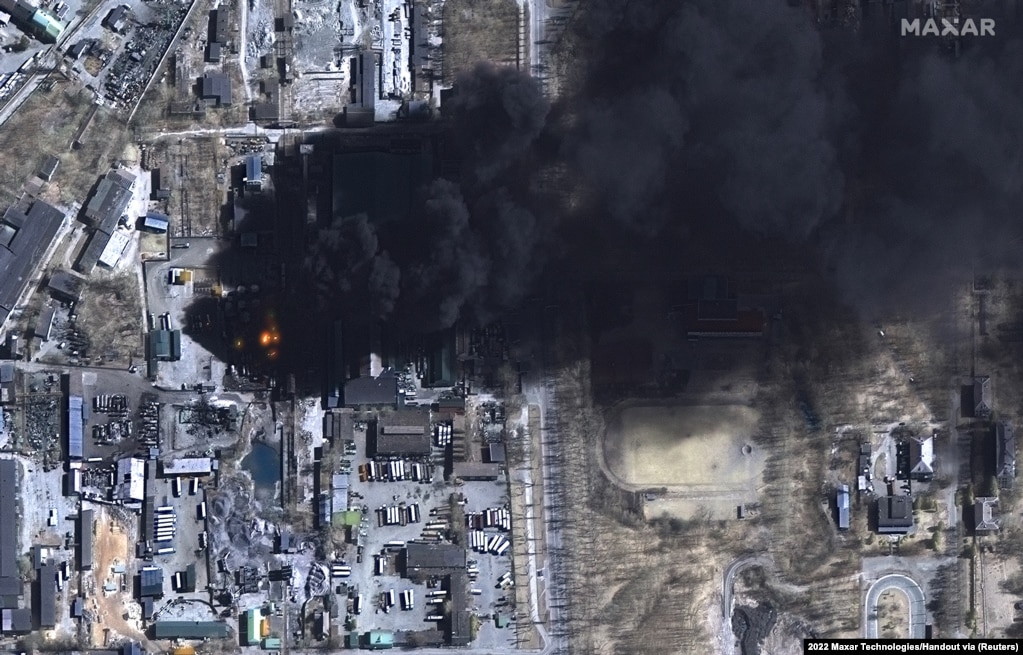
A satellite image of burning oil-storage tanks in Chernihiv during Russia's invasion of Ukraine on March 21.
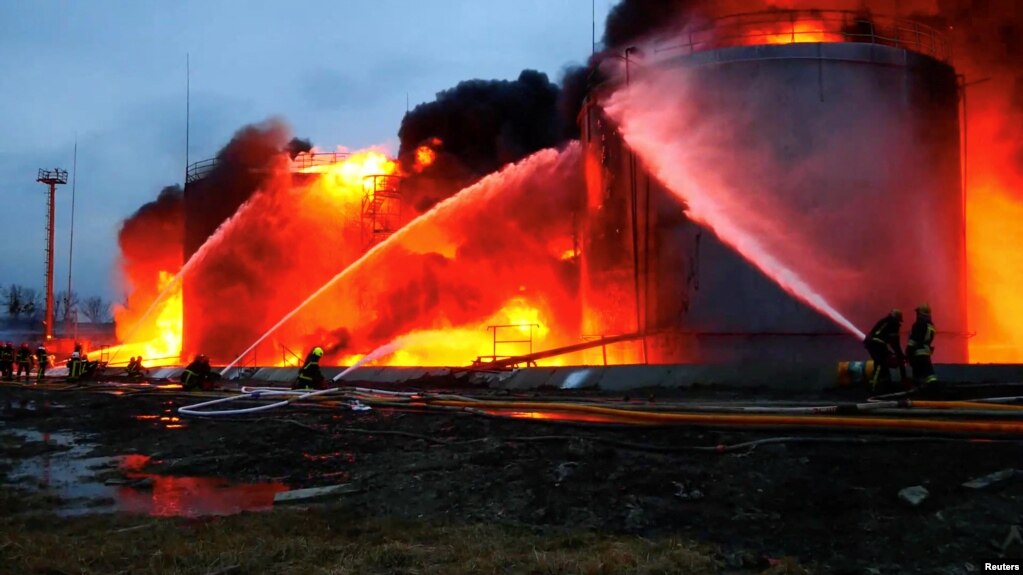
First responders work at a fuel-storage facility hit by cruise missiles in Lviv in western Ukraine on March 27.
According to a war assessment by the Dutch peace organization PAX, Ukraine had already been on the brink of an environmental catastrophe since the beginning of the ongoing war in the Donbas in 2014. This was avoided by the creation of de-escalation lines to prevent the bombing of chemical plants and continuous monitoring by the OSCE.
However, since this period, many industrial installations that store a huge amount of toxic and radioactive waste are in bad condition due to the effects of previous attacks and a lack of maintenance.
At the beginning of June, shelling on a chemical plant hit nitric-acid tanks, causing a big cloud of pink smoke to cover residential areas in Syevyerodonetsk. The governor of the Luhansk region, Serhiy Hayday, urged the population to stay inside their houses, since nitric acid can be dangerous if it is inhaled or swallowed or if it comes into contact with the skin.
According to a war assessment by the Dutch peace organization PAX, Ukraine had already been on the brink of an environmental catastrophe since the beginning of the ongoing war in the Donbas in 2014. This was avoided by the creation of de-escalation lines to prevent the bombing of chemical plants and continuous monitoring by the OSCE.
However, since this period, many industrial installations that store a huge amount of toxic and radioactive waste are in bad condition due to the effects of previous attacks and a lack of maintenance.
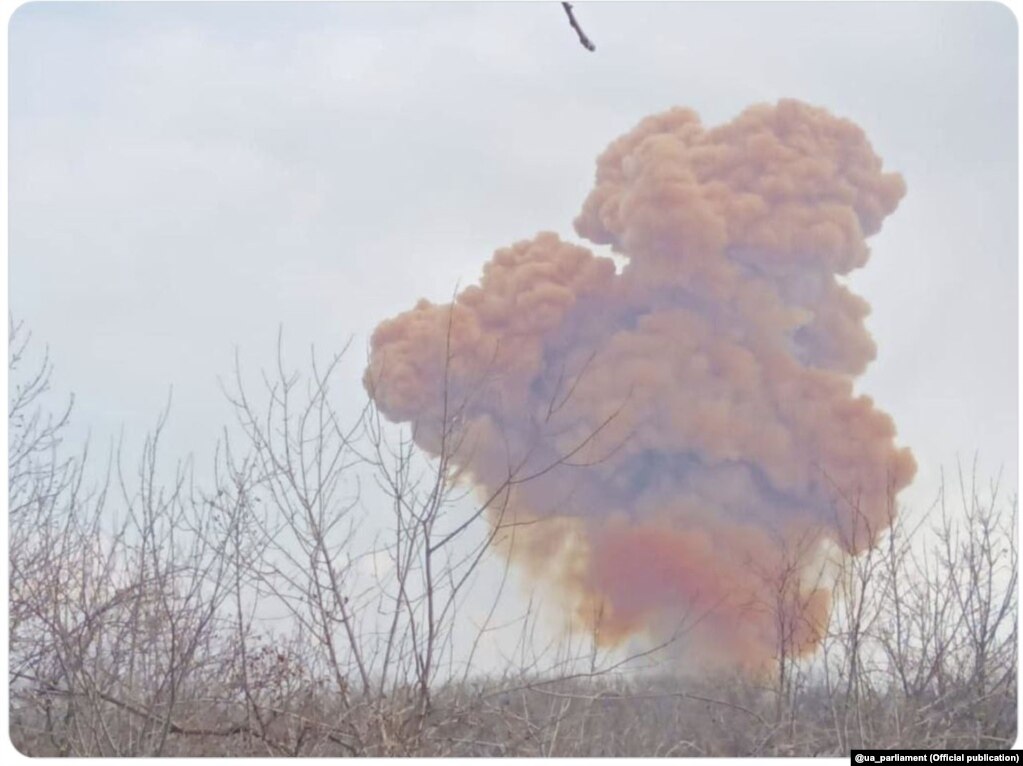
At the beginning of June, shelling on a chemical plant hit nitric-acid tanks, causing a big cloud of pink smoke to cover residential areas in Syevyerodonetsk. The governor of the Luhansk region, Serhiy Hayday, urged the population to stay inside their houses, since nitric acid can be dangerous if it is inhaled or swallowed or if it comes into contact with the skin.
A toxic cloud of smoke rises above Rubizhne in Ukraine’s Luhansk region in this social media image released by Ukraine’s parliament on April 5.
Laws And Obstacles
The four treaties of the Geneva Conventions that are supposed to regulate conduct during armed conflict don’t expressly mention the environment. However, after the Vietnam War, two important changes occurred in the law.
The first prohibits the violent use of environmental modification techniques that have “widespread, long-lasting, or severe effects.” The second blocks “methods or means of warfare that are intended, or may be expected, to cause widespread, long-term, and severe damage to the natural environment.”
As of May 2022, the Ministry of Ecology and Natural Resources of Ukraine had recorded 231 environmental crimes allegedly committed by Russia.
The problem is that, even when actions in war are harmful to the environment, it is difficult for them to be considered a violation of the provisions, because the standards for military action to fall under the two new conventions are very high.
Health Costs
The lingering consequences felt by the population include lung diseases and various types of cancer due to the inhalation of heavy metals and carcinogens present in explosives, and also in the rubble of shelled buildings. Asbestos, a highly toxic substance that was only recently banned in Ukraine, is the main concern when it comes to human health.
The asbestos still present in the structure of buildings that are being torn apart by bombardments can cause a series of diseases, ranging from breathing difficulties to cancers of the lungs, stomach, ovaries, and other organs.
Postwar Actions And Obstacles
Experts from Ecoaction: Center for Environmental Initiatives say that, after the war is over, in addition to documenting all the environmental damage (in an effort to make Russia pay for it), it is also important to include the rehabilitation and protection of ecosystems in the Ukrainian recovery plan, as well as the rebuilding of settlements focusing on nature-based solutions for dealing with and adapting to climate change.
Sources: Ecoaction, International Committee of the Red Cross, PAX For Peace, Conflict and Environment Observatory, VOX, Ministry of Ecology and Natural Resources of Ukraine, Reuters, The Guardian, Pravda, OSCE, The Washington Post, The New York Times, Al-Jazeera, the State Forest Resources Agency of Ukraine, and Brown University.
Giovana Faria is a visual journalist with RFE/RL's Central Newsroom.
FOR INFOGRAPHICS SEE